


 Copy Link
 Share on X
 Share on Facebook
 Share on LinkedIn
Always Active
Required for core functionality such as security, network management, and accessibility. These cannot be disabled.

Uncover the transformative potential of digital and mobile solutions for your industry.





 Last Updated: Sep 18, 2026
Apr 14, 2026
Last Updated: Sep 18, 2026
Apr 14, 2026  957
957  37 min. Read


Key Takeaways
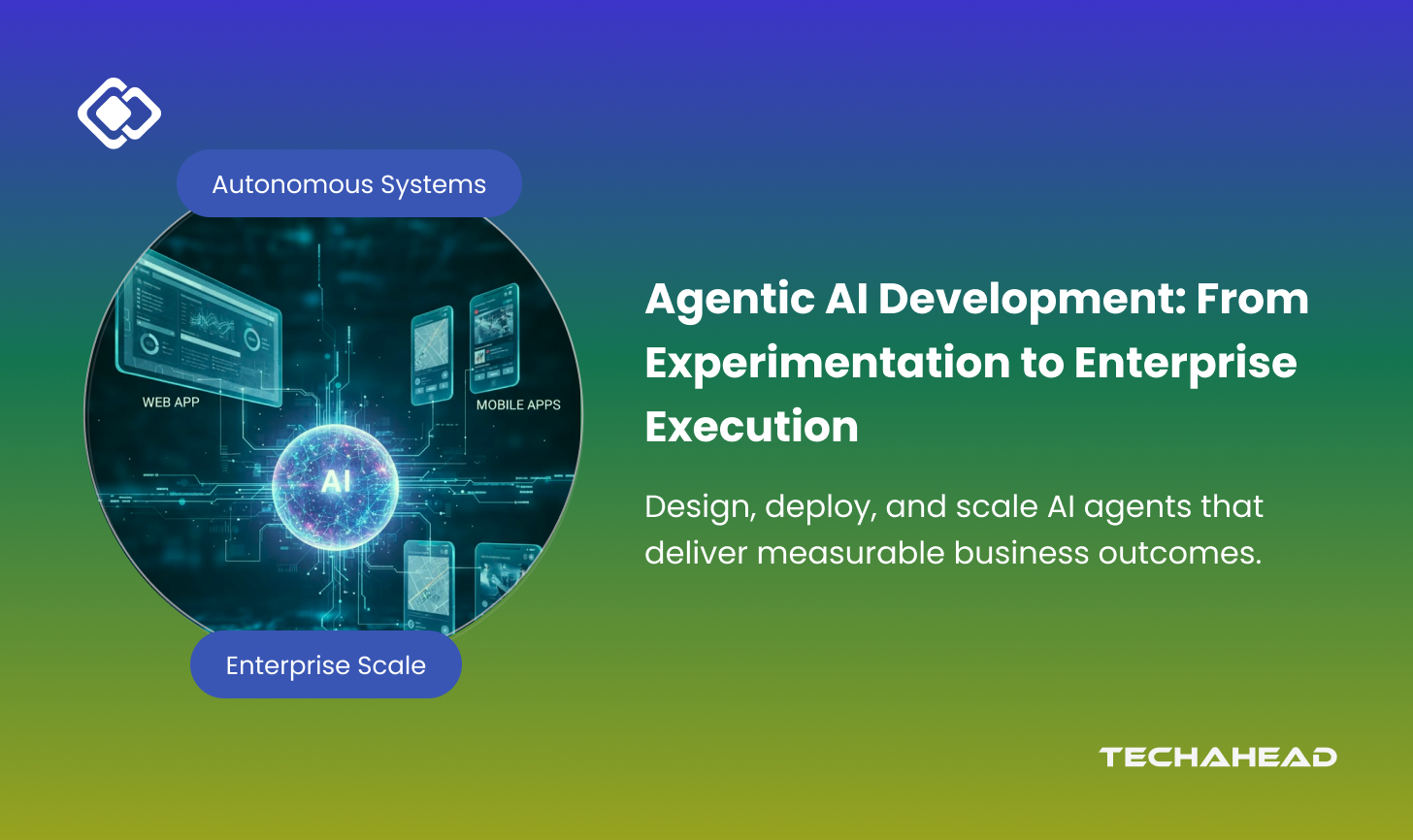
Agentic AI development is the process of designing, building, and deploying AI systems that can reason, plan, use tools, and execute multi-step tasks autonomously toward a defined goal without requiring human prompting at each step. Unlike generative AI, which responds to instructions, agentic AI acts on objectives.
Most enterprise AI investments to date have followed a familiar pattern: a model receives a prompt, generates an output, and waits. That pattern is changing.
The shift toward agentic AI represents a fundamental change in how organizations deploy artificial intelligence. Instead of systems that answer questions, enterprises are now building systems that take actions, coordinate workflows, connect to internal tools, and operate continuously toward business goals.
Consequently, the global enterprise agentic AI market size that was estimated at $2.58 billion in 2024 is now projected to reach $24.50 billion by 2030, showing a CAGR of 46.2% from 2025 to 2030. This immaculate growth is a clear implication that Agentic AI adoption is substantial. Thus, organizations looking for custom agentic AI development want to move beyond experimentation and invest in scalable, governed systems that deliver measurable business outcomes while integrating seamlessly with their existing enterprise architecture.
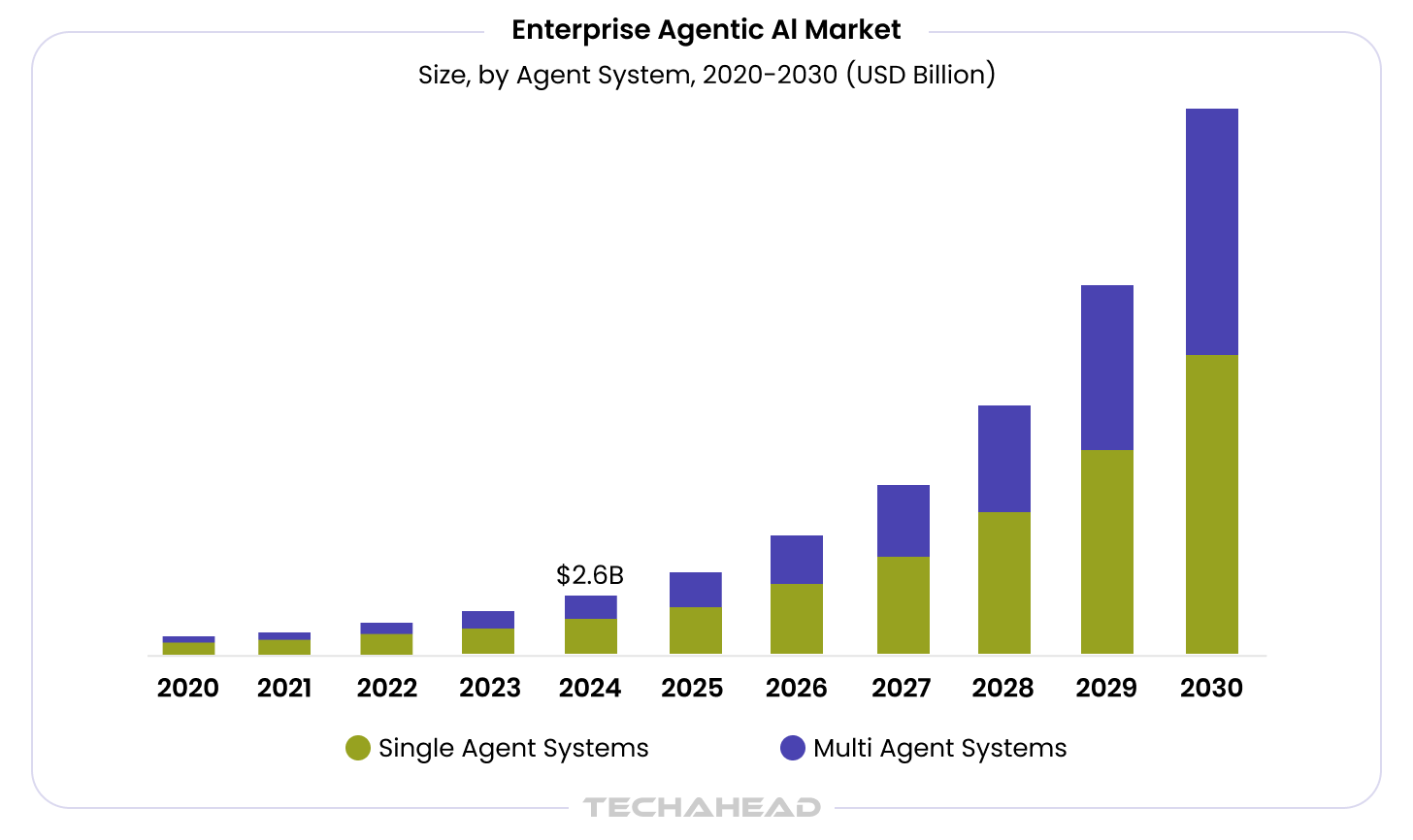
This guide covers what agentic AI development actually involves, what architecture and infrastructure it requires, what realistic implementation looks like, and how to measure the business case. It also covers where agentic AI is not the right choice and what separates production-ready deployments from failed pilots.
The data clearly shows that enterprise Agentic AI adoption is scaling. 2x as many executives expect AI agents to make autonomous decisions in processes and workflows by 2027. Whereas, industries are expected to see full autonomous robotic systems with embodied AI by 2030. (IBM)
Gartner projects that 40 percent of enterprise applications will include task-specific AI agents by the end of 2026, compared to near zero in 2024.
BCG research finds that well-deployed AI agents accelerate business processes by 30 to 50 percent. These numbers are not projections. They reflect outcomes from organizations that have moved agentic AI into production.
Agentic AI is expected to autonomously resolve 80% of common customer service issues without human intervention by 2029. This will lead to a 30% reduction in operational costs. Organizations that wait do not avoid agentic AI. They inherit an environment shaped by ungoverned decisions made by teams that moved without them.
Agentic AI refers to autonomous AI systems that independently perceive environments, set goals, reason through complex multi-step problems, and execute actions across enterprise systems to deliver outcomes. It proactively monitors conditions, makes decisions, and coordinates workflows with minimal human oversight.
These systems combine large language models for reasoning with tool integrations, memory, and orchestration layers to handle dynamic enterprise challenges. A logistics agent, for example, might detect a shipping delay, reroute deliveries, update inventory across ERP systems, and notify customers—all within defined governance boundaries.
The term emphasizes agency: the capacity to act purposefully toward objectives rather than passively await instruction. Enterprises deploy agentic AI for end-to-end automation in operations, customer service, IT management, and revenue workflows where traditional RPA or copilots fall short.
Three properties define an agentic AI system and distinguish it from simpler AI applications:
Agentic AI development is the practice of building AI systems designed to pursue goals rather than answer prompts. A generative AI model waits for input and returns a response. An agentic AI system receives a goal, breaks it into tasks, executes those tasks using available tools, evaluates the results, and continues until the objective is met.
The distinction matters for enterprise architecture. Agentic systems require different infrastructure, different oversight mechanisms, and different governance frameworks than conversational AI or traditional automation.
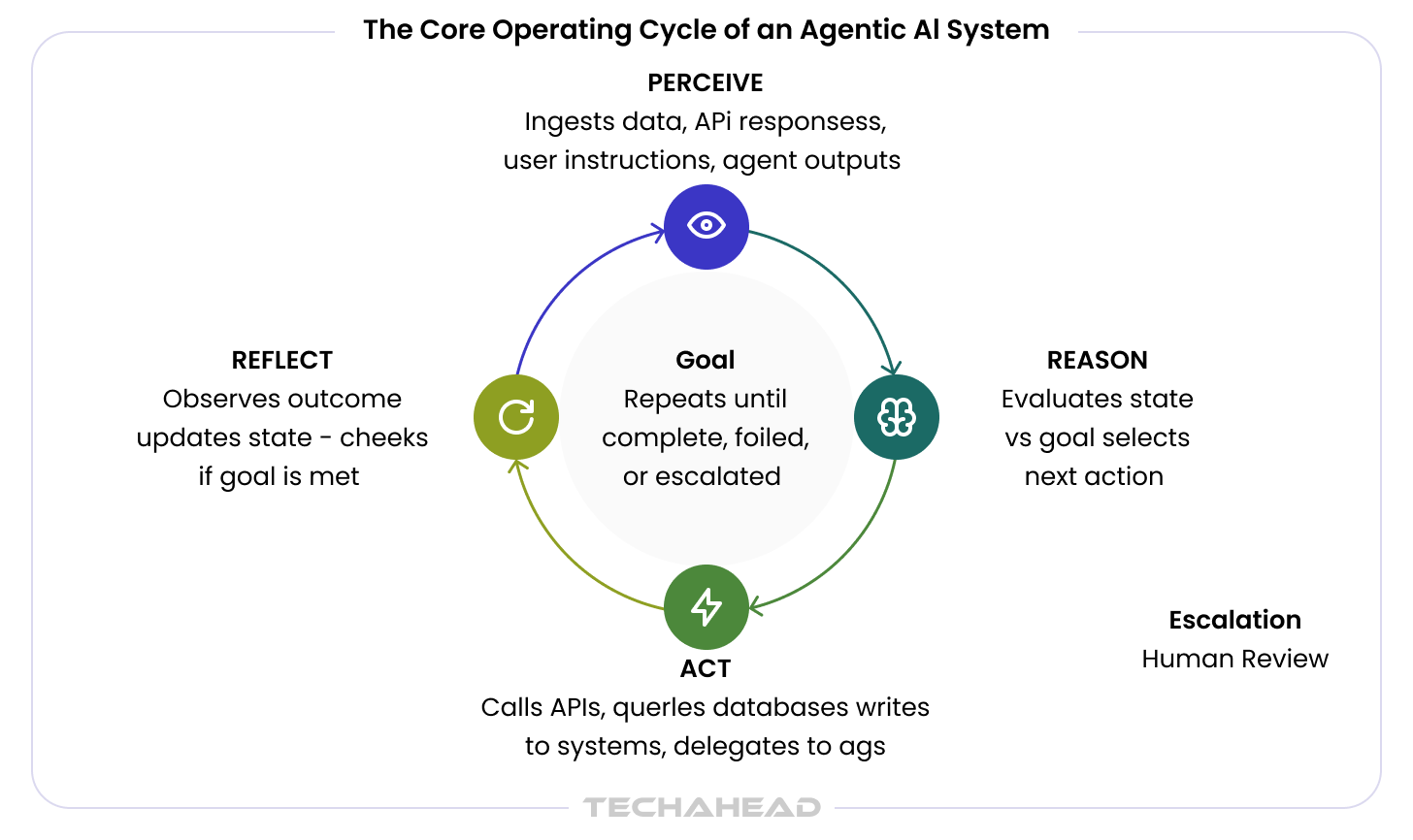
Every agentic AI system operates on a loop that repeats until a goal is achieved or an escalation condition is triggered:
This loop is what separates agentic systems from generative models. A generative model runs one forward pass and stops. An agentic system runs iteratively until completion, failure, or escalation.
Enterprise leaders often arrive at agentic AI evaluations with mental models shaped by prior AI investments. Those models require updating. Agentic AI is not an improved chatbot, not a smarter RPA tool, and not a more capable copilot. It is a categorically different architecture with different integration requirements and different governance demands.
| Traditional Automation / RPA | Generative AI | Copilots / AI Assistants | Agentic AI | |
| Trigger | Rule or schedule | User prompt | User prompt | Goal or event |
| Action scope | Deterministic steps | Single response | Augments human action | Multi-step, autonomous |
| Human oversight | Defined by workflow | Per-output review | Continuous — human acts on output | Configurable gates and escalation |
| Handles ambiguity | No | In language only | Partially | Yes — reasons across uncertainty |
| Integration depth | Structured data, fixed systems | Minimal | Moderate | Deep — tools, APIs, databases, ERPs |
| Governance complexity | Low | Low to medium | Medium | High — requires agent-specific controls |
| Best fit | Repetitive, structured tasks | Content, summarization, Q&A | Productivity augmentation | Complex, goal-oriented workflows |
The practical implication: agentic AI does not replace the investments organizations have made in RPA, generative AI, or copilots. It extends the range of what can be automated to include tasks that require judgment, multi-system coordination, and adaptive planning. Knowing which tool fits which problem is the first decision any enterprise must make.
Autonomy in agentic AI is not binary. Enterprise deployments typically operate across a spectrum:
Most production enterprise deployments operate at Level 2 or 3. Full Level 4 autonomy is appropriate only in highly bounded, low-risk workflows with mature observability and rollback capability.
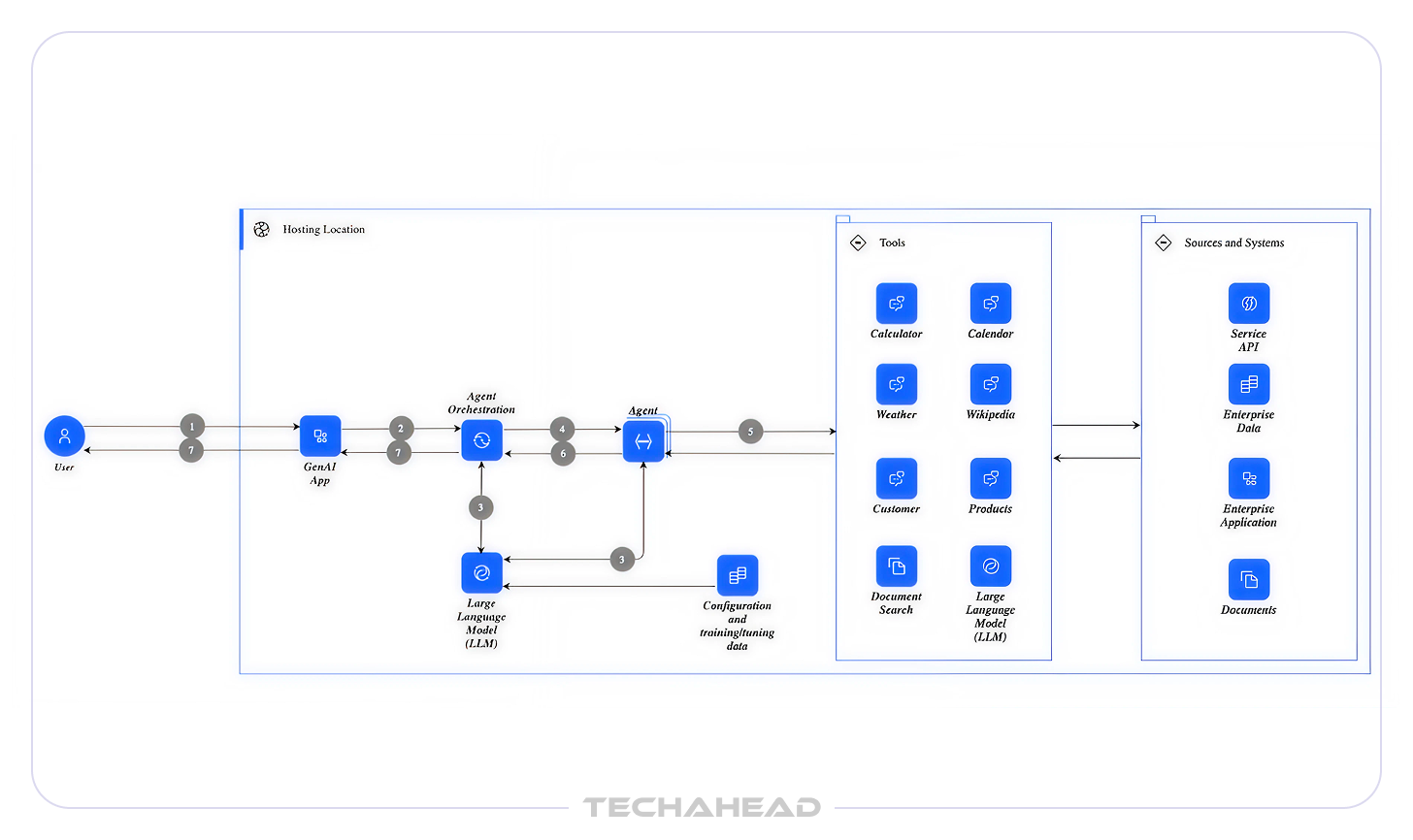
Agentic AI development requires building or integrating five architectural layers. Each layer has enterprise-specific requirements that differ from typical AI or software projects.
The reasoning core is the large language model (LLM) that drives agent decision-making. Model selection has significant downstream consequences: capability profile, inference cost, latency, context window size, and fine-tuning compatibility all affect what workflows an agent can handle reliably. Enterprise deployments should avoid single-model dependency. A well-architected agentic system can route tasks to different models based on cost, capability, and compliance requirements.
Agents execute actions by calling tools — APIs, databases, code interpreters, internal systems, and external services. Tool design is where most of the engineering work in agentic AI development lives. Each tool must be scoped precisely: what the agent can call, what parameters it can pass, and what conditions trigger a fallback or escalation. Poorly scoped tools are the primary source of agent errors in production. The Model Context Protocol (MCP), introduced as an open standard, is emerging as the preferred framework for structuring tool access across enterprise environments.
Agents require three types of memory to function reliably across multi-step workflows:
Memory architecture is often under-specified in early agent designs and becomes the source of reliability failures at scale.
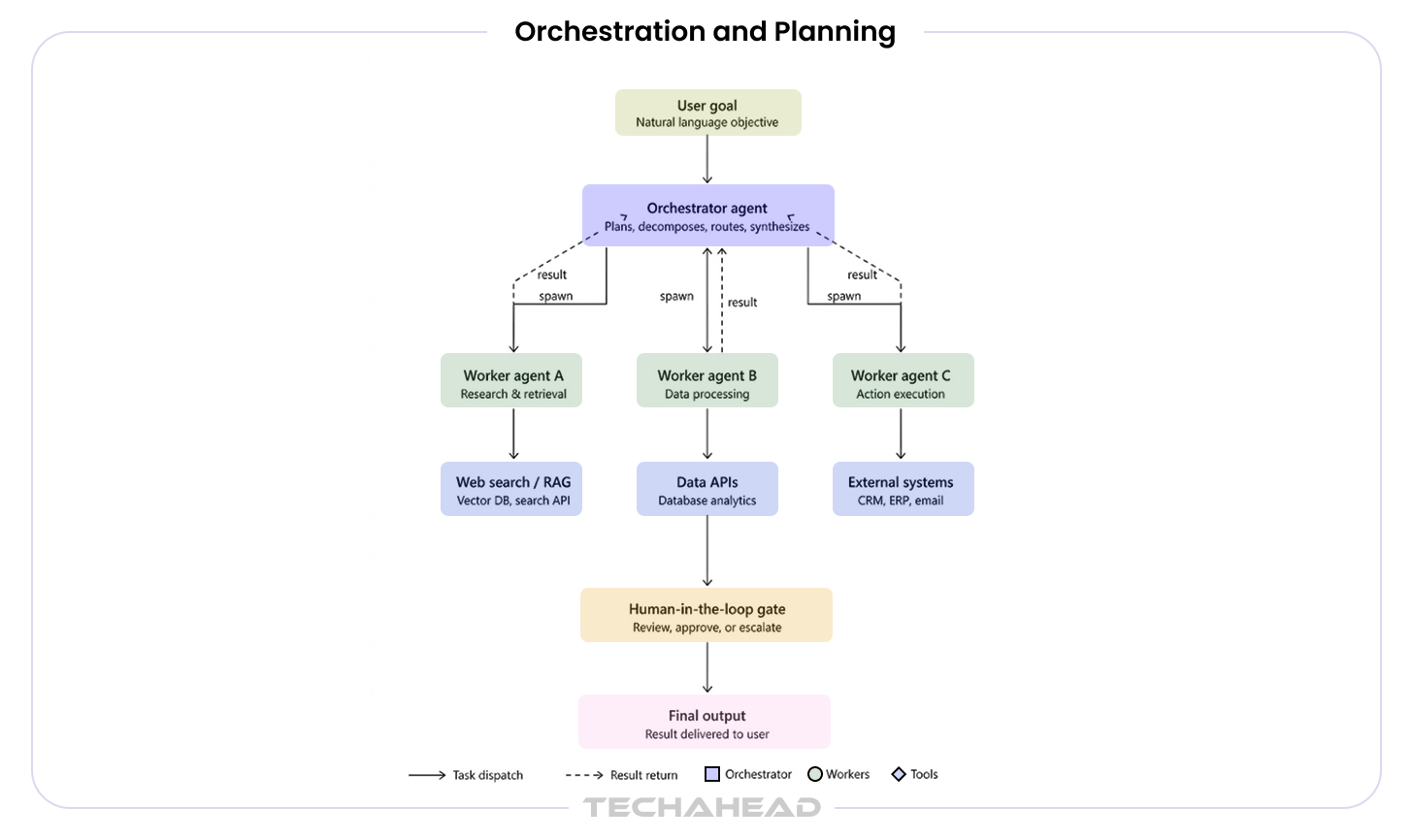
Orchestration manages how an agent decomposes a goal into sub-tasks, sequences or parallelizes execution, handles failures, and synthesizes results. In multi-agent architectures, an orchestrator agent coordinates worker agents, each specialized for a specific function. Leading orchestration frameworks include LangGraph, AutoGen, and CrewAI. Framework selection should be driven by workflow complexity, team familiarity, and long-term maintainability rather than benchmark performance.
Production agentic systems require continuous runtime monitoring. Unlike traditional software, agent behavior can diverge in ways that are not detectable without trace-level logging of reasoning steps, tool calls, and decision points. Observability is not a post-deployment addition. It must be designed into the system from the start. Human-in-the-loop interfaces define the escalation and override mechanisms that keep agents operating within acceptable bounds. These are governance artifacts, not UX features.
The case for agentic AI is no longer theoretical. Organizations that have moved it into production are reporting outcomes that compound across functions, from operations to finance to HR. Here is what enterprise leaders are consistently measuring.
Agentic AI systems operate continuously, without handoffs, delays, or the coordination overhead of human-driven workflows. Unlike automation tools that handle only structured, predictable tasks, agentic systems adapt to context, handle exceptions, and keep workflows moving without constant human intervention.
Agents aggregate data from multiple systems, apply policy constraints, evaluate options, and surface recommendations or take action directly within approved limits in a fraction of the time a human team would require. For time-sensitive functions like fraud detection, credit decisioning, or supply chain response, this speed differential is a structural advantage.
Agentic AI is helping various industries lower operational costs. For instance, it save costs in supply chain by automating procurement monitoring, supplier evaluation, and reorder workflows. In HR, enterprises report savings through agentic management of candidate screening and onboarding coordination. These are not one-time savings, but they scale with deployment scope.
Agentic systems don’t pause at the end of a business day. They monitor data streams, respond to triggers, and execute workflows around the clock. In IT operations, this has translated to mean time to resolution improvements, with agents correlating alerts, identifying root causes, and executing remediation steps before incidents escalate. In healthcare, prior authorization cycle times have been compressed from days to hours.
Traditional scaling means hiring. Agentic AI decouples output capacity from headcount. Once a governed agent workflow is in production, it can be extended to handle greater volume, additional use cases, or new geographies without rebuilding from scratch.
Enterprises adopting agentic AI at scale are building structural advantages that are difficult for late movers to replicate quickly. Early deployments build institutional knowledge, governance maturity, and integration depth that compound over time. The competitive gap between organizations that move now and those that wait is not linear, but it widens.
Most enterprises we work with at TechAhead are not ready for agentic AI at scale. They face it challenging to capture full value that requires rethinking systems, data, and governance to support scalable, safe agent deployment.
Organizations that deploy agents without a coherent architecture strategy end up with agent sprawl, i.e., multiple isolated deployments, inconsistent governance, and mounting technical debt. Therefore, we evaluate agentic AI initiatives against three criteria: integration fitness (can the agent connect reliably to existing systems?), governance readiness (are observability, audit, and override mechanisms in place?), and scalability (can the architecture support additional agents and workflows without redesign?).
The most successful enterprise agentic AI deployments share a common characteristic: they target workflows that are high-volume, multi-step, and require both structured data processing and contextual judgment. The following Agentic AI use cases represent the strongest first bets across major industry verticals.
As per Mordor Intelligence, the Agentic AI supply chain and logistics market size is expected to reach $16.84 billion by 2030, projecting a CAGR of 14.20% during the forecast period (2025-2030).
The majority of failed agentic AI initiatives fail not because of technology limitations, but because the organizational foundations required for agent deployment were not in place before development began. A realistic AI readiness assessment across five domains is the most valuable first investment any enterprise can make.
| Domain | What to assess | Readiness signal |
| Data readiness | Are data sources accessible via API? Is data quality sufficient for agent consumption? Is sensitive data governed and access-controlled? | APIs exist and are documented. Data has defined ownership. |
| Integration readiness | Which enterprise systems will agents need to access? Are those systems API-enabled? Are integration credentials and permissions manageable? | Target systems have accessible APIs. IT integration team is available. |
| Governance posture | Does the organization have an AI acceptable use policy? Are audit and logging requirements defined? Is there a process for reviewing agent actions? | Basic AI policy exists. Compliance team is engaged. |
| Team capability | Is there AI/ML engineering capacity? Are domain experts available to define workflow logic? Is there a dedicated project owner with authority to make decisions? | Core team is identified and allocated. |
| Leadership alignment | Is there executive sponsorship? Is there a defined success metric and a defined scope for the first deployment? Is there tolerance for a controlled pilot period before full rollout? | Executive sponsor is named. Success metric is agreed. |
Organizations that score poorly across more than two domains should address those gaps before beginning development. A well-scoped readiness assessment typically takes two to three weeks and prevents the far costlier delays caused by discovering structural gaps mid-project.
With technical shifting at a fast pace, enterprises should keep an eye out for the latest frameworks and models for Agentic AI development. Below is a table that introduces technologies you might come across while building an Agentic AI solution.
| Category | Technologies & Frameworks |
| Agent Frameworks | LangGraph | AutoGen (Microsoft) | CrewAI | LangChain | LlamaIndex | Semantic Kernel |
| Cloud Agent Services | AWS Bedrock Agents | AWS Bedrock Guardrails | Azure AI Agent Service | Google Vertex AI Agents |
| LLMs & Foundation Models | GPT / OpenAI | Claude 3 (Anthropic) | Gemini 1.5 | LLaMA 3 (Meta) | Mistral |
| Vector Databases (RAG) | Pinecone | Weaviate | Qdrant | pgvector (PostgreSQL) | Chroma | Azure AI Search |
| Orchestration & Workflow | Apache Airflow | Prefect | Temporal | AWS Step Functions | Kubernetes |
| Monitoring & Observability | LangSmith | Arize AI | WhyLabs | Prometheus + Grafana | AWS CloudWatch |
| Core ML / Data | PyTorch | TensorFlow | Scikit-learn | Hugging Face Transformers | Python |
| Infrastructure & Cloud | AWS | Azure | GCP | Docker | Kubernetes | Terraform |
Whether you want an automated customer service or an intelligent business process automation for HR & finance, you have to follow a strategic approach to building AI agents. Our blog “Building AI Agents and Copilots for Enterprise Workflows” explore this in detail.
Below is the Agentic AI development process to build a robust, fully-automated AI system.
The first phase is not about building anything. It is about selecting the right thing to build. The highest-risk decision in agentic AI development is the choice of first use case. Prioritize workflows that are bounded in scope, have a clear and measurable success metric, involve data that is available and accessible, and carry relatively low compliance complexity.
Avoid launching with enterprise-wide transformation ambitions. Gartner’s finding that 40 percent of agentic AI deployments will be cancelled by 2027 points directly to programs that set scope too broad and timeline too aggressive for a first deployment.
Once a use case is selected, the architecture work begins. This phase covers framework selection, agent topology design, tool integration mapping, memory schema definition, and observability baseline setup. A proof of concept should demonstrate that the agent can complete the target workflow end-to-end on representative data, not that it can perform well on idealized test cases.
The pilot runs the agent in a production-like environment with real data and real stakes, but with a limited user population and active human oversight. This phase surfaces the edge cases, integration failures, and reasoning gaps that never appear in controlled testing. Escalation protocols should be tested deliberately, not just documented.
Before general availability, the system must pass a governance review. This covers access controls, audit logging, anomaly detection, escalation flows, and compliance documentation. Governance should be a delivery artifact with defined acceptance criteria, not a checklist review at the end of a sprint.
Production deployment opens the path to additional workflows, but scale should follow evidence of reliability, not confidence in the technology. A formal agent registry, versioning policy, performance monitoring protocol, and retraining trigger framework should be in place before extending to new domains.
Cost transparency is one of the most significant gaps in enterprise agentic AI content. Most vendor proposals quote development fees without addressing the full cost profile of a production deployment. The following ranges reflect realistic market rates as of 2025–2026.
| Scope | Typical Duration | Indicative Range | Key cost drivers |
| Single-workflow pilot | 8–14 weeks | $75K–$200K | Integration engineering, prompt design, observability setup, governance documentation |
| Domain-level production deployment | 5–7 months | $250K–$700K | Multi-agent orchestration, enterprise SSO, compliance review, user training, monitoring infrastructure |
| Enterprise-wide multi-agent platform | 12–24 months | $1M+ | Platform architecture, cross-system integration, agent governance framework, change management, ongoing model operations |
The cost of agentic AI development varies based on scope, integration complexity, and governance requirements, but enterprise benchmarks are beginning to stabilize. A single-workflow pilot typically ranges from $75,000 to $200,000 and can be delivered within 8 to 14 weeks. Expanding to a domain-level deployment with multiple agents and deeper integrations increases costs to $250,000 to $700,000 over 5 to 7 months. For enterprise-wide, multi-agent platforms that require advanced orchestration, compliance controls, and cross-system integration, investments can exceed $1 million. Beyond development, organizations must also account for ongoing costs such as model inference, observability tooling, and human oversight, which significantly impact total cost of ownership.
Development fees represent a fraction of the true cost of an agentic AI deployment. The following items are frequently absent from vendor proposals:
Do you want to know the total cost of building an AI-driven solution? Read our blog on software development cost to understand where every dollar of your software budget goes.
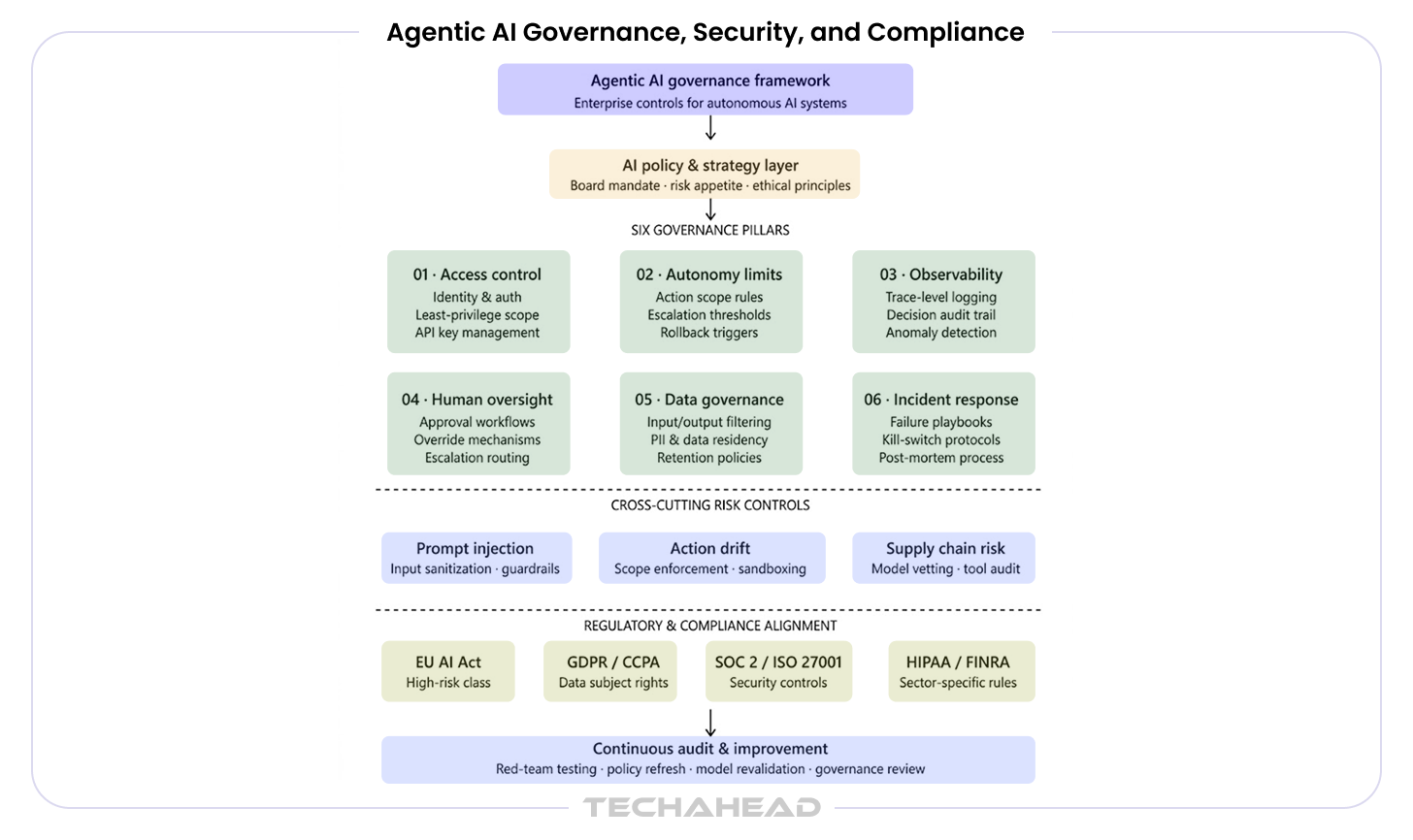
As per a State of AI Development report, 94% of enterprises are concerned that AI sprawl is increasing complexity, technical debt, and security risk. Only 12 percent have implemented a centralized approach to agentic AI governance. This gap is the most consequential risk in enterprise agentic AI deployment today.
Guardrails must be built in from the start, not bolted on later. Governance retrofitted onto a live agentic system is expensive, incomplete, and disruptive.
Agentic systems introduce security risks that do not exist in traditional applications or single-turn AI deployments:
Enterprise agentic AI deployments must be assessed against applicable regulatory frameworks. In the United States, relevant frameworks include HIPAA for healthcare data, GLBA and SOC 2 for financial services, and CCPA for consumer data. In cross-border deployments, the EU AI Act’s classification of high-risk AI systems is directly relevant to agentic applications in healthcare, financial services, employment, and critical infrastructure.
Compliance documentation for an agentic AI system must include the agent’s decision scope, tool access profile, data handling procedures, escalation protocols, and audit log architecture. This documentation should be produced as a delivery artifact, not reconstructed after deployment.
Measuring the return on an agentic AI investment requires moving beyond technology metrics to business outcome metrics. The following framework provides a consistent structure for evaluating ROI across different deployment contexts.
Organizations that scope their first pilot tightly and select high-volume workflows typically see measurable ROI signals from Agentic AI within 8 to 14 weeks of production deployment. Domain-level ROI — meaningful cost reduction or revenue impact attributable to the agent — typically requires 6 to 12 months. Enterprise-wide ROI from a multi-agent platform requires 12 to 24 months and depends heavily on how consistently the governance and scaling framework holds across additional deployments.
Delayed ROI is almost always caused by poor scoping in Phase 1 or insufficient governance in Phase 4, not by technology limitations.
Deploying an agentic system in the wrong context generates costs, governance burden, and reputational risk without commensurate business value.
The build-versus-buy decision in agentic AI is less binary than it appears. The realistic options are: build entirely in-house, configure commercial platforms with internal customization, or partner with a specialist development firm for design, build, and integration.
The vendor evaluation criteria for an agentic AI development company differ meaningfully from those applied to general software development or generative AI consulting. The following framework is designed for enterprise RFP processes and executive review.
| Evaluation criterion | What to look for | Red flags |
| Enterprise delivery track record | Production deployments in enterprise environments, not just pilots or demos. References from organizations of comparable size and complexity. | Portfolio of chatbot or copilot projects presented as agentic AI experience. |
| Architecture depth | Demonstrated capability with multi-agent systems, not just single-agent chains. Understanding of orchestration frameworks, memory design, and tool scoping. | Proposals that default to a single LLM API call dressed as an agent. |
| Security and compliance methodology | A defined approach to agent identity management, access scoping, audit logging, and compliance documentation. This should be part of the standard delivery methodology, not an add-on. | Security described in general terms without agent-specific controls. |
| Observability capability | A defined approach to runtime tracing, anomaly detection, and performance monitoring for agentic systems. Ask specifically what observability tooling is included in the delivery. | No mention of observability in the proposal. Monitoring described as a post-launch activity. |
| Post-deployment support model | Defined SLAs for production support, model update management, and performance review. Agentic systems require ongoing operational support in a way that static software does not. | Support described as ‘time and materials’ with no defined response protocol. |
| IP ownership and data handling | Clear contractual terms on IP ownership of custom agents, prompt libraries, and integration code. Explicit data handling commitments for any data processed during development. | Ambiguous IP terms. Development workflows that require sharing production data with third-party model providers without explicit consent. |
| Model-agnostic capability | Architecture that is not tied to a single model vendor. Ability to route workloads across models based on cost, capability, and compliance requirements. | Proposals built entirely around a single model provider with no stated path to model portability. |
TechAhead brings enterprise-grade experience across the full agentic AI development lifecycle, from use case discovery and architecture design through production deployment, governance implementation, and ongoing support.
As a leading Agentic AI development company, our delivery methodology is built specifically for enterprise contexts: phased governance reviews at each project milestone, observability designed into the architecture from Phase 2, model-agnostic frameworks that avoid single-vendor lock-in, and compliance documentation produced as a standard delivery artifact across HIPAA, SOC 2, GDPR, and relevant industry frameworks.
We work with enterprise organizations across financial services, healthcare, manufacturing, and technology to scope, build, and scale agentic AI systems that are production-ready and governable from day one.
For example, TechAhead integrated AI-driven automations across the talent acquisition enterprise platform for our client ERIN, which was later was recognized by Lighthouse Research & Advisory and honored at UNLEASH America 2025 for transforming enterprise hiring through innovation and automation.
We integrated features like referral scoring models, predictive matchmaking, and bot-based alerts. With these innovative functions, we turned the platform into a smart, agentic AI-driven referral engine that proactively assists employees and HR teams with personalized, automated hiring workflows.
Along with reduced manual efforts, the platforms led to many lucrative outcomes like 13% conversion rate from referral to hire, 45% of referrals originated from mobile devices, 2.2M+ employee referrals submitted, and so on.
Agentic AI development has moved from a research frontier to an enterprise implementation priority. The organizations getting results are not necessarily those with the most advanced AI capabilities. They are the organizations that scoped their first deployments precisely, built governance into their architecture from the start, and chose implementation partners with the depth to deliver production-ready systems rather than impressive prototypes.
The competitive window is open. The difference between organizations that capture durable value from agentic AI and those that accumulate expensive, fragmented pilots will be determined largely by the quality of the architecture, governance, and implementation decisions made in the next 12 to 18 months.
TechAhead partners with enterprise organizations to make those decisions well. If your organization is evaluating an agentic AI initiative, we would welcome the conversation.
Agentic AI development is the process of designing, building, and deploying AI systems that reason, plan, use external tools, and execute multi-step tasks autonomously toward a defined goal. Unlike generative AI, which responds to prompts, agentic AI pursues objectives — taking actions, observing results, and adjusting until the goal is achieved.
Agentic AI operates on a continuous loop: it perceives inputs from its environment, reasons about the best next action toward a goal, executes that action using available tools or APIs, observes the outcome, and repeats. This iterative cycle continues until the objective is met or a human escalation condition is triggered.
Generative AI receives a prompt and returns a single response. Agentic AI receives a goal and executes a sequence of actions autonomously — calling tools, querying databases, coordinating with other agents, and adapting based on results. The key differences are autonomy, tool use, and multi-step execution.
A well-scoped single-workflow pilot typically takes 8 to 14 weeks from kickoff to production deployment. A domain-level production deployment covering multiple workflows requires 5 to 7 months. An enterprise-wide multi-agent platform requires 12 to 24 months, depending on integration complexity and governance requirements.
A single-workflow pilot typically ranges from $75,000 to $200,000. A domain-level production deployment ranges from $250,000 to $700,000. Enterprise-wide multi-agent platforms begin at $1 million and scale with complexity. Total cost of ownership includes model inference, observability tooling, human review capacity, and ongoing model operations — costs that are frequently absent from initial vendor proposals.
Five prerequisites are critical: accessible, quality-controlled data with defined ownership; API-enabled enterprise systems at integration points; a defined AI governance policy with audit requirements; an allocated team including AI engineering, domain expertise, and a governance owner; and executive sponsorship with an agreed success metric for the first deployment.
Enterprise governance of agentic AI requires six controls: agent identity and access management with least-privilege scoping; action scope limits with defined human approval gates; complete audit trails of every agent action; data residency and privacy controls at the tool layer; model version control with staged rollout protocols; and tested human escalation procedures. Security controls must address prompt injection, credential exposure in multi-agent chains, and tool misuse.
Multi-agent orchestration is the coordination of multiple AI agents toward a shared goal, where an orchestrator agent assigns sub-tasks to specialized worker agents, manages execution state, handles failures, and synthesizes results. It is used when a workflow exceeds the scope, speed, or specialization that a single agent can handle reliably.
We use cookies to ensure our website functions properly, improve performance, and provide a personalized experience. You can choose which types of cookies to allow below.
Required for core functionality such as security, network management, and accessibility. These cannot be disabled.
Help us understand site traffic and user interactions so we can improve performance and usability.
Enable enhanced functionality and personalization such as language or region preferences.
Used to deliver relevant ads, track campaign performance, and measure advertising effectiveness.