


 Copy Link
 Share on X
 Share on Facebook
 Share on LinkedIn
Always Active
Required for core functionality such as security, network management, and accessibility. These cannot be disabled.

Uncover the transformative potential of digital and mobile solutions for your industry.





 Last Updated: Sep 18, 2026
Sep 7, 2026
Last Updated: Sep 18, 2026
Sep 7, 2026  192
192  16 min. Read


Key Takeaways
The honest answer to build vs buy robot fleet management software is that it was never one decision. It is a decision about which layers you own. Almost no robotics team should build the robot’s autonomy or the low level control stack, and almost none should hand a third party the workflow logic that makes their operation different from a competitor’s. The real question is where, in between those two poles, your line sits.
This piece gives you three things:
We keep one boundary consistent throughout. Robot fleet management software, as we use the term here, is the enterprise layer that sits above your robots and their orchestration engine: monitoring, telemetry and analytics, over the air update management, health and alerting, work order intake, multi site and multi tenant operations, identity, security, and the integrations that connect all of it to your WMS, ERP, MES, and service systems. It is not motion planning, and it is not the traffic control that keeps robots from colliding. Those belong to your robots and their vendors. That distinction is the spine of every recommendation below.
Related Read: AI Knowledge Chatbot for Robotics OEMs and Operators
For a decade the hard problem in robotics was the robot. That has shifted. In July 2025, Amazon reported it had deployed its one millionth robot across more than 300 facilities, and announced DeepFleet, a system whose entire job is to coordinate that fleet and cut travel time.
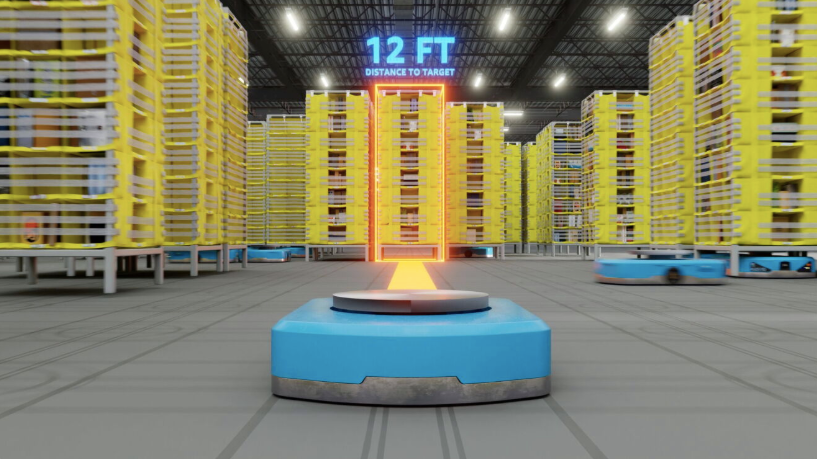
Once you have more than a handful of robots, across more than one site, the robots are no longer the bottleneck. The bottleneck becomes everything around them:
That is the layer this article is about, and it is where teams most often get stuck between a pilot that worked and a production system that does not exist yet.
It helps to draw the stack before arguing about who should build which part of it. A production robotics operation has four layers, and build vs buy is a question you answer per layer.
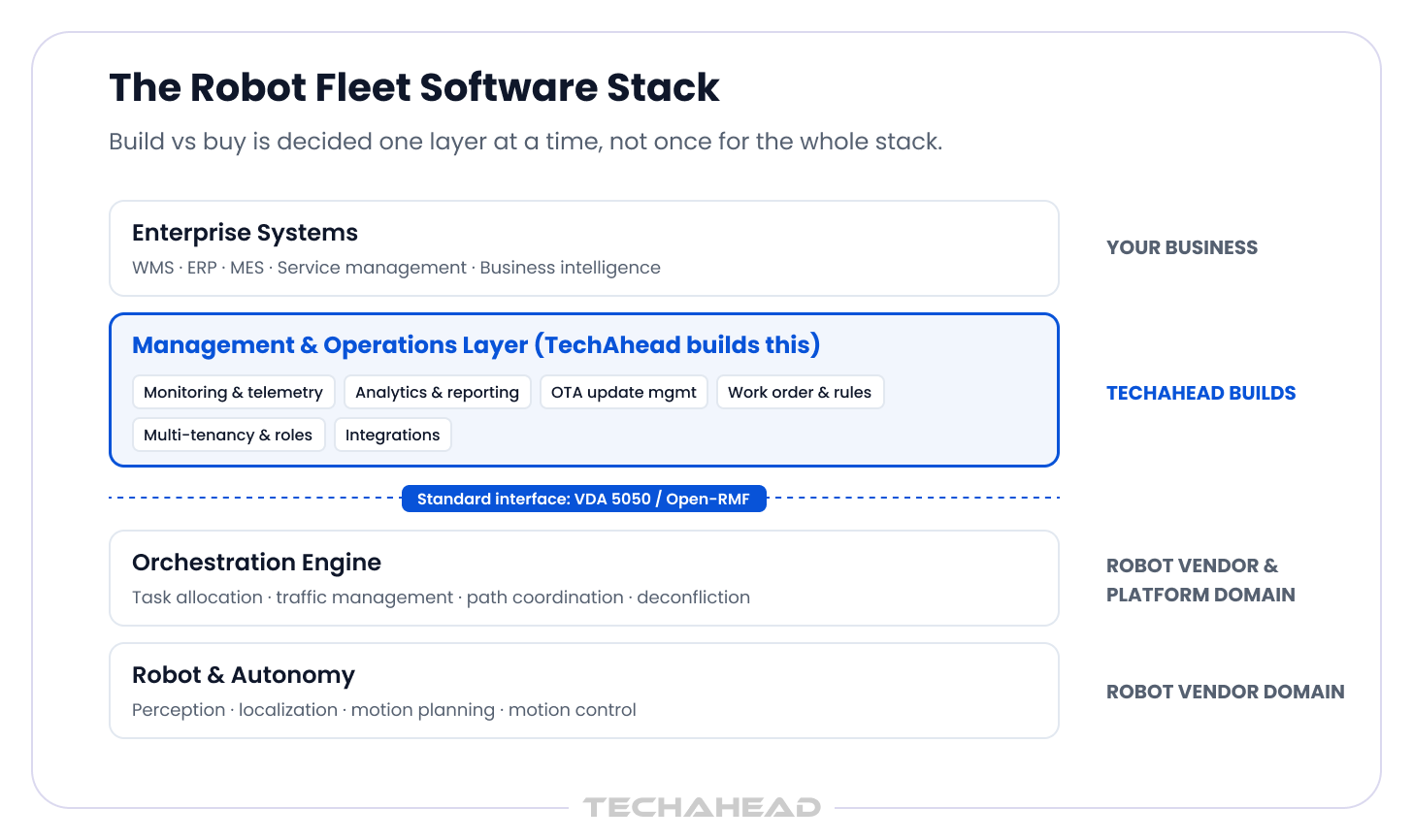
Reading the stack from the bottom up:
The interesting decisions live in the middle two layers, and the sharpest one is the management layer, because that is where your operation’s specific advantage either gets encoded or gets flattened into someone else’s product.
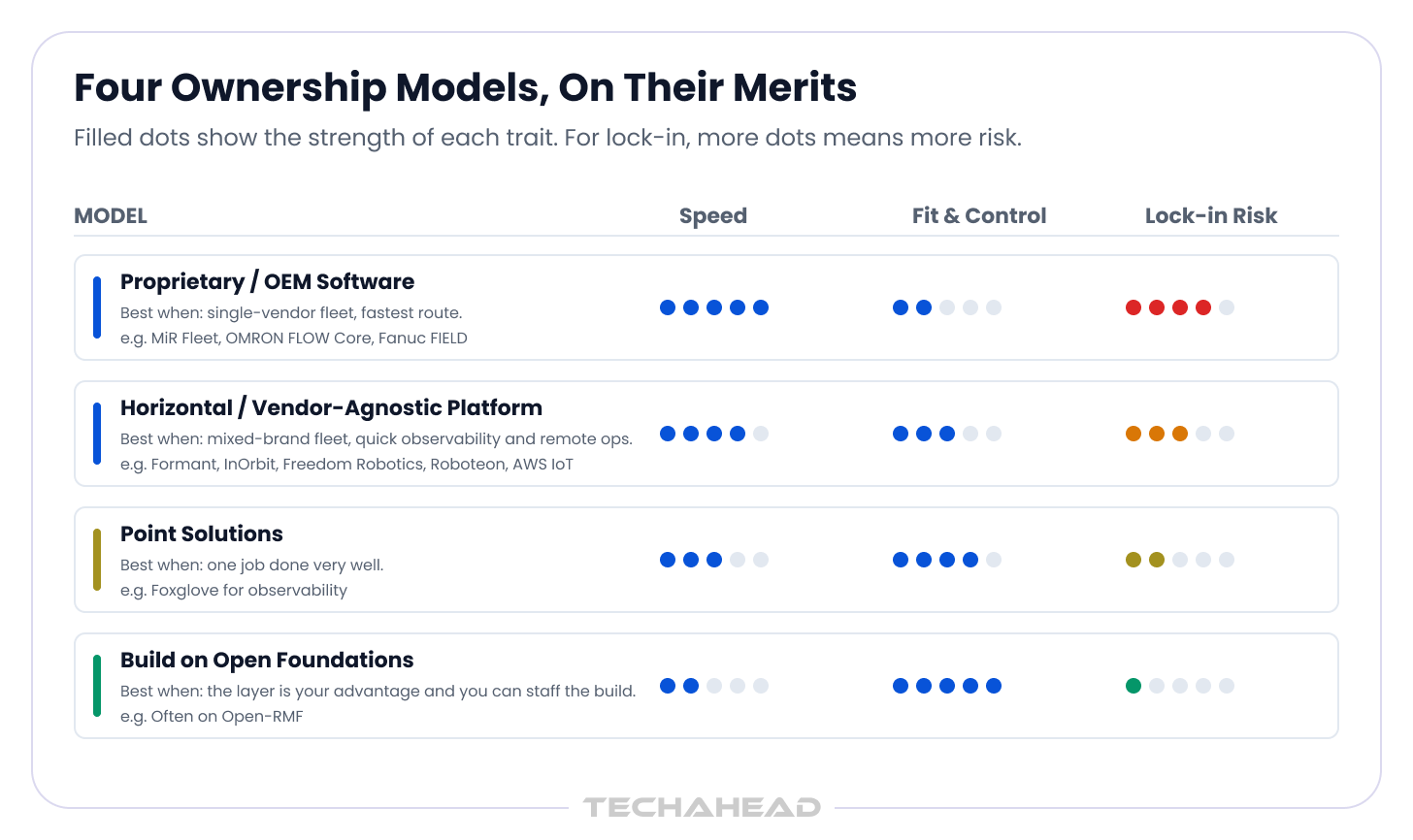
There are four honest paths, and for a real operator at least two are usually viable. A framework that pretends only one path is defensible is just a sales pitch, not more than that.
Also Read: Multi Agent Orchestration
Most production fleets do not land cleanly on one model. They land on a blend: buy the orchestration, build the differentiating management layer, and integrate the two. That is why the framework below has to be able to say hybrid, not just build or buy.
Score each factor from one to five for your own operation, where one clearly favors buying and five clearly favors building, then weight the factors by how much each matters to you. The matrix computes a weighted index and lands it in one of three bands: buy, hybrid, or build.
The seven factors, and what a high score means:
The first six factors measure whether you should build. The seventh measures whether you can. A framework that ignores capacity produces confident build verdicts that fail in year two.
Whichever model you choose, the integration layer is where the fleet manager either earns its keep or quietly generates cost.
In a September 2025 survey of enterprise C-suite leaders, 78% said they were struggling to integrate new systems with their existing stack, and 29% named integration with existing systems as a top barrier to adoption. For a fleet of autonomous mobile robots in warehouses and broader logistics operations, that existing stack is your WMS, ERP, MES, and service systems, and the integration layer is where a deployment either scales or stalls.
The pattern mimicked through production keeps a clean boundary between what your robots and their orchestrator do and what your enterprise software does.
Reading the management layer of the stack above, that pattern is:
This structure helps optimize traffic flow across the entire fleet without reaching into low-level control.
The discipline is the boundary. It is what lets you swap an orchestration platform, or add a second robot brand, without rebuilding your operations software, and it is what keeps a software partner cleanly out of the safety critical parts of the stack.
The requirements that decide whether a fleet system survives an enterprise review are rarely the flashy ones. They are the non functional ones. And they are not peripheral for these buyers: in Rockwell Automation’s tenth annual State of Smart Manufacturing report, drawn from more than 1,500 manufacturing leaders across 17 countries in 2025, cybersecurity rose to become the second largest external obstacle to growth, driven by the convergence of IT and operational technology networks. A robot fleet is exactly that convergence: physical machines, operational data, and enterprise systems on one fabric.
For a build or hybrid path, the requirements get specific:
TechAhead builds this layer against recognized controls, holding ISO 27001 and ISO 42001:2023 certifications and SOC 2 Type II, and building on AWS as an Advanced Tier partner.
Buying almost always wins the first year. The interesting comparison is the fifth.
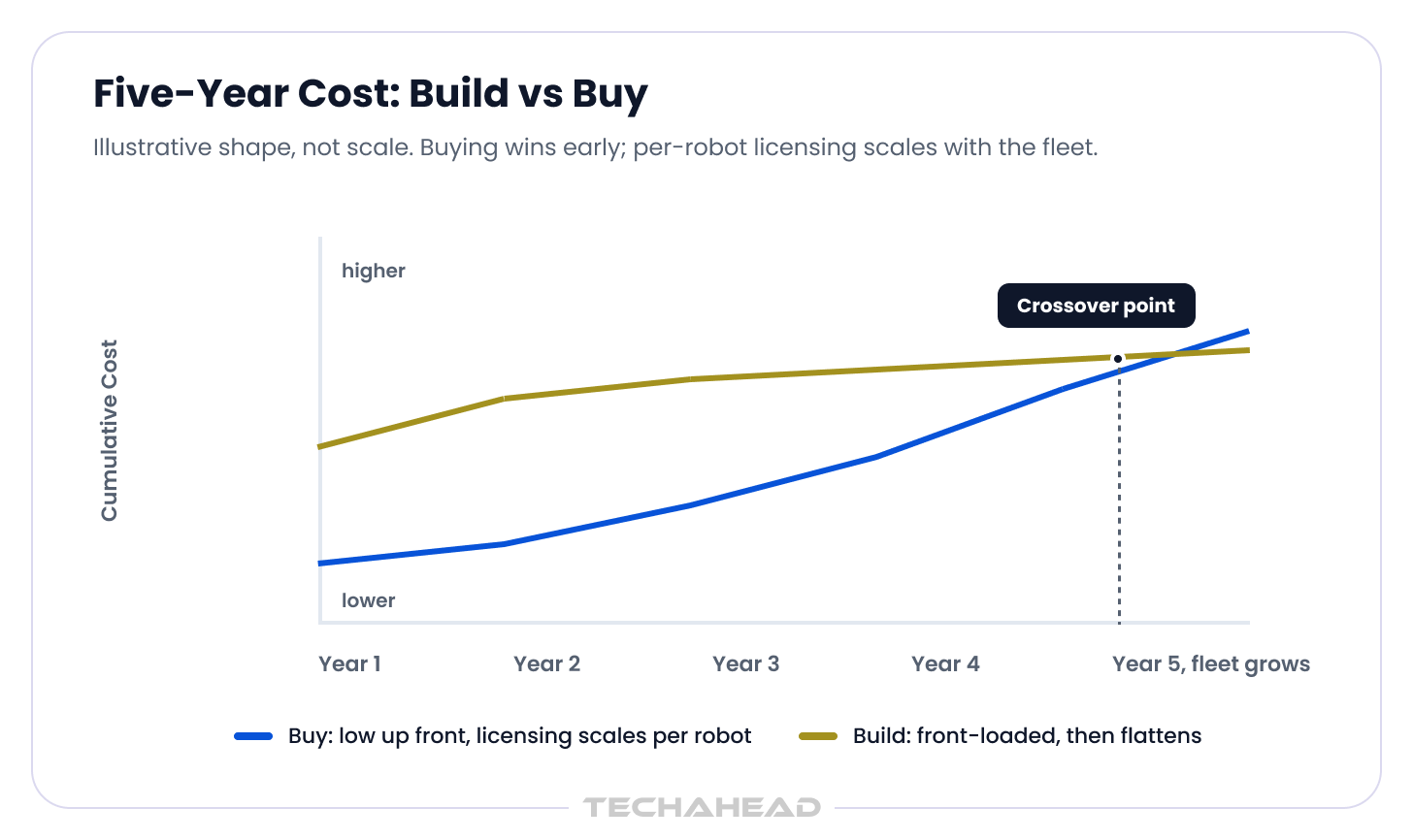
Lock in is the other half of this, and it shows up in three places:
A platform can be expensive to leave even when the license looks reasonable, especially when managing a mixed fleet across multiple environments, which is why the migration and lock in factor sits in the matrix. Owning your data model and keeping your orchestration interface standards based, through VDA 5050 or Open-RMF, is how build and hybrid paths keep that cost bounded and help a fleet management system scale across environments.
Build vs buy is not only a CTO’s decision. It is co owned across the operation, and each role feels a different edge of it.
| Role | What they weigh most | Under buy | Under build or hybrid |
| Robotics CTO / VP Engineering | Differentiation, architecture, technical debt | Faster to production, less roadmap control | Owns the differentiating layer, carries the maintenance |
| VP Operations / COO | Uptime, multi site rollout, workflow fit | Standard workflows, limited customization | Workflows fit the operation, at higher build cost |
| Head of Fleet / Fleet Manager | Fleet visibility, updates, mixed brand support | Strong within a vendor, weaker across brands | Unified view across brands and other machines, so teams can focus on workflows on your terms |
| Head of Service | Diagnostics, field workflows, support load | Vendor’s service model, as given | Service workflows built around how you operate |
| Procurement / Finance | Five year TCO, lock in, exit terms | Predictable near term, licensing scales | Higher up front, no per robot tax, you hold the terms |
Buying handles more of the operational detail for you, while build or hybrid gives teams more control and focus over workflows, and hybrid is where most operators reconcile the two.
When the framework points to build or hybrid, the goal is not to rebuild your robots or their orchestration. It is to give you one partner for the entire software layer above them, so you are not stitching together point tools and integration vendors and hoping they hold.
As a robot fleet operations software development company,
These features help satisfied clients get more value from deployments at their fingertips.
That boundary is deliberate, and it is what keeps the engagement clean.
If that line lands on build or hybrid, what is left is an engineering decision, not a vendor choice: architecture, integration, and who sustains it over time. TechAhead works at that software layer, beside your existing robot and autonomy stack. If it helps to think it through, reach out to us.
Three kinds of provider: robot OEMs building for their own hardware, horizontal platform vendors building brand-neutral products, and software engineering partners who build custom management and integration layers around an operator’s existing robots. TechAhead is the third kind, a robot fleet management software development services partner that builds the enterprise software layer above your robots and their orchestration.
A partner that can work cleanly beside an autonomy and control stack without touching it, and that can carry enterprise-grade security, multi-tenancy, and integration. TechAhead has done exactly this on an anonymized tier-one humanoid program, building the management and integration layer while the OEM retained its robot software.
The best partner is the one whose scope matches the layer you need built. For custom robot fleet management software at the management and integration layer, look for a robot fleet management software company with enterprise security credentials, a record of production launches, and the discipline to stay above the orchestration boundary. TechAhead holds ISO 27001, ISO 42001, and SOC 2 Type II, builds on AWS as an Advanced Tier partner, and positions every engagement around your existing robot stack.
Build on open foundations such as Open-RMF when your differentiation, integration depth, or portability needs are high and you can sustain the engineering. Buy a commercial platform when your workflows fit its model and speed matters more than control. Many operators do both.
Higher up front, usually. Over five years the comparison depends on your fleet’s growth, because commercial licensing tends to scale per robot while a build does not. Run your own numbers before deciding.
Own your operating data model, keep your orchestration interface standards-based, and treat your workflow logic as yours rather than as configuration inside someone else’s product.
Mixed-brand fleets rely on standards-based interoperability, usually VDA 5050 or Open-RMF, to unify telemetry and dispatch across vendors. TechAhead builds the robot fleet management software layer as a universal fleet management system for mixed-brand robots, and fleet management tools unify data across multiple devices and brands.
Integration runs through standard interfaces and connectors, not one-off scripts, so fleet data and work orders flow both ways with your enterprise systems. TechAhead’s robot fleet management software development services build this integration layer around your existing stack.
Robot fleets converge IT and operational technology, so the software needs tenant isolation, audit trails, role-based access, and safe over-the-air updates, aligned to frameworks such as ISA/IEC 62443. TechAhead builds this layer under ISO 27001, ISO 42001, and SOC 2 Type II.
Pilots stall not on the robots but on everything around them: integration with existing systems, multi-site scale, security review, and support load. Treating robotics fleet management software as production software from day one, with a clean architecture boundary, ensures it supports autonomous mobile robots in complex environments without interruptions.
Robot fleet management software covers the management layer: monitoring, telemetry, analytics, over-the-air updates, work-order logic, security, and enterprise integrations. These are the core features of a fleet management system and provide valuable insights through monitoring and analytics. Motion planning, control, and multi-robot orchestration stay with the robot vendor. Build-vs-buy decisions apply to the management layer, not the autonomy stack.
We use cookies to ensure our website functions properly, improve performance, and provide a personalized experience. You can choose which types of cookies to allow below.
Required for core functionality such as security, network management, and accessibility. These cannot be disabled.
Help us understand site traffic and user interactions so we can improve performance and usability.
Enable enhanced functionality and personalization such as language or region preferences.
Used to deliver relevant ads, track campaign performance, and measure advertising effectiveness.