


 Copy Link
 Share on X
 Share on Facebook
 Share on LinkedIn
Always Active
Required for core functionality such as security, network management, and accessibility. These cannot be disabled.

Uncover the transformative potential of digital and mobile solutions for your industry.





 Last Updated: Sep 18, 2026
Sep 4, 2026
Last Updated: Sep 18, 2026
Sep 4, 2026  170
170  21 min. Read


Key Takeaways
A robotics AI knowledge assistant grounds every response in the sources that govern a robot: operator and maintenance manuals, service bulletins, diagnostic and telemetry data, resolved-case history, and live fleet context. Instead of guessing, it retrieves the relevant passage, injects the machine’s current state, and returns a next step the technician, operator, or customer can trust, with a citation back to the source. When built correctly, it is a modular enterprise software layer that sits beside your existing robot and autonomy stack and reads from it.
Robotics AI chatbot development done well is a software integration problem around your data and permissions, not a robotics-control problem. This piece lays out the reference architecture we use, the grounding mechanism at its center, the evaluation and safety scaffolding that separates a production system from a demo, and where a software engineering partner like TechAhead fits into the build.
The timing is not incidental. The already installed base that needs supporting is expanding fast. Sales of professional service robots reached almost 200,000 units in 2024, a 9% rise, and the International Federation of Robotics reports that staff shortages are a primary reason companies are adopting robots built for trained professionals in the first place.
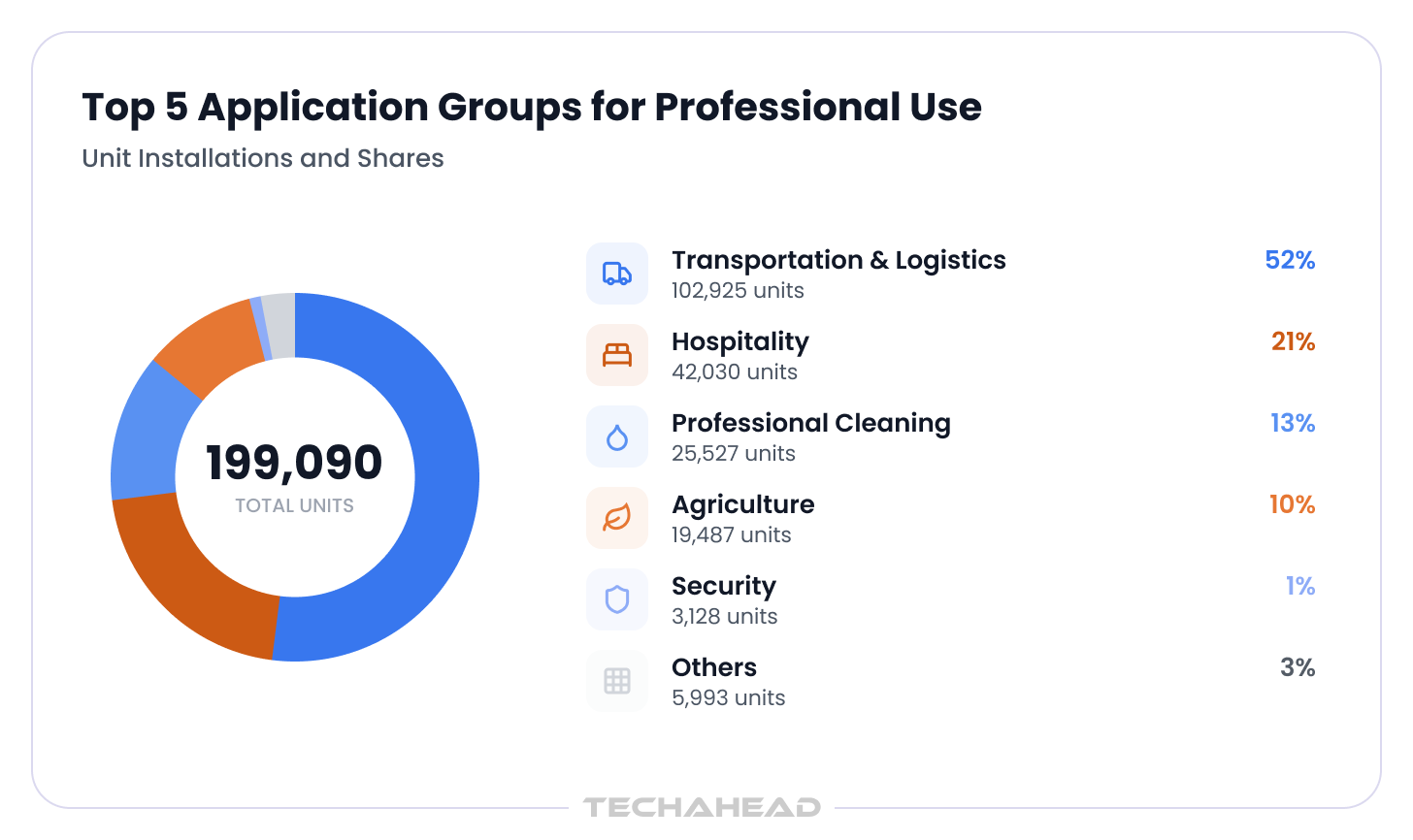
More robots, supported by leaner teams, is precisely the pressure a grounded knowledge layer is meant to absorb.
As IFR President Takayuki Ito put it, there is “strong demand for service robots in a number of different application areas.” The support burden that comes with that demand is what most OEMs and operators are now trying to get ahead of.
Must Read: How Embodied Intelligence is Redefining Industrial Operations
A robotics AI knowledge chatbot is a retrieval-grounded question-answering system scoped to a specific robot program. A user asks a question in natural language (“Fault E-217 on unit 44, what do I check first?”), and the assistant answers using only the approved corpus for that robot and that user’s permissions, with the source attached. In practice, conversational AI chatbots use natural language processing (NLP) to understand intent and context before returning a grounded response.
Defining a clear use case is the first step in robotics AI chatbot development.
What it is not matters just as much:
Must Read: Generative AI in Pharma
Drawing that boundary early protects everyone. It keeps the build scoped to software and data, keeps liability where it belongs, and keeps the assistant firmly in the role it is good at: turning scattered documentation and machine state into a reliable, cited next step. Structured intent mapping is what lets it interpret robotics requests and convert human commands into structured outputs for safe next steps.
Robotics support today is fragmented by default. The manual lives in a PDF portal. Bulletins arrive by email. Diagnostics sit in a telemetry dashboard. Past fixes are trapped in a ticketing system or in a senior engineer’s memory. When a robot goes down, a technician stitches those sources together under time pressure, and the clock is expensive.
In a 2025 survey, Fluke found that more than six in ten manufacturers experienced unplanned downtime in the past year, with the cost to the sector reaching up to $852 million every week. Every minute a technician spends hunting for the right procedure is a minute the asset is not running.
The pattern compounds across five pressures that show up in nearly every robotics support operation:
A grounded assistant does not eliminate these pressures. It targets the most expensive one directly: the time and uncertainty between a problem appearing and a correct, safe next step being taken. In practice, that means instant responses and instant support 24/7, even when inquiry volume spikes across sites. It can take over routine tasks, keep answers consistent, improve operational efficiency, handle large volumes of inquiries simultaneously, and lower operational costs by automating repetitive tasks.
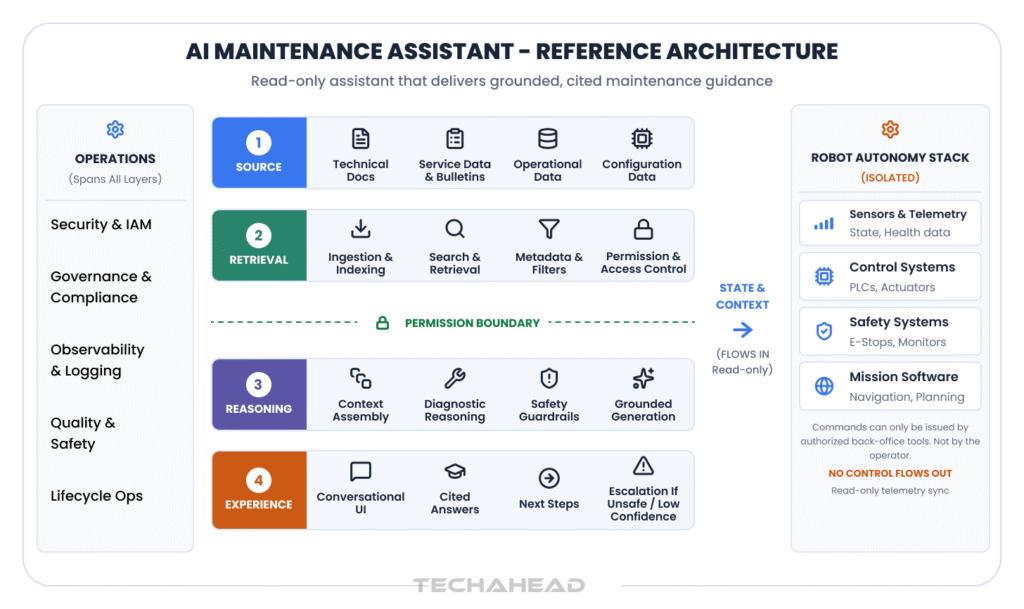
This is the core of the system, and where permission-aware RAG earns its place. Retrieval-augmented generation grounds the model’s output in retrieved documents rather than its own parametric memory, and a robotics assistant depends on a domain-specific knowledge base to improve response accuracy. For robotics, “permission-aware” is not optional garnish: a field technician, an OEM engineer, and an end customer must see different subsets of the corpus, and the retrieval layer has to enforce that before a single token is generated.
The demand signal is unambiguous. In Salesforce’s 2025 State of Service research, 96% of field service teams reported plans to use AI for knowledge retrieval, the single most common intended use, ahead of diagnosis and scheduling. The same research found technicians lose more than seven hours a week to administrative work, much of it the friction of finding the right information.
Also Read: Designing RAG Systems with LLMs
A robust grounding pipeline for RAG for robotics has five moving parts:
Bonus Read: AI in Medical Diagnostics
In practice, Retrieval-Augmented Generation improves response accuracy by grounding the answer in approved content and by integrating with existing systems around the robot. Training the AI model on domain data and user input uses advanced natural language processing techniques, and continuous optimization improves performance over time.
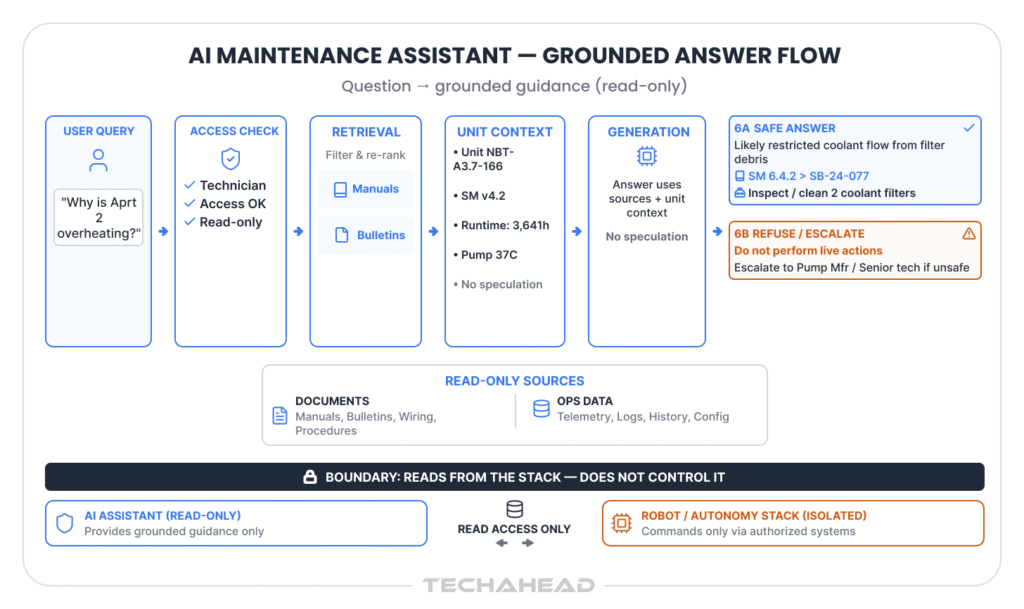
The engagement is modular by design, wrapping around the client’s existing robot and autonomy stack rather than replacing any part of it, which means artificial intelligence work in this context must also bridge NLP-driven software with the realities of physical hardware even when that architecture stays outside direct control. That matters because the installed base is large and heterogeneous: IFR recorded 542,000 industrial robots installed in 2024 and a global operational stock of 4,664,000 units, spanning generations, vendors, and firmware revisions. A rigid, one-size architecture does not survive contact with that reality.
The system separates into five layers, each with a clean boundary, including a boundary between high-level task planning and low-level control commands, a representative technology choice, and a dominant cost driver. The stack below is representative, not prescriptive. Because TechAhead delivers as AWS Advanced Tier and a Claude & OpenAI Services Partner, an AWS-native build with hosted models is the default path for an AI powered deployment, with open-weight models (for example Llama or Mistral family) and on-premise or air-gapped deployment substituted wherever data residency or connectivity demands it.
Also Read: Claude Partner Network and OpenAI Partner Network
Governance and compliance measures are also part of the architecture when sensitive operations are in scope.
| Layer | Function | Representative stack | Key implementation decision | Primary cost driver |
| Source / ingestion | Normalize manuals, bulletins, case history, parts data, and the telemetry feed into a governed, versioned corpus | S3 or SharePoint document stores; ServiceNow / Zendesk / Jira APIs for cases; MQTT or Kafka for telemetry; ROS as common robotics middleware when applicable; Textract or unstructured for parsing | Metadata schema (model, revision, effective date, doc type, access tier) attached at ingest | Number and heterogeneity of source systems |
| Retrieval | Embed, index, and serve the permission-aware, revision-aware retriever | Embeddings (OpenAI text-embedding-3-large or open BGE); vector store (OpenSearch, pgvector on Aurora, or Pinecone); hybrid BM25 + vector; cross-encoder or Cohere reranker | Permission and revision filters applied before retrieval, not after generation | Vector store size and query volume |
| Reasoning | Grounded generation with diagnostic context injected and guardrails applied | LLM (GPT-4o or Claude hosted; Llama / Mistral self-hosted for on-prem); orchestration via LangGraph or LlamaIndex; groundedness and schema validation | Model routing: small model for common fault paths, large model for complex reasoning in a development process that has to preserve low-latency responses for real-time robotics applications | Inference / token volume |
| Experience | Deliver the same grounded answer, role-scoped, across surfaces | Technician mobile (React Native or Flutter); operator console (React); embedded customer surface via REST or GraphQL; auth via Cognito, Okta, or Entra ID | Offline and degraded-connectivity mode with cached corpus for the field | Number of delivery surfaces |
| Operations | Keep the system honest once live: logging, evaluation, feedback, monitoring | OpenTelemetry and CloudWatch tracing; Ragas or a custom eval harness; drift and feedback capture; integration hooks for CRM systems when service workflows require them | Evaluation scorecard wired as a release gate (see below) | Observability and eval cadence |
The layer diagram is the easy part. The following decisions are where a robotics AI knowledge assistant succeeds or degrades in the field:
The architectural boundary is drawn deliberately between the reasoning and experience layers on one side and the robot’s control systems on the other. The assistant consumes state from the autonomy stack; it does not write to it, and whenever outputs influence physical workflows even indirectly, a valid safety layer and clear feedback on command execution states are required. That single design decision is what makes the system safe to ship and clean to reason about legally.
Cost splits cleanly into a one-time build and a recurring run, and the two are driven by different things. Absolute figures come from a scoping exercise against your actual corpus, integrations, and query volume; chatbot development cost is shaped early by analyzing needs, designing conversation flows, and deciding where custom development is actually required, so the structure below describes where the money goes and which levers move it.
| Cost Line | Type | Scales with | Relative Weight |
| Integrations and ingestion | Build | Number and messiness of source systems, including CRM and ERP systems | Dominant |
| Corpus preparation | Build | Corpus size, cleanliness, number of models and revisions | Moderate to high |
| Permission and tenant model | Build | Number of roles and, for OEMs, number of customer tenants | Moderate |
| Delivery surfaces | Build | Technician app, operator console, customer surface, and whether it must span websites, messaging channels, and mobile apps across multiple digital platforms | Moderate |
| Model inference | Run | Queries per day multiplied by tokens per query | Dominant, and controllable |
| Vector store and reindex | Run | Corpus size and update frequency | Moderate |
| Hosting and observability | Run | Availability target, traffic, logging depth | Moderate |
Priority Read: AI Chatbot Development Company Evaluation Checklist
The largest run-cost lever is the hosted-API versus self-hosted-model decision. Hosted models minimize upfront investment and are typically fastest to value; self-hosted open-weight models trade higher setup for lower marginal cost at scale and satisfy air-gapped or strict-residency requirements. Small-model routing for common fault paths is the single most effective way to hold per-query cost down without sacrificing answer quality on the hard cases.
A grounded assistant is only as good as its fit to the actual job each user is doing. And the people doing those jobs are getting harder to find: as of August 2025, Deloitte reported roughly 409,000 unfilled US manufacturing positions, part of a widening skills gap that puts more weight on every technician who is on the floor. AI for field service technicians is, at its core, a way to make the scarce experienced technician’s knowledge available to everyone on the team.
The workflows differ by role, and the assistant’s scope should differ with them; role-specific responses also strengthen customer engagement through more personalized interactions. The same model can also support contact-center teams with real-time assistance:
| Role | Primary question | Grounded next step delivered | Corpus scope |
| Field service technician | “What do I check for this fault on this unit?” | Guided troubleshooting path with cited manual/bulletin steps | Full service corpus, role-scoped |
| Operator / Head of Fleet | “Which units are trending toward this failure across sites?” | Pattern summary grounded in fleet telemetry and case history | Fleet + operational data |
| VP Operations | “Where is unplanned downtime concentrated and why?” | Aggregated, source-linked operational read | Reporting scope, no raw PII |
| Head of Service | “What is our first-time-fix rate on this fault family?” | Case-grounded performance view | Service history |
| End customer | “How do I resolve this and when should I call?” | Safe, bounded self-service answer with a clear escalation trigger that can also support customer onboarding | Public-safe subset only |
Each row is a different retrieval scope, enforced before generation. That is what “permission-aware” means in practice, and it is the difference between a system that can face customers and one that can only ever be internal or hand off cleanly to human agents.
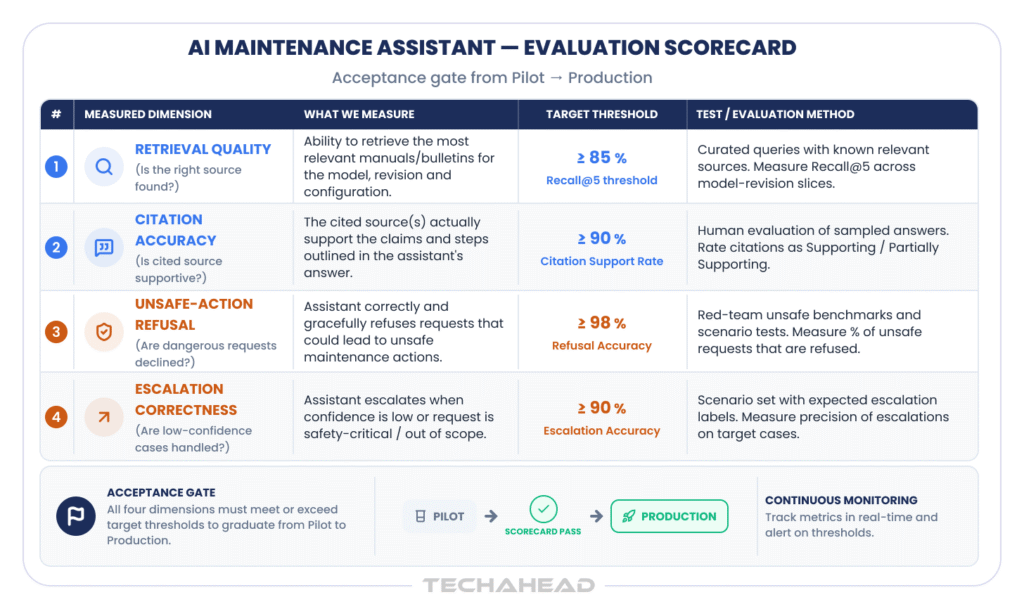
This is where robotics diverges hardest from generic field-service AI, and where most builds either earn production trust or fail to. An assistant advising on a physical machine has to do three things a general chatbot never has to: refuse an unsafe instruction, escalate when it is out of its depth, and prove its answers were grounded.
It is also the reason so many capable prototypes never ship. McKinsey’s 2025 State of AI found that nearly two-thirds of organizations have not yet begun scaling AI across the enterprise. The gap is rarely the model. It is the absence of the evaluation and guardrail scaffolding that makes a system trustworthy enough to put in front of a technician standing next to a live robot.
Four controls make up that scaffolding:
These are not qualitative aspirations. They are measurable, and they belong on a scorecard the client signs off on before go-live.
“Everyone benchmarks answer quality. Almost nobody benchmarks the refusals, and the refusals are the whole reason a technician standing next to a live machine can trust the thing at all. We spend more review time on what the assistant declines to answer than on what it gets right, and I’d defend that split to anyone.”
– Deepak Sinha, CTO, TechAhead
For robotics OEMs and operators, security is not a section at the end of the build; it is a constraint on the whole design. It is also the number-one thing standing between an AI project and deployment. In Cloudera’s 2025 research, data privacy was the top barrier to deploying AI agents at 53%, ahead of integration with legacy systems at 40% and cost at 39%. A robotics knowledge assistant touches proprietary manuals, fault data, customer information, and outputs from analytics tools, so all three barriers land at once.
The non-functional requirements that decide whether a build reaches production:
TechAhead approaches these as engineering requirements backed by formal controls: ISO 27001 for information security, ISO 42001 for AI management systems, SOC 2 Type II, and AWS Advanced Tier delivery. The point of naming them is not the badges; it is that permission-awareness, auditability, and data governance are designed in from the first sprint rather than retrofitted after a security review stalls the launch. |
The build runs as a modular, phased engagement so value lands early and risk stays contained: a scoped discovery and corpus assessment, a grounded retrieval pilot on one fault family or one site, an evaluation gate against the scorecard above, and a staged rollout across roles and sites, often starting with text-first conversational interfaces and later expanding to multimodal inputs such as voice or images.
Each phase has an exit criterion, which is how a pilot actually becomes production rather than stalling as a permanent experiment. In that roadmap, generative AI chatbots can create original responses using deep learning, but in robotics they still need grounding and staged validation before wider deployment.
Familiar speech-recognition patterns from Siri, Alexa, and google assistant help frame the voice layer, while keeping the implementation focused on robotics workflows.
The experience behind that approach: Being a reputed humanoid robot software development company, TechAhead brings 16+ years of digital product engineering and more than 2,500 product launches, delivered as a software engineering partner rather than a product vendor locking you into a fixed platform.
In an anonymized program for a tier-1 humanoid robotics company, TechAhead built the software and knowledge layer around the client’s existing robot and autonomy stack, with no involvement in motion or control systems. The engagement delivered a permission-aware, grounded assistant with a measurable operating result on time-to-answer for frontline support, and multimodal extensions can incorporate sensor data and visual inputs when the use case requires them. |
We have built this layer around a tier-1 robot stack without touching motion or control, and we can do the same around yours. Contact TechAhead to walk through what that engagement looks like for your fleet.
Software engineering partners who integrate retrieval, permissions, and evaluation around an existing robot stack build these systems, distinct from robot manufacturers and horizontal field-service product vendors. The right robotics AI knowledge assistant company treats it as enterprise software: grounded retrieval, a safety scorecard, and a phased path to production. While AI bot development also supports healthcare and finance customer experiences, manufacturing engineers with component selection, retail flows like virtual try-ons and style suggestions, and insurance, HR, and internal helpdesk operations, robotics still needs a more specialized architecture. TechAhead builds custom robotics AI knowledge assistant software for OEMs and operators on that basis.
TechAhead has delivered a grounded, permission-aware assistant for a tier-1 humanoid robotics program, built entirely in the software layer beside the robot’s autonomy stack. As a robotics AI knowledge assistant development services provider holding ISO 27001, ISO 42001, SOC 2 Type II, and AWS Advanced Tier, the engagement covers retrieval, permissioning, evaluation, and staged rollout.
Off-the-shelf tools rarely fit a robot’s manuals, permissions, and telemetry. They are usually better when teams build chatbots for narrow workflows, and transactional chatbots perform specific repetitive tasks efficiently rather than supporting robotics diagnosis and repair contexts. A custom robotics AI knowledge assistant built around your existing stack avoids rip-and-replace and keeps you from being locked into a fixed platform you do not own chatbot.
It uses permission-aware RAG to ground every answer in approved manuals, bulletins, and diagnostics, attaching a citation to each response. When confidence is low or an action is unsafe, it refuses and escalates to a human rather than guessing.
No. It reads state and documentation and returns cited answers and next steps for people. It does not send commands to motion or control systems. That boundary is a core design principle, not a limitation to be removed later.
For field service technicians, the assistant turns fragmented manuals, bulletins, and fault data into a guided, cited troubleshooting path for the specific unit in front of them, most valuable exactly when an experienced technician is not available to ask.
Access is permission-aware, enforced by role before any answer is generated, with tenant isolation and full auditability. Enterprise buyers now expect SOC 2 Type II and ISO 42001 alongside ISO 27001 and data-residency control, which TechAhead builds in from the first sprint.
Through a phased path: discovery, a grounded pilot on one fault family or site, an evaluation gate on retrieval quality and safe refusals, then staged rollout across roles and sites. Each phase has an exit criterion, so pilots do not stall.
We use cookies to ensure our website functions properly, improve performance, and provide a personalized experience. You can choose which types of cookies to allow below.
Required for core functionality such as security, network management, and accessibility. These cannot be disabled.
Help us understand site traffic and user interactions so we can improve performance and usability.
Enable enhanced functionality and personalization such as language or region preferences.
Used to deliver relevant ads, track campaign performance, and measure advertising effectiveness.