


 Copy Link
 Share on X
 Share on Facebook
 Share on LinkedIn


Always Active
Required for core functionality such as security, network management, and accessibility. These cannot be disabled.

Uncover the transformative potential of digital and mobile solutions for your industry.





 Last Updated: Oct 15, 2026
Oct 13, 2026
Last Updated: Oct 15, 2026
Oct 13, 2026  85
85  21 min. Read


Key Takeaways


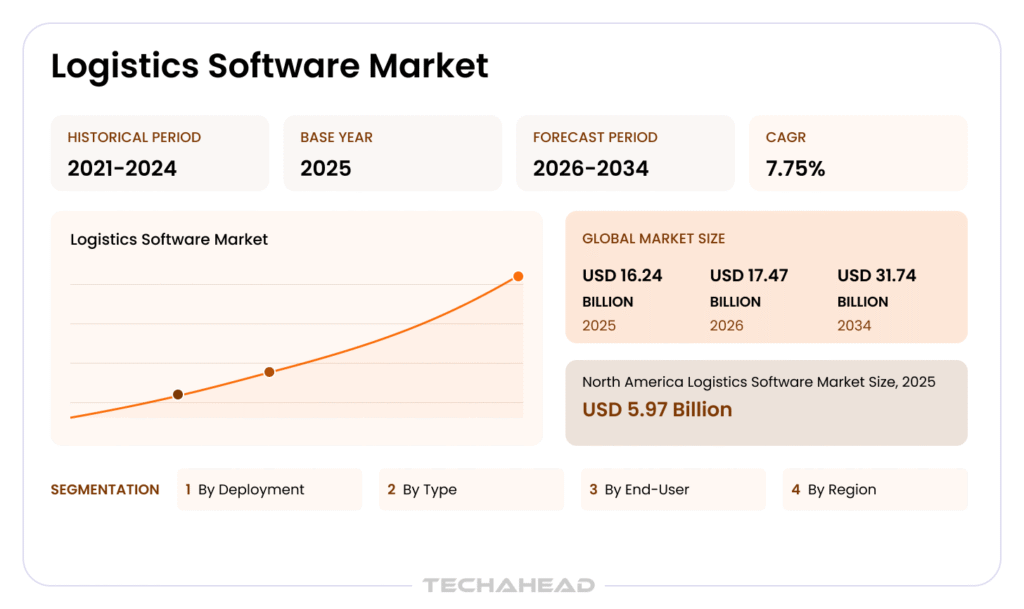
The global logistics software market is valued at about 2026 Market Size: USD 17.47 billion, and Fortune Business Insights expects it to reach $31.74 billion by 2034, growing at roughly 7.75% a year. If you’re searching for a development partner, that’s a crowded field to sort through.
A logistics app can do a lot more than track a delivery. It can tie drivers, dispatchers, warehouses, customers, and supply chain managers into one operational system. But getting it to work reliably at scale takes more than mobile development skills. The team also needs to understand fleet operations, real-time data, third-party integrations, security, and the daily headaches of moving goods.
Picking a development partner is a big business call. The right company can cut down on manual coordination, give you better shipment visibility, help with route optimization, and build software that keeps up as your operations grow.
If you’re trying to find that partner, this guide compares 10 logistics app development companies worth a look in 2026. You’ll see what each one offers, where it might fit, and how its technical capabilities stack up. You’ll also get a list of what to look for before you sign and what to define on your side before you talk to anyone.
This list mixes companies that publish logistics or transportation services with software engineering providers that could handle a complex logistics product. It’s an editorial shortlist, not a certified industry ranking. Check project experience and credentials yourself before you hire anyone.
Here’s what we looked at:
The best choice comes down to your requirements, budget, internal team, and how complex your logistics workflows are.
Which company fits depends on what you’re building: mainly a mobile app, a transportation platform, an enterprise integration project, or an AI-enabled logistics product.
| Company | Primary area to explore | Potential fit |
| TechAhead | Custom logistics apps and fleet mobility | Mobile-first logistics products |
| ScienceSoft | Transportation systems and enterprise IT | Complex operations and modernization |
| Intellias | Transportation technology and connected mobility | Large fleets and data-intensive platforms |
| ELEKS | Logistics software and operational data | Connected supply chain workflows |
| LeewayHertz | AI-enabled logistics software | Automation and predictive features |
| Chetu | Transportation and dispatch software | Fleet and transportation operations |
| Intellectsoft | Enterprise digital transformation | Broader business system modernization |
| Itransition | Custom enterprise software | Complex internal workflows |
| Simform | Cloud-native product engineering | Scalable digital platforms |
| Mind Studios | Mobile product development | User-focused logistics applications |
Treat this table as a starting point and still do your own complete verification. The first six companies publish clearly relevant transportation or logistics offerings. For the broader engineering providers, confirm their logistics experience before going further.
| Also read: Top 10 Mobile App Development Companies in USA (2026)
TechAhead is a software development company that builds digital products, mobile apps, and connected solutions. Its logistics app development services cover fleet management, driver management, order management, delivery management, resource allocation, and supply chain workflows.
Its published logistics portfolio also includes a platform for truck drivers, designed to help trucking businesses get more from the resources they already have. That makes TechAhead a good option if you want a mobile-first solution built around your operational requirements, not a generic off-the-shelf product.
Key capabilities
Best suited for: Businesses that want to build or modernize a custom logistics application, especially when driver and fleet workflows sit at the center of the product.
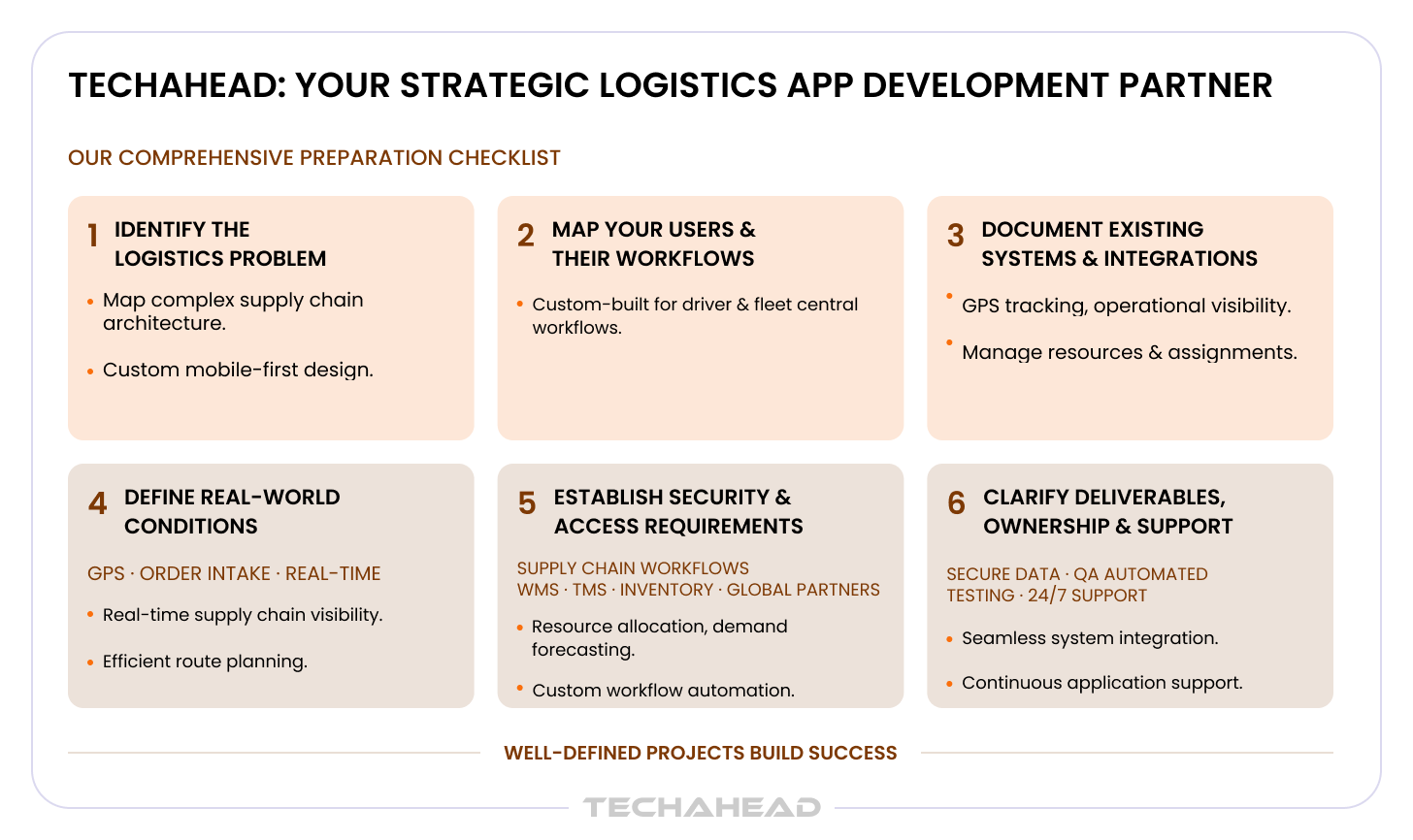
Why consider TechAhead: TechAhead is a logistics app development company with a dedicated service for it, and it describes a process that runs from requirements analysis and supply chain architecture through wireframing, development, testing, and launch. Its logistics page also carries a client testimonial from a trucking company, who talks about how well the team responded to their requirements.
Also Read: Top 10 On-Demand App Development Companies
| Must read: TechAhead’s trucking platform case study
ScienceSoft is an established software engineering and IT services company with its own transportation and logistics practice. Its published services cover logistics providers, freight forwarders, carriers, courier companies, digital logistics marketplaces, and enterprises that run transportation in-house.
The company works on transportation management, warehouse management, operational analytics, fleet-related solutions, and system implementation. It also offers consulting, testing, cybersecurity, support, and IT team augmentation.
If you’re dealing with complex business processes or established enterprise systems, that range can help when the project goes beyond a standalone mobile app.
Key capabilities
Best suited for: Enterprises and logistics service providers that need specialized software engineering, system integration, or a modernization of their existing operations.
ScienceSoft publishes examples of its transportation and logistics software work. Its transportation and logistics services page has the details.
Intellias works on transportation technology, mobility, and software engineering for complex connected systems. Its transportation services include fleet and freight management, location-based services, navigation, and solutions that use data to improve how transportation operations run.
For logistics companies, that expertise goes past putting vehicles on a map. A connected system can pull together location data, route information, asset status, and operational analytics, so dispatchers and fleet managers can see what’s happening across the whole network.
Intellias also describes work on real-time tracking, ETA estimation, route optimization, telematics, and predictive maintenance.
Key capabilities
Best suited for: Transportation providers, large fleet operators, and businesses building connected mobility or data-heavy logistics platforms.
You can find more on its transportation and logistics solutions page.
ELEKS offers software development for logistics operations, including transportation, delivery optimization, fleet management, vehicle tracking, warehousing, and telematics.
Its logistics practice focuses on linking front-end applications with back-end operational systems. That matters a lot when your information is scattered across separate tools for orders, inventory, carriers, dispatch, and delivery confirmation.
ELEKS also describes using GPS navigation, mobile reporting, operational analytics, and data-driven decision-making to support logistics workflows.
Key capabilities
Best suited for: Organizations that need tailored logistics software to connect their operational processes and make better use of transportation and supply chain data.
Its logistics software development services page is worth a read.
LeewayHertz provides custom software development and AI engineering services, and it has a dedicated logistics software offering. Its published capabilities include route optimization, real-time tracking, inventory management, order processing, warehouse management, and predictive analytics.
AI helps in logistics when it targets a specific operational problem. Historical order data plus current GPS information can improve route planning, for example, and forecasting models can back up inventory and demand decisions. How well it works depends on data quality, integration, and whether the recommendations fit how the business actually runs.
If intelligent automation is a big part of your product roadmap, LeewayHertz is worth evaluating.
Key capabilities
Best suited for: Businesses exploring AI-assisted logistics workflows, or building custom applications that mix conventional software with data-driven features.
Check its logistics software development page for the full list of services.
Chetu develops custom software for transportation operations, including fleet management, dispatching, traffic management, parking, public transportation, and supply chain management.
Its transportation services make sense for businesses that need software shaped around a specific operating model. A dispatch platform for a regional carrier, for instance, needs different scheduling, mapping, communication, and reporting features than a public transportation system does.
Chetu also describes solutions involving vehicle telematics, route optimization, GPS and GIS technologies, and transportation-related integrations.
Key capabilities
Best suited for: Transportation businesses that need customized dispatch, fleet, or operational management software.
Its transportation software services and supply chain management solutions pages have more detail.
Intellectsoft provides software engineering and digital transformation services for businesses that are building or modernizing digital platforms. Its broader engineering skills could be relevant for logistics companies with projects that touch several business systems, customer-facing apps, and enterprise workflows.
For a logistics project, the thing to find out is whether the proposed team has real experience with transportation-specific requirements, and not only general enterprise app development. Ask for examples involving dispatch, shipment visibility, warehouse operations, fleet management, or integration with logistics platforms.
Potential areas to evaluate
Best suited for: Businesses looking for a broader software engineering partner for a logistics modernization initiative.
Before you shortlist Intellectsoft, ask for relevant logistics case studies, technical references where available, and proof of integrations similar to yours. Its services page is the place to start.
Itransition provides software development and IT consulting across business applications and enterprise systems. Its wide engineering scope makes it a possible candidate for logistics organizations that need custom software, application modernization, or links between existing business platforms.
Logistics apps usually depend on several systems working together. An order created in one platform might need to trigger warehouse activity, update shipment status, notify a customer, and send financial data to an ERP system. A development partner has to understand those dependencies before it recommends an architecture.
Potential areas to evaluate
Best suited for: Companies with complex internal systems that need a software partner to evaluate and build connected business workflows.
This listing reflects Itransition’s broader software engineering capabilities. Before you treat it as a specialist option, confirm its current logistics-specific portfolio, relevant references, and the domain experience of the team it would assign to you.
Simform offers digital product engineering and cloud-related development services. Those skills can help when a logistics platform has to handle growing user numbers, frequent data updates, mobile access, and connections to several external services.
Take a shipment visibility platform. It might need to ingest location events from multiple carriers, process status changes, and show consistent information on web dashboards and mobile apps. Cloud architecture and solid data design make that possible, but the build still has to reflect your business’s specific logistics requirements.
Potential areas to evaluate
Best suited for: Businesses that put scalable product engineering and cloud architecture first for a logistics-related application.
Ask Simform for directly relevant logistics examples, including the scale of the systems it delivered and the integrations involved.
Mind Studios develops custom digital products, including mobile and web apps. For a logistics business launching a new product, its product development skills could matter where usability, workflow design, and a clear mobile experience are priorities.
Driver-facing and customer-facing logistics apps serve people with very different needs. Drivers may want fast status updates, navigation, proof-of-delivery capture, and an app that behaves reliably in areas with poor connectivity. Customers usually care more about shipment visibility, notifications, and delivery scheduling. Those differences should shape the product design from day one.
Potential areas to evaluate
Best suited for: Businesses exploring a new logistics product where user experience and mobile workflow design matter most.
Mind Studios is on the list as a broader product development option, and not as a confirmed logistics specialist. Before you shortlist it, check its experience with comparable logistics workflows and integrations.
A polished interface is only one piece of a good logistics app. The software has to hold up in real operating conditions, swap accurate information with other systems, and stay dependable as the business grows.
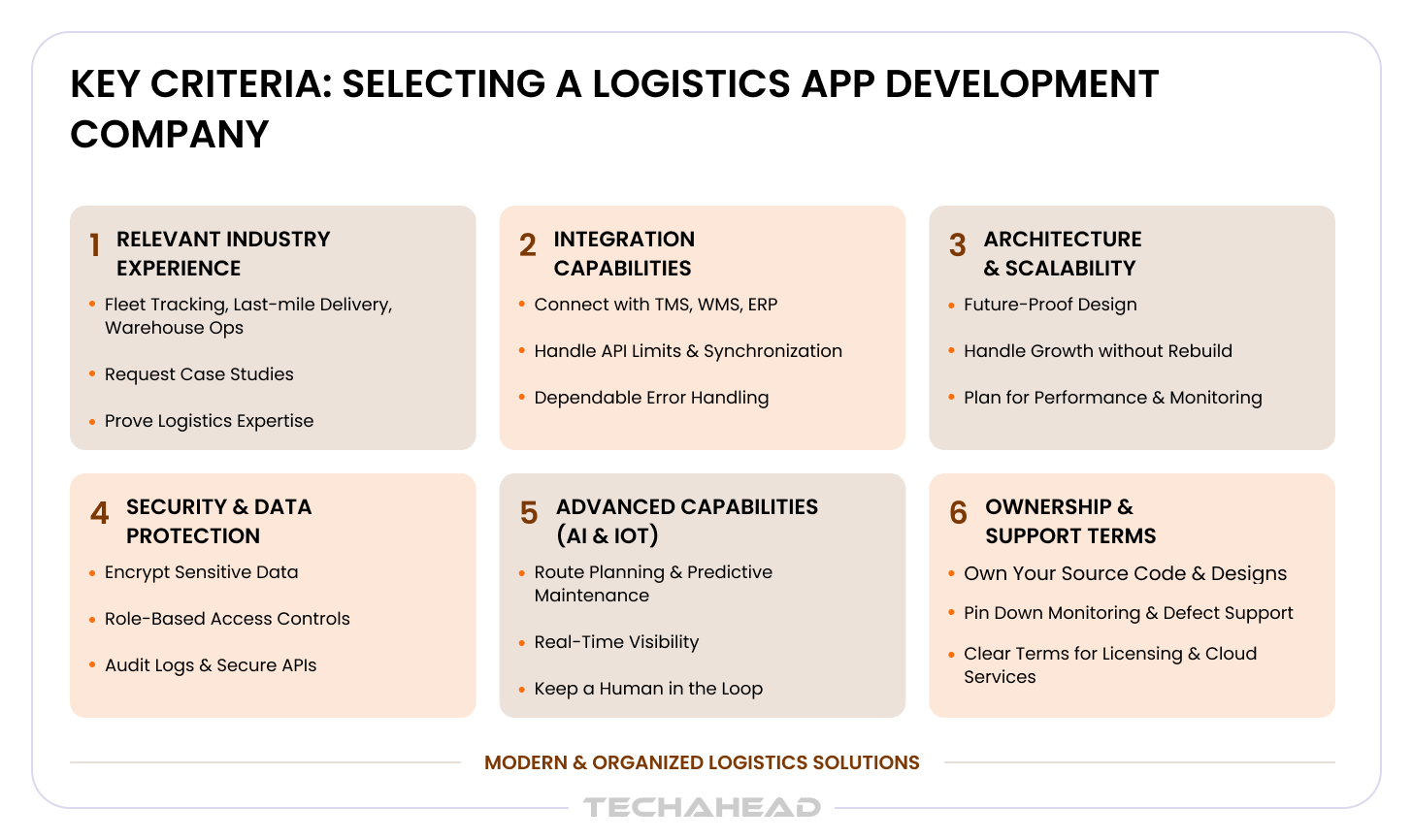
Ask whether the team has built apps for workflows like yours. Fleet tracking, last-mile delivery, freight management, warehouse operations, and logistics marketplaces each come with different requirements.
Request case studies that lay out the business problem, the solution they delivered, the systems involved, and the measurable result. A general mobile app portfolio doesn’t prove logistics expertise.
Your app may need to exchange data with a TMS, WMS, ERP, CRM, payment service, mapping provider, GPS device, or telematics platform.
Talk through integration methods, API limits, data synchronization, error handling, and what happens when an external system goes down. These details often decide whether the app improves your operations or just becomes one more disconnected source of information.
A logistics app might start with a small fleet and grow to cover multiple locations, carriers, and customer accounts. The architecture should handle that growth without forcing an expensive rebuild.
Ask how the team plans for performance, monitoring, background processing, data storage, and service availability. The right design depends on traffic, data volume, operational risks, and how fast you expect to grow.
Must read: Mobilize Your Business for Success: Top Mobile App Development Trends of 2026
Logistics platforms can hold customer details, delivery addresses, employee information, commercial records, and vehicle data.
Look at authentication, role-based access controls, encryption, audit logs, secure API design, backups, and incident response. If a vendor claims ISO 27001 or SOC 2 credentials, confirm the current certificate or report, what it covers, and which entity it applies to. A vendor’s general security statement doesn’t guarantee compliance for the app you end up with.
AI and IoT can help with route planning, demand forecasting, predictive maintenance, and shipment visibility. Those features need dependable data and a clear operational purpose, though.
Ask how the team will measure results, deal with inaccurate or delayed inputs, and keep a human in the loop when decisions affect costs, safety, or delivery commitments.
| Also read: Ethical AI in Mobile Technologies: Bridging Innovation with Responsibility
| Explore: TechAhead’s smart IoT logistics solutions
Before you sign a contract, get clear on who owns the source code, designs, documentation, and custom-built components. Check the terms for third-party libraries, cloud services, licensing, and handover.
Also pin down who monitors the app after launch, how defects get handled, which service levels apply, and how future changes will be priced.
Shortlisting a logistics app development company gets easier when you know what the app needs to do. A clear project brief helps vendors understand your operations, suggest a fitting technical approach, and estimate the work from real requirements instead of guesses.
Before you contact development partners, work through these eight areas.
Start with the operational issue behind the project. Are dispatchers spending too much time assigning drivers? Do customers have no shipment visibility? Are warehouse teams stuck with manual updates? Is delivery coordination split across disconnected systems?
Define the problem first. The features should come out of it.
List everyone who will use the app: drivers, dispatchers, fleet managers, warehouse staff, administrators, and customers.
For each group, outline the tasks they need to complete. A driver may need to accept assignments and upload proof of delivery, while a dispatcher may need to monitor shipments and reassign jobs. Mapping these workflows helps you avoid gaps in the initial product scope.
Split the essential launch features from the ones that can come later.
Depending on your business model, the initial scope might include:
Not every logistics app needs every feature. Prioritize the ones tied directly to your business goals.
Must read: Mobile App Unboxing: Uber Freight – Hassle-free load boards & freight shipping
Identify the software and devices your app has to work with. These might include a TMS, WMS, ERP, CRM, payment gateways, mapping services, GPS devices, and telematics platforms.
Write down what information needs to move between systems, how often it has to update, and which system should be the source of truth for each type of data. That gives development teams a better picture of how complex the integrations will be.
Logistics software has to work outside the office. Think about poor network coverage, delayed location updates, device limitations, changing delivery schedules, and unexpected route disruptions.
If drivers need to record information offline, spell out which actions must keep working without a connection and how the data should sync once connectivity comes back. Sorting this out early can save you from costly changes later.
Decide who can access shipment information, customer records, location data, and administrative controls. Identify any contractual, regulatory, or internal security requirements that apply to your business.
Ask prospective vendors how they’ll handle authentication, permissions, encryption, audit logs, backups, and incident response. Require evidence for any security certifications or compliance claims that matter to the project.
Decide how you’ll judge the app after launch. Depending on the problem you’re solving, useful measures might include:
Set a baseline before development starts. That way you can tell whether the app is actually improving the operation, instead of calling it a success just because the software launched.
Before you sign an agreement, confirm what the vendor will deliver at each stage, how scope changes will be handled, and who’s responsible for testing and deployment.
Also clarify source code ownership, documentation, third-party licenses, maintenance arrangements, issue resolution, and how the product gets handed over to an internal team or another provider.
The takeaway: A well-defined project brief lets you compare logistics app development companies on the same criteria. It also makes early conversations more productive, brings integration challenges to the surface, and gives both sides a clearer basis for planning the project.
TechAhead is worth a look when a business needs custom logistics software development shaped around its own operational workflows. Its published logistics offering covers fleet, driver, order, delivery, and resource management, plus supply chain app development, a documented development process, and a trucking-related case study.
The company also lists broader mobile, web, and IoT development capabilities. Those could matter if your logistics product needs connected devices, multiple interfaces, or integrations with existing business systems.
Before you pick TechAhead, or any development partner, talk through your requirements in detail. Ask for a proposed architecture, a phased delivery plan, relevant case studies, a security review, a clear cost breakdown, and written terms on source code ownership and post-launch support.
A strong partner should be able to explain what it can build and also why its proposed solution fits your operation.
Logistics software has to connect people, vehicles, orders, and business systems without making daily operations more complicated. Choosing the right partner starts with understanding your workflows, deciding which features matter most, and checking whether a company has the technical and industry experience to deliver them.
Compare vendors on evidence and ignore the promises. The best partner is the one that can show how its approach will meet your requirements, plug into your systems, protect your data, and support the product after launch.
A logistics app development company designs, builds, tests, and maintains software for transportation, fleet management, delivery operations, warehousing, and supply chain management. Its services may include custom mobile app development, GPS tracking, dispatch management, route optimization, shipment visibility, and integration with existing logistics systems.
Some companies to evaluate for logistics app development in 2026 include TechAhead, ScienceSoft, Intellias, ELEKS, LeewayHertz, Chetu, Intellectsoft, Itransition, Simform, and Mind Studios. Their specializations differ, so businesses should compare relevant logistics experience, technical capabilities, case studies, and integration requirements before choosing a development partner.
Logistics app development services can include custom logistics software development, fleet management app development, driver management, transportation management, delivery management, GPS tracking, route optimization, warehouse management, order management, supply chain software development, API integration, and ongoing application maintenance. The exact services depend on the company’s expertise and the project’s scope.
The features depend on the logistics business model, but common options include real-time GPS tracking, shipment status updates, driver assignment, dispatch management, route planning, delivery scheduling, proof of delivery, push notifications, fleet monitoring, and operational reporting. Enterprise applications may also require TMS, WMS, ERP, payment, and telematics integrations.
Start by defining your business problem, target users, essential features, existing systems, security requirements, and expected outcomes. Then evaluate potential partners based on logistics-specific case studies, mobile and cloud engineering capabilities, API integration experience, scalability, project delivery processes, source code ownership, and post-launch support. Request a technical proposal and references before making a decision.
Custom logistics app development allows businesses to build software around their specific operational workflows instead of relying entirely on standard features. A tailored application can connect drivers, dispatchers, customers, warehouses, and fleet managers while reducing manual coordination, improving shipment visibility, and supporting integration with existing business systems. The benefits depend on implementation quality and how well the application addresses the underlying operational challenges.
Yes. A logistics application can integrate with transportation management systems, warehouse management systems, enterprise resource planning platforms, CRM software, GPS services, payment gateways, and telematics systems when suitable APIs or other integration methods are available. The development team should define data flows, synchronization rules, error handling, security controls, and the source of truth for each data type before development begins.
The development timeline depends on the application’s complexity, number of user roles, required features, integrations, security requirements, and testing needs. A basic delivery tracking application will have different requirements from an enterprise logistics platform connecting fleets, warehouses, dispatch systems, and multiple third-party services. A development company should provide a realistic timeline after reviewing the project scope and technical dependencies.
We use cookies to ensure our website functions properly, improve performance, and provide a personalized experience. You can choose which types of cookies to allow below.
Required for core functionality such as security, network management, and accessibility. These cannot be disabled.
Help us understand site traffic and user interactions so we can improve performance and usability.
Enable enhanced functionality and personalization such as language or region preferences.
Used to deliver relevant ads, track campaign performance, and measure advertising effectiveness.