


 Copy Link
 Share on X
 Share on Facebook
 Share on LinkedIn

Always Active
Required for core functionality such as security, network management, and accessibility. These cannot be disabled.

Uncover the transformative potential of digital and mobile solutions for your industry.





 Last Updated: Oct 13, 2026
Oct 9, 2026
Last Updated: Oct 13, 2026
Oct 9, 2026  57
57  18 min. Read


Key Takeaways


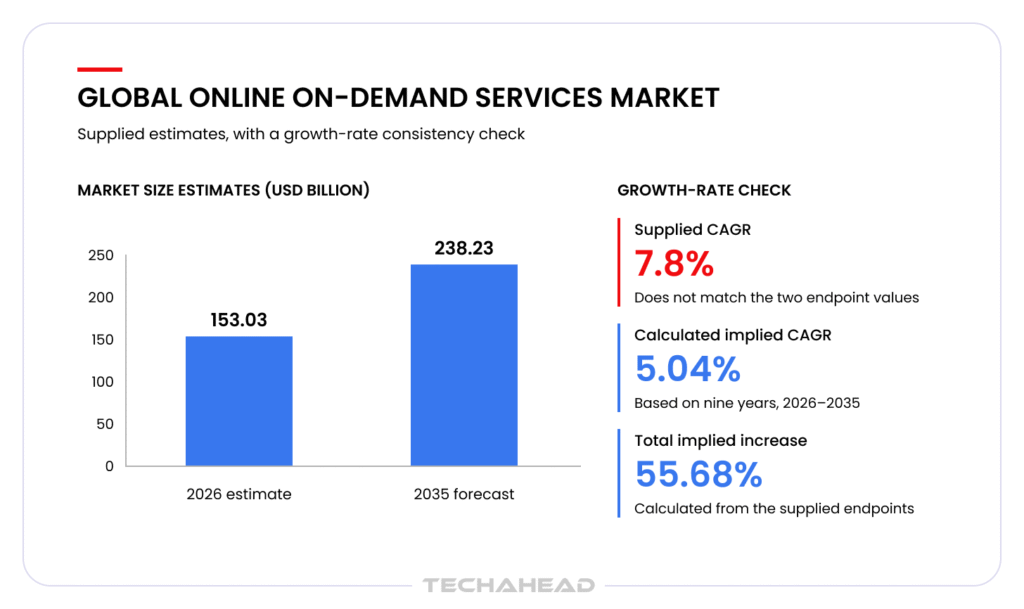
The on-demand economy continues to expand rapidly on a global basis. Industry predictions suggest rising smartphone penetration, digital transformation, and changing client preferences will boost the on-demand services market to 238.23 billion by 2035. With 96% internet penetration and more than 91% smartphone ownership among adults in 2025, the United States remains one of the largest contributors to the online on-demand services sector. About 58% of families booked house cleaning or repair services online, while 63% of millennials used on-demand transportation at least twice a week.
It simply takes a few taps to order dinner, book a cab, request same-day delivery, or schedule home maintenance. Customers rarely see the technology that handles requests, confirms availability, allocates service providers, processes payments, and keeps everyone informed.
For businesses, delivering that experience requires more than developing a mobile application. The platform must connect customers and service providers, handle transactions consistently, and give operations staff the visibility they need to keep things running.
That is why selecting the best on-demand app development company requires careful research.
An on-demand app development partner must understand the business driving the application. A supermarket delivery platform must handle inventories and replacements. A ride-hailing app requires driver allocation and location monitoring. A home-services marketplace must manage appointments, provider availability, cancellations, and client feedback.
These criteria influence the design, development timeframe, and long-term cost of the product.
If you’re looking to launch a new service platform or upgrade an existing one, this article highlights the top ten on-demand app development businesses to consider in 2027. You will get an overview of their skills, project types that they may be suitable for, and practical questions to ask before signing a development agreement.
| Company | Notable capabilities | Best suited for |
| TechAhead | Mobile engineering, backend systems, cloud integration, AI-enabled features | Custom applications with complex workflows |
| EmizenTech | Dedicated on-demand app development, booking, delivery, and tracking | Businesses building service-based platforms |
| MindInventory | Web and mobile application development | Startups and growing businesses |
| IndiaNIC | On-demand, mobility, and service platforms | Transportation and delivery applications |
| Hyperlink InfoSystem | Custom mobile app development across service categories | Businesses exploring different on-demand models |
| Konstant Infosolutions | End-to-end app development and maintenance | Businesses seeking a structured development process |
| TELUS Digital | Digital product strategy, design, and engineering | Established brands and complex digital products |
| ScienceSoft | Software engineering and systems integration | Integration-heavy applications |
| Fueled | Product strategy, UX, and mobile app development | Businesses prioritizing product experience |
| Blue Label Labs | Product discovery, design, and software development | Businesses validating and building digital products |
On-demand app development businesses are groups of specialists that have extensive experience developing applications that allow customers to access items or services instantaneously with real-time updates, such as food delivery and taxi booking apps. These organizations assist businesses in expanding their reach and consumer base by transforming their app ideas into reality. Their ultimate goal is to develop highly functional and efficient applications for businesses that improve operational efficiency and enable them to dominate the market.
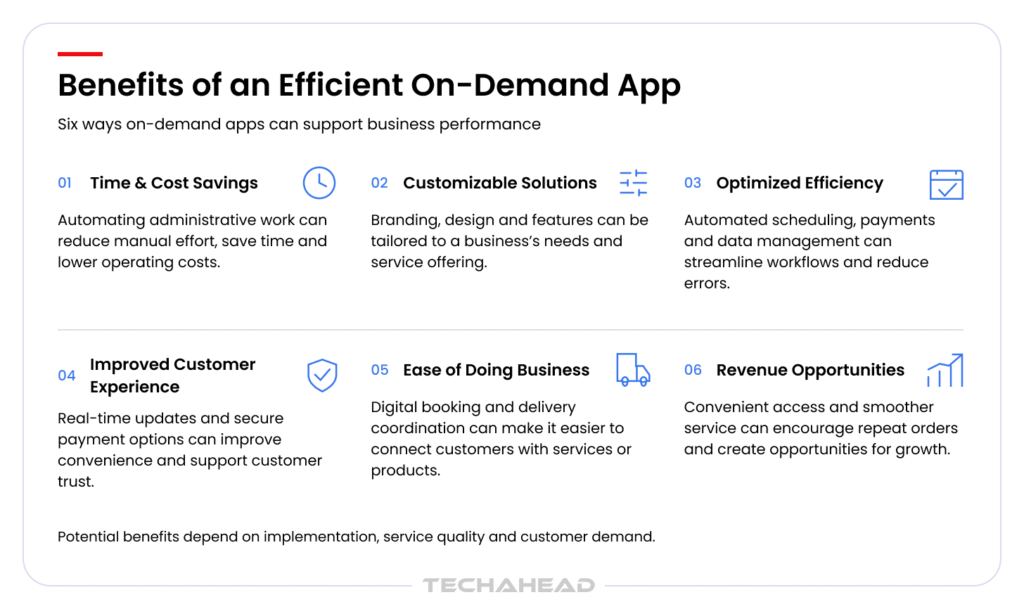
Today, several organizations claim to be the greatest on-demand app development companies. However, selecting a reputable business to provide disruptive on-demand app development services is critical for long-term success. Choosing the top organization with an established track record is one of the most difficult tasks.
Most on-demand platforms start small. A booking app might launch with a customer flow and a basic provider login. A year later, the business wants automated scheduling, payment reconciliation, a proper admin dashboard, and integration with its accounting software. TechAhead builds apps for businesses at that stage. Its mobile app development services cover native iOS and Android work, cross-platform builds with React Native and Flutter, and the backend and cloud pieces that keep everything running.
Their broader service list includes AI development and product engineering, which runs from discovery and UX/UI design through frontend and backend work, testing, and ongoing support. That range helps if the app will later need features like demand prediction or smarter customer support. You can see the full list of technologies they work with on their site.
Consider a home-services marketplace. Customers book appointments, providers manage their own calendars, and the admin team sees every booking, cancellation, and complaint in one place. Those are three different interfaces built on the same data. Keeping them in sync is the real job, and it’s the part to press any partner on.
Best suited for: Businesses that want a custom on-demand app and expect it to grow more complex over time.
Relevant reading: Mobile App Development: The Complete Guide
EmizenTech has a dedicated on-demand app development page on its website, and its industry list includes food delivery, grocery, car services, and logistics. The company says it has delivered more than 1,200 projects across 30-plus industries, and it has been in business since 2013. Its logistics page mentions real-time tracking and route planning, which matter for any delivery operation.
Delivery is a good test of a partner’s thinking. The customer places an order and follows it. The merchant accepts it. The driver needs the right pickup and drop-off details. The admin wants the whole picture. When one of those views falls behind, you get an order that looks finished to the customer but still open on the operations screen. Ask any team how they keep those views in sync, and pay attention to whether the answer is specific or vague.
Best suited for: Service marketplaces, delivery apps, and booking platforms where customers, providers, and admins all need to stay coordinated.
MindInventory develops web and mobile applications. If you have an idea but haven’t settled the details, its planning work is the part to focus on.
On-demand products raise a lot of questions early. Can customers book instantly, or do they pick a time slot? How do providers accept requests? What happens when nobody is free? Who approves refunds after a cancellation? The answers shape the data model and the backend, and changing them once development is underway gets expensive.
Ask MindInventory for examples of past work with similar booking or matching logic. Then find out how they test third-party integrations, handle deployment, and support the product once it’s live.
Best suited for: Startups and growing businesses that need help turning an idea into a defined product.
IndiaNIC works with clients in several countries. Its case study library lists a range of projects across industries, and its leadership has described the company’s early involvement in iPhone app development in interviews. Browse the case studies that match your category before you get on a call.
Location-based products need extra scrutiny. A taxi or delivery app has to match people with drivers, update trip status, calculate fares, and work with patchy GPS signals. These problems rarely show up in a demo. Ask IndiaNIC how its proposed system would handle a driver who goes offline mid-trip, a payment that fails after the ride ends, or a location reading that jumps across the map. The quality of their answers will tell you more than any portfolio page.
Best suited for: Transportation, delivery, and other services that depend on real-time location.
Hyperlink InfoSystem builds custom mobile apps for a variety of industries. The question to ask is whether the team designs around your workflow or hands you a standard set of features.
Two on-demand apps can look similar and still need very different things. A salon booking app needs staff schedules and appointment rules. A grocery delivery app needs live stock levels, substitutions, and delivery windows. A healthcare app adds privacy requirements and controlled access to sensitive records. Ask for examples in your category, get the scope in writing (including which integrations, testing, and support are covered), and confirm who maintains the app after launch.
Best suited for: Businesses exploring consumer-facing apps across several service categories.
Konstant Infosolutions provides mobile app development that moves through requirements gathering, design, development, testing, and maintenance. For an on-demand product, that kind of staged process helps keep the customer app, provider tools, backend, and admin functions planned together rather than built in isolation.
Think about a repair-booking platform. The customer describes the problem and picks a time. The technician updates availability and job status. The business assigns jobs and tracks payments and complaints. All three depend on the same records and the same business rules.
Best suited for: Businesses that want clear stages and a predictable process from planning through post-launch support.
WillowTree, a product strategy, design, and engineering firm, is now part of TELUS Digital. The combined group works on digital products for organizations that need web and mobile experiences connected to the rest of their business.
That background fits an on-demand app that has to plug into existing customer accounts, loyalty programs, payment systems, or support tools. Once you connect those systems, the hard problems multiply. Customer records have to match across platforms, transactions need a clear audit trail, and a status update should look the same in the app, in the confirmation email, and on the support agent’s screen.
If you’re an established brand, confirm that the team you meet will be the team doing the work. It’s also worth checking whether the engagement size suits a project that may start small.
Best suited for: Established brands building larger digital products that must connect to existing systems.
ScienceSoft offers custom software development, mobile app development, and IT consulting. It’s a reasonable name to add to your shortlist if your on-demand app has to work alongside systems you already run.
Imagine a field-service company. It likely has a CRM for customers, an ERP for billing, and scheduling software for technicians. A new app has to read and write to all three without creating duplicate records or leaving them out of step. Before any code is written, the team needs to map which system owns which data and how updates should move between them.
That work is less visible than the screens customers see, but it decides whether the app saves time or just adds another system to check. Ask ScienceSoft for integration projects similar to yours, and ask how they’d handle conflicting data, failed syncs, and future changes to the systems involved.
Best suited for: On-demand apps that need to connect with enterprise software and internal processes.
Fueled is a digital product agency that works on strategy, design, and app development. In an on-demand product, the experience often decides the outcome. People compare services quickly. They want to find what they need, understand the price, finish a booking, and get help if something goes wrong. Confusing forms, extra steps, and vague status messages send them to a competitor.
A good on-demand app makes the next step obvious without hiding important details. It also handles the awkward moments well: a provider who isn’t available, a card that gets declined, and a booking that has to be moved. Ask Fueled how its design decisions connect with technical limits, analytics, and changes after launch. Design that ignores feasibility usually comes back later as expensive rework.
Best suited for: Businesses where the app experience is a key reason customers will choose them.
Blue Label Labs offers product discovery, design, and custom software development. It suits founders who have a strong idea and a long feature list but haven’t decided what the first release should include.
A service marketplace might want subscriptions, loyalty points, personalized recommendations, several payment options, and a detailed analytics dashboard. Some of those will matter eventually. Building all of them into version one usually costs more and slows down the feedback you need from real customers.
Discovery narrows the list to the core problem, the smallest version that proves the idea works, and a roadmap for what comes next. Ask Blue Label Labs how they test assumptions, decide what goes into the first release, and estimate effort.
Best suited for: Businesses validating an idea before committing to a full build.
Selecting the right on-demand app development company is crucial to ensure the success of your app, as it involves finding a partner who can understand your vision, execute your ideas, and help you deliver a high-quality product. Here are some steps and considerations to help you make the right choice:
When selecting the best on-demand app development company, check its industry experience first. A company with more years of experience is likely to have a deeper understanding of industry challenges and demands. Their expertise enables them to fulfill complex client requirements while delivering high-quality products. Therefore, create a list of companies with a proven track record of success in building efficient apps and select the one that meets your business requirements while helping you lead in the competitive market.
Customer reviews accurately reflect how reliable the app development company is. Therefore, checking the company’s feedback on trusted platforms like Google, Clutch, and GoodFirms is always necessary. These platforms allow you to gauge the company’s client satisfaction rate, communication skills, and ability to meet deadlines. Positive reviews from satisfied clients demonstrate trustworthiness, while negative reviews indicate red flags. Hence, companies with consistently higher ratings should always be considered, as this shows their higher technical capabilities and work ethic.
Next, inquire whether the team has dedicated specialists like professional designers, developers, project managers, and quality assurance specialists helping you deeply customize the software, including API integrations or complex user interfaces.
Various companies have different pricing structures based on app features and their complexities. Consider your business budget and select solutions within its range, but never compromise quality for a lower price. Therefore, choose a reputable, reliable company with transparent pricing and detailed breakdowns, delivering robust, efficient, and scalable solutions worth your time and money.
The tech stack used in development defines an app’s success. Companies that stay relevant with the latest tech stacks and trends offer scalable, secure, and future-ready applications. Ensure that the on-demand app development company you choose utilizes new programming languages, frameworks, libraries, cloud-based solutions, and advanced technologies to help you tackle complex industry challenges and stay competitive.
Never forget to go through the company’s profile to understand its capabilities. Check its previous projects to evaluate their style, quality, and expertise. A well-curated portfolio includes successful projects, experience, and case studies, helping you identify whether the company is trustworthy for building customized, efficient, and robust on-demand applications.
Proper quality assurance ensures that the final product meets the desired quality, performance, and security standards. The right on-demand app development company includes a professional QA team that performs comprehensive testing to identify and mitigate bugs, usability issues, and performance glitches, ensuring a smoother user experience.
Proper support and maintenance are crucial to keep the application updated, secure, and functional. Hence, choose a company that provides comprehensive post-launch services such as software updates, system monitoring, and bug fixing while ensuring the app remains compatible with all devices for a smoother navigation experience.
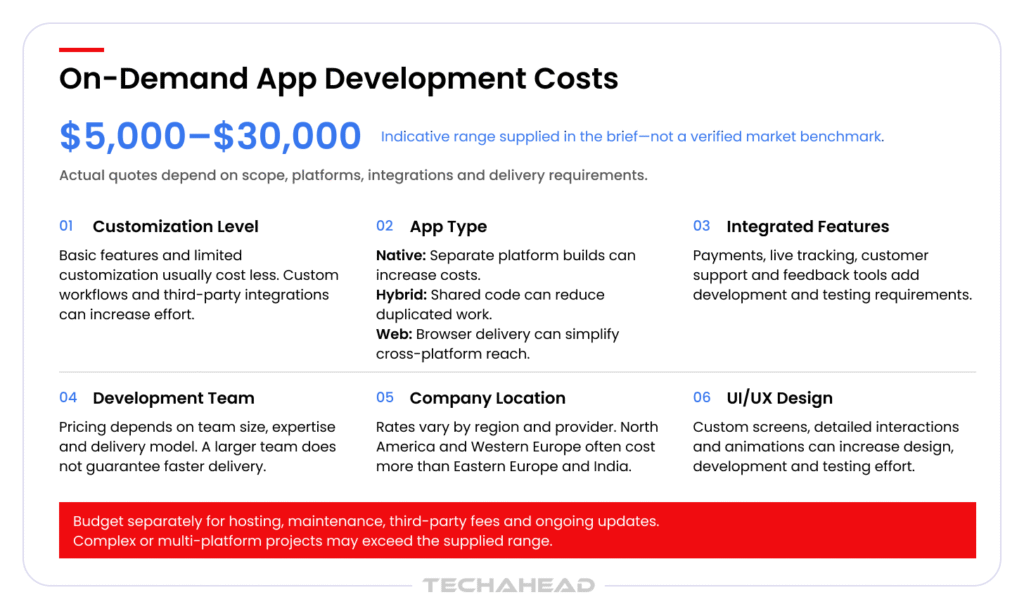
After reviewing the companies based on the above checklist, you should consider the criteria below for understanding the cost of on-demand app development.
Packing too many features into the first release. A crowded launch raises costs and makes it harder to tell which features matter. Start with the core booking and delivery flow, then expand based on what customers actually use.
Treating the customer app as the whole product. Provider tools, admin controls, support workflows, and backend integrations are what keep the business running every day.
Ignoring provider availability. If the system can’t accurately show who is free, where they work, and which jobs they can take, customers will end up with unreliable service.
Choosing a partner based only on price. A low quote may leave out integrations, proper testing, deployment, or maintenance. Ask every vendor to price the same written scope so you’re comparing like with like.
Putting analytics off until later. Without event tracking from day one, you won’t know why bookings fail or where customers give up. Those answers are hard to reconstruct after the fact.
Skipping post-launch planning. Once the app is live, it needs monitoring, security updates, bug fixes, and improvements. Decide who is responsible for that work before development begins.
Picking among on-demand app development companies is about more than comparing service lists or chasing the lowest quote. What matters is whether a team understands how your business delivers its service, manages providers, handles money, and holds up when demand spikes.
Before you commit, put together a clear project brief, shortlist companies with work similar to yours, ask each one for a proposal based on the same scope, and talk through architecture, security, ownership, and support. Those conversations will tell you more than any website.
If you’re planning a custom on-demand platform, review TechAhead’s mobile app development services to see how their mobile, backend, and cloud work could fit your plans.
An on-demand app development company designs and builds mobile or web platforms that connect customers with service providers in real time. Its work may include customer apps, provider apps, admin dashboards, booking systems, payment gateways, location tracking, backend infrastructure, and ongoing maintenance.
The cost of on-demand app development depends on the number of user interfaces, feature complexity, platform selection, integrations, security requirements, and maintenance needs. A basic booking app will typically require a different budget from a multi-vendor marketplace with live tracking, automated dispatch, and complex payment workflows. Request an estimate based on a clearly defined scope.
Core features include user registration, service discovery, booking or ordering, provider availability, payment processing, notifications, ratings, and an admin dashboard. Depending on the business model, the app may also need GPS tracking, automated provider matching, inventory management, cancellation rules, refunds, and analytics.
The development timeline depends on the scope, integrations, design requirements, and complexity of the booking or dispatch workflow. A focused minimum viable product (MVP) generally takes less time than a complete platform with separate customer and provider apps, administrative tools, and advanced automation. Ask development companies for a phased timeline with testing and launch milestones.
A single-service app typically manages bookings for one business or service provider. A multi-vendor marketplace must coordinate multiple providers, their availability, service areas, pricing, commissions, payments, and performance. This additional operational complexity affects the app architecture, admin functionality, and development cost.
These apps can combine location services, availability data, dispatch rules, and backend event processing to assign requests and update customers. The implementation should account for GPS inaccuracies, network interruptions, unavailable providers, cancelled jobs, and delayed status updates. The exact approach depends on the service model and operating requirements.
Compare companies based on relevant case studies, experience with your service model, technical architecture, API integration expertise, security practices, delivery process, and post-launch support. Ask how each team would handle provider availability, failed payments, cancellations, and increased demand. Compare proposals against the same project scope rather than choosing on price alone.
Yes, depending on the existing architecture, code quality, dependencies, and technical limitations. An assessment can identify whether the app can be improved through targeted feature development, backend optimization, API integration, or infrastructure upgrades. A full rebuild may be appropriate when fundamental architectural problems make ongoing maintenance or scaling impractical.
We use cookies to ensure our website functions properly, improve performance, and provide a personalized experience. You can choose which types of cookies to allow below.
Required for core functionality such as security, network management, and accessibility. These cannot be disabled.
Help us understand site traffic and user interactions so we can improve performance and usability.
Enable enhanced functionality and personalization such as language or region preferences.
Used to deliver relevant ads, track campaign performance, and measure advertising effectiveness.