


 Copy Link
 Share on X
 Share on Facebook
 Share on LinkedIn
Always Active
Required for core functionality such as security, network management, and accessibility. These cannot be disabled.

Uncover the transformative potential of digital and mobile solutions for your industry.



 Last Updated: Oct 30, 2026
Oct 24, 2026
 16
 17 min. Read


Key Takeaways


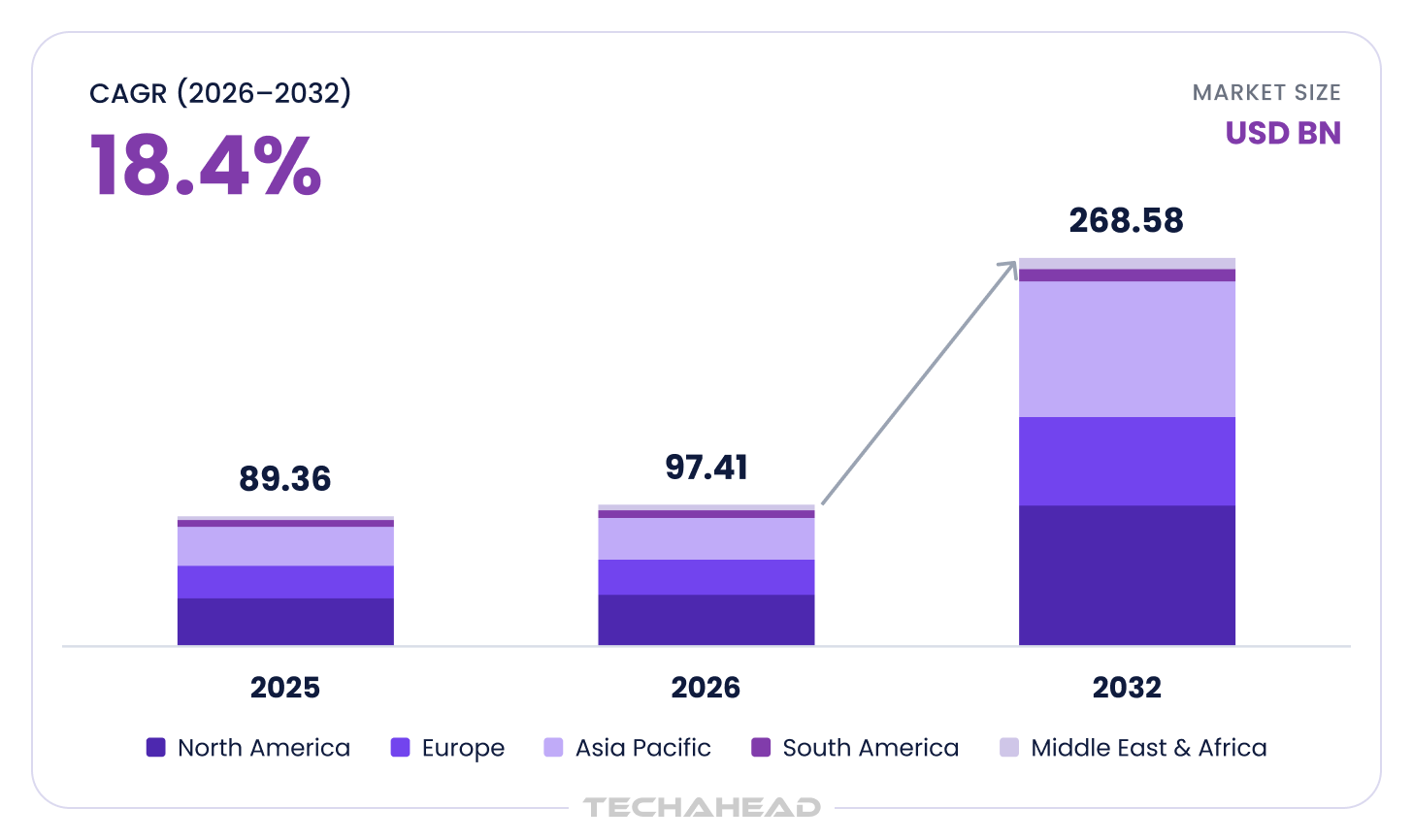
The global AR and VR market at about $97.4 billion in 2026, heading to roughly $268.6 billion by 2032, as put by MarketsandMarkets. Other research organizations come up with quite different totals since they count various items, so consider this an approximate figure. However, all estimates indicate that more money is being invested in immersive goods. Who creates it has a significant impact on whether or not people utilize it.
If you’ve attended a few vendor demos, you know how it works. The app looks fantastic on the presenter’s phone. Then it encounters a customer’s older Android, a poor signal in a warehouse, or a product catalog that no one intended to link it to. If you’re currently considering AR/VR partners, you generally want to avoid this gap.
Say a furniture brand wants customers to see how a sofa looks in their own living room. Or a plant manager wants a new hire to practice running a machine without stepping onto the factory floor. The first is AR; the second is VR. Both count as immersive technology, but the build behind each one is quite different. Augmented reality app development comes down to camera tracking, lighting, and getting a 3D object to stay put on a real floor. VR means headsets, motion comfort, and building a whole environment from nothing.
And that changes who you should hire.
Some teams need an Android app with a few AR features. Others want a VR training setup, a 3D product configurator, or something immersive plugged into enterprise software they already run. What fits depends on what you’re building, who’ll use it, and where it has to run.
We’ve pulled together 10 AR/VR app development companies so you can compare them side by side. For each one we looked at the wider technical capabilities, the immersive experience on record, and the kinds of projects you’d want to raise with them. It’s an editorial shortlist, not an audited ranking, so use it to shape your questions and still do your own checking.
If you only have a minute, this table gives the short version.
| Company | Area to investigate | Potential fit |
| TechAhead | Mobile and custom software engineering | Immersive products connected to wider digital platforms |
| Mobulous | AR/VR and mobile application development | Mobile-first immersive applications |
| SynapseIndia | Software engineering and AR-related development | AR features combined with custom software |
| Capermint Technologies | Immersive and interactive development | AR/VR experiences and interactive products |
| Tata Consultancy Services (TCS) | Enterprise technology and immersive innovation | Large enterprise programmes |
| Infosys | Digital engineering and enterprise solutions | Immersive experiences within broader enterprise systems |
| Accenture | Spatial computing and enterprise transformation | Complex, large-scale immersive initiatives |
| Cognizant | Digital engineering and enterprise technology | Immersive applications linked to business workflows |
| HCLTech | Engineering and digital transformation | Enterprise technology programmes |
| Fingent | Custom software and digital product development | Tailored software projects with integration needs |
Company capabilities, offices, and specific AR/VR experience should be verified before shortlisting. The best choice is the one that can demonstrate experience relevant to your application, not simply the one with the longest services page.
A practical way to use the table: read the middle column as a question, not a claim. “Mobile and custom software engineering” tells you where to dig. The call, the portfolio, and the proposal should tell you whether it holds up for AR/VR.
TechAhead works across mobile applications, custom software, cloud engineering, and digital product development, and it has a dedicated page for AR VR app development. That range helps when the immersive piece has to connect with user accounts, business data, APIs, or an app you already run.
Take a retail company planning an AR product visualizer. The 3D view is one piece; customers also browse a catalogue, save configurations, and head to checkout. An Android AR app development company should be able to show how the camera screen and those other parts get built together.
Its wearable practice also lists AR/VR work and smart eyewear apps. Ask which fits your case, since a phone-based AR feature and a headset-based VR build are separate projects. Settle that before you get into AR VR development services and scope.
Capabilities to discuss:
Best suited for: Businesses exploring immersive features as part of a larger digital product or connected software platform.
Must read: Mobile App Development: The Complete Guide (2026)
Mobulous offers AR/VR application development alongside mobile app development. Its public service offering makes it a relevant candidate for businesses exploring immersive experiences on phones and compatible headsets.
Mobile AR has its own failure points. Camera access, tracking, lighting, and device performance all change how an object sits in a room, and a prototype that behaves on one phone can wobble on another. You usually find out after the demo.
Ask Mobulous how it tests across hardware and which comparable projects it can show. Also settle whether you need mobile AR, a headset-based VR experience, or both. If it’s both, ask whether that’s one project or two, since the budget changes.
Capabilities to investigate:
Best suited for: Businesses looking for a mobile-focused development partner with an AR/VR offering.
Also read: Exploring Augmented Reality (AR) in Android App Development Projects
SynapseIndia provides software development, mobile engineering, and other technology services. Its published technology portfolio includes augmented reality-related capabilities, which makes it a company to look at for projects that combine AR functionality with conventional software.
Picture an AR app for a field technician that shows details about a piece of equipment. The camera and 3D layer are the visible part. Underneath, the technician has to log in, the app has to pull asset records, and a central system has to update when the job closes.
So the question for SynapseIndia is whether it can show AR work similar to your application and explain how the whole system would be built, not only the screen the technician sees.
Capabilities to investigate:
Best suited for: Businesses looking to combine AR features with custom applications and connected software systems.
Also read: Top 10 Software Development Companies for 2026
Capermint Technologies offers game and application development services, including AR/VR-related work. Its profile suggests a fit for projects that depend on interactive content, 3D environments, or engaging user experiences.
A flashy demo and a useful business application are different things. A training app needs interaction that reinforces what the trainee should learn. A product visualizer has to let people inspect and position the object so they can tell whether it fits the wall.
Ask Capermint for relevant examples and how it handles 3D content, interaction design, and device compatibility. Performance gets its own question: a detailed model that stutters on a mid-range phone loses people fast.
Capabilities to investigate:
Best suited for: Businesses evaluating immersive, interactive, or 3D-led digital products.
TCS is a global IT services company with a broad enterprise technology practice. Its digital innovation work makes it a potential option for organizations exploring immersive technology as part of a larger transformation initiative.
In a large enterprise, AR/VR usually has to work alongside business systems, data platforms, connected devices, or workforce applications. Someone has to own security review, procurement, rollout across sites, and training for the people who’ll use it.
TCS fits when AR/VR is one component of a broader programme. Ask for specific evidence: the immersive solution, how it was implemented, and the team’s experience in your industry.
Best suited for: Large organizations evaluating immersive technology within a wider digital transformation programme.
Infosys provides digital engineering, consulting, and enterprise technology services. Its innovation and digital experience initiatives make it another provider to look at for immersive projects that need to connect with wider enterprise systems.
Imagine a manufacturer building virtual training for staff across several sites. Every site needs the same scenarios, and the results have to reach learning or reporting systems. The plan also has to cover where the headsets are stored, who charges them, and what happens when a site has weak connectivity.
For Infosys, confirm the specific AR/VR capabilities, the proposed delivery team, and the comparable projects it can show for a rollout like that.
Best suited for: Enterprises considering immersive experiences as part of a larger technology or digital engineering engagement.
Accenture works across consulting, technology, and digital transformation. Its broader spatial computing and immersive technology initiatives make it a potential partner for complex enterprise projects.
Large immersive programs can involve 3D models of physical assets, operational data, training workflows, and connected systems that run across multiple sites. Each piece has its own owner inside the business, and these projects slow down when nobody coordinates them.
Accenture is one to look at when immersive technology sits inside a wider operational or transformation effort. Its scale may suit a complex program, so look closely at the scope, the team, and the commercial model.
Best suited for: Enterprises exploring immersive technology within broader digital transformation initiatives.
Cognizant provides technology consulting, software engineering, and digital transformation services. Its broader engineering capabilities make it a candidate for enterprise applications that include immersive functionality.
An AR/VR project gets harder when it depends on enterprise data, identity systems, reporting, or other operational software. Treat those dependencies as day-one work. Leaving integration for the last step before launch is a common way for schedules to slip.
Ask Cognizant for examples close to your use case, and find out whether the proposed team has hands-on experience with the platforms you need.
Best suited for: Organizations exploring connected applications and immersive features within existing enterprise systems.
HCLTech works across engineering, IT services, and digital transformation. Its broad technical practice makes it a provider to look at when an immersive application is part of a larger engineering or enterprise technology program.
Industrial applications bring their own demands. You might be tying digital information to physical equipment, building realistic training scenarios, or making an application behave the same way across a defined set of devices.
That takes a clear technical plan and realistic testing in the operating environment. Before shortlisting HCLTech, ask for a specific AR/VR portfolio example and for the delivery team’s experience with the relevant technology.
Best suited for: Enterprises evaluating immersive functionality alongside broader engineering and digital transformation requirements.
Also read: Top 10 Industrial IoT Platforms Modernizing Smart Manufacturing
Fingent provides custom software development and digital product engineering. It’s a candidate for businesses whose immersive application needs to connect with a broader software product or business workflow.
A custom application might manage user permissions, pull information from existing systems, offer a mobile interface, or support a defined operational process. Those requirements should be clear before anyone decides how AR or VR fits in.
Confirm Fingent’s current AR/VR portfolio, the relevant client work, and whether the right technical specialists are available before you decide.
Best suited for: Businesses exploring custom digital products that may include immersive features and software integrations.
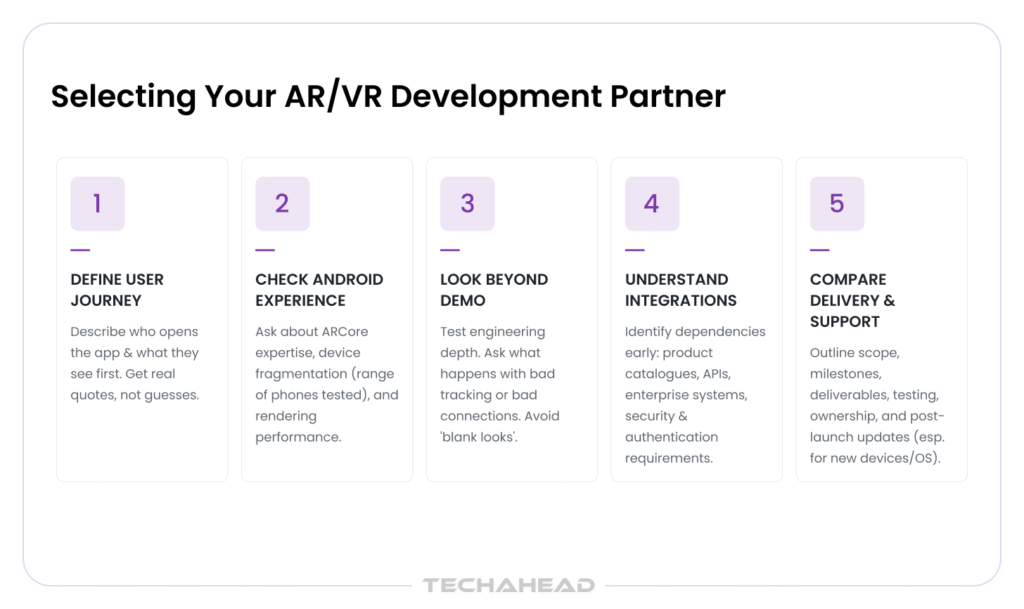
A company list can help you find potential providers. It can’t tell you which team will make the best technical decisions for your project. That takes a closer look at the proposed solution, and the five checks below are where we’d spend the time.
AR and VR solve different problems. AR adds digital information to a view of the real world, while VR places users inside a virtual environment.
If you’re planning an AR product visualizer, your priorities might be tracking, 3D rendering, camera interaction, and device compatibility. A VR training application is more likely to need realistic environments, spatial interaction, assessment, and headset support.
Write the user journey down before you talk to anyone. If you can describe who opens the app, what they see first, and what they do next, vendors can quote something real instead of guessing.
If Android is your primary platform, ask whether the team has worked with ARCore and understands which devices support it.
An Android AR app development company should be able to explain how it approaches tracking, environmental understanding, device compatibility, rendering performance, and testing. Ask to see working examples rather than relying on a list of technologies. Android AR development is also where the range of devices on the market causes surprises, so ask which phones the team tests on and how it picks them.
Clarify whether the project needs native Android development, cross-platform functionality, or a wider application that supports several platforms. For AR app development for Android, that choice affects both the budget and the team you need.
Must read: Step-by-Step Guide to Develop an Android App with Ease
Also read: iOS vs Android: Why Cloud Development Wins for Both Platforms
A polished prototype can make an idea look convincing. Production software has to deal with device limitations, user behaviour, connectivity, security, and maintenance.
Ask what happens when tracking is unreliable, when a device can’t support a feature, or when a connected service goes down. The answers will tell you more about the team’s engineering approach than a demonstration will. If the answer is a blank look, you’ve learned something useful.
An immersive application may need to connect to product catalogues, APIs, enterprise software, analytics, or user management systems. Identify those dependencies before development begins, because they tend to decide the timeline more than the 3D work does.
If the project involves sensitive business information, bring up authentication, authorization, data handling, and security requirements in the first architecture discussion, not in a review at the end.
Ask every shortlisted company to outline the project scope, milestones, deliverables, testing approach, ownership terms, and post-launch support. For AR Android app development services, ask whether new Android versions and devices are covered after launch.
If your business works across the United States and India, clarify communication arrangements, who makes which decisions, and how the team will handle time-zone differences.
A lower initial estimate isn’t automatically the better deal. If integrations, testing, or ongoing support are left out of the quote, you’ll be paying for them later, usually at a worse moment.
Must read: In House vs Outsourcing Software Development: Hardening an Application Built With AI
The value of an immersive application depends on the problem it solves. Here are a few areas where businesses are exploring these technologies.
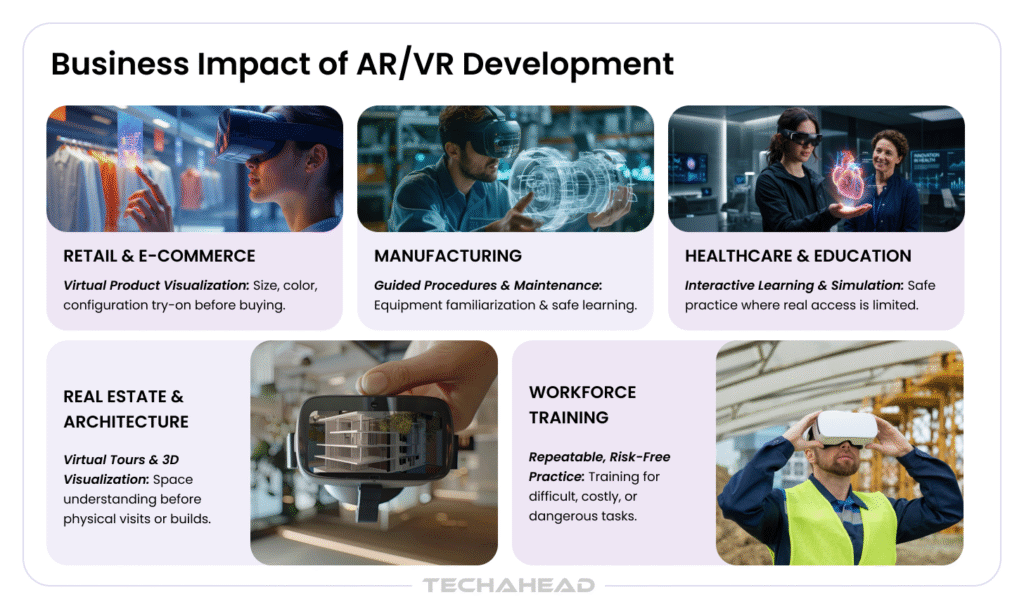
Retail and e-commerce: AR can help customers visualize products in their own surroundings, inspect details, or try different configurations before buying. For a shopper who’s unsure about size or colour, that’s often the missing piece.
Manufacturing: Immersive applications can support equipment familiarization, guided procedures, and certain maintenance workflows. New staff can learn the layout and the steps before they stand next to live equipment.
Healthcare and education: AR/VR can provide interactive learning environments and support selected training and simulation use cases, particularly where practice on the real thing is limited.
Real estate and architecture: Virtual tours and three-dimensional visualization help people understand a space before visiting it or before it’s built.
Workforce training: VR simulations offer repeatable practice for tasks that would be difficult, costly, or risky to reproduce in real life.
The strongest business case starts with a specific need. Immersive technology should make an existing task easier, safer, clearer, or more effective. If it only adds another screen, skip it.
Also read: TechAhead Is Reshaping the Travel and Tourism Industry With Augmented Reality
There’s no single AR/VR development company that’s right for every project. A team building mobile AR experiences may have a different skill set from one developing enterprise simulations or complex spatial applications.
Start by defining your intended experience, target devices, integrations, and business objectives. Then compare providers on relevant work, engineering expertise, delivery approach, and the support they can offer after launch.
If you want immersive features tied to mobile applications, backend services, or wider software systems, TechAhead is a reasonable AR VR development company to bring into the conversation. Confirm the exact AR/VR capabilities your project needs during the first discussion, and ask to see how similar work was handled.
Look for demonstrated AR/VR projects, experience with your target devices, 3D development expertise, software integration capabilities, and post-launch support. If you need an enterprise application, also assess security, scalability, and the team’s experience connecting immersive features with existing business systems.
AR/VR app development services can include product discovery, immersive UX design, 3D asset creation, application engineering, device integration, backend development, testing, deployment, and maintenance. The scope depends on whether you are building a mobile AR application, a VR simulation, or a cross-platform immersive product.
Evaluate the company’s Android development portfolio, experience with Google ARCore, device compatibility testing, 3D rendering capabilities, and integration expertise. Ask for examples of working applications and clarify which Android devices and operating-system versions the proposed solution will support.
Android AR applications may use Google ARCore for capabilities such as motion tracking and environmental understanding, alongside Android development frameworks and 3D engines such as Unity. The right technology stack depends on the required experience, device support, rendering complexity, and integration requirements.
The cost of custom AR/VR app development depends on the application’s complexity, 3D assets, target platforms, hardware requirements, backend integrations, and testing needs. A simple AR product preview typically has a different scope from a multi-user VR training simulation. Request a project estimate based on defined features and deliverables.
Development timelines vary according to the scope, target devices, content requirements, and technical integrations. A proof of concept can be simpler than a production-ready application that requires custom 3D assets, extensive device testing, backend services, and enterprise deployment.
Yes. AR/VR applications can integrate with APIs, databases, product catalogues, identity systems, analytics platforms, and enterprise software when supported by the relevant architecture. Integration requirements should be identified early to address data security, performance, and maintainability.
A development partner with established operations in both markets may offer closer coordination with US stakeholders alongside access to India-based engineering teams. Evaluate the actual delivery structure, overlapping working hours, project ownership, communication practices, and relevant AR/VR experience rather than relying on office locations alone.
We use cookies to ensure our website functions properly, improve performance, and provide a personalized experience. You can choose which types of cookies to allow below.
Required for core functionality such as security, network management, and accessibility. These cannot be disabled.
Help us understand site traffic and user interactions so we can improve performance and usability.
Enable enhanced functionality and personalization such as language or region preferences.
Used to deliver relevant ads, track campaign performance, and measure advertising effectiveness.