


 Copy Link
 Share on X
 Share on Facebook
 Share on LinkedIn
Always Active
Required for core functionality such as security, network management, and accessibility. These cannot be disabled.

Uncover the transformative potential of digital and mobile solutions for your industry.





 Last Updated: Oct 7, 2026
Sep 30, 2026
Last Updated: Oct 7, 2026
Sep 30, 2026  144
144  18 min. Read


Key Takeaways


MarketsandMarkets expects the industrial IoT platform market to grow from USD 12.55 billion in 2026 to USD 29.40 billion by 2032, a 12.8% compound annual growth rate. Nobody spends at that pace out of curiosity. Stoppages are expensive, and manufacturers know it.
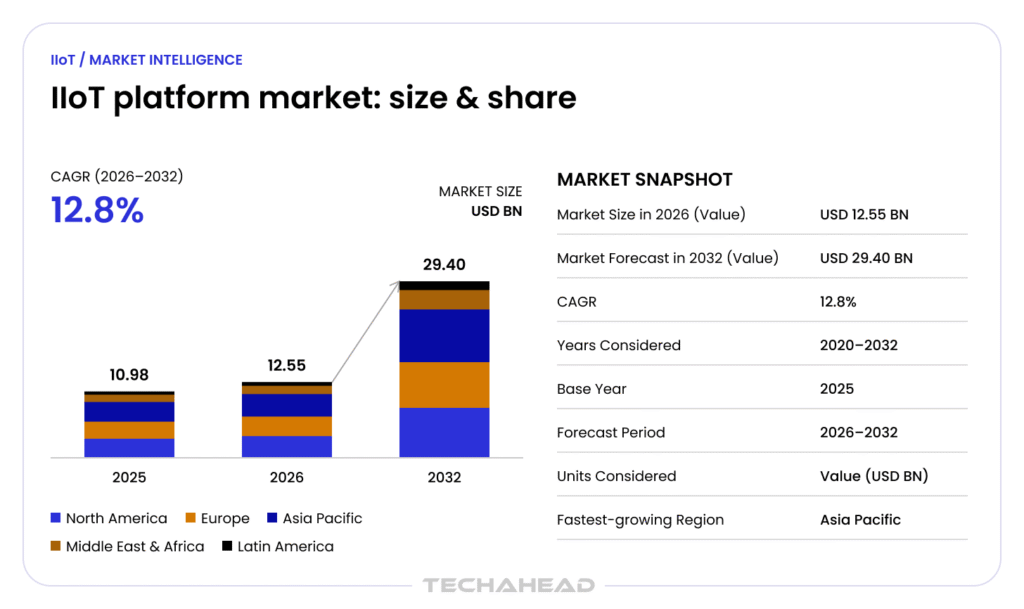
A Verdantis analysis built on Siemens and Aberdeen benchmarks puts unplanned downtime at more than $1.4 trillion a year for the world’s 500 largest companies. That’s roughly 11% of revenue, up from 8% in 2019, even though outages happen less often than they used to. In automotive plants, one hour offline can cost up to $2.3 million.
Numbers like these are why industrial IoT platforms have moved from pilot budgets to regular ones. Plants want machines that flag issues before they fail. They want data to reach the cloud without somebody retyping it. And they want edge systems that carry on when the network goes down. Lately, the focus has also shifted from logging data to acting on it at the machine, which is the idea behind edge IIoT and physical AI development services.
Buying the platform is the easy part. Most factories run controllers, drives, and sensors from a dozen vendors, some decades old, and someone has to connect it all. This guide covers ten IIoT platforms for smart manufacturing in 2026.
Must Read: How IoT Predictive Analytics Cuts Manufacturing Downtime
A smart manufacturing setup has four IIoT layers, and no single platform usually covers all of them.
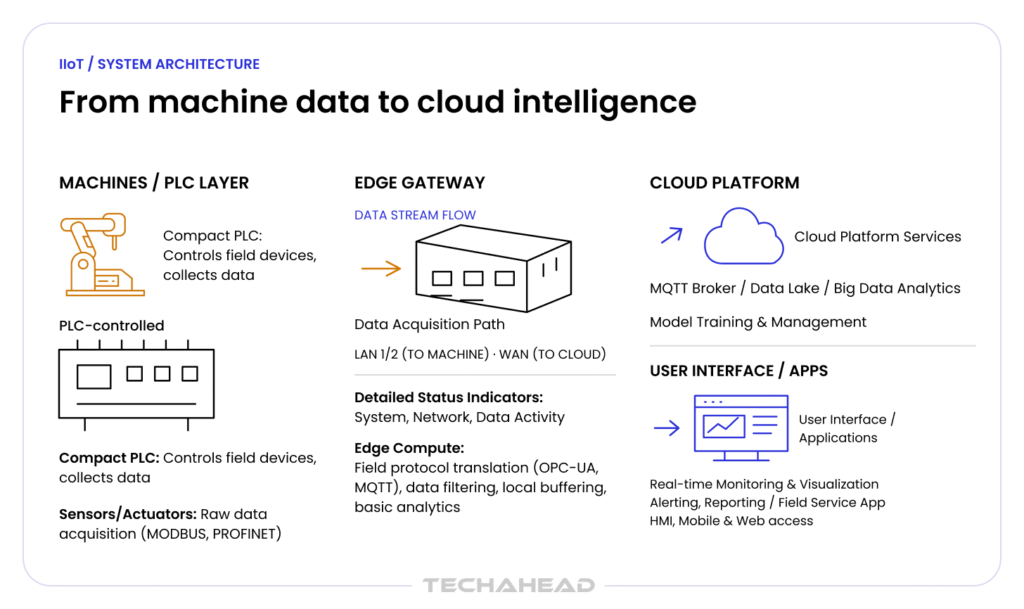
At the bottom are machines and their controllers, including PLCs, drives, CNC units, and sensors. Many use Modbus, OPC-UA, or a vendor-specific dialect. Above them is the edge, a gateway or industrial PC that interprets signals, filters noise, and executes time-sensitive logic locally, sometimes using edge AI models. The cloud layer then comes into play, storing history, doing analytics, and feeding reports. Operator screens, maintenance apps, and management dashboards are at the top of the list of programs that people interact with.
Also Read: The Rise of Edge AI in Manufacturing: Enterprise Trends for 2026
Off-the-shelf software handles the cloud layer admirably. It becomes thin in the gaps between layers: the hardware bridge to a 15-year-old controller, the edge pipeline that must operate offline, and the interface that a line operator may use while wearing gloves. That’s why selecting a platform based only on its feature list often disappoints when it meets a real production floor.
Four things are worth checking before you shortlist anything in 2026:
Also Read: Edge Computing Meets the Cloud
| Rank | Platform | Primary Focus | Ideal Use Case |
| 1 | TechAhead | Custom IIoT and smart manufacturing engineering | Custom edge gateways, legacy PLC integration, bespoke apps |
| 2 | Inductive Automation | SCADA and industrial data platform | Mixed-vendor machine fleets |
| 3 | AWS IoT | Cloud infrastructure and edge analytics | Multi-site data lakes, serverless edge processing |
| 4 | Microsoft Azure IoT | Enterprise analytics and digital twins | Plants already invested in the Microsoft stack |
| 5 | Proficy (formerly GE Vernova) | Process manufacturing and plant historian | Continuous production, regulated industries |
| 6 | Rockwell Automation FactoryTalk | Industrial automation and SCADA | Allen-Bradley and Rockwell PLC plants |
| 7 | Litmus Edge | Multi-protocol edge data normalization | Vendor-neutral OT/IT bridging |
| 8 | Samsara | Connected operations and telematics | Equipment, yard, and logistics visibility |
| 9 | Particle | Embedded IoT hardware and device cloud | Manufacturers building connected machines |
| 10 | Tulip | Frontline operations | No-code operator apps and digital work instructions |
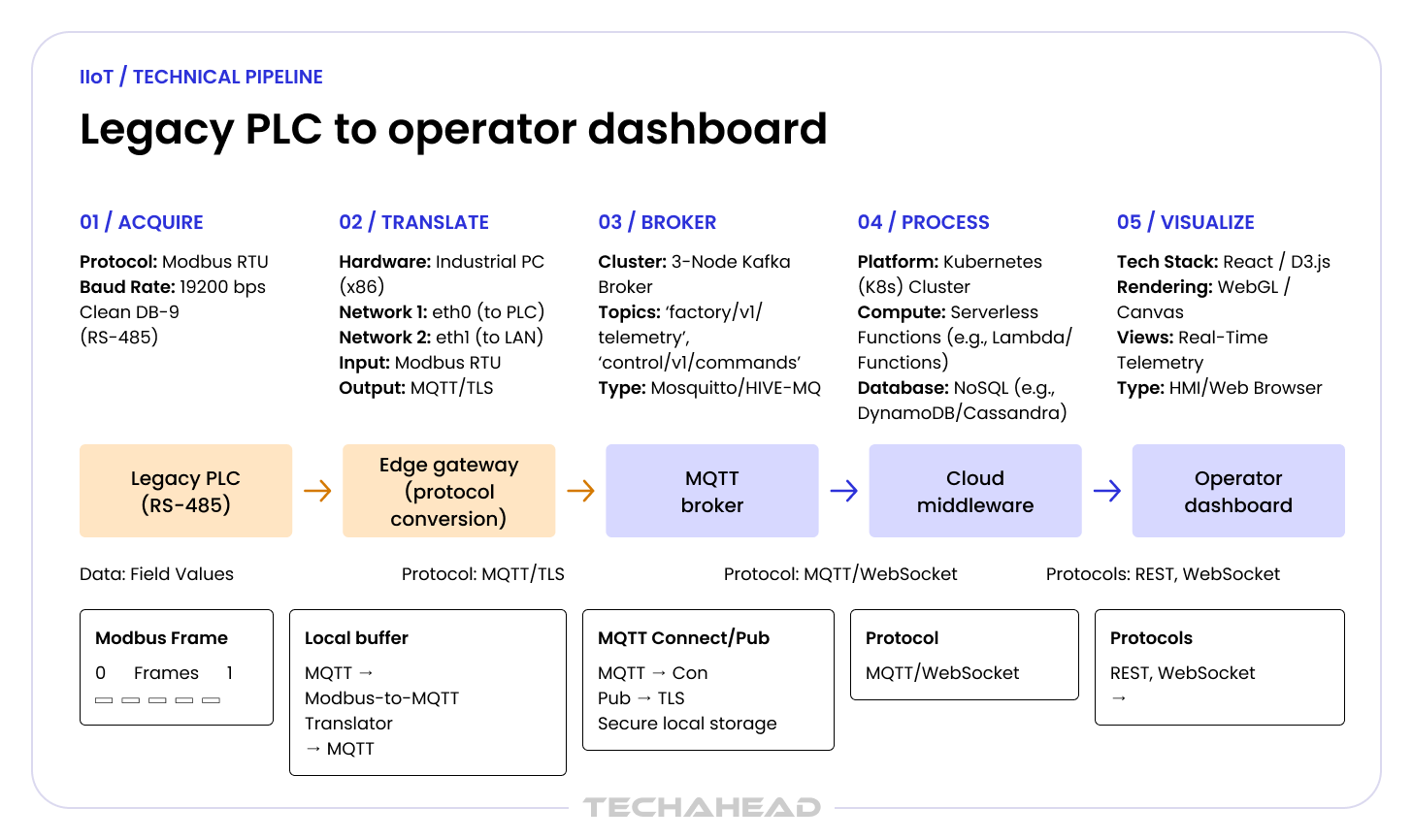
Evaluating controllers, protocols, and network architecture is the first step in an engagement. The architecture is as follows: how gateways connect to PLCs, where logic runs at the edge, and how telemetry is sent to the cloud. Industrial gateways connect legacy equipment, and specialist industrial IoT development services include everything from sensor selection and hardware consulting to customized software, on-premises or cloud installation, and ongoing maintenance.
Additionally, TechAhead offers smart industrial services, including condition-based maintenance and machine monitoring. As a software provider, it develops industrial manufacturing apps, including MES and factory automation tools, and integrates them with existing SCADA and ERP systems.
TechAhead lists SOC 2 Type II, ISO/IEC 27001, and AWS Advanced Tier Partner credentials among its certifications and partnerships. Outside of the facility, it designed a building intelligence platform for JLL that handles IoT sensor data, and TechAhead reports a projected 30% reduction in equipment downtime.
Best for: Enterprise manufacturers with proprietary or legacy equipment that need a more tailored IIoT architecture.
Key services: IIoT hardware consulting and implementation, custom IIoT solution development, legacy equipment integration, smart factory development, condition-based monitoring, industrial data analytics, on-premises and cloud deployment, and ongoing support.
Inductive Automation’s Ignition platform starts from a different place than most on this list. It is one server application, and you add what you need through modules. The OPC UA module ships with drivers for Allen-Bradley, Siemens, Modbus, and other controllers, so a single install can talk to machines from several vendors at once. Tags go into a built-in historian that writes to a standard SQL database, keeping your history somewhere your team can query.
Two modules sit on top of that. Vision and Perspective build the operator screens, and Perspective runs in a browser, so a maintenance lead can check an alarm from a tablet on the floor instead of at a desk. Python scripting covers the logic no vendor planned for, and MQTT modules push data out to cloud platforms. Ignition Edge is a lighter version for small, machine-side installs. Licensing is per server rather than per tag, which helps keep costs predictable as you add machines. The platform is strongest at SCADA and visualization, so heavy analytics or machine learning usually means pairing it with a separate data platform.
Best for: Plants with machines from many vendors that need protocol connectivity, SCADA, and a base for custom dashboards or mobile worker apps.
Key services: OPC UA connectivity and device drivers, built-in tag historian, Vision and Perspective visualization, Python scripting, MQTT modules, and Ignition Edge.
SiteWise categorizes plant data into asset models and hierarchies, including press, line, and site. It transforms incoming data and computes metrics. SiteWise Edge employs the same logic on a local gateway, with an OPC UA collector that gets tags from the shop floor. It is surrounded by green grass. It operates components and distributes containers and components. Its stream management locally buffers data and exports it when the connection is reestablished.
Because of this, the stack is well suited for fleet-wide predictive maintenance models learned in the cloud and run at the edge. Equipment using unsupported or proprietary protocols may require additional gateways, partner integrations, or custom connectivity work.
Best for: Multi-facility enterprises building centralized industrial data lakes and running edge inference on site.
Key services: AWS IoT SiteWise asset modeling, SiteWise Edge gateway, AWS IoT Greengrass edge runtime, and offline buffering with Stream Manager.
Also Read: How AI + IoT + Cloud Convergence Is Driving the Next Wave of Digital Transformation
Azure IoT Operations is Kubernetes-native. It runs on a site-enabled Azure Arc cluster and includes an MQTT broker, an OPC UA connection, and data flows to route and transform messages. It then sends data to Microsoft Fabric or Event Hubs and feeds it into Power BI and machine learning pipelines. Azure Digital Twins handles the modeling. Entities are described in DTDL and connected to form a queryable graph of a facility’s lines and equipment.
The architecture can require more operational expertise than a lightweight edge deployment, particularly when Kubernetes and Azure Arc are involved. Running Kubernetes at the edge requires someone to manage cluster operations, and integrating the edge, Fabric, and current ERP is seldom a weekend project. Organizations without in-house Azure expertise frequently hire Microsoft Azure consultants to create the stack before committing.
Best for: Enterprises already on the Microsoft cloud stack that want digital twins, predictive modeling, and Power BI reporting.
Key services: Azure IoT Operations (MQTT broker, OPC UA connector, data flows), Azure Digital Twins, Microsoft Fabric, and Power BI reporting.
Proficy is a stack, not a single product. iFIX and CIMPLICITY both support HMI/SCADA. The Proficy Historian saves time-series tag data collected from OPC servers and other sources. Plant Applications manages industrial operations, such as production and batch tracking. When auditors inquire about a line’s activities during a specific period, regulated plants rely on the historian and its records.
Ownership also changed this year. In March 2026, GE Vernova sold Proficy to TPG for $600 million, and the company now runs independently with over 20,000 clients. Deployment requires a larger commitment than a lightweight monitoring tool, so plan carefully.
Best for: Process manufacturers in pharmaceuticals, energy, and chemicals with strict tracking and regulatory demands.
Key services: iFIX and CIMPLICITY HMI/SCADA, Proficy Historian, Plant Applications MES, and industrial data analytics.
The communication layer is FactoryTalk Linx. It supports Logix 5000 and PlantPAx controllers over EtherNet/IP. The Linx Gateway then exposes controller data to outside applications as an OPC UA server, supports traditional OPC DA, and serves as the typical gateway to third-party systems. Higher up, FactoryTalk Historian SE is based on the PI System core, while FactoryTalk Optix addresses HMI.
Using Rockwell controllers and software together can simplify integration, diagnostics, and tag access compared with a more mixed environment. The drawback is that this advantage diminishes quickly in mixed plants. Other vendors’ equipment needs its own bridge before enterprise systems may access it.
Best for: Facilities built mainly on Allen-Bradley hardware and Rockwell PLCs.
Key services: FactoryTalk Linx and Linx Gateway (OPC UA), FactoryTalk Historian SE, FactoryTalk Optix HMI, and supervisory control and condition monitoring.
Litmus Edge operates on industrial PCs, virtual machines, or appliances located close to the machinery. Its connections read controllers using protocols including OPC UA, Modbus, and EtherNet/IP. It then standardizes the data into a consistent model, processes it in local flows, and broadcasts it northbound, usually over MQTT. The firm offers over 250 out-of-the-box connections, reducing custom driver development that can take weeks on brownfield projects. Litmus Edge Manager manages fleet-level deployment across several locations.
Tulip’s documentation shows Litmus Edge as a supported OT gateway, and Litmus published an Azure IoT Operations bridge in April 2026. It is a data layer rather than an application platform; therefore, dashboards and processes must originate elsewhere.
Best for: Factories with diverse legacy machinery that need a vendor-neutral OT/IT data translation layer.
Key services: Litmus Edge data collection, normalization, and local analytics; Litmus Edge Manager for multi-site fleets; 250+ connectors; MQTT and cloud publishing.
The architecture puts hardware first. Samsara puts gateways and sensors on cars, trailers, and equipment, sending data to the cloud via cellular. The data is provided via a REST API and webhooks, allowing it to feed into your existing logistics and maintenance systems. Asset location, environmental observations, and equipment health are all captured in a single data model.
That makes it a perimeter tool for yards, fleets, and mobile equipment, and it does not read PLC tags on the line. Pair it with an edge layer if you need both.
Best for: Manufacturers managing plants, warehouse yards, and distribution fleets together.
Key services: Asset tracking, site logistics, environmental monitoring, equipment health monitoring, REST API, and webhooks.
Particle is designed around its own firmware. The device OS operates on Particle’s cellular and Wi-Fi modules, while the device cloud offers functions, variables, and events. Webhooks let you forward events to your own backend. Over-the-air upgrades deliver new firmware to fleets in the field, which can cause problems later if you don’t plan early.
The target is a manufacturer shipping connected products. A plant retrofitting machines it already owns will find the hardware model awkward.
Best for: Industrial OEMs building connected products, smart machinery, or specialized field-deployed hardware.
Key services: Cellular and Wi-Fi IoT modules, Device OS firmware, device cloud (functions, variables, events, webhooks), and over-the-air updates.
Tulip defines equipment as machines with attributes that change via OPC UA connections, MQTT connectors, or the API. A connector host, whether cloud or on-premises, proxies traffic to your OPC UA server or MQTT broker. Tulip sells Edge IO and Edge MC devices as station hardware. These read digital inputs directly into app triggers and can execute Node-RED processes. Apps are created in a no-code editor, so quality checks and work instructions exist alongside the machine signal that initiates them.
Tulip leans on an OT gateway for broad protocol coverage, and its docs point to tools like KEPServerEX or Litmus Edge for that role. Plan the gateway at the same time as the apps.
Best for: Assembly operations that rely on manual workflows and need step-by-step guidance, quality logging, and operator tracking.
Key services: No-code operator apps, machine monitoring via OPC UA and MQTT connectors, Edge IO and Edge MC devices, digital work instructions, and quality logging.
A ranked list only gets you so far. The better question is which IIoT platform fits your plant. Work through these five checks in order.
Here’s a quick way to shortlist:
| If your plant… | Start by looking at |
| Runs mostly Allen-Bradley PLCs | Rockwell FactoryTalk |
| Has machines from many vendors | Inductive Automation or Litmus Edge |
| Needs multi-site cloud analytics | AWS IoT or Azure IoT |
| Is a regulated process plant | Proficy |
| Relies on manual assembly work | Tulip |
| Has proprietary or offline equipment; no product can read | Custom engineering with TechAhead |
Two mistakes show up again and again. The first is buying a platform before auditing the equipment, which turns a software purchase into a surprise integration project. The second is treating the pilot as the finish line. A pilot proves the technology works once. It says little about whether it will work across ten lines and three plants.
Also Read: IoT App Development Cost: What Enterprises Pay in 2026
On this list, platforms two through 10 effectively fulfill their intended purposes. None of them were made especially for your plant. Homegrown workflows, offline edge needs, and proprietary machines all demand additional support. Projects stall after the pilot when that something is absent.
The data shows the pattern. A Kaufman Rossin survey of U.S. mid-market manufacturers found 73% still stuck in the AI pilot phase. Siloed data and legacy systems were named as the main blockers. A pilot can get by on hand-cleaned data. Production can’t.
Imagine a 20-year-old press controller on a stamping line that can only communicate via a proprietary serial interface. It cannot be read by a cloud platform, and a protocol translator may only be able to partially handle it. The plant requires a mobile screen so the maintenance lead can view the alarm on the floor rather than at a desk, middleware that cleans and sends the signal, and a tiny edge gateway designed specifically for that controller.
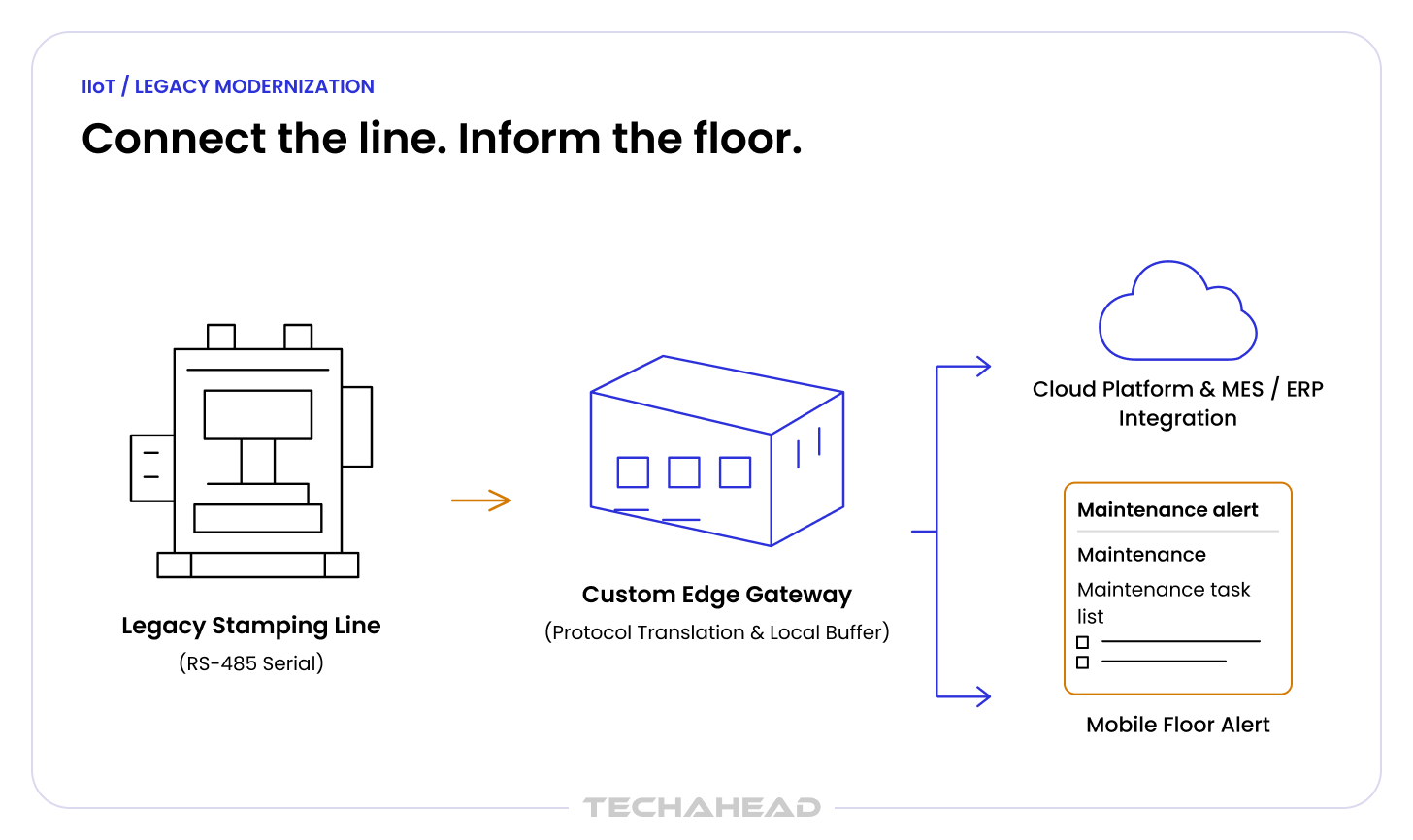
Custom engineering is justified in that combination. TechAhead develops IoT platforms, and as a more comprehensive customized software development partner, it can integrate the outcome with the plant’s current ERP and MES systems. That connecting layer determines whether the platform you choose truly functions.
Must Read: Physical AI in Manufacturing: Safely Connecting AI to Real-World Systems
Timelines are delayed because integration work is necessary for even the best industrial IoT systems. Budget early and choose the platform that best fits your current stack, people, and machines. If you do that right, smart manufacturing won’t just be a strategy presentation slide. When things go wrong, it shows up as fewer unplanned stops and faster fixes.
Connecting old plant equipment, deploying edge AI, and building interfaces operators will actually use takes real technical execution. The software engineering teams at TechAhead offer enterprise-grade, scalable industrial solutions that are customized to meet your unique operational needs. Schedule a consultation, show an engineer your equipment and limitations, and see how a custom build may perform on your first site.
Industrial IoT platforms are software and technology systems that connect industrial machines, sensors, controllers, edge devices, and enterprise applications to collect, process, analyze, and act on manufacturing data.
This guide covers leading industrial IoT platforms and solutions, including TechAhead, Inductive Automation, AWS IoT, Microsoft Azure IoT, Proficy, Rockwell FactoryTalk, Litmus Edge, Samsara, Particle, and Tulip. The right choice depends on your equipment manufacturer, protocols, cloud environment, and operational requirements. The right choice depends on your equipment manufacturer, protocols, cloud environment, and operational requirements.
Start by auditing your machines and communication protocols. Then evaluate edge-processing needs, compatibility with your existing technology stack, security, integration requirements, scalability, and total implementation cost.
IoT broadly connects physical devices to digital systems, while Industrial IoT (IIoT) focuses specifically on industrial environments such as factories, production lines, warehouses, energy facilities, and other operational technology environments.
Edge computing processes data closer to the machines generating it. This reduces latency and allows time-sensitive manufacturing operations to continue locally even when cloud connectivity is unavailable.
Yes. However, legacy machines may require industrial gateways, protocol converters, middleware, or custom software to connect them with modern IIoT platforms. Assess equipment compatibility before selecting a platform.
An IIoT platform provides prebuilt capabilities for connectivity, data collection, analytics, and applications. A custom IIoT solution is engineered around a manufacturer’s specific equipment, workflows, protocols, integrations, and operational requirements.
The cost depends on factors such as the number and age of machines, communication protocols, gateway hardware, cloud infrastructure, integrations, analytics requirements, cybersecurity, and the number of facilities involved. Manufacturers should evaluate total implementation and ownership cost, not just the software license.
We use cookies to ensure our website functions properly, improve performance, and provide a personalized experience. You can choose which types of cookies to allow below.
Required for core functionality such as security, network management, and accessibility. These cannot be disabled.
Help us understand site traffic and user interactions so we can improve performance and usability.
Enable enhanced functionality and personalization such as language or region preferences.
Used to deliver relevant ads, track campaign performance, and measure advertising effectiveness.