


 Copy Link
 Share on X
 Share on Facebook
 Share on LinkedIn
Always Active
Required for core functionality such as security, network management, and accessibility. These cannot be disabled.

Uncover the transformative potential of digital and mobile solutions for your industry.





 Last Updated: Sep 28, 2026
Sep 28, 2026
Last Updated: Sep 28, 2026
Sep 28, 2026  94
94  18 min. Read


Key Takeaways
A product can feel close to launch when its core workflow runs end to end. You can create an account, complete a transaction and see the expected result. But those are the paths your team designed and tested. Production also includes a user opening someone else’s record, a webhook arriving twice, a provider timing out after a charge, and a deployment that needs to be reversed quickly.
Cursor helps teams move through implementation and iteration quickly. The question for you is whether the application behind that interface has controls you can demonstrate under those less convenient conditions. In Google Cloud’s 2025 DORA research, more than 80% of respondents said AI increased their productivity, while 30% reported little or no trust in AI-generated code. Those are perceptions across AI-assisted development and capture the review gap teams need to close before launch.
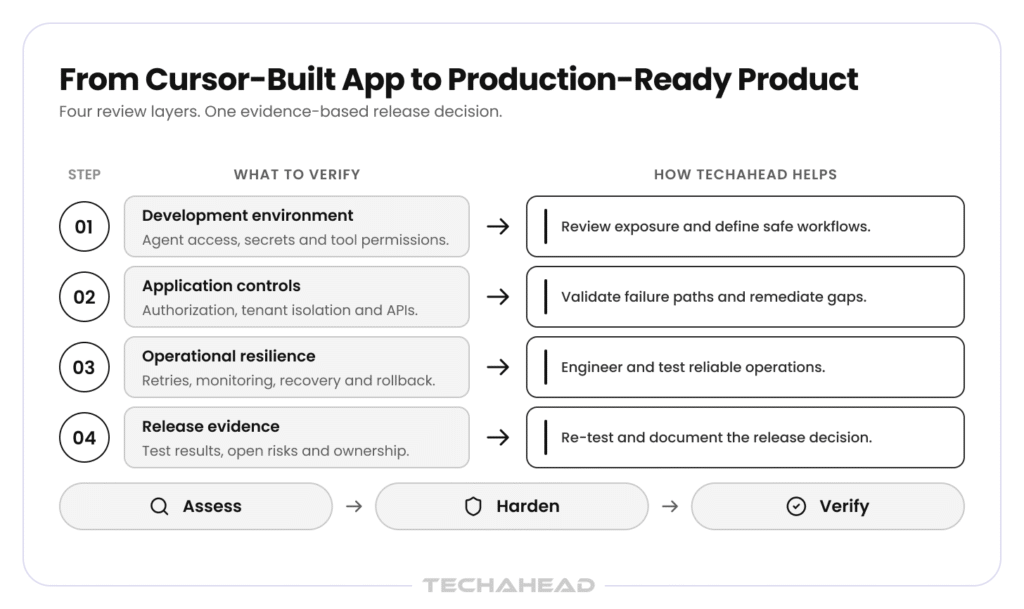
This guide gives you an order of work: identify what the app actually exposes, test the highest-consequence failures, decide whether to harden or restructure it, and produce evidence that another engineer or an enterprise buyer can inspect.
Also Read: AI-Generated Code Security: Input Validation, Injection, and Business-Logic Risks
Cursor is an AI-assisted development environment that works in a codebase. It can help write features, refactor modules, generate tests and run tools. That speed is useful, especially when a small team is validating a product. It does not establish that every route checks permission, that data stays within its tenant, or that an on-call engineer can explain a failure at a random given time.
There are two related reviews. The Cursor workspace review looks at who can connect tools, what an agent can read and execute, what data enters the service, and how proposed changes are approved. Cursor’s own security and privacy hardening guidance describes configuration choices for identity, privacy, agents, extensions and monitoring. Its agent-security documentation also says some agent guardrails are best effort. Check the current settings for your plan and deployment, keep sensitive credentials out of agent reach, and require human review of consequential changes.
Must Read: Best AI Model for Developers (H2 2026 Edition)
The application review follows the software your customers will use: authentication, authorization, APIs, storage, integrations, infrastructure and incident response. An editor setting cannot substitute for a server-side permission check. Conversely, fixing an API does not settle whether a cloud agent can access a production-adjacent secret. Treat the two as connected workstreams with different owners and evidence.
Do not assume every defect was caused by AI. A traditional team can make the same mistakes. What changes with assisted development is the rate at which plausible code and configuration can accumulate. Veracode’s 2025 study of coding tasks across more than 100 models found that 45% of generated code samples failed its security tests. That controlled result does not mean 45% of Cursor applications are vulnerable; it explains why passing functional tests cannot be the sole release criterion.
Start with a data-flow map, not a blanket request to “make the app secure.” List the actors, roles, tenants, sensitive records, write operations, third-party services and environments. Then trace each customer-critical workflow from the browser or mobile client through the API and storage layers to its external side effects.
The first questions are concrete. Can an unauthenticated request reach a private endpoint? Can a signed-in user substitute another record ID? Can an administrator in one customer account see another customer’s data? What happens when an API responds slowly or sends an unexpected payload? Which action can be repeated without creating a duplicate payment or order?
Review both code and the deployed configuration. A correct middleware rule can be undermined by a second route that bypasses it. A secure query helper may coexist with one direct database call. The login flow can work perfectly while an exported report omits tenant scoping. These failures are easy to miss when tests use one user, one organization and a cooperative network.
Prioritize by reachable exposure × business consequence × ease of exploitation, then record the evidence behind each rating. A cross-tenant read of customer records deserves immediate containment. An unused dependency with a lower-severity advisory may be scheduled differently after you confirm whether it is reachable.
OWASP’s Top 10:2025 places broken access control first and security misconfiguration second. Use it to orient review, then use the Application Security Verification Standard to define testable controls that fit the product. A general checklist is a starting point; your release decision must reflect your actual data and exposure.
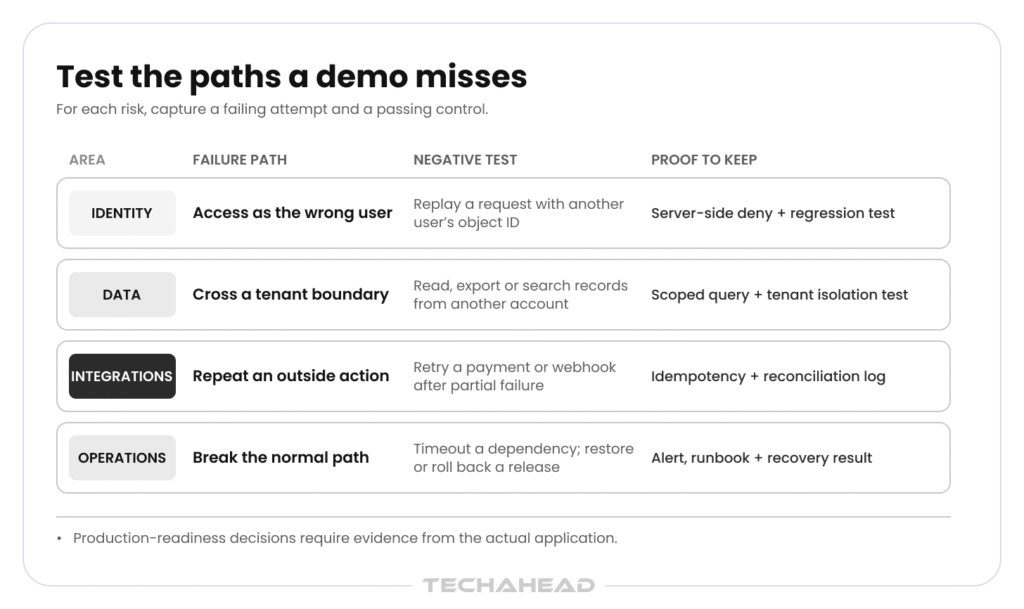
Authentication proves who a caller is. Authorization determines what that caller may do. Check both on the server for every API route, server action, job and administrative path. Test unauthenticated access, expired sessions, role changes, password-reset flows and privileged actions. If single sign-on or multifactor authentication is a buyer requirement, establish whether the current identity provider and session design can support it.
Create at least two users in two separate organizations. Attempt to read, edit, delete, export and enumerate each other’s objects through direct requests, not only through the interface. Include background jobs and file URLs. Deny by default; place ownership checks close to the operation they protect. A hidden button is a user-interface choice, not an access-control boundary. The OWASP authorization guidance supports server-side enforcement and permission testing.
Draw the data model and label every tenant-owned table, object store path, cache key, search index and analytics export. Confirm how tenant context is derived from the authenticated principal, carried across service calls and enforced at the data-access layer. Test direct object references and joins that could return another tenant’s rows. If your database supports row-level security, inspect the policies and test them with the same roles the app uses; a policy file existing in the repo is not proof it is active in production.
The OWASP multi-tenant security guidance calls for isolation across data, configuration and resources. Also examine backup restoration, support access, reporting and migration scripts. A customer export is still a data-access path even if it runs only once a month. Give engineers a repeatable negative test that fails whenever another tenant’s data becomes visible.
Inventory secrets in source, commit history, build logs, client bundles, CI settings, agent contexts, third-party dashboards, and source or agent access to API keys, hardcoded API keys, environment variables, env files, sensitive files, and configuration files. Teams should implement .cursorignore files and repository blocklists to protect sensitive data; Cursor uses .cursorignore files to exclude sensitive data from processing and repository blocklists prevent sensitive files from being accessed by AI.
Remove exposed credentials and rotate them; deleting a line in the latest commit does not revoke a key already published, and replace hardcoded API keys with environment variables kept out of version control. Use managed secret storage, scoped credentials and separate environments. Know which requests and data are sent to each provider, and test how your app handles timeouts, retries, revoked credentials and malformed responses.
Recommended: Open Baking API Strategy
At API boundaries, validate input on the server, limit request sizes and rate where appropriate, use parameterized queries, and verify webhook signatures. Make state-changing operations idempotent when retries can occur. For payments or provisioning, test the split case in which the external side effect succeeds but your own update fails. Decide how to reconcile it, alert on it and safely retry. If the product itself includes an LLM, its prompt-injection and model-output risks need an additional, separate review; Cursor’s use during development does not by itself turn the shipped app into an LLM application.
Inspect environment separation, infrastructure configuration, dependency pinning, build provenance, deployment permissions, extension allowlists, and Workspace Trust for untrusted local folders. Add automated gates for tests, dependency and secret scanning, review of material configuration changes, review of ai generated commands, and restrictions on terminal commands. Disable auto run mode so execute commands requires human approval. A scanner finding needs triage; a clean scanner result does not prove business logic is safe.
Instrument the journeys users care about: sign-in, account switching, writes, external API calls and background jobs. Capture structured errors and traces without leaking sensitive data into logs. Define alerts for failed jobs, elevated error rates, unusual access patterns, degraded dependency performance, and signs of malicious commands or unusual command execution when running terminal commands. Practice a rollback and a backup restore, including the data migration question: can you roll back application code without corrupting records written by the new version?
Before launch, name the person who can stop a release and the person who owns incidents. This is often the smallest operational decision with the largest practical effect. NIST’s Secure Software Development Framework offers a useful structure for preparing the organization, protecting software, producing secure software and responding to vulnerabilities.
Also Read: NIST AI RMF (A Practical Implementation Guide)
A fast app can be production-ready without a fashionable architecture. The concern is whether you can predict its behavior, change it safely and operate it as demand grows. Start with the workloads that matter: concurrent users, transaction bursts, background tasks, data growth and the service-level expectations buyers will place on the product.
Load-test representative workflows with realistic data volumes. Measure latency, error rate, resource use, queue depth and database contention. Look for unbounded queries, missing indexes, synchronous calls that block a request and retries that multiply load. A single “requests per second” figure without user mix, dataset size and failure behavior will not tell a founder whether the application can handle its next customer.
Maintainability deserves equal attention. Can a new engineer install, run, test and deploy the repo from documented instructions? Does one permission policy govern each workflow, or have several Cursor sessions produced competing implementations? Are dependencies supported, interfaces owned and tests concentrated on negative cases? A team may be able to ship another feature quickly while taking progressively longer to diagnose every regression.
Cursor-generated source code normally lives in the project repository, so the core question is not “Can we export the Cursor app?” It is whether the system has avoidable dependencies in its runtime services and development process. Identify managed auth, database, hosting, background jobs, storage, analytics and proprietary SDKs. Record where the data resides, how you would export it, and how much code assumes one provider’s behavior.
Separately, document the conventions that currently exist only in prompts, chat history or one engineer’s memory. Put architecture decisions, security invariants and test commands in the repo and review process. That makes future work less dependent on a particular editor or person. Cursor’s workspace rules can help guide an agent, but tests and code review must still enforce the important behavior.
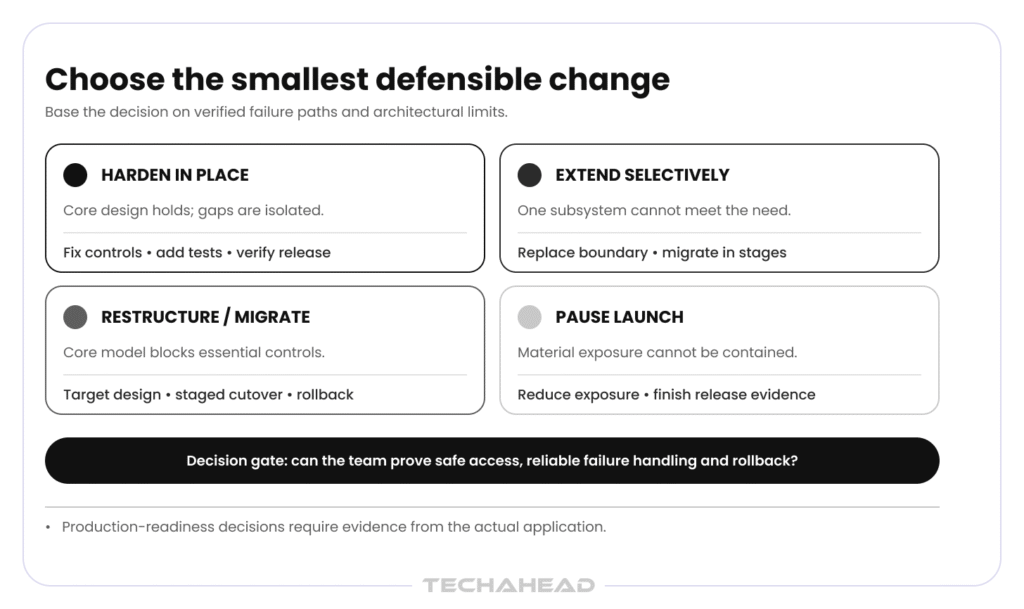
The right decision follows the findings. Rebuilding a working product because it used Cursor is rarely a defensible rule. Preserving a design that cannot reliably separate customer data is not defensible either. Compare options against the same evidence: customer impact, security exposure, effort to change, operational constraints and the product roadmap.
| Decision | When it fits | What the team should deliver |
| Harden in place | The architecture is coherent; flaws are isolated or controls are missing around working paths. | Correct the paths, add negative tests, improve monitoring and establish release gates. |
| Extend selectively | Core workflows are useful, but identity, data access, integrations or operations need a stronger subsystem. | Replace or isolate the weak component behind clear interfaces; migrate data and traffic in stages. |
| Restructure or migrate | Tenant isolation, data model or operating model is fundamentally at odds with buyer requirements. | Design a target architecture, migration and rollback plan, acceptance criteria and staged cutover. |
| Pause launch | A material exposure cannot be contained or verified in time. | Reduce exposure, protect affected data and finish the evidence needed for a release decision. |
Custom engineering is useful when the product needs explicit ownership of domain permissions, complex workflows, enterprise identity, auditability or integration behavior. It can also reconcile duplicated modules into one maintainable design. It does not automatically mean a full rebuild or a move away from Cursor as a development tool. A team can continue using Cursor while engineers change the application architecture, tests and operational controls.
A useful decision gate asks: Can we demonstrate safe behavior under an unauthorized request, a dependency failure, a concurrent write and a rollback? If the answer is no, identify which invariant fails and whether it can be corrected within the present design. That is more informative than a generic “production-ready score.”
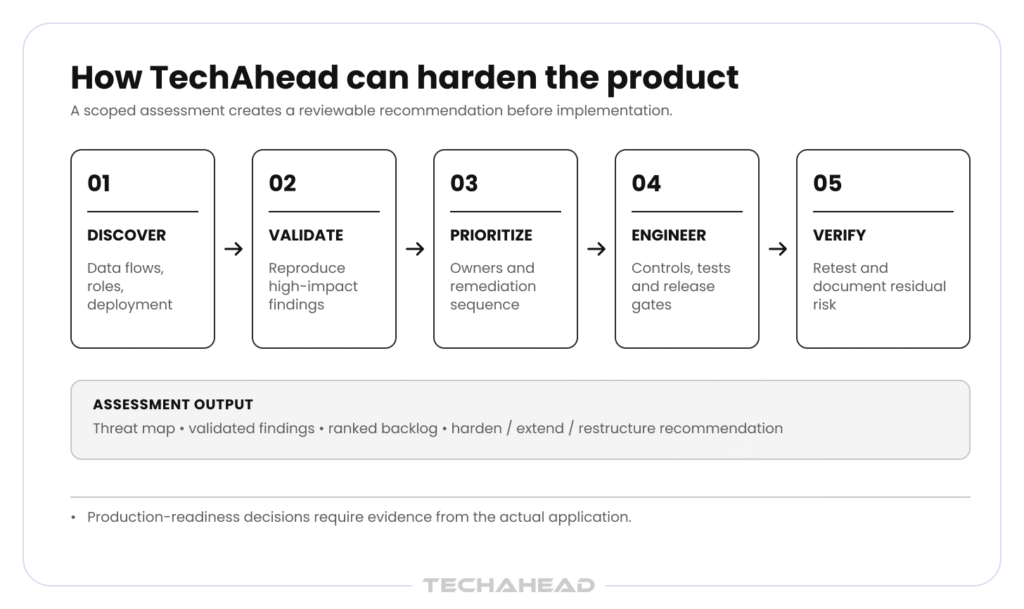
A credible review begins with access to the actual repository, architecture and deployment configuration. The team should also know the intended users, customer contracts, sensitive data, launch date and known incidents. If those inputs are unavailable, mark the findings provisional rather than issuing a clean bill of health.
Map assets, data flows, roles, environments and external services. Reproduce the application and its deployment. Inspect the Cursor workflow and permissions if the development environment is in scope. Name the release-critical journeys and define what “ready” means for this product.
Review source and configuration, then run negative tests against a safe staging environment. Focus first on auth and tenant isolation, secrets, injection and unsafe data handling, external side effects and exposed administrative functions. Use automated scanning to widen coverage and manual review to validate exploitability and business impact.
For each finding, record severity rationale, affected path, evidence, owner, proposed change and regression test. Contain urgent exposures before broad refactoring. Add checks to CI, review policies and the data layer so a later feature cannot quietly reintroduce the same failure.
Run realistic load and failure scenarios, verify alert routing, rehearse recovery and confirm who can roll back. Re-test the deployed build, because a correct repository can still be deployed with incorrect permissions, secrets or network settings.
Publish a release record: what was tested, what passed, what remains open, who accepted residual risk and the conditions that would require another review. The output should give a founder a go/no-go decision and give engineering an ordered backlog. A buyer may also request specific evidence about access controls, testing and incident readiness.
TechAhead’s cybersecurity services include application security and architecture review; our DevSecOps practice covers security in delivery workflows, and our digital product engineering team supports product changes. For this engagement, the practical starting deliverable would be a scoped assessment: a data-flow and threat map, validated findings, a ranked remediation plan, and a recommendation to harden, extend or restructure. The specific tests and schedule should be agreed after inspecting the codebase and deployment.
If implementation follows, the work would concentrate on the issues the evidence reveals: permission and tenant controls, integration reliability, automated regression coverage, deployment safeguards and operational visibility. An independent verification pass would then check the changed application and document the remaining decisions. That leaves the team with a product it can explain and operate, not simply a larger collection of generated fixes.
Bring your repo, deployment context and launch requirements to TechAhead. We can identify the critical gaps and define a defensible next step. Talk to TechAhead today.
Yes, if the application’s architecture can support the required controls. A production-readiness review should verify authorization, tenant isolation, failure handling and deployment safeguards in the running system. Using Cursor to build an application neither qualifies nor disqualifies it for production.
Start with exposed secrets and reachable access-control failures, particularly cross-user or cross-tenant data access. Then review privileged APIs, input handling, third-party integrations and deployment settings. Prioritize findings by actual exposure and business impact rather than scanner severity alone.
Yes. TechAhead can assess the existing codebase, data flows and deployment before recommending changes. Where the architecture is sound, Cursor app security hardening may involve targeted fixes, regression tests and release controls rather than replacing the application.
Consider restructuring when essential requirements – such as tenant separation, enterprise identity, data integrity or reliable operations – cannot be met safely within the present design. Base the decision on verified limitations, migration risk and the roadmap, not on Cursor’s involvement.
The schedule depends on the application’s scope, access and testing depth. A documented single-service app differs from a multi-tenant product with several integrations. Agree on critical workflows, environments and deliverables first; then estimate the review and remediation separately.
Build a test matrix covering users, roles, tenants, resources and actions. Send direct API requests using another tenant’s object IDs, and test exports, jobs and storage paths too. Keep passing isolation tests in CI so future changes cannot reopen access.
It can be engineered to support an organization’s SOC 2 control program, but Cursor’s own attestation does not cover your application automatically. Define the relevant controls, retain change and access evidence, and have the organization’s compliance team determine examination scope.
Yes, but distinguish developing the application from submitting PHI to Cursor. Cursor says an Enterprise agreement and signed BAA are required before submitting PHI; approved services, models and configuration also matter. Assess the shipped application’s HIPAA safeguards separately.
No. Privacy Mode addresses aspects of how Cursor handles code and prompts during development. Your deployed application still needs its own authorization, encryption decisions, tenant controls, logging and incident procedures. Review agent permissions and integrations alongside those application controls.
Prepare an architecture and data-flow map, access-control test results, vulnerability remediation records, dependency and deployment controls, incident procedures, and evidence of backup and rollback tests. Match the package to the buyer’s questionnaire and the data your application handles.
Automated review helps identify suspicious code and common vulnerabilities, but it may miss business-logic abuse, cross-tenant paths and deployment-specific behavior. Use it within an AI-generated code audit, then validate material risks through manual testing of the running application.
Turn each validated finding into a regression test. Gate changes to authorization, data access and critical integrations in CI, require accountable code review, and retest the deployed build. Document security invariants so new contributors understand what every change must preserve.
Simulate timeouts, duplicate webhooks, revoked credentials and partial success. Check whether retries create duplicate actions, whether failed jobs alert an owner, and how records are reconciled. Production readiness depends on recoverable outcomes, not merely successful API calls.
TechAhead can help rank findings by reachable exposure, business consequence and dependencies between fixes. Contain material data-access risks first, then sequence structural changes and release controls. The outcome should be an owned backlog with verification criteria, not an undifferentiated vulnerability list.
Often, yes, if identity and permissions have clear boundaries in the current architecture. Assess how sessions, roles, tenant context and administrative actions flow through every service. Replace a subsystem only where the existing design cannot enforce the required behavior reliably.
We use cookies to ensure our website functions properly, improve performance, and provide a personalized experience. You can choose which types of cookies to allow below.
Required for core functionality such as security, network management, and accessibility. These cannot be disabled.
Help us understand site traffic and user interactions so we can improve performance and usability.
Enable enhanced functionality and personalization such as language or region preferences.
Used to deliver relevant ads, track campaign performance, and measure advertising effectiveness.