


 Copy Link
 Share on X
 Share on Facebook
 Share on LinkedIn
Always Active
Required for core functionality such as security, network management, and accessibility. These cannot be disabled.

Uncover the transformative potential of digital and mobile solutions for your industry.





 Last Updated: Sep 16, 2026
Sep 15, 2026
Last Updated: Sep 16, 2026
Sep 15, 2026  199
199  21 min. Read


Key Takeaways
Your product works in the demo. Customers like the idea. An investor asks when it can launch, while a promising enterprise buyer asks for SSO, audit logs, a security review, recovery commitments, and proof that its data will remain isolated.
Those are not requests for a few finishing touches. They expose a maturity gap.
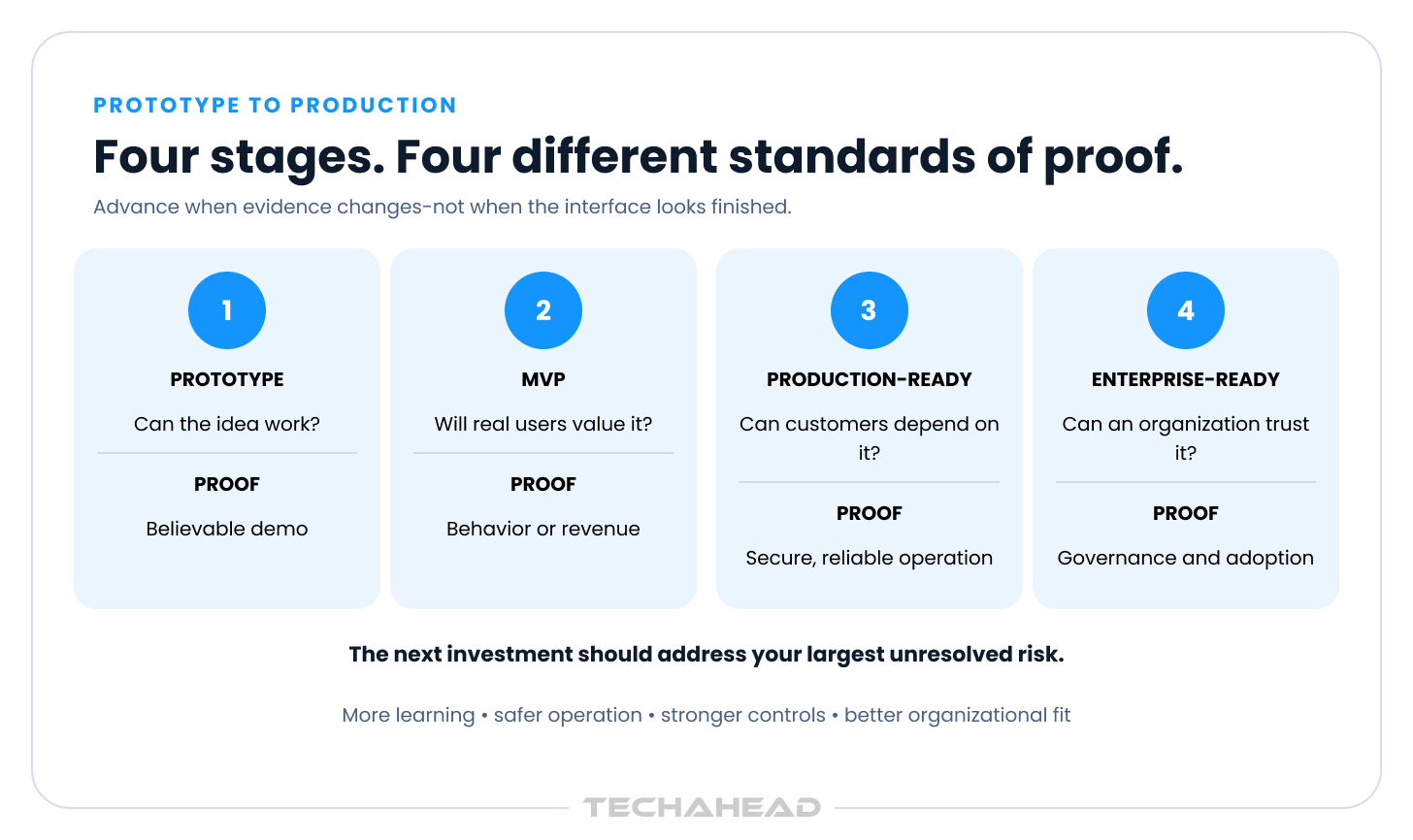
The terms prototype, minimum viable product (MVP), production-ready, and enterprise-ready software describe four different levels of evidence. That distinction matters even more as AI-generated code moves beyond experimentation:
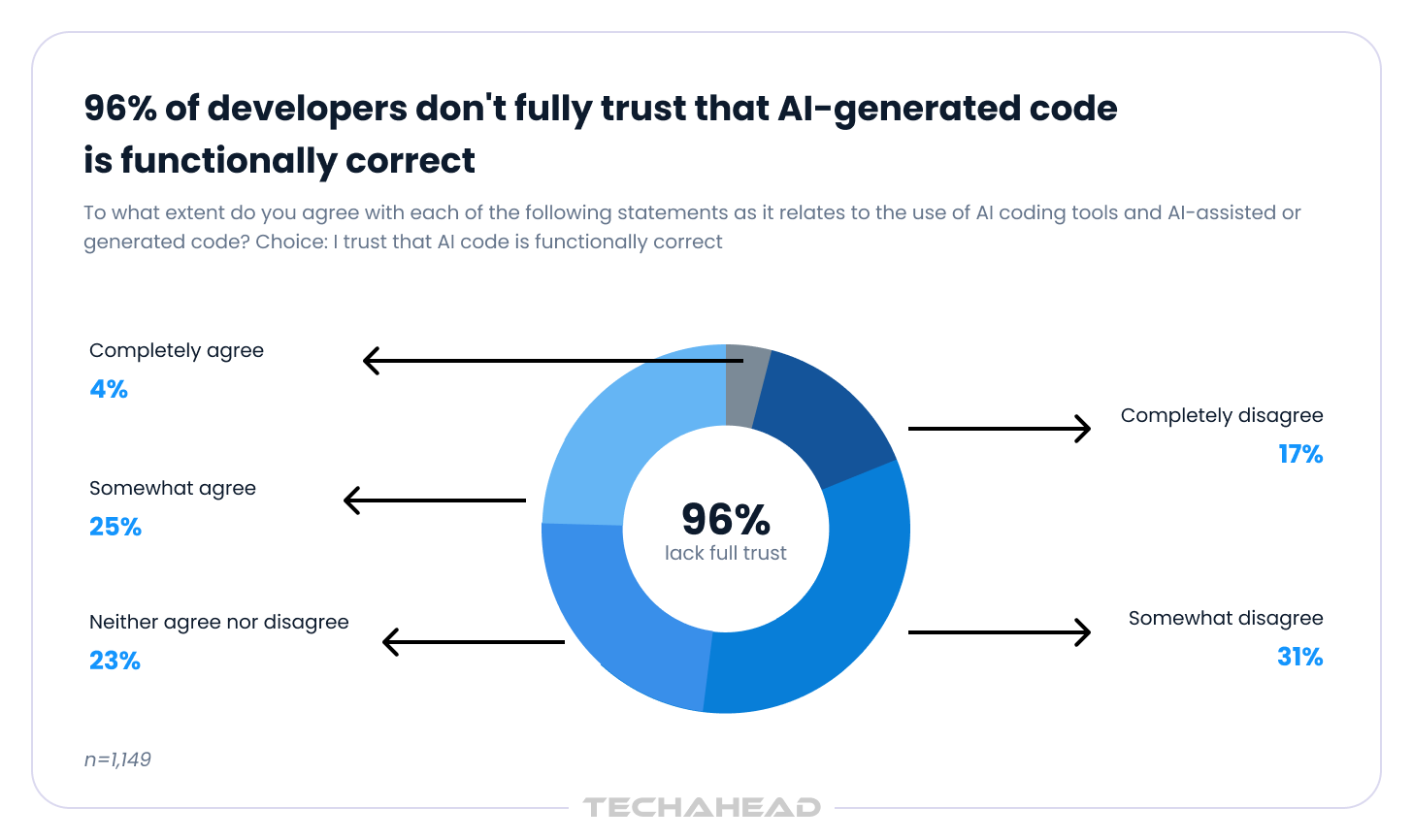
Sonar’s 2026 survey of more than 1,100 professional developers found that 96% did not fully trust AI-generated code to be functionally correct.
Treating the four stages as interchangeable creates predictable problems: you promise dates before understanding technical risk, expose customer data to experimental controls, or spend enterprise-level money before proving demand.
This guide gives you a practical prototype to production decision framework. It also accounts for AI-assisted and vibe-coded products built with tools such as Cursor, Replit, Lovable, Bolt, or GitHub Copilot. The tool may change your speed; it does not change what your software must prove.
Also Read: Enterprise App Production Readiness Checklist for AI-Built Products
The labels become useful when they influence what you fund next. Instead of asking which stage sounds most impressive, start with the business situation in front of you.
| Your current situation | What you should fund next | Readiness target | What you can defer for now |
| Stakeholders disagree about the experience, or one technical assumption could invalidate the idea | User-flow experiments, technical spikes, and fast feedback | Prototype | Broad feature development, scale engineering, and formal enterprise controls |
| The core workflow works in controlled conditions, but you lack evidence that real users value it | One complete user journey, analytics, feedback loops, and baseline data controls | MVP | Feature breadth, complex integrations, and requirements without a validated buyer |
| Usage or revenue is growing, while releases, incidents, security, performance, or manual operations are becoming risky | Testing, observability, deployment controls, recovery, security, and maintainability | Production-ready | Buyer-specific governance features that no target customer has requested |
| The service is dependable, but larger deals stall in security review, procurement, administration, or integration | Enterprise identity, auditability, data governance, SLAs, support processes, and priority integrations | Enterprise-ready | Turning every prospect request into a universal platform capability |
A proof of concept may come before a prototype when you need to test one technical unknown – whether a model can reach an accuracy threshold, for example. It is a focused experiment, not a mandatory fifth product stage.
These stages are not medals. Enterprise readiness is unnecessary for many consumer or small-business products. The correct target is the maturity your next real user, use case, and commercial promise require.
A prototype converts an assumption into something people can see, touch, or challenge. It may be a clickable design, a thin coded workflow, a model demonstration, or a manually supported experience. Its job is to answer a small number of high-value questions quickly.
You probably have a prototype when:
It is appropriate engineering if you label the artifact honestly and control who can use it.
AI makes prototype creation unusually fast. Sonar’s 2026 survey of more than 1,100 professional developers found that 72% of developers who had tried AI coding tools used them daily, while respondents estimated 42% of their contributed code was AI-generated or AI-assisted. It also found AI use extending from prototypes to mission-critical systems. The implication is not that AI code is inherently unsafe; it is that origin no longer tells you maturity. Verification does.
Do not ask, “Was this vibe-coded?” as a substitute for due diligence. Ask what the prototype proves, what it deliberately ignores, and what evidence exists behind every production claim.
Related: What is Vibe Coding (An Enterprise Guide)
A prototype earns you the right to test a product. An MVP earns you evidence about a market.
The “viable” in minimum viable product matters. Your MVP must complete a meaningful job for a defined user. A polished interface with stubbed logic may be an excellent prototype, but it is not an MVP if users cannot receive the promised outcome.
Before moving from prototype to MVP, replace the riskiest simulations with enough real behavior to learn safely. That usually means basic identity, controlled data storage, meaningful analytics, defined user feedback, error handling for the core journey, and a repeatable deployment path. Scope can remain narrow. Trust cannot be fake.
You are likely operating an MVP when:
The most useful answer to what comes after MVP is not automatically “the full product.” Your next stage depends on the largest unresolved risk. Weak retention calls for learning and product changes. Strong demand with operational failures calls for production hardening. A signed enterprise opportunity may pull identity, auditability, integration, or compliance work forward.
Bonus Read: Best AI Models for Developers
If you need a structured route into first-market learning, TechAhead’s MVP development approach is relevant when your immediate goal is to validate the smallest credible product before funding broader scale. Before moving from prototype to MVP, treat that step as part of the broader product design process and development process, using iterative testing and feedback to replace staged moments with enough real behavior to learn safely. Scope can remain narrow, but the team should focus on the core workflow first, especially in the early stages; trust cannot be fake.
Must Read: Create an MVP for your Mobile App
Production readiness is a key point in the transition from prototype to production, beginning when real users, revenue, data, or operations depend on the product. At that point, “it worked in testing” is not sufficient. You need evidence that the system behaves acceptably when traffic spikes, dependencies fail, deployments go wrong, credentials leak, data grows, and the person who built the first version is asleep.
This shift creates a strong foundation for scaling and long term success.
A production-ready application normally has:
This is where the difference between working software and durable software becomes visible. A working demo optimizes for the successful path. A durable product assumes failures will occur and makes them detectable, containable, and recoverable.
The risk is commercial, not merely technical. Uptime Institute’s 2026 outage analysis reports that 57% of respondents said their most recent major outage cost more than $100,000, while one in five put the cost above $1 million. Those findings are not a price prediction for your product; they show why reliability must become an explicit business decision as your dependency and exposure grow.
Security deserves the same discipline. Verizon’s 2025 DBIR found that vulnerability exploitation was present in 20% of analyzed breaches, a 34% year-over-year increase.
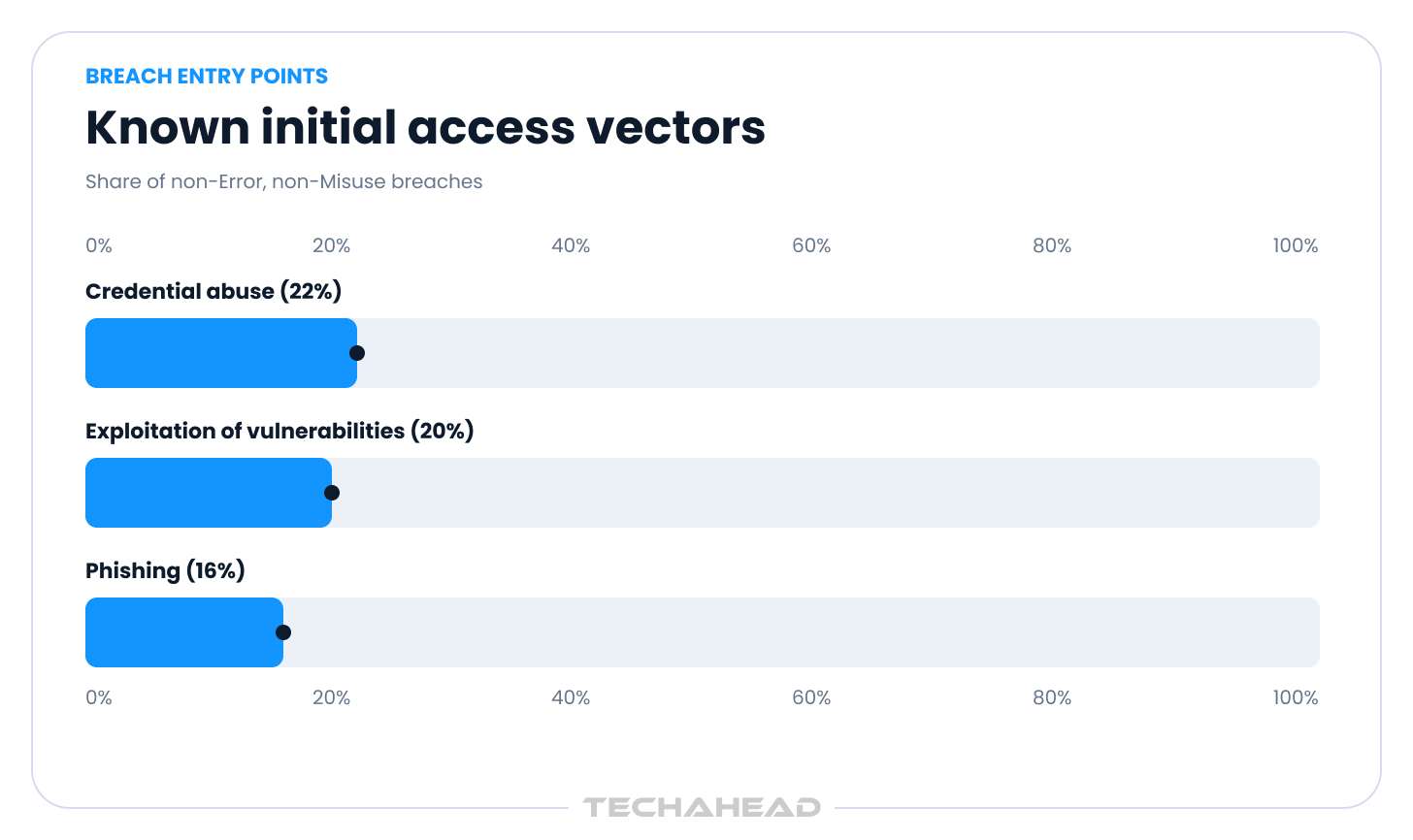
A launch decision without patching ownership, dependency visibility, and remediation targets is therefore a decision to accept unmanaged exposure.
Production readiness asks whether your service can operate dependably. Enterprise readiness asks whether another organization can trust, approve, integrate, and govern it.
An application can be production-ready for thousands of individual customers and still fail an enterprise review. Conversely, adding SAML SSO does not make experimental software enterprise-ready. The buyer evaluates the complete product-service system: architecture, controls, evidence, contracts, support, and the team responsible for them.
The exact bar depends on the buyer, data, use case, and contractual risk, but common dimensions include:
Also Read: Enterprise AI Compliance & Governance
For AI-enabled products, buyers may also ask how you evaluate models, isolate customer data, defend against prompt injection, control model and vendor changes, trace outputs, supervise high-impact actions, and handle human review. You should treat those as product requirements, not security paperwork added at the end.
| Use our enterprise-ready application checklist for AI products when you need a deeper control-by-control review. The distinction matters: this article helps you select the right maturity target; the checklist helps you examine enterprise controls once that target is justified. |
The transition is not a linear march toward more features. These software/application product development stages change the standard of proof and give you a more useful view of product readiness.
This matrix should prevent two expensive mistakes. The first is premature hardening: spending months on multi-region infrastructure before proving anyone cares. The second is premature exposure: putting a prototype under revenue, regulated data, or an SLA because the interface looks finished.
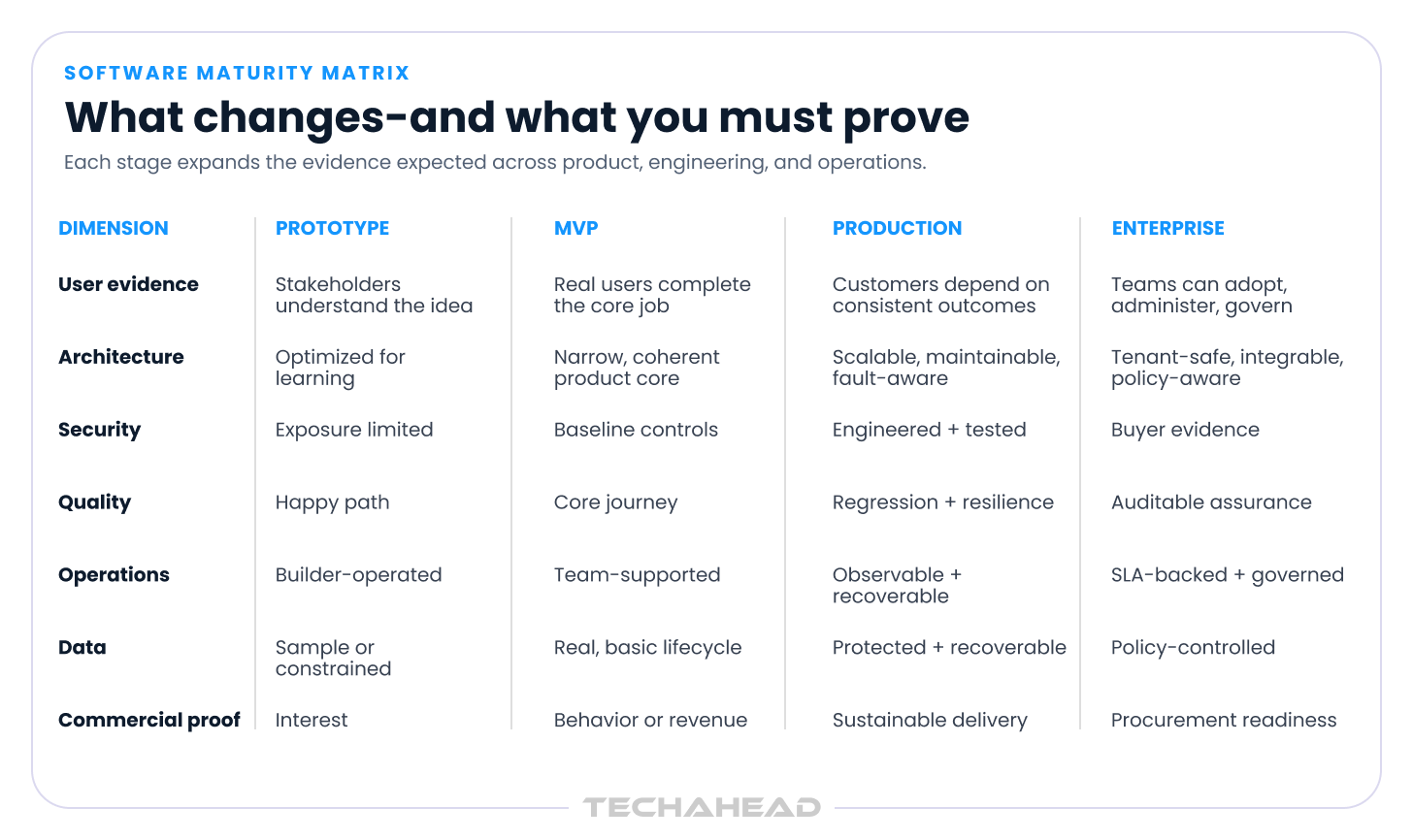
Before you change the stage label, ask:
Instead of approving one large “make it production-ready” project, use three explicit gates.
Confirm the user, problem, smallest complete outcome, success metric, and data boundary. In the early stages, the goal is to replace a working prototype with a controlled product path that can reduce risk. Decide which prototype components are disposable. The team should focus on the smallest complete outcome and the key details needed for a stable handoff into later stages. Establish enough analytics, identity, testing, and deployment discipline to expose the core product safely to a controlled cohort.
Exit evidence: real users complete the job, you can measure the hypothesis, and failures remain contained.
Run a production readiness assessment covering architecture, code, data, security, performance, reliability, observability, accessibility, release engineering, and operations; at this stage, formalize the production process so releases no longer depend on heroics. Convert findings into a risk-ranked backlog. This transition should stabilize architecture choices and delivery dependencies, the software equivalent of stabilizing design and supply chain processes. Define the capacity envelope and service objectives; test restore, rollback, and incident procedures.
Exit evidence: your team can release and operate the service repeatedly, failures trigger useful signals, recovery has been tested, and critical risks have owners.
Select a target customer segment and map its actual procurement and operating requirements. Add enterprise identity, administration, data governance, integrations, contractual service levels, support, and compliance evidence only where justified. Pilot with a design partner before generalizing one buyer’s wish list into your architecture.
Exit evidence: the buyer can approve, configure, integrate, govern, and support the product without exceptional founder intervention.
These gates can overlap, but they should not disappear. A well-funded team can move from prototype to production faster; it cannot purchase evidence before doing the work.
An AI-built or vibe-coded MVP does not automatically require a rewrite. Nor should you preserve it merely because customers like it. Your AI prototype to production path should be decided at the component level, using evidence rather than sentiment about the tool that generated the code.
First, commission a time-boxed technical audit. Examine architecture and dependencies; code ownership and readability; test coverage; authentication and authorization; secrets and data flows; license provenance; performance; deployment; observability; and recovery. For an AI-enabled product, also review evaluation datasets, prompt and model versioning, tool permissions, output handling, fallbacks, and the effect of vendor changes.
Related Read: AI Model Cards & Data Provenance 2026 Guide
CodeRabbit’s analysis of 470 open-source pull requests found AI-generated pull requests contained 1.7 times as many issues across logic, maintainability, security, and performance. Neither result proves your code is defective; both argue against promoting it on appearance alone.
GitGuardian’s 2025 analysis adds a concrete control concern: across 69.6 million public repositories scanned, it detected 23,770,171 new hardcoded secrets added in 2024, up 25% year over year. Secret scanning, rotation, least privilege, and removal from history belong in the audit.
Use this decision model after the audit:
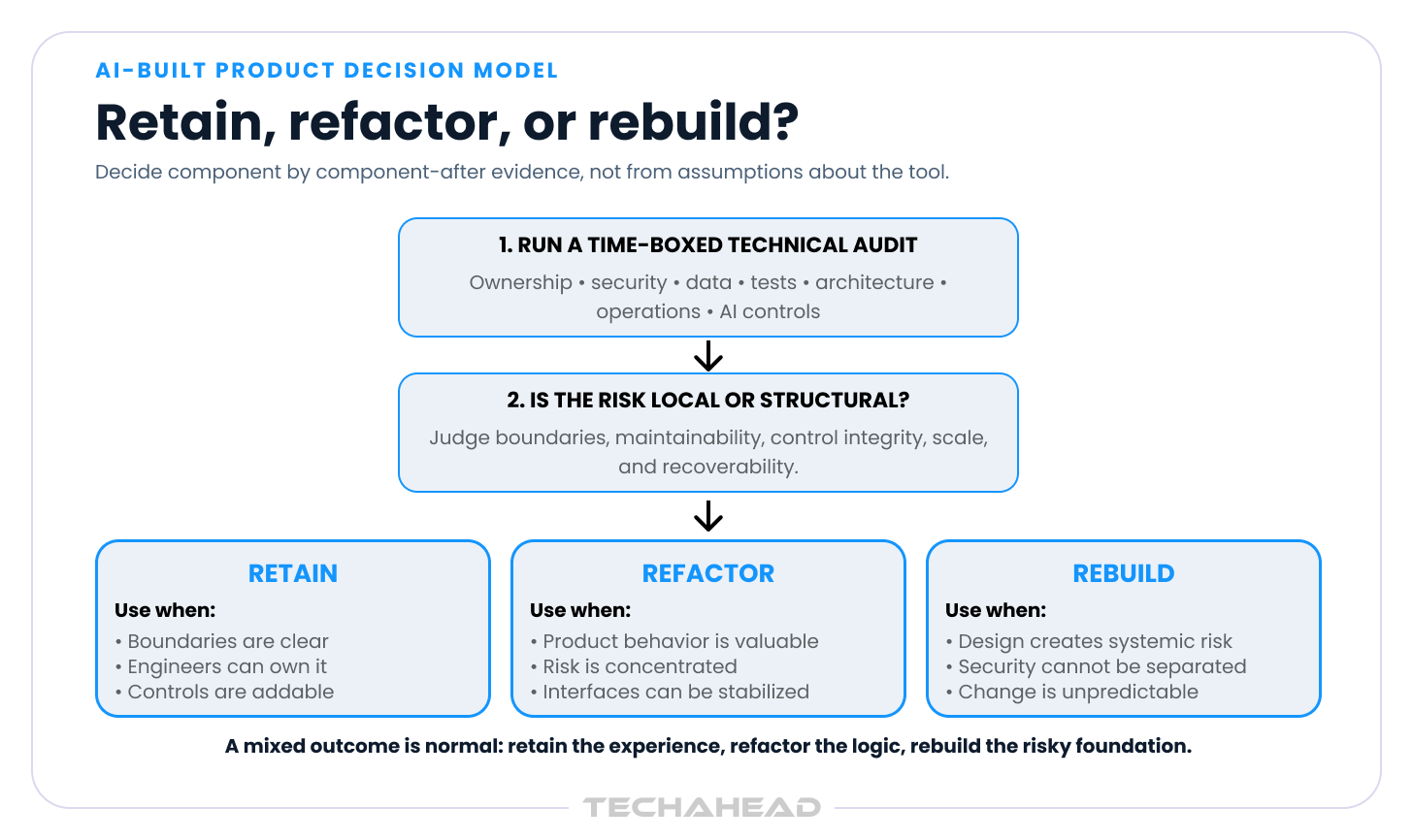
Keep a component when its boundaries are clear, engineers can understand and own it, critical paths are tested, dependencies and licenses are acceptable, security findings are manageable, and its architecture fits the expected load. Add missing controls without changing the underlying design.
Refactor when the product behavior is valuable but implementation complexity and quality create local risk: duplicated logic, oversized modules, inconsistent error handling, brittle generated abstractions, missing tests, inefficient queries, or tangled integrations. Stabilize interfaces first, add characterization tests, then improve the code incrementally.
Rebuild a component when defects are structural: authorization cannot enforce the required tenancy model; data ownership or provenance is unclear; the platform cannot meet recovery or scale needs; dependencies are unsupported; security is inseparable from the design; or no engineer can change the system predictably. Rebuild behind stable interfaces and migrate in slices where possible.
A mixed decision is often best. You might retain the user experience, refactor business logic, and rebuild identity and data architecture. This preserves validated learning while removing risks that would compound in production.
However, there is one caution on productivity forecasts: a 2025 METR randomized study of 16 experienced developers completing 246 tasks in mature repositories found that early-2025 AI tools made completion 19% slower, despite participants expecting a speedup. The researchers explicitly warn against broad generalization, and later tools may perform differently. For you, the useful lesson is narrower: estimate transition work after inspecting your codebase, not from generic claims about AI velocity.
The cheapest stage transition is the one matched to a validated risk. The most expensive is an enterprise transformation built on unproven demand – or a successful MVP whose shortcuts remain invisible until customers depend on them.
Separate your investment into three categories:
Then estimate by component and evidence, not by stage label. A useful forecast includes audit time, remediation, test creation, infrastructure, data migration, third-party review, rollout, and contingency. Attach a range to known scope and list the assumptions that would move it.
For planning, a focused technical and production-readiness audit often fits into roughly two to four weeks; a contained hardening or refactoring program may take six to sixteen weeks. A structural rebuild, complex migration, or enterprise control program can take several months. These are planning bands, not universal promises – the codebase, team, integrations, data sensitivity, traffic profile, and assurance requirements determine your real timeline.
Fund discovery first when uncertainty is high. A short assessment that identifies one structural blocker can prevent you from polishing code that must later be replaced. Also preserve optionality: wrap external services, document data contracts, keep migrations reversible, and introduce observability before major changes. You will learn faster because you can see the effect of each decision.
Your prototype to production maturity plan has two jobs: preserve what you have already learned and address the risks introduced by the next stage. Bringing product judgment and engineering depth together is what turns a promising build into credible enterprise-grade software, when that maturity matches the market you want to serve.
TechAhead can begin with a product and engineering audit, using the findings to determine whether you should:
TechAhead’s custom software development capability supports targeted rebuilding and modernization. Its digital product engineering expertise covers the broader journey across product strategy, architecture, delivery, quality, cloud infrastructure, and ongoing operations.
The recommendations should ultimately produce outcomes you can observe and measure:
| JoyJam shows that transition in practice. Its early prototypes ran on traditional VPS infrastructure and struggled with buffering, rising egress costs, attack traffic, and manual moderation. TechAhead re-engineered the platform on serverless AWS infrastructure with automated moderation, multi-region recovery, CI/CD, and global content delivery, turning early traction into resilient, production-ready scale. |
“Speed matters, but only while product risk remains visible. The moment software starts carrying customer data, revenue, or business-critical decisions, engineering evidence must determine whether it is ready to scale.”
Vikas Kaushik, CEO, TechAhead
Start by naming three things: the stage your product is in, the stage the business needs next, and the evidence missing between them. Audit the riskiest assumptions before turning that gap into a roadmap.xw
Depending on what the assessment reveals, you may need:
The label matters less than the evidence behind it. When you can explain why the product is ready, how failures will be detected, and how your team will recover, you can scale with greater confidence.
A successful prototype deserves an engineering foundation capable of supporting its momentum. Contact TechAhead to turn early product validation into secure, scalable, production-ready software.
A prototype demonstrates that an idea, workflow, or technical assumption can work under controlled conditions. Production-ready software has evidence that real customers can rely on it: security controls, repeatable releases, monitoring, performance testing, incident ownership, backups, and tested recovery. A polished interface is not evidence of operational readiness.
For a prototype, you optimize for learning speed and constrain exposure. For production, you optimize for dependable change and operation. That shifts work toward maintainable architecture, automated testing, security, observability, deployment controls, resilience, documentation, and support.
You should not apply the full production burden before validating the idea, but you should not carry prototype shortcuts into uncontrolled real-world use.
Yes. The generation method does not set the maturity ceiling. Your application can become enterprise-ready software if professional review establishes ownership and you add or verify the necessary architecture, tests, security, data governance, operations, integrations, and procurement evidence.
The right outcome may combine retained components, focused refactoring, and selective rebuilding.
Bring professional engineers in before the software handles sensitive data, accepts payments, supports a contractual commitment, integrates with business-critical systems, or expands beyond a controlled cohort. Earlier review is valuable when architecture or vendor choices could become difficult to reverse. Do not wait for an enterprise security questionnaire to discover foundational gaps.
No. A readiness audit may show that the architecture is sound and needs stronger controls, testing, observability, or documentation. Rebuild only where risk is structural, such as inadequate tenant isolation or an unmaintainable dependency model.
A component-level retain, refactor, or rebuild decision usually preserves more validated product value than a blanket rewrite.
A production readiness assessment should examine architecture, authentication, authorization, data protection, dependencies, test coverage, performance, observability, deployment controls, incident ownership, rollback, backups, and recovery. Every material gap should receive an owner, severity, remediation decision, and review date. Google SRE and OWASP ASVS provide useful reference points.
When demand is proven but operations remain fragile, what comes after MVP is usually focused hardening rather than indiscriminate feature growth. Prioritize failures that could damage customer trust, revenue, data, or your team’s ability to release and recover safely.
Product should define the customer promise and acceptable tradeoffs; engineering should own architecture and release evidence; security should validate exposure; operations should own monitoring and recovery. A named leader should record exceptions and make the final prototype to production readiness decision. Google SRE treats production readiness as a formal ownership transition.
No. Production-ready software may operate reliably without satisfying a particular buyer’s assurance requirements. SOC 2 scope depends on service commitments and relevant Trust Services Criteria; contractual, privacy, accessibility, or industry-specific obligations may also apply. AICPA defines SOC 2 around security, availability, processing integrity, confidentiality, and privacy controls.
Enterprise buyers commonly request architecture and data-flow documentation, access-control evidence, security testing, vulnerability management, recovery procedures, subprocessor details, audit logs, and policy records. TechAhead can help connect requested evidence to the engineering work supporting it. CISA’s Secure by Design guidance emphasizes vendor ownership of customer security outcomes.
As an AI prototype moves into production, governance should become repeatable and owned. Document approved use cases, data boundaries, evaluation criteria, model and prompt versions, human oversight, failure thresholds, monitoring, fallback behavior, vendor changes, and incident escalation. These areas align with the NIST AI RMF functions of govern, map, measure, and manage.
TechAhead can review each component for ownership, maintainability, architecture, security, data integrity, dependencies, tests, deployment, and operational risk. Sound foundations can remain; localized weaknesses can be refactored; structural problems may justify a controlled rebuild through focused digital product engineering.
TechAhead can begin with a product and engineering audit, preserve validated journeys, and rank production gaps by business risk. The resulting MVP to production roadmap can sequence hardening, selective refactoring, infrastructure changes, testing, and rollout without treating the entire product as disposable.
We use cookies to ensure our website functions properly, improve performance, and provide a personalized experience. You can choose which types of cookies to allow below.
Required for core functionality such as security, network management, and accessibility. These cannot be disabled.
Help us understand site traffic and user interactions so we can improve performance and usability.
Enable enhanced functionality and personalization such as language or region preferences.
Used to deliver relevant ads, track campaign performance, and measure advertising effectiveness.