


 Copy Link
 Share on X
 Share on Facebook
 Share on LinkedIn

Always Active
Required for core functionality such as security, network management, and accessibility. These cannot be disabled.

Uncover the transformative potential of digital and mobile solutions for your industry.





 Last Updated: Nov 25, 2026
Nov 25, 2026
 16
 17 min. Read


Key Takeaways
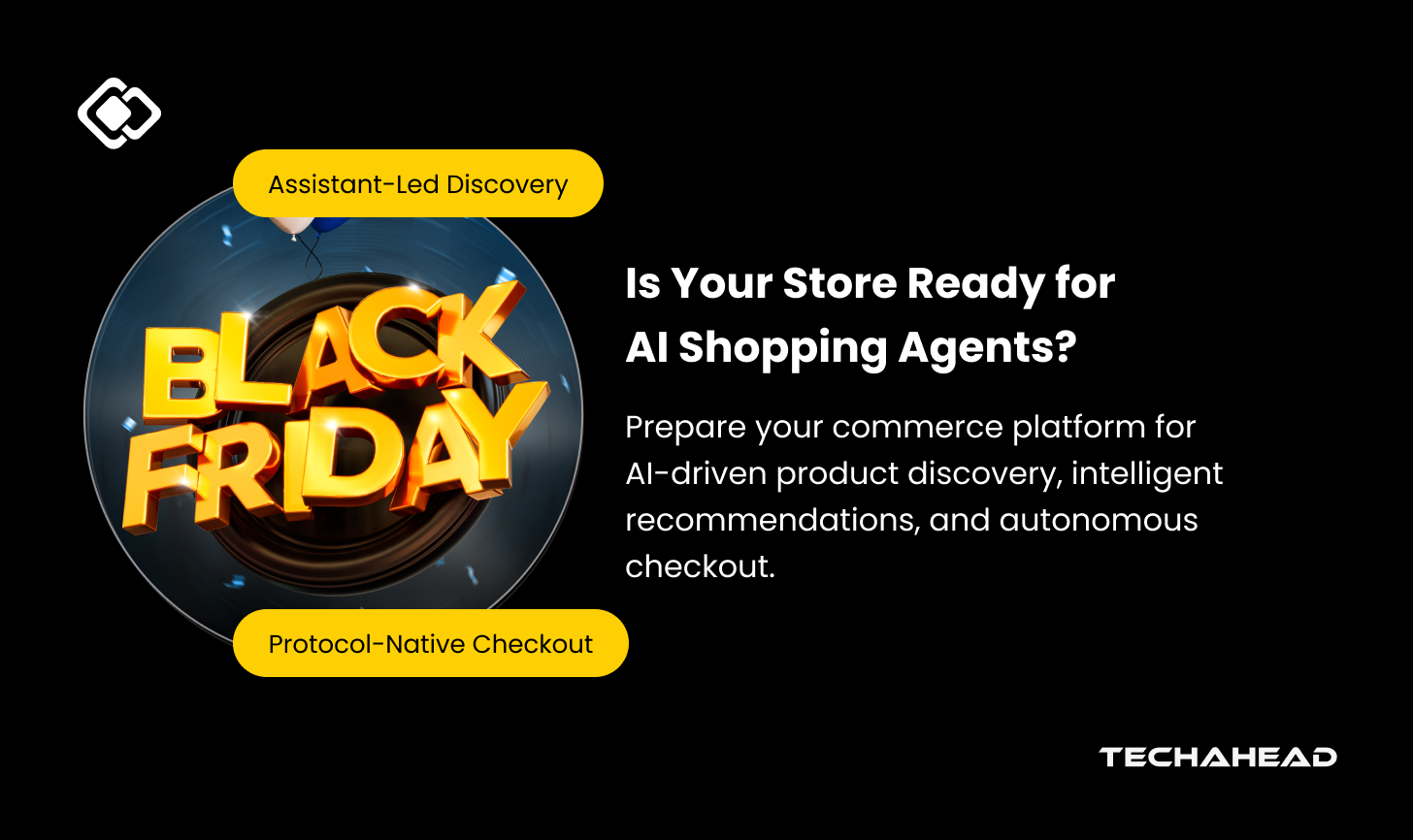
Black Friday arrives on November 27, and a new kind of customer will be shopping alongside your human visitors. It compares your price, your stock position and your returns policy against several competitors in seconds. Then it either hands a short list to a shopper or completes the purchase itself. This customer is an AI shopping agent, and it has become a measurable channel.
The data supports the attention. Adobe Digital Insights found that AI traffic to US retail sites grew 71% year over year in September 2026, converted 90 percent better than other traffic and delivered 83 percent more revenue per visit. The same research forecasts AI-driven traffic growth of 95% on Black Friday itself.
This blog offers a point of view for the leaders in commerce technology. It separates what deserves attention before Black Friday from what deserves a decision in the first quarter of 2027, and it shows how agentic commerce readiness can be scored, funded and governed like any other enterprise capability.
Three horizons organize AI shopping agent viewpoint on Black Friday. Each one has a clear owner and a clear outcome.
| Horizon | Mode | Priorities |
| Before Black Friday | Fix | Align price, stock and policy data across product pages, cart and checkout. Admit verified AI shopping agents through bot controls. Run an agent smoke test on the major AI assistants. |
| Before Cyber Monday | Watch | Track feed freshness, price parity and agent checkout success each day. Review how assistants describe your products. Adjust offers and policies based on what agents see. |
| By the end of Q1 2027 | Decide | Choose a protocol path for ACP and UCP. Set the build, partner or wait position on a branded AI shopping assistant. Approve a governance model for agent-initiated orders. |
Leaders planning for Black Friday benefit from a calibrated view, so here are the numbers on both horizons.
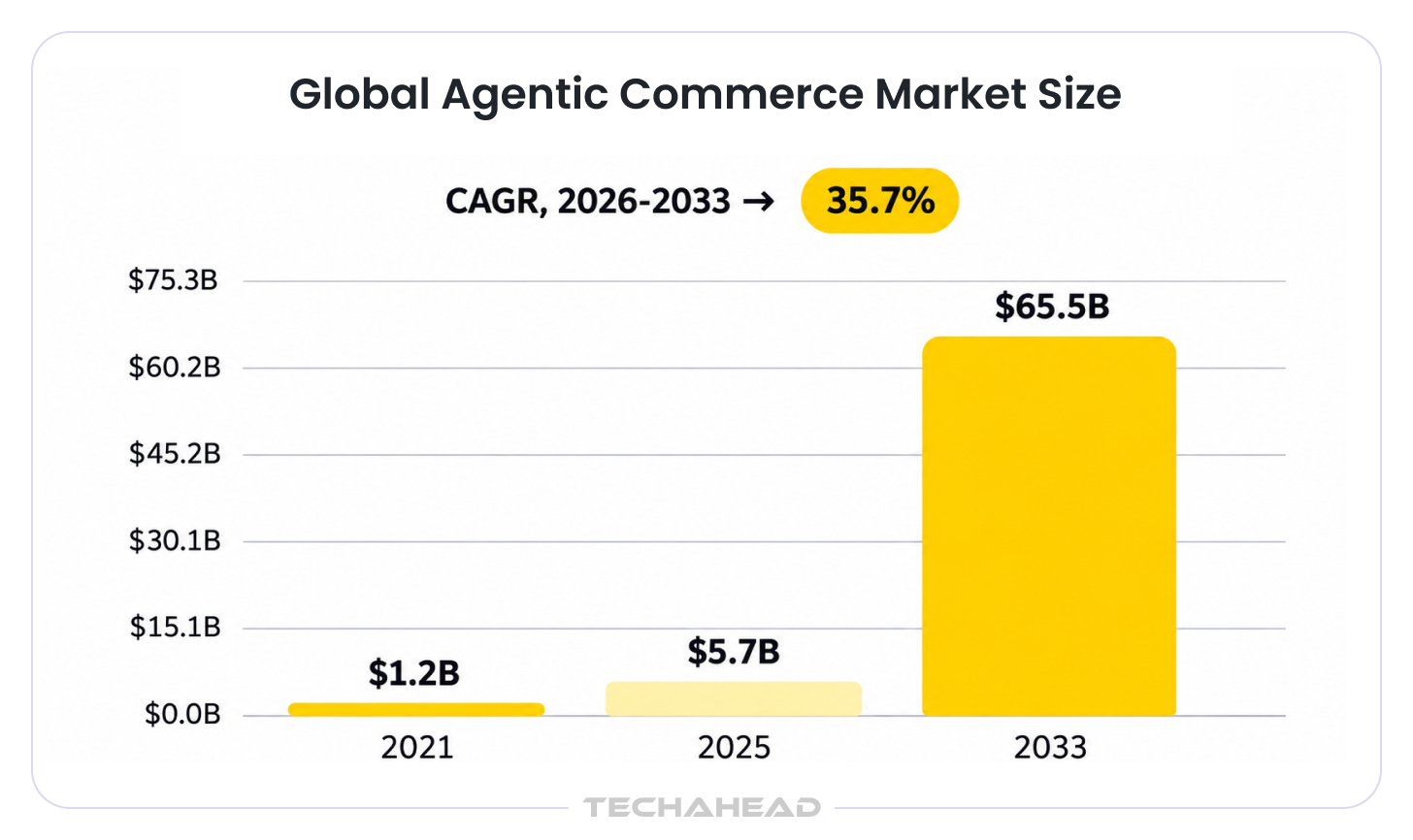
On the long horizon, the forecasts are large. McKinsey estimates that agentic commerce could orchestrate up to $1 trillion of US B2C retail revenue by 2030, with global projections between $3 trillion and $5 trillion.
Gartner describes the shift as an expansion of commerce from human-centric models to dynamic flows enabled by agents, and it expects that 60% of brands will use agentic AI for one-to-one customer interactions by 2028.
On the near horizon, the picture is one of rapid growth from a focused base. eMarketer forecasts that AI platforms will account for about 1.5 percent of US retail e-commerce sales in 2026, nearly four times the 2025 level. YouGov found that planned AI use among likely Black Friday and Cyber Monday shoppers rose from 16% to 34% in a year. On the supply side, Salesforce reports that 28% of commerce organizations already use agentic AI and another 44% plan to adopt it within six months.
The pattern that matters for planning is influence before checkout. McKinsey’s research shows that AI platforms lead in discovery while retailer assistants draw level at checkout, and that AI search is 3X more influential than traditional search for AI users. AI shopping agents shape the shortlist today and will increasingly complete the order. Investment sized to that sequence produces returns in both phases, because the same product data, pricing integrity and governance serve discovery now and checkout later.
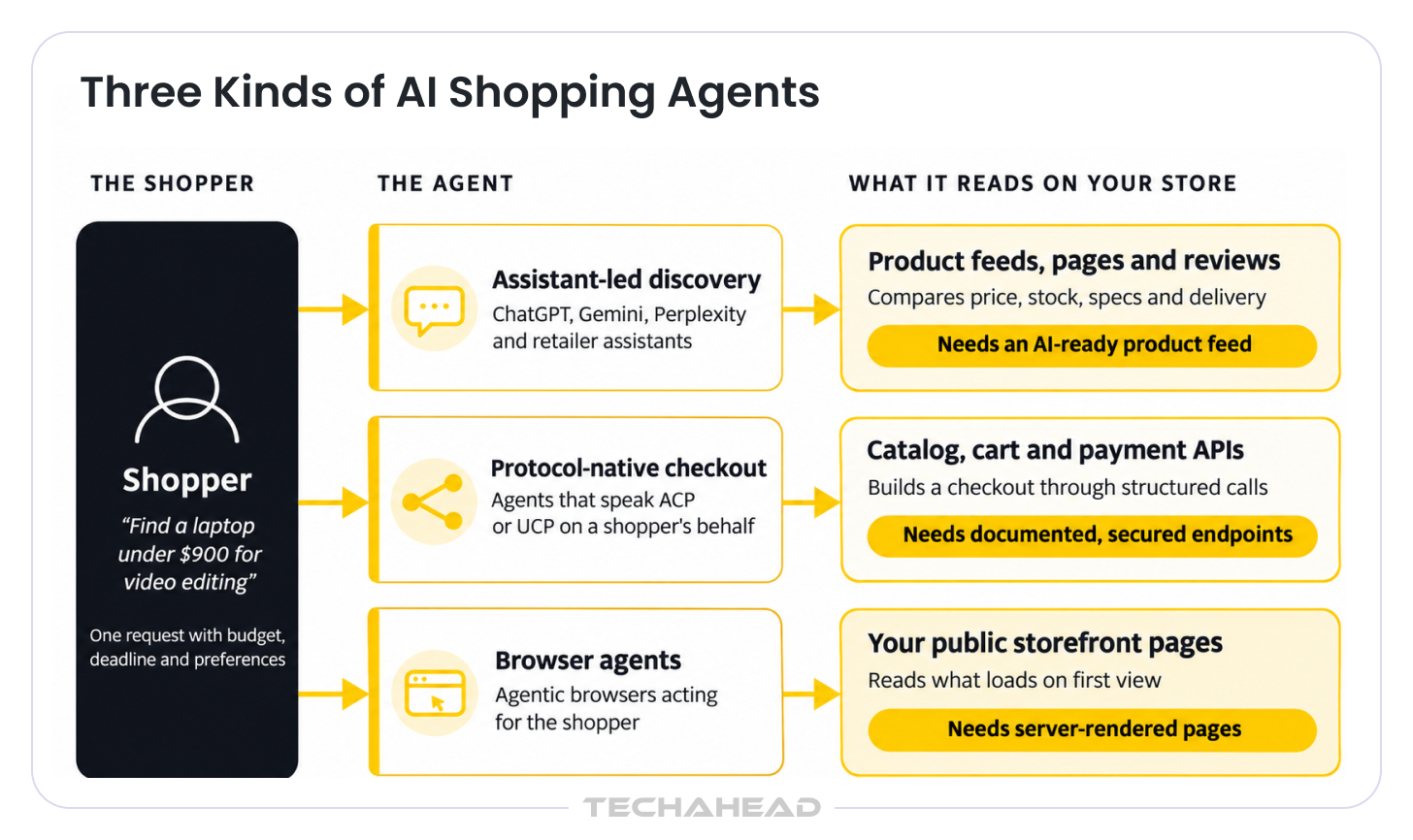
The phrase AI shopping agents covers three distinct behaviors, and each one asks something different of your stack. Planning for each separately gives every surface the attention it needs on Black Friday and beyond.
| Agent type | Where it shows up | What it reads | What it needs from you |
| Assistant-led discovery | An AI shopping assistant in ChatGPT, Gemini, Perplexity or a retailer app | Product feeds, product pages and reviews | An AI-ready product feed and structured product data |
| Protocol-native checkout | Agents that speak ACP or UCP | Merchant endpoints for catalog, cart and payment | Stable, documented endpoints and payment authorization |
| Browser agents | Agentic browsers acting on a shopper’s behalf | Your public pages, as a person would see them | Fast, server-rendered pages and clear handling of agent identity |
The AAIF guide to how agentic commerce works observes that agentic commerce runs on several protocols working together, with each one covering part of the purchase. Agents use protocols where merchants support them and use ordinary websites everywhere else, so a durable readiness plan covers both routes.
Agentic commerce readiness becomes manageable when it has four layers and a score. We call the framework V-V-T-G: Visible, Verifiable, Transactable and Governable. Each layer receives a score from zero to three, for a maximum of twelve.
| Layer | The executive question | What a score of 3 looks like |
| Visible | Can agents reach and parse our store? | Verified agents are admitted, pages render on the server and an AI-ready product feed is live. |
| Verifiable | Can agents trust our price, stock and policies? | One source of truth feeds every channel, and promotions match across product page, cart and checkout. |
| Transactable | Can agents complete a purchase with us? | Documented endpoints support the protocols our customers use, with secure payment authorization. |
| Governable | Can we control and audit what agents do? | Spend limits, audit trails, human handoff and capacity controls are in place and tested. |
Scoring each layer separately shows where investment creates the most movement in agentic commerce readiness, and it gives the board a single number to track from quarter to quarter.
Visibility starts with access, and AI shopping agents will reach your store through several routes on Black Friday. Many bot-management tools were configured years ago to protect stores and customers, and those settings sometimes treat a legitimate shopping agent like any other automated visitor. Updating those rules to recognize verified agents is one of the fastest improvements available this week.
Agent identity is maturing quickly. The AAIF guide points to Web Bot Auth and the Trusted Agent Protocol as current approaches for identifying an agent that arrives through an existing website. Identity-aware access controls let retailers welcome AI shopping agents that identify themselves and keep protection high for everything else.
The legal landscape reinforces the case for planning. A federal court granted Amazon an injunction against Perplexity’s Comet agent in March 2026, and the Ninth Circuit later vacated that injunction. The signal for retailers is that steady arrivals of AI shopping agents are the planning assumption for 2027.
Product data completes the picture. A recent audit of 207 high-traffic product pages across 29 retailers found that only about three in ten met Universal Commerce Protocol expectations. An AI-ready product feed with complete attributes, identifiers such as GTIN, delivery estimates and policy fields gives every AI shopping agent the structured product data it needs to include your products in a shortlist. Server-rendered pages give browser agents the full content on first load.
AI shopping agents compare current prices with price history and with rival offers, so consistency becomes a brand asset. A promotional price that appears in the same form on the product page, the cart and the checkout earns trust from agents and from people alike.
Freshness carries equal weight. Black Friday pricing moves quickly, sometimes hour by hour, and agents act on whatever the feed says at that moment. A feed freshness target measured in minutes keeps the price an agent sees aligned with the price a shopper pays. The same discipline applies to inventory, where an in-stock signal that matches the warehouse creates a smooth order and a satisfied customer.
This is where the leader conversation begins. Agents compare offers across retailers instantly, which makes pricing discipline a leadership topic, so leaders benefit from setting price floors, promotion calendars and approval rules before Friday. A pricing engine that responds in real time lets the business compete on its own terms and protect contribution margin.
Recommendation share is the metric to watch. Products first reach baseline credibility, with a bestseller rank in the top and high ratings. Content optimization then raises what the researchers call share of agent recommendations, and an agent returns an average of eight items per search. Reviews, ratings and product detail therefore function as visibility assets.
Also read our complete agentic AI development guide explaining how to build, govern, and scale AI agents.
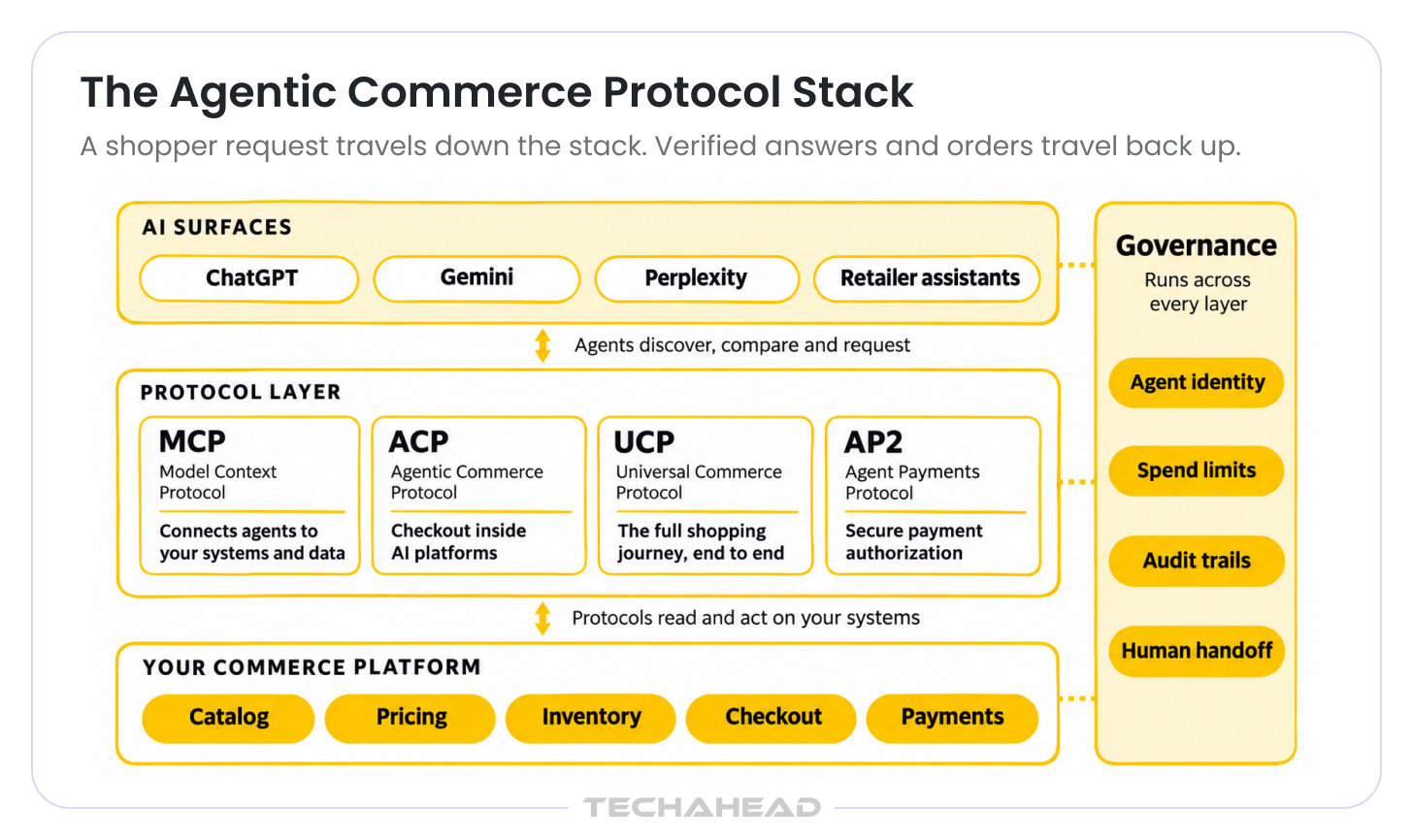
Four acronyms dominate the conversation, and each has a clear job. MCP, the Model Context Protocol, is the connection layer that lets agents securely use business systems and data. The Agentic Commerce Protocol, or ACP, was built by OpenAI and Stripe and released in September 2025 to let agents complete purchases from merchants so merchants keep their existing backend. The Universal Commerce Protocol, or UCP, was announced by Google in January 2026 and covers a broader journey that includes discovery, cart, checkout and post-purchase support. AP2, the Agent Payments Protocol, adds the secure authorization layer that agentic payments rely on.
UCP and AP2 work like HTTP and SSL for the AI era, with one providing a shared language for catalogs and carts and the other providing secure payment. For executives, the useful takeaway is that agentic commerce is assembling as a protocol stack. The stack rewards organizations that build clean data and clean endpoints once and extend them as standards mature. Agentic payments, in particular, reward early clarity on authorization and accountability. For a deeper technical comparison, see our guide to MCP, A2A and ACP.
| Layer | The executive question | What a score of 3 looks like |
| Visible | Can agents reach and parse our store? | Verified agents are admitted, pages render on the server and an AI-ready product feed is live. |
| Verifiable | Can agents trust our price, stock and policies? | One source of truth feeds every channel, and promotions match across product page, cart and checkout. |
| Transactable | Can agents complete a purchase with us? | Documented endpoints support the protocols our customers use, with secure payment authorization. |
| Governable | Can we control and audit what agents do? | Spend limits, audit trails, human handoff and capacity controls are in place and tested. |
A sequencing principle applies. Product data, pricing integrity and policy consistency come first, because every protocol depends on them. Endpoints and checkout integrations follow once those foundations score well. Our view is that a full checkout redesign delivers more value after the basics are in place than before Friday.
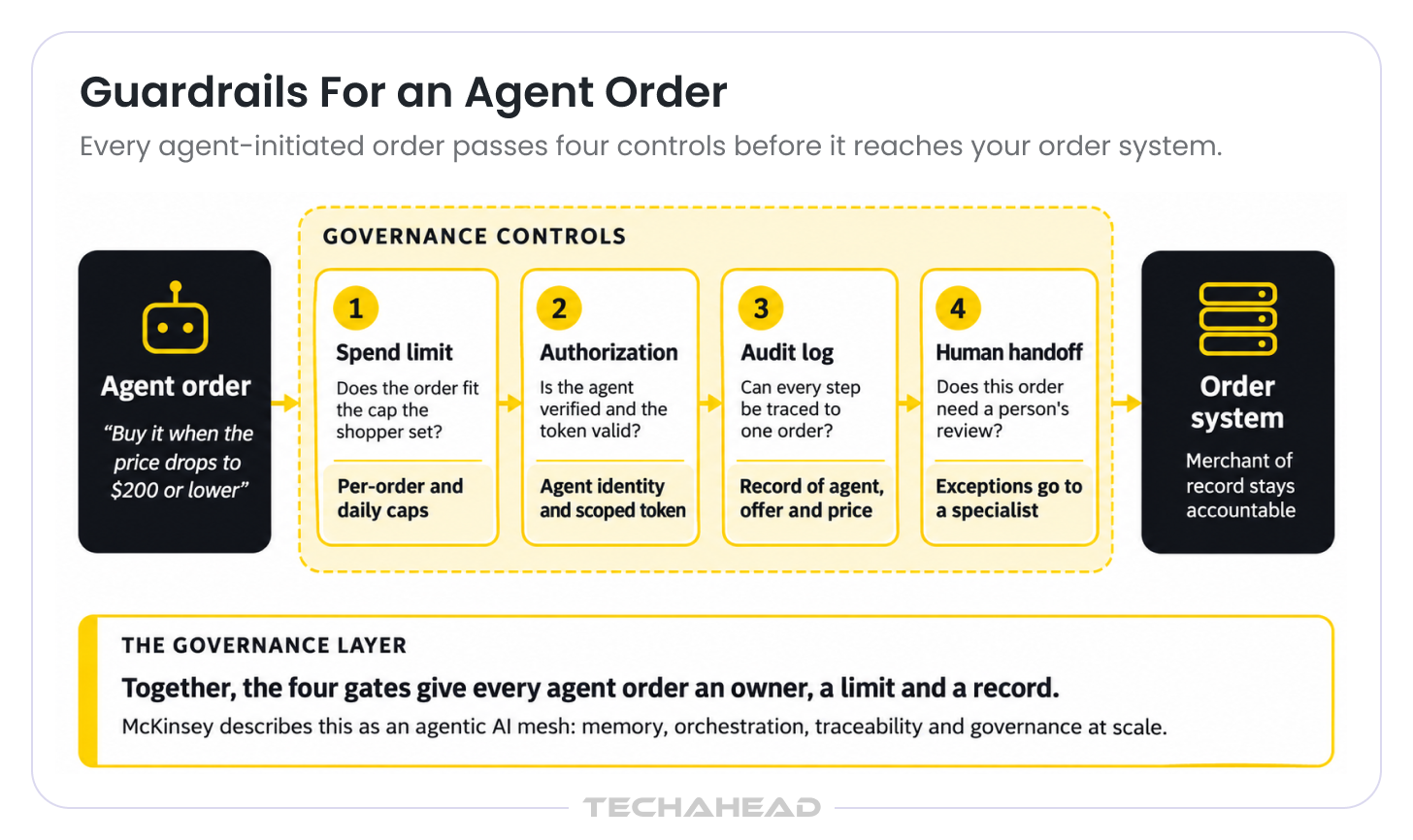
Governance converts AI shopping agent traffic into trusted revenue. An agentic AI mesh is like a software architecture that coordinates memory, orchestration, traceability and governance at scale. Four working parts translate that idea into daily operations:
Trust also depends on transparency. Retailers that publish accurate, verifiable product and policy data give those consumers a reason to rely on the answers an agent gives about their brand.
Capacity planning belongs in the same conversation. It was observed that during Black Friday and Cyber Monday 2025, agent traffic rose more than 28% from the pre-Black Friday baseline to its peak, and daily traffic directed at shopping sites rose 144.7%. Rate limits, autoscaling and monitoring for agent sessions keep the experience smooth for every shopper.
TechAhead builds these controls into enterprise AI agent development programs that are trusted. and operates under ISO/IEC 42001 AI governance, SOC 2 Type II and ISO 27001 certifications.
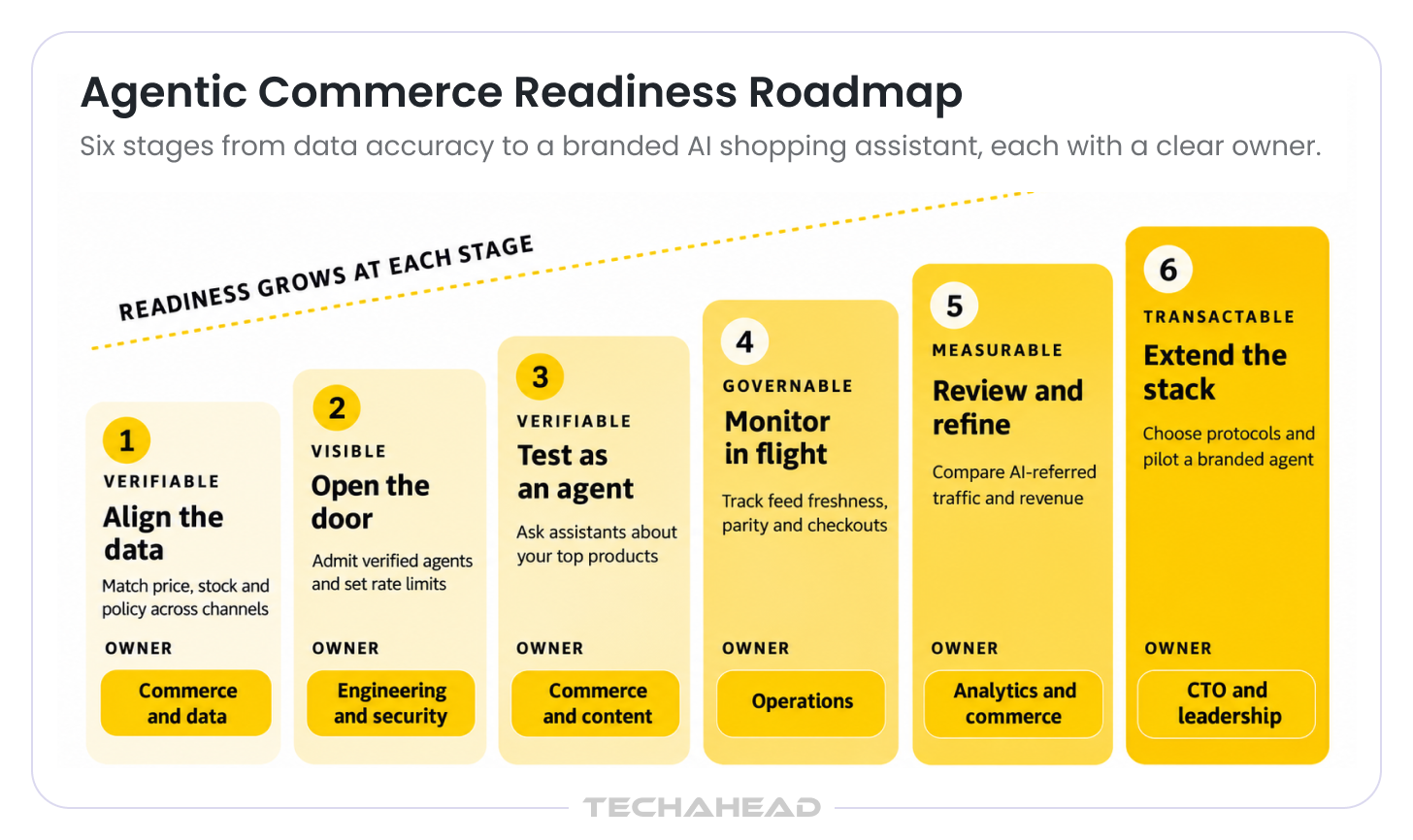
Sequencing creates the most value, and the same six stages apply whether Black Friday is days away or already behind you. Each stage names an owner, so the roadmap works as a shared plan across commerce, engineering, security and leadership.
| Stage | Focus | Actions |
| 1. Align the data | Verifiable | Confirm price, stock and policy parity across product pages, cart and checkout for priority products. Validate the AI-ready product feed against live inventory. |
| 2. Open the door | Visible | Update bot-management rules to admit verified agents. Confirm server-rendered pages and structured product data. Set rate limits for agent sessions. |
| 3. Test as an agent | Verifiable | Ask the major AI assistants about your top products and record how they describe price, delivery and returns. Route promotion and feed changes through an approval path. |
| 4. Monitor in flight | Governable | During peak events such as Black Friday, track feed freshness, price parity, stock accuracy and agent checkout success. Keep an incident owner ready for pricing or inventory corrections. |
| 5. Review and refine | Measurable | Compare AI-referred sessions, conversion and revenue per visit against other traffic. Refresh the facts that assistants cite so they match your site. |
| 6. Extend the stack | Transactable | Choose the protocol path, build endpoints for it, approve the governance model and pilot a branded AI shopping assistant on owned channels. |
Our guide to 15 prompts shoppers will use with AI shopping agents offers a ready list for the third stage.
How to Measure AI Shopping Agent Revenue and Recommendation Share
Analytics platforms label AI referrals in different ways, so agreeing on definitions before Black Friday gives the leadership team a reliable view. A compact scorecard works well:
Adobe’s research gives a benchmark. AI-referred retail visitors converted 60% more often than other traffic in July 2026, and the September figure reached 90%. A widening gap of that size gives finance teams a concrete reason to track AI-referred revenue as its own line.
The strategic question for 2027 is where to compete for the shopper’s attention. Three positions are available: appear well inside the assistants shoppers already use, build a branded AI shopping assistant on owned channels, or combine both.
Read our blog Build vs Buy vs Partner AI for an in-depth understanding on what’s the best route for AI adoption.
Black Friday results give the pilot its baseline, and the roadmap above keeps investment proportionate. Complete the V-V-T-G agentic commerce readiness scorecard and agree on KPIs first, build the AI-ready product feed, protocol endpoints and governance controls next, and then pilot a branded AI shopping assistant on owned channels and review the results against the scorecard.
Specialist partners add speed at the pilot stage, and enterprise AI agent development experience shortens the path from scorecard to production.
TechAhead offers Agentic AI services and Retail and eCommerce services that cover these stages for product, data and security leaders.
Four Assumptions About AI Shopping Agents Leaders Should Update
Agents evaluate structured fields, so complete attributes, identifiers and delivery details deliver more value than extra copy.
Planning for a protocol stack, as the AAIF guide describes, protects the investment.
Identity-aware rules welcome verified agents and keep protection strong.
It is a data, engineering and governance program, and SEO teams gain the most when they partner with commerce and security leaders.
AI shopping agents have moved from experiment to channel in a single year. Black Friday offers the first large-scale view of what that means for your store, and leaders who treat it as an agentic commerce readiness milestone will carry the learning into 2027.
Build an eCommerce platform equipped to handle complex workflows, intelligent recommendations, and automated business processes. Explore TechAhead’s Agentic AI development services that help businesses integrate intelligent agents that support customer experiences and business growth.
Fix the data before Black Friday, decide on protocols and governance in the first quarter, and measure agent influence with the same rigor applied to every other channel.
Ready to score your store on the four layers? Talk to the TechAhead AI team about an agentic commerce readiness review that turns this point of view into a prioritized plan.
Agentic commerce is a method of shopping in which an AI agent researches, compares and often buys on a shopper’s behalf, within limits the shopper sets.
They favor stores whose product data, price, stock and policies are complete, current and consistent. Structured product data, an accurate feed and clear delivery and returns terms give agents the confidence to include a store in a shortlist.
MCP connects agents to business systems, ACP supports checkout inside AI platforms and UCP covers the wider shopping journey. Most enterprises start with data and policy foundations, then add endpoints for the protocols their customers use, often through their commerce platform.
Use identity-aware bot management that admits verified agents, applies rate limits to agent sessions and keeps strong protection for unverified automation.
Agree on definitions for AI-referred traffic, then track AI-referred share of sessions, conversion, revenue per visit, agent checkout success and share of agent recommendations. A shared definition keeps reporting consistent across analytics tools, and Black Friday and Cyber Monday supply the first baseline.
Agent checkout and agentic payments are safe when spend limits, authorization tokens, audit trails and human handoff are in place. The merchant of record remains accountable for the order, so governance belongs in the design from the start.
A chatbot answers a question and waits for the next one. An AI agent carries a request through several steps, such as researching products, comparing offers and completing a purchase within set limits.
A focused team can complete the Visible and Verifiable layers for priority products within weeks. The Transactable and Governable layers typically follow over a quarter, in line with the roadmap above.
We use cookies to ensure our website functions properly, improve performance, and provide a personalized experience. You can choose which types of cookies to allow below.
Required for core functionality such as security, network management, and accessibility. These cannot be disabled.
Help us understand site traffic and user interactions so we can improve performance and usability.
Enable enhanced functionality and personalization such as language or region preferences.
Used to deliver relevant ads, track campaign performance, and measure advertising effectiveness.