


 Copy Link
 Share on X
 Share on Facebook
 Share on LinkedIn
Always Active
Required for core functionality such as security, network management, and accessibility. These cannot be disabled.

Uncover the transformative potential of digital and mobile solutions for your industry.





 Last Updated: Sep 22, 2026
May 11, 2026
Last Updated: Sep 22, 2026
May 11, 2026  675
675  40 min. Read


Key Takeaways
Sixteen years ago, TechAhead built its first mobile application. Back then, “IoT” was not even a mainstream enterprise conversation. Today, the enterprises running connected intelligence are not just operating more efficiently; they are preventing failures before they happen, cutting operational costs by 30-40%. The gap between IoT-enabled operations and manual ones is widening every quarter.
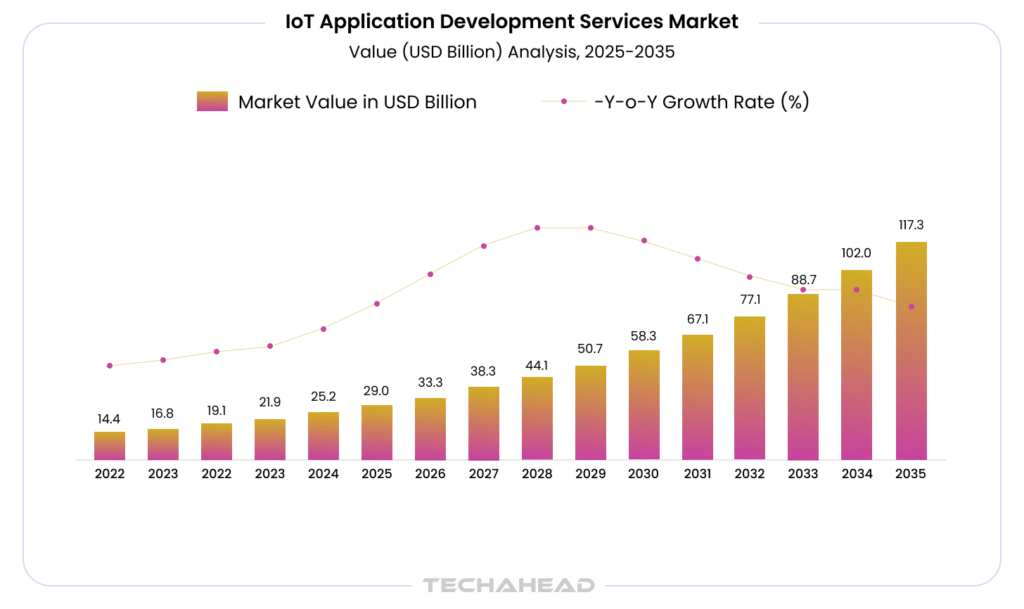
The IoT application development services market is valued at $29.0 billion in 2025 and projected to reach $117.3 billion by 2035; a 15% CAGR that reflects how aggressively enterprises are investing in connected intelligence. That capital is going somewhere. The question is whether it is going toward IoT systems that transform operations or toward connected dashboards that nobody acts on.
At TechAhead, we have built enterprise IoT systems for Fortune 500 clients across commercial real estate, healthcare, insurance, and smart home; SOC 2 Type II certified, ISO 42001 governed, AWS Advanced Tier backed. We know exactly where enterprise IoT investments deliver measurable returns and where they quietly drain budgets.
This guide exists because most IoT resources tell you what is possible. This one tells you what is practical, what it costs, and what separates the IoT deployments that show up on a P&L from the ones that just show up on a dashboard.
IoT is a network of physical devices (sensors, machines, and systems) connected through the internet to collect, share, and act on real-world data automatically.
However, behind every IoT application is a stack of interconnected engineering decisions, device communication protocols, real-time data pipelines, edge computing architecture, cloud infrastructure, and security frameworks.
All these compound into a system your operations either depend on or struggle to maintain.
At its core, IoT app development covers:
Device connectivity & communication: protocols like MQTT, CoAP, and Zigbee that determine how physical devices talk to your application
Real-time data processing: streaming pipelines that handle thousands of simultaneous device events without latency
Edge computing: processing data at the device level before it reaches the cloud, reducing bandwidth and improving response times
Cloud infrastructure: scalable backend architecture that stores, analyzes, and acts on device data at enterprise scale
IoT software platforms: solutions that support the creation and management of interconnected devices within large-scale IoT ecosystems
Mobile and web interfaces: the dashboards and apps that make device data actionable for the humans who need it
Security & encryption: end-to-end protection for device communication, data transmission, and user access
AI & predictive analytics: intelligent layers that analyze data and turn raw device data into operational decisions before problems surface
Now, what separates a production-grade IoT application from an expensive proof of concept? It is the architecture and data flow that keep those devices communicating intelligently within robust IoT ecosystems.
At TechAhead, we have built IoT systems for JLL managing 5.4 billion square feet of global real estate, and Heatmiser’s smart home platform connecting thousands of heating devices across the UK. These are not lab-scale IoT, these are enterprise IoT under real operational pressure—powered by IoT technology.
Most people understand that IoT connects physical devices to digital systems. What they underestimate is how many engineering layers sit between a temperature sensor on a factory floor and the dashboard a plant manager reads on their phone.
Worldwide IoT connections reached 21.9 billion in 2026, and every single one of those connections depends on four distinct layers working together without a single point of failure.
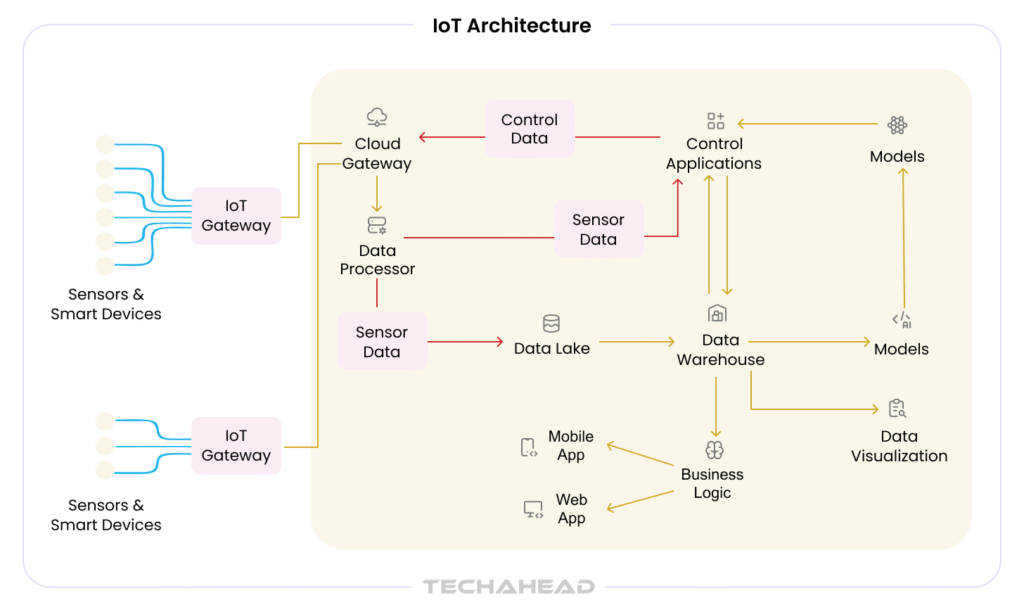
Advanced network infrastructure and seamless data transfer are essential for reliable IoT operation, ensuring that data flows efficiently between interconnected devices across diverse environments.
Here is what those layers actually look like in production:
Here everything starts with the physical world. Sensors, actuators, wearables, industrial machines, smart meters, connected vehicles, IoT sensors, and wearable devices; these are the endpoints that generate the data IoT systems run on.
The number of IoT devices worldwide is forecast to more than double from 19.8 billion in 2025 to over 40.6 billion by 2034.
Source: Statista
It means the device layer is growing faster than most enterprise infrastructure teams are prepared for.
At TechAhead, device selection is not a procurement decision we leave to clients alone. For Heatmiser’s smart home platform, the heating controller’s device firmware constraints and communication protocols shaped the entire application architecture, decisions made at the device layer that rippled through every engineering decision that followed.
Optimizing device firmware is especially crucial for battery-powered IoT devices, as poorly optimized firmware or software can rapidly drain batteries and render the system unusable.
Devices generate data. Connectivity determines how that data travels. Wi-Fi holds the top position among IoT connectivity technologies with a 32% share of total global IoT connections, while Bluetooth ranks second at 24% and cellular IoT ranks third at 22%. Here are key connectivity protocols and their enterprise use cases:
For JLL’s Intellicommand platform, different property types, regions, and equipment generations required different connectivity approaches running simultaneously under one unified architecture.
Raw device data without cloud infrastructure is just noise. The global IoT market is valued at $714.48 billion in 2024 and expected to exceed $4 trillion by 2032. The majority of that value is created at the cloud layer.
Cloud storage solutions like AWS S3, Google Cloud Storage, and Azure Blob Storage are essential for securely storing and managing the large volumes of data generated by IoT devices.
However, cloud infrastructure for IoT covers device management, data ingestion pipelines, stream processing, storage architecture, and the APIs that make device data accessible to applications and dashboards.
Cloud computing plays a critical role in processing and analyzing the data generated by connected devices, enabling scalable and efficient data workflows. Cloud services also facilitate integration with enterprise systems, providing centralized data visibility and improved decision-making across departments.
As an AWS Advanced Tier partner, TechAhead builds IoT cloud infrastructure on AWS IoT Core which handles device registration, message routing, and real-time event processing for enterprise deployments.
When building APIs and dashboards, we integrate analytics tools to help derive actionable insights from stored data. Leading IoT platforms provide comprehensive services including device management, analytics, security, and scalability to support data-driven IoT applications.
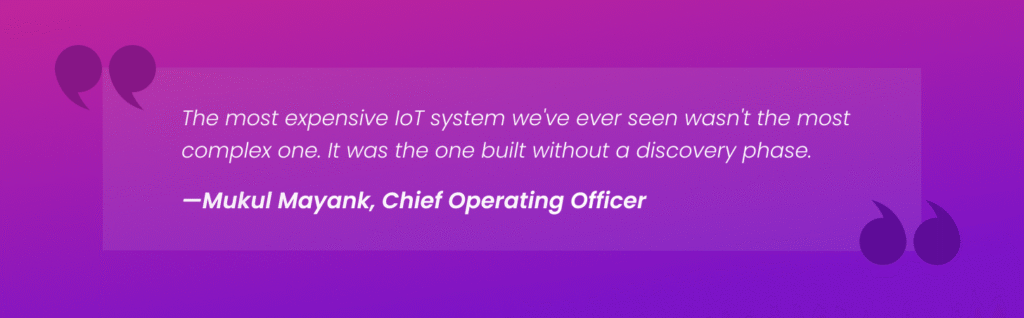
The cloud layer processes the data. The application layer puts it in front of the humans who need to act on it. Dashboards, mobile apps, user interfaces, alerting systems, automated workflows, and AI-powered analytics; these are the interfaces that determine whether an IoT investment delivers operational value or just generates data nobody looks at.
User interfaces facilitate interaction between users and connected devices, enabling real-time communication and data visualization. IoT applications can also deliver personalized services by analyzing user preferences and providing tailored recommendations, further enhancing user satisfaction.
Process automation leads IoT adoption with a 58% adoption rate, followed by quality control and management at 55% and energy monitoring at 55%. These tell you exactly what enterprise buyers are actually trying to achieve with IoT applications. Not connectivity for its own sake. Operational outcomes that show up on a P&L.
Features like remote access and remote monitoring enhance convenience, comfort, and security, allowing users to control and monitor devices from anywhere, which is especially valuable in inaccessible or harsh environments.
For JLL, the application layer translated IoT equipment data into predictive maintenance alerts that field technicians acted on before failures occurred. That is the difference between an IoT system that connects devices and one that saves $10M annually.
Unlike smart devices, which are standalone and perform single tasks independently, IoT devices are integrated into connected systems for data sharing, monitoring, and automation.
Most people use IoT and IIoT interchangeably. They should not. The distinction is not just academic, it is actually in the architecture you build. While IoT primarily enhances consumer experiences and IIoT focuses on industrial environments, both significantly impact business processes and operational efficiency.
IoT or AIoT applications streamline workflows and automate tasks, while IIoT solutions are designed to optimize decision-making and productivity in complex enterprise and manufacturing settings, shaping both the technical approach and the outcomes achieved.
Consumer IoT connects everyday devices to improve personal convenience and lifestyle. Smart speakers, home thermostats, fitness wearables, connected appliances, security cameras; these are products designed for ease of use, intuitive setup, and broad market appeal.
Characteristics of Consumer IoT
Heatmiser’s smart home platform is consumer IoT, but consumer IoT with a level of platform compliance complexity most enterprise teams do not anticipate.
When TechAhead built Heatmiser’s iOS heating control application, the design goal was deceptively simple; give homeowners intuitive, real-time control over their heating systems from their phone.
What that actually required was navigating Apple’s HomeKit compliance framework, which reshaped the entire device communication architecture before a single UI screen was designed. IoT device communication protocols and firmware constraints surfaced during discovery that the original brief had not accounted for.
The result was a polished iOS experience that felt effortless to the homeowner. What they never saw was the engineering underneath (NFC device pairing, HomeKit-compliant data transmission, and background monitoring architecture) that required as much precision as any industrial system we have built.
IIoT applies connected device technology to industrial environments, which means manufacturing plants, energy grids, supply chains, commercial real estate, healthcare infrastructure. The stakes are fundamentally different. Reliability, security, and precision are not design preferences; they are operational requirements.
Characteristics of IIoT
JLL’s Intellicommand platform is Industrial IoT in its most demanding form. Managing equipment health across 5.4 billion square feet of global real estate across thousands of properties, dozens of building management systems, and equipment from multiple vendors and generations.
When we started this engagement at TechAhead, the brief sounded manageable. Connect field technicians to real-time equipment data. Surface predictive maintenance alerts before failures occur. The reality was significantly more complex. Building management APIs varied across property types and regions. Some systems had no documented APIs at all.
Data schemas were inconsistent across facilities. A sensor failure in this environment does not generate a missed notification; it means an undetected equipment fault cascading into unplanned downtime across a property that JLL’s clients depend on daily.
The outcome validated the architecture; $10M saved annually in maintenance costs, 60% reduction in unplanned equipment failures, and 30% decrease in downtime across the portfolio. That is what IIoT built correctly actually delivers.
The enterprise IoT conversation has shifted. Three years ago, leadership teams were asking whether IoT was worth the investment. Today, the IoT world is rapidly expanding, with enterprises competing in an increasingly crowded IoT space where the interconnected ecosystem of devices, sensors, and systems is transforming how businesses operate.
The reality is, the worldwide spending on IoT is expected to exceed $862.75 billion in 2026, growing toward $1.3 trillion by 2030. Here is what is driving that shift, and why the enterprises moving fastest are pulling away from the ones still deliberating.
The most compelling IoT business case is not innovation; it is elimination. Elimination of unplanned downtime. Elimination of manual inspection cycles. Elimination of the maintenance costs that compound quietly every quarter on aging infrastructure.
When TechAhead built JLL’s Intellicommand platform, the business case was not built around technology; it was built around $10M in annual operational savings. Predictive maintenance alerts that caught equipment faults before failures occurred. Real-time health monitoring that replaced scheduled inspections with condition-based maintenance.
Energy consumption data that identified inefficiencies across thousands of properties simultaneously. Here IoT did not just reduce costs; it fundamentally changed how JLL’s operations team made decisions.
Most enterprise operations run on delayed data. Reports generated yesterday. Inspections completed last week. Inventory counts from last month. IoT changes the fundamental latency of operational intelligence; from periodic snapshots to continuous visibility across every asset, every location, every moment.
IoT generates data. AI turns that data into decisions. Separately, both are powerful. Together, they are transformative. The edge AI market is projected to grow from $24.91 billion in 2025 to $118.69 billion by 2033, driven largely by IoT deployments where processing data at the device level delivers faster decisions and lower cloud infrastructure costs.
Integrating AI with IoT creates intelligent systems capable of autonomous operation, enhanced decision-making, and adaptive responses across various applications.
At TechAhead, as Claude & OpenAI partner with ISO 42001 certification and an AI development company, we architect AI in IoT solutions that modernize enterprises as a unified system where device data feeds intelligent models that trigger autonomous actions before a human needs to get involved.
For JLL, that meant a predictive ML pipeline that did not just alert technicians to equipment problems; it diagnosed the fault pattern, estimated remaining useful life, and recommended the maintenance action.
These AI models can also identify unusual data patterns that may indicate security breaches or other anomalies, ensuring greater system reliability and safety. The technician arrived with the right parts, at the right time, with the right information. That is the IoT and AI working exactly the way enterprise operations need them to.
The competitors who implemented IoT two years ago are operating with visibility, efficiency, and cost structures that manual operations simply cannot match. Fortune Business Insights projects the global IoT market to reach $4.06 trillion by 2032 at a 24.3% CAGR, which means the gap between IoT-enabled enterprises and those still evaluating is widening every quarter.
Every enterprise IoT conversation eventually lands on the same question: what is the return? And it is the right question. Building an IoT system without a defined ROI model is not innovation. It is expensive experimentation on your operational budget.
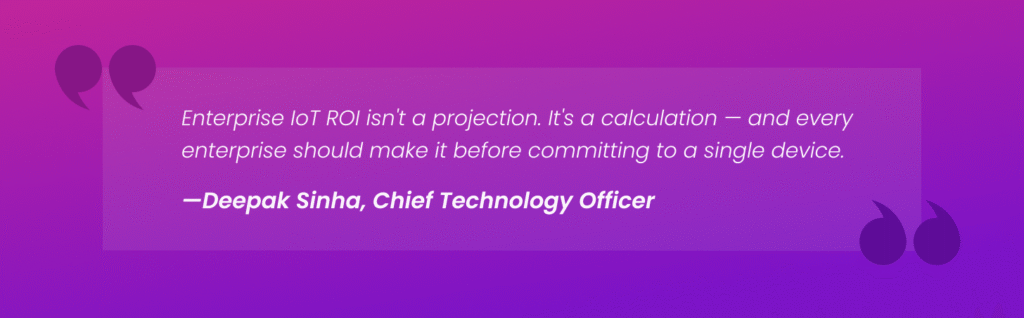
At TechAhead, we run an ROI framework in discovery, before architecture decisions are made, and before a budget number is committed to. Here is how that calculation actually works.
ROI starts with an honest number on the left side of the equation. What is your existing problem actually costing you?
For JLL, quantifying unplanned equipment failures across 5.4 billion square feet of real estate produced a number that made the IoT investment decision simple. The cost of the problem (measured in downtime, emergency maintenance, and energy waste) significantly exceeded the cost of solving it.
Vague IoT benefits do not build board-approved business cases. Specific, measurable outcomes do:
| Current Problem | IoT Solution | Measurable Outcome |
| Unplanned equipment failures | Predictive maintenance sensors | 60% reduction in unplanned failures |
| Manual energy monitoring | Real-time consumption tracking | 20% reduction in energy costs |
| Reactive field service dispatch | Condition-based maintenance alerts | 30% decrease in equipment downtime |
| Manual inventory counts | Asset tracking and RFID integration | 40% reduction in inventory discrepancy |
| Paper-based compliance reporting | Automated audit trail generation | 70% reduction in compliance documentation time |
IoT ROI is not just build cost versus savings. It is the total cost of ownership including hardware, connectivity, cloud infrastructure, development, integration, security, ongoing maintenance versus the quantified operational improvements your system delivers.
A realistic IoT TCO model covers:
At TechAhead, most enterprise IoT clients with well-defined problem statements reach positive ROI within 12-18 months.
The most important ROI calculation is the one you do before the first architecture decision is made, in discovery, with your operational data, mapped against specific outcomes your business actually measures. That is the calculation that separates IoT investments that transform operations from IoT pilots that generate dashboards nobody reads.
The more useful question is not whether your industry is ready for IoT; it is whether your operations can afford to keep running without it.
Every major industry vertical is already seeing IoT deployments from competitors who moved first.
The industry readiness question was relevant in 2018. In 2026, the question is simpler: how far behind do you want to be before you start?
IoT app development follows a more complex lifecycle than standard mobile or web development because you are not just building software. You are building a system where physical hardware, communication protocols, cloud infrastructure, and user-facing applications, including next-generation mobile apps with IoT and bots, all need to work together, reliably, under real-world conditions that no test environment fully replicates.
At TechAhead, this is the IoT application development process we follow, refined across 16+ years and enterprise IoT deployments for clients including JLL and Heatmiser. Every stage exists for a reason. Skipping any of them shows up not during development, but after launch, when fixing it costs significantly more.
Every IoT project that goes over budget skipped this stage, or rushed it.
Discovery for IoT is significantly more involved than standard app discovery. It covers device selection and compatibility assessment, connectivity protocol evaluation, existing infrastructure mapping, data volume estimation, compliance requirement identification, and security architecture planning; all before a single line of code is written.
For JLL’s Intellicommand platform, discovery revealed building management APIs that varied across property types, regions, and equipment vendors. None of that was visible in the brief. All of it shaped the architecture. Finding it in week two cost hours. Finding it in week twelve would have cost months.
Software engineers who have never prototyped with physical hardware underestimate this stage consistently.
Hardware selection covers sensor types, microcontroller specifications, communication module compatibility, power supply requirements, and enclosure specifications for the deployment environment.
A sensor selected for a climate-controlled server room performs completely differently in an outdoor industrial environment. A communication module that works perfectly in a dense WiFi environment fails in a warehouse with signal interference.
At TechAhead, hardware prototyping runs in parallel with early software architecture because firmware constraints, communication protocol limitations, and device capabilities discovered in prototyping directly affect the software decisions that follow, the same systems thinking we apply as a custom software development company.
This is the layer most enterprises forget to budget for and the one that determines whether your devices communicate reliably or intermittently.
Firmware development covers device initialization sequences, sensor data collection logic, communication protocol implementation, power management optimization, and over-the-air update capability.
For battery-powered IoT devices, power management is the engineering discipline that determines whether your device lasts six months or six years on a single charge.
This is where device data becomes enterprise intelligence.
Cloud infrastructure for IoT covers device registry and management, message ingestion pipelines, stream processing for real-time event handling, time-series data storage, API layer for application consumption, and security controls for device-to-cloud communication.
As an AWS Advanced Tier partner and IoT app development company, TechAhead builds IoT cloud infrastructure on AWS IoT Core, giving enterprise clients a managed, scalable, and secure backbone for device communication that does not require a dedicated DevOps team to maintain.
The application layer is where device data becomes actionable for the humans who need it.
Mobile app development for IoT covers mobile apps, web dashboards, alerting systems, and automated workflow triggers—these are the interfaces that determine whether an IoT investment delivers operational value or just generates data nobody acts on.
IoT mobile app development is especially important, as it enables seamless integration between digital and physical systems, driving digital transformation and supporting the future of interconnected IoT ecosystems.
At TechAhead, application development for IoT follows the same lifecycle as our standard mobile development: Swift for iOS, Kotlin for Android, React Native or Flutter for cross-platform with the additional complexity of real-time data synchronization, device state management, and edge case handling for connectivity interruptions.
IoT security is a foundational architecture requirement, and one of the most commonly underscoped line items in IoT project proposals. Every device is a potential attack surface. Every communication channel is a potential interception point. Every cloud API is a potential unauthorized access vector.
Our SOC 2 Type II certification and ISO 27001 framework mean IoT security architecture is an audited engineering standard, not a checklist completed before launch. Device authentication, end-to-end encryption, certificate management, anomaly detection, and penetration testing all run before a single device goes into production.
For enterprise IoT deployments in regulated industries (healthcare, fintech, insurance) security architecture also carries compliance implications that standard IoT vendors are not equipped to handle. Besides that, our ISO 42001 certification adds an additional governance layer for IoT systems with AI-powered features.
Testing an IoT system is fundamentally different from testing a standard mobile app because the failure modes are fundamentally different. Communication protocols behave differently under interference. Cloud message queues back up under unexpected load. Edge cases that never appeared in a lab environment surface the moment real devices operate in real environments.
Our IoT testing covers device interoperability across hardware variants, connectivity resilience under degraded network conditions, cloud infrastructure load testing at projected device scale, and end-to-end integration testing across every system the IoT platform connects to.
Post-launch monitoring for IoT is not optional, it is the operational infrastructure that keeps the system performing after go-live.
Device health monitoring, connectivity anomaly detection, cloud infrastructure scaling, and ongoing security patch management are all part of every TechAhead IoT engagement because an IoT system that performs perfectly on launch day and degrades quietly over the following six months is not a successful deployment. It is a delayed problem.
It depends entirely on what you are building, how many physical devices are involved, and how much of your existing infrastructure actually has documented APIs. Simple IoT applications can move from discovery to launch in 12–16 weeks.
Enterprise IoT deployments rarely fit that description, which is why understanding how long it will take to create an IoT application for your specific use case is a critical part of early planning. Advanced IoT apps, which connect multiple devices and include features like real-time data analytics or geolocation, typically incur higher development costs due to their increased complexity.
| IoT Project Type | Timeline |
| Simple single-device IoT app | 12–16 weeks |
| Mid-complexity multi-device platform | 6–9 months |
| Enterprise IoT with legacy integration | 9–14 months |
| Full IIoT platform with AI and compliance | 12–18+ months |
IoT development costs more than most enterprises anticipate and less than most enterprises spend when they skip discovery and find out mid-build. The range is wide because the variables are genuinely wide. A single-device consumer IoT app connecting a smart home product to an iOS interface is a fundamentally different engineering problem than an industrial IoT platform monitoring thousands of assets across global enterprise infrastructure. Advanced IoT apps that connect multiple devices and leverage features such as real-time analytics or geolocation will fall on the higher end of the cost spectrum.
IoT project costs vary dramatically by complexity. Here is what each tier actually costs, and what drives the difference:
| Project Type | Description | Typical Cost Range | Timeline |
| Simple Consumer IoT App | Single device type, basic cloud connectivity, mobile interface | $30,000–$80,000 | 12–16 weeks |
| Mid-Complexity IoT Platform | Multiple device types, real-time data, custom dashboard | $80,000–$200,000 | 4–7 months |
| Enterprise IoT System | Legacy integration, multi-site deployment, advanced analytics | $200,000–$600,000 | 7–12 months |
| Industrial IIoT Platform | Mission-critical, compliance controls, AI-powered, global scale | $500,000–$1,500,000+ | 12–18+ months |
| IoT Proof of Concept | Scoped discovery, single device prototype, feasibility validation | $15,000–$40,000 | 4–8 weeks |
Understanding what each IoT component costs separately is the only way to know if your vendor’s total number makes sense:
| Cost Component | Description | Cost Range |
| Discovery & Architecture Planning | Device assessment, protocol selection, compliance mapping | $15,000–$50,000 |
| Hardware & Firmware Development | Device selection, embedded software, OTA update capability | $20,000–$150,000 |
| Cloud Infrastructure Setup | AWS IoT Core, device registry, message pipelines, storage | $25,000–$120,000 |
| Application Development (Mobile/Web) | iOS, Android, or cross-platform dashboard and control interface | $40,000–$200,000 |
| System Integration | ERP, CRM, legacy infrastructure, third-party API connections | $20,000–$150,000 |
| Security & Compliance Implementation | Encryption, penetration testing, SOC 2, HIPAA, ISO compliance | $20,000–$100,000 |
| AI & Predictive Analytics Layer | ML model development, real-time inference, anomaly detection | $30,000–$150,000 |
| Testing & Quality Assurance | Device interoperability, load testing, security testing | $15,000–$60,000 |
| Post-Launch Maintenance (Annual) | Monitoring, firmware updates, security patches, platform updates | $30,000–$120,000/year |
Hidden Costs Most IoT Proposals Leave Out
Clean IoT proposals do not mean complete ones. These hidden costs are what separate a realistic budget from an optimistic opening position designed to win the contract:
| Hidden Cost | Why It Gets Missed | Cost Range |
| Device certification fees | Hardware must pass FCC, CE, or industry-specific certifications | $10,000–$50,000 |
| Connectivity costs at scale | Per-device cellular or LPWAN data plans compound significantly | $2–$15/device/month |
| Legacy system remediation | Undocumented APIs and inconsistent schemas require unplanned engineering | $20,000–$100,000 |
| Firmware versioning across device fleet | Managing OTA updates across thousands of deployed devices | $10,000–$40,000 |
| Compliance documentation | Regulatory artifacts for HIPAA, SOC 2, ISO 42001 audits | $15,000–$45,000 |
| Edge computing infrastructure | On-premise processing hardware for latency-sensitive IIoT deployments | $20,000–$80,000 |
The most important cost insight we share with every enterprise IoT client at TechAhead is this; the discovery phase that maps every one of these variables before the build starts costs $15,000-$50,000. The change orders generated by skipping it routinely cost ten times that.
As an AWS Advanced Tier partner with SOC 2 Type II and ISO 42001 certifications, we have built the compliance and security cost into our delivery framework from day one, so it does not surface as a surprise in month six of a build that was already over budget before the first device went into production.
The programming language your IoT system is built in determines performance, security, and long-term maintainability. Here are the six languages powering the most reliable enterprise IoT deployments:
The original IoT language, still the standard for firmware and embedded systems where memory constraints, processing speed, and hardware-level control are non-negotiable engineering requirements.
The fastest path from IoT prototype to production analytics. Python’s libraries for data processing, machine learning, and cloud integration make it the dominant language for IoT backend and AI layers.
Enterprise IoT’s backbone language — platform-independent, scalable, and backed by decades of production reliability. Java powers the middleware and enterprise integration layers of large-scale industrial IoT deployments.
The full-stack IoT language. JavaScript runs on device gateways, backend servers, and web dashboards simultaneously — giving teams a single language across every layer of a connected system.
The fastest-growing language in embedded IoT development — delivering C-level performance with memory safety guarantees that prevent entire categories of firmware vulnerabilities that have historically plagued connected device security.
The mobile layer of every enterprise IoT system. Swift powers iOS IoT interfaces — including Heatmiser’s HomeKit-compliant smart home app — while Kotlin handles Android enterprise deployments and device fleet management tools.
| Language | Best For | Performance | IoT Layer |
| C / C++ | Firmware, embedded systems | Highest | Device |
| Python | Backend, AI/ML, rapid prototyping | Moderate | Cloud / Analytics |
| Java | Enterprise middleware, integration | High | Backend / Enterprise |
| JavaScript / Node.js | Full-stack, gateway, dashboards | Moderate | Gateway / Application |
| Rust | Security-critical firmware, embedded | Highest | Device / Edge |
| Swift / Kotlin | iOS and Android mobile interfaces | Near-native | Application |
Every enterprise IoT system needs a cloud backbone, and the platform you choose determines your device management capabilities, data processing architecture, integration options, and long-term infrastructure costs.
Leading IoT platforms like Microsoft Azure IoT Hub play a crucial role by offering device management, secure data ingestion, and advanced security features as part of the broader IoT platform infrastructure and cloud security.
The three dominant platforms each have genuine strengths. The right choice depends on your existing enterprise infrastructure, your device scale, and the specific IoT capabilities your system requires.
At TechAhead, as an AWS Advanced Tier partner, we build most enterprise IoT cloud infrastructure on AWS, but not because it is our default, because for most enterprise IoT use cases, AWS IoT Core’s device management, message routing, and real-time processing capabilities represent the most mature and complete IoT platform available. Here is the details:
AWS IoT Core is the most widely adopted enterprise IoT cloud platform. Device registry, message broker, rules engine, shadow state management, and seamless integration with AWS’s broader analytics, ML, and storage services make it the most complete end-to-end IoT platform available.
For JLL’s Intellicommand platform, AWS provided the cloud backbone that handled real-time IoT data streams across thousands of properties simultaneously — scaling elastically during peak demand without manual infrastructure intervention.
AWS IoT Greengrass extended that capability to the edge — processing time-sensitive device data locally before sending aggregated results to the cloud, reducing latency and bandwidth costs simultaneously.
AWS IoT strengths:
Azure IoT Hub is the platform of choice for enterprises already running Microsoft infrastructure — M365, Dynamics 365, or Azure Active Directory. The integration story is genuinely compelling. IoT device data flows directly into Power BI dashboards, Azure Digital Twins, and existing enterprise data warehouses without custom middleware.
For enterprises where IoT is one component of a broader Microsoft digital transformation, Azure IoT eliminates the integration overhead that cross-platform deployments introduce.
Azure’s Digital Twins capability — creating live virtual models of physical environments — is the most advanced in the market. For smart building, manufacturing, and industrial IoT use cases where simulating physical system behavior adds operational value, Azure Digital Twins has no direct AWS equivalent.
Azure IoT strengths:
Google Cloud IoT is the platform built for enterprises where the primary IoT value driver is data analysis and AI — rather than device management at scale. BigQuery’s ability to analyze billions of IoT data points in seconds, combined with Google’s AI and ML platform, makes GCP the strongest choice for IoT deployments where real-time analytics and predictive modeling are the primary outcomes.
Google Cloud’s Pub/Sub messaging system handles IoT data ingestion at massive scale, but the device management layer does not match AWS or Azure in maturity for complex enterprise deployments.
GCP IoT strengths:
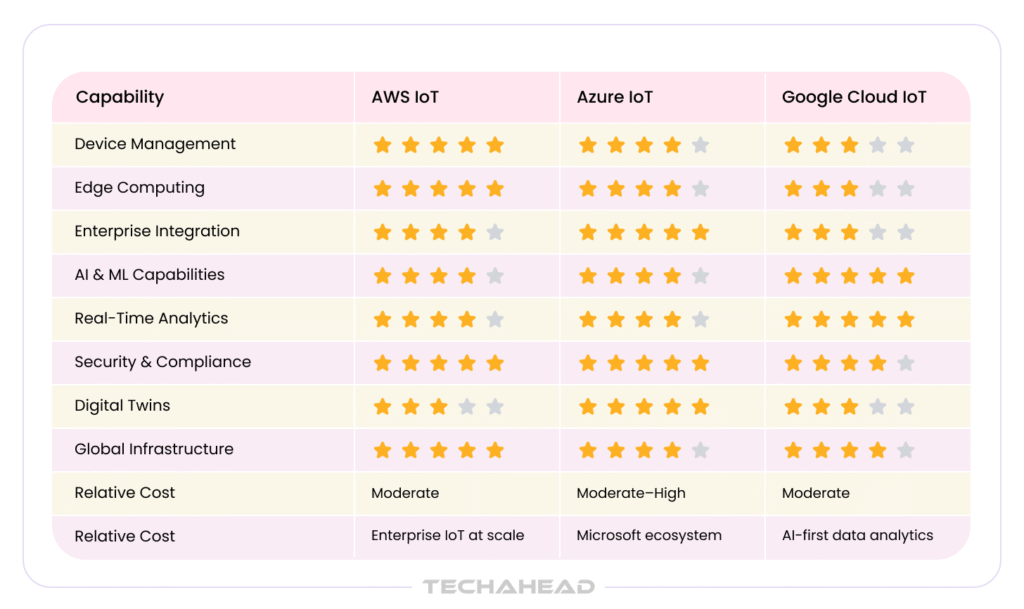
At TechAhead, platform selection is a discovery conversation, not a default decision. We have architected IoT systems on all three platforms. The recommendation we make is always the one that fits your existing infrastructure, your device scale, your compliance requirements, and your long-term data strategy. As an AWS Advanced Tier partner, we have the deepest technical relationship with AWS IoT.
IoT is not a single use case; it is a capability that reshapes operations differently in every industry (fintech, transportation healthcare, IoT education app ) it touches. The industries moving fastest are not the ones with the biggest technology budgets.
They are the ones that identified a specific operational problem, connected the right devices to solve it, and built the data infrastructure to act on what those devices tell them. Here is where IoT is delivering measurable enterprise outcomes in 2026:
Commercial real estate was one of the earliest enterprise industries to recognize that buildings are essentially large collections of connected systems: HVAC, electrical, plumbing, elevators, security, each generating data that most operators were not capturing or acting on.
JLL’s Intellicommand platform, built by TechAhead, changed that equation for one of the world’s largest commercial real estate firms. Real-time equipment health monitoring across 5.4 billion square feet of global property with predictive ML pipelines that identified fault patterns before failures occurred.
As a result, it delivered $10M in annual operational savings, 60% reduction in unplanned equipment failures, and 20% decrease in energy consumption. That is not a technology case study, that is a P&L impact that justified the IoT investment within the first operational year.
Smart home IoT has moved from novelty to expectation. The global smart home market reached $180.12 billion in 2026, with nearly 50% of US households adopting smart home devices. Thermostats, lighting, security cameras, door locks, and appliances are all connected, all controllable, all generating data that makes homes more efficient and more responsive to the people living in them.
Heatmiser’s smart home platform, built by TechAhead on iOS with HomeKit compliance, sits at the premium end of this market. Homeowners control their heating systems in real time, receive temperature anomaly alerts, and manage energy consumption from their iPhone. However, that invisibility is exactly what consumer IoT done right looks like.
Medical facilities will employ approximately 7.4 million IoT devices by 2026 (iQlance). It includes monitoring patients, tracking equipment, managing medication dispensing, and maintaining environmental conditions in clinical settings where a sensor failure is not an operational inconvenience, similar to how IoT impacts the pharmaceutical industry across cold-chain integrity, drug safety, and regulatory compliance.
Healthcare IoT covers remote patient monitoring, asset tracking for high-value medical equipment, environmental monitoring in sterile facilities, and medication adherence platforms.
HIPAA compliance, data encryption, audit trails, and access controls are not optional additions to healthcare IoT architecture; they are foundational requirements that shape every engineering decision.
At TechAhead, our SOC 2 Type II and ISO 27001 certifications mean healthcare IoT compliance is built into our delivery framework as an audited standard, not a checklist completed before launch.
Manufacturing was the industry that coined Industrial IoT because the cost of downtime in a production environment is immediately quantifiable. An unplanned production line stoppage does not generate a support ticket. It generates a financial impact that shows up on that quarter’s P&L.
Process automation leads IoT adoption at 58% and quality control at 55%, both manufacturing-dominated use cases. Predictive maintenance, quality inspection automation, energy consumption monitoring, and supply chain visibility are the four IoT applications delivering the most consistent ROI in manufacturing environments.
Insurance IoT, such as telematics, connected home sensors, wearable health monitors is changing how insurers price risk. Instead of actuarial models built on historical population data, IoT-enabled insurers price individual policies based on real behavioral and environmental data collected continuously from connected devices.
For AXA, TechAhead built a platform that needed to operate across multiple regional markets with different regulatory environments, different data residency requirements, and different compliance frameworks simultaneously.
Embedded systems are where IoT projects meet physical reality and where most of the hardest engineering problems live. The challenges below are not theoretical. They are the ones our engineers encounter on different enterprise IoT engagements:
Battery-powered IoT devices that drain in weeks instead of months are not good for enterprise. Usually, power management requires deliberate engineering at every layer such as sleep mode optimization, communication interval tuning, and sensor sampling frequency calibration.
For Heatmiser’s smart home platform, background device monitoring had to maintain real-time awareness without continuously draining the user’s iPhone battery. That balance required firmware and application-layer engineering working in precise coordination, not a power optimization pass at the end of development.
Embedded devices operate with kilobytes of RAM. Every line of firmware code has to earn its place. Inefficient memory allocation, unnecessary libraries, and unoptimized data structures that would be invisible on a server create critical failures on constrained hardware. The solution is disciplined firmware architecture from day one with memory budgets set per feature and enforced in code review.
Choosing the wrong RTOS (or skipping one entirely) creates timing failures that only surface under specific load conditions in production. FreeRTOS, Zephyr, and ThreadX each serve different device profiles and reliability requirements. The wrong choice is not always obvious during development. It becomes obvious when a device misses a crucial sensor reading during peak operational load.
Deployed IoT devices need firmware updates for security patches, bug fixes, and capability additions. Getting OTA updates wrong means either devices that cannot be updated without physical access, or update processes that brick devices in the field.
At TechAhead, OTA update architecture is scoped in stage two and not added as an afterthought when the first security vulnerability needs patching across a fleet of thousands of deployed devices.
Firmware and application software are developed by different engineers using different tools, different languages, and different mental models of how the system works. Integration failures between hardware and software layers are one of the most common sources of IoT project delays, and the hardest to diagnose because the failure mode often looks like a software bug when it is actually a firmware timing issue, or vice versa. At TechAhead, hardware and software engineering teams work in the same sprint cycle.
Protocols that perform perfectly in a clean lab environment fail under real-world interference. WiFi drops in warehouses. Bluetooth struggles through metal enclosures. Cellular coverage gaps in basements and rural locations create connectivity windows that firmware needs to handle gracefully.
For JLL’s Intellicommand platform, connectivity resilience across thousands of properties with variable building infrastructure required protocol selection and fallback logic that no single connectivity standard could have solved alone.
Every deployed IoT device is a potential attack surface. Default credentials, unencrypted communication channels, absent firmware signing, and missing secure boot implementations are the vulnerabilities that make enterprise IoT deployments targets for credential harvesting, data interception, and botnet recruitment.
Device-level security architecture (authentication, encryption, secure boot, and certificate management) is a mandatory engineering workstream on every IoT engagement. Our SOC 2 Type II certification and ISO 27001 framework mean these controls are audited standards, not optional recommendations.
The IoT landscape is moving faster than most enterprise IoT technology roadmaps can keep up with. The five trends below are not emerging concepts; they are active engineering realities that are reshaping how enterprise IoT systems are architected. Here are the latest trends:
AI is moving off the cloud and onto the device. The edge AI market is projected to grow from $24.91 billion in 2025 to $118.69 billion by 2033, driven by IoT deployments where sending raw device data to the cloud introduces latency that real-time operational decisions cannot tolerate.
Edge AI is now a standard architecture conversation for enterprise IoT clients, particularly in healthcare and industrial deployments where on-device inference delivers both performance and compliance advantages and where AI is making IoT smarter for enterprise operations across monitoring, prediction, and automated control.
Digital twins create live virtual replicas of physical assets, updated continuously by IoT sensor data that enterprises use to simulate, monitor, and optimize operations without touching the physical system.
The digital twin manufacturing market will reach $47.24 billion in 2026, a number that reflects how seriously enterprise operations teams are taking simulation-based decision making. For commercial real estate, manufacturing, and infrastructure operators, digital twins are rapidly becoming the primary interface for IoT operational intelligence.
5G is the connectivity upgrade that unlocks IoT use cases that 4G could not support. Ultra-low latency for real-time industrial control, massive device density for smart city deployments, and reliable high-bandwidth connectivity for video-based IoT applications.
The cellular IoT chipset market reached $4.07 billion in 2024 and is forecast to reach $14.08 billion by 2030 at a 23% CAGR. It shows the enterprise investment in 5G-enabled IoT infrastructure which is already underway and raises new questions about how to scale IoT securely worldwide with zero-trust architectures, multi-region deployments, and edge security controls. 5G architecture conversations are now standard in enterprise IoT discovery sessions for clients with latency-sensitive operational requirements.
Agentic AI and IoT are converging, and the result is connected systems that do not just monitor and alert, but diagnose, decide, and act autonomously across multi-step workflows without human intervention at each step.
For JLL’s Intellicommand platform, TechAhead deployed agentic workflows where IoT sensor data fed autonomous decision pipelines, identifying equipment fault patterns, estimating remaining useful life, and triggering maintenance workflows before a human engineer reviewed a single alert.
That is not IoT monitoring. That is IoT acting, and it is the direction every serious enterprise IoT program is moving. As Claude & OpenAI partner with ISO 42001 certification, TechAhead architects agentic IoT systems with documented governance frameworks.
IoT app development is the one that connects physical assets, enterprise infrastructure, and business outcomes into a single system that operations will depend on daily. TechAhead has delivered enterprise AIoT systems for Fortune 500 clients across commercial real estate, healthcare, insurance, and smart home. SOC 2 Type II, ISO 42001, and ISO 27001 certified. AWS Advanced Tier, Claude, and OpenAI partner. Recognized by Clutch as a Top App Developer and Top Generative AI Company for 2026. As an AI-native app and enterprise software development company, we ensure the IoT system your operations deserve is architected, certified, and delivered by a team with the credentials to prove it.
Edge computing processes data directly on or near the device, minimizing latency and cloud bandwidth. Fog computing adds an intermediate layer between devices and cloud; a local gateway that aggregates, filters, and preprocesses data from multiple edge devices before transmission. For enterprise IIoT deployments requiring real-time decisions and TechAhead architects the right layer based on latency requirements and device density.
A digital twin is a live virtual replica of a physical asset used for monitoring, simulation, and predictive decision-making without touching the physical system. Not every IoT deployment needs one. However, for complex industrial environments, smart buildings, or manufacturing operations where simulating system behavior before making operational changes delivers measurable value, digital twins are the best solution.
IoT data lakes store raw, unprocessed device data at any scale — flexible, cheap, and queryable later. IoT data warehouses store structured, processed data optimized for fast analytical queries. Most enterprise IoT architectures need both — a data lake for long-term raw storage and historical analysis, a data warehouse for real-time operational dashboards. Data architecture is scoped in discovery because the wrong choice compounds every analytics decision that follows.
Secure boot ensures a device only executes firmware that has been cryptographically signed and verified — preventing unauthorized code from running at startup. Without it, compromised firmware can persist through reboots, software updates, and factory resets. For enterprise IoT deployments where devices operate unattended across distributed locations, secure boot is the basic security control that everything else depends on. TechAhead implements it as a mandatory device-level requirement, not an optional security enhancement.
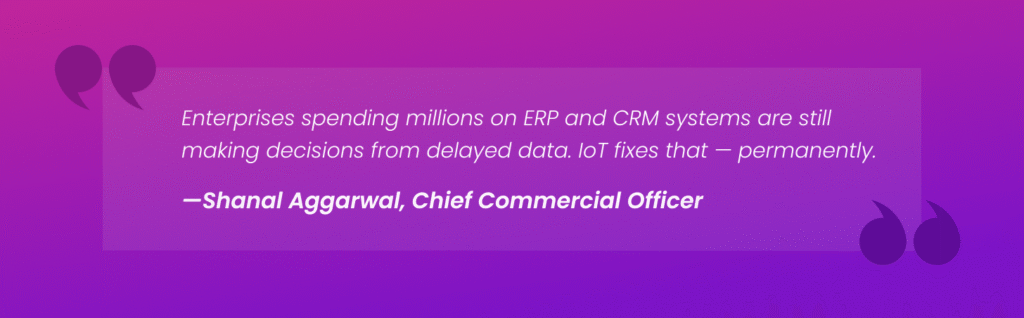
Through API-first integration architecture that treats your ERP and CRM as consumers of IoT data, not systems that need to be modified to accept it. Message queuing layers buffer IoT data streams so integration failures do not cascade into operational disruptions.
A device shadow — or device twin — is a persistent cloud-side record of a device’s last known state. When connectivity drops, the application reads from the shadow rather than the device directly. When connectivity restores, the device syncs any state changes that occurred during the outage. For enterprise IoT deployments where devices operate in environments with intermittent connectivity — warehouses, field locations, remote assets — device shadowing is the architecture that keeps applications functional when the physical network is not.
Zero-touch provisioning automates device registration, configuration, and certificate assignment — so devices connect securely to the correct IoT platform without manual setup at each endpoint. For enterprise deployments across hundreds or thousands of devices, manual provisioning is operationally unsustainable.
Through a layered observability stack, device-level health metrics, connectivity status, message delivery confirmation, firmware version tracking, and anomaly detection; all feeding a centralized monitoring dashboard with automated alerting thresholds. Our post-launch IoT monitoring is a contractual delivery standard, our SOC 2 Type II certified operational framework means device fleet health monitoring is an audited ongoing responsibility, not an informal check when something breaks.
We use cookies to ensure our website functions properly, improve performance, and provide a personalized experience. You can choose which types of cookies to allow below.
Required for core functionality such as security, network management, and accessibility. These cannot be disabled.
Help us understand site traffic and user interactions so we can improve performance and usability.
Enable enhanced functionality and personalization such as language or region preferences.
Used to deliver relevant ads, track campaign performance, and measure advertising effectiveness.