


 Copy Link
 Share on X
 Share on Facebook
 Share on LinkedIn

Always Active
Required for core functionality such as security, network management, and accessibility. These cannot be disabled.

Uncover the transformative potential of digital and mobile solutions for your industry.



 Last Updated: Nov 18, 2026
Nov 18, 2026
 12
 21 min. Read


Key Takeaways
One way to pay twice for modernization is to open up the same part of the application in two separate projects. The first project moves it to a current PHP release. The second reopens the checkout code because changing a discount still breaks refunds. Both projects require you to test checkout. After the first release, your finance team may still be correcting the same refund errors.
These are three different reasons to invest in legacy PHP modernization. A project can address one or all three. Its scope depends on what the business needs the application to do, which parts are still useful, and how much disruption you can absorb while the work is underway. That is why this blog looks at upgrade planning, refactoring, and rebuild decisions together, including framework and Laravel versions, PHP compatibility, abandoned packages, external integrations and third-party services, data migration, and transition planning that protects business-critical workflows.
The version question alone affects plenty of sites. On November 16, 2026, PHP 7 still accounted for 24.8% of the websites in W3Techs’s PHP version breakdown.
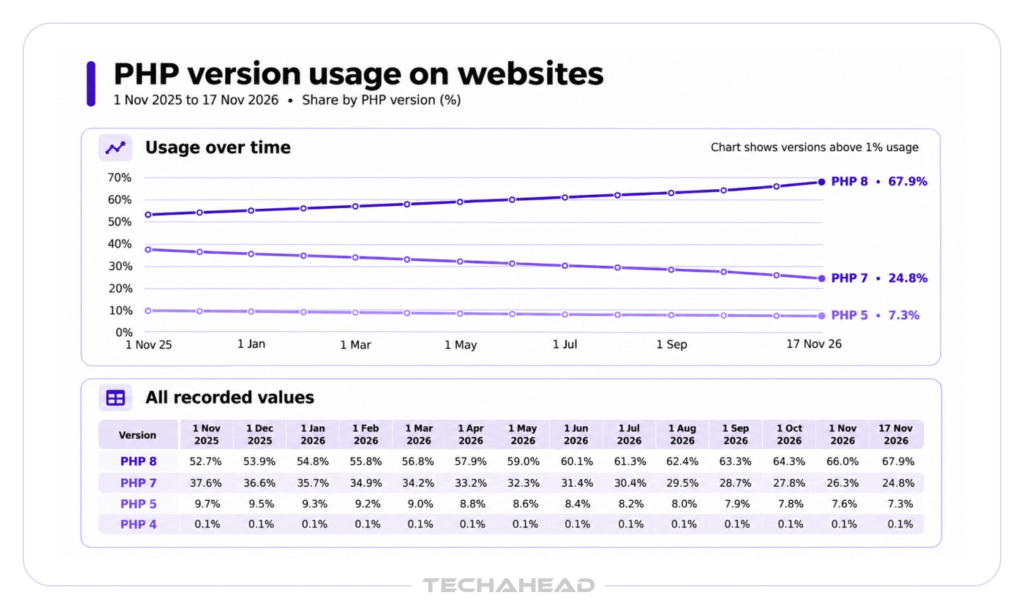
Moving off PHP 7 can address the support problem, reduce exposure to security vulnerabilities, and make new features easier to deliver. Whether checkout needs a refactor or fulfillment needs a rebuild depends on what the business needs those parts of the application to do.
Must Read: PHP Migration Guide: Upgrading Business-Critical Applications from PHP 7.4 and 8.1
A PHP upgrade moves the application to a newer version of the software that runs it. PHP refactoring reorganizes the code so future changes are easier and safer while preserving the behavior people rely on. A PHP application rebuild creates a replacement for part or all of the application, with room to change how the business operates.
| Approach | When it makes sense | What you’re paying for | What could expand the scope |
| Upgrade | The application still fits the business. Its PHP version, framework, or packages are falling out of support. | Compatibility work and proof that existing transactions still behave as expected. | A framework or payment integration that cannot move to the target environment. |
| Refactor | The business rules still work, but the way the code is organized makes routine changes slow or risky. | Changes to the internal structure and tests that make future releases safer. | A supposedly isolated problem that also affects accounting, fulfillment, or another part of the application. |
| Rebuild | The current design or data model cannot support a requirement you need to deliver. | Replacement software, migration, and a transition for users and connected systems. | Historical data, hidden rules, and the time needed to support two systems during the transition. |
A refactor vs rewrite discussion is usually about how much of the existing implementation to keep. For a PHP application, the third question is whether restoring support would solve enough of the problem on its own. For most businesses, the right path is not to default to a full rewrite, but to choose the option that preserves the business value already built into the existing application. It can be the right investment even when there are other changes you’d like to make later.
An upgrade makes sense when the application still does the work you need and the immediate pressure comes from the technology it runs on. A host could be withdrawing support for your version. A vendor could require a newer environment for its payment integration. Either can put a deadline on work you otherwise would have scheduled later.
A refactor vs rewrite discussion should also account for whether the existing application still contains valuable business logic, since a complete rewrite should not be the default response for most businesses in that case.
Yes, when the application and its essential dependencies can run on a supported PHP version with manageable changes. A PHP version upgrade can involve replacing an outdated library or changing how the application handles errors. The scope becomes clearer when you know which production workflows depend on those changes.
Take the order-management example. If an old payment library is the only barrier, a maintained alternative may let the business move forward. The question for the proposal is whether the replacement can handle the transactions that already matter to you, including declined payments, partial refunds, and retries after a timeout. A checkout page loading in staging tells you very little about those outcomes.
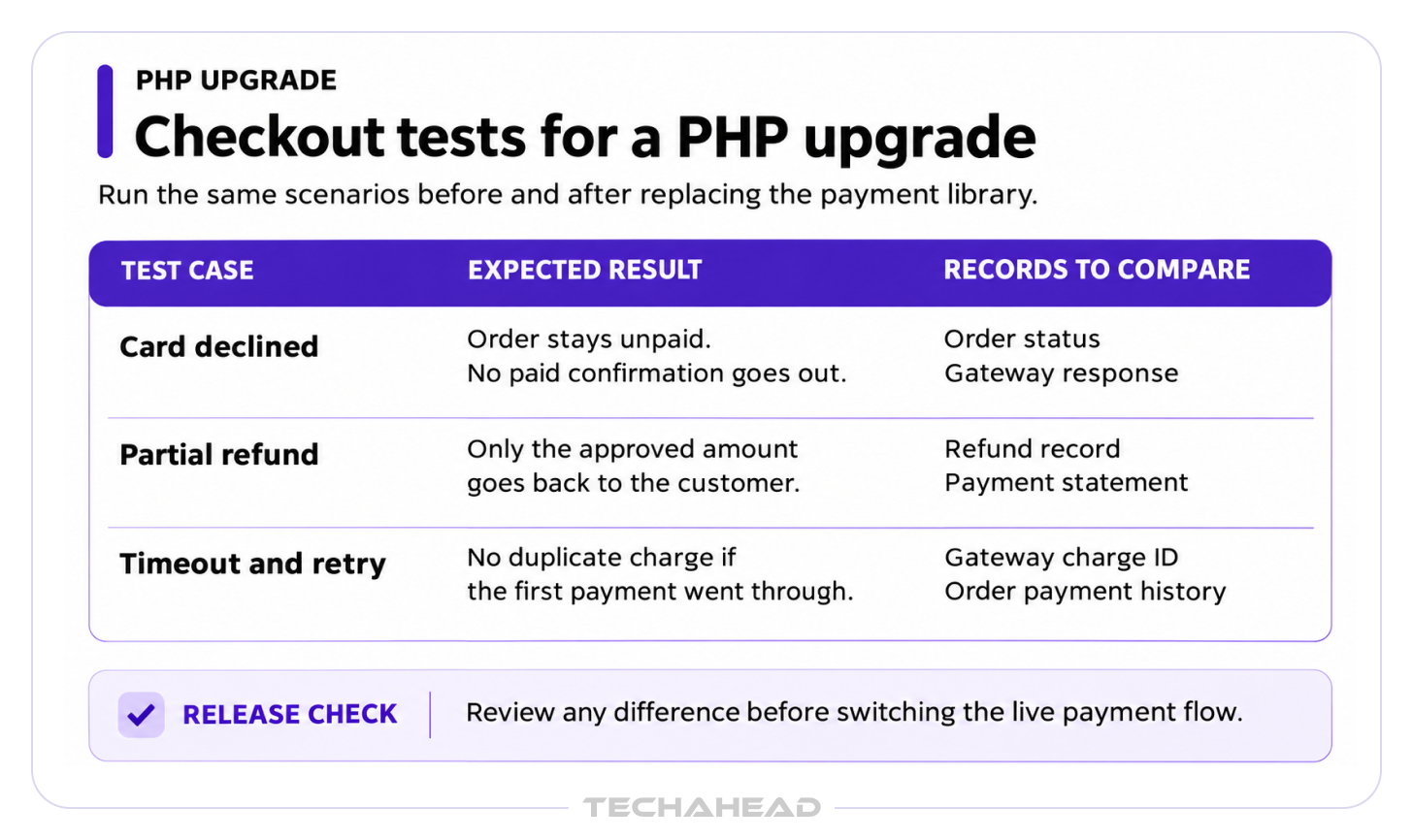
Framework compatibility can change the picture. The framework is the software the application is built on. If it cannot run on the target version, a PHP framework migration may be part of the same project. That adds work even if customers will see the same checkout screens. A proposal should explain the difference between a localized dependency compatibility issue and a framework change that touches many parts of the application.
| An online retailer was preparing to upgrade PHP, but its existing payment library didn’t support the target version. TechAhead replaced the library, then tested what would happen if a payment went through but checkout timed out before receiving confirmation. In staging, the team verified that a retry linked the original payment to the order without charging the customer a second time. |
The PHP project gives each release branch two years of active support, followed by two years of critical security fixes. That makes PHP end of life a useful planning date. If compatibility work will take months, the target version’s remaining support period matters to the investment.
If a security issue needs attention before the full upgrade is ready, our PHP Security & Emergency Remediation can help you identify what needs fixing now and what can move with the planned upgrade.
Refactoring is worth considering when you want to keep the business behavior but changes to the application have become harder to predict. The team may be able to explain the discount and refund policies clearly. The trouble comes from the way those policies are implemented, especially when PHP compatibility issues force risky code changes in the PHP code and major upgrades have to move through versions sequentially.
In our example, pricing, refunds, and the order export all draw on the same calculation. A developer changes a promotion rule and discovers days later that the amount shown on a credit note is wrong. Feature work pauses while support and finance reconcile the affected transactions. If the same pattern keeps coming back, you have a business cost attached to the technical debt.
Also Read: Cost to Make a Vibe Coded App Production Ready: Prototype to Enterprise Readiness
The case for PHP refactoring is strongest when the team can trace the problem to a part of the code it can change safely. In the order-management example, the business would be funding three connected improvements.
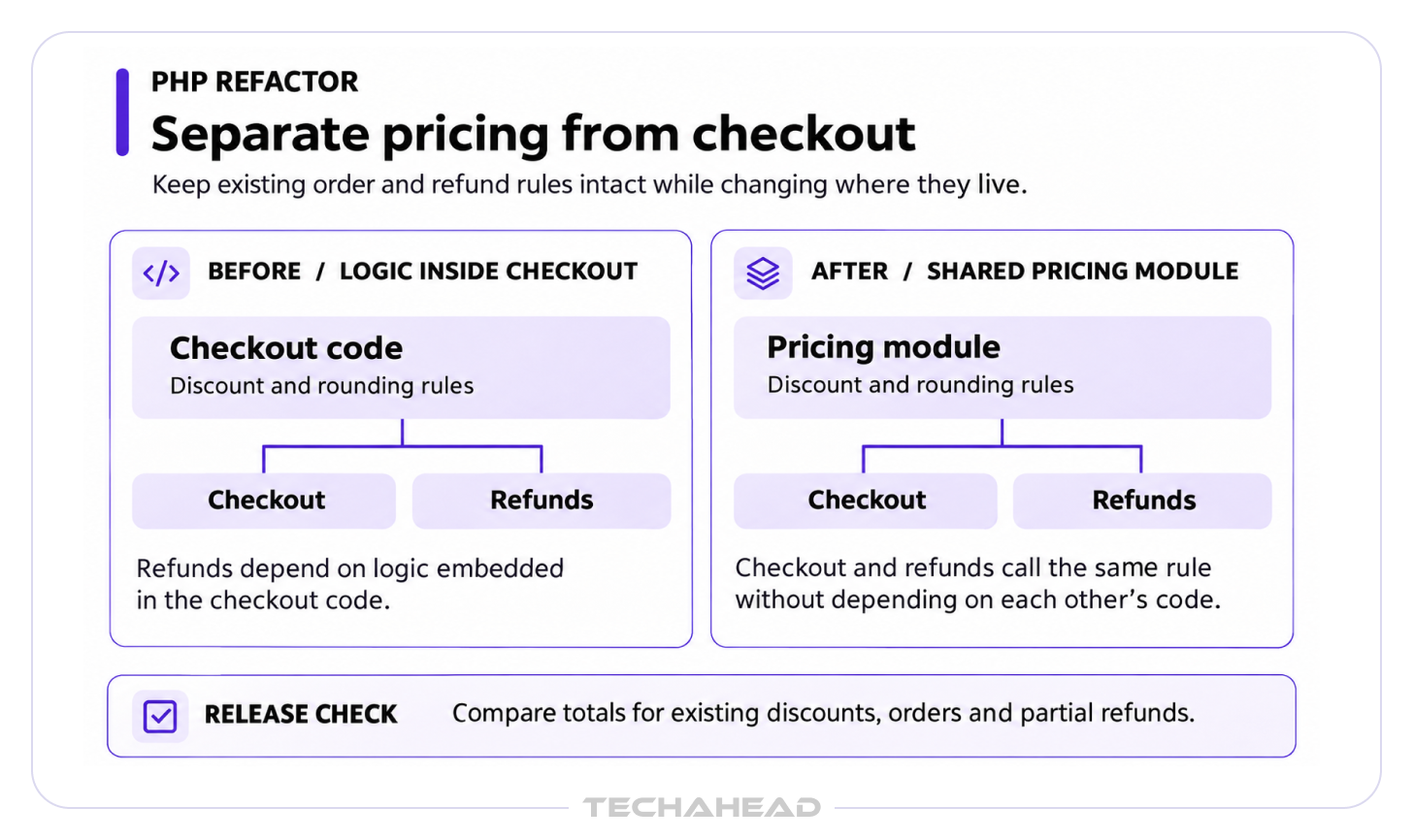
Here, refactoring legacy code has a measurable purpose. It can reduce the number of places that need to change when you introduce a promotion. The value of legacy application refactoring is easier to judge if the proposal names the changes your team is struggling to release today and explains what would become easier afterward.
Also Read: Building a Secure CI/CD Pipeline for AI-Generated Code
If problems extend across several workflows and the team cannot isolate them, a refactor estimate has more uncertainty. Paying for a focused assessment and regression testing around pricing and refunds may make the next decision clearer. The expected outcome is a more maintainable application that still applies the business rules your customers and finance team depend on.
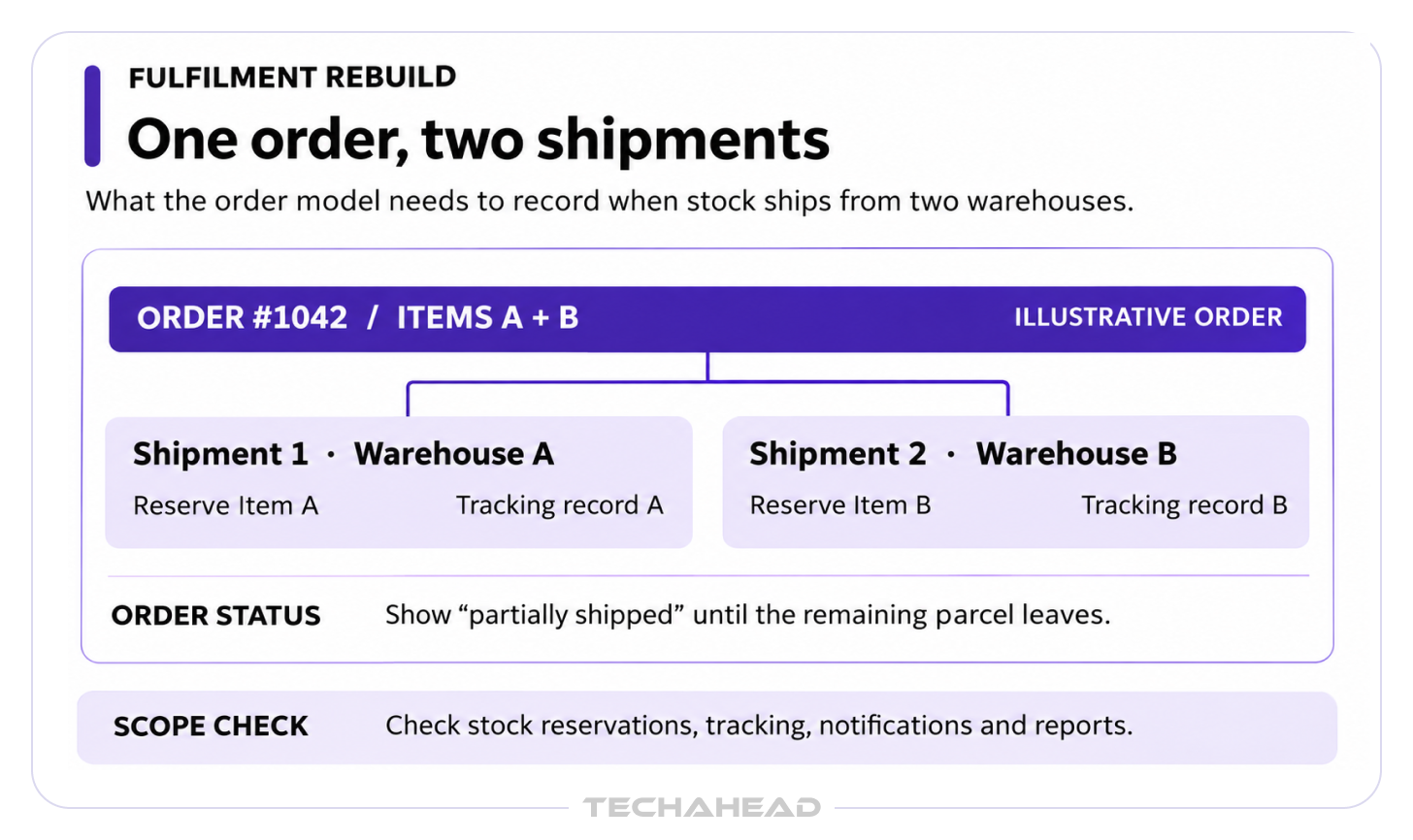
A rebuild becomes a serious option when there’s a clear requirement the existing design cannot reasonably support. Suppose you want one order to ship from two warehouses. The current application records one warehouse per order, and inventory reservations, shipping labels, customer notifications, and reporting all assume the same thing.
A workaround might get the second warehouse online, at the cost of sending some orders through manual reconciliation. If split fulfillment will become routine, the recurring cost of that work belongs in the decision. A PHP application rebuild could cover the affected fulfillment capabilities and any parts of order management that need to represent split shipments. The required scope depends on which areas rely on the same assumption.
The replacement has to take over the work people depend on while the business continues serving customers. In the fulfillment example, that adds three areas to the rebuild scope.
In a 2025 review, the U.S. Government Accountability Office found that modernization plans for only 3 of the 11 federal legacy systems it identified as most in need of modernization covered all three elements it looked for: milestones, a description of the work, and what would happen to the old system. The review concerned government IT, and that last question applies directly to the order-management example. The rebuild proposal needs to account for who handles live orders until the replacement is ready and when the old system can be retired.
The rebuild earns its place when the required capability matters to the business and a smaller change can’t support it reliably. Getting to that answer requires a clearer understanding of the workflow than a quote based on the age of the code can provide.
Yes. An application may need urgent support work and still benefit from a separate improvement to the way pricing is maintained. Incremental modernization lets the business fund changes in an order that reflects the pressure each one creates while keeping the business running. The trade-off is that some work shares a release boundary. If pricing code relies on a library that has to be replaced during the upgrade, it may make sense to handle that part of the refactor at the same time.
The order-management business could split the modernization work around three priorities.
That sequence lets the business narrow the next investment after it sees what the first release resolved. Gradual replacement patterns such as Strangler Fig can reduce business risk when old and new features need to coexist.
Related Read: How AI Vulnerability Discovery Is Changing Application Modernization Strategy and Maintenance
Sometimes application replatforming sits between an upgrade and a rebuild. That might mean moving the application onto a maintained framework while keeping the workflows people use today in the existing system. The scope depends on how closely those workflows are tied to the old framework, how much of their behavior can be verified during the move, and whether runtime upgrades and database access changes, such as replacing outdated methods with PDO or a modern ORM, can be handled safely without changing the interface of a business-critical application.
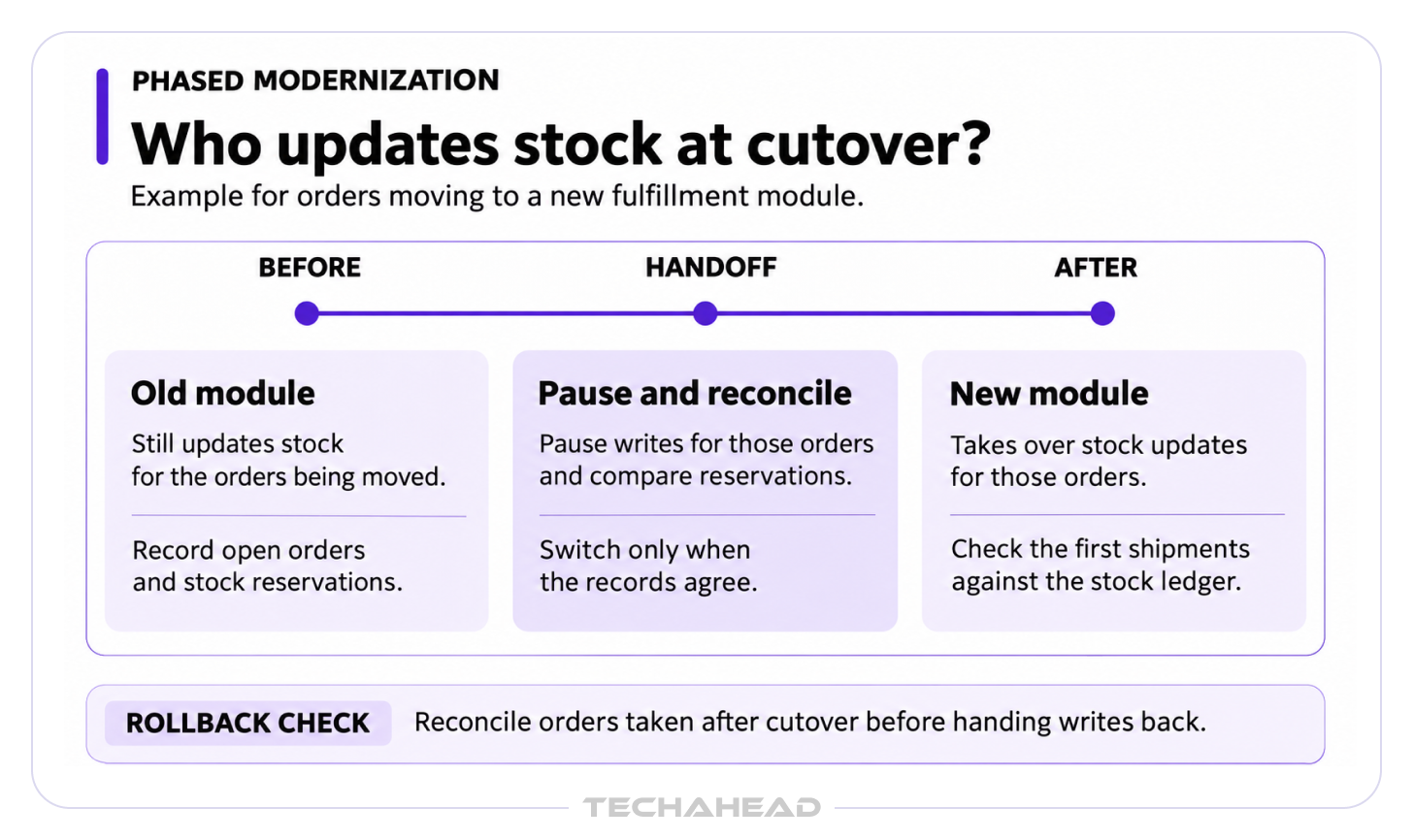
A phased replacement can also make sense for fulfillment, provided the old and new parts agree on who owns each order and inventory update. If both can change the same stock balance independently, splitting the release introduces a new operational risk. A plan for incremental modernization needs to account for that shared data, define clear service boundaries, and explain when the business can hand over responsibility safely. That is where the development team needs focused tests around each business critical application workflow before release.
The symptoms you see are often enough to start a discussion. They rarely tell you how much work to approve on their own. One 2025 HFS Research survey found that 42% of the 305 major-enterprise decision-makers surveyed selected higher operating costs from maintaining legacy systems among the most significant effects of outdated technology.
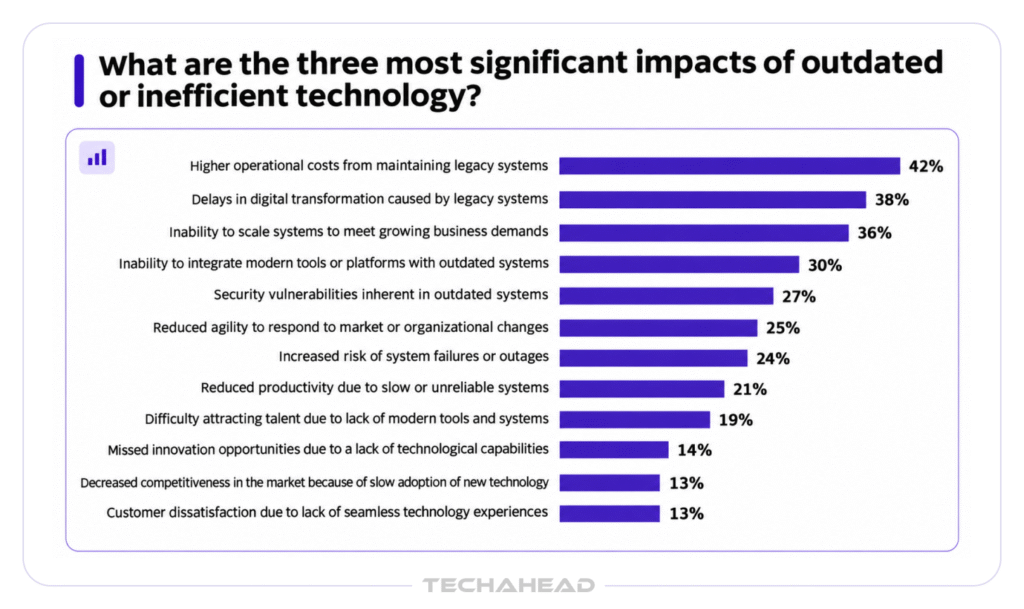
For your application, the deciding question is where that cost shows up and which change would reduce it, especially in legacy applications where a development team can make phased work easier to manage with continuous integration and deployment pipelines and Docker-based containers that keep testing consistent across runtime upgrades.
The table uses three versions of the same order-management problem. In each case, the recommendation depends on how far the constraint reaches and what the business needs the first release to accomplish.
| What you know today | What would support a decision | What would change it |
| The hosting provider is ending support, and an old payment library is blocking the move. | A maintained library works on the target environment and passes the same purchase and refund scenarios. That supports a scoped upgrade. | The replacement requires a framework change or exposes more incompatible integrations. The business now has a wider compatibility project to evaluate. |
| Pricing releases keep causing problems with refunds. | The team can isolate the issue in shared pricing code and test the existing refund rules. That supports a targeted refactor. | The issue comes from conflicting assumptions in order and accounting records. The problem reaches beyond the pricing module, and the proposal needs to account for that. |
| You need to fulfill one order from multiple warehouses. | The team confirms that the current order and inventory model cannot handle split shipments reliably. That supports rebuilding the affected capabilities. | Analysis shows the order model can represent multiple shipments and the constraint sits in one integration. The replacement scope could be much smaller. |
This is also where you can tell whether two proposals are comparable. One quote may assume an upgrade with existing tests and another may include recording how business-critical workflows behave, replacing unsupported dependencies, and preparing a rollback plan. Those are different commitments. In legacy applications, modernization costs vary by application complexity, target architecture, and the number of external integrations and deployment steps the development team has to untangle.
With 75% of technology decision-makers expecting high technical debt by 2026, the useful comparison is not just age but how much business impact and business value each option carries, what work it includes, and how the business can tell when the first release is ready.
At TechAhead, we start a legacy PHP modernization assessment with the work the application does for your business. That means understanding which changes keep getting delayed, which transactions can’t be interrupted without a material impact, and what the application needs to support next. We look at framework compatibility, integrations, and the design of the application in that context.
If a security advisory flags the PHP version or a package your application depends on, our PHP Security & Emergency Remediation service can help confirm whether you’re affected, identify the right fix, and verify that critical workflows still work after the change. That gives you a clearer basis for deciding what still needs to change in the wider modernization.
In the order-management example, what we verify depends on the problem you’re trying to solve.
The assessment should give you a recommendation you can act on. It should explain the proposed scope, the finding that supports it, and what could change the estimate. The better proposal is the one with a clearer modernization plan tied to business value, business impact, and target architecture, not simply the one that proposes a rewrite, because a complete rewrite should not be the default response to legacy issues.
The first release might be compatibility work that restores support, a pricing change verified against existing returns, or a replacement fulfillment capability checked against live operational needs. In some cases, a successful PHP upgrade can even reduce maintenance from 160 to 100 hours monthly. Each has different acceptance criteria, drawn from the business-critical workflows the release touches.
Before committing to a legacy PHP modernization project, you should be able to name the problem the first release will solve and the result you’ll accept as evidence that it worked.
If you’re weighing options for an application your business relies on, talk to TechAhead about what needs to change and what the first release could cover.
Start with what’s blocking the business. Upgrade when the runtime or dependencies are the main constraint. Refactor when existing workflows fit but routine changes cause regressions. Consider rebuilding when the architecture cannot support a specific business requirement.
Check whether your vendor still provides security fixes for the exact PHP build you run. Start by assessing the application’s business value, business impact, and business risk before deciding to rebuild, since critical workflows may need protection even if an old version is no longer the right foundation. If the system still contains valuable business logic, security vulnerabilities and runtime constraints can still justify upgrade work. If support is missing or ends before the rebuild launches, plan a move to a supported PHP version alongside the replacement work, including coverage for security patches during the transition.
Check framework compatibility before committing to a PHP version upgrade. Review supported laravel versions, dependency constraints, abandoned packages, php compatibility, and third party services before locking the plan. A maintained framework release or a replacement for one dependency may clear the blocker. Staying on an old version raises business risk unless the vendor is still issuing security patches; for example, PHP 8.2 ends security support on December 31, 2026. If there’s no viable upgrade path, assess whether the affected modules can move independently.
Poor test coverage makes every option harder to verify. Start by documenting what the existing code does for business-critical workflows such as checkout, refunds, and permissions, then capture that behavior in characterization tests. Before assuming the framework is the only blocker, also check PHP compatibility across Laravel versions, abandoned packages, and third-party services. Those scenarios should become automated tests so the team can compare old and new code, preserve behavior, and leave clearer guidance for new developers whichever approach you choose.
Yes, if the existing backend can support the transactions and permissions the new screens require. Characterization tests can capture current behavior, and automated tests verify that refactoring preserves it, which also lets new developers work more safely in the codebase. If customers need a capability the backend cannot represent, such as splitting an order across warehouses, the scope must include that business logic and any related application functionality exposed through controlled interfaces for ai systems or semantic search.
Yes, when the module has a clear boundary and the old and new components can exchange data reliably, with the backend still able to support the required application functionality. AI capabilities such as customer-support assistance, document processing, or semantic search can be added without replacing the entire application if the backend exposes reliable APIs. Phased modernization work is also easier when service boundaries are clear, as with an independent reporting module, than with checkout, where payments, inventory, and order status are closely connected.
A phased rollout may be possible when old and new application instances can safely share sessions, data, and queued work. TechAhead can assess those dependencies as a development team effort and help determine whether a phased release or a planned maintenance window is appropriate. This is especially important for any business critical application. Modular replacement works best when service boundaries are clear, and approaches like the Strangler Fig pattern can support gradual modernization work, including selective runtime upgrades.
TechAhead can assess framework compatibility, review code quality and security vulnerabilities, map critical workflows, external integrations, and deployment steps, and identify where the current design limits the business. The recommendation should explain which capabilities need replacement, what can be retained, and how the first release will be verified, including a target architecture and a modernization plan. For a business-critical application, the team may also use containerized environments such as Docker to test runtime upgrades under conditions closer to production and improve development consistency through environment parity.
Compare outcomes across both systems using representative orders, including partial refunds, cancellations, and split shipments, and use characterization checks to verify old behavior against the new code. During data migration, test with real data, review transaction handling, and reconcile open orders, payment totals, and stock reservations so the business can confirm zero data loss at cutover. The assessment should also deliver a modernization plan covering target architecture, code quality, security vulnerabilities, external integrations, and deployment steps.
A rollback plan should define when to roll back, who makes the call, and how to handle orders, payments, and queued jobs created after launch. For an existing system, discovery should also map application behavior, integrations, data relationships, operational knowledge, and deployment steps so teams can spot business risk early. Returning to the previous software version may still leave new transactions that need reconciliation. Verification should use real data where possible, include transaction handling checks, and treat zero data loss as a core migration objective.
A PHP upgrade can support patch management. PCI DSS also applies to the wider in-scope payment environment. Document the change and security testing, and confirm with your assessor whether it qualifies as a significant change that requires additional validation.
Review how the change affects electronic protected health information, including access permissions, audit logs, backups, and test environments. Use the findings to update the organization’s risk analysis and document any safeguards that need to change before release.
We use cookies to ensure our website functions properly, improve performance, and provide a personalized experience. You can choose which types of cookies to allow below.
Required for core functionality such as security, network management, and accessibility. These cannot be disabled.
Help us understand site traffic and user interactions so we can improve performance and usability.
Enable enhanced functionality and personalization such as language or region preferences.
Used to deliver relevant ads, track campaign performance, and measure advertising effectiveness.