


 Copy Link
 Share on X
 Share on Facebook
 Share on LinkedIn


Always Active
Required for core functionality such as security, network management, and accessibility. These cannot be disabled.

Uncover the transformative potential of digital and mobile solutions for your industry.



 Last Updated: Oct 27, 2026
Oct 22, 2026
 153
 19 min. Read


Key Takeaways


Ordering dinner from a phone takes a few seconds. Building the technology behind that order is a much bigger job.
Every food delivery app runs on a handful of moving parts: restaurant menus, order processing, payments, delivery assignments, customer notifications, and support for when something goes wrong. If one of them lags, customers notice fast. A late notification or a wrong total is often enough to lose them.
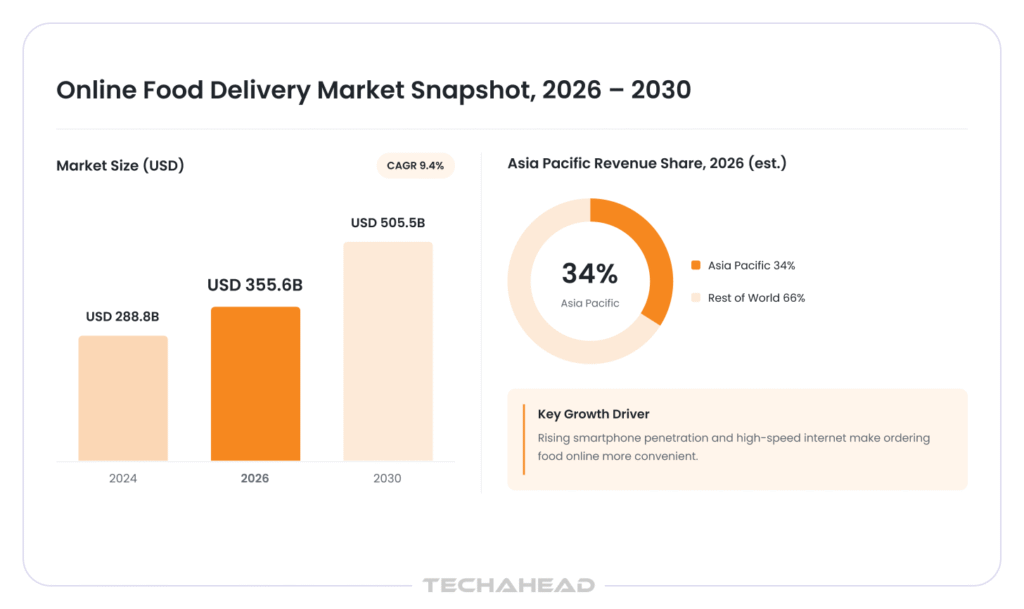
The demand is clearly there. Grand View Research estimates that the global online food delivery market will reach $505.5 billion by 2030, so digital ordering isn’t going anywhere.
For restaurants, startups, and established food brands, that growth is a strong reason to build their own ordering experience. The hard part is finding a development company that understands the technology and also knows what a Friday dinner rush does to a delivery operation.
This guide covers 10 companies to look at in 2026, what each one could bring to your project, and the questions to ask before you pick a partner. Treat the list as an editorial comparison rather than a ranking. The right choice depends on your product, business model, and day-to-day operations.
| Company | What to evaluate it for |
| TechAhead | Custom mobile apps and tailored food delivery platforms |
| Code Brew Labs | Food delivery and multi-sided on-demand platforms |
| Mobulous | Food ordering, restaurant workflows, and delivery apps |
| Apptunix | On-demand products with multiple user roles |
| Techugo | Customer-focused mobile ordering experiences |
| Hyperlink InfoSystem | Custom applications and third-party integrations |
| App Maisters | Mobile apps connected to existing business systems |
| Zco Corporation | Custom mobile applications and complex software products |
| Brainvire | Mobile apps integrated with commerce and enterprise systems |
| Goji Labs | Product strategy, UX design, and custom app development |
These companies don’t all offer the same services, and they don’t all specialize in food delivery to the same degree. Use the shortlist as a starting point, then check each provider’s current capabilities and relevant experience before you decide.
Must Read: Top 10 On-Demand App Development Companies
Best for: Businesses that need a custom food delivery platform built around specific workflows and growth plans.
No two food delivery products follow the same blueprint. A restaurant managing its own orders has very different needs from a marketplace that connects multiple restaurants, customers, and delivery partners, and the development approach should reflect that from day one.
TechAhead builds mobile applications and custom digital products, with services that cover app development, software engineering, and product design. Its food delivery app development services are a good fit when you want a platform built around your own business rules instead of bending your processes to match ready-made software. The portfolio gives a sense of the range: a stadium food delivery app that gets food and drinks to fans at their seats, and an on-demand ordering app for Café Javas, a restaurant chain in Kampala with 12 locations.
Whatever you choose, settle the operating model before development starts. Who manages delivery? How do orders move from one stage to the next? How do payments and refunds work? Which systems need to talk to the app? Those answers shape everything that follows.
What to discuss with the team:
A useful question to ask: How would the proposed architecture support our current order volume while letting us add restaurants, delivery zones, or new revenue models later?
Also Read: How Much Does It Cost to Build a Food Delivery App Like GrubHub?
Best for: Businesses exploring food delivery platforms with several connected user groups.
A multi-sided delivery app has to keep customers, restaurants, delivery partners, and administrators in sync. Code Brew Labs offers food delivery app development alongside other on-demand technology services, so it’s a relevant name to check for this kind of product.
The thing to look at is how the company handles the connections between those roles. A customer may see an order as confirmed, but the restaurant still has to receive it quickly, and the delivery side has to reflect what’s actually happening in the kitchen and at pickup.
When you talk to Code Brew Labs, ask how its solution handles those handoffs and how much of it can be customized. A polished demo helps, but the workflows underneath decide whether the product holds up in daily operations.
What to discuss with the team:
A useful question to ask: Which parts of the proposed platform are ready to use, and which will be built specifically for our business?
Best for: Food businesses that need ordering functionality supported by practical restaurant and delivery workflows.
Mobulous has a dedicated food delivery app development service, and it describes solutions that cover customer ordering, restaurant operations, and delivery-related functionality.
That combination matters because food ordering isn’t a shopping cart with a pay button. Restaurants have to manage menu availability, item customizations, prep times, and a stream of incoming orders. Customers expect accurate prices, clear updates, and an easy way to change or cancel an order.
If your product needs those connected workflows, Mobulous belongs on the list. Ask the team to show you how it handles the messy moments of real service: an item that sells out, an order the restaurant rejects, or a payment that fails after checkout.
What to discuss with the team:
A useful question to ask: How will the system keep menu availability, order status, and customer notifications in sync?
Best for: Startups and businesses building on-demand apps with distinct customer and service-provider experiences.
Apptunix develops mobile and software products, including solutions for delivery and logistics. It’s a reasonable pick if you want a multi-user application rather than a basic restaurant ordering screen.
A delivery platform runs several journeys at the same time. Customers place and track orders, restaurants manage preparation, and delivery partners need clear pickup and drop-off details. Administrators have to be able to step in and fix problems anywhere along the way.
Those needs should shape the architecture and the first release. In your conversations with Apptunix, ask how it would structure the different interfaces, manage changes in order status, and handle the moments when the expected workflow breaks.
What to discuss with the team:
A useful question to ask: How will the app handle cancellations, refunds, reassigned deliveries, and other exceptions without confusing users?
Best for: Businesses prioritizing the customer experience in a mobile-first food ordering product.
Techugo provides mobile application development services and offers a dedicated food delivery app development service. If you’re comparing teams that can shape the ordering experience as well as build the app behind it, it’s one to consider.
Customers want to find a meal quickly, see the total cost, customize their order, and know when it’s arriving. When any of those steps feels confusing, even a technically sound app can struggle to keep users.
So usability deserves real attention in your evaluation. Ask how the team researches user needs, tests navigation and checkout, and keeps the interface useful as the menu, the restaurant count, or the delivery area grows.
What to discuss with the team:
A useful question to ask: How will the team test the complete ordering journey with real users before the app goes live?
Best for: Businesses seeking custom mobile development with flexibility around integrations and technical requirements.
Hyperlink InfoSystem offers mobile app development along with broader software engineering services. That range makes it a candidate if you’re comparing providers for a custom food ordering product.
Integrations deserve extra attention in food delivery projects. You might need to connect the app to payment gateways, mapping services, point-of-sale software, loyalty programs, or an existing inventory system. Every connection adds a dependency, and each one affects implementation, testing, and maintenance.
Hyperlink InfoSystem is worth a conversation if your requirements go beyond the customer-facing screens. Before development begins, the team should list the integrations you need, confirm the APIs are available, and explain what happens when one of them fails.
What to discuss with the team:
A useful question to ask: Which integrations are included in the proposal, and what happens if a third-party service changes or goes down?
Best for: Food businesses that need their app to work alongside existing operational systems.
App Maisters offers mobile application development, custom software, and integration services. Look at it if your food delivery app will sit inside a larger business operation instead of running as a standalone product.
Take a restaurant group that already has systems for inventory, sales, customer records, and loyalty programs. A new ordering app should plug into those wherever it makes sense. Otherwise staff end up maintaining disconnected records and typing the same information twice.
The scope should spell out which systems need to exchange data and what has to stay consistent between them. It should also cover permissions, data ownership, and how the business will handle changes to connected services.
What to discuss with the team:
A useful question to ask: Can you map how orders, payments, menu updates, and customer information will move between our app and our existing systems?
Best for: Businesses with custom mobile requirements that go beyond a standard ordering app.
Zco Corporation develops custom mobile applications and software products. Its services include native and cross-platform app development, backend integration, testing, and ongoing support.
A food delivery app can launch with a small set of features and get more complicated as the business grows. New restaurant partners, multiple delivery zones, promotions, loyalty programs, and operational reporting each bring their own technical requirements.
Zco makes sense to evaluate when your project needs a tailored mobile product. Broad app development experience doesn’t automatically mean food delivery expertise, though, so ask for proof of relevant work and a clear explanation of how the team would approach your specific workflows.
What to discuss with the team:
A useful question to ask: What would you recommend building in the first release, and which features could come later without major rework?
Best for: Businesses connecting food ordering with broader commerce and business systems.
Brainvire provides mobile app development and software engineering services, including work that involves commerce platforms and enterprise systems. It may suit you if the food delivery product has to fit into a wider digital setup.
Picture a business that already runs online sales, loyalty, promotional campaigns, and inventory management. The new delivery app may need to share product data, customer records, or transactions with all of them. Getting those connections right can matter as much as designing the app itself.
Brainvire is a fit for projects where mobile development and integration are tied together. The strongest proposal will name the actual systems involved, the dependencies between them, and the work needed to keep information accurate across all of them.
What to discuss with the team:
A useful question to ask: How will the solution prevent duplicate records or conflicting information between the app and our existing business systems?
Best for: Businesses that need to define the product clearly before committing to development.
Goji Labs offers product strategy, UX/UI design, and mobile app development. That mix suits startups and established businesses that need help turning a food delivery idea into a well-defined product.
Before anyone writes code, a business has a few basic questions to answer. Are you serving one restaurant, a chain, or a marketplace? Will delivery run in-house or through an outside partner? How will the app make money? Which features have to be there at launch?
A discovery phase turns those decisions into user journeys, priorities, and a realistic scope. Consider Goji Labs if you want product planning and design to carry real weight before engineering starts.
What to discuss with the team:
A useful question to ask: What will we receive at the end of discovery, and how will those findings set the development scope?
Must Read: How Much Does It Cost to Develop an App Like DoorDash?
The right feature set depends on your business model. A single restaurant might need little more than ordering, payment, and pickup or delivery updates. A marketplace connecting multiple restaurants and couriers needs a much bigger system.
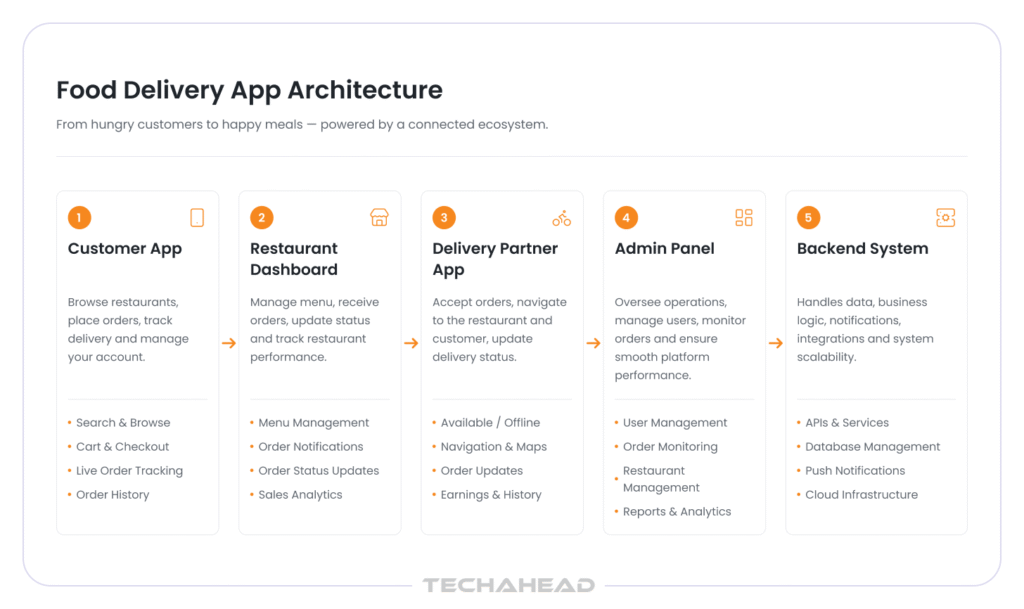
Before you add features, define the roles the platform has to support and the work each role needs to get done.
Customers should be able to find food, understand the price, place an order, and follow its progress without extra steps getting in the way.
Core features may include:
Restaurants need tools to manage incoming orders and keep their listings accurate.
Think about menu and price updates, item availability, order acceptance, preparation status, operating hours, promotions, and sales summaries. If a restaurant can’t take orders for a while, the platform should show that clearly to customers.
If your business runs its own delivery network, couriers may need delivery assignments, pickup details, navigation, status updates, and proof of delivery.
If you use an outside logistics provider, some of those functions might come through an integration instead. Decide this early, because it changes both the development scope and your operating costs.
Administrators may need to manage accounts, monitor orders, handle refunds, set commissions, resolve disputes, and review delivery performance.
Access permissions matter here too. Restaurant staff shouldn’t have the same controls as platform administrators, and sensitive information should only be visible to people authorized to see it.
The backend connects the app people see to the systems that handle orders, payments, notifications, and business rules. It also needs proper security, monitoring, backups, and performance planning.
Pay close attention to failure scenarios. A payment can fail, a restaurant can reject an order, or a delivery partner can drop out. Planning for those cases early is much cheaper than fixing them after launch.
Must Read: Quick Commerce App Development: Cost, Stack and Scalability of Apps Like Instacart
Also Read: How On-Demand Mobile Apps Are Driving the Service Industries
Not every food business needs to build an app from scratch. Ready-made software can get you live quickly, while custom development gives you more room when existing tools can’t support the workflows you need.
| Factor | Ready-made or white-label software | Custom development |
| Time to launch | Often shorter when the features fit | Usually requires more planning and development |
| Initial investment | Often lower | Typically higher |
| Custom workflows | Limited by the platform | Designed around business requirements |
| Control | Depends on licensing and vendor terms | Depends on the contract and ownership agreement |
| Future changes | Bound by product flexibility and roadmap | Can be planned around business priorities |
| Maintenance | Often managed partly by the vendor | Requires an agreed support arrangement |
A single restaurant may be well served by an existing ordering system. A marketplace with its own commission rules, delivery operations, or merchant requirements has a stronger case for custom software.
There’s also a middle route: launch with configurable software, confirm that people actually want it, and add custom functionality as the business grows. If you go this way, check whether you can export your data and move later without paying a lot or disrupting your operations.
Also Read: Mobile App Development Costs in 2026: A Comprehensive Guide
A company can have a strong portfolio and still be the wrong fit for your project. The proposal, the technical approach, and the working relationship deserve as much of your attention as the feature list.
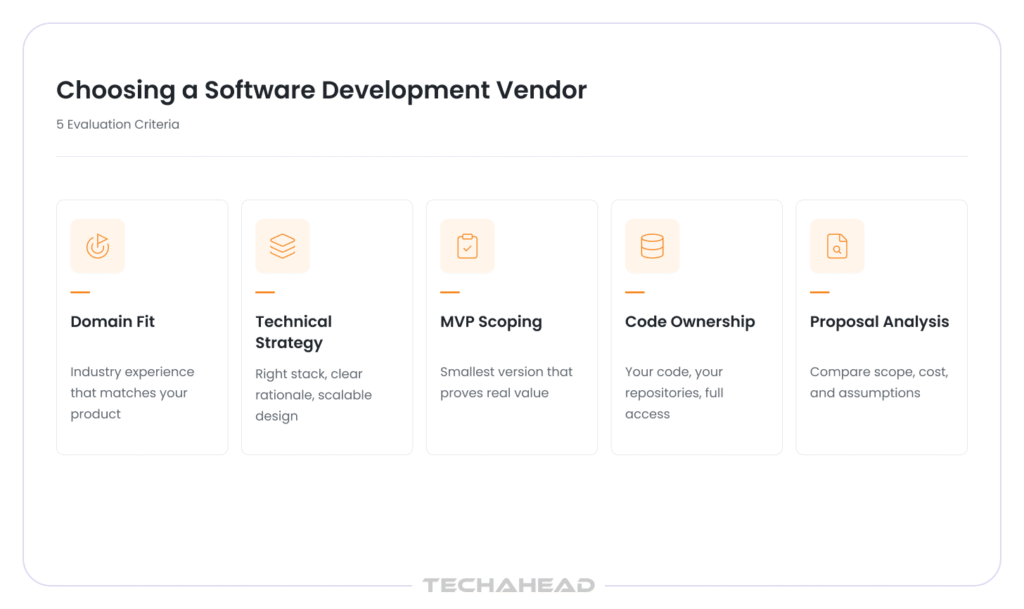
Ask whether the team has worked on food ordering, restaurant operations, logistics, or products with similar workflows. Request a demo or a reference the company is allowed to share.
General app development experience is valuable, but it doesn’t prove the team understands order management, delivery assignment, or how a restaurant actually runs.
The company should be able to explain the proposed architecture, the integrations, the data flow, and how it plans to handle performance. You don’t have to pick every technology yourself, but you should understand why the team recommends a particular approach.
It’s tempting to put every possible feature into the launch. A better starting point is the essential customer journey plus the operational tools needed to deliver it.
Ask the company to separate must-have features from later improvements. That makes it easier to control scope, test your assumptions, and set priorities.
Your agreement should say who owns the source code, design files, documentation, accounts, and data. It should also cover bug fixes, security updates, support response times, and how future changes will be priced.
Give every shortlisted company the same brief. Then compare scope, assumptions, milestones, exclusions, team structure, testing plans, and support terms, not only the headline price.
A detailed proposal that calls out risks and dependencies is often more useful than a low estimate that leaves big questions open.
Must Read: How to Create an MVP for Your Mobile App
Also Read: How to Build an App: A Step-by-Step Guide
Choosing a food delivery app development company starts with knowing what business the app has to support. A restaurant ordering app, a multi-location chain, and a marketplace can all be called food delivery, but their technical and operational needs are very different.
Define your operating model first. Then compare companies against the same requirements, check their relevant experience, and make sure the proposed solution can handle the workflows your business depends on.
If you’re planning a custom platform, TechAhead is one option to consider for mobile app development and tailored software engineering, including restaurant app development for brands that want their own ordering channel. Start with a conversation about your business model, core features, integrations, and long-term plans before you commit to a build.
Some companies to evaluate include TechAhead, Code Brew Labs, Mobulous, Apptunix, Techugo, Hyperlink InfoSystem, App Maisters, Zco Corporation, Brainvire, and Goji Labs. The best fit depends on your business model, required features, integration needs, budget, and the company’s relevant experience.
Start by defining your business model, target users, essential features, and delivery operations. Compare companies based on relevant portfolio experience, technical expertise, project timelines, integration capabilities, source-code ownership, and post-launch support. Request a detailed proposal before making a decision.
Services commonly include custom iOS and Android app development, UI/UX design, backend development, restaurant management dashboards, delivery partner apps, payment gateway integration, real-time order tracking, API integration, testing, deployment, and ongoing maintenance.
A food delivery app typically needs restaurant and menu discovery, search, item customization, cart and checkout, secure payments, order tracking, push notifications, and customer support. Depending on the business model, it may also need restaurant dashboards, delivery partner apps, an admin panel, analytics, and promotional tools.
The timeline depends on the product’s complexity, number of applications, integrations, and testing requirements. A basic ordering app may take a few months, while a multi-vendor platform with customer, restaurant, delivery partner, and admin interfaces can require considerably longer. A development company should provide a timeline after reviewing the project scope.
White-label software can be a practical choice when your business needs standard ordering and delivery features and wants to launch quickly. Custom development is more suitable when you need specialized workflows, unique business rules, deeper integrations, or greater control over the product. Compare flexibility, ownership, maintenance, and long-term costs before deciding.
Yes. A food delivery app can integrate with supported point-of-sale systems, payment gateways, mapping services, notification tools, inventory platforms, and third-party delivery providers. The available integrations depend on the systems’ APIs, provider requirements, and the technical scope of the project.
A company with relevant food delivery experience may better understand restaurant workflows, order-state management, delivery coordination, payment exceptions, and marketplace operations. However, industry specialization should be verified. Review comparable work, ask technical questions, and assess the proposed approach before choosing a partner.
We use cookies to ensure our website functions properly, improve performance, and provide a personalized experience. You can choose which types of cookies to allow below.
Required for core functionality such as security, network management, and accessibility. These cannot be disabled.
Help us understand site traffic and user interactions so we can improve performance and usability.
Enable enhanced functionality and personalization such as language or region preferences.
Used to deliver relevant ads, track campaign performance, and measure advertising effectiveness.