


 Copy Link
 Share on X
 Share on Facebook
 Share on LinkedIn
Always Active
Required for core functionality such as security, network management, and accessibility. These cannot be disabled.

Uncover the transformative potential of digital and mobile solutions for your industry.





 Last Updated: Sep 25, 2026
May 26, 2026
Last Updated: Sep 25, 2026
May 26, 2026  505
505  32 min. Read


Key Takeaways
The global quick commerce market is expected to grow from $68.82 billion in 2022 to over $323.91 billion by 2030 with a CAGR of approximately 22.2%, according to Grand View Research. That growth trajectory is a structural shift in how urban consumers think about time.
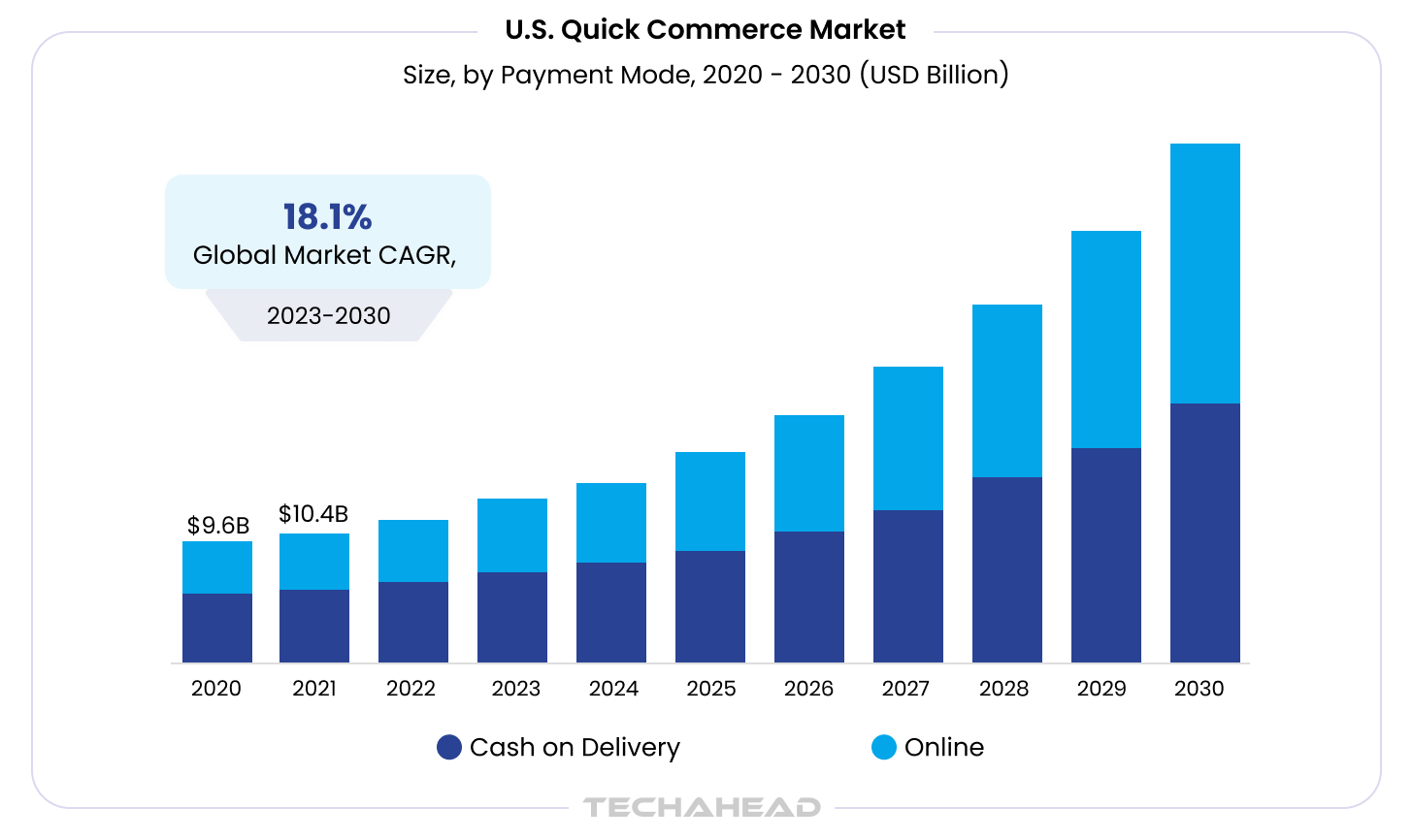
They simply do not want to wait in queues to buy basic groceries or other household essentials. This leads to growth in demand for quick commerce app development like Instacart.
Why Instacart? Because this application has become common in more than 85% of U.S. households due to its q-commerce functionality that allows them to schedule same-day grocery delivery or in-store pickup from local and national retailers.
Instacart processes millions of grocery orders every week across the United States and Canada. The platform got there by engineering an entire operational system, such as dark store placement, real-time inventory management, delivery partner assignment, and route optimization. At the same time, layering a clean consumer experience on top was an exemplary result.
This guide is for founders, investors, and product leaders who want to understand what building such an app actually involves. It includes the cost, technology stack, dark store operations, and scalability decisions that separate quick commerce apps that grow from the ones that stall at city one.
The primary challenge of quick commerce app development? It is building a seamless distributed system, with a consumer interface sitting on top of it.
Most people frame quick commerce as a faster version of e-commerce. That framing misses the point entirely, and it leads founders to underestimate the engineering investment by a wide margin.
Traditional e-commerce is built for cost efficiency at scale. Orders are batched. Warehouses sit outside the city. Delivery windows run in days, and the supply chain is designed for predictability and volume. Unlike traditional e-commerce, q-commerce does not batch anything. It cannot. The moment a customer taps ‘order’, the clock starts.
Instant delivery app development optimizes for time, and that single constraint rewrites every other layer of the system. Inventory must sit within 2 to 3 kilometers of the consumer. Route optimization decisions must fire in under 500 milliseconds. The warehouse layout inside every micro-fulfillment center must allow a picker to pull and pack an order in under 3 minutes. Delivery partner assignment must account for real-time GPS tracking, current load, and projected order batching all at once.
| Dimension | Q-Commerce | E-Commerce | Traditional Grocery Delivery |
| Delivery Window | 8-15 minutes | 1-5 days | Same day / next day |
| Inventory Location | Dark stores (2-3 km radius) | Central warehouses | Retail stores + hubs |
| SKU Count per Node | 2,000-5,000 | 100,000+ | 5,000-30,000 |
| Routing Model | Real-time, single-order | Batch fulfilment | Scheduled routes |
| Demand Forecasting | Hyperlocal + hourly | City-level + daily | Zone-level + weekly |
| Tech Complexity | Very high | High | Moderate |
The operational intensity of on-demand grocery delivery app development means the technology and the business model cannot be separated. A platform that gets the engineering wrong will not patch the problem with marketing spend. Consumer expectations in this category are set at 10 minutes. Deliver slower than that consistently, and users leave.
Read our blog on digital transformation in e-commerce to know how this change occurs in the retail industry and how you can utilize it for increased ROI.
Q-commerce is one of the most capital-intensive consumer models ever run at scale. Anyone entering the space needs to understand that clearly before committing resources. The unit economics are structurally difficult in the early stages, and improving them is primarily a density problem.
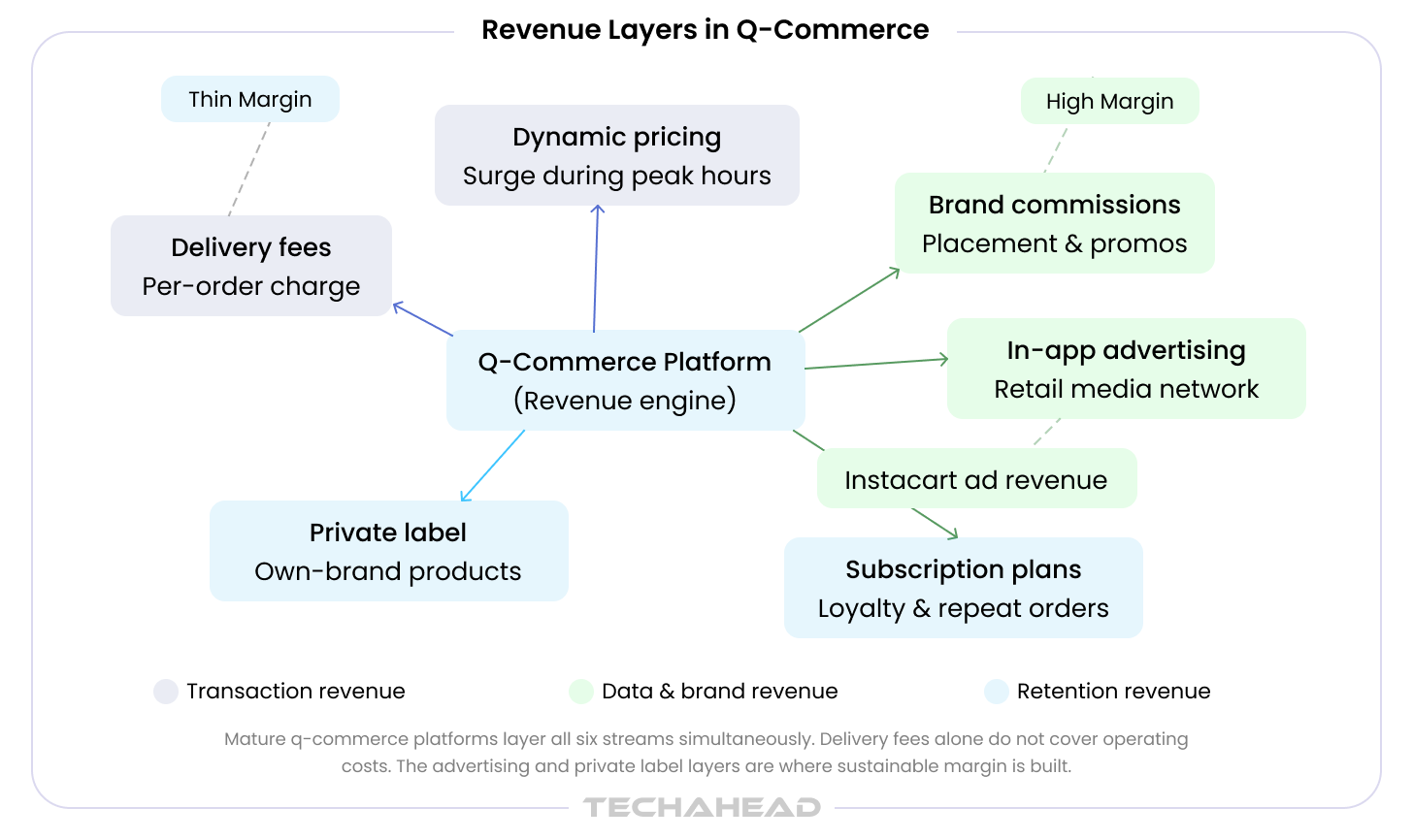
A mature q-commerce platform draws revenue from several layers at once. Delivery fees are the visible one, but they rarely cover operational costs in year one. The real margin driver for platforms like Instacart is brand commerce like the advertising, placement, and data layer that sits on top of the transaction.
Instacart’s advertising and other revenue reached approximately $1,065 million in 2025, up 11% year-over-year, representing 2.9% of GTV. That is the model every serious q-commerce platform is building toward, moving from a logistics operator to a retail media business with logistics as its data engine.
The core tension in the quick commerce business model is that fulfilling a single sub-10-minute order is expensive, while the average basket size stays relatively low. The categories that drive order frequency like beverages, dairy, snacks, and personal care are low-margin by nature.
The profitability inflection point is a density question. A dark store processing 80 to 120 orders per day begins to amortize its fixed costs across enough transactions to approach break-even. Below that threshold, every order generates a contribution loss. The business model rewards operators who build demand density before expanding their dark store footprint, not the other way around.
Customer loyalty is what shifts the economics over time. A retained customer with 3-4 weekly orders from the same dark store is the unit that makes the model work. Chasing new customer acquisition without building repeat purchase behavior is where most early-stage q-commerce operations burn cash without improving unit economics.
The business model of q-commerce rewards density. Every additional order through an existing dark store improves margin. And every dark store opened before demand justifies it is a cash drain.
A full q-commerce platform is a suite of interconnected products, each serving a different user with different real-time requirements. Understanding the complete feature scope is what allows founders to make honest decisions about MVP scope and total software development cost.
| Layer | Technologies | Use Cases / Functions of Q-Commerce App |
| Frontend | React Native, Flutter, Next.js | Customer App, Rider App, Admin Panel |
| Backend Services | Node.js, Go, Python, gRPC | Order, Dispatch, Payment, Inventory, Notifications |
| Real-time Infrastructure | Kafka, Redis, WebSockets, Socket.io | Event streaming, Caching, Live tracking |
| Databases | PostgreSQL, MongoDB, Elasticsearch, Redis | Transactional, Catalog, Search, Session |
| AI / ML | Route Optimization, Demand Forecasting, Fraud Detection | ML models (Python, TensorFlow), Real-time inference |
| Cloud Infrastructure | AWS, GCP, Kubernetes, Docker, CI/CD | Auto-scaling, Load balancing, Zero-downtime deployment |
The architecture decisions made early determine whether the platform scales cleanly or accumulates technical debt that limits it later. This is not about technology preferences — every choice here is a deliberate trade-off with compounding consequences.
React Native and Flutter are the dominant choices for cross-platform mobile development in this space. Both enable shared codebases across iOS and Android, including the Apple App Store and Google Play, which matters when you are shipping simultaneous updates to both the customer app and the delivery partner app. React.js or Next.js powers the admin panel, where server-side rendering keeps data-heavy views fast. React Native in particular has become the default for grocery delivery apps because its JavaScript bridge allows faster iteration cycles than fully native builds, which is important during early market validation.
Performance engineering at the frontend is non-negotiable when the SLA is 10 minutes. App startup time, product catalog image optimization, and offline resilience for delivery partners working in low-connectivity urban areas all require deliberate investment.
Microservices architecture is the only model that supports the independent scaling that q-commerce requires. A monolith cannot scale the order management service independently during a demand spike without dragging every other service with it. That is inefficient and expensive, especially during peak hours.
The core backend services in a competitive quick commerce app cover order management, real-time inventory management, delivery partner dispatch, payment processing, notification delivery, and analytics ingestion. Each service is independent, communicates through defined APIs, and can be deployed or scaled without breaking adjacent services.
This is the layer that separates a proper q-commerce platform from a basic delivery app. Three components carry most of the weight.
WebSockets via Socket.io create persistent bidirectional connections between the server, the customer app, and the rider app. Real-time GPS tracking and live ETA updates depend entirely on this. Without it, the platform falls back to polling, which breaks under load.
Apache Kafka handles real-time data processing at scale by acting as the event streaming backbone. Every order state change such as placed, assigned, picked, dispatched, and delivered fires as an event. Downstream services consume those events asynchronously. Nothing is lost under load, and the analytics layer stays accurate in real time.
Redis handles caching, session management, and pub/sub messaging. At volume, reducing database reads through intelligent caching has a direct impact on both cloud hosting costs and response time SLAs.
No single database engine handles every data pattern in q-commerce optimally. A polyglot persistence strategy is standard in production platforms.
Horizontal sharding and read replicas are deployed at the database layer to maintain read performance during peak hours. This becomes critical during festival-driven demand spikes when order volumes can jump 5 to 10 times the daily average.
Cloud infrastructure for q-commerce runs on AWS or GCP with auto-scaling groups that provision additional compute within seconds of a traffic spike. Kubernetes orchestrates container deployments, enabling zero-downtime releases and automatic recovery when a service fails. Load balancing distributes incoming traffic across service instances, preventing any single node from becoming a bottleneck during demand surges.
A CDN layer serves product images and static assets close to the consumer, reducing perceived load time and improving user satisfaction at the point where most purchase decisions are made. CI/CD pipelines make rapid feature deployment practical — in a competitive quick commerce market, the ability to ship and iterate fast is itself a competitive advantage.
AI in route optimization goes beyond mapping. Production systems use machine learning models trained on historical delivery data to predict ETAs that account for traffic, time of day, weather, and individual delivery partner speed profiles. These models retrain continuously on new data.
Demand forecasting is the intelligence that keeps dark stores stocked without overstocking. Time-series models analyze purchase patterns at the dark store level, hour by hour, predicting what inventory is needed before demand arrives. The accuracy of those models directly drives both stockout rates and waste, which are two of the most controllable cost levers in the business model.
Dark stores are the part of the q-commerce equation that most investors and founders understand least. Platforms and apps get the coverage. The micro-fulfillment center infrastructure is where the real competitive moat actually sits.
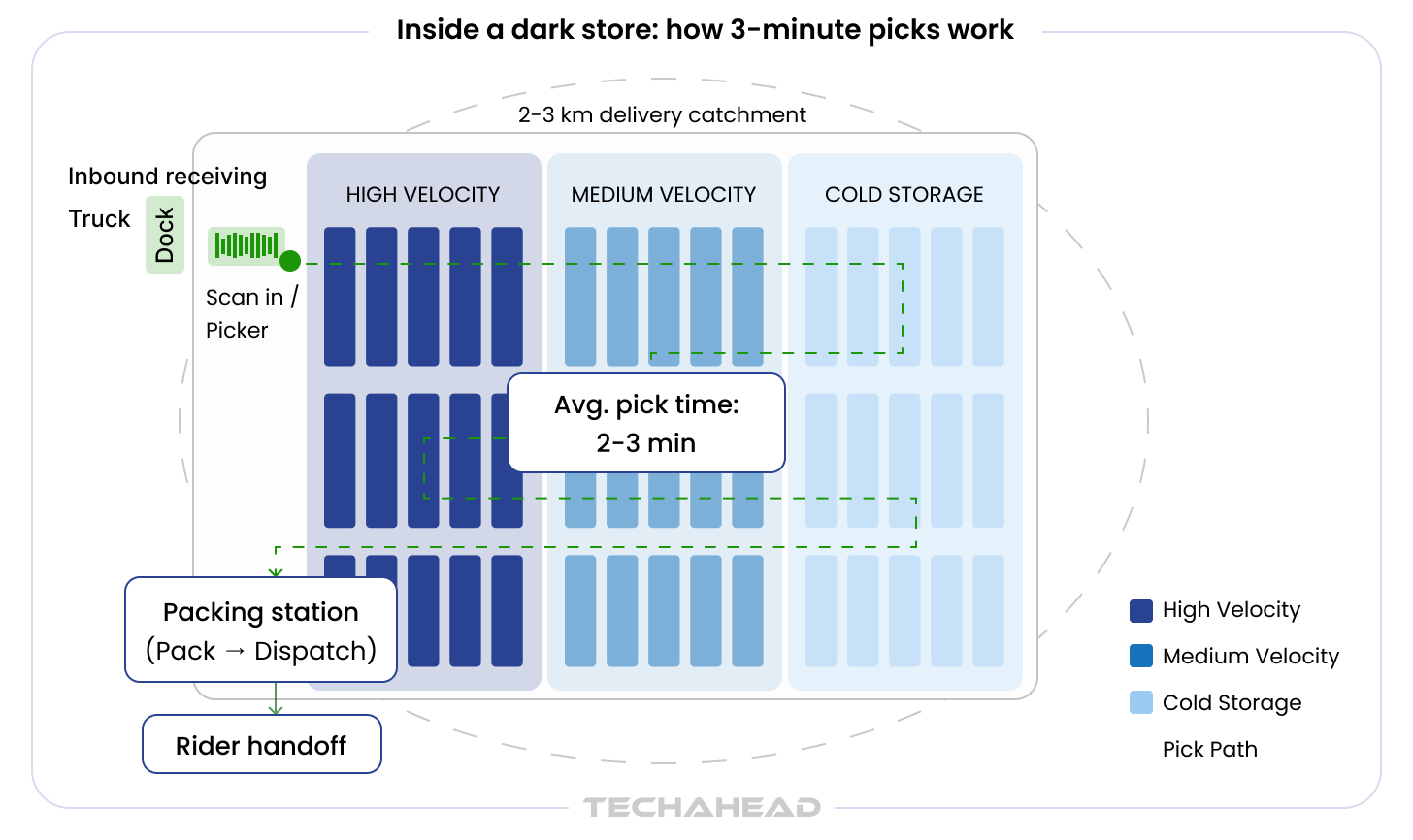
A dark store is a micro-fulfillment center built for speed, not footfall. There are no customers, no shelf displays, and no retail economics. The entire physical space is engineered around pick velocity. Shelving is organized by order frequency, not product category. High-velocity SKUs — items ordered multiple times per hour — live closest to the packing station.
A standard dark store for quick commerce runs between 2,000 and 5,000 square feet, carries 2,000 to 5,000 SKUs, and operates within a delivery radius of 2 to 3 kilometers. That radius constraint is what makes the delivery SLA achievable. A rider leaving the dark store needs enough time to reach any address in the catchment after a 3-minute pick window and a brief dispatch handoff.
One of the technically demanding aspects of q-commerce is that real-time inventory management is not centralized. It is hyperlocal. Each dark store carries a different assortment, calibrated to the purchase behavior and demographic profile of its specific catchment area.
A dark store in a high-income residential neighborhood in Mumbai carries a meaningfully different assortment than one serving a student-dense area. The inventory management system must support this dark store-level assortment differentiation while maintaining real-time inventory visibility across the full network.
The warehouse management system in a dark store is architected around a 3-minute pick target. The software generates pick lists that sequence items by the optimal physical path through the floor. It assigns picks to the closest available picker in real time and updates the order status so the dispatch system can stage a delivery partner before picking is even complete.
How do quick commerce apps deliver in 10 minutes? The 10-minute promise is the engineered sum of three components: a 2-to-3-minute pick window inside the dark store, a 1-to-2-minute handoff and dispatch window, and a 4-to-6-minute delivery time to an address inside the 2-to-3-kilometer catchment. Every number in that chain is tracked, monitored, and optimized continuously.
| Attribute | Dark Store | Ghost Kitchen | Traditional Warehouse |
| Primary Output | Grocery / FMCG orders | Prepared food | Bulk goods / e-commerce |
| Delivery SLA | 8-15 minutes | 20-45 minutes | Same day to 5 days |
| Footprint | 2,000-5,000 sq ft | 300-1,500 sq ft | 50,000+ sq ft |
| SKU Range | 2,000-5,000 | 20-100 menu items | 100,000+ |
| Consumer-Facing | No | No | No |
| Technology Intensity | Very High | Moderate | High |
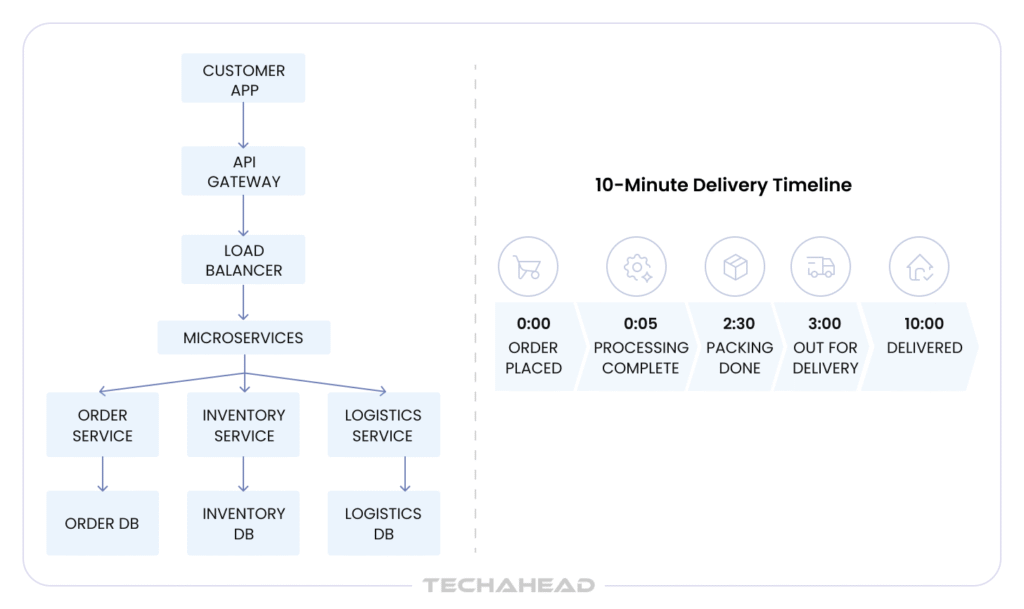
Route optimization is where hyperlocal delivery app development separates from standard logistics software. The routing problem in q-commerce is tightly constrained: assign the right delivery partner, plan the optimal route, and commit to a delivery time — all in under 500 milliseconds, for every order, across every active dark store in the network simultaneously.
The order batching and dispatching system must evaluate several variables at once. Delivery partner proximity to the dark store matters. So does their current load, the predicted pick completion time, and traffic on the projected route. A partner who is physically close but carrying another order may produce a worse actual delivery time than one who is further away but available immediately.
Production systems use modified versions of the Vehicle Routing Problem with time window constraints, solved through heuristic algorithms that return good-enough solutions in milliseconds. At q-commerce order volumes, speed of solution matters more than theoretical optimality.
Live tracking and ETA calculation in production platforms goes well beyond dividing distance by average speed. Accurate ETA models pull in GPS telemetry updated every 3 to 5 seconds, historical travel time data for specific road segments at specific times of day, live traffic feed integration, and delivery partner-specific speed profiles built from historical order data.
Kalman filtering smooths GPS signal noise and produces stable, consistent location updates — removing the jarring position jumps that erode user satisfaction on the tracking screen. The displayed ETA is a continuously recalculated probability estimate. If actual travel deviates from the model, the ETA adjusts before the customer notices a delay.
Last-mile delivery optimization in this context is not just about shorter routes. It is about consistently meeting the promise that drives customer loyalty and repeat purchases.
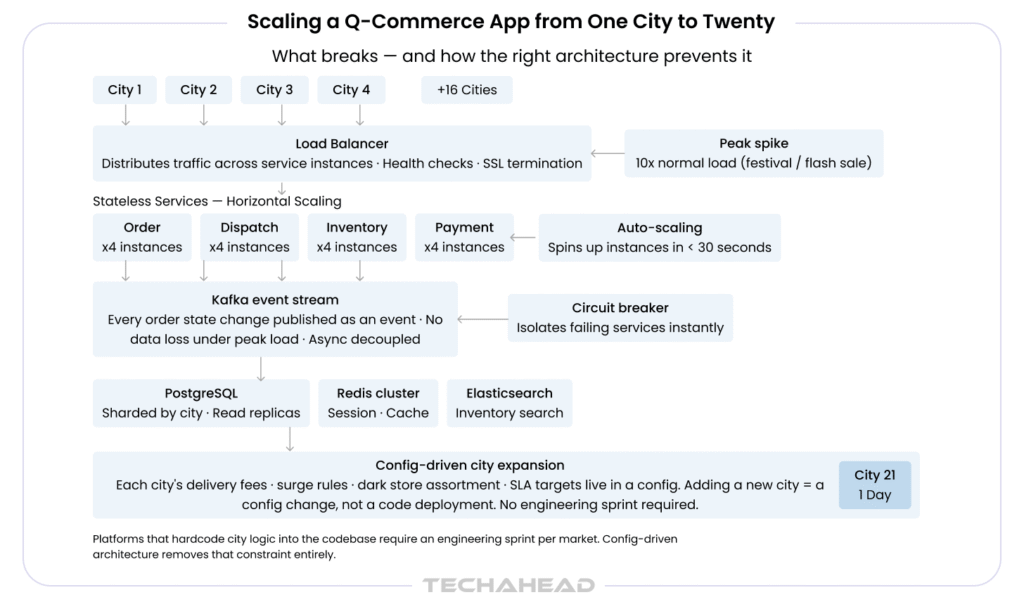
The most common technical failure in q-commerce is building an MVP that works cleanly in one city and then discovering that the architecture cannot extend to ten. The decisions that allow clean operation across 10 dark stores are not the same ones that allow it across 500.
High concurrency means handling thousands of simultaneous order state transitions — each requiring writes to the order database, reads from the real-time inventory system, event publishing to the dispatch service, and notifications sent to both the customer app and delivery partner app — without any operation blocking another.
Stateless service design is foundational. No application server retains session state between requests. This enables horizontal scaling: adding more service instances behind a load balancer without coordination overhead. Circuit breakers prevent cascading failures when a downstream service degrades. Rate limiting protects core services during sudden traffic spikes.
Peak load handling is a distinct engineering problem. Festival events, flash sales, and unexpected weather events can drive order volumes 5 to 10 times the daily baseline within minutes. The infrastructure must detect the spike, provision additional compute automatically, and hold response time SLAs throughout.
Auto-scaling groups in AWS or GCP are configured with policies that trigger new instance launches when CPU utilization or queue depth crosses defined thresholds. Pre-warming — bringing additional capacity online before a known high-demand event — reduces reaction time from minutes to seconds. Post-launch support infrastructure for monitoring and alerting during these events is not optional; it is part of the operational readiness requirement.
Scaling delivery apps to multiple cities requires that the platform’s configuration model is completely decoupled from its codebase. Each city, and each dark store within a city, has distinct delivery fees, surge pricing curves, inventory assortments, SLA targets, and operational rules.
A config-driven architecture externalizes all of that into a configuration management layer. Adding a new city becomes a configuration operation, not a backend development sprint. That is the architecture that enables Instacart’s expansion velocity. A platform that requires code changes to add a city will lose the market timing window every time.
| Criteria | MVP Build | Full-Scale Platform (Recommended) |
| Cost | $45K – $80K | $163K – $265K |
| Timeline | 14 – 20 weeks | 9 – 14 months |
| Positioning | Initial development budget | Recommended for serious operators |
| Includes | Customer app (iOS + Android) Delivery partner app Basic dark store panel Core backend + APIs | All 5 application surfaces Microservices + Kafka real-time layer AI routing + demand forecasting Multi-city config architecture DevOps, CI/CD, load balancing |
| Limitations | No AI/ML layer No multi-city configuration | Higher cost and longer build time |
| Best For | Market validation | Series A platform |
How much does it cost to build a quick commerce app? It depends on scope, team composition, and how seriously the architecture treats scalability from day one. Most app development estimates founders encounter in the market understate the real number — particularly when real-time infrastructure and AI capabilities are included in scope.
An MVP for quick commerce covers the three essential applications, with core functionality and a solid backend, including, customer app, delivery partner app, and dark store operations panel. The goal is to validate demand density and consumer experience before committing to full-scale infrastructure. How long does it take to build a delivery app like Instacart at MVP scope? Fourteen to twenty weeks with an experienced team.
| Component | MVP Estimate (USD) | Timeline |
| UI/UX Design (3 apps) | $4,000 – $8,000 | 3-4 weeks |
| Customer App (iOS + Android) | $10,000 – $18,000 | 6-8 weeks |
| Delivery Partner App | $7,000 – $12,000 | 4-6 weeks |
| Dark Store Ops Panel | $5,000 – $10,000 | 4-5 weeks |
| Backend + APIs | $12,000 – $20,000 | 8-10 weeks |
| Real-Time Infrastructure (basic) | $4,000 – $7,000 | 3-4 weeks |
| QA Deployment | $3,000 – $5,000 | 2-3 weeks |
| Total Q-Commence MVP Cost | $45,000 – $80,000 | 14-20 weeks |
A full-scale competitive quick commerce app includes all five surfaces, AI-powered routing and demand forecasting, multi-city configuration support, and enterprise-grade cloud infrastructure. This is the initial development budget required for a platform that can realistically support a Series A operational footprint.
| Component | Full-Scale Estimate (USD) | Timeline |
| UI/UX Design (5 surfaces) | $12,000 – $20,000 | 5-6 weeks |
| Customer App (iOS + Android) | $25,000 – $40,000 | 10-14 weeks |
| Delivery Partner App | $18,000 – $28,000 | 8-10 weeks |
| Dark Store Management Software | $15,000 – $25,000 | 8-10 weeks |
| Admin Panel + BI Dashboard | $15,000 – $22,000 | 8-10 weeks |
| Backend + Microservices Architecture | $30,000 – $50,000 | 14-18 weeks |
| Real-Time Infrastructure (Kafka + WS) | $12,000 – $20,000 | 6-8 weeks |
| AI / ML Layer (routing + forecasting) | $18,000 – $30,000 | 8-12 weeks |
| DevOps + Cloud Infrastructure Setup | $10,000 – $16,000 | 4-6 weeks |
| QA + Security Audit | $8,000 – $14,000 | 4-6 weeks |
| Total Full-Scale Build | $163,000 – $265,000 | 9-14 months |
How long does it take to build a delivery app like Instacart? The realistic answer depends heavily on scope and team structure. Compressed timelines driven by investor pressure are the single biggest source of technical debt in q-commerce platforms, and that debt shows up at the worst possible moment, during the first major demand spike.
| Phase | MVP Timeline | Full-Scale Timeline | Key Deliverables |
| Discovery & Architecture | 2-3 weeks | 3-4 weeks | Tech spec, system design, API contracts |
| UI/UX Design | 3-4 weeks | 5-6 weeks | Wireframes, prototypes, design system |
| Backend Development | 8-10 weeks | 14-18 weeks | APIs, services, database schema |
| App Development | 8-10 weeks | 12-16 weeks | Customer, rider, ops panel apps |
| Real-Time & AI Layer | 3-4 weeks | 8-12 weeks | Tracking, routing, forecasting models |
| QA & Security Testing | 2-3 weeks | 4-6 weeks | Load testing, penetration testing |
| Deployment & Launch | 1-2 weeks | 2-3 weeks | Infrastructure setup, store submission, go-live |
| Total | 14-20 weeks | 9-14 months |
The biggest timeline risk in q-commerce development is the real-time infrastructure layer. The routing system, live GPS tracking, and Kafka-based event streaming are significantly harder to build correctly than their surface description suggests. Teams that have not built these systems before consistently underestimate the engineering time required and the cost of getting it wrong is not a bug fix, it is a rearchitecture.
The right mobile app development partner brings genuine domain knowledge in hyperlocal logistics, real-time systems architecture, and dark store operations. And TechAhead is the right tech partner for your requirements since they have already delivered 2500+ mobile apps and digital products in total.
Checkout the online delivery platform named OrderNow that TechAhead developed to connect businesses with customers. It fulfills doorstep deliveries made on demand basis. Built on React Native, Node.js, MySQL and MongoDB, this application allows the user to track their order with real-time updates.
The market window for quick commerce is open. The infrastructure required to compete is well-understood. The question for every founder and investor in this space is whether the eCommerce development company building their platform has the domain expertise to make the right architecture decisions from the start.
We work with e-commerce founders, logistics startups, and growth-stage investors on quick commerce app development. From architecture strategy and MVP scoping to full-scale platform engineering and dark store technology integration, we handle end-to-end development for you.
If you are evaluating a build, preparing an investment thesis, or working to scale an existing delivery app beyond its current city footprint, a focused technical discovery conversation is the fastest way to get clarity on scope, cost, and timeline for your specific situation.
Schedule a no-commitment 45-minute session with our q-commerce engineering team. We will map your concept to a realistic build scope, validate your cost assumptions, and surface the architectural risks that catch most founders after development begins.
The cost to build a quick commerce app ranges from $45,000 to $80,000 for an MVP and $163,000 to $265,000 for a full-scale production platform. The range reflects meaningful differences in architecture scope like microservices versus monolith, basic ordering versus AI-powered routing, single-city versus multi-city configuration. Factor in recurring costs: cloud hosting at scale runs $8,000 to $20,000 per month, and third-party API costs add another $15,000 to $50,000 monthly at commercial order volume.
A production-ready MVP takes 14 to 20 weeks. A full-scale platform comparable to Intacart’s core infrastructure takes 9 to 14 months. The constraint is not development speed — it is building the right technology stack the first time. The real-time infrastructure layer (live GPS tracking, Kafka event streaming, route optimization) is consistently underestimated by teams building it for the first time.
Instacart uses a microservices architecture with heavy investment in real-time data infrastructure, machine learning for demand forecasting and personalization, and distributed systems to handle multi-retailer real-time inventory synchronization across thousands of store locations. The platform runs on cloud infrastructure with auto-scaling for peak load handling.
The 10-minute delivery is a product of three engineered components running in sequence: a 2-to-3-minute pick window inside a dark store with optimized floor layout and real-time pick-list generation; a 1-to-2-minute dispatch window where the delivery partner is staged before picking is complete; and a 4-to-6-minute delivery from a dark store located within 2 to 3 km of the delivery address. Each component is tracked, monitored, and optimized continuously.
The backend of a production q-commerce platform is a microservices architecture with independent services for order management, real-time inventory, delivery partner dispatch, secure payments, push notifications, and analytics. The real-time layer uses WebSockets for live GPS tracking and Apache Kafka for event streaming. The database layer uses PostgreSQL for transactional data, MongoDB for the product catalog, Elasticsearch for search, and Redis for caching and real-time operations. Cloud infrastructure runs on AWS or GCP with Kubernetes and load balancing.
Scaling to multiple cities requires four foundational decisions made before expansion begins: stateless service architecture supporting horizontal scaling behind load balancers; a config-driven model where city-level delivery fees, surge pricing, and operational rules are externalized from application code; event-driven architecture using Kafka that handles peak hours without service degradation; and a database sharding strategy that partitions data by geography to maintain query performance as order volume grows. Platforms that hardcode city-level logic into the codebase cannot scale without engineering sprints for every new market.
Common business models for quick commerce include inventory-led, hyperlocal marketplace, and aggregator models, each providing different approaches to inventory management and customer engagement. Delivery fees and dynamic pricing cover baseline operational costs in high-density markets. Brand placement commissions and in-app advertising become the primary margin driver at scale. Subscription plans drive customer loyalty and predictable repeat purchases. Private label products improve margin per order. The quick commerce business model often relies on a hyperlocal fulfillment strategy, utilizing dark stores or micro-warehouses to ensure rapid delivery of high-demand items within minutes. Data monetization through retail media networks, built on actual purchase behavior, is the long-term asset that separates platforms from logistics operators.
Beyond basic ordering and real-time GPS tracking, the advanced features that matter most for competitive quick commerce apps are: AI-powered route optimization with live ETA recalculation; demand forecasting at the dark store level to prevent stockouts and reduce waste; dark store management software with pick-path optimization; multi-channel push notifications with behavioral personalization; dynamic pricing with surge logic for peak hours; in-app advertising infrastructure for brand placement revenue; and subscription plan management for loyalty programs. These are not future roadmap items — they are table-stakes features for any platform entering a market where Instacart have set consumer expectations.
Development team location is a real cost lever. Senior engineers in India with genuine expertise in real-time systems and logistics technology deliver comparable output to US-based teams at 40 to 60% of the cost. The cost efficiency is real, but only when the vendor has domain knowledge in q-commerce architecture — not just mobile app development experience. The cost of working with a discount-rate vendor who lacks real-time systems expertise shows up in the rearchitecture costs after launch, not in the initial project quote.
We use cookies to ensure our website functions properly, improve performance, and provide a personalized experience. You can choose which types of cookies to allow below.
Required for core functionality such as security, network management, and accessibility. These cannot be disabled.
Help us understand site traffic and user interactions so we can improve performance and usability.
Enable enhanced functionality and personalization such as language or region preferences.
Used to deliver relevant ads, track campaign performance, and measure advertising effectiveness.