


 Copy Link
 Share on X
 Share on Facebook
 Share on LinkedIn


Always Active
Required for core functionality such as security, network management, and accessibility. These cannot be disabled.

Uncover the transformative potential of digital and mobile solutions for your industry.



 Last Updated: Nov 17, 2026
Nov 13, 2026
 211
 25 min. Read


Key Takeaways


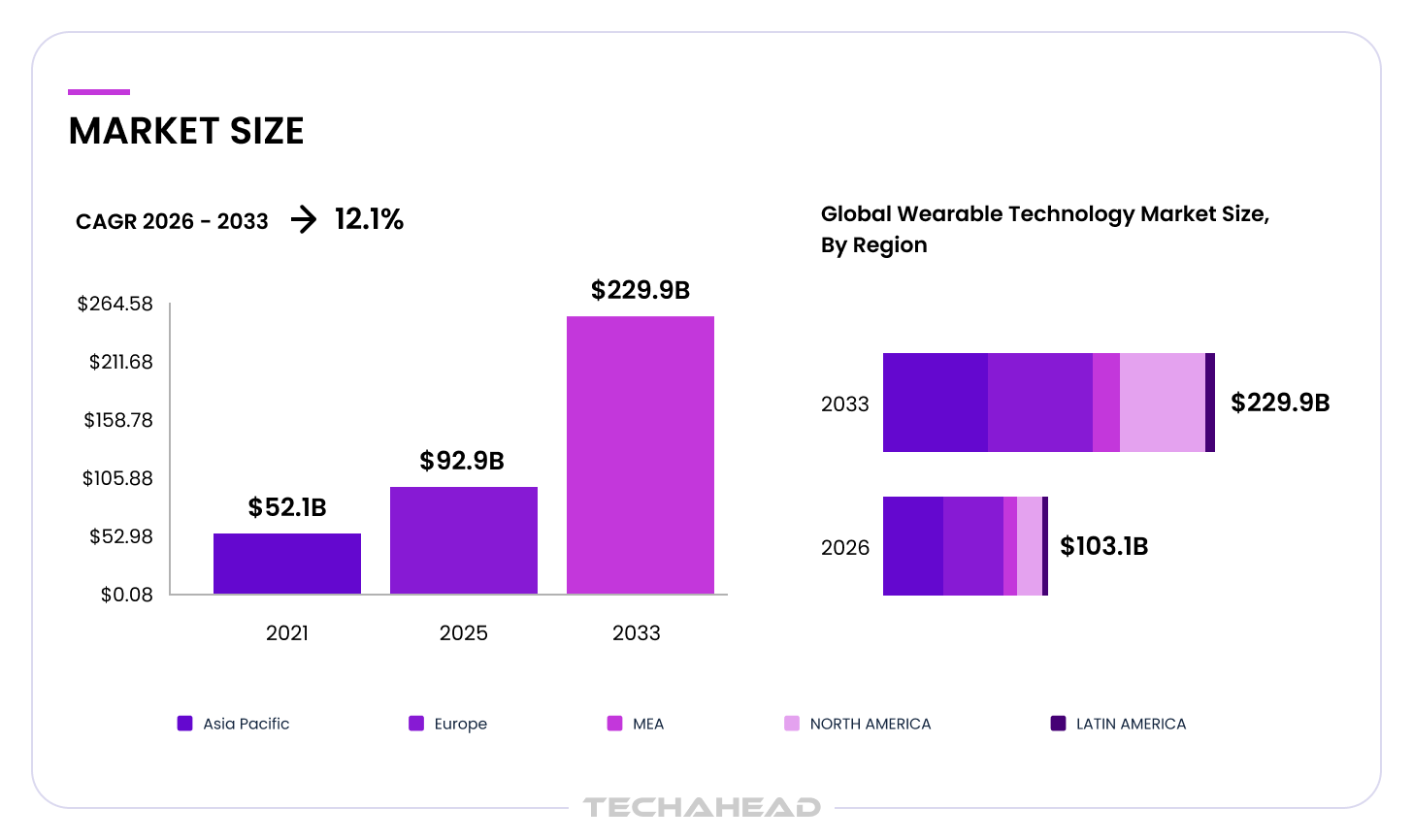
Wearables have moved well past step counters and buzzing notifications. Today they track heart rhythm around the clock, sync with connected gym equipment, keep factory workers out of danger, and put directions right in front of your eyes through smart glasses. According to Grand View Research, the global wearable technology market is estimated to reach $103.1 billion in 2026, growing at a CAGR of 12.1% through 2033. North America accounted for 33% of global market revenue in 2025, so if you’re building for the US, you’re building where a large share of demand is.
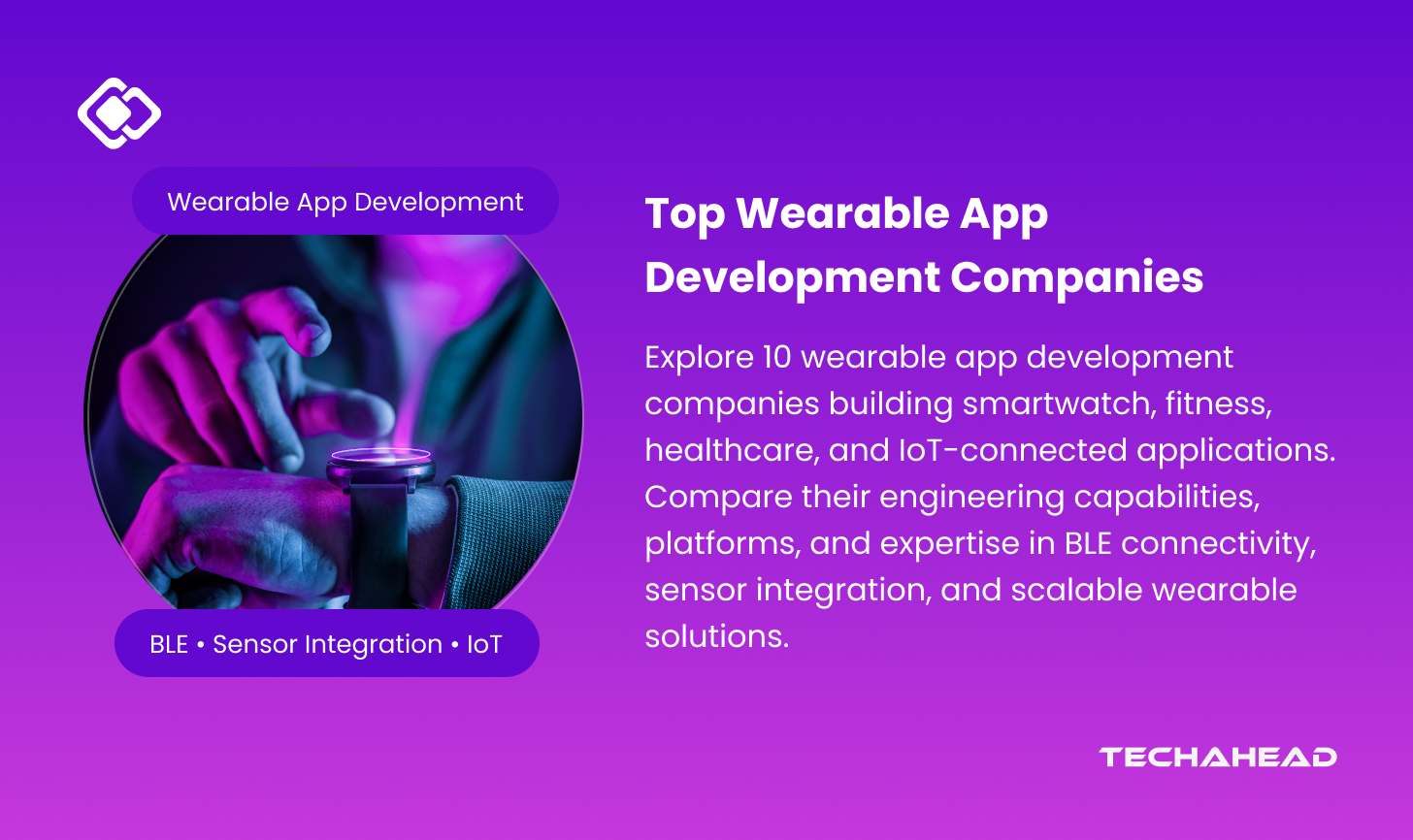
Still, shrinking a phone app to fit a watch doesn’t make it a wearable product. The app has to read from physical sensors, communicate with other devices, process data without draining the battery, and display something useful on a very small screen. In healthcare and enterprise settings, the bar goes even higher, because inaccurate data, privacy slips, or a flaky connection can break the whole product.
That’s why a general mobile development shop isn’t always the right pick. You want a team that actually knows wearable operating systems, Bluetooth Low Energy (BLE), sensor integration, embedded systems, cloud architecture, and real-time data processing.
If you’re a startup, a healthcare provider, a fitness brand, or an enterprise heading into this space, the right development partner can take you from a rough concept to a product that holds up in production.
This guide covers 10 wearable app development companies with a US presence, what each one does well, and the engineering questions worth asking before you sign with anyone.
The companies below cover wearable app development, mobile engineering, healthcare software, IoT connectivity, and embedded systems. We picked them based on the technical services they describe publicly, their industry focus, the platforms they work with, and whether they have a US business presence. The order is an editorial selection, not an independently verified ranking of how well any of these companies perform.
| Company | Core expertise |
| TechAhead | Wearable, mobile, IoT, and AI development |
| MobiDev | Mobile engineering, AI, and connected applications |
| Mercury Development | Wearable, BLE, and fitness applications |
| Softeq | Embedded systems, firmware, and hardware engineering |
| N-iX | IoT, embedded engineering, and enterprise software |
| Orangesoft | Healthcare and medical software development |
| Dogtown Media | Medical wearables and healthcare applications |
| ScienceSoft | Healthcare, enterprise, and integration engineering |
| Topflight | Healthcare software and connected medical devices |
| Vention | Wearable, healthcare, and cross-platform engineering |
TechAhead builds wearable apps alongside mobile applications, IoT solutions, AI, and cloud products. Its wearable app development services cover smartwatches, Apple Watch apps, fitness bands, smart eyewear, AR/VR devices, and connected wearable ecosystems.
The team handles application development, sensor connectivity, device synchronization, and backend infrastructure under one roof. That matters if your wearable app has to communicate with a phone, a connected device, and a cloud system, rather than sit on its own as a standalone product. It also has a dedicated practice for healthcare app development, which comes in handy when a wearable needs to feed data into patient-facing tools.
Core technical capabilities:
Best suited for: Startups and enterprises building custom wearable applications, connected fitness platforms, healthcare solutions, and IoT-enabled digital products.
Explore: TechAhead’s Wearable App Development Services
MobiDev is a software engineering company that provides custom application development, artificial intelligence, computer vision, and IoT-related engineering. Because it’s strong in mobile product development and intelligent software, it’s a fit for businesses building connected apps that interact with wearables and the data their sensors produce.
The team works across mobile platforms, machine learning, cloud infrastructure, and custom software. On wearable-related projects, that mix can support companion apps, activity data processing, and connected product experiences.
Core technical capabilities:
Best suited for: Businesses developing intelligent mobile products, fitness-related applications, and connected digital experiences that need AI, mobile, and backend engineering.
Mercury Development is a software company with experience in wearable apps, Bluetooth Low Energy connectivity, mobile platforms, and connected fitness products. Much of its work involves apps that talk to external hardware, sync device data, and run across several platforms.
Its technical toolkit includes Swift, SwiftUI, Android development, BLE integrations, and mobile health functionality. Those are the skills you need when an app has to pass data between smartwatches, smartphones, and connected fitness equipment.
Core technical capabilities:
Best suited for: Fitness technology businesses, consumer electronics companies, and startups building apps that communicate with Bluetooth-enabled devices and wearable platforms.
Softeq focuses on product engineering across hardware, firmware, embedded software, and application development. That range is useful for wearable products where the software has to work directly with physical components, sensors, microcontrollers, and communication modules.
Many development teams stop at the app interface. Softeq also works on the lower layers of connected products, including hardware prototyping, embedded software, device connectivity, and cloud integration. If you’re building a custom wearable device and need the hardware and software developed side by side, that experience across electronics and embedded engineering is the main draw.
Core technical capabilities:
Best suited for: Enterprises and product companies developing custom wearable hardware, sensor-based devices, and connected products that need both embedded and application-level engineering.
N-iX is a global software engineering company offering IoT development, embedded systems engineering, cloud integration, and enterprise software services. Its IoT work includes device connectivity, edge computing, data analytics, and application development, all of which come into play in larger wearable ecosystems.
The company works with clients in manufacturing, healthcare, logistics, energy, and other enterprise sectors. Its engineering services can support systems that link physical devices, data pipelines, cloud platforms, and business applications. N-iX also lists wearable solution development as part of its IoT expertise.
Core technical capabilities:
Best suited for: Enterprises developing connected wearable ecosystems that need scalable IoT infrastructure, embedded engineering, and integration with existing business systems.
Orangesoft is a software development company that specializes in healthcare technology, mobile apps, and digital product engineering. Its healthcare focus makes it relevant to businesses building connected health apps, remote monitoring platforms, and software that works with medical devices.
Its engineering work spans mobile and backend development, healthcare integrations, data management, and compliance-oriented software architecture. That combination matters for wearable healthcare products, since they collect sensitive information and pass it to patient apps or clinical systems.
Core technical capabilities:
Best suited for: Healthcare startups, medical technology companies, and businesses developing connected patient experiences or apps that interact with health monitoring devices.
Dogtown Media is a digital product development company with a strong focus on mobile healthcare apps, medical technology, and connected devices. Its medical wearable development services cover apps for platforms such as Apple Watch, Fitbit, Garmin, Oura, and Android Wear.
The team builds with the limits of wearable hardware in mind: small displays, limited processing power, sensor connectivity, and spotty network access. Its healthcare engineering also includes remote patient monitoring, secure data transmission, and integration with provider systems.
Core technical capabilities:
Best suited for: Healthcare organizations and medical technology startups developing connected medical devices, remote monitoring apps, and wearable-enabled patient solutions.
ScienceSoft is an IT consulting and software development company offering enterprise application engineering, healthcare software development, system integration, and data analytics. Its background in complex software architecture helps when a wearable app has to exchange information with enterprise systems, healthcare platforms, and cloud infrastructure.
The company serves organizations in healthcare, manufacturing, retail, and financial services. Its engineering services include application integration, backend development, cloud enablement, and cybersecurity. On wearable-related projects, those skills can support data management platforms, healthcare integrations, and connected application ecosystems.
Core technical capabilities:
Best suited for: Enterprises and healthcare organizations that need secure software platforms, complex integrations, and scalable infrastructure behind their connected wearable products.
Topflight is a US-based product engineering company that specializes in healthcare apps, digital health platforms, and AI-enabled software. Its healthcare development work includes device connectivity, Bluetooth integration, sensor-based apps, and interoperability with existing healthcare systems.
If you’re building a healthcare wearable, being able to connect device-generated data to clinical apps and patient platforms is a big deal. Topflight’s engineering services also cover healthcare data integration, HL7 and FHIR interoperability, medical device software, and HIPAA-focused application architecture.
Core technical capabilities:
Best suited for: Healthcare startups, medical technology businesses, and organizations building wearable-enabled apps that need to connect with clinical and healthcare systems.
Vention is a software engineering company offering wearable application development, custom software engineering, AI, and IoT solutions. Its wearable services cover apps for Apple watchOS, Google Wear OS, Fitbit, Garmin, and AR/VR platforms.
The team works across sensor integration, Bluetooth connectivity, cross-platform development, and cloud-based application architecture. Its healthcare and enterprise engineering experience also applies to wearable apps that need secure data exchange, analytics, and integration with existing systems.
Core technical capabilities:
Best suited for: Startups and enterprises developing multi-platform wearable products, healthcare apps, and connected digital ecosystems that need dedicated engineering teams.
A wearable app isn’t a phone app squeezed onto a smaller display. It lives within a connected system comprising physical hardware, device-level software, communication protocols, a mobile app, and backend infrastructure.
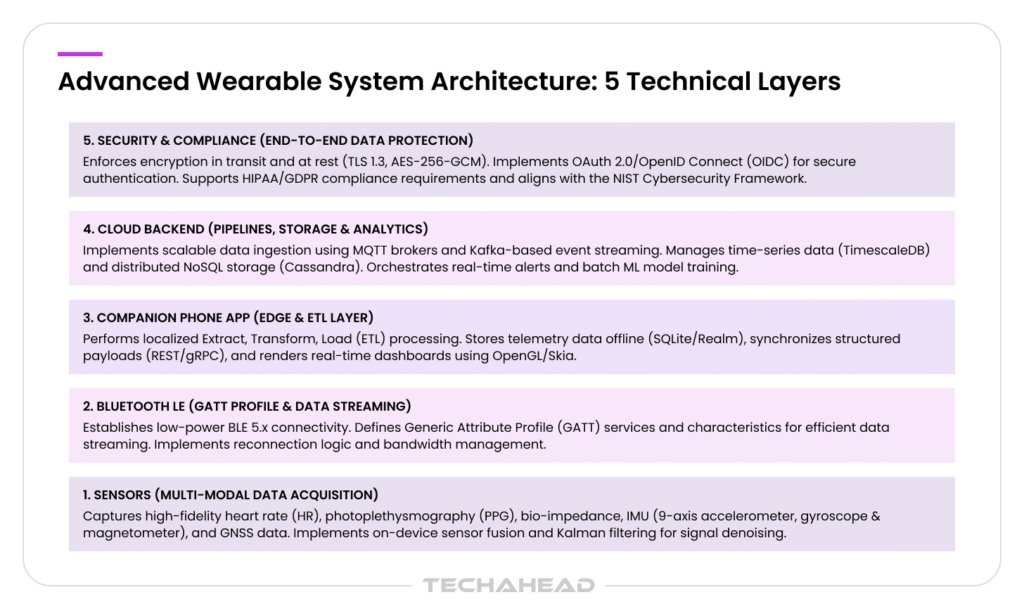
It helps to understand these pieces before you shop for a development partner, because the architecture decides how reliably data moves between devices and how the app behaves once real people start using it.
Most wearable ecosystems break down into five layers.
The sensor layer picks up information from the environment or from the person wearing the device. Depending on the product, that can include:
The app has to read this data in line with what the device hardware and its SDKs actually allow.
Sensor integration also means dealing with sampling frequency, calibration, accuracy, and missing readings. A fitness app might need frequent motion readings during a workout, while a sleep tracker can sample far less often to save battery.
Developers also need to tell raw sensor readings apart from processed measurements. Raw data picks up noise from movement, a loose strap, interference, or hardware limits. Filtering, validation, and signal processing clean that up before the data reaches the user.
Once the wearable has data, it needs a dependable way to send it somewhere. Bluetooth Low Energy (BLE) is the usual choice because it handles short-range communication while using very little power.
A common setup uses the Generic Attribute Profile (GATT), which organizes communication into services and characteristics. The wearable exposes certain characteristics, and a connected mobile app reads them, writes to them, or subscribes to notifications from them.
Take a fitness tracker with a heart-rate service. The companion app connects to the device, discovers the service, subscribes to the right characteristic, and then receives measurement updates as they come in.
That process raises a few engineering questions:
Developers also need to know how BLE differs from classic Bluetooth. BLE works well for low-power data exchange, but if you need more bandwidth, another connectivity approach may fit better.
The connection strategy should be built around what the actual device can do and what the app needs, instead of assuming every wearable behaves the same way.
Many wearables lean on a companion mobile app for a fuller interface and for managing how the device behaves.
The watch might show quick, glanceable information, while the phone takes care of accounts, detailed dashboards, history, notifications, and settings.
On Apple devices, developers typically work with Swift, SwiftUI, watchOS SDKs, and HealthKit. HealthKit gives apps a way to access and share health and fitness data with the user’s permission.
On the Android side, Kotlin and the Wear OS framework are the common tools. Health Connect can handle exchanging and syncing health and fitness records between compatible apps.
The sync layer has to account for:
A good companion app never assumes the watch and phone stay connected. It should keep working offline for a while, store the important data locally, and sync changes once the connection comes back.
When a wearable app serves a large user base or collects data continuously, processing everything on the device usually stops being enough.
Cloud infrastructure gives you one place for data ingestion, storage, processing, analytics, and communication with other business systems.
A typical backend might include:
Imagine a remote patient monitoring app. It receives readings from many wearables, validates each record, stores it securely, and makes the relevant data available to authorized clinicians.
When the app needs to respond right away, edge computing can process selected data closer to the device instead of sending every event to a central cloud. That cuts latency and reduces unnecessary data transfer.
Whether to process data on the device, at the edge, or in the cloud comes down to response time, connectivity, data volume, and privacy requirements. TechAhead’s IoT app development services cover this kind of device-to-cloud planning for connected products.
Wearable apps can collect sensitive information like location, activity patterns, health measurements, and biometric data. Security needs to be part of the architecture from day one, not something added at the end.
The controls that matter most include:
Healthcare apps need extra care. Whether HIPAA applies depends on which organizations are involved and how protected health information is handled. Collecting health-related data doesn’t automatically put every consumer wearable app under HIPAA.
In the same way, apps that perform medical functions may need a regulatory review based on their intended use and features. FDA requirements should be addressed early, not left to the end of the project as a checklist item. If you’re working on a healthcare product, TechAhead’s healthcare app development team can walk you through the compliance side during planning.
Must Read: IoT App Development: The Complete Guide
The platform you pick affects what your app can do, how it performs, which hardware it can reach, and how much work it takes to maintain later. The right tech stack depends on which devices your target customers already use and which features your product needs.
| Platform or technology | Technical role | Common use cases |
| Apple watchOS | Native smartwatch application environment | Fitness, notifications, health experiences |
| Google Wear OS | Android smartwatch application environment | Connected services and activity tracking |
| Fitbit SDK and APIs | Fitbit ecosystem integration | Fitness and wellness applications |
| Garmin Connect IQ | Garmin wearable application ecosystem | Sports and performance tracking |
| Swift and SwiftUI | Native Apple application development | Apple Watch and iOS companion apps |
| Kotlin | Android application development | Wear OS and Android companion apps |
| Flutter | Cross-platform application development | Companion mobile applications |
| Bluetooth Low Energy | Low-power device communication | Sensors and fitness trackers |
| HealthKit | Apple health data framework | Health and fitness data integration |
| Health Connect | Android health data platform | Health record synchronization |
One early decision is whether the product needs native wearable apps or a cross-platform companion app.
Native development usually makes more sense when the app needs platform-specific sensor access, background execution, advanced device features, or tight integration with the wearable’s operating system.
Cross-platform frameworks can work well for the companion mobile app when you want to share logic across iOS and Android. You may still need native modules for platform-specific integrations, though.
Base the decision on the features and devices you need to support. Saving a bit on the first build isn’t a good enough reason on its own.
Also Read: Enterprise Mobile App Development: A Technical Guide
A wearable app can run flawlessly in a demo and still fall apart once real people wear the device all day. The gap usually stems from how the app handles hardware limitations, patchy connectivity, data quality, and changing conditions.
Wearables run on much smaller batteries than phones. Constant sensor access, frequent network calls, background processing, and too many screen updates all cut into battery life.
Developers need to tune sensor polling frequency, batch data transfers where appropriate, limit background activity, and choose efficient communication methods.
The goal is to collect enough data to support the app’s features without keeping every component switched on all the time.
Wearables move in and out of connection all the time. Network drops, Bluetooth range limits, and mobile operating system restrictions all affect how fast data reaches the companion app.
A reliable sync setup needs local buffering, timestamps, retry logic, duplicate detection, and conflict resolution.
When multiple devices are involved, the system also needs a consistent way to identify where each record came from and which one wins when records disagree.
Not every sensor reading is a trustworthy measurement. Where the device sits on the body, how much the wearer is moving, hardware quality, and the environment can all skew the data.
Apps should validate incoming measurements, flag incomplete records, and separate missing data from genuine zero values.
For health-related apps, the software should also be upfront about the limits of consumer-grade measurements instead of presenting every reading as a clinical result.
Wearable ecosystems include a mix of device models, OS versions, screen sizes, sensor setups, and manufacturer-specific APIs.
Testing on a single smartwatch or fitness tracker doesn’t cut it if you plan to support a wider range of devices.
A solid QA plan covers device compatibility testing, real-world connectivity scenarios, background execution checks, performance testing, and regression testing after every operating system update.
A wearable product can involve several apps, devices, APIs, and cloud services, and each one adds a possible weak point.
Authentication, encryption, permission management, secure storage, and audit trails should be designed across the whole data flow.
If you work in healthcare or another regulated industry, compliance requirements should shape the architecture, data access, hosting, and operations from the discovery stage.
Picking a wearable app development partner is both a technical and a business decision. A company can be great at mobile development and still have no real experience with device communication, sensor data, or embedded integrations.
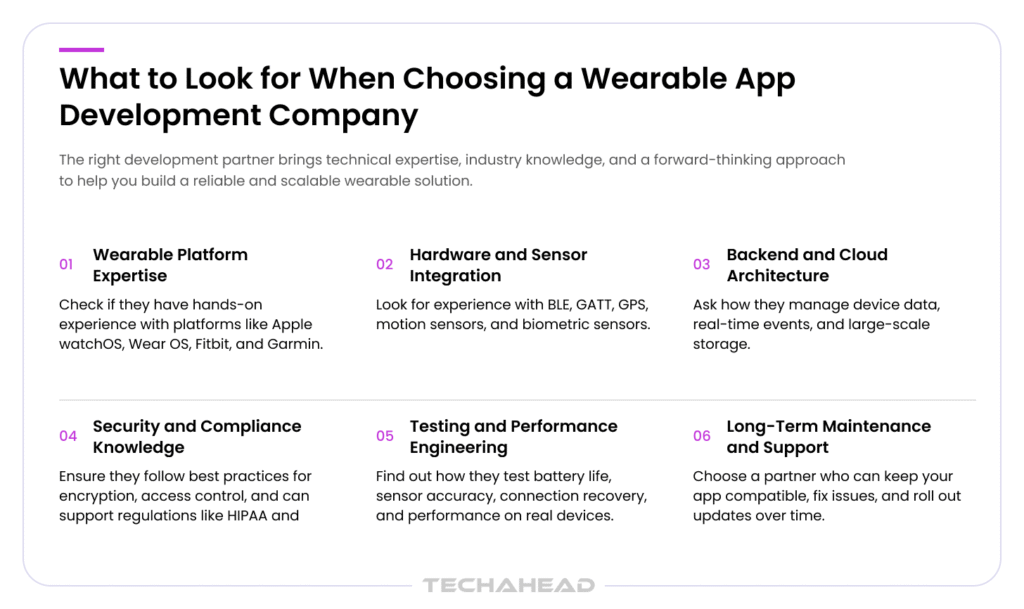
Before you commit to a partner, check these areas.
1. Wearable Platform Expertise
Find out whether the team knows the platforms your product depends on, such as Apple watchOS, Wear OS, Fitbit, and Garmin. Ask how they handle platform-specific APIs, background execution, and device compatibility.
2. Hardware and Sensor Integration
Look at their experience with BLE, GATT, GPS, motion sensors, biometric sensors, and custom hardware. They should be able to explain how device data gets collected, sent, validated, and stored.
3. Backend and Cloud Architecture
Ask how they’d manage incoming device data, real-time events, synchronization, and storage. A scalable architecture should handle new devices and a growing user base without a full redesign.
4. Security and Compliance Knowledge
If your app handles health or biometric data, dig into how the team approaches encryption, consent management, access controls, audit logging, and the applicable regulations.
5. Testing and Performance Engineering
Find out how they check battery drain, sensor accuracy, connection recovery, and performance on real devices, not just emulators.
6. Long-Term Maintenance and Support
Wearable platforms change often. Your partner should be able to keep the app compatible, fix device-specific issues, update integrations, and add new features after launch.
One handy way to compare companies is to book a technical discovery session with each shortlisted team. Have them walk through the device architecture, connectivity approach, data flow, security requirements, and testing plan they’d propose for your product.
That lets you compare partners based on actual engineering decisions rather than marketing copy.
What you’ll pay depends on your product architecture, the devices you support, the integrations you need, and the app’s complexity.
A smartwatch companion app that shows notifications and basic activity stats is a very different job from a healthcare wearable platform that processes continuous biometric data and connects to clinical systems.
A few factors drive the total investment.
Application and Platform Complexity: Native smartwatch apps, companion mobile apps, and cross-platform builds each have different requirements. Supporting multiple operating systems also adds testing and maintenance workload.
Hardware and Sensor Integration: Connecting standard wearables via existing SDKs is different from integrating custom sensors or proprietary hardware. Device protocols, firmware dependencies, and calibration needs all change the engineering scope.
Backend and Data Infrastructure: Apps that collect large volumes of device data may need event-processing systems, time-series databases, cloud storage, analytics, and monitoring.
Security and Compliance: Healthcare apps and enterprise wearables may require more robust security architectures, access controls, audit trails, and regulatory reviews.
Testing and Maintenance: Real-device testing, performance tuning, OS compatibility work, and ongoing support should all be in the budget.
Once you’ve settled on your target devices, user workflows, data requirements, and integration dependencies, ask for a project estimate. That gives you a much more realistic number than any generic price per app.
Also Read: IoT App Development Cost: What Enterprises Pay in 2026
A wearable product requires several engineering disciplines to work together. The app has to communicate with physical devices, process data reliably, provide a usable interface, and integrate with the systems your business already runs on.
TechAhead puts wearable app development, mobile engineering, IoT, AI, and cloud capabilities under one team to cover those needs.
Its wearable app development services cover smartwatches, fitness bands, smart eyewear, connected devices, and other wearable experiences. You can also pull in related engineering for companion apps, device integrations, backend systems, and data-driven features.
The wider tech setup is especially useful if your product needs any of the following:
TechAhead’s wider engineering services also include mobile app development, cloud IoT development, AI solutions, and healthcare software. That lets you plan a wearable product alongside the infrastructure and apps it’ll likely need as the platform grows.
If you’re entering the wearable market, the first step is to define the product architecture before any development starts. Device selection, sensor requirements, connectivity, data ownership, security, and future scalability all need to be considered together.
Building a Wearable Product for Your Business?
Whether you’re working on a fitness-tracking platform, a healthcare monitoring app, or a connected smartwatch experience, TechAhead can help you define the technical requirements and plan the engineering approach.
Explore TechAhead’s Wearable App Development Services to talk through your product requirements, or contact the team directly.
Wearable technology is evolving into a broader connected-product ecosystem, with opportunities in healthcare, fitness, consumer electronics, and enterprise operations. Building a wearable app that lasts takes more than designing a smartwatch interface. You’re dealing with sensor integration, device communication, data sync, backend architecture, security, and performance tuning all at once.
The companies in this guide each bring something different. Some center on dedicated wearable platforms, while others are stronger in embedded systems, healthcare apps, IoT infrastructure, or enterprise software integration.
Which one suits you depends on the devices you plan to support, how complex your app will be, and the engineering skills you need to get from concept to production.
If you want a team that covers wearable, mobile, IoT, AI, and cloud development in one place, TechAhead is a good starting point for your product conversation.
A wearable app development company builds applications for smartwatches, fitness trackers, smart glasses, and connected devices. Its services can include wearable app development, sensor integration, BLE connectivity, mobile companion apps, cloud backend development, and device synchronization.
Evaluate the company’s experience with your target wearable platforms, BLE and sensor integration, mobile and backend architecture, security practices, and real-device testing. Also check whether it can support the product after launch as devices and operating systems evolve.
Common platforms include Apple watchOS, Google Wear OS, Fitbit, and Garmin Connect IQ. The choice depends on your target users, device compatibility requirements, sensor access, and the features your application needs.
Wearable app development commonly uses Swift and SwiftUI for Apple platforms, Kotlin for Android and Wear OS, and Flutter for certain cross-platform companion apps. BLE, GATT, HealthKit, Health Connect, cloud APIs, and IoT technologies are also used for device connectivity and data management.
Bluetooth Low Energy enables wearables to exchange data with smartphones and other compatible devices while using relatively little power. Through the Generic Attribute Profile (GATT), applications can discover device services, access characteristics, and receive updates from connected sensors.
The cost depends on the application type, supported devices, platform requirements, sensor integrations, backend infrastructure, and security needs. A basic smartwatch companion app will generally require a different level of investment than a multi-device healthcare or IoT wearable platform. A detailed estimate requires a defined feature and integration scope.
Wearable applications can use encrypted data transmission and storage, secure device pairing, authentication, access controls, permission management, and audit logging. Applications handling health information may also need to meet applicable privacy, security, and regulatory requirements based on their intended use and the organizations involved.
Yes. Wearable applications can connect with healthcare platforms, mobile applications, cloud services, IoT devices, and enterprise systems through APIs and supported data frameworks. Healthcare integrations may also use standards such as HL7 and FHIR, depending on the product’s requirements.
We use cookies to ensure our website functions properly, improve performance, and provide a personalized experience. You can choose which types of cookies to allow below.
Required for core functionality such as security, network management, and accessibility. These cannot be disabled.
Help us understand site traffic and user interactions so we can improve performance and usability.
Enable enhanced functionality and personalization such as language or region preferences.
Used to deliver relevant ads, track campaign performance, and measure advertising effectiveness.