


 Copy Link
 Share on X
 Share on Facebook
 Share on LinkedIn



Always Active
Required for core functionality such as security, network management, and accessibility. These cannot be disabled.

Uncover the transformative potential of digital and mobile solutions for your industry.


 Last Updated: Nov 3, 2026
Oct 29, 2026
 76
 23 min. Read


Key Takeaways


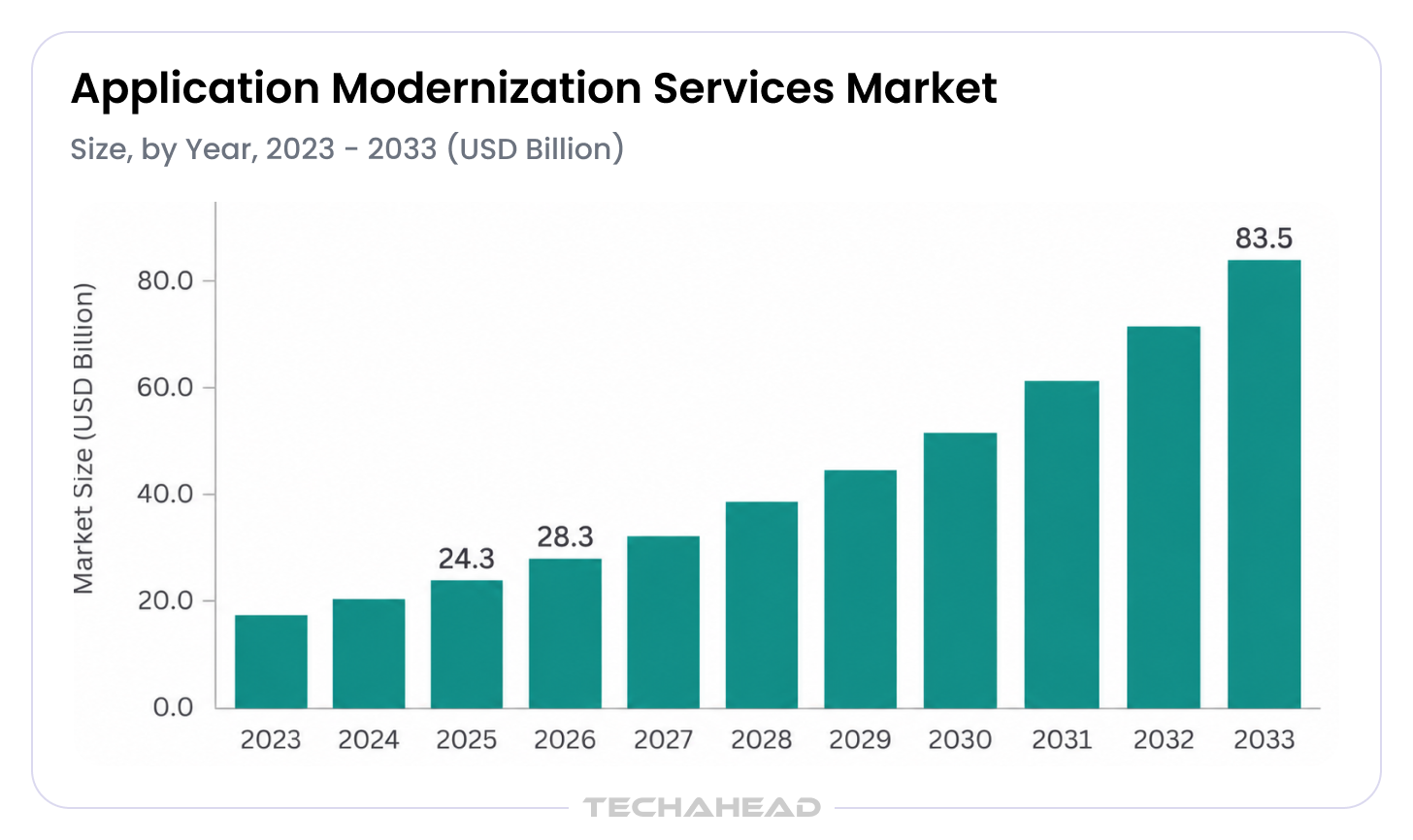
The global application modernization services market is projected to reach $83.5 billion by 2033, growing at a CAGR of 16.7% from 2024, according to Grand View Research. The money is moving for a simple reason: software built a decade or two ago keeps getting harder to maintain, secure, and connect to anything new.
If you own one of these systems, you are familiar with how it works. Nobody wants to touch it since it still handles payroll, orders, claims, and customer data. However, the security team continues to find components that are no longer receiving updates; each new integration takes weeks, and the last engineer acquainted with the code is about to retire.
Replacing everything isn’t the answer for most teams. Years of business rules are buried in that code, and a full rewrite means rediscovering all of them the hard way. Modernization works in smaller moves: shift workloads to the cloud, break a monolith into services, put APIs in front of a system that has none, or use AI tooling to map and test code that nobody has documented.
The harder decision is who does the work. Some applications need a light replatform. Others need a ground-up rebuild. A good partner tells you which after reading your code, not before. If you’re deciding between a specialist legacy modernization company and a global consultancy, this list is meant to help you narrow that down.
A long client list or a modern tech stack tells you little on its own. Plenty of firms build cloud applications well and stall the moment they meet a decade of undocumented dependencies. Those are different skills.
Whether you end up with a global consultancy or a focused legacy software modernization company, here’s what to check before you commit.
Legacy technology depth. Ask for a past project that involved a stack as old as yours. Experience with COBOL, older Java or .NET versions, stored-procedure-heavy databases, or a tightly coupled monolith is different from building cloud apps from scratch, and the gap shows quickly once the team opens your codebase.
A method, not a default. The usual options are rehosting, replatforming, refactoring, re-architecting, rebuilding, and replacing. A vendor that recommends the same one for every client hasn’t looked closely at your application.
Cloud and AI used where they help. Cloud platforms, microservices, and automation are standard offerings now. What you want to hear is where the vendor would use them on your system, where it wouldn’t, and how engineers check AI output before it reaches production.
Continuity during the move. Your data, integrations, and day-to-day operations have to survive the transition. Ask how the vendor handles parallel runs, cutover, and rollback.
Support after launch. A modernized application still needs monitoring, tuning, and maintenance. If the vendor’s involvement ends at go-live, you’re left holding the hardest part.
Also Read: Legacy System Modernization: Key Strategies for Future-Proofing Your Enterprise
| Company | What sets it apart | Where it fits best |
| TechAhead | Assessment-first approach with AI-assisted engineering and UX redesign | Custom apps, mobile platforms, cloud-connected products |
| IBM Consulting | watsonx Code Assistant for Z for COBOL to Java | Mainframe and mission-critical systems |
| Accenture | Portfolio assessment and rationalization before conversion | Large application portfolios across business units |
| Cognizant | Skygrade modernization platform plus managed services | Enterprises wanting build-and-run from one partner |
| EPAM Systems | AI/Run platform, in-place modernization, migration factories | Complex products needing architectural change |
| Hexaware | Amaze automation for Java, .NET, and TIBCO replatforming | Standardized portfolios with repetitive workloads |
| TCS | MasterCraft business-rule extraction and code conversion | Large, interconnected enterprise estates |
| Infosys | Five-pattern approach and Modernization Suite | Programs combining cloud adoption and modernization |
| Simform | MACH architecture and Azure modernization assessment | Cloud-native product and web platforms |
| Persistent Systems | SASVA for repository analysis and code migration | Product and platform modernization |
We built this list from each company’s published modernization services and proprietary tooling, third-party analyst recognition where it exists, and fit across different project types. Where a result or percentage appears below, it’s reported by the vendor itself, and we’ve said so. Treat this as an editorial shortlist, not an independently audited performance ranking.
TechAhead turns outdated applications into modern, scalable platforms through application re-engineering, cloud enablement, architecture transformation, and AI-assisted development. The company says it has been modernizing enterprise applications since 2009. If you’re comparing legacy application modernization services, the thing that separates TechAhead from the larger names below is where it starts: the existing system comes first, and the fix comes after.
That means an assessment of what’s holding the application back before any recommendation. Some apps need a full re-architecture. Others only need their integrations cleaned up, or their infrastructure moved, or their interface redone. Through its AI legacy modernization services, the team covers assessment and consulting, microservices, and architecture transformation cloud-native and multi-cloud enablement, data migration and API integration, DevOps automation and testing, and security and UX redesign.
One limit worth knowing: TechAhead’s strength is custom applications, mobile platforms, and cloud-connected products. If your estate is a large COBOL mainframe, the vendors further down this list have dedicated tooling for that.
Best suited for: Businesses modernizing custom applications, mobile platforms, cloud-connected products, and existing digital systems that need better scalability and usability.
Explore TechAhead’s AI-Native Modernization Services to see how its modernization process works.
A lot of large enterprises still run critical operations on COBOL applications and IBM Z mainframes. The systems are dependable, but older codebases are hard to maintain, experienced developers are hard to find, and connecting to newer technology takes real effort. IBM Consulting specializes in these environments and focuses on keeping essential business logic intact while the modernization happens around it.
Its key offering here is Watsonx Code Assistant for Z. It helps developers understand COBOL applications, refactor them, and transform them into Java, then checks whether the converted code behaves the way the original did. That lets teams modernize selected components step by step instead of replacing the whole mainframe environment in one go.
IBM also takes a hybrid route, so workloads that run best on mainframe infrastructure can stay where they are while the rest moves. Forrester named IBM a Leader in its Q1 2024 Wave for Application Modernization and Migration Services.
Fit is the main thing to check. IBM’s tooling is most valuable for organizations on IBM Z. If your legacy platform is something else, look closely at what IBM offers beyond that.
Best suited for: Large enterprises modernizing mainframe applications, mission-critical systems, and complex legacy infrastructure.
Modernizing one system and modernizing two hundred are different problems. Organizations with dozens or hundreds of legacy applications usually have them spread across departments, built on different technology stacks, and tied together by dependencies nobody has fully mapped. Accenture works at the portfolio level. It helps enterprises assess what they have, find opportunities to consolidate, and put together a transformation roadmap.
A big part of that is deciding which applications to keep, modernize, replace, or retire before any large-scale development starts. Accenture also adds AI capabilities to its mainframe work. With AWS Transform, it supports application discovery, code analysis, test generation, and planning for phased modernization.
The portfolio-first model pays off when technology changes have to be coordinated across several departments and interconnected systems. For a single application, though, Accenture’s enterprise-scale services may be more than the project needs.
Best suited for: Global enterprises managing large application portfolios and multi-system transformation programs.
Migrating an application is only part of the job. Someone also has to monitor performance, manage integrations, deal with security issues, and keep the application healthy after launch. Cognizant pairs modernization with managed IT services, so one partner can cover both the transformation and the day-to-day running.
Skygrade is its platform for cloud-native application modernization, and Cognizant Neuro AI adds AI-driven monitoring and operations. Cognizant reports that it modernized 5 million lines of code for a retailer’s order management system into a microservices-based platform on Google Cloud. According to the company, that system now supports more than $10 billion in digital sales.
Continuity between building and operating is the draw. If you’re considering this model, read the service agreement closely, ask who owns any custom tooling, and think about how dependent on the vendor you’d become over time.
Best suited for: Enterprises modernizing business applications while seeking ongoing engineering and application management support.
Moving a legacy application to the cloud doesn’t automatically fix what’s wrong with it. A tightly coupled monolith can keep struggling with scalability, integration, and maintenance long after the migration. EPAM Systems treats modernization as an engineering problem, which suits businesses that need to improve the architecture underneath their software products and platforms.
Its AI/Run platform supports assessment by helping teams see dependencies, data flows, and where modernization will pay off. EPAM also offers incremental options, including in-place modernization, where the existing application is improved without a complete migration. For larger portfolios, its migration factory approach standardizes the repetitive work and keeps it coordinated.
That engineering depth matters when you have to preserve what the application already does while adding new architecture, integrations, and product capabilities. EPAM was named AWS Global Innovation Partner of the Year in 2025.
Best suited for: Businesses modernizing complex software products, digital platforms, and applications requiring significant architectural changes.
Big application portfolios mean a lot of manual work. Teams have to understand the existing code, map dependencies, migrate workloads, and test everything afterward. Hexaware’s answer is Amaze, an automation-led modernization platform.
Amaze handles enterprise applications built on Java, .NET, and TIBCO BusinessWorks, including ones connected to databases such as Oracle, DB2, and Sybase. It automates much of the assessment and migration work, so applications can move to modern platforms with minimal changes to how they function.
Hexaware reports that Amaze cut migration effort by roughly 66% and sped up modernization by 66% on a banking project on Azure. Those numbers come from that one engagement, so don’t read them as typical results for every modernization program.
Automation helps most when your portfolio is standardized and the migration work repeats itself. Heavily customized applications will probably still need a good amount of manual engineering.
Best suited for: Businesses looking to combine application modernization with automation and cloud transformation.
Large enterprises tend to have application environments that were built up over decades. Departments run separate systems in different languages on different databases, which makes modernization hard to coordinate. TCS tackles that through its enterprise modernization services and its MasterCraft platform.
MasterCraft handles legacy application analysis, business-rule extraction, and code transformation, including automated COBOL-to-Java conversion. The point is to understand what the existing application logic does before moving it to newer technology. In 2025, TCS added generative and agentic AI capabilities to the platform.
TCS reports that a North American bank got 2x productivity and 3x faster delivery than conventional approaches while modernizing its mainframe applications with MasterCraft. That’s a vendor-reported result from one engagement. TCS was also named a Leader in Forrester’s Q1 2024 Wave for Application Modernization and Migration Services.
The mix of modernization tooling and enterprise delivery makes TCS a sensible option for organizations with interconnected applications across several business functions.
Best suited for: Large enterprises modernizing extensive application portfolios and interconnected business systems.
Putting a legacy application on cloud infrastructure doesn’t solve its underlying problems. Older architectures, tightly coupled components, and outdated integrations can still hold back performance and scalability. Infosys handles this with a set of transformation patterns, so enterprises can choose the one that matches their infrastructure and business needs.
For mainframes, the options include renewing existing systems by exposing their functions through REST APIs, re-engineering business logic into cloud-native applications, rehosting workloads, refactoring code, and replacing applications when that makes more sense. Through its Infosys Cobalt ecosystem, the company combines cloud migration, application transformation, mainframe modernization, technology migration, and database modernization.
That range helps enterprises that need application, infrastructure, and data changes to move together as part of a wider cloud strategy. Forrester named Infosys a Leader in its Q1 2024 Wave for Application Modernization and Migration Services.
Best suited for: Enterprises modernizing legacy application environments while expanding cloud adoption, improving integrations, and transforming existing technology platforms.
Best suited for: Enterprises modernizing legacy application environments while expanding their cloud and digital capabilities.
In a tightly coupled application, a small change in one component can ripple through several others. Development slows down and scaling gets harder. Simform focuses on modernizing exactly this kind of application using cloud-native architecture, microservices, and API-led development.
The work includes breaking up monolithic applications, improving API structures, adopting microservices, and reworking infrastructure for changing workloads. Simform also runs Azure modernization assessments that help businesses review their application portfolios, set priorities, and decide whether containerization or microservices actually fit.
It follows MACH principles: microservices-based, API-first, cloud-native, and headless. MarketsandMarkets recognized Simform as a Pervasive Player in its application modernization services quadrant, picking it from more than 200 evaluated vendors as one of 35.
Simform makes sense if you want modernization to support continuing product development, not just a move onto new infrastructure.
Best suited for: Businesses modernizing cloud-connected products, web applications, and platforms that require greater architectural flexibility.
Modernizing an enterprise application usually means several changes have to land together. The database needs updating, APIs need improving, infrastructure has to move, and components need redesigning, all while existing services keep running. Persistent Systems brings product engineering and modernization experience to that kind of project.
Its SASVA platform uses generative AI to analyze large code repositories, trace how files and services relate to each other, and help build modernization roadmaps. Engineering teams can use it to understand legacy structures, document dependencies, and plan code migration. Typical examples include upgrading older Java applications and pulling business rules out of legacy COBOL systems.
Persistent reports that SASVA cut the effort of discovering and documenting legacy workflows by 40% in a retirement-services engagement. That figure applies to that project and shouldn’t be read as a guarantee.
Its product engineering background suits businesses that need to modernize existing platforms while still improving their products.
Best suited for: Organizations modernizing enterprise software products, digital platforms, and data-intensive applications.
The right partner depends on what your application needs. A stable but outdated monolith calls for a different approach than an enterprise juggling unsupported infrastructure, fragmented databases, and several interconnected systems. Work through these five checks before you sign with anyone.
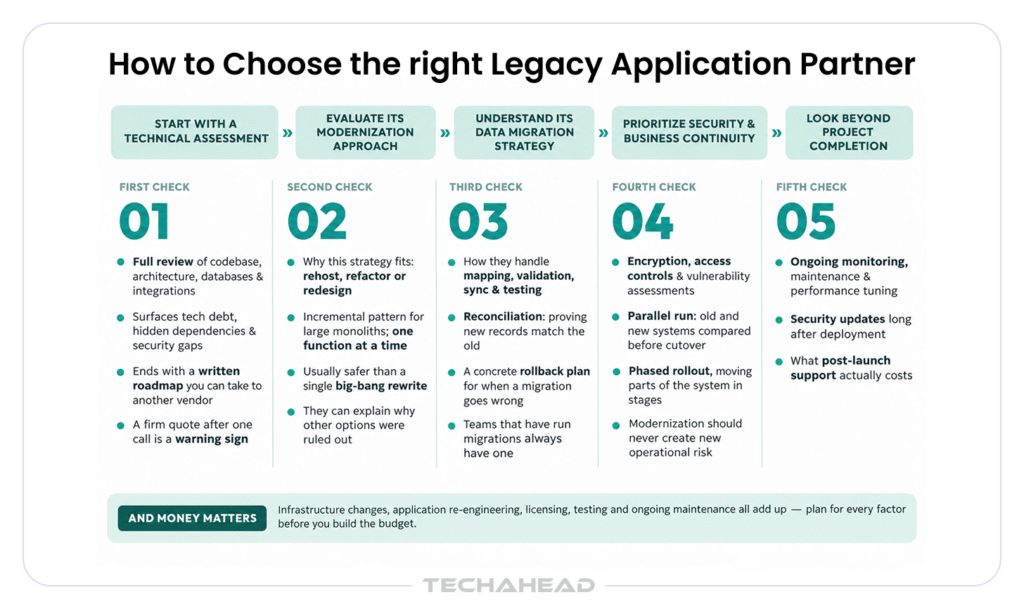
Ask whether the company will evaluate your codebase, architecture, databases, integrations, and infrastructure before it recommends anything. A proper assessment should surface technical debt, hidden dependencies, security gaps, and migration risks, and it should end with a written roadmap you can take to another vendor if you want to. A legacy modernization consulting firm worth hiring will usually insist on this step before quoting a price. If a vendor offers a firm number after one call, treat that as a warning sign.
A reliable partner can explain why a particular strategy fits your application. Rehosting may be enough for some workloads. Others need refactoring or a full architectural redesign. For large monoliths, ask whether the vendor uses an incremental pattern, such as routing traffic to new services one function at a time while the old system keeps running. That’s usually safer than a single big-bang rewrite. Ask them to walk you through why they ruled out the other options.
Data migration is often the most complicated part of the project. Ask how the vendor handles data mapping, validation, synchronization, testing, and rollback planning. Ask about reconciliation too: how will they prove that the records in the new system match the old one? The rollback answer tells you a lot, because teams that have actually run migrations have a specific plan for what happens when one goes wrong.
Modernization shouldn’t create new operational risk. Ask about encryption, access controls, vulnerability assessments, phased deployment, and testing procedures. Find out whether the vendor runs the old and new systems in parallel for a period and compares their outputs before cutting over. A phased rollout, where parts of the system move in stages, is usually safer than a single cutover.
A modernized application still needs monitoring, maintenance, performance tuning, and security updates. Confirm that the vendor supports the application after deployment, and find out what that support costs.
Money matters here too. Infrastructure changes, application re-engineering, licensing, testing, and ongoing maintenance all add up. Our guide to enterprise app modernization costs walks through the factors to plan for while building your budget.
You’ll get a sharper conversation, and a more accurate estimate, if you walk in with a few things already gathered:
If you’d rather not assemble all of this alone, a short discovery engagement with a modernization team is a reasonable first step. TechAhead’s engineers run assessments like this before any commitment to a full project.
Not every legacy application needs a rebuild. The right strategy depends on the existing architecture, business requirements, technical limitations, and your long-term roadmap. These are the six approaches you’ll hear most often:
| Approach | What it involves | When it makes sense |
| Rehosting | Moving applications to new infrastructure with minimal code changes | When infrastructure is outdated but application functionality remains suitable |
| Replatforming | Moving to a modern platform with limited application changes | When businesses need better infrastructure without extensive redevelopment |
| Refactoring | Improving existing code without fundamentally changing functionality | When technical debt makes development difficult |
| Re-architecting | Redesigning application architecture and components | When the existing structure limits scalability or integration |
| Rebuilding | Developing a new application to replace the existing system | When the legacy application cannot reasonably support future requirements |
| Replacing | Adopting an existing software solution instead of maintaining a custom application | When a commercial platform can meet business requirements more effectively |
A few signals can help you pick. If the application works fine and the real problem is aging servers, rehosting or replatforming is usually enough. If developers dread touching the code because every change breaks something, refactoring comes first. If the architecture itself blocks scaling or integration, you’re looking at re-architecting. And if nobody can explain what the application does, start with discovery before you choose anything.
Here’s how that plays out. A company running a monolithic application might refactor it in stages, cutting technical debt first and then moving selected components into microservices. Another might put cloud migration first because its data center costs too much to keep running. Both are reasonable, and they lead to very different projects.
Pick based on what your application actually needs, not on whichever architecture is fashionable this year. An experienced AI application modernization company should be willing to tell you when the simpler option is the better one.
If cloud migration is on your roadmap, our article on overcoming legacy system cloud migration complexities covers the technical challenges that tend to show up along the way.
Must Read: Rehost, Replatform, Refactor: Which Modernization Strategy Fits Your App?
The slowest part of modernizing a legacy system is usually understanding it. Documentation is thin or missing, the original developers have moved on, and business rules have piled up in the code over years. Before anyone changes a line, engineers spend weeks reading and mapping what’s there. AI is cutting that time.
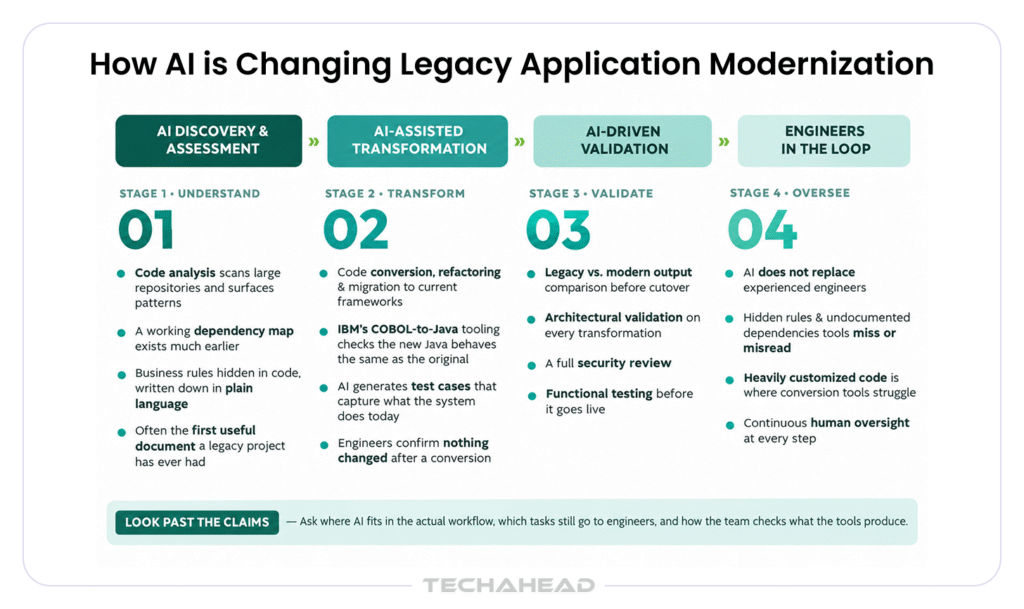
Code analysis tools can scan large repositories, surface patterns, and show how components depend on each other, which gives engineers a working map much earlier. The same tools can pull out business rules that live only in the code, such as how a premium gets calculated or when an order gets flagged, and write them down in plain language. That’s often the first useful document a legacy project has ever had.
When the project moves to transformation, AI-assisted tooling can help convert code, refactor it, and migrate older components to current frameworks. IBM’s COBOL-to-Java tooling is one example, and its design includes a step that checks whether the new Java behaves the same as the original. Testing benefits too. AI can generate test cases that capture what the system does today, so engineers can confirm nothing changed after a conversion. That matters when nobody fully remembers how the old system behaves.
None of this replaces experienced engineers. Legacy applications often hide business rules and undocumented dependencies that automated tools miss or misread, and heavily customized code is where conversion tools tend to struggle. Every transformation still needs architectural validation, a security review, and functional testing before it goes live.
So when you’re evaluating an AI modernization company, look past the automation claims. Ask where AI fits into the actual workflow, which tasks still go to engineers, and how the team checks what the tools produce.
Also Read: How AI Is Speeding Up Legacy Code Analysis and Migration
Modernization projects fail more often from poor planning than from bad code. You have to understand what the system does day to day, what users expect from it, and which architectural limits are blocking future development. TechAhead combines application engineering, AI, cloud technologies, and product development to deal with all of that in one engagement.
Here’s how a typical legacy modernization services engagement unfolds. It starts with a strategy and consulting phase, where the team assesses the existing application, identifies technical limitations, and builds a transformation roadmap. That roadmap is where the approach gets decided: targeted fixes, a staged re-architecture, or a rebuild. From there, the work turns to architecture, restructuring outdated structures and moving toward microservices where it makes sense, so the application is easier to maintain and extend.
The cloud work follows, adapting applications for AWS, Azure, and Google Cloud. Data migration and integration run alongside it, improving data accessibility and connecting existing systems with newer applications and services. Throughout, security and governance work covers vulnerabilities, data protection, and compliance requirements. DevOps and automation round it out, improving development workflows, testing, deployment, and ongoing application management.
A project also has to account for the people using the application. An app can run on a clean new architecture and still frustrate everyone who touches it, so usability deserves the same attention as infrastructure and code.
The goal should be technology that’s more useful, secure, adaptable, and easier to maintain than what you started with. Teams that want a structured, end-to-end option can look at TechAhead’s legacy system modernization services, which run from assessment through post-launch support.
Whether you’re modernizing a mobile application, re-engineering an enterprise platform, or moving an outdated system to a cloud-native architecture, TechAhead can help you work out the right direction.
Also Read: The Roadmap to Modernization: Effective Technology Migration Strategies
Planning to modernize an existing application? Book a modernization assessment with TechAhead’s engineering team and get a written view of your options, risks, and where to start before you commit to a full project.
Some companies to consider include TechAhead, IBM Consulting, Accenture, Cognizant, EPAM Systems, Hexaware, Tata Consultancy Services, Infosys, Simform, and Persistent Systems. Their expertise varies across AI-assisted modernization, mainframe transformation, cloud migration, application re-engineering, and enterprise-scale modernization.
Legacy application modernization companies typically provide application assessment, legacy code refactoring, cloud migration, re-platforming, microservices architecture, API integration, database modernization, security improvements, and ongoing application maintenance. Some also use AI-powered tools for code analysis, documentation, and automated testing.
Start by evaluating the company’s experience with your existing technology stack, application architecture, and business requirements. Review relevant modernization projects, migration strategies, security practices, and post-launch support. Also, request a technical assessment and a clear modernization roadmap before committing to a project.
The cost depends on application complexity, existing technology, code quality, data volume, integrations, infrastructure, and the modernization approach. A simple rehosting project generally involves a different level of effort than re-architecting or rebuilding a complex enterprise application. A technical assessment is the best starting point for estimating costs.
The six common approaches are rehosting, replatforming, refactoring, re-architecting, rebuilding, and replacing. Rehosting moves an application with minimal code changes, while re-architecting changes its underlying structure. Rebuilding creates a new application, whereas replacing adopts an existing software solution.
Yes. AI can assist with legacy code analysis, dependency mapping, business-rule extraction, code conversion, documentation generation, and automated test creation. However, developers must validate the generated code, check application behavior, and conduct security and performance testing before deployment.
Businesses can reduce disruption through phased migration, incremental refactoring, parallel system testing, data validation, and planned rollback procedures. A gradual transition allows teams to verify new components while the existing application continues supporting business operations.
Common challenges include undocumented code, outdated programming languages, complex integrations, data migration risks, security vulnerabilities, limited technical expertise, and business continuity requirements. A detailed application assessment helps identify these issues before the modernization process begins.
We use cookies to ensure our website functions properly, improve performance, and provide a personalized experience. You can choose which types of cookies to allow below.
Required for core functionality such as security, network management, and accessibility. These cannot be disabled.
Help us understand site traffic and user interactions so we can improve performance and usability.
Enable enhanced functionality and personalization such as language or region preferences.
Used to deliver relevant ads, track campaign performance, and measure advertising effectiveness.