


 Copy Link
 Share on X
 Share on Facebook
 Share on LinkedIn


Always Active
Required for core functionality such as security, network management, and accessibility. These cannot be disabled.

Uncover the transformative potential of digital and mobile solutions for your industry.





 Last Updated: Sep 17, 2026
Sep 8, 2026
Last Updated: Sep 17, 2026
Sep 8, 2026  84
84  22 min. Read


Key Takeaways


Choosing the right partner among social media app development companies is one of the most important decisions a founder or product leader will make this year, and most teams make the same mistake: they hire for design first and scale later, when it should be the other way around.
Here is how much that error truly costs.
A social app that looks sophisticated in a demo may still fail in the real world because social networks don’t behave like traditional mobile apps.
A single post can be liked, commented on, and shared thousands of times in minutes, and each interaction must appear in other people’s feeds almost immediately. That’s a fundamentally different engineering challenge than building shopping software or a booking tool, which is why serious social networking app development gets scoped as distributed-systems work rather than standard mobile work, and why so many social products that run well at first start to lag, miss messages, or show stale feeds as soon as they gain popularity.
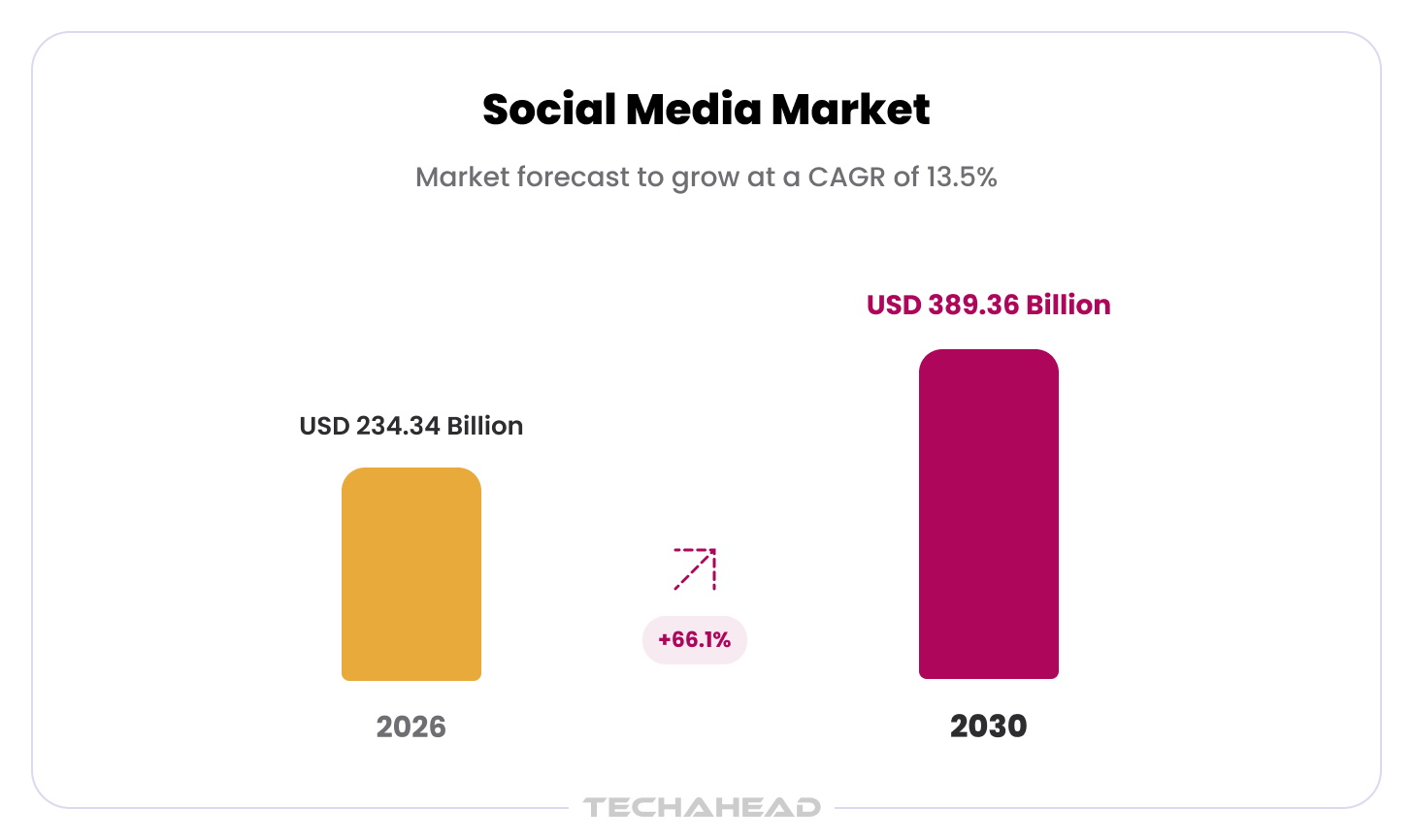
The market opportunity is enormous, which is why it’s worth getting the foundation right. The worldwide social media market was estimated at $234.34 billion in 2026 and is expected to increase to $389.36 billion by 2030. Social platforms now reach over 5.66 billion people globally, with 91% of them using mobile, and short-form video alone accounts for more than 70% of all engagement on these platforms. Businesses are no longer only building social applications for fun; they are also creating owned, branded communities, since organic reach on third-party platforms has dropped to 1 to 4%, making it far less dependable than it once was.
That is why technological architecture matters when selecting a social media app developer: it is the difference between a platform that can withstand that growth and one that breaks under it. This holds whether you are commissioning custom social media app development from scratch or adding social features to a product that already has users. The best partners in this space understand how to build for three things at once: real-time features like live chat, video, and notifications that respond instantly; a feed that remains personalized and relevant as your user base grows; and infrastructure that can handle sudden spikes in traffic, such as a viral post, without slowing down everyone else.
Below is a realistic methodology for assessing a development partner against those needs, followed by a thorough, side-by-side comparison of the 10 social media app development firms best positioned to build a high-performing social platform in 2026.
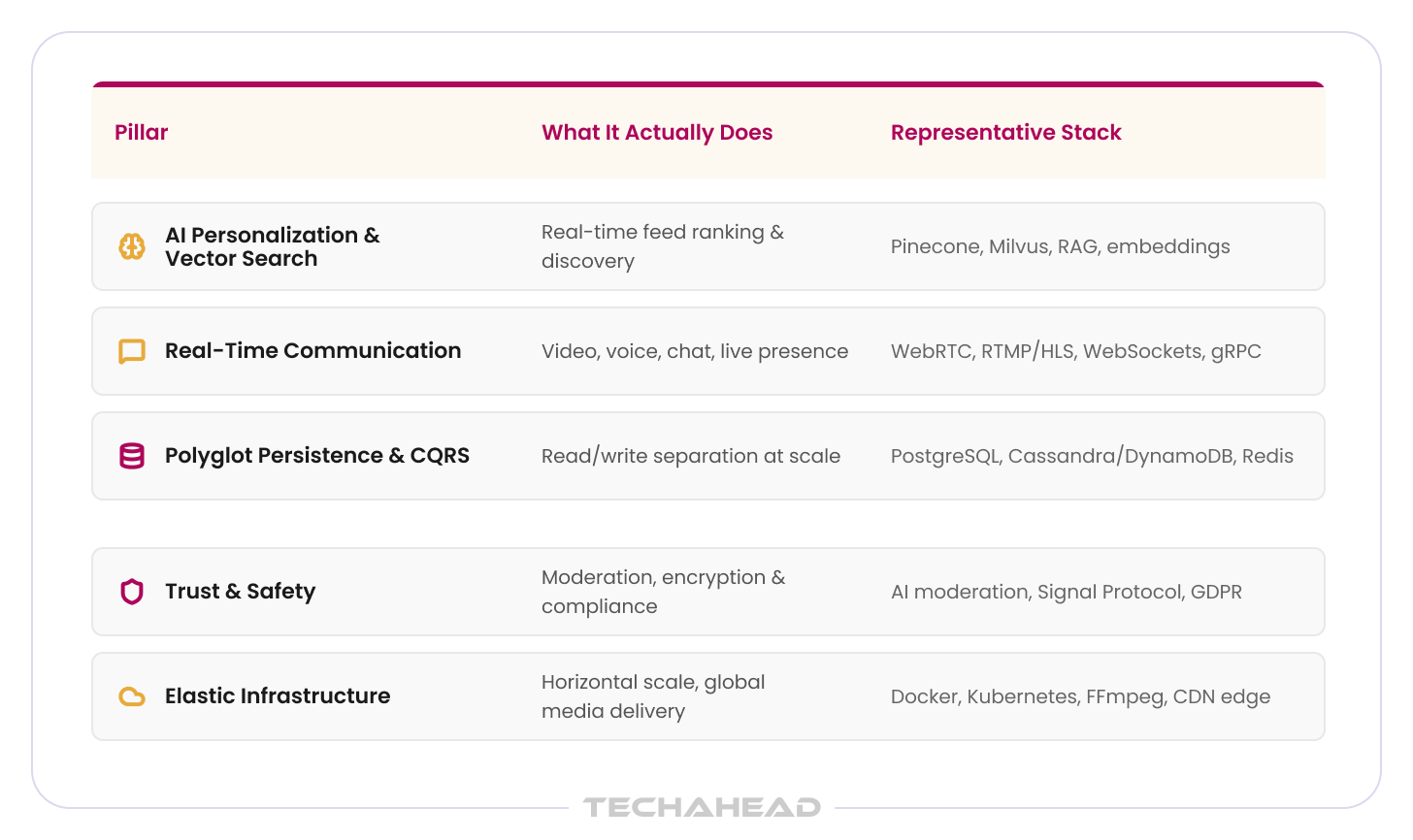
A quick approach to determine if an agency has created a social platform at scale or nice-looking software that has never encountered real concurrent traffic is to ask them to go through these five pillars unprompted. A company that has seen a traffic rise will have thoughts on all five. A company that hasn’t will shift the debate back to UI screenshots.
Feed ranking now uses embedding-based retrieval rather than the engagement-count algorithms used in 2015. This includes real-world production experience with vector databases like Pinecone, Milvus, and Weaviate, plus RAG pipelines for contextual content surfacing and hybrid ranking models that combine traditional collaborative filtering with real-time embedding similarity, allowing the feed to adapt within a single session rather than overnight. If this layer is new territory for your team, it is worth scoping it alongside dedicated AI development service work rather than treating it as a feature ticket.
Buyers must consider: AI Application Development Company | Enterprise AI Apps—the vector-database, RAG, and MLOps stack a partner needs in production before it can own this pillar.
Must Read: Decoding Instagram System Design & Architecture (And How Reels Recommendation Works)—a breakdown of how a real platform’s recommender system actually ranks feed content at scale.
This is the layer that customers really experience. WebRTC handles peer-to-peer and SFU-routed media for calls and live rooms; RTMP and HLS handle one-to-many broadcasts for creators going live to large audiences; WebSockets carry bidirectional app state such as typing indicators and presence; and gRPC is increasingly replacing REST for internal service-to-service calls where HTTP overhead affects latency budgets.
No single database can handle all social workloads adequately, and assuming otherwise leads to platforms reinventing their data layer at Series B. Mature designs use CQRS to separate reads and writes and then route each data type to the appropriate store: PostgreSQL for transactional data and authentication, Cassandra or DynamoDB for high-velocity activity streams, and Redis for in-memory session state and pre-computed feed caching.
This pillar is underbuilt more than any other, mostly because it does not appear in demos. It requires automated multimodal AI moderation across text, image, and video; dedicated CSAM detection integrated with industry hash-matching databases; end-to-end encryption for private messaging, typically using the Signal Protocol’s Double Ratchet algorithm; and compliance tooling that can withstand GDPR and CCPA audits, not just a privacy policy page.
The infrastructure must scale horizontally without a person in the loop at 2 a.m. Docker and Kubernetes (EKS or AKS) handle container orchestration, FFmpeg-based transcoding pipelines feed HLS/DASH adaptive bitrate streams, and a global CDN layer pushes static assets and media to the edge, ensuring origin servers aren’t the bottleneck during spikes. This is cloud application development work in the truest sense, and it rarely goes well when it is handed to a mobile team as an afterthought.
Buyers must consider: Cloud App Development Company—the AWS/Kubernetes/CDN foundation this pillar depends on.
Buyers must consider: Custom Streaming App Development company—transcoding pipelines, CDN delivery, and adaptive bitrate streaming for video-heavy social feeds.
This list is not ranked by agency size, marketing spend, or how many awards sit in a footer. We assessed each firm against the five pillars above, weighting evidence that the work actually happened: named platforms, documented stacks, published engineering detail, and capability that holds up when you ask a second question.
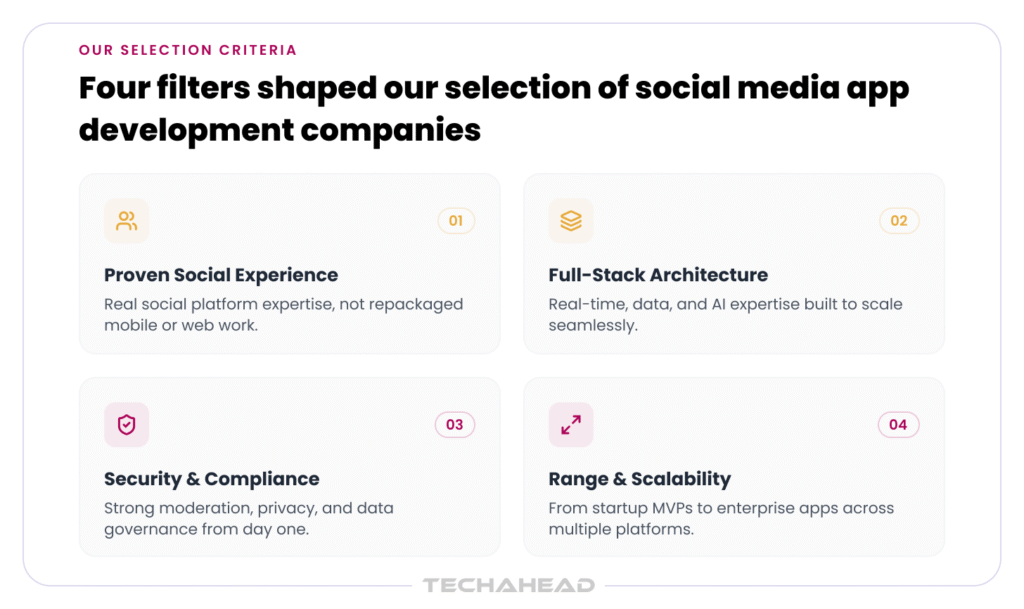
No scores or star ratings are assigned here, because a single number would flatten what actually matters: these firms are good at different problems.
Must Read: How TikTok Works: Decoding System Design & Architecture with Recommendation System
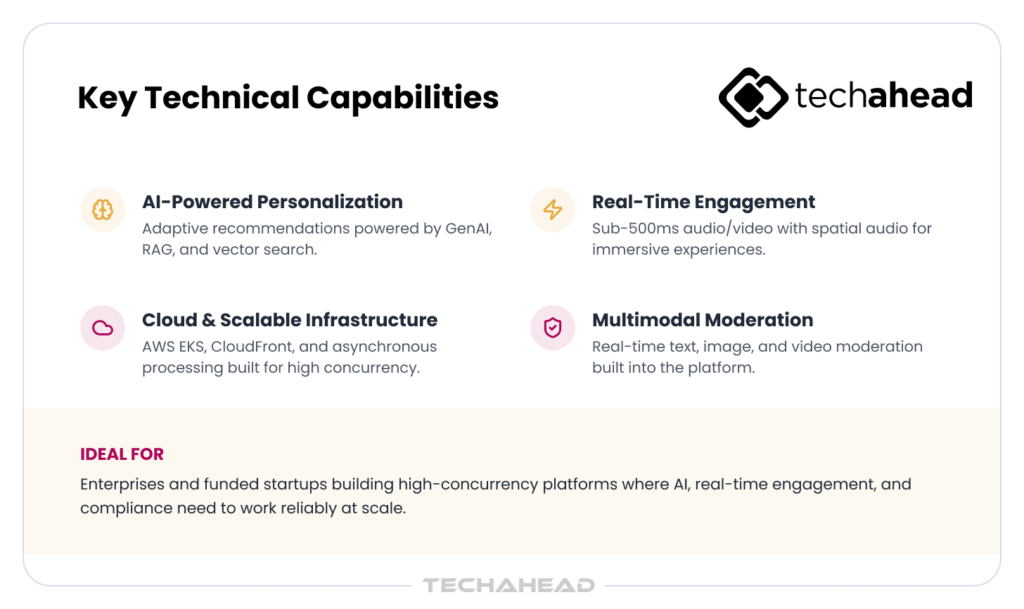
TechAhead builds social platforms the way a distributed-systems team would, not the way a mobile app shop would, and that matters the moment your product has to survive its own growth curve instead of just demo well. The firm holds both ISO 42001 for AI management and SOC 2, which isn’t a badge for the website; it’s why their trust-and-safety and data-governance work holds up when an enterprise buyer’s legal team starts asking questions. That same rigor shows in their custom social media app development work for Tripple, a social platform built to help people preserve and share their digital legacy, engineered as one coherent system covering real-time engagement, AI-driven personalization, and elastic infrastructure instead of three vendors stitched together after launch.
Key technical capabilities:
Ideal for: Enterprises and funded startups building high-concurrency platforms where AI personalization, real-time engagement, and regulatory compliance must hold together under real load, not just in a pitch deck.
Fueled’s reputation is built on native mobile craft, the kind of scroll feel and micro-animation polish that makes a feed app feel expensive rather than assembled from a template. Their Swift and Kotlin teams tune UI rendering for 60 to 120 FPS on modern high-refresh-rate devices, which sounds cosmetic until you watch user retention drop because a feed stutters on scroll. Underneath the UI layer, they lean on GraphQL API gateways so client teams can shape their own data requirements without waiting on backend schema changes, and Realm-based offline-first sync so the app degrades gracefully instead of blanking out the moment connectivity drops.
Key technical capabilities:
Ideal for: Consumer social apps where UI craft and native performance are the primary competitive edge against larger, better-funded competitors.
ScienceSoft comes at social platforms from the data-engineering side rather than the mobile side, which shows in the projects they take on. Much of their social work sits adjacent to regulated industries where a data breach or compliance gap is a business-ending event, not a PR problem. Their architecture leans hard on polyglot persistence, splitting PostgreSQL’s transactional guarantees from Cassandra’s write throughput for activity streams, and they route the connective tissue between services through Apache Kafka so nothing is tightly coupled to anything else. Add SOC 2 and HIPAA experience, and you get a partner that’s genuinely comfortable when “social features” have to coexist with strict data governance requirements.
Key technical capabilities:
Ideal for: Platforms where data governance and regulated-industry compliance carry as much weight in the build as the social features themselves.
WillowTree runs at a scale that most agencies have never seen: enterprise-level delivery across iOS, Android, and web at the same time, coordinated via Kubernetes-orchestrated microservices rather than a single monolithic backend attempting to serve all platforms at once. Their work on video pipelines is particularly noteworthy. HLS and DASH adaptive bitrate implementations alter stream quality in real time based on a viewer’s current network circumstances, which is critical for video-heavy feeds where a single buffering event might be the difference between a user staying or leaving the app. It’s a heavier-weight engagement paradigm, but it’s designed for enterprises that require coordinated distribution rather than a single app delivered once.
Key technical capabilities:
Ideal for: Large organizations that need synchronized cross-platform delivery and have video as a core, not peripheral, part of the product.
MindInventory’s whole value proposition is speed without making shortcuts that will come back to harm you after launch. They’re the team you contact when you need a social MVP in the market in weeks rather than a year, but you still need a backend that can handle actual user traffic from the start. Flutter and React Native provide a unified, fast-moving codebase across platforms, while the backend uses Node.js and FastAPI microservices to grow on demand rather than sitting on fixed infrastructure designed for traffic you don’t yet have. Firebase and MongoDB complete the stack for real-time sync; while not the heaviest architecture on our list, it is actually production-ready for an early-stage development.
Key technical capabilities:
Ideal for: Early-stage founders who need to validate a social concept fast with a backend that won’t need a full rewrite the moment it gets real traction
Hedgehog Lab specializes in the behavioral layer of social app design, which impacts how people use a product rather than just how it appears. Their UX methodology is based on habit-formation patterns, and they combine it with truly practical edge AI work, such as running CoreML and TensorFlow Lite models directly on-device, which reduces both latency and server costs for features like content filtering and gesture detection. Where they truly stand out is their support for various devices, bringing fundamental social capabilities to wearables like watchOS in ways that seem natural to the device rather than a scaled-down phone app.
Key technical capabilities:
Ideal for: Social products expanding beyond the phone screen into wearable and ambient computing experiences.
Cleveroad has developed a true expertise in the piece of infrastructure that other generalist firms surreptitiously outsource: the video pipeline itself. Their teams collaborate directly with FFmpeg and AWS Elemental to create unique transcoding pipelines, optimize adaptive bitrate ladders to account for real-world network unpredictability, and set up WebRTC-based live broadcast infrastructure for creator livestreams. If your product’s fundamental loop is video, whether live, on-demand, or both, this is the type of tedious infrastructure labor that decides whether streams truly operate when ten thousand users tune in at the same time.
Key technical capabilities:
Ideal for: Platforms where live or on-demand video is the primary content format, not a feature bolted on after launch.
Netguru’s methodology involves specialized engineering pods embedded directly with a product team, which is ideal for entrepreneurs who prefer an agile, iterative development process over a fixed-scope statement of work that is handed off and delivered months later. Their infrastructure work is done with Docker and Kubernetes for cloud-native microservices, and their GraphQL prototyping speed is truly fast, which is useful for social products where the feed algorithm, social graph structure, and core feature set are all still evolving based on early user data rather than being locked in before a single user opens the app.
Key technical capabilities:
Ideal for: Product teams that want an embedded, agile engineering partner rather than a fixed-scope delivery relationship.
Intellectsoft is at the decentralized end of the social spectrum, catering to teams who don’t want user content and revenue hosted on centralized servers that they completely control. Instead of a regular cloud bucket, content is stored using IPFS and Filecoin, and creator monetization (tipping, income splits, ownership) is handled via smart contracts. They match it with end-to-end encrypted communications by default, which aligns with the whole philosophy: user data and earnings should be portable and verifiable, not trapped inside a single company’s infrastructure.
Key technical capabilities:
Ideal for: Web3-native social platforms built around creator ownership and decentralized, verifiable content storage.
Appinventiv creates consumer social apps with the goal of achieving rapid, high-volume adoption across all major platforms simultaneously. Their architecture is based on cloud auto-scaling patterns designed for the unpredictable, spiky traffic associated with consumer acquisition efforts, rather than the more consistent load patterns of an enterprise B2B offering. They ship concurrently on native iOS, native Android, and Flutter, which is important for organizations looking to achieve broad device coverage in a single launch window rather than extending platform by platform across a year.
Key technical capabilities:
Ideal for: Consumer social apps targeting fast, high-volume user acquisition across every major mobile platform at once.
| Company | Key Strength | Core Capabilities | Best Suited For |
| TechAhead | End-to-end AI-native social architecture | RAG and vector-search feeds, sub-500ms RTC, AWS EKS and CloudFront, multimodal moderation, ISO 42001 and SOC 2 | Enterprises and funded startups needing personalization, real-time engagement, and compliance in one system |
| Fueled | Native mobile craft and UI performance | Swift/Kotlin rendering at 60 to 120 FPS, GraphQL gateways, Realm offline-first sync | Consumer apps competing on feel and native polish |
| ScienceSoft | Data engineering and regulated-industry governance | PostgreSQL plus Cassandra polyglot persistence, Apache Kafka streaming, SOC 2 and HIPAA experience | Platforms where compliance weighs as much as social features |
| WillowTree | Enterprise multi-platform delivery | Kubernetes microservices, HLS/DASH adaptive bitrate, coordinated iOS, Android and web release | Large organizations with video at the core of the product |
| MindInventory | Speed to market without a throwaway backend | Flutter and React Native, Node.js and FastAPI microservices, Firebase and MongoDB sync | Early-stage founders validating a concept quickly |
| Hedgehog Lab | Behavioral UX and on-device AI | CoreML and TensorFlow Lite edge inference, habit-formation UX, watchOS and wearables | Social products extending past the phone screen |
| Cleveroad | Video pipeline engineering | FFmpeg and AWS Elemental transcoding, tuned ABR ladders, WebRTC live broadcast | Platforms where live or on-demand video is the main format |
| Netguru | Embedded agile engineering pods | Docker and Kubernetes microservices, rapid GraphQL prototyping, co-located pod model | Teams iterating on feed and social-graph design with real user data |
| Intellectsoft | Decentralized and creator-owned social | IPFS and Filecoin storage, smart-contract monetization, default end-to-end encryption | Web3-native platforms built on creator ownership |
| Appinventiv | High-volume consumer launch engineering | Cloud auto-scaling for spiky traffic, native iOS, native Android and Flutter in parallel | Consumer apps chasing fast adoption across every platform at once |
Buyers must consider: Machine Learning Application Development—the recommendation engine and generative AI build options behind the “AI-native” column above.
Three decisions determine how expensive it is to fix your architecture later. Get these wrong at the start, and you won’t be tweaking code in six months; you’ll be migrating data stores under live traffic.
There’s no single “best” social media app development company. There’s a best fit for your platform’s specific complexity, latency requirements, and growth trajectory. A firm built to ship an MVP in weeks solves a fundamentally different problem than one built to sustain AI-driven engagement at enterprise concurrency. The honest question isn’t “Who’s the best agency?” It’s “Which of the five architectural pillars is my platform going to stress first, and who’s actually built for that?”
For teams building toward high-scale, AI-native social products, where real-time engagement, enterprise-grade compliance, and elastic infrastructure all have to work together from the first release and not the third, TechAhead is built to take that on end-to-end. If you’re scoping a social platform and want a second set of eyes on the architecture before you commit to a stack or a vendor, get in touch with TechAhead’s engineering team and walk through the system design together.
Cost depends far more on scale and complexity than on feature count. The biggest drivers are whether you are building an MVP or a full platform, how many platforms you ship on, whether the feed is AI-ranked, and whether live video and multimodal moderation are in scope. Expected concurrency matters as much as the feature list, since the same app built for ten thousand and for one million users is two different engineering efforts.
A validation MVP is the fastest path, a single-platform production launch takes meaningfully longer, and a multi-platform AI-native build with live video is longer again. Video pipelines, moderation and compliance integration, cross-platform parity, and custom feed ranking are the four factors that extend schedules most.
There is no single stack, but mature social platforms tend to converge on similar patterns: PostgreSQL for transactional data, Cassandra or DynamoDB for activity streams, Redis for caching and session state, WebRTC and WebSockets for real-time features, Kubernetes for orchestration, and a vector database such as Pinecone or Milvus if the feed is AI-ranked. The right choice depends on which workloads your product will stress hardest.
Yes, and for most early-stage products it is the right call. The caveat is that some decisions are genuinely hard to reverse, particularly the data model, the real-time transport, and how media is processed. An MVP built with those three decided correctly can scale. An MVP built on a single database with synchronous uploads usually gets rewritten.
Effective moderation is layered: automated multimodal classification across text, image, and video, hash-matching against industry CSAM databases, user reporting flows, and human review for edge cases. It should be designed into the architecture from the start, since retrofitting moderation into a live platform is significantly harder than building it in.
Concurrency and fan-out. A standard mobile app mostly handles one user’s requests at a time. A social platform must propagate a single action to thousands of other users’ feeds within moments, which makes it a distributed-systems problem with a mobile interface rather than a mobile problem with a backend attached.
Through architecture rather than optimization. Separating read and write models with CQRS, pre-computing feeds in cache, processing media asynchronously, serving assets from a CDN edge, and scaling services independently so a spike in messaging does not slow down the feed. Performance problems at scale are almost always design problems surfacing late.
Cross-platform frameworks like Flutter and React Native are entirely viable for most social products and are often the better choice for speed and cost. Native becomes worth the extra investment when scroll performance, animation fidelity, or deep hardware and on-device AI integration are central to how your product competes.
We use cookies to ensure our website functions properly, improve performance, and provide a personalized experience. You can choose which types of cookies to allow below.
Required for core functionality such as security, network management, and accessibility. These cannot be disabled.
Help us understand site traffic and user interactions so we can improve performance and usability.
Enable enhanced functionality and personalization such as language or region preferences.
Used to deliver relevant ads, track campaign performance, and measure advertising effectiveness.