


 Copy Link
 Share on X
 Share on Facebook
 Share on LinkedIn
Always Active
Required for core functionality such as security, network management, and accessibility. These cannot be disabled.

Uncover the transformative potential of digital and mobile solutions for your industry.





 Last Updated: Nov 23, 2026
Nov 19, 2026
 259
 25 min. Read


Key Takeaways


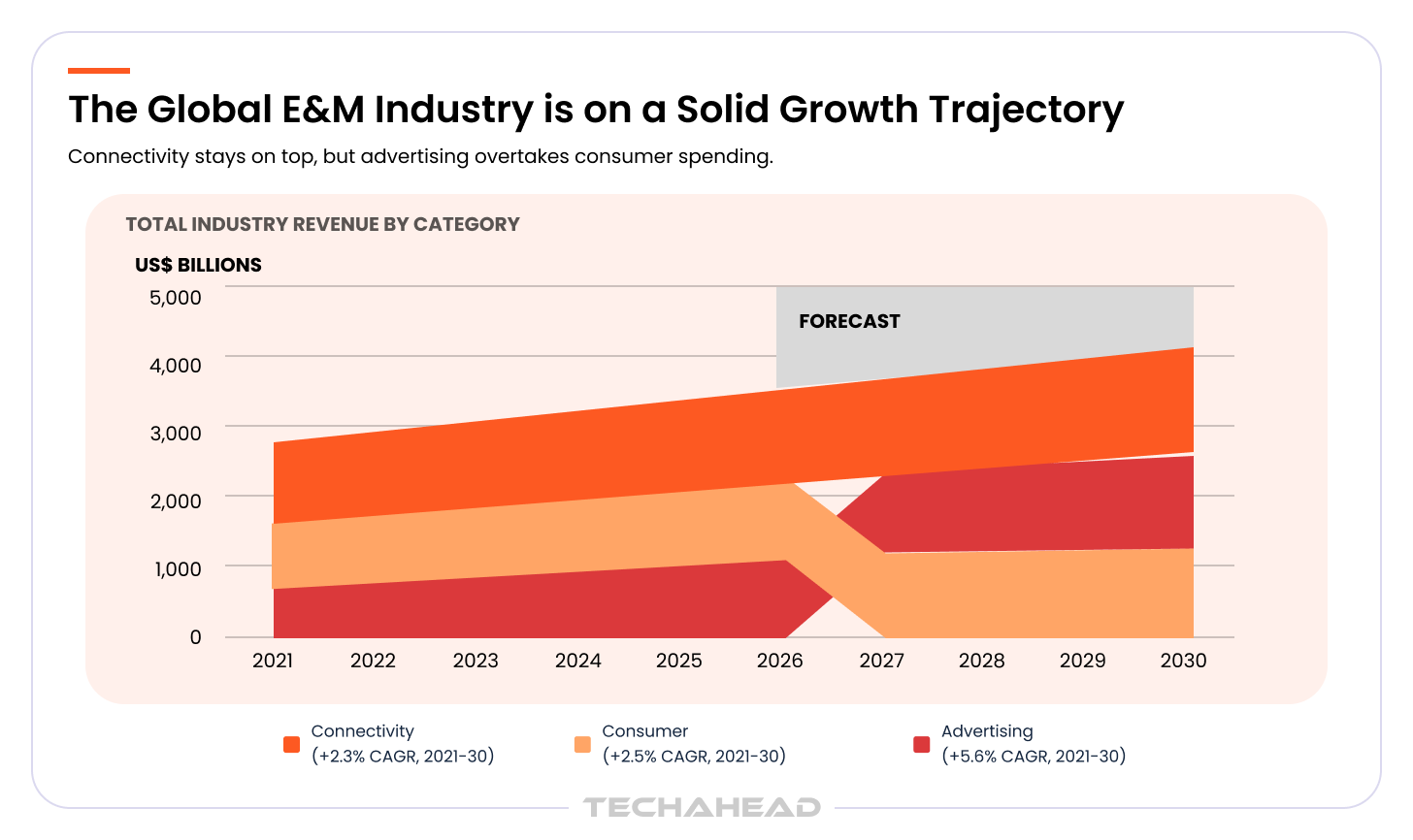
PwC’s Global Entertainment & Media Outlook 2026–2030 puts the global entertainment and media industry on track to reach $4.2 trillion by 2030. Digital platforms, advertising, personalized content, and shifting audience habits are driving a big share of that growth, and they’re changing how entertainment businesses operate day to day.
An entertainment app is much more than just material that sits behind a mobile screen if you intend to reach this industry. It must seem consistent across all platforms, assist users in finding content they genuinely desire to watch or listen to, enable a revenue strategy that works for your company, and continue to function flawlessly as demand spikes on release night.
Maybe you’re building a video streaming platform, a music app, a game, a live entertainment service, or a social content product. Whichever it is, the development partner you pick will shape how well the app handles all of this.
Here’s the catch. Plenty of mobile app development companies can build a solid app, but far fewer have dealt with problems that are specific to entertainment: media processing, content delivery, digital rights management, subscription billing, and real-time engagement.
To make the comparison easier, we’ve put together 10 entertainment app development companies to consider in 2027. The guide looks at what each one builds, where it’s strongest, and which kind of entertainment product it suits, so you can shorten your list before the project starts.
Must Read: Top 10 OTT App Development Companies to Consider in 2026
Before you pick a partner, get clear on what each company can actually build. Some focus almost entirely on streaming infrastructure. Others cover a wider range, from mobile apps and interactive experiences to gaming and digital media platforms.
The table below provides a quick overview of each company, and the sections that follow go into detail. Match them against your own product requirements, not against each other.
| Company | Key Specializations | Best Suited For |
| TechAhead | Mobile development, AI, cloud, custom applications | Custom entertainment platforms |
| Mercury Development | Mobile, web, connected-device applications | Multi-platform media products |
| Accedo | OTT, video streaming, connected TV | Streaming service providers |
| Oxagile | Video streaming, media workflows, OTT | Enterprise media platforms |
| SoluLab | Entertainment applications, AI, gaming, streaming | Interactive entertainment products |
| ELEKS | Media software, AI, analytics, AR/VR | Complex media platforms |
| Zco Corporation | Mobile applications, gaming, custom software | Interactive entertainment and games |
| Brainvire | OTT, media portals, gaming, adtech | Digital media businesses |
| Softjourn | Live streaming, music, VOD, ticketing | Streaming and event-based platforms |
| Goji Labs | Mobile product development, UX, digital platforms | Audience-focused entertainment applications |
TechAhead is a digital product engineering company that builds custom mobile apps and technology-driven digital products. Its mix of mobile engineering, AI, cloud development, and custom software makes it a fit for businesses planning an entertainment app.
An entertainment platform has a lot of moving parts. The interface, backend services, content management, payment integrations, and data infrastructure all have to work together without piling on complexity. TechAhead builds around each client’s requirements, so these pieces are planned as one product from the start.
In practice, that gives you one team that can handle the mobile experience, the smart features inside the app, and a backend that can grow with your audience. If your product leans on video, TechAhead’s OTT app development and streaming app development services cover the streaming side too.
Key Entertainment App Development Services:
Technology Capabilities: Swift, Kotlin, Flutter, React Native, AWS, cloud technologies, artificial intelligence, and machine learning.
Why Consider TechAhead?
TechAhead makes sense when you need more than a basic entertainment app. Mobile engineering, AI, and cloud work under one roof suits content-driven products that need personalization, connected services, and an architecture that can change as the product does.
Say a startup is building a content discovery platform. It’ll probably need recommendations, user profiles, search, subscriptions, and content management, all talking to each other. A partner that covers all of those areas can pull them together without handing pieces off between vendors.
If you’re planning a custom entertainment product, start with TechAhead’s mobile app development services to see how the team works.
Mercury Development offers custom software engineering across mobile, web, desktop, and connected-device applications. That range matters for entertainment businesses whose apps need to run on various devices.
People rarely stick to one screen. Someone finds a show on their phone, picks it up later on a tablet, and finishes it on the living room TV. Making that feel seamless requires coordinated frontend work, backend engineering, and platform-specific optimization. Mercury works across all of these environments and supports clients with custom product development and technical delivery.
Key Services:
Why Consider Mercury Development?
Mercury is a good one to look at if your app has to run on several devices. Its background in mobile, web, and connected-device development helps when the same service needs to behave consistently across different screens. It may suit media companies planning a set of connected apps better than those building a single mobile product.
Accedo focuses on video technology and digital streaming experiences. Its work covers OTT app development, connected TV apps, streaming platform engineering, and UX design. A streaming service is not just a video player with a login. The app has to handle content discovery, playback, subscriptions, device compatibility, and performance monitoring, and a weakness in any one of those shows up quickly for viewers.
Accedo provides development and consulting services for these needs. Its modular OTT application frameworks also let businesses launch a streaming product while keeping room to customize it later.
Key Services:
Why Consider Accedo?
Accedo fits best when video streaming is your main product. Its focus on OTT technology and multi-device delivery makes it relevant for subscription streaming, broadcaster apps, and connected TV experiences. If you already run a streaming service and want to reach more platforms, its application frameworks and consulting could save you some groundwork.
Oxagile builds software for media, entertainment, and video technology. Its work covers the infrastructure behind streaming products, including video delivery, OTT apps, media asset management, and connected-device experiences. That infrastructure matters because viewers judge an app by what happens behind the interface. Ingestion, encoding, storage, distribution, and playback all have to line up, or people notice in the form of buffering and dropped streams.
Oxagile works with streaming providers, broadcasters, publishers, and content distribution companies.
Key Services:
Why Consider Oxagile?
Oxagile suits companies with technically demanding media products. Its focus on streaming infrastructure and media workflows applies to platforms that need dependable video delivery, content management, and multi-device support. If live video, on-demand libraries, or complicated media distribution sit at the center of your product, pay close attention to these strengths when you compare vendors.
SoluLab provides custom software and application development, including work for the entertainment industry. Its entertainment projects cover streaming, music, gaming, social content, and interactive digital experiences. More entertainment products now mix formats. One app might include video, user-generated media, social features, and personalized recommendations all at once. Building that takes frontend engineering, backend development, and several technology integrations working together.
SoluLab’s wider development range makes it a candidate for businesses exploring products like this.
Key Services:
Why Consider SoluLab?
SoluLab is a fit for businesses building interactive entertainment apps with several ways for users to engage. Because it covers streaming, gaming, and social apps, it’s relevant for startups and companies exploring ideas that go past a standard video-on-demand platform.
ELEKS is a software engineering and technology consulting company that serves media and entertainment businesses. It works across custom software engineering, data analytics, cloud solutions, artificial intelligence, and immersive technologies. Media companies deal with huge volumes of content and audience data. Handling it well means having systems for content distribution, audience segmentation, personalized experiences, and day-to-day operations.
ELEKS builds technology that helps media organizations improve those processes while creating digital experiences across channels.
Key Services:
Why Consider ELEKS?
ELEKS is a good match if you need serious software engineering alongside entertainment app development. Its strength in data analytics, AI, and cloud engineering helps organizations that are building content platforms around audience insights, personalization, and connected digital operations.
Zco Corporation develops custom software and mobile apps, and it has particular depth in mobile game development and interactive digital products. Games ask for different engineering than a typical entertainment app. They can need real-time interactions, custom graphics, game mechanics, animation, performance tuning, and platform-specific releases. Zco covers the stages of game production, from planning and design through programming, testing, and release.
Key Services:
Why Consider Zco Corporation?
Zco makes sense for businesses building mobile games and interactive entertainment. Its game engineering, animation, and app development skills help when the product needs more specialized interactive features. Look at Zco if your product revolves around gameplay, visual experiences, or interactive user participation.
Brainvire develops software for media and entertainment, including streaming platforms, digital media portals, gaming, and advertising technology. Entertainment businesses need their content delivery, audience engagement, and monetization systems connected. That means managing media libraries, serving personalized content, integrating ad systems, and analyzing what audiences do.
Brainvire’s media-focused services touch several of these needs, with skills in application development, AI integration, and digital platform engineering.
Key Services:
Why Consider Brainvire?
Brainvire fits businesses building content-driven platforms that tie media distribution to audience engagement and monetization. Its focus on OTT, gaming, advertising technology, and AI suits organizations that want a more connected entertainment ecosystem, not a single standalone app.
Softjourn builds custom software for media, entertainment, and event businesses. Its work includes streaming apps, audio and video platforms, ticketing systems, and real-time digital experiences. Entertainment isn’t only about watching or listening. Live events, interactive broadcasts, and digital ticketing each need their own technology to connect audiences with the experience.
Softjourn covers these areas through application engineering, backend development, and media technology solutions.
Key Services:
Why Consider Softjourn?
Softjourn is worth a look if you’re building apps that link digital content to live entertainment or events. Its experience with streaming, ticketing, and audience engagement applies to products where real-time features and content distribution have to work side by side.
Goji Labs focuses on digital product strategy, user experience design, and software development. It’s relevant for businesses building consumer apps that need clear positioning and easy-to-follow user journeys. For entertainment apps, UX carries extra weight. People should be able to find content, move through categories, reach the features they care about, and finish actions without friction. Every extra tap costs you viewers.
Goji Labs combines product planning, UX research, interface design, and development to build digital products around what users need.
Key Services:
Why Consider Goji Labs?
Goji Labs suits businesses that need product strategy and UX design alongside development. Its approach helps entertainment startups planning a new consumer platform and companies that want to improve the usability and structure of a product they already have.
Also Read: Top 10 Social Media App Development Companies in 2026
Before choosing a development partner, decide what kind of entertainment product you want to build. Each type needs different technology, infrastructure, and engagement features, and a company that’s great at one can be a poor match for another.
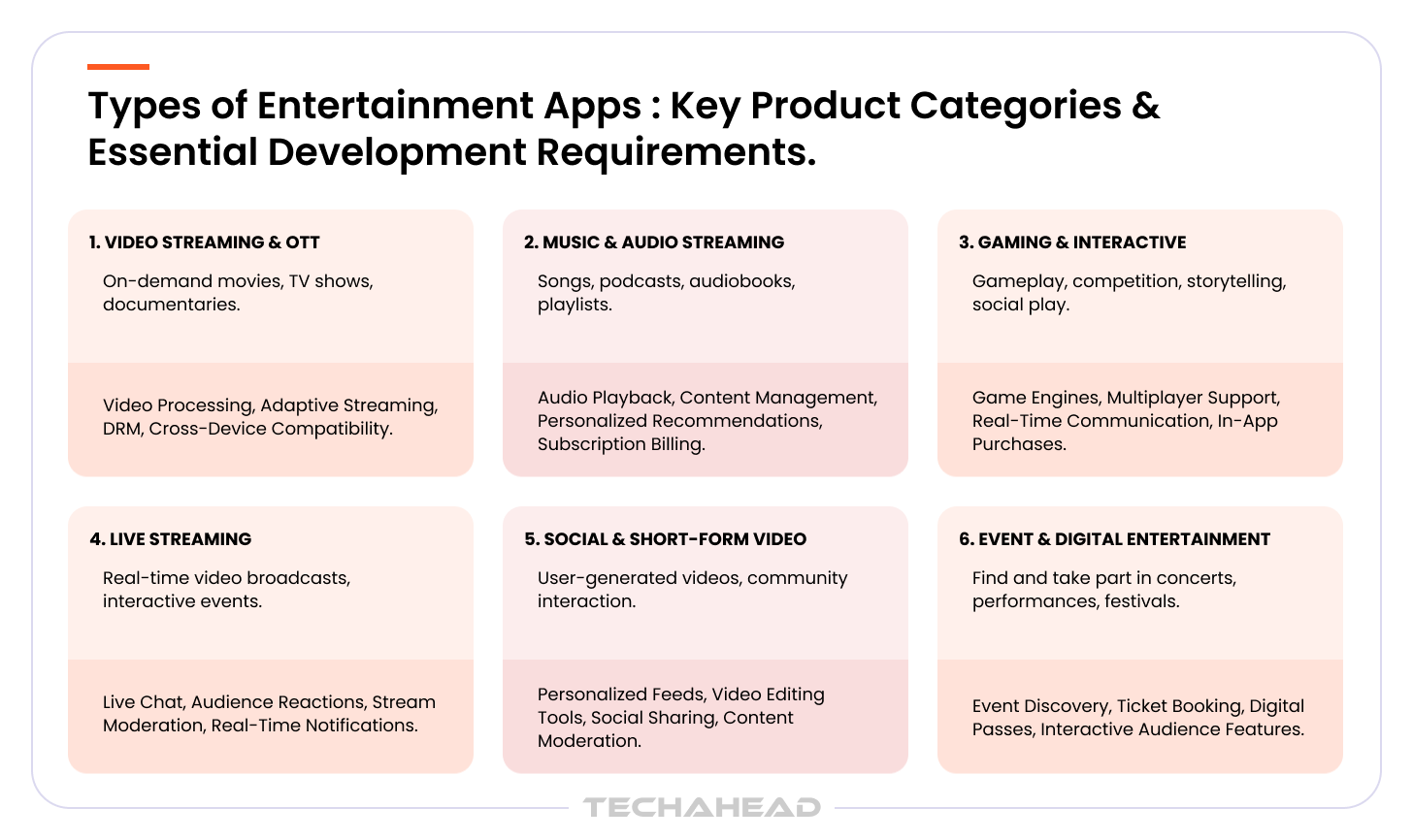
Here are the main categories businesses can explore.
Video streaming apps let users watch movies, TV programs, documentaries, and other digital content on demand. You can build a subscription service, an ad-supported platform, or a pay-per-title app, depending on your content strategy and revenue model.
The main development requirements are video processing, adaptive streaming, content management, digital rights management, and cross-device compatibility. TechAhead’s OTT app development services cover this category from consultation to maintenance.
Must Read: How Much Does It Cost to Make a Video Streaming App Like Netflix?
Music and audio platforms let users stream songs, podcasts, audiobooks, and other audio content. These apps need audio playback, playlist management, content discovery, user preferences, and subscription billing. You can add personalized recommendations and offline listening to make the experience better.
Must Read: How Much Does It Cost to Develop an App Like Spotify?
Gaming apps offer interactive experiences built around gameplay, competition, storytelling, and social play. Depending on the product, you might need game engines, multiplayer support, real-time communication, leaderboards, in-app purchases, and custom graphics.
Live streaming platforms let creators, businesses, and audiences interact through real-time video broadcasts.
Common uses include live performances, gaming broadcasts, digital events, creator communities, and interactive entertainment. TechAhead’s streaming app development services include live streaming builds. Features can include live chat, audience reactions, virtual gifting, stream moderation, and real-time notifications.
Social entertainment apps combine watching content with user-generated videos and community interaction. These platforms usually need personalized content feeds, video editing tools, social sharing, comments, content moderation, and recommendation engines.
Also Read: How TikTok Works: System Design, Architecture and Recommendation System
Event apps help audiences find and take part in concerts, performances, festivals, and other entertainment experiences. They can include event discovery, ticket booking, digital passes, event schedules, notifications, and interactive audience features.
An entertainment app has to make content easy to reach, give people reasons to come back, and support the business model behind the product. The exact feature set changes depending on whether you’re building a streaming service, a game, or a social platform.
Still, a few capabilities deserve a spot in almost every product plan.
Accounts let people save preferences, bookmark content, and get personalized features.
Consider including:
Discovery decides how quickly someone finds something to watch, listen to, or explore. If it’s slow or clumsy, people leave. A good discovery experience combines search, filters, categories, trending content, and personalized recommendations.
AI and machine learning can study how people interact with content and suggest what they might enjoy next. A music app can build playlists from listening patterns. A video platform can suggest titles based on viewing history and stated interests. TechAhead’s AI app development services include recommendation engines like these.
Must Read: How the Spotify Recommendation System Works
Streaming apps need playback that holds up across devices and network conditions. Buffering is the fastest way to lose a viewer.
Consider:
Entertainment businesses can earn through subscriptions, advertising, premium access, and in-app purchases. Whatever you choose, payments need to be secure, and users should be able to see renewals, check billing history, and change plans without contacting support.
Community features can make a product feel more alive. Depending on the app, that could mean comments, reactions, messaging, live chat, social sharing, and collaborative playlists.
Notifications can tell users about new content, live events, subscription changes, and recommendations they’ll care about. Let people configure them. Alerts that ignore preferences get muted fast.
A content management system gives administrators one place to organize, publish, update, and manage content. It should handle categorization, metadata, publishing schedules, access permissions, and moderation workflows where they apply.
Entertainment platforms can end up holding payment details, personal data, and licensed content, so security can’t be an afterthought. Depending on the product, that can include encryption, secure authentication, access controls, DRM, and content moderation.
Also Read: Mobile App Development: The Complete Guide
Pick the tech stack based on what the app does, who uses it, and what infrastructure it needs. A streaming platform has very different technical needs from a multiplayer game. These are the technologies you’ll see most often across entertainment products.
| Technology | How It Is Used |
| Swift | Native iOS application development |
| Kotlin | Native Android application development |
| Flutter | Cross-platform mobile application development |
| React Native | Cross-platform application development |
| Node.js | Backend services and APIs |
| Python | AI, machine learning, and backend services |
| AWS | Cloud infrastructure and application hosting |
| Google Cloud | Cloud computing and data processing |
| WebRTC | Real-time communication |
| FFmpeg | Audio and video processing |
| CDN | Content distribution and delivery |
| AI/ML | Recommendations and personalization |
| DRM | Digital content protection |
If you’re weighing native against cross-platform, TechAhead’s cross-platform app development page explains how a single codebase can serve both iOS and Android.
AI can power personalized recommendations, automatic metadata generation, smarter search, and content moderation. Machine learning models can use permitted audience interaction data to show a business what people like and make discovery better.
Must Read: AI-Driven Predictive Optimization in Cross-Platform Apps
Cloud infrastructure gives you room to handle app workloads, user data, content storage, and backend services as they grow. For entertainment apps, plan the architecture around swings in traffic, storage needs, and the cost of delivering content.
A CDN spreads content across a network of servers, which cuts delivery latency and improves access to media in different regions. For video and audio platforms, the CDN you choose and how you configure it can affect playback quality and your infrastructure bill.
WebRTC and related technologies handle live communication, interactive broadcasts, and real-time audience participation. The right setup depends on how many people join, how low your latency needs to be, and what kind of interaction you want.
DRM lets content owners control who can access protected media and how it can be used. If you distribute licensed content, think about DRM early. It can affect which player you choose, which devices you support, and how the platform is built.
The cost depends on features, technical complexity, supported platforms, and infrastructure.
A basic content discovery app has a very different scope from a streaming service with live broadcasting, subscription management, personalized recommendations, and connected TV support. Instead of relying on a generic price estimate, look at the factors below, as they’re what actually drive the budget.
More features and harder features mean more development effort. User registration and content browsing are fairly standard. Live streaming, real-time chat, personalized recommendations, and advanced media processing take extra engineering.
Building for one platform is not the same as supporting iOS, Android, web, and connected TV. Each extra platform brings its own design, development, testing, and maintenance work.
The backend has to support user accounts, content libraries, subscriptions, analytics, and app integrations. Streaming products may also need video encoding, storage, CDN services, DRM, and playback monitoring. Many of those infrastructure costs keep going after development ends.
Payment gateways, analytics tools, authentication providers, ad networks, and content management systems all affect cost. Count both the integration effort and the ongoing subscription fees in your budget.
Entertainment apps often call for content-heavy interfaces, interactive elements, personalized dashboards, and custom playback experiences. Scope the design work around the different journeys users will take inside the product.
Testing should cover supported devices, operating systems, network conditions, playback quality, security, and app performance. After launch, set aside budget for maintenance, infrastructure monitoring, updates, and new features.
A practical way to estimate your budget: Before you ask for proposals, write down the core features, target platforms, expected content volume, monetization model, and launch requirements. A development partner can use those details to give you a more realistic estimate.
Must Read: Mobile App Development Costs in 2026: A Comprehensive Guide
Hourly rates and long service lists on a website don’t tell you much. What you need is a company that understands your product and can make the technical calls your business model depends on.
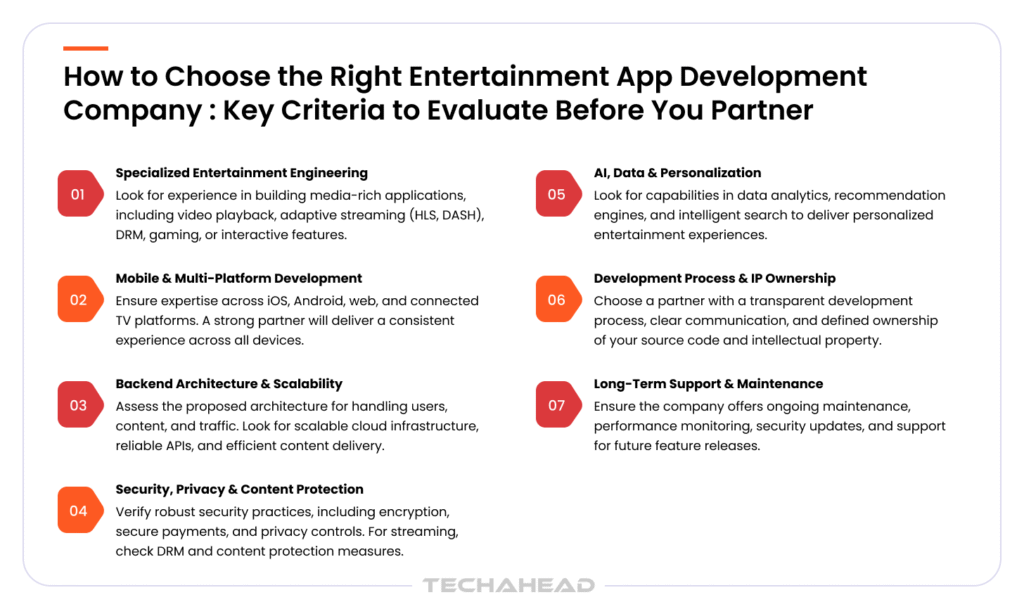
Use these criteria as you evaluate potential partners.
First, check whether the company understands your type of entertainment product. A video streaming app needs skill in media processing, playback, content delivery, and DRM. A game needs a different set: game engines, graphics, and gameplay engineering. Ask how they’d handle the specific technical requirements of your product.
Think about which devices your audience actually uses. You might need native iOS and Android, cross-platform mobile, web access, or connected TV apps. Make sure the team can explain how it will keep functionality consistent across all of them.
An entertainment platform needs dependable backend services for users, content, subscriptions, and app data.
Ask potential partners how they approach:
The aim is a platform that can grow without forcing an expensive rebuild.
Raise security during planning, not after the build. Depending on your app, that may include authentication, encryption, secure payment processing, DRM, privacy controls, and content moderation. Ask how the team handles security through development, testing, and maintenance.
If your product relies on personalized recommendations, smart search, or automated content management, look closely at the company’s AI and data engineering skills. They should be able to tell you what data is needed, how recommendations will be generated, and how the system will be measured and improved.
Before you sign anything, get clear on:
Settling these up front avoids arguments during the build and after delivery.
Entertainment apps need regular updates as user expectations, platforms, and technologies shift. Choose a company that can handle maintenance, performance work, security updates, and future features.
Must Read: Top 10 Mobile App Development Companies in USA (2026)
An entertainment product needs a partner who understands how app functionality, user experience, and backend infrastructure fit together. TechAhead works across mobile app development, custom software engineering, AI, and cloud technologies to help businesses build digital products around their own requirements.
For companies planning an entertainment app, those skills apply at several stages of the project.
Every entertainment product has its own functionality and business goals. TechAhead builds custom applications around the intended user experience, the platforms you need, and what the product is meant to achieve. For video-focused products, that includes OTT app development and streaming app development.
TechAhead’s mobile engineering covers native and cross-platform development, including React Native and cross-platform app development. You can choose an approach based on the devices you support, the product’s functionality, and your development priorities.
AI can drive recommendation systems, smarter content discovery, and personalized app experiences. What’s right for you depends on the data you have and what the product needs to do. See TechAhead’s AI app development services for the options.
Entertainment apps need backend systems that support user accounts, app data, integrations, and workloads that rise and fall. Cloud engineering helps you set up infrastructure that matches your technical and operational needs.
TechAhead can support you from product planning and interface design through development, testing, deployment, and maintenance. If you’re planning a custom entertainment platform, explore TechAhead’s mobile app development services and talk through your product requirements with the team.
Building an entertainment app takes more than picking a tech stack and shipping. You have to think about how audiences will find content, how they’ll interact with the platform, which features they’ll reach for, and what keeps them coming back.
The right development company will understand those needs and turn them into a product architecture that holds up on performance, usability, security, and future growth.
The companies in this guide cover different ground: mobile engineering, streaming technology, media software, gaming, and digital product development. Judge them against what your own app requires, not against the length of their service lists.
If you’re planning a new entertainment app or expanding a digital product you already run, TechAhead can help you work out the development requirements and settle on a sensible technical approach. Connect with TechAhead to discuss your entertainment app development project.
An entertainment app development company designs, builds, tests and maintains digital entertainment applications. Its services may include video and music streaming apps, mobile games, live streaming platforms, social video applications, event apps and custom media platforms. These companies can also provide UI/UX design, backend engineering, cloud integration, content management and ongoing application maintenance.
The cost of entertainment app development depends on the application’s features, supported platforms, backend architecture, integrations and infrastructure requirements. A basic content discovery application will have a different budget from a platform that includes live streaming, subscription management, AI-powered recommendations and multi-device playback. Hosting, content delivery, third-party services and ongoing maintenance should also be included when estimating the total development budget.
An entertainment app should include features that make content easy to discover, access and engage with. Common features include user registration, profile management, content search, personalized recommendations, audio and video playback, subscription management, secure payments, push notifications, social sharing and content administration. The final feature set depends on the application’s purpose, target audience and monetization model.
The development timeline depends on the application’s scope, technical complexity, number of supported platforms, integrations and testing requirements. Features such as live streaming, multiplayer functionality, recommendation engines and connected TV support can require additional engineering and testing. A development company can provide a more accurate timeline after evaluating the product requirements and defining the project scope.
Entertainment app development uses different technologies depending on the application’s functionality. Swift and Kotlin support native iOS and Android development, while Flutter and React Native are used for cross-platform applications. Backend services may use Node.js or Python, with cloud infrastructure from providers such as AWS and Google Cloud. Streaming-focused applications may also use WebRTC, FFmpeg, content delivery networks and digital rights management technologies.
Entertainment apps generate revenue through business models such as subscriptions, in-app advertising, freemium access, pay-per-view content, in-app purchases, premium memberships and event ticket sales. Some platforms combine multiple monetization methods to serve different audience segments. The right approach depends on the type of content, audience expectations, licensing agreements and overall business strategy.
To choose the right entertainment app development company, evaluate its experience with your type of application, mobile and multi-platform capabilities, backend architecture, security practices, AI and data engineering expertise, and long-term support services. You should also review its development process, project deliverables, communication practices, pricing structure, source-code ownership and intellectual property terms before signing an agreement.
Entertainment app development is a broader category that includes video streaming, music platforms, gaming, social video, live entertainment and event applications. OTT app development specifically focuses on delivering video or other media content directly to audiences over the internet, typically through mobile, web and connected TV platforms. Therefore, OTT development is one specialized area within the wider entertainment app development industry.
We use cookies to ensure our website functions properly, improve performance, and provide a personalized experience. You can choose which types of cookies to allow below.
Required for core functionality such as security, network management, and accessibility. These cannot be disabled.
Help us understand site traffic and user interactions so we can improve performance and usability.
Enable enhanced functionality and personalization such as language or region preferences.
Used to deliver relevant ads, track campaign performance, and measure advertising effectiveness.