


 Copy Link
 Share on X
 Share on Facebook
 Share on LinkedIn



Always Active
Required for core functionality such as security, network management, and accessibility. These cannot be disabled.

Uncover the transformative potential of digital and mobile solutions for your industry.



 Last Updated: Oct 23, 2026
Oct 20, 2026
 126
 25 min. Read


Key Takeaways


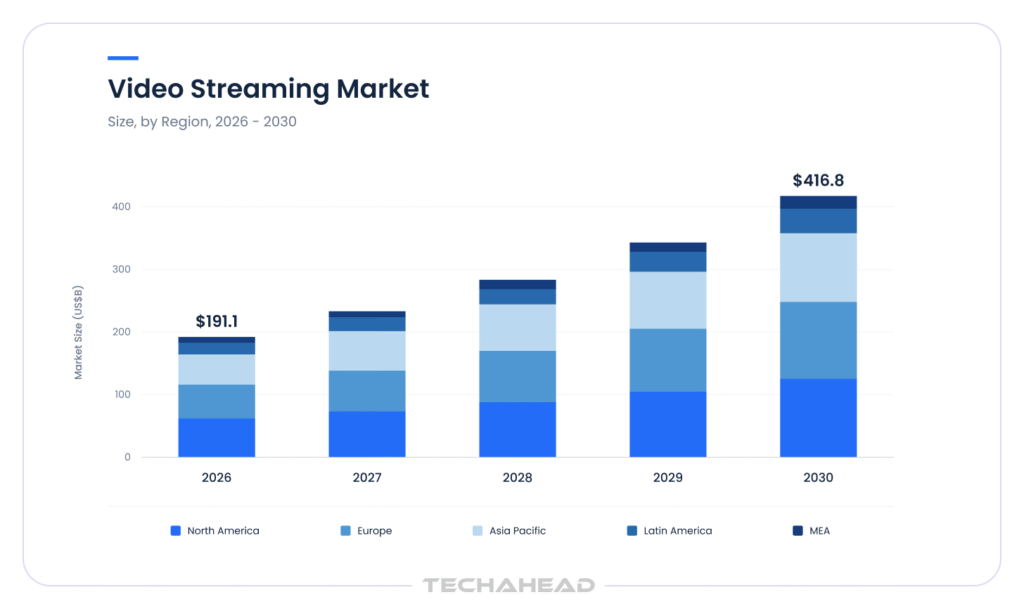
Picture the viewer you’re building for. They get home, open an app on their phone, and cast the same show to the living room TV without thinking about it. Now multiply that habit by a few hundred million people. Grand View Research values the global video streaming market at USD 191.1 billion in 2026 and expects it to reach $416.8 billion by 2030, a compound annual growth rate of 21.5% between 2025 and 2030.
If you’re planning to get a slice of that, you’ve probably noticed that the idea is the easy part. The hard part is finding a team that can build something people keep opening. A good OTT platform has to play video smoothly on every screen, keep your content from leaking, and earn money without driving viewers away. Plenty of vendors say they can do all of that. Far fewer have shipped it, so you’ll want to look at what they’ve built, not what they’ve written on their homepage.
This guide compares 10 OTT app development companies. For each one, you’ll see what it does well, where you should ask harder questions, and what kind of business it suits. Whether you’re launching your first streaming service or trying to fix one that isn’t performing, you’ll leave with a shortlist you can defend in a meeting.
Also Read: Essential App Development for Startup Guide: Choosing the Right Partner in 2026
Short on time? This table shows who each company is best for, what stands out, and what to ask before you shortlist it. The full breakdown comes further down.
| # | Company | Best for | Standout strength | Ask about before shortlisting |
| 1 | TechAhead | Custom streaming platforms, new device launches, OTT modernization | Multi-device delivery across LG, Samsung, Android TV, Roku, and web (Agora TV) | Your launch scope, device list, and monetization model |
| 2 | Oxagile | Broadcasters and media companies with video-heavy or integration-heavy needs | Video-first engineering since 2005, with live streaming, video CMS, and multi-screen apps | Fit and cost for smaller projects, since its client list leans enterprise |
| 3 | Contus | Fast launches on a ready-made platform | VPlayed white-label OTT platform with multi-device support and DRM | How far customization goes and who owns the code and data |
| 4 | Yudiz Solutions | Budget-conscious custom streaming apps | Broad app, game, and interactive experience, plus dedicated OTT services | Live OTT projects it has delivered, with device coverage |
| 5 | Oodles Technologies | IPTV apps and streaming tied to existing systems | Streaming plus custom software integration | OTT vs. IPTV experience, case studies, and code ownership |
| 6 | Cleveroad | Full-cycle builds with cloud-heavy architecture | Media and entertainment practice with AWS-certified architects | How many of its projects are video-first |
| 7 | Mercury Development | Apps across mobile, web, and smart TVs | Building for connected TVs since 2009, including Apple TV and HTML5-based TV apps | Video-specific work such as playback, DRM, and live content |
| 8 | Entrans | OTT products with AI-driven personalization | AI and data focus for recommendations and discovery | Past results from its personalization features |
| 9 | Intellectsoft | Enterprises connecting streaming to existing business systems | Enterprise integration and AI engineering | Pure video skills such as DRM, adaptive streaming, and TV apps |
| 10 | Scalevista | Early-stage vendor research for a custom app | Dedicated OTT development services | Project examples and which work it hands to partners |
Quick rule of thumb: If you need something custom across phones and TVs, start with TechAhead, Mercury Development, or Oxagile. If speed matters more than full control, look at Contus. If your streaming product must plug into a large existing system, it is worth a conversation with Intellectsoft.
Streaming a video file is the easy part of this business. The platform also has to deliver content reliably, help viewers find something they’ll enjoy, keep premium titles from being copied, and give you a steady way to earn. Before you speak to any OTT app development company, it helps to know the five pieces you’ll be discussing. Knowing them also makes it easier to spot a vendor who skips over one.
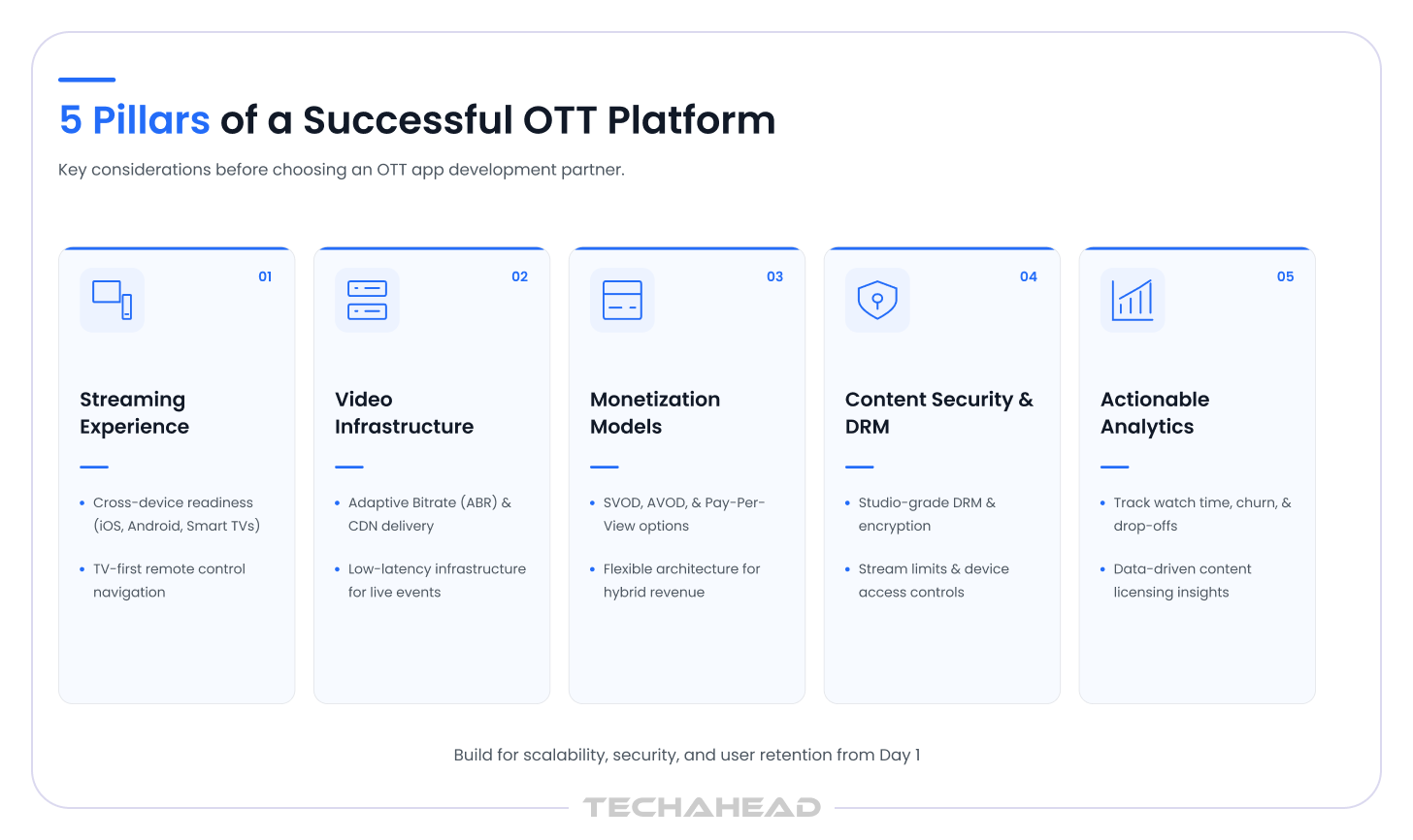
Your viewers will watch on whatever device is closest, and they won’t think about which operating system it runs. The experience still has to hold up everywhere you launch. Depending on your market, that could be Android and iOS apps, web browsers, Android TV, Apple TV, Roku, or other smart TV platforms.
TV apps deserve extra attention. People navigate them with a remote, from a couch, so a layout that works on a touchscreen can feel clumsy on a TV. Playback quality, navigation, and device compatibility decide whether someone finishes the first episode or closes the app after two minutes. When you review a vendor’s portfolio, check the TV work separately from the phone work.
Uploading a file to a server doesn’t get video to someone on a weak connection. A real platform usually needs video transcoding, adaptive bitrate streaming, cloud storage, and a content delivery network (CDN). Together they keep playback steady when a viewer’s network slows down, and they stop one busy region from dragging the whole service down.
Live streaming raises the bar. You’ll need low-latency delivery and infrastructure that can absorb a sudden jump in viewers, such as the minutes before a match starts. A vendor who has only built on-demand apps may underestimate how different live traffic behaves.
How you earn shapes what the product feels like and how it’s built underneath. Subscription services need billing and entitlement management so that paid users get access and lapsed users don’t. Ad-supported platforms need ad integration and reporting. Pay-per-view needs transaction handling and tight access controls around single events.
Most businesses begin with one model and add others once the audience grows. Tell your vendor early which model you want and which you might add later. Retrofitting a second revenue model onto an architecture built for the first one gets expensive.
If you distribute licensed or premium content, think about security on day one. Your licensing agreements may require digital rights management (DRM), encryption, secure authentication, and controls over who can watch what, and where. Studios and rights holders often write these requirements into the contract, so you may not get to choose.
Account sharing is a quieter problem. Limits on concurrent streams and registered devices protect revenue as well as content, and they’re far easier to design in at the start than to bolt on later.
Watch time, subscription conversions, engagement, and churn tell you how the platform is really doing. Without them, you’re guessing which titles to license or produce next. With them, you can see where viewers drop off, which content brings people back, and which subscribers are about to cancel.
The point is to build analytics into the product early. Adding them after launch usually means rebuilding parts of the app and losing the first few months of data.
None of this has to be delivered at once. A focused minimum viable product (MVP) can test demand before you pay for the rest. The skill to look for in a partner is the ability to separate what you need at launch from what can wait. A technical consultation before development starts helps settle platform priorities, integrations, and the roadmap while changing course is still cheap. If you want a team that does OTT platform development end to end, TechAhead’s OTT app development services cover consultation, build, deployment, and support.
The companies below have relevant experience in OTT applications, video streaming, or digital product engineering. Treat the list as a starting point for your own research, not an independently verified ranking. Which one suits you depends on your platform requirements, your budget, and how you prefer to work with a vendor.
TechAhead is a digital product engineering company that builds custom applications and streaming solutions for businesses launching or modernizing digital entertainment platforms. Its OTT work covers the full cycle, from early consultation through development, deployment, testing, and maintenance.
The Agora TV case study shows what that looks like in practice. It’s a cross-platform streaming ecosystem running on LG, Samsung, Android TV, Roku, and the web. The project included QR-based authentication, creator verification, and subscription-related functionality. QR sign-in matters more than it sounds: typing a password with a TV remote is slow and frustrating, so moving that step to a phone removes a common reason people abandon a new TV app.
That experience helps if your audience watches on a television as much as on a phone. A team that has already solved the TV side won’t treat it as an afterthought, and it will have run into the device-specific quirks that catch newer teams off guard.
Key capabilities:
Best suited for: Businesses building a custom streaming platform, adding more devices, or modernizing an existing OTT product.
Beyond the front end, TechAhead’s engineers also handle backend development, cloud infrastructure, integrations, and ongoing product improvements, so you don’t need a second vendor for the pieces behind the screen. If you’re mapping out a new product, its OTT app development company page is a good place to start a conversation about requirements and roadmap.
Oxagile is a software engineering company built around online video. Its own materials say it has been working in video since 2005, so it has roughly two decades behind it. That history is the main reason to shortlist it if you want specialized video engineering instead of a general-purpose development shop.
Its OTT page says the team has customized and extended more than 30 market-leading video platforms and streaming servers. Its core skills include live streaming, video CMS, MAM orchestration, and multi-screen app creation. Press releases from 2019 name clients such as VEON, Vodafone, Telecom Argentina, Motorsport TV, and Discovery. The same releases describe partnerships with Vimond, a video platform provider, and Cleeng, a subscriber retention platform. That suggests Oxagile is used to plugging into an existing video stack instead of insisting on rebuilding everything.
If you already have a video platform, a content management system, or a subscriber management tool, that integration experience is valuable. Telecom and broadcast clients also tend to have demanding requirements, which is useful evidence when your own are strict.
Key capabilities to evaluate:
Best suited for: Media organizations, broadcasters, and streaming businesses with specialized video engineering or integration needs.
Contus approaches OTT differently from most companies on this list. Its main streaming offering is VPlayed, a white-label OTT platform for video and audio streaming, built by the same company that makes the MirrorFly communications product. Instead of designing everything from a blank page, you start from an existing platform and customize it.
According to its own materials, VPlayed supports a wide device range, including smart TVs, Apple TV, Android TV, Amazon Fire TV, Roku, Chromecast, mobile, and web. It lists subscription, ad-supported, and transactional revenue models, and DRM support that includes FairPlay. The company also promotes no revenue sharing and platform ownership. Its marketing numbers, including more than 1,900 OTT apps launched and go-live times as short as four days, are self-reported, so ask for proof and references before you rely on them.
Starting from a platform can be faster and cheaper, but you should understand where customization stops. Ask what you can change, what you can’t, and what ownership means in practice for the code, the data, and the deployment.
Key capabilities to evaluate:
Best suited for: Businesses that want to launch quickly on an existing platform and are weighing a packaged solution against a fully custom build.
Yudiz Solutions is an Ahmedabad-based development company that lists ISO 9001:2015 certification and describes itself as an app development company with more than a decade of experience. Its background is broad: mobile apps, web, games, blockchain, and AR/VR, with OTT as one of the services it offers. Its OTT pages cover custom OTT app development and OTT TV app development, along with live streaming and video-on-demand.
A wide background has pros and cons. A team that has built games and interactive apps often handles user experience well, and a broad engineering bench can help when your project reaches beyond video. The flip side is that OTT depth varies from one development company to another, so you shouldn’t assume it.
When you evaluate Yudiz, ask to see the OTT projects themselves. Confirm which devices they ran on, whether live streaming was involved, and how monetization was handled. Pricing in India is often lower than in the US or Europe, but compare scope as carefully as price.
Key capabilities to evaluate:
Best suited for: Budget-conscious businesses exploring custom streaming apps for entertainment, education, sports, or other content-driven services.
Oodles Technologies provides software development services, including video streaming and IPTV applications. It makes sense to consider when a project needs streaming functionality alongside custom software integrations, for example, a streaming layer that has to talk to billing, CRM, or content systems you already run.
IPTV and OTT are often mentioned together but behave differently. IPTV usually runs over a managed network and is often tied to set-top boxes and operator-style service. OTT runs over the open internet to whatever device the viewer owns. The two lead to different architecture, different testing, and different costs, so decide which model you’re building before you compare proposals. A vendor who blurs the two may not have thought hard about your distribution.
Since public detail on Oodles’ OTT delivery is limited, treat the conversation as a discovery exercise. Ask for relevant case studies, the size and makeup of the team that would work on your project, and who would own the code at the end.
Key capabilities to evaluate:
Best suited for: Businesses building IPTV applications or streaming products with specific integration requirements.
Cleveroad is a software development company founded in 2011 and based in Tallinn, Estonia. It serves a mix of industries, including healthcare, logistics, fintech, retail, travel, and education. For streaming, it has a media and entertainment practice that says it builds streaming, video-on-demand, broadcasting, and OTT solutions from scratch, with content processing that includes CDN and geolocation.
Two things stand out. Cleveroad has published a detailed guide on OTT app development cost, which suggests it has thought about budgeting and not just engineering. And its site says it works with AWS-certified solution architects, which matters if your platform will live in the cloud and you need someone who can design the delivery infrastructure properly.
The main question is how much of its portfolio is video-first. Cleveroad is a generalist with a media practice, so ask for streaming projects specifically, and ask who on the team has worked on them.
Key capabilities to evaluate:
Best suited for: Businesses that want a full-cycle development partner with a media practice and clear thinking about cost and cloud architecture.
Mercury Development is a custom software and mobile app company founded in 1999. What makes it relevant here is a long history with TVs. Its own pages say it began building for Apple TV in 2009, and that it works on Apple TV, Google TV, and Chromecast, using HTML5 to reach platforms such as Samsung Smart TV and LG webOS. Few firms on this list have been on connected TVs that long.
Its wider skill set includes native and cross-platform mobile development, IoT, machine learning, and DevOps. That helps when your streaming product connects to hardware or other systems. Device-specific testing is where many OTT projects run into trouble, and a team with years on TV platforms is more likely to have seen those problems before.
Mercury’s history is broader than streaming, so confirm what it has done for video in particular. Ask about playback, DRM, and live content, not only whether it can get an app onto a TV.
Key capabilities to evaluate:
Best suited for: Businesses that need apps across mobile, web, and connected TVs and want a team with long experience on TV platforms.
Entrans focuses on digital engineering and AI-enabled software development. Its published OTT content covers topics that matter for modern streaming services, including cloud scalability, personalization, and monetization. That tells you the team understands the vocabulary of the space, though a blog post isn’t proof of delivery.
Personalization is where its AI focus could be useful. Recommendations, search, and content discovery strongly influence how long people stay on a streaming service, and a team comfortable with data and machine learning can add a lot there. The risk is paying for AI features before the basics, such as playback, device coverage, and billing, are in place.
If you’re considering Entrans, confirm which of those capabilities are part of its actual delivery services. Ask for comparable implementations and the results they produced. Be specific: ask what the recommendation features did to watch time or retention on a past project.
Key capabilities to evaluate:
Best suited for: Businesses exploring OTT products that pair app development with data-driven personalization or AI features.
Intellectsoft is a custom software and AI engineering company founded in 2007. Its Clutch profile lists a New York headquarters and offices across the US, the UK, Norway, Ukraine, and Latin America, and says it works with mid-market and enterprise clients. Streaming is not its core story, so it belongs on the list for a different kind of project.
That kind of project is a streaming product that must connect to existing business systems. Think of a company that already runs customer accounts, billing, a content library, and internal reporting, and now wants a video service that works with all of it. In that situation, the integration plan, security controls, and support arrangements can matter as much as the app viewers see. Intellectsoft’s work includes an AI audience intelligence layer built into a native app builder’s platform, which points to experience adding data features to an existing product.
Because it’s an enterprise-focused firm, ask early how it handles pure video problems such as adaptive bitrate delivery, DRM, and TV apps, and whether it would bring in specialists or partners for them.
Key capabilities to evaluate:
Best suited for: Enterprises building streaming products that must connect with existing business systems and operational workflows.
Scalevista publishes content and services related to OTT application development and digital solutions. It’s another provider worth looking at when you’re researching options for a custom streaming platform, especially if you want a wider field before you narrow things down.
Because less is publicly documented about its delivery than for some others on this list, your due diligence matters more. Ask for project examples with live links or screenshots, and confirm which services Scalevista delivers directly and which it hands to partners. A vendor that subcontracts parts of the work isn’t a problem by itself, as long as you know who is accountable for what.
Then check how it handles multi-device compatibility and streaming infrastructure. A short paid discovery phase is a sensible way to test a smaller vendor before committing to a full build. You’ll see how the team thinks, communicates, and estimates, at a much lower cost than a failed project.
Key capabilities to evaluate:
Best suited for: Businesses comparing development partners for a new streaming application, or for an existing platform that needs more functionality.
Note: These descriptions are meant to support early research. Confirm each provider’s current services, portfolio, and technical capabilities directly before you decide.
Finding OTT app development companies takes an afternoon of searching. Finding one that understands your business model, technical needs, and long-term plans takes a lot more digging.
A company can have an impressive portfolio and still be the wrong fit if its experience doesn’t match what you’re building. A vendor who has done excellent work on a live sports app may be less useful if you’re launching a film library for smart TVs. Use the criteria below to narrow the field.
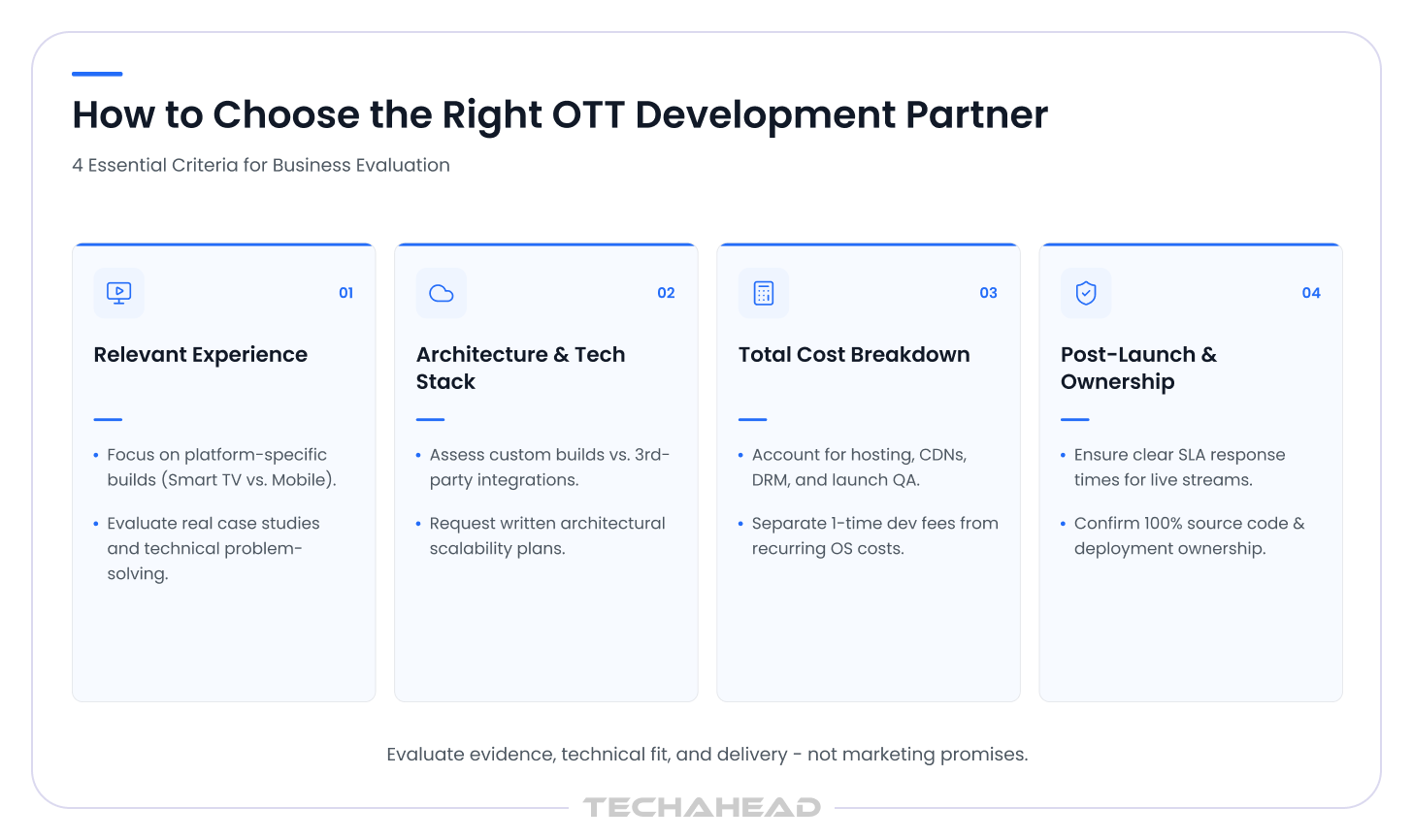
Start with case studies on streaming apps, video platforms, or connected-device ecosystems. Look past the finished screens. Ask what the team built, which platforms it supported, what technical problems came up, and how the solution matched the client’s requirements. A good case study explains a problem and how it was solved, instead of only showing screenshots.
Say you’re building a smart TV app. Mobile experience alone won’t be enough. You’ll want to hear how the vendor handles TV-specific navigation, device compatibility, playback testing, and app store deployment. Ask which TV platforms the team has shipped to, and whether the same people will work on your project.
Ask each shortlisted company how it would approach your project, and ask for it in writing. A good proposal accounts for your expected audience, content delivery requirements, security needs, integrations, and plans for growth.
You should also know which parts will be custom-built, which will rely on third-party services, and how the system will be monitored and maintained after launch. If a vendor plans to use an existing video platform for part of the stack, that’s fine, and often smart, but you should know about it up front and understand what it costs. A clear architecture proposal tells you far more than a promise that the platform will scale.
Two proposals with different prices may cover very different scopes. One might include application development only, while another also covers backend services, integrations, testing, deployment, and ongoing maintenance. The cheaper one can end up costing more once the missing pieces are added.
Before you compare estimates, check whether they include:
Ask vendors to split one-time development costs from recurring operating expenses. That shows you the real long-term commitment, and it makes it easier to see whether the business model still works at your target audience size.
An OTT product needs attention long after launch, because audiences, devices, and business requirements keep changing. Get clear on who handles maintenance, fixes production issues, ships updates, and supports future integrations. A streaming outage during a live event doesn’t wait for office hours, so ask what response times look like.
Also settle how progress will be reported, how scope changes will be handled, and who will own the source code and deployment environments. Ownership is easy to skip in the excitement of a new project, and painful to sort out later if you part ways with the vendor.
Before you make a final decision, put these to each provider:
Their answers should let you compare providers on evidence, technical fit, and delivery approach instead of marketing claims. Pay attention to how specific the answers are. Vague replies at this stage usually mean vague delivery later.
Good partnerships start with a clear picture of what you want to build. Whether you’re launching a subscription streaming service, taking an existing video platform to smart TVs, or building for live events, defining scope early helps you avoid extra complexity and surprise costs. Even a one-page brief covering your audience, devices, revenue model, and launch date will make every vendor conversation more useful.
TechAhead builds custom digital products and cross-platform streaming solutions, including the multi-device Agora TV project in its portfolio. If you’re evaluating an OTT platform, talk to the team about your target audience, required devices, monetization model, and launch priorities. You can read more about its OTT app development company work and how it approaches a new build.
Choosing an OTT app development company comes down to balancing technical skill, product experience, budget, and long-term support. Each company on this list has a different strength. Some are deep in video engineering, some give you a packaged platform to start from, and some are better at fitting streaming into a larger enterprise system. The right pick depends on which of those matches the product you’re building.
Use this guide as a starting point, look at real project evidence, and compare written proposals against your own requirements before you decide. Then run a small paid discovery phase with your top choice, because a few weeks of working together will tell you more than any pitch deck.
If you’re planning a new streaming platform or reworking an existing one, TechAhead’s OTT app development services team can walk you through your product requirements, platform strategy, and development roadmap.
An OTT app development company builds streaming applications that deliver video or audio content over the internet. Services can include mobile and smart TV apps, video delivery infrastructure, subscription management, content security, analytics, and maintenance.
Companies to consider include TechAhead, Oxagile, Contus, Yudiz Solutions, Oodles Technologies, Cleveroad, Mercury Development, Entrans, Intellectsoft, and Scalevista. Compare their project portfolios, device support, technical expertise, and service models before choosing a provider.
OTT app development costs depend on supported devices, feature complexity, streaming infrastructure, content security, integrations, and maintenance. A basic video-on-demand app will have different requirements from an enterprise platform with live streaming, smart TV apps, and advanced personalization.
Essential features include user registration, video playback, search, content categories, watchlists, profiles, payment integration, and analytics. Depending on the business model, additional features may include live streaming, DRM, offline downloads, personalized recommendations, and multi-device synchronization.
OTT platforms commonly use cloud infrastructure, video transcoding, adaptive bitrate streaming, CDNs, APIs, databases, and analytics tools. The stack may also include DRM solutions, payment gateways, video content management systems, and mobile, web, and smart TV development frameworks.
OTT apps typically generate revenue through subscriptions (SVOD), advertising (AVOD), or pay-per-view and individual content purchases (TVOD). Some platforms combine these models to reach different audience segments and diversify revenue.
Assess streaming case studies, device compatibility, system architecture, content security, monetization capabilities, timelines, and post-launch support. Request a detailed proposal that separates development fees from hosting, CDN usage, third-party licenses, and maintenance.
We use cookies to ensure our website functions properly, improve performance, and provide a personalized experience. You can choose which types of cookies to allow below.
Required for core functionality such as security, network management, and accessibility. These cannot be disabled.
Help us understand site traffic and user interactions so we can improve performance and usability.
Enable enhanced functionality and personalization such as language or region preferences.
Used to deliver relevant ads, track campaign performance, and measure advertising effectiveness.