


 Copy Link
 Share on X
 Share on Facebook
 Share on LinkedIn


Always Active
Required for core functionality such as security, network management, and accessibility. These cannot be disabled.

Uncover the transformative potential of digital and mobile solutions for your industry.





 Last Updated: Sep 18, 2026
Aug 5, 2026
Last Updated: Sep 18, 2026
Aug 5, 2026  306
306  18 min. Read


Key Takeaways


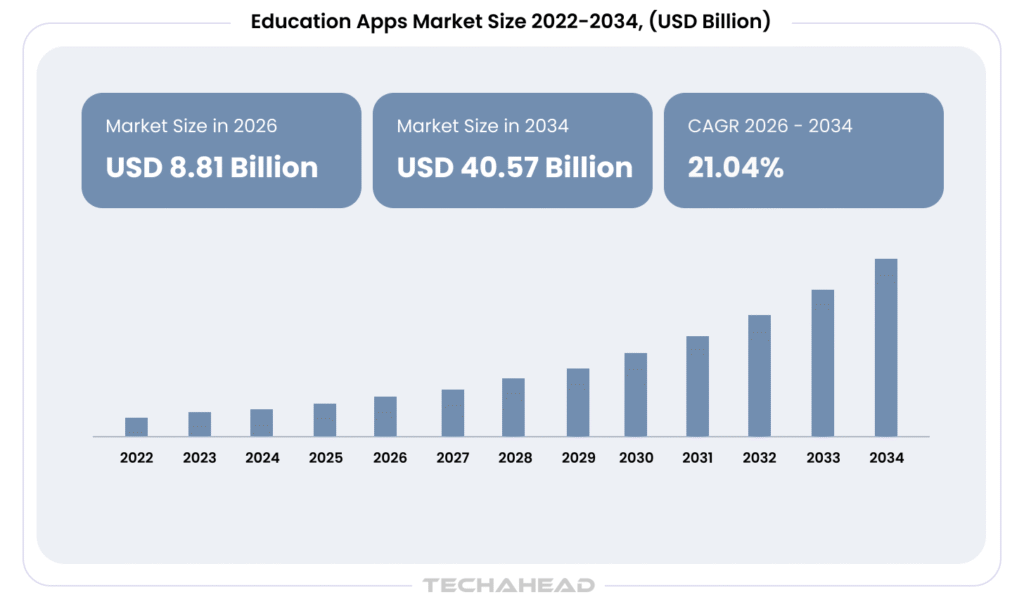
A long time ago, online education stopped being a pandemic-era workaround. Today, a large portion of the global population studies, trains, and upskills this way by default, and financial evidence supports it. With a compound annual growth rate of about 11%, the worldwide e-learning industry is expected to increase from around $275.9 billion in 2026 to almost $462 billion by 2031. That is no longer a niche. Most of the education sector operates via a screen.
However, what users anticipate when they arrive has changed more than the monetary statistics. A business L&D manager implementing compliance training, a mom comparing homework-help applications for their child, or a university assessing an LMS replacement are all no longer grading on a curve. Everybody has used Duolingo. Each of them has completed a Coursera course. Therefore, “good enough” educational software is insufficient; it needs to feel like consumer applications that people use on a daily basis while yet adhering to corporate data-governance regulations, FERPA, and COPPA, which consumer apps never have to deal with.
Most development shops fail to provide both a consumer-grade experience and institution-grade compliance. So choosing the right education app development company matters. Here is a thorough, criteria-based analysis of 10 businesses that don’t.
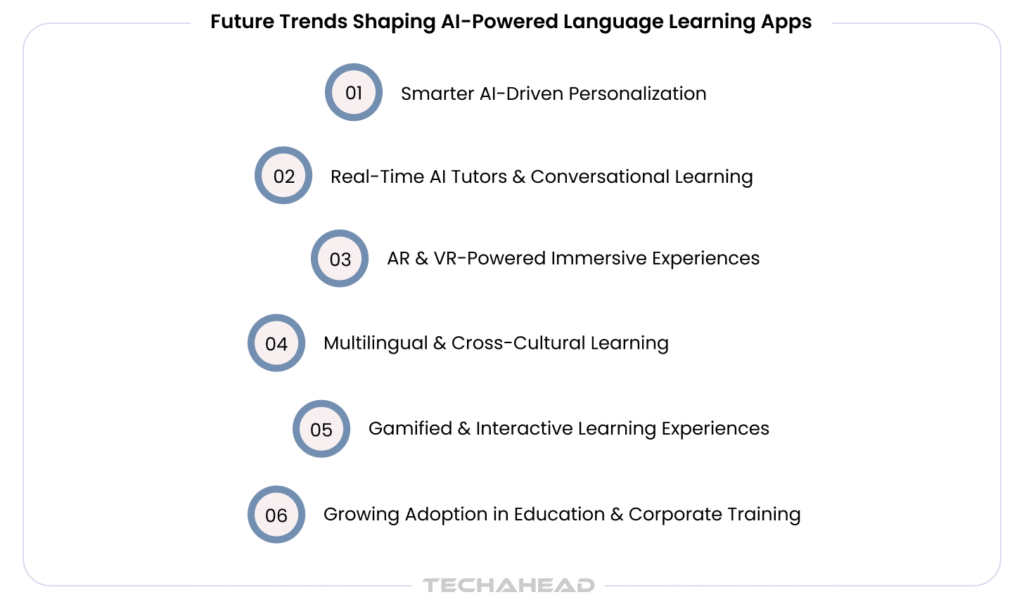
A few shifts are driving this year’s stronger platforms.
From “nice to have” to the entire product, personalization has evolved. Adaptive learning engines now monitor a student’s actual knowledge, not just the course they are enrolled in, and make real-time adjustments to material format, difficulty, and speed.
To keep tens of millions of learners interested, Duolingo’s models make well over a billion individualized micro-decisions every day. Duolingo’s machine learning pipeline for personalizing lessons is a fascinating read. Since most education apps still lose the vast majority of users after a month, it’s a helpful guide for any team trying to build retention into an educational product from day one.
Generative AI development services are also doing the unglamorous labor. The greater short-term benefit of automating lesson preparation, grading, and content creation for instructors and trainers, freeing them up for real instruction, goes beyond ostentatious tutoring chatbots. Before you scope for an AI feature, it’s important to understand how generative AI and LLMs are changing customized learning pathways across sectors. This is because “add a chatbot” and “add adaptive, LLM-driven pathways” are very distinct from technical issues with very different price tags.
Mobile-first is now the main surface, not a checkbox. Nowadays, almost all students under 25 have smartphones, and mobile e-learning is the fastest-growing delivery method.
Apps that were designed primarily for desktop computers and then scaled down for mobile devices are becoming more noticeable and easier for consumers to stop using. In this summary of how mobile apps are changing the traditional classroom, it’s important to grasp how the trend toward on-the-go, bite-sized formats has affected how classrooms operate, not just how applications look.
Instead of being a post-launch patch, compliance is now a launch requirement. From the very first sprint, any app that handles K–12 data must consider COPPA. GDPR must be included in everything that affects students in the EU or the UK. Before business customers will even answer the phone, corporate training platforms increasingly need a SOC 2 or ISO 27001 posture. Retrofitting this after a security evaluation finds vulnerabilities is costly and time-consuming; it must be discussed in the design discussion from the outset.
During a surge, cloud-native infrastructure is what keeps a platform afloat. On exam days, viral course debuts, and live courses, concurrency can spike abruptly and intensely. If the backend wasn’t built to scale elastically from the beginning, a platform that functions flawlessly for 5,000 daily users may falter at 50,000.
Hourly rates and portfolios provide only part of the picture. Each business was evaluated using the following standards in order to compile this list:
| Evaluation Criteria | Why It Matters |
| EdTech Portfolio Depth | Demonstrated experience building LMS platforms, e-learning apps, virtual classrooms, or assessment tools—not general software work with one education client tacked on. |
| AI & Adaptive Learning | Real experience with personalized learning paths, AI-driven content recommendations, or automated grading and feedback. |
| LMS & Systems Integration | Ability to integrate with or build on top of Moodle, Canvas, Blackboard, SCORM/xAPI content, and existing school or HR systems. |
| Compliance & Data Security | Working knowledge of FERPA, COPPA, GDPR, and (for corporate training platforms) SOC 2 or ISO 27001 posture. |
| Mobile & Cross-Platform Engineering | Strong native and cross-platform iOS/Android capability, since most learners now study primarily on a phone. |
| Scalable Cloud Architecture | Infrastructure that holds up during exam periods, live sessions, and enrollment spikes without a costly re-architecture. |
| UI/UX for Learning Outcomes | Design that measurably improves completion rates and retention, not just design that looks good in a portfolio screenshot. |
| Client Track Record | Verifiable client history, case studies, and reputation specific to education and training software. |
Businesses were ranked based on their demonstrated match across all these factors, not just their size or marketing expenditures. The following 10 businesses have the technological range to provide a K–12 learning app, a corporate LMS, a language-learning platform, or an entire campus environment.
TechAhead ranks top because it treats educational applications as learning products first and assesses them by students’ course completion and content retention, not just timely software delivery. The firm uses AI engineering deep enough to offer actual adaptive learning paths rather than a surface-level recommendation layer applied to a course catalog, and it develops virtual classroom software, custom LMS platforms, adaptive learning apps, and full institutional ecosystems. These capabilities are demonstrated by TechAhead’s rebuilding of the eLearning platform for Your Access, which was previously split into distinct, challenging-to-maintain iOS and Android codebases with a congested user interface that actively hinders student engagement.
Your Access e-learning platform case study, which describes how TechAhead integrated it into a single cross-platform experience, redesigned around a human-centric UX approach, and rebuilt the community and communication features that connect teachers and learners, is a good read for anyone evaluating whether a vendor can actually untangle a legacy education product rather than just build a new one from scratch. Its more comprehensive education app development services include gamified tests and simulations, AR/VR-based virtual labs, AI-powered adaptive learning pathways, and LMS integrations with Moodle, Canvas, and Blackboard. All of these features are built on scalable architecture that will grow with an institution rather than need to be replaced in two years.
Best for: AI-powered adaptive learning apps · LMS integration and modernization · K-12 and higher-ed platforms · corporate training software · virtual classroom and simulation-based learning
Key features: AI-driven adaptive learning paths · LMS integration (Moodle, Canvas, Blackboard) · AR/VR virtual labs and simulations · gamified assessments · cross-platform iOS and Android development · cloud-native, scalable architecture · FERPA/COPPA-aligned data handling · end-to-end product strategy
MindInventory has developed a really diverse EdTech portfolio that includes self-paced mentorship tools, career-focused upskilling platforms, and K–12 learning applications. This is evident in the team’s discussion of grade-level subtlety rather than presenting “education app” as a single, homogeneous category. From the first sprint, its eLearning practice leans toward gamification, subscription monetization, and a clean, contemporary user interface. It also pays close attention to onboarding processes to prevent younger learners from quitting during the first week, which is usually the most dangerous time for any new education app to permanently lose a user. Because of this mix, it is a great option for entrepreneurs who want a platform that is both truly functional for students and ready for investor demos. This is especially true for teams who are still verifying product-market fit before committing to more complex, enterprise-grade infrastructure.
Best for: K-12 and higher-ed learning apps · course-based platforms like Coursera-style marketplaces · gamified learning experiences · EdTech MVPs
Key features: Custom LMS and eLearning platform builds · gamification and subscription models · Flutter and React Native development · UI/UX-led design process · cloud deployment and hosting support
ScienceSoft’s advantage in education comes from decades in enterprise software and roughly a decade specifically in LMS consulting and development, which matters most for institutions and enterprises that need a vendor who already understands SCORM, xAPI, and ISO 27001-grade security before the project even starts. It’s less about flashy consumer UX and more about getting complex, compliance-heavy learning infrastructure right the first time, including migrating legacy LMS platforms onto modern, headless, cloud-native architectures without disrupting active students mid-term, a genuinely difficult technical problem that trips up less experienced vendors. For universities and enterprises replacing an aging LMS rather than launching something new from scratch, that migration track record alone can matter more than a flashier consumer-facing portfolio.
Best for: Enterprise LMS and LCMS platforms · compliance-heavy corporate training · academic institutions modernizing legacy systems
Key features: Custom and platform-based LMS development · SCORM/xAPI/AICC standards support · CRM/HRIS/BI system integrations · ISO 27001 and ISO 9001-aligned security practices · LMS migration and modernization
Simform operates as a digital product engineering partner rather than a traditional agency, which is its real strength for EdTech companies past the MVP stage that need an extension of their own engineering team, not a vendor relationship they have to manage from a distance. Its modular, cloud-ready architecture approach and CMMI Level 3-appraised process show up in how well its education platforms handle scale, with adaptive learning systems and collaborative digital classroom tools that keep performing as user counts climb into the hundreds of thousands. Clients also point to consistent delivery timelines and a genuinely collaborative planning process, which matters as much as the tech stack once a cohort launch date or academic term start is locked in and simply can’t slip.
Best for: Scaling EdTech platforms · adaptive learning infrastructure · startups needing a long-term engineering extension team
Key features: AWS and Azure cloud architecture · adaptive learning and automated assessment support · agile, CMMI Level 3-appraised delivery process · scalable backend engineering · long-term product support
Accenture plays a different game from most firms on this list, less “build my app” and more “modernize how our institution or workforce learns.” Its education practice has supported over 300 institutions globally on enrollment, retention, and student-experience platforms, backed by a team of 500-plus dedicated practitioners, while its $1 billion LearnVantage investment and acquisition of Udacity built an AI-native corporate learning platform now used by major global employers, including a documented 18-week LMS rollout for Henkel that reshaped how the company assesses and develops talent. It’s the natural fit for large universities, school systems, and enterprises overhauling learning infrastructure at a scale few smaller firms can realistically match, though it’s a heavier engagement than most startups building a first version of an app will need.
Best for: Enterprise and higher-ed digital transformation · large-scale corporate upskilling platforms · institutions modernizing enrollment and student-experience systems
Key features: AI-native learning platform architecture · large-scale LMS and talent-management integration · data and analytics-driven personalization · global delivery capability · institutional digital-core consulting
Andersen takes a team-extension model to LMS and eLearning work, which suits organizations that see their learning platform as a living product needing continuous iteration rather than a one-time build to hand off and forget about. Its education practice covers LMS and LXP development from scratch as well as modernization of existing systems, with gamification elements like leaderboards, challenges, and badges built in for engagement, plus dedicated UI/UX design work rather than templated interfaces reused across clients. The dedicated-team structure also gives institutions continuity across releases, rather than starting over with a new team each time a feature request or compliance update needs to go live.
Best for: Long-term LMS/LXP development and modernization · institutions wanting an ongoing dedicated team rather than a one-off vendor
Key features: Custom LMS/LXP development · gamified engagement features · UI/UX design services · secure data processing architecture · flexible technical support tiers
Daffodil has quietly built more than 20 applications in the education delivery space, giving it a portfolio depth that’s easy to underrate next to bigger-name firms on this list. Its work spans e-learning platforms with real-time video conferencing and adaptive bitrate streaming, student information systems handling enrollment and academic records, and certification platforms for specialized fields like continuing professional education. The team’s comfort with research-backed feature choices, caching strategies that keep video lessons usable on low-bandwidth connections, and gamification grounded in learning science rather than generic badge systems points to a genuine EdTech specialization rather than general software work stretched to fit a new vertical.
Best for: Student information systems · certification and continuing-education platforms · video-based e-learning with real-time features
Key features: Custom e-learning software development · real-time video conferencing with adaptive streaming · student information system (SIS) builds · gamification and caching optimization · UI/UX design through to product sustainability
Infosys earns its spot through Wingspan, its cloud-native digital learning platform now trusted by 90-plus enterprise clients across 13-plus countries, and Infosys Springboard, a free large-scale reskilling platform built on the same technology and also repurposed as InfyTQ, an app used by more than a million college students in India. That combination of AI-powered personalization, generative-AI content creation, and real-time skill intelligence, proven at genuinely enormous scale, makes Infosys a credible option for enterprises and governments building workforce-training platforms rather than classroom apps, where deep HR-system integration and reporting matter as much as the learning experience itself. It’s less suited to a single-course consumer app and more to organizations that need learning woven directly into existing talent-management infrastructure.
Best for: Enterprise reskilling and upskilling platforms · government and large-scale workforce training · organizations needing deep HR-system integration
Key features: Cloud-native SaaS learning platform architecture · AI-powered and generative AI content personalization · real-time skill intelligence · enterprise HR-system integration · large-scale global deployment experience
Hidden Brains brings CMMI Level 3 and ISO 27001 certification to its eLearning practice, along with decades of software delivery experience across a genuinely large global client base. Its education offerings run from virtual classroom software to online training platforms and analytical toolkits that let institutions actually measure whether learners are mastering material, not just logging in and clicking through slides without absorbing much. It’s a dependable, process-heavy choice for organizations that prioritize predictable delivery and security certification over bleeding-edge AI experimentation, and one worth considering when procurement or compliance teams need certification paperwork in hand before a contract can even be signed.
Best for: Virtual classroom software · training-effectiveness analytics · organizations that prioritize certified, process-driven delivery
Key features: Virtual classroom development · learning analytics and progress tracking · ISO 27001-certified security practices · custom eLearning software development · global delivery across multiple regions
QBurst’s education work leans hard into analytics, designing platforms where institutions can track full learner journeys, optimize content based on real usage data, and make product decisions backed by numbers instead of guesswork. Its client history includes education-sector work for organizations like NYU and National Geographic, and its broader engineering base across healthcare, retail, and manufacturing gives it strong systems-integration instincts that transfer well into LMS and student information system work. For organizations that already run on data-driven decision-making elsewhere, applying that same discipline to a learning platform tends to be a natural, low-friction fit rather than a culture shift.
Best for: Data- and analytics-driven education platforms · institutions wanting deep learner-journey tracking
Key features: Web and mobile education platform development · learner journey analytics · 24/7 monitoring and post-launch support · enterprise-grade integrations · cross-industry engineering depth
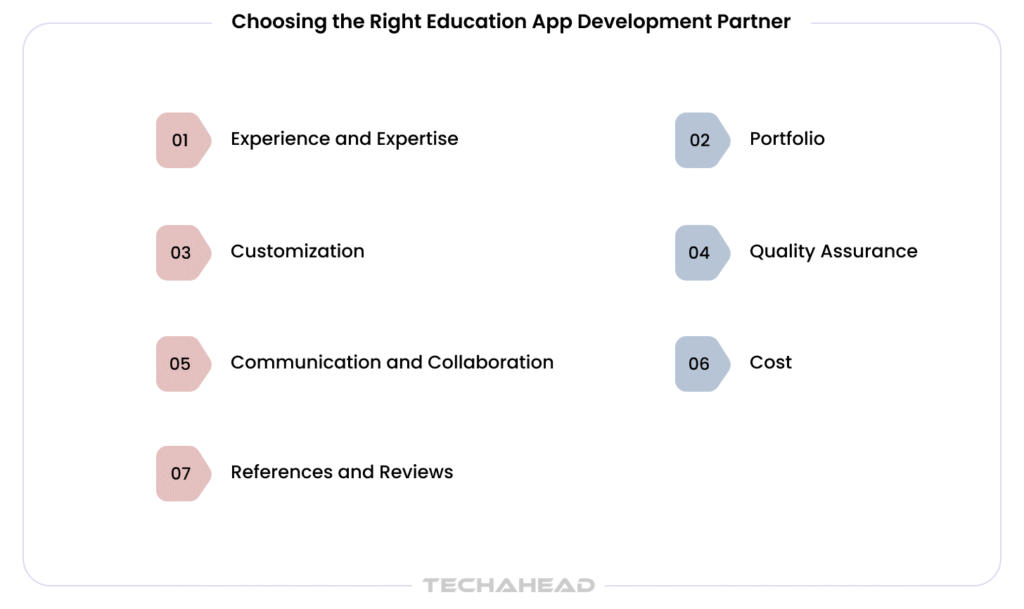
With ten capable education development companies on this list, the right choice usually comes down to fit rather than name recognition.
Instead of starting with the feature list, start with the compliance discussion. Include COPPA in the design from sprint one if the application uses K–12 data. GDPR also applies if it affects students in the UK or the EU. Ask the vendor directly whether they have produced anything that has passed a SOC 2 or ISO 27001 evaluation if they are providing corporate training platforms to enterprise buyers. It is much more costly to retrofit compliance after launch than to incorporate it from the beginning.
Inquire about the inner workings of customization. In this business, the term “AI-powered” is used ambiguously. A system that modifies material format and difficulty according to what a student has truly shown to know is very different from a static suggestion list. Ask a vendor to walk through the mechanics as well as the marketing jargon.
In particular, emphasize integration experience. Most educational platforms must communicate with an existing LMS, student information system, HR platform, or payment processor for course sales to function. A team that has completed this integration work will save more time than one working on your project for the first time and encountering SCORM or xAPI.
Before it becomes an issue, consider scale. Exam periods, cohort start dates, and live sessions cause severe concurrent surges in education systems. If the backend wasn’t built with that ceiling in mind from the start, a platform that functions well for 1,000 users might collapse at 50,000.
Additionally, seek out a partner who will resist. Instead of discreetly building whatever is requested, the best teams inform a customer immediately if a desired shortcut could create a compliance gap or, worse, lower completion rates in the future.
The educational apps that truly matter in 2026 are those that take data privacy seriously without making the experience feel bureaucratic, integrate seamlessly with the systems that institutions already run, adapt to each learner in real time, and don’t collapse when a cohort or exam window opens. It needs a partner skilled in AI-driven customization, education-specific compliance, and cloud infrastructure that can adapt to real-world load to get all of that right, not just a competent mobile team.
What sets TechAhead apart from the others on this list is that combination. Delivered by a team that has already transformed a failing e-learning platform into one designed for retention and growth, it is more than just EdTech expertise or AI engineering. It’s a challenging mix to discover and even more challenging to replicate for a business developing a learning product that is intended to evolve over years rather than just debut once.
An education app development company designs and builds eLearning apps, LMS platforms, virtual classrooms, adaptive learning apps, assessment platforms, and corporate training solutions. A specialized partner can also handle AI integration, mobile development, LMS integrations, cloud infrastructure, security, and post-launch support.
Education app development costs depend on features, platform, UI/UX complexity, AI capabilities, LMS integrations, security requirements, and backend architecture. A basic learning app will cost considerably less than an AI-powered platform with adaptive learning, live classes, analytics, payments, and enterprise integrations.
Key features include AI-powered personalization, adaptive learning, interactive courses, video lessons, assessments, gamification, learner analytics, progress tracking, virtual classrooms, push notifications, and LMS integration. The right feature set depends on the learners, educators, and business model the app serves.
AI can power personalized learning paths, content recommendations, automated grading, AI tutors, content generation, learner analytics, and adaptive assessments. Adaptive learning can also adjust content difficulty, format, and pace based on a learner’s demonstrated knowledge.
Education apps can integrate with platforms such as Moodle, Canvas, and Blackboard, along with technologies such as SCORM and xAPI. Depending on the project, integrations may also include student information systems, HR platforms, analytics tools, and payment systems.
Education apps may need to address FERPA, COPPA, and GDPR, depending on the users, location, and data being processed. Corporate learning platforms may also need to consider SOC 2 and ISO 27001 requirements.
Compare providers based on EdTech portfolio depth, AI and adaptive learning expertise, LMS integration experience, education data security, mobile development, scalable cloud architecture, learning-focused UI/UX, and verified education-sector case studies. These criteria are more useful than comparing companies solely by hourly rates or portfolio size.
The timeline depends on the product’s scope and integrations. An education app MVP with core learning features can be developed faster than a full platform requiring AI personalization, LMS/SIS integrations, real-time classrooms, analytics, gamification, and enterprise security. Defining the MVP and technical requirements early helps establish a realistic development timeline.
We use cookies to ensure our website functions properly, improve performance, and provide a personalized experience. You can choose which types of cookies to allow below.
Required for core functionality such as security, network management, and accessibility. These cannot be disabled.
Help us understand site traffic and user interactions so we can improve performance and usability.
Enable enhanced functionality and personalization such as language or region preferences.
Used to deliver relevant ads, track campaign performance, and measure advertising effectiveness.