


 Copy Link
 Share on X
 Share on Facebook
 Share on LinkedIn
Always Active
Required for core functionality such as security, network management, and accessibility. These cannot be disabled.

Uncover the transformative potential of digital and mobile solutions for your industry.





 Last Updated: Sep 18, 2026
Aug 20, 2026
Last Updated: Sep 18, 2026
Aug 20, 2026  201
201  24 min. Read


Key Takeaways


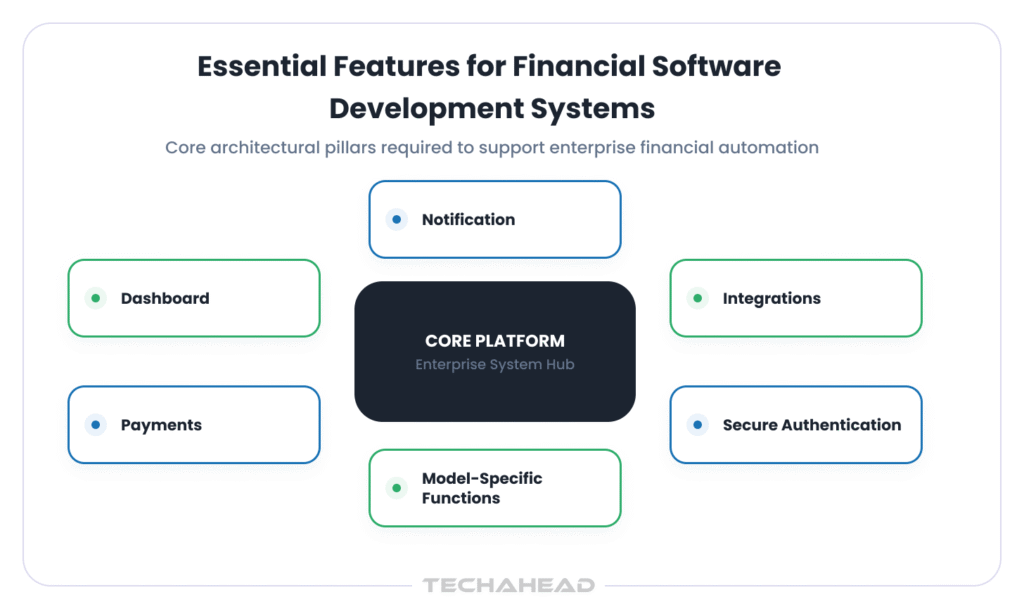
Today, banking software is far more than a mobile app that interacts with customers. It consists of the fundamental banking systems that handle each account, transaction, and ledger entry; the payment rails and fraud engines that operate in the background; the compliance and regulatory reporting tools that keep a bank audit-ready; and the digital channels that customers actually interact with, including mobile, web, and increasingly voice and API-based.
Modern banking software must handle all of these tasks simultaneously: instantaneous money transfers, AI-powered personalization, strict security, and seamless integration with any legacy infrastructure the organization may already have.
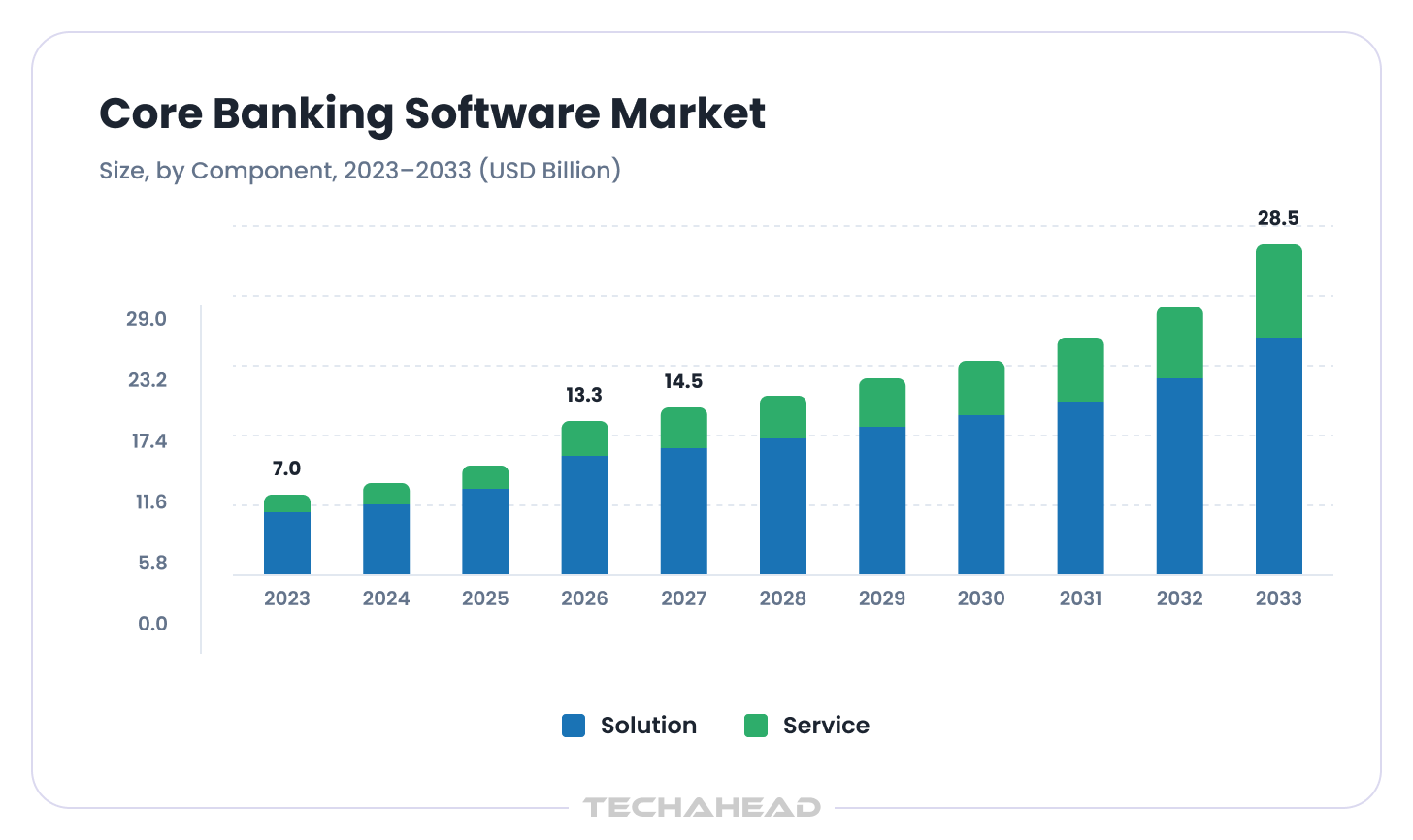
The global core banking software market size was valued at USD 13.3 billion in 2025 and is projected to grow from USD 14.5 billion in 2026 to USD 28.5 billion by 2033, at a CAGR of 10.2% from 2026 to 2033. It reflects a broader trend in which financial institutions are replacing decades-old, monolithic systems with modern, API-first software designed to enable real-time payments, AI-driven decision-making, and digital-first consumer experiences.
Banking software development differs from ordinary corporate software development because of this intricacy. An hour-long outage of a retail inventory system is a horrible day. An hour-long outage of a key financial platform threatens liquidity, triggers a regulatory event, and creates a trust issue that may take years to resolve. Security, accuracy, and compliance must be embedded into every layer—from the database design to the API gateway to the mobile interface—rather than being added as afterthoughts before launch.
Finding a partner that can provide safe, compliant, scalable banking software development is a major task in itself, since hundreds of vendors claim experience in banking and fintech. Based on their actual banking and financial services track record, technical depth, security posture, integration skills, AI maturity, and preparedness to sustain enterprise-scale systems long after go-live, this ranking assesses the best banking software development firms of 2026.
Every company on this list was evaluated against the same set of criteria, so you can compare them directly instead of relying on marketing claims.
We looked for a demonstrated history of building software specifically for banks, credit unions, neobanks, and financial services platforms, not just generic enterprise software with a financial client mentioned in passing. Depth in core banking, payments, lending, or wealth management counted more than breadth across unrelated industries.
Strong banking software needs strong fundamentals: robust backend architecture, clean API design, cross-platform delivery across web and mobile, and the ability to handle real transaction volume without performance degradation. We weighed each company’s software development services track record alongside its ability to scale a platform well past its first few thousand users.
Data security is non-negotiable in banking software. We considered encryption standards, authentication and authorization design, secure API practices, and each company’s experience working inside regulatory frameworks like PCI DSS, SOC 2, GDPR, and relevant regional banking regulations.
Banking software rarely stands alone. We assessed how well each company connects new systems to existing core banking platforms, payment gateways, open banking APIs, third-party financial services, and the legacy infrastructure that most established banks still run on.
AI has moved from a nice-to-have to a core part of how banking software detects fraud, personalizes financial guidance, and automates manual back-office work. We looked at practical AI implementation, not just AI language on a services page, along with each company’s AI development services maturity and its use of machine learning for fraud detection, credit scoring, and process automation.
Finally, we considered whether a company’s cloud architecture, development processes, and long-term support model could hold up for a large-scale financial platform, not just a proof of concept. Banking software that cannot scale past its pilot phase is a liability, not an asset.
The ten companies below cleared all six criteria. They are ranked by overall fit for banking software development in 2026, not company size, and each earned its place for a distinct reason.
TechAhead is a California-based, AI-native software development company that has spent more than 16 years building enterprise platforms and financial software for organizations ranging from venture-backed fintech startups to Fortune 500 brands like Audi, Disney, and American Express. Its dedicated fintech and banking practice works specifically on the problems that make financial software different from every other category: regulatory audits, transaction integrity, fraud exposure, and the operational reality of systems that cannot afford downtime. That combination of enterprise engineering discipline and financial services focus is what makes TechAhead a strong fit for banks and fintechs that need a software partner rather than a vendor.
The company’s banking software work spans core banking modernization, digital account management platforms, real-time payment systems, and AI-powered fraud and risk tooling, backed by PCI DSS, SOC 2 Type II, and GDPR-aligned development practices. One representative project, a banking CRM platform, processes more than 10 million transactions with 99.9% uptime while remaining PCI DSS compliant, and a separate cross-border payments system built on React Native handles multi-currency wallets, QR code payments, and KYC compliance for global transactions. That range, from backend core systems to the customer-facing software running on top of them, is what allows TechAhead to support projects from MVP through enterprise scale.
Key Banking Software Development Services
Best For
Banks, fintechs, and financial institutions that need a single software partner to handle everything from core banking infrastructure to the customer-facing platforms built on top of it.
Key Strengths
Intellectsoft has been building financial software since 2007, with a client base that leans toward larger, more established organizations tackling digital transformation rather than early-stage products. Its work spans digital and online banking software, blockchain-based financial platforms, open banking integrations, and cloud infrastructure for financial institutions, giving it the breadth that enterprise banking programs typically require.
What stands out about Intellectsoft is its comfort operating inside complex, multi-year transformation initiatives, the kind large banks run when replacing legacy software rather than launching something new. That enterprise delivery experience, paired with strong software engineering depth, makes it a natural fit for institutions further along the digital maturity curve.
Key Banking Software Development Services
Best For
Large banks and enterprise financial institutions are running multi-year software modernization programs.
Key Strengths
ScienceSoft brings 36 years of software engineering experience to a dedicated financial services practice built around one central idea: compliance has to be engineered into the software from the start, not bolted on afterward. Its team of 750-plus engineers, architects, and QA specialists builds digital banking software, payment and transaction processing systems, fraud detection software, and the regulatory reporting tooling that sits behind them.
The company holds ISO 9001, ISO/IEC 27001, and ISO 13485 certifications, and its financial services division works specifically on underwriting automation software, risk analytics, and compliance consultancy alongside development. For banks and credit unions where a failed audit is a far bigger risk than a late feature, that regulatory-first approach to software carries real weight.
Key Banking Software Development Services
Best For
Banks and financial institutions where compliance and regulatory reporting are as important as the software itself.
Key Strengths
DataArt built one of its earliest dedicated industry practices around financial services, and that focus has stayed central to the company for nearly three decades. With more than 5,000 engineers across 30-plus global locations, DataArt supports banks, payment providers, and financial platforms with data-driven, cloud-native software rather than off-the-shelf templates.
The company’s strength is depth over volume. Rather than treating banking as one vertical among dozens, DataArt has maintained a standing financial services team that understands the sector’s operational and regulatory nuances, which shows up in how it approaches everything from data architecture to compliance-aware software design.
Key Banking Software Development Services
Best For
Financial institutions that need deep domain expertise paired with strong data engineering and cloud software architecture.
Key Strengths
Cleveroad has spent over a decade building neobank platforms, payment processing software, digital wallets, and core banking integrations, with engineering teams distributed across the US, Estonia, Norway, Poland, and Ukraine. Its focus on PSD2- and PCI DSS-compliant software architecture, combined with ISO 27001 and ISO 9001 certification, positions it well to deliver digital-first banking software that can launch fast without cutting corners on security.
Recognized as a Clutch Global Leader and included in Clutch’s Top 1000 companies, Cleveroad has built a reputation among neobanks and digital-first challengers rather than traditional branch-based institutions, shaping its approach to software design for mobile-native, self-service systems.
Key Banking Software Development Services
Best For
Neobanks and digital-first financial brands that need to launch mobile-native banking software quickly.
Key Strengths
Innowise operates at a serious scale, with a team of more than 2,500 professionals that has delivered over 1,200 projects, many in banking and financial services software. Its core banking work includes custom core banking systems, cross-platform banking software, and AI-powered credit scoring and fraud detection software, which makes it a strong option for institutions that need to rebuild infrastructure, not just the interface layer on top of it.
That scale comes with breadth: SaaS software for neobanks, AI-driven risk tooling, and platform engineering all sit under one roof, simplifying vendor management for banks that would otherwise need to coordinate multiple specialized firms.
Key Banking Software Development Services
Best For
Banks and fintechs that need core banking infrastructure rebuilt alongside their customer-facing software.
Key Strengths
Simform specializes in cloud and platform engineering, and that shows up clearly in its banking work: financial software built to hold up under real transaction volume rather than buckle when usage spikes. As a holder of Azure Expert MSP status, a designation fewer than 105 Microsoft partners worldwide carry, Simform brings genuine depth in cloud-native software architecture to banking clients that need their infrastructure to scale as smoothly as their user base grows.
Its UX-led approach to experience engineering also means banking software built with Simform tends to prioritize usability alongside backend reliability, rather than treating the interface as an afterthought to the infrastructure work.
Key Banking Software Development Services
Best For
Fintechs and banks that expect rapid user growth and need software architecture built to scale from day one.
Key Strengths
Praxent is the most narrowly focused company on this list: it works exclusively in financial services. Over more than two decades, it has helped upward of 400 organizations, mostly banks, credit unions, lenders, and wealth and insurance platforms, launch and modernize customer-facing software. Its signature approach is incremental modernization rather than a full rip-and-replace, rebuilding software through manageable development sprints so clients see measurable outcomes in weeks instead of after a multi-year program.
That single-industry focus shows up in how the team works: product strategy, UX design, and engineering sit under one roof, which suits regulated software where usability and compliance both matter equally. For community banks and credit unions without the budget or appetite for an enterprise-scale transformation program, Praxent’s sprint-based approach offers a lower-risk way to modernize without a multi-year commitment.
Key Banking Software Development Services
Best For
Credit unions, community banks, lenders, and wealth platforms that want measurable modernization in sprints rather than a multi-year rebuild.
Key Strengths
Simpalm has spent more than 15 years building financial software from a fully US-based team, with offices in Rockville, Maryland, Washington, DC, and Chicago. Its fintech practice covers payment and transfer applications, mobile banking software, invoicing solutions, and investment and wealth management platforms, giving it a broad footprint across the software a bank or fintech typically needs.
For institutions that specifically want a domestic team, whether for data residency reasons, time zone alignment, or simply the ability to meet in person, Simpalm’s US-only office structure sets it apart from most of the other companies on this list, nearly all of which run distributed or offshore engineering. That local presence is paired with real fintech depth: the company has built for clients across banking, payments, and financial services rather than treating fintech as a side practice.
Key Banking Software Development Services
Best For
Banks and fintechs that specifically want a fully US-based development team for data residency, time zone, or compliance reasons.
Key Strengths
Vention, formerly known as iTechArt, has built financial software since 2002 and runs a dedicated fintech practice with clients that include PayPal, StoneX, Brex, and Zilch. Its model centers on integrating experienced engineers directly into client teams, which makes it a strong option for banks and fintechs that already have in-house product leadership but need to scale software engineering capacity for a specific initiative, like a new payments feature or open banking integration.
The company’s fintech advisors work across lending, banking, real estate, and insurance software, with particular strength in payment systems, cloud infrastructure, and the DevOps automation that keeps financial platforms running reliably at scale.
Key Banking Software Development Services
Best For
Banks and fintechs with existing product teams that need to scale software engineering capacity for payments or infrastructure work.
Key Strengths
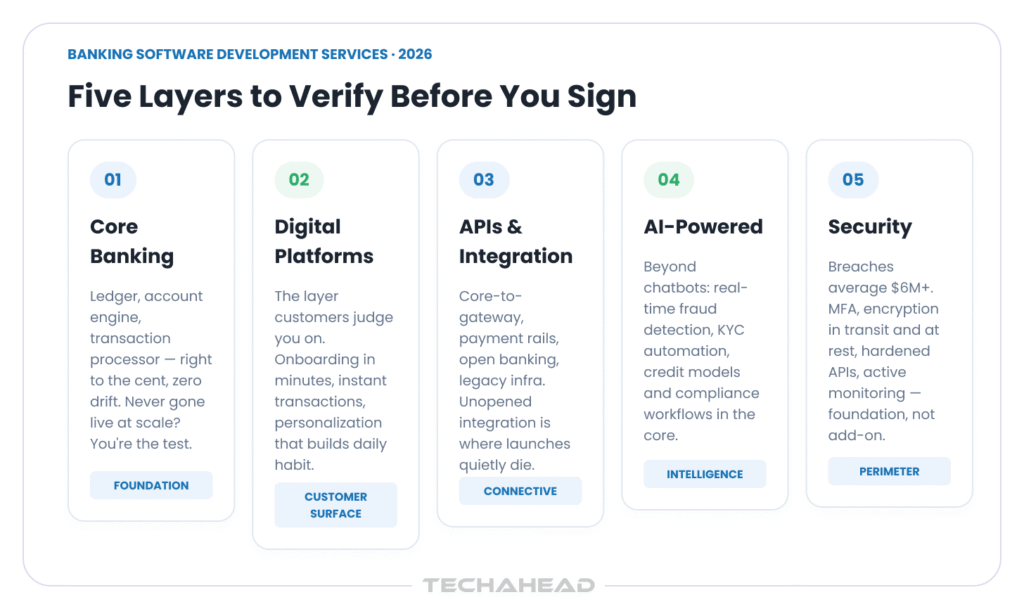
Here is the uncomfortable part nobody puts in the RFP. Most banking software projects do not fail because a vendor could not code. They fail because the buyer did not know what “good” actually looks like until it was too late to fix cheaply. So before you sign anything, here is what a serious banking software development partner needs to be capable of delivering, not what they say on a sales call.
Everything else in your stack is decoration if the core system underneath it cannot be trusted. This is the ledger, the account engine, the transaction processor, the part of the software that has to be right to the cent every time, with zero tolerance for drift. If a vendor’s core banking work has never actually gone live at scale, you are not hiring a banking software partner. You are funding their first attempt, with your customers’ money as the test data.
This is the layer your customers actually judge you on. Account opening that takes three minutes instead of three days. Transaction processing that feels instant. Dashboards that surface the one thing a customer needs to see instead of burying it under twelve tabs. Personalization is not a nice-to-have anymore; it is the difference between an app someone opens once a month out of obligation and one they open every day out of habit, and habit is what keeps customers from switching to the neobank that just launched down the street.
No banking software lives alone. It has to talk to core systems, payment rails, open banking frameworks, and legacy infrastructure that predates most of the engineers building on top of it. This is where projects quietly die, buried in integration work nobody scoped properly, three months behind schedule, and nowhere near launch. TechAhead’s mobile app development work is built on exactly this kind of integration layer, connecting the app your customers see to the banking software running underneath it, without the six-month backend surprise.
If your banking software’s AI story starts and ends with a chatbot, you are already behind. The vendors worth hiring are building fraud detection that catches anomalies in real time, not after the money is gone, KYC automation that speeds up onboarding without opening a compliance hole, credit models that get smarter with every transaction, and compliance workflows that stop eating your team’s week. TechAhead’s approach to agentic AI, paired with its work on AI in digital banking and AI in fintech, is built around exactly this: AI running the operational core of the software, not sitting on top as a demo feature.
Here is a number that should change how you think about this line item: the average financial services data breach now costs more than $6 million, and that figure does not count what a breach does to customer trust, which does not come back on any timeline you control. Multi-factor authentication, encryption at rest and in transit, identity verification, hardened API design, and active fraud monitoring are not features you add later. They are the foundation, and no honest partner will tell you the software is completely secure, because security is a practice, not a finished state. What they should tell you is exactly how they are building each layer, in specifics, not slogans.
Anyone who quotes you a number before understanding your project is guessing, and you should not build a financial platform on a guess. A simple digital wallet and a full core banking platform with multi-market compliance are not the same species of project, even though both technically fall under “banking software.”
These are the variables that swing your number the most, in roughly the order they tend to bite:
Mobile banking app development cost climbs fastest with compliance scope and integration complexity, not with how polished the interface looks, and the same pattern holds for banking software as a whole. A fintech app development cost estimate for a lending or payments product will usually land well above a simple account management build, because the regulatory surface area is bigger, and every corner cut there gets expensive later. Custom banking app development cost tends to run higher upfront than working from an established platform too, but it buys you flexibility that off-the-shelf software cannot, which matters the moment your product needs to do something your competitor’s platform was never built to do.
Skip the guesswork. The move that actually saves you money is a discovery conversation with a shortlisted partner who scopes your modules, compliance needs, and platform choices before quoting a single dollar.
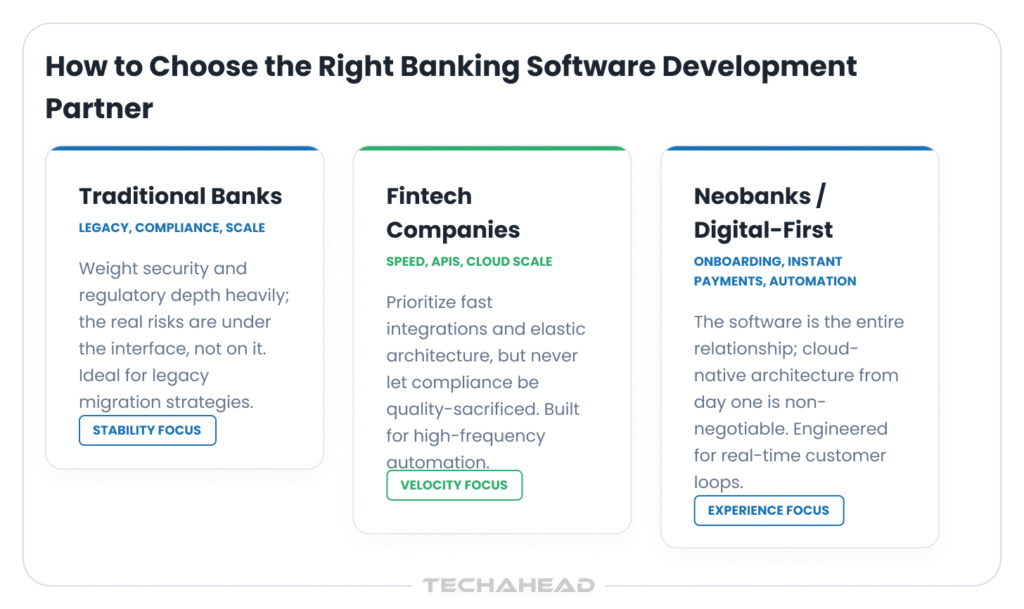
Different institutions are solving different problems, and the “best” partner changes depending on which problem is actually yours.
If you are a traditional bank, your risk is not the interface; it is everything underneath it. Weight security, regulatory compliance, and legacy modernization experience heavily, and ask hard questions about how a vendor has handled decades-old infrastructure without breaking it. Scalability matters from day one here too, because your software needs to serve millions of existing customers immediately, not grow into that volume over a few quiet years.
If you are a fintech, speed is your currency. You need a partner who moves fast on clean API integrations, reliable payment infrastructure, and cloud architecture that scales the moment your product takes off, because moments like that do not wait for a slow vendor to catch up. AI capability matters more here too, since your edge is often smarter underwriting or sharper fraud detection, not a banking license. A strong fintech development partner keeps that speed without quietly cutting the compliance corners that come back to bite you later.
Must Read: Vertical AI Agents in Fintech: The Enterprise Leader’s Guide to Building What Actually Works
If you are a neobank, the software is not part of the customer relationship; it is the entire relationship. There is no branch to fall back on when onboarding is clunky or a transfer feels slow. Digital onboarding has to be frictionless, payments have to feel instant, and automation should strip out every manual step that does not need a human. Cloud-native architecture from day one, not a legacy system dressed up in a modern skin, is usually what separates the neobanks that scale cleanly from the ones that hit a wall at their first real growth spike.
Ask these out loud, in the first call, before you get anywhere near a contract:
If a vendor gets vague or defensive on any of these, that is your answer. Banking software is not a one-time build you hand off and forget. It is a system that has to keep evolving alongside your customers, your regulators, and the technology underneath it for years after launch, and the partner you pick now is the partner living inside your infrastructure when the next audit, the next fraud pattern, or the next competitor’s feature launch shows up.
That is exactly the kind of long-haul partner worth choosing. The best banking software development companies are not just the ones with the cleanest portfolio or the fastest quote. They are the ones still standing next to you when the next audit lands, the next fraud pattern emerges, or your customers start expecting something your platform was not built to do yet. Pick with that horizon in mind, not just the one in front of you.
A banking software development company builds custom digital solutions for banks and financial institutions, including mobile banking apps, digital banking platforms, payment systems, APIs, core banking integrations, and AI-powered financial applications.
Banking software development costs depend on the application’s complexity, platforms, integrations, security requirements, compliance needs, AI capabilities, and development team. An enterprise banking platform with complex integrations will typically cost significantly more than a focused banking application.
Look for banking and fintech expertise, strong security practices, core banking and API integration capabilities, scalable cloud architecture, AI expertise, and experience building enterprise-grade financial software.
Banking software development companies provide services such as mobile banking app development, digital banking platforms, payment solutions, banking API development, core banking integration, fintech software development, AI-powered banking solutions, cloud development, and ongoing maintenance.
The timeline depends on the software’s functionality and technical complexity. A focused banking application may take several months, while an enterprise banking platform involving multiple integrations, security requirements, compliance workflows, and AI features can take considerably longer.
Yes. Experienced banking software development companies can integrate new banking applications with core banking systems, payment gateways, APIs, customer databases, third-party financial services, and legacy infrastructure. Integration requirements should be assessed early in the development process.
AI can be used for customer support, fraud detection, KYC automation, financial recommendations, transaction monitoring, personalization, document processing, and workflow automation. The right AI use cases depend on the bank’s data, workflows, risk requirements, and business objectives.
Banking software should include strong authentication and authorization, encryption, secure APIs, identity verification, access controls, audit trails, fraud prevention mechanisms, data protection, and appropriate regulatory and compliance controls.
We use cookies to ensure our website functions properly, improve performance, and provide a personalized experience. You can choose which types of cookies to allow below.
Required for core functionality such as security, network management, and accessibility. These cannot be disabled.
Help us understand site traffic and user interactions so we can improve performance and usability.
Enable enhanced functionality and personalization such as language or region preferences.
Used to deliver relevant ads, track campaign performance, and measure advertising effectiveness.