


 Copy Link
 Share on X
 Share on Facebook
 Share on LinkedIn
Always Active
Required for core functionality such as security, network management, and accessibility. These cannot be disabled.

Uncover the transformative potential of digital and mobile solutions for your industry.





 Last Updated: Oct 1, 2026
Sep 19, 2026
Last Updated: Oct 1, 2026
Sep 19, 2026  77
77  20 min. Read


Key Takeaways


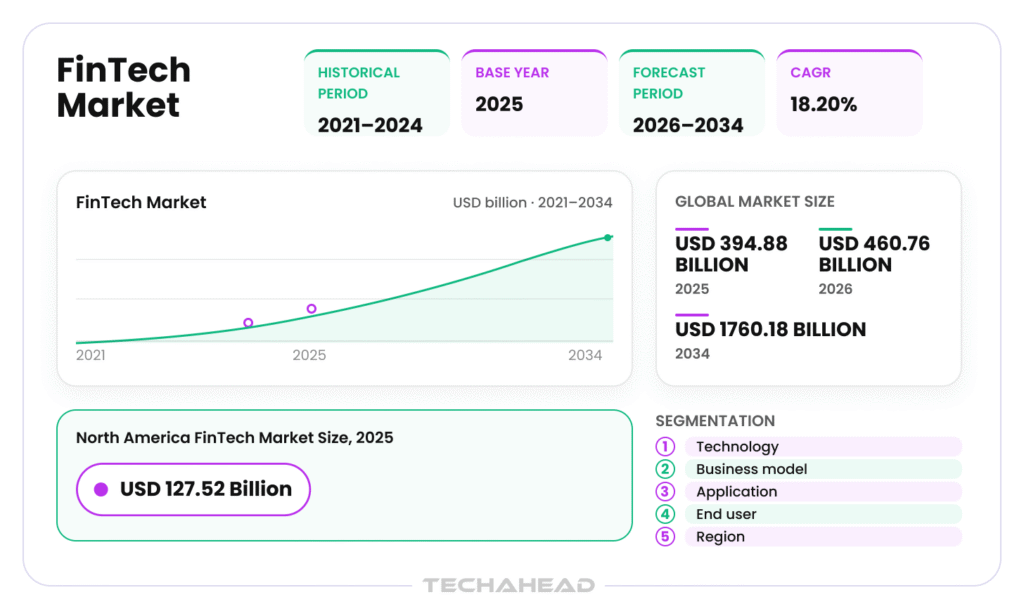
Fintech is growing fast, and buyers can feel it. According to Fortune Business Insights, the worldwide fintech market is expected to increase at an annual pace of 18.2% to reach $1.76 trillion by 2034, from an estimated $460.76 billion in 2026. Read the figure as a direction rather than a measurement because various analysts have different definitions of fintech. The claim is that more money means more vendors can be built.
Buyers have been deceived at this stage. A fintech system can handle regulated data, money, and identity all at once. It must do so across a wide range of bank, card network, and data provider connections, both under load and during audits. A team that created a successful consumer app may not be the greatest fit for a payments engine or lending platform. Errors come late and cost real money: a failed reconciliation, sluggish sponsor-bank onboarding, or a security discovery that delays launch.
This article analyzes 10 FinTech software development companies based on buyer criteria, including proven fintech work, security and compliance posture, engineering depth, integration experience, scalability, and post-launch support. Each profile covers what firms publish or what third parties can corroborate, as well as any assertions based on business strategy rather than proven outcomes for your product.
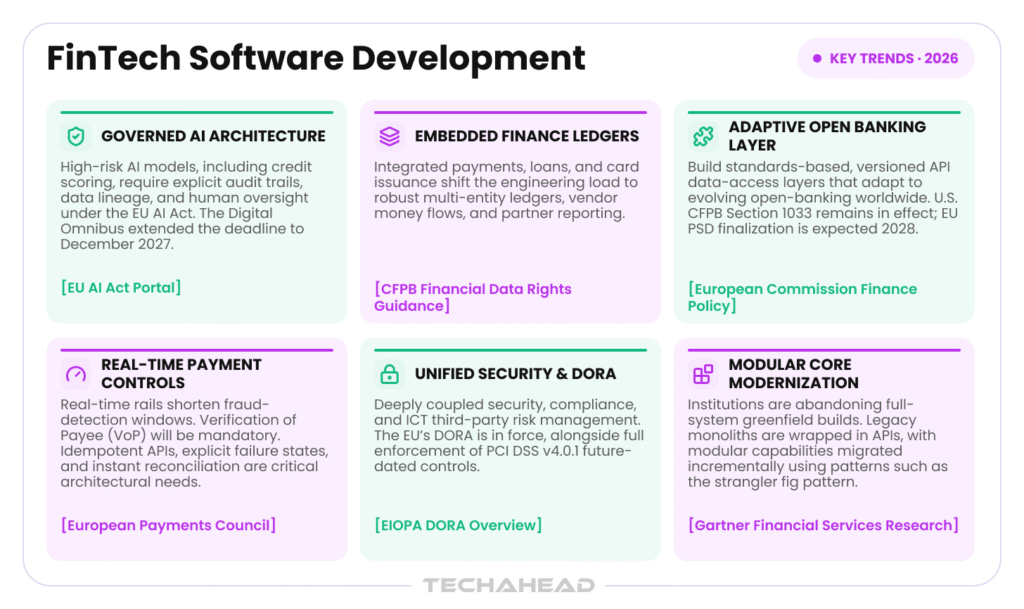
Governed AI Architecture
Machine learning is already standard across fraud, KYC, and underwriting. With the EU AI Act treating credit assessment as a high-risk system (and full compliance for standalone models arriving by December 2027 under the Digital Omnibus), build model explainability, audit trails, and data lineage directly into early application design. So model documentation, data lineage, and human-review paths belong in the first architecture, not the last sprint. Teams planning AI development for a regulated product should scope that work at discovery.
Embedded Finance & Ledger Heavy Lifting
Moving payments, credit, and card issuance into non-bank software shifts engineering effort from core user interfaces to multi-entity ledgers, partner-bank reporting, and onboarding compliance. Money flow choices are foundational and difficult to rework later.
Source: CFPB Financial Data Rights Guidance
Adaptive Data-Access Layers
Open banking regulations remain in flux globally. In the US, compliance dates for Section 1033 are stayed amid legal reviews, while Europe’s PSD3 and PSR frameworks target full application around 2028. Building flexible, versioned API architectures ensures software adapts without full-system rewrites.
Real-Time Payment Controls
Instant rails drastically shrink fraud detection and recovery windows. Regulations increasingly expect payee verification across instant transfers, making idempotent APIs, explicit state management, and real-time reconciliation fundamental technical prerequisites.
Source: European Payments Council
Unified Security & Operational Resilience
Security, privacy, and third-party risk controls are now deeply linked. PCI DSS v4.0.1 rules are fully active, and the EU’s Digital Operational Resilience Act (DORA) keeps third-party software providers under direct regulatory scrutiny during bank vendor evaluations.
Modular Core Modernization
Institutions are replacing monolithic core banking platforms by wrapping legacy systems in modern APIs and migrating capabilities one module at a time, favoring phased modernization patterns over greenfield rewrites.
Source: Gartner Financial Services Research
| Company | FinTech Expertise | Key Services | Best For |
| TechAhead | Banking, payments, lending, wealth, KYC, embedded finance | Consulting, custom software, AI, APIs, apps, cloud, managed services | One team from compliance planning to run |
| ScienceSoft | Banking, payments, lending, insurance, financial security | Custom software, cybersecurity, modernization, managed IT | Compliance-heavy US builds with long-term IT support |
| DataArt | Capital markets, asset management, banking, payments | Data and analytics, AI, cloud, product engineering | Data-intensive platforms at large institutions |
| Praxent | Financial services only: lending, banking, wealth, insurance, payments | Integrations, AI-assisted modernization, UX, custom development | Credit unions, community banks, lenders |
| Softjourn | Cards and payments | Payment processing, gateways, EMV, PCI DSS consulting | Payment processors and card programs |
| Itransition | Banking, lending, payments | Core banking, CRM, analytics, API integration | Banks needing broad enterprise integration |
| ELEKS | Banking software, transaction monitoring | Core and mobile banking, data science, QA | Enterprises wanting engineering plus R&D depth |
| Simform | Banking and payments, one of six sectors | Cloud, data, AI/ML, Open Banking APIs | Scaling cloud-native fintech products |
| Innowise | Banking, payments, cards, lending, crypto | Banking software, payment gateways, integration, staffing | Larger teams and flexible capacity |
| Simpalm | Mobile banking, wallets, payments, trading apps | Mobile and web apps, payments, investment platforms | Startups wanting a US-based mobile-first team |
TechAhead delivers end-to-end FinTech software development, building digital banking apps, payment wallets, AI fraud analytics, KYC systems, wealth platforms, and embedded finance. Their team includes over 240 consultants specializing in AI/ML, cloud, and financial technology.
To protect client data, TechAhead maintains SOC 2 Type II, ISO/IEC 27001:2022, and ISO/IEC 42001:2023 certifications, along with AWS Advanced Tier Services Partner status and a Security Services Competency. These standards ensure institutional-grade security and governance are built into every project from day one.
FinTech development services: strategy and consulting (compliance planning across PCI DSS, SOC 2, GDPR, AML, and KYC, plus legacy modernization), AI for fraud detection, credit scoring, and risk modeling with explainability and audit trails, custom software for banking, lending, insurance, wealth, and payments, API development using REST, GraphQL, and OAuth 2.0, native and cross-platform apps, cloud engineering, blockchain, data analytics, security testing, and managed operations.
Strengths: a published six-phase process that produces a compliance matrix during discovery, clear governance language around AI (explainability, drift monitoring), and coverage from consulting through post-launch support.
Best for: banks, lenders, payment companies, and startups that want consulting, building, AI, and operations from one partner.
ScienceSoft has worked in financial IT for around two decades, and its cybersecurity expertise dates back much further. It reports on about 100 financial IT projects and employs in-house compliance experts who are conversant with PCI DSS, SEC, SOX, GLBA, AML/CFT, OFAC, NYDFS, and GDPR. It also has ISO 9001 and 27001 certifications.
Acknowledgment is also documented. The Financial Times named ScienceSoft USA Corporation one of the fastest-growing businesses in the Americas in 2022, 2023, and 2024, and FinTech Futures awarded them a 2024 Banking Tech Award for web and mobile banking software development. Delivery is shaped by the security context; regulatory mapping and threat modeling are integral components of the project, not add-ons.
FinTech development services: banking software; payment software built around PCI DSS, 3D Secure, SOX, and GDPR requirements; loan management and treasury software; actuarial and insurance software; modernization of existing financial systems; cybersecurity services; and managed IT.
Strengths: a long record in both software and security, named regulatory frameworks across US and EU markets, and a full-cycle model from consulting to support.
Best for: US banks, insurers, and fintechs expecting a compliance-heavy build and wanting the same firm to maintain it.
DataArt runs a financial services practice covering asset management, capital markets, digital banking, payments, and insurance, next to cloud, data, analytics, AI, and product engineering services. It says it serves 400+ clients overall, lists 1,200+ finance industry specialists, and is an AWS Premier Tier Services Partner and Microsoft Solutions Partner. It also describes Artisyn, an AI-enabled delivery model with built-in governance, which it positions for regulated sectors. On the Clutch profile, reviewers praise delivery quality and project management, and some say pricing runs high. That points to a firm better suited to complex data and trading-adjacent platforms than to a lean MVP.
FinTech development services: product and software engineering, data and analytics platforms, AI programs taken to production, cloud migration and optimization, and legacy modernization.
Strengths: a dedicated financial services practice, a strong data and analytics orientation, capacity for multi-team programs, and public client work in wealth management and capital markets.
Best for: asset managers, broker-dealers, and large banks building data-heavy or AI-heavy platforms.
Praxent specializes primarily in financial services and fintech. It advertises 450+ digital transformations completed and claims to be SOC 2 Type II certified. The core effort includes integrating with legacy and core systems before creating products on top of them, with UX handled as a first-rate discipline. Its current posture centers on AI-assisted legacy modernization and controlled AI agents for regulated activities.
Earlier targets, recorded in press releases, include a SOC 2 certification and more than 60 digital projects for financial firms in 2023, as well as certified MXmobile SDK development partner status by 2022. Its solution pages include auto financing, banking, commercial lending, fintech SaaS, insurance, investment, wealth management, and payments.
FinTech development services: software integrations and custom development, modernization and technical debt reduction, financial technology consulting, AI engineering, and UX design for banking and lending products.
Strengths: a single-sector focus, so less ramp-up on financial vocabulary, comfort with core system integration, and design depth for onboarding and account flows.
Best for: credit unions, community banks, lenders, and fintech SaaS companies modernizing customer-facing products. For very large multi-country programs, ask about team capacity.
Softjourn splits its work between fintech, cards and payments, and media and entertainment ticketing, so confirm that your project will be staffed from the payments side. On that side, it publishes payment processing and gateway development, EMV, 3-D Secure, fraud protection, multi-currency processing, contactless payments, and PCI DSS security assessment expertise. It also lists KYC/AML integration, card issuing, prepaid, digital wallets, and cross-border payment work.
That narrow specialty pays off when the product is the payment flow itself: prepaid programs, card processing, transaction platforms.
FinTech development services: payment gateway and processing development, EMV and 3-D Secure work, card and prepaid platforms, fraud protection, PCI DSS consulting, and QA for transaction systems.
Strengths: depth in card and payment technology, testing for high transaction volumes, compliance consulting alongside engineering, and dedicated team and R&D models.
Best for: payment processors, prepaid and card program managers, and fintechs whose core risk sits in transaction handling.
Itransition is a large software engineering and consulting firm. Its financial services offering, as described in directory listings, spans core banking systems, banking CRM, financial analytics, mobile banking, payment software, lending software, customer portals, and bank API integrations. It lists Microsoft, Salesforce, SAP, AWS, and Google Cloud as partners and names PayPal as a client.
A large engineering firm cuts both ways. You get breadth and process maturity, but you should confirm that a fintech-experienced team, not a generalist one, is assigned to you.
FinTech development services: core banking development, banking CRM, financial analytics and reporting, mobile and web banking, lending and payment software, customer portals, and dedicated development centers.
Strengths: wide enterprise stack coverage, including CRM and analytics tied to banking systems, experience with integration-heavy programs, and dedicated team models for long engagements.
Best for: banks and financial institutions wanting one vendor for core-adjacent systems, portals, and analytics.
ELEKS is a software engineering and consulting firm. Its banking page describes core banking solutions, mobile banking, API-first payment capabilities, and real-time transaction monitoring. On security, it announced in April 2025 that it renewed ISO 9001:2015 and moved to ISO 27001:2022, and it reports completing a SOC 2 Type II audit. As with every certification in this list, ask which entity and scope the report covers.
ELEKS pairs software delivery with research and data science, which suits products where analytics sits at the center.
FinTech development services: banking software and core system design, mobile banking, transaction monitoring, data science and analytics, custom application development, and quality assurance.
Strengths: deep engineering history, R&D and data science alongside delivery, and security standards listed publicly with dates.
Best for: mid-to-large financial firms that want engineering plus analytical depth on products like monitoring, risk, or advisory tools.
Simform is a digital engineering company whose work spans cloud, data, AI/ML, and product engineering for ISVs and enterprises in high-tech, fintech, healthcare, supply chain, retail, and professional services. Think of it as a strong cloud engineering firm with a fintech practice, not a pure fintech house.
Its finance page describes machine-learning fraud detection, digital onboarding with e-KYC, NLP virtual assistants, Open Banking API integrations, and payment systems. Simform is an Azure Expert Managed Services Provider, a Microsoft Solutions Partner, and an AWS Premier Tier Services partner.
FinTech development services: banking and payments engineering, fraud and onboarding ML, Open Banking API integration, cloud and DevOps, data engineering, and AI/ML engineering.
Strengths: cloud architecture and scalability, data and AI engineering, and partner credentials with the major cloud providers.
Best for: fintech product companies and enterprises scaling a platform on AWS or Azure that need engineering muscle more than regulatory advisory.
Innowise is a full-cycle software development company with more than 3,500 IT professionals, and it was named to the Inc. 5000 list in 2024. Its fintech work covers banking software (core banking, mobile banking, open banking, banking CRM), payments (gateways, mobile payments, payment hubs), lending, crypto and blockchain, and fintech consulting, integration, support, and cybersecurity services. It also offers dedicated fintech developers on a staff-augmentation basis.
Size is the main differentiator, and it helps when you need to ramp a team quickly. Test any compliance claim before relying on it: ask for the SOC 2 report, its scope, and the audit period.
FinTech development services: banking software development, integration, modernization, and support; payment gateways; card software; lending platforms; crypto software; and fintech consulting and cybersecurity.
Strengths: a large engineering bench, project delivery combined with staff augmentation, and breadth across banking, payments, and lending.
Best for: organizations that need to scale teams quickly or pair a defined project with extra capacity.
Simpalm is a US digital product firm with offices in several US states, and it describes 400+ successful deployments. It is a generalist that has built a fintech practice, so it fits a narrower set of projects than the specialists above.Its fintech site includes payments and transfer applications, digital wallets, invoice management, wealth management, investing and trading platforms, mobile banking (account management, fund transfers, bill payments, MFA), and AI-powered fintech solutions on native and cross-platform mobile stacks.
FinTech development services: mobile banking apps, payments and transfers apps, digital wallets, invoicing, investment and trading apps, and custom fintech software.
Strengths: a US-based team and local meetings, mobile-first product delivery, and a practical size for early-stage and mid-market engagements.
Best for: startups and smaller financial companies that want a US partner for a focused mobile or web fintech product.
We assessed each company against six criteria and cross-checked facts using official websites, press releases, and reputable directories. Directory rankings informed our research but not the scoring, because many third-party “top” lists are published by the companies they rank. Every company on the list also has a verifiable US presence.
| Criterion | What to verify | Evidence to request |
| FinTech domain expertise | Shipped products in your category (payments, lending, banking, wealth) | Case studies, reference calls with regulated clients |
| Security and compliance capabilities | Company-level certifications and how they scope to your build | SOC 2 report scope and period, ISO certificate, pen-test summary, responsibility matrix |
| Technical expertise | Architecture choices for ledgers, queues, and data stores | Sample architecture document, code review practices |
| API and integration capabilities | Prior work with your core, processor, or identity provider | Named integrations, sandbox-to-production examples |
| Scalability and performance | Load testing and failure-handling approach | Test reports, incident postmortem examples |
| Post-launch support | SLAs, monitoring, patching, and compliance upkeep | Support model, escalation path, sample SLA |
Two rules keep the evaluation honest. Separate what a company says it can do from what it can show. And separate the company’s certifications from anything that covers your product.
Partners package services differently, so use this as a checklist for scoping calls. A partner offering the full range of FinTech app development services should be able to explain each area below in terms of your product and your risk.
FinTech app development. Customer-facing apps carry the trust burden: biometric login, device binding, secure storage, clear error states when a payment fails. Ask how the team handles app-store review, accessibility, and release cadence for a regulated product, not just how the screens look. Our mobile app development team scopes these questions up front.
Custom fintech software development. Custom work makes sense when your pricing, risk logic, or workflow is the differentiator. Expect a build-versus-buy conversation about commodity components like identity checks or card issuing. A good partner will not rebuild what a vetted provider already does well.
Digital banking development. Whether you are launching a neobank or modernizing a retail channel, the key topics are the core system of record, account and ledger design, and cutover. Ask about phased migration, parallel runs, and rollback plans. TechAhead’s banking practice covers this territory.
Must Read: Top 10 Banking Software Development Companies in 2026
Payment software development. Look for fluency in gateways, card networks, ACH or real-time rails, tokenization, reconciliation, and chargebacks. A strong partner designs to shrink your PCI DSS scope, not widen it.
AI in fintech. Useful applications include fraud detection, document processing, and decision support. Ask for explainability, drift monitoring, human review of adverse decisions, and a documented data-use policy.
FinTech API integrations. This is where schedules slip. Ask how the vendor handles sandboxes, certification cycles, versioning, and what happens when a partner API goes down. Our API and integration engineering page lists what we cover.
FinTech consulting services. Consulting should produce decisions, not slides: an architecture assessment, a compliance mapping with owners, a modernization sequence, and a cost model. It earns the most before you commit to a build, and AI strategy and consulting is a common starting point when AI is in scope.
Define product requirements first. Write down what moves money, what data you store, which jurisdictions you serve, and which partners (sponsor bank, processor, and identity provider) are involved. A vague brief invites vague estimates.
Check relevant fintech experience. Ask for work similar to yours in regulatory exposure and integration complexity, then speak to a client. A payments specialist and a wealth-platform specialist are not interchangeable.
Evaluate security and compliance capabilities. Review the vendor’s own controls (SOC 2 or ISO 27001). Then ask separately how they would build yours: secrets management, secure development lifecycle, testing, and evidence production for your auditors.
Review integrations. Ask for specific systems they have connected to, not categories. Prior experience with your core or processor can remove weeks of discovery.
Understand development and support models. Fixed scope, time and materials, and dedicated teams each suit a different level of uncertainty. Clarify who owns production support, incident response, and compliance upkeep after launch.
Evaluate long-term scalability. Ask how the architecture handles ten times your launch volume and what changes when you add a second market.
Questions worth asking every vendor:
We would rather make the case with documents than adjectives, so here is what you can ask to see.
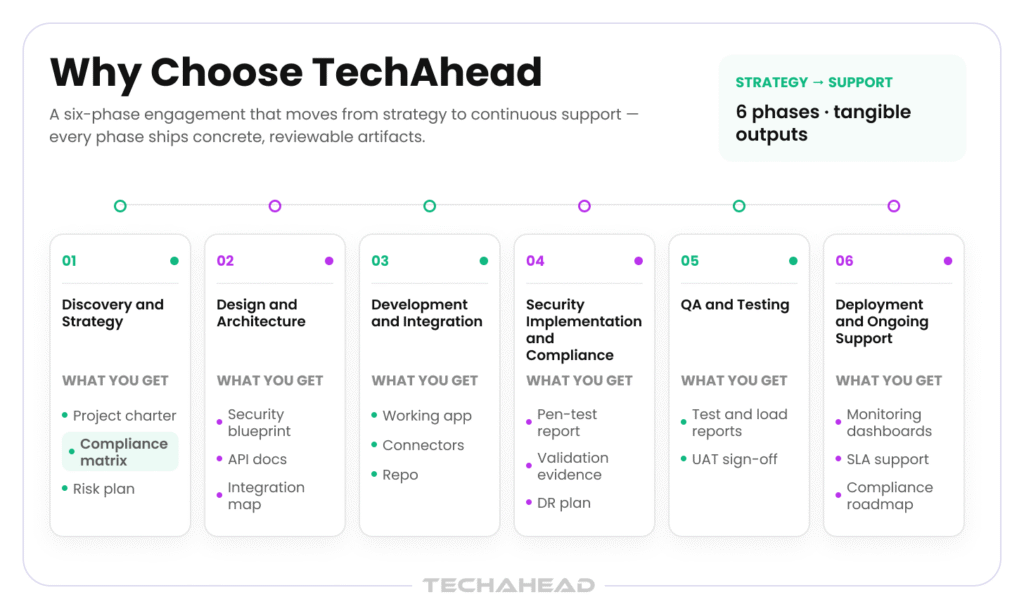
A published delivery process. TechAhead’s six-phase process runs from discovery through deployment and support. Along the way, it produces concrete artifacts a buyer can review before work starts: a compliance matrix, technical architecture, security blueprint, and integration map.
Security work you can inspect. TechAhead lists SOC 2 Type II and ISO/IEC 27001:2022 certifications and describes encryption, access controls, audit logging, and penetration testing in its builds, backed by cybersecurity and DevSecOps practices. As with any vendor, those certifications cover TechAhead’s own controls. Your product’s compliance depends on scope, configuration, and shared responsibilities, and a discovery phase should clarify those.
AI with governance attached. The fintech offering includes fraud detection, credit scoring, and risk modeling with explainability and audit trails, supported by an ISO/IEC 42001:2023 certification for AI governance. The team also builds blockchain-enabled settlement, as in the RaspberryFX cross-border payments case study.
Cloud and long-term support. TechAhead builds on AWS, Azure, and Google Cloud, holds AWS Advanced Tier Services Partner status with Cloud Operations and Security Services competencies, and offers cloud engineering plus managed operations and security patching after launch. QA and test automation cover load testing for peak transaction volumes.
Consulting before commitment. Strategy work covers compliance planning across PCI DSS, SOC 2, GDPR, AML, and KYC, plus legacy modernization roadmaps, helping buyers who aren’t ready to commit to a build.
A FinTech software development company builds and modernizes technology for financial products such as digital banking platforms, payment systems, lending applications, wealth management platforms, trading solutions, and embedded finance products. Depending on the engagement, services can include product development, API integrations, cloud engineering, AI, cybersecurity, compliance support, and post-launch maintenance.
Start by defining your product, target markets, regulatory requirements, integrations, and scalability needs. Then evaluate vendors based on relevant FinTech experience, security and compliance capabilities, technical expertise, integration experience, delivery model, and post-launch support. Ask for comparable projects, security documentation, client references, and evidence of production integrations.
Common services include FinTech app development, custom financial software development, digital banking development, payment software development, lending and wealth management solutions, AI and analytics, API integrations, cloud engineering, cybersecurity, and FinTech consulting services.
The cost depends on the product type, features, integrations, regulatory scope, technology architecture, development model, and ongoing support requirements. A simple financial application and a regulated payment or banking platform can have very different development requirements, so a reliable estimate requires a defined scope and technical discovery.
FinTech applications handle financial transactions, personal information, identity data, and other sensitive information. Security therefore needs to be built into architecture, authentication, access controls, encryption, monitoring, testing, and deployment processes rather than treated as a final-stage feature.
Depending on the project, buyers may evaluate certifications and standards such as SOC 2 and ISO 27001, along with relevant payment-security and regulatory requirements. The important point is to verify the certification’s scope, covered entity, and validity rather than treating the certification alone as proof that your product will be compliant.
A development partner can help translate applicable requirements into technical controls, architecture decisions, documentation, security practices, and integrations. However, regulatory compliance ultimately depends on the specific business, product, jurisdiction, operating model, and responsibilities shared between the client and its technology partners.
FinTech projects commonly use cloud platforms, APIs, microservices, secure databases, mobile and web technologies, AI/ML, data analytics, identity and authentication systems, payment integrations, and monitoring infrastructure. The appropriate technology stack depends on the product’s transaction, integration, security, scalability, and regulatory requirements.
We use cookies to ensure our website functions properly, improve performance, and provide a personalized experience. You can choose which types of cookies to allow below.
Required for core functionality such as security, network management, and accessibility. These cannot be disabled.
Help us understand site traffic and user interactions so we can improve performance and usability.
Enable enhanced functionality and personalization such as language or region preferences.
Used to deliver relevant ads, track campaign performance, and measure advertising effectiveness.