


 Copy Link
 Share on X
 Share on Facebook
 Share on LinkedIn
Always Active
Required for core functionality such as security, network management, and accessibility. These cannot be disabled.

Uncover the transformative potential of digital and mobile solutions for your industry.



 Last Updated: Oct 21, 2026
Oct 21, 2026
 8
 21 min. Read



Key Takeaways
Charging for a robot-hour requires a definition of when that hour starts, pauses, and ends. Charging for a completed delivery requires agreement on what counts as completion. Promise a service level alongside either model, and the invoice also depends on whether the agreed service was available.
These definitions determine what your software must measure. A counter can record activity accurately while the resulting charge is wrong: the task may have failed acceptance, the allowance may have changed, or a replacement robot may have inherited the same subscription.
RaaS billing automation puts those commercial definitions into operation. It connects measured work with entitlements, pricing, SLA credits, and the contract version governing each billing period. To automate RaaS billing using robot usage data, your teams need a repeatable way to decide which evidence qualifies, which rules apply, and when a charge is ready to invoice.
At TechAhead, we design that connection around your existing robotics and finance systems. A RaaS billing and usage metering platform should let you introduce a pricing model, amend a contract, or exchange a robot while preserving a clear explanation of what the customer owes. This guide follows the software decisions and validation work required to achieve that.
Also Read: Robotics Field Service Management Software: Designing an End-to-End Field Service Workflow
Start with a signed agreement and a representative workflow. A robot can be powered on, available, working, or waiting. Those states have different commercial meanings. Your Robotics-as-a-Service billing rules must establish which evidence creates a charge and which evidence affects service commitments.
We will use one illustrative warehouse contract throughout:
These assumed commercial terms let us follow a calculation from agreement to invoice.
Map the agreement into an executable specification:
| Contract element | Operational evidence | Software rule |
| Billable unit | Completed delivery and destination acceptance | Count one accepted business delivery |
| Subscription entitlement | Activated service, customer, site, and assigned assets | Apply the correct plan and coverage dates |
| Usage allowance | Accepted units within the billing period | Deduct the included quantity before overages |
| Minimum commitment | Approved commercial terms | Apply the agreed floor without duplicating subscription charges |
| Availability commitment | Eligible service time and qualifying downtime | Evaluate the specified SLA scope |
| Contract amendment | Approved version and effective date | Apply changed terms to the applicable service period |
Your RaaS subscription management model should connect the subscription plan, service entitlement, usage limits, and activated capabilities. For a SaaS business or cloud provider running on recurring contracts, the same structure functions as a SaaS billing platform for software as a service offers used by subscription businesses. A deployment date may trigger billing, or the contract may require commissioning acceptance. Record the agreed trigger explicitly. It should also support complex pricing models, including hybrid pricing and subscription tiers.
Related: Replacing SaaS with Custom AI Software (A Guide)
For usage-based billing for robotics, select a unit the customer can understand and your systems can prove. Productive operating hours need state definitions; completed tasks need acceptance conditions. Outcome-based robotics billing also requires agreement on who decides whether the delivered work qualifies, including failed missions, partial completion, and rework.
Build these definitions with operations, product, and finance together. A metric that sales can explain but engineering cannot measure will become a recurring exception.
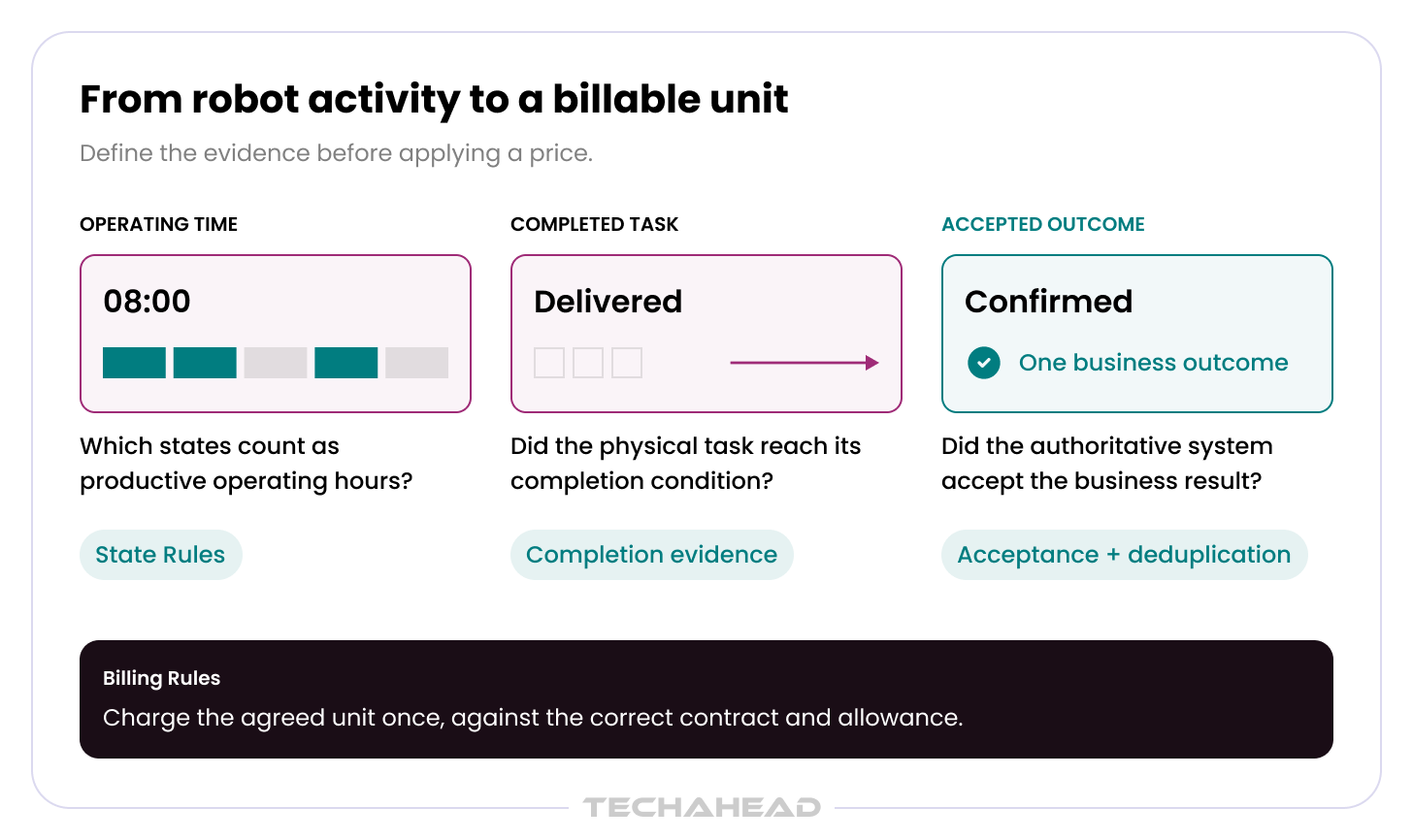
Robot usage metering begins with durable identity and an agreed event schema. Each record needs enough context to establish:
For customer attribution, resolve the assignment applicable when the work occurred. Link configuration changes that alter a metric’s meaning.
A robot may finish a transport task while the warehouse management system records an exception at the destination. Decide which system establishes acceptance and how the two records join. For our contract, the business delivery becomes billable only after the required confirmation arrives. An unresolved delivery remains pending.
Must Read: Humanoid Robots in Warehouses: Software Stack Guide
Hourly billing needs equally specific boundaries. Tutor Intelligence’s published pricing rules, reviewed in October 2026, start billable robot time when an operator starts a job, measure that time to fractions of a second, and specify a minimum of 80 hours per month. Implementing those terms requires both a job-time meter and a minimum-charge rule. Other usage based pricing models meter usage based charges such as API consumption, for example $0.002 per API call, which is why subscription creation and the billing cycle must be defined precisely. The bill cannot be reconstructed from a powered-on counter alone.
To prevent duplicate charges in robot usage billing, assign stable identifiers and apply deduplication at the event and business-outcome levels. Transport retries should not create additional usage. A robot retrying a failed delivery should retain the original business relationship so the acceptance rule determines whether one outcome or several distinct units exist. Done well, automated systems reduce manual intervention and manual data entry when reconciling retries and recovered events.
Design connectivity recovery around the evidence that must survive:
A monotonic controller counter can provide a useful cross-check, while customer acceptance may depend on a downstream record. Keep raw evidence separate from the auditable usage records derived from it. This separation also helps prevent billing errors and manual errors during later corrections by limiting unnecessary data entry. Record the qualification rule version and retain correction history so finance can reproduce a billed quantity after operational totals change.
Where fleet integration is still evolving, our guide to multi-site robot fleet management software explains the operational identity and event handoffs that this commercial layer relies on.
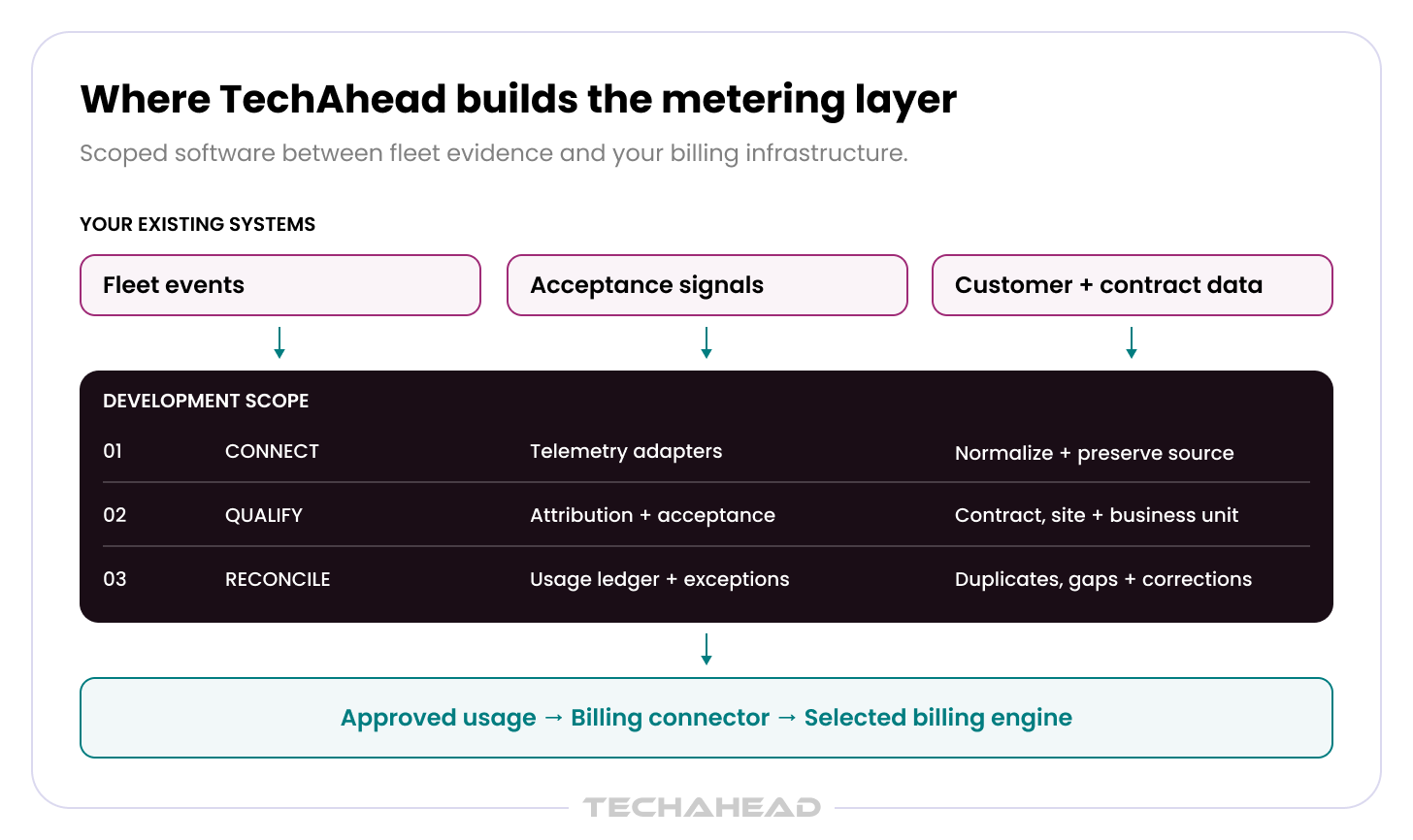
Robot telemetry billing integration needs clear ownership. Your fleet management system supplies operational events; the commercial layer qualifies them against customer and contract context; your selected billing infrastructure rates usage or receives approved charges, according to the agreed architecture. For B2B companies, automated billing systems provide the layer that streamlines the revenue cycle from invoice creation through payments.
Through our RaaS management platform development services, we can scope that connection around your existing systems. Depending on the gaps, our software work can include:
The output is an inspectable usage ledger with a defined route to finance. The qualification rules depend on the service you sell:
We would specify these differences before designing shared metering components. Each new workflow should have a testable definition of billable work. Unlike accounting software, specialized automated billing software is built for recurring billing and usage-based operations.
Our RaaS billing integration scope also establishes tenant isolation, service credentials, authorized updates, and recovery behavior. A failed connector should preserve pending records and expose an owner. Replaying a submission should produce the same intended financial result.
Discuss your telemetry sources and current reconciliation steps with us. We can identify which adapters, mappings, and metering rules a first production workflow needs.
Robot uptime monitoring provides evidence, but its headline percentage may not match the SLA. Establish the covered function, measurement scope, eligible service time, and approved exclusions. A robot undergoing repair may be unavailable while a replacement maintains workflow availability.
Check what the source metric actually includes before using it for credits. AutoStore distinguishes system availability from recovery uptime: its recovery metric counts error stoppage time from the start of resolution work, while system availability reflects whether the system is active. An SLA covering the whole interruption needs evidence from the beginning of that interruption.
Selecting the metric is therefore part of implementing the agreement. In modern platforms, this also helps preserve unified data between operational uptime evidence and financial data so SLA reporting is explainable.
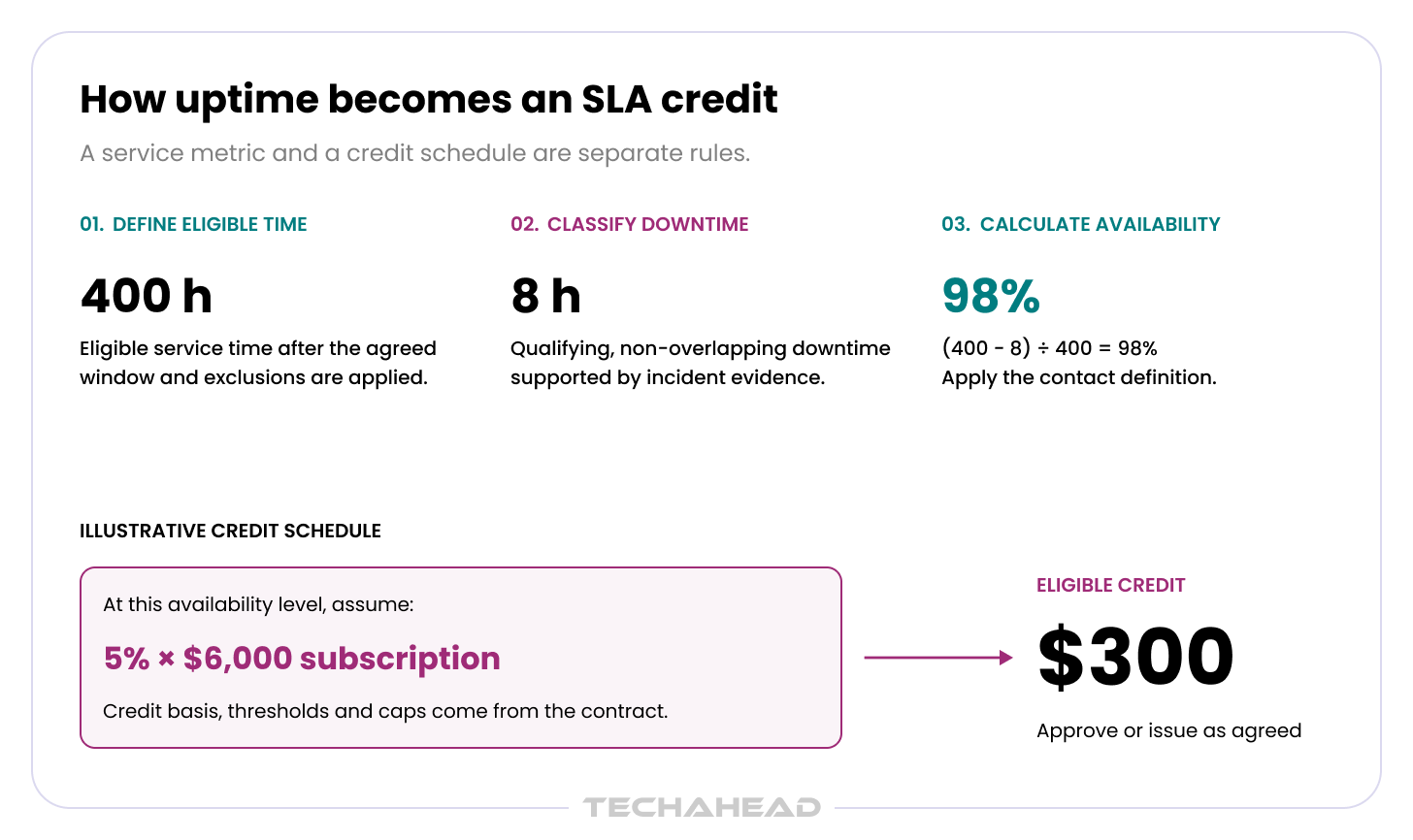
For an SLA measured over eligible service hours, a possible calculation is: Availability = (eligible service hours − qualifying downtime) ÷ eligible service hours. |
Build the two inputs from agreed rules:
Keep those decisions inspectable alongside the calculated availability to support stronger financial management and better cash flow visibility when service evidence and commercial records stay connected.
Effective RaaS SLA credit automation works as part of a single platform that connects SLA credits to the entire process of billing and revenue treatment. Configure the breach threshold, credit eligibility, affected fee basis, credit cap, and approval requirements. If several commitments are missed, the agreement must establish whether remedies accumulate.
For our illustrative contract, the calculation is:
Automated invoicing and credits also support more predictable cash flow by reducing delays and keeping adjustments tied to approved evidence.
Response-time and restoration commitments need their own clocks and evidence. A fast acknowledgement does not establish timely restoration. Keep RaaS SLA credits linked to incident records, classification decisions, and the contract version that authorized them.
For automated credit issuance, the agreement and approvals must permit it. Otherwise, automation can prepare an evidence-backed calculation for review. Unknown incident responsibility should remain visible rather than silently becoming an exclusion.
A replacement asset can take over a service entitlement while the subscription continues. To manage robot replacements without duplicate billing, close the old asset assignment and activate the new one at explicit effective times. Retain both histories under the applicable contract line.
The system should recognize temporary overlap during commissioning without charging twice unless the contract authorizes additional capacity. Controller resets also need an attributable before-and-after record. An identity change must not erase earlier usage or automatically restart the allowance.
RaaS contract management should preserve approved versions. Store when a change was approved separately from when it becomes commercially effective. Late telemetry must resolve against the terms applicable when the activity occurred.
Multi-year fleet commitments make these records particularly important. Agility Robotics’ October 6, 2026 investor presentation describes orders, as of May 2026, for 1,000 Digit 5 robots under a three-year RaaS contract, subject to contractual milestones.
A billing platform supporting a commitment of that kind needs to distinguish ordered capacity, activated services, and the periods each entitlement covers. Deployment progress and subsequent amendments must reach the commercial record. Many enterprise SaaS companies also rely on hybrid pricing models, which makes effective-dated amendments and version control essential as the business model evolves.
For mid-cycle RaaS contract amendments, resolve four questions before publishing the change:
Our RaaS billing platform development scope can implement the contract version model, entitlement transitions, pricing rules, credit approvals, and adjustment history. We connect these controls to the selected billing engine and customer portal so the invoice and supporting explanation use the same approved records, helping the finance team avoid manual workarounds as billing complexity grows.
We would build the controls around the people accountable for those decisions:
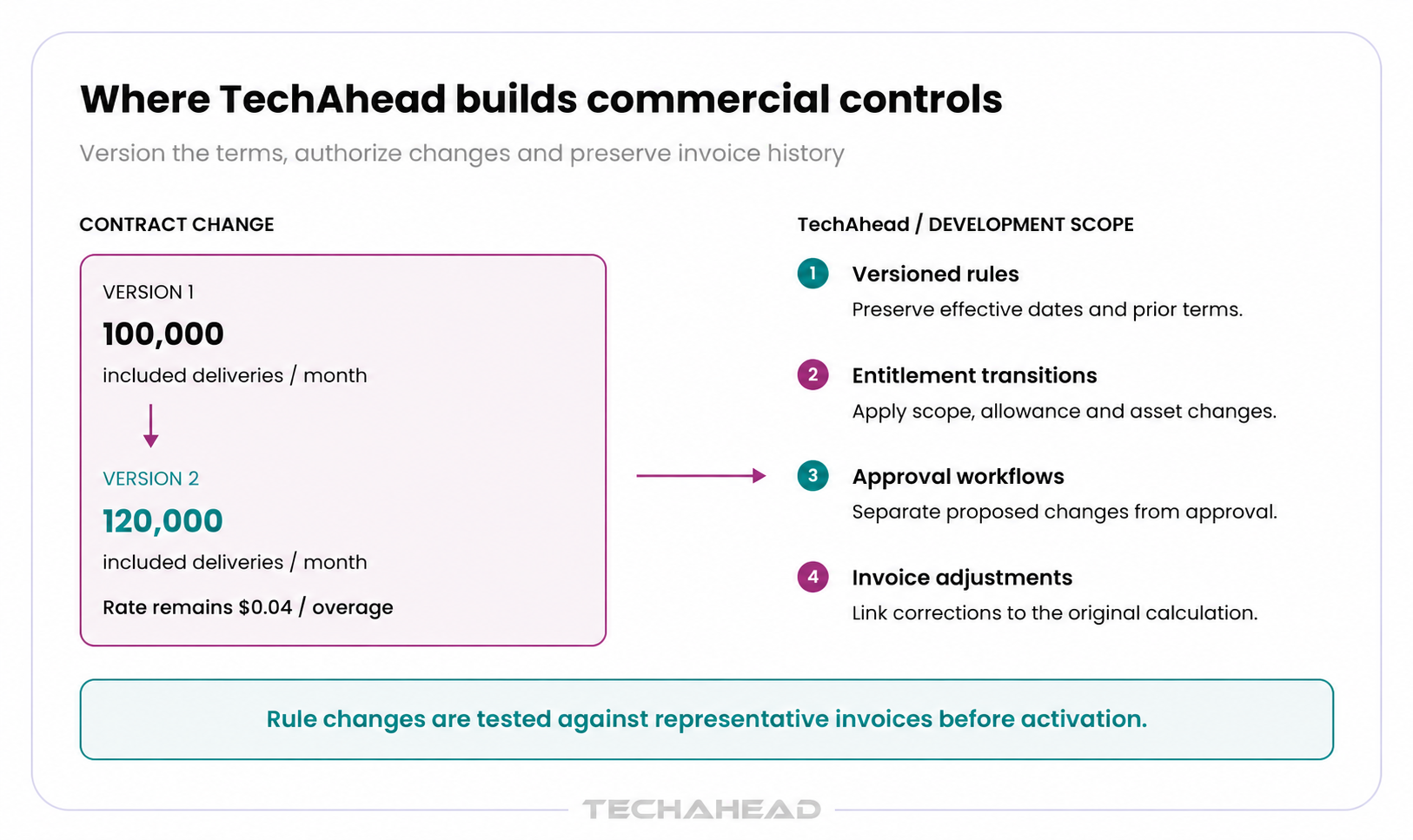
Validate rule changes against historical examples and future-dated scenarios. These commercial controls give your metering records a stable set of instructions to bill against.
Give the billing system an explicit input contract: approved quantities or rated charges, customer and contract references, billing period, rule versions, and evidence references. Choose which rating engine applies prices so two systems do not independently apply an allowance or discount. Define the billing API’s acknowledgment and rejection behavior before release. This supports automated invoicing by generating draft charges from approved records, which reduces manual errors, saves time for the finance team, and avoids manual data entry.
For our example, 140,000 accepted deliveries exceed the amended allowance by 20,000 units. The invoice calculation becomes:
Faster, cleaner invoice generation can also improve cash flow by reducing Days Sales Outstanding.
Each invoice line item should show its calculation basis, including the amended allowance used to determine overages.
RaaS invoicing automation should retain line-level links to usage aggregation, contract amendments, and service credits. An invoice approval workflow lets finance inspect the draft; the customer can inspect the relevant supporting evidence. Restrict access by account, site, and role.
Connect approved invoice records with your ERP integration and reconcile identifiers and posting status. CRM integration maintains commercial context, while webhooks carry financial state changes back to the platform. Keep billing, collections, and revenue recognition as distinct processes with explicitly assigned system ownership, and sync with accounting software so financial data stays consistent.
For RaaS billing reconciliation, distinguish accepted telemetry from usage included on an invoice, because if late or missing evidence is not handled in a controlled way, it can create revenue leakage; Stripe’s Billing Meters documentation notes that events accepted after finalization may appear in meter summaries without updating the finalized invoice.
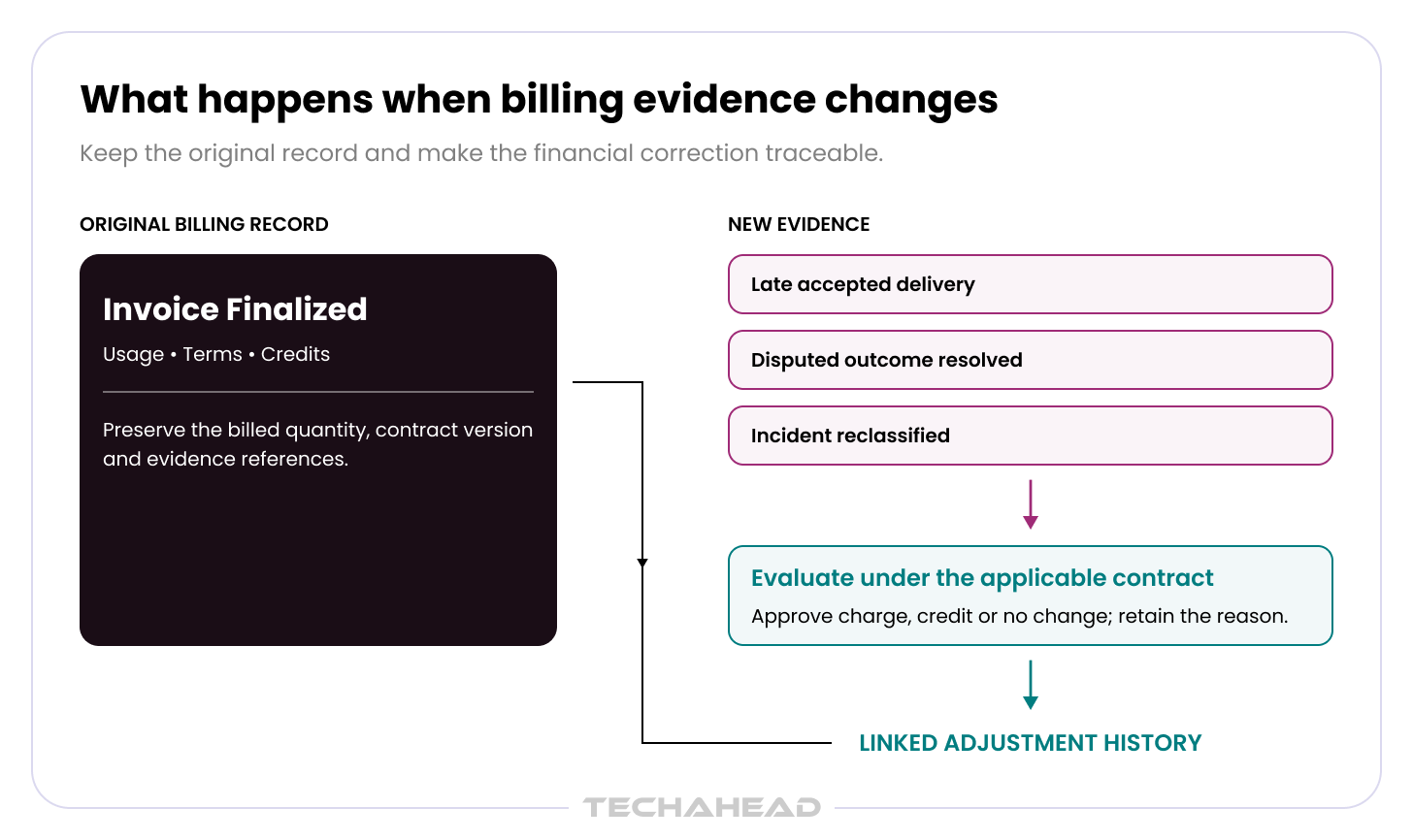
Define a billing cutoff and route later evidence to a controlled decision:
Preserve links between the original invoice, revised evidence, and financial decision. Show the follow-up owner for unresolved gaps. A disconnected robot may still have completed work locally; the correction process needs to establish what happened before changing the charge.
To validate automated RaaS billing before launch, run shadow invoices against representative contracts and compare every component with approved reference calculations. Include different outcomes, service windows, rate changes, and site assignments.
| Injected condition | Expected behavior | Evidence to retain |
| An accepted delivery event repeats | One chargeable business outcome | Duplicate decision and original identifier |
| Offline usage arrives late | Correct service period and terms | Event time, arrival time, and rating version |
| An SLA incident overlaps another | No duplicated qualifying downtime | Merged intervals and classification history |
| A robot is exchanged | Continued entitlement without unintended overlap charges | Effective-dated assignments |
| An amendment changes the allowance | Approved allowance applied once | Version, effective period, and calculation |
| Evidence changes after invoice close | Authorized adjustment workflow | Original invoice and correction references |
Agree release criteria before reviewing the first shadow invoice. Measure reconciliation variance, unresolved exceptions, duplicate rejection, credit accuracy, invoice correction frequency, and time to close against tolerances your teams approve.
The pilot also needs operating ownership. Assign missing evidence to someone who can investigate it, disputed downtime to an authorized reviewer, and rejected submissions to an integration owner. Rehearse those handoffs before another customer or region joins. Calculation accuracy and dependable exception resolution must both be demonstrated.
The same commercial record can inform renewal review and account health, and reconciled billing data can also support recurring revenue analysis and more reliable cash flow planning during renewals and expansion decisions. An account approaching its allowance may need a higher commitment or added fleet capacity. Falling usage alongside repeated incidents may signal renewal risk and require a service recovery conversation before a renewal proposal.
Use the commercial record to answer specific account questions:
Compare those measures by account and site. Distinguish a change in customer demand from a capacity or service problem before recommending expansion.
If a fleet expansion changes service windows, robot assignments, or rates, feed the approved change back into the entitlement and contract model. That closes the connection between operations, billing, renewals, and subsequent contract amendments.
Our approach to Robotics-as-a-Service billing automation begins with the decisions your software must execute. We map a representative contract to fleet events, acceptance signals, incident records, and finance interfaces, then identify the components to configure, integrate, or develop.
Existing billing infrastructure may already support usage rating, subscriptions, taxes, invoice generation, and for global deployments, multi currency, global tax, or international transactions. We assess those capabilities alongside your robotics requirements to decide what to configure, what to connect, and where custom development is justified. That assessment establishes a delivery scope your engineering and finance teams can review together.
For custom RaaS billing and metering platform development, a scoped engagement can deliver:
TechAhead brings AWS Advanced Tier Services Partner status, AWS Cloud Operations Competency, and ISO/IEC 27001:2022 certification to this work. We apply relevant cloud engineering and delivery practices to the agreed scope, including access controls, integration monitoring, change management, and recovery procedures.
Bring one representative agreement, sample robot events, your SLA definitions, and a current invoice to scope your RaaS management platform with TechAhead. We can establish what your existing systems support, where software changes are needed, and what the pilot must prove before billing goes live.
Connect with us today to turn your robot usage, uptime, and SLA data into accurate, traceable billing. Let’s build a RaaS billing workflow that supports your contracts, customers, and growing fleet.
TechAhead can connect fleet telemetry with entitlements, accepted usage, and contract rules. RaaS billing automation then applies pricing and eligible SLA credits, reconciles exceptions, and sends approved billing records to invoicing systems with supporting evidence.
A RaaS billing and usage metering platform should include contract records, entitlements, telemetry ingestion, usage qualification, SLA rules, reconciliation, invoicing integrations, and adjustment history. Other key features should cover automated payment collection and compliant revenue recognition, while customer evidence and renewal insights remain connected to those records.
Capture robot identity, customer and site assignments, event timestamps, operating states, task completion, and acceptance confirmations. Robot usage metering should distinguish productive time, failed attempts, and accepted outcomes using definitions agreed in each customer contract.
Define the acceptance conditions for each billable unit and identify the system authorized to confirm them. Outcome-based robotics billing should preserve task identifiers across retries and apply explicit rules for failed, partial, canceled, or reworked tasks.
Measure availability against contracted service windows, qualifying downtime, and approved exclusions. RaaS SLA credit automation then applies the relevant threshold, fee basis, and credit cap, with approvals and incident evidence retained for customer and finance review.
Yes. TechAhead can develop RaaS billing integration around existing fleet platforms, CRM, ERP, and billing systems. The implementation defines record ownership, identifier mapping, approved data exchanges, retry behavior, and reconciliation either through a single platform or across connected operational and financial interfaces.
Buffer events durably where supported, exclude duplicates from billable quantities, and reconcile missing records before invoice approval. Attribute delayed usage to its service period and contract version, with unresolved evidence assigned to an accountable owner.
Separate the customer’s service entitlement from individual robot identities. Record effective dates for outgoing and replacement assets, preserve historical usage, and apply agreed overlap rules. A replacement should continue the subscription without unintentionally restarting allowances or charges.
Store approved amendments with effective dates, affected services, and explicit allowance, rate, and proration rules. RaaS contract management should apply the correct version to each service period while preserving earlier calculations and the authorization behind changes.
Implement customer and site isolation, role-based permissions, encryption, retention policies, and controlled contract changes. Map these controls to applicable privacy, contractual, and audit requirements, including protection of sensitive financial data, with documented ownership and evidence showing how they operate across connected systems.
Retain source events, accepted quantities, contract versions, pricing rules, SLA calculations, approvals, and adjustment history. An auditable usage ledger should connect each invoice line to its evidence, allowing finance and customers to investigate discrepancies consistently.
Preserve the finalized invoice and evaluate new evidence against the applicable contract. RaaS billing reconciliation should route approved changes into linked credit notes, supplemental charges, or other supported adjustments, retaining the reason, authorization, and calculation history.
Yes. A RaaS billing and usage metering platform can connect allowance utilization, accepted outcomes, service credits, and unresolved disputes with account reviews. These signals help teams assess renewal readiness, service interventions, and potential fleet expansion.
TechAhead can start with contract and telemetry mapping, then implement a representative workflow and run shadow invoices. Validation should cover duplicates, offline events, amendments, SLA credits, corrections, and support for recurring billing as subscription businesses scale, against agreed operational and financial acceptance criteria.
Define account hierarchies, allowance pooling, and SLA scope in the contract model. Attribute usage and incidents to the correct site, then consolidate only as agreed. Preserve site-level evidence so centralized invoices remain explainable across customer locations.
We use cookies to ensure our website functions properly, improve performance, and provide a personalized experience. You can choose which types of cookies to allow below.
Required for core functionality such as security, network management, and accessibility. These cannot be disabled.
Help us understand site traffic and user interactions so we can improve performance and usability.
Enable enhanced functionality and personalization such as language or region preferences.
Used to deliver relevant ads, track campaign performance, and measure advertising effectiveness.