


 Copy Link
 Share on X
 Share on Facebook
 Share on LinkedIn
Always Active
Required for core functionality such as security, network management, and accessibility. These cannot be disabled.

Uncover the transformative potential of digital and mobile solutions for your industry.





 Last Updated: Oct 12, 2026
Oct 12, 2026
Last Updated: Oct 12, 2026
Oct 12, 2026  26
26  20 min. Read


Key Takeaways
Your AMRs may work reliably inside each warehouse while your support team still struggles to answer basic questions across the fleet. Which robot belongs to which customer? Has a delayed transport task completed? Who can intervene? Which sites can accept the next software release?
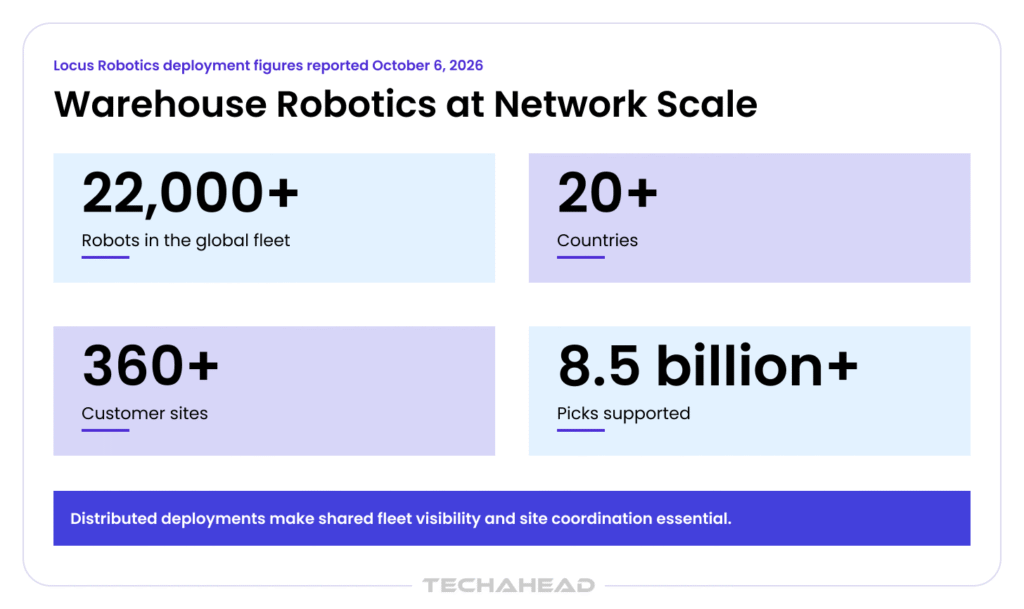
The scale of deployment makes those questions consequential. In its October 6, 2026 announcement, Locus Robotics reported a fleet exceeding 22,000 robots, supporting customers across more than 360 sites in over 20 countries. Its robots had supported more than 8.5 billion picks.
Building multi-site robot fleet management software means connecting those operations without making every warehouse depend on a distant service for local execution. You need shared identity, trustworthy mission status, accountable intervention, controlled releases, and integrations that survive real operating conditions.
This guide explains how to build that robot fleet operations platform around your existing AMRs and local fleet managers, then validate it before expanding to another warehouse.
Recommended: Build vs Buy: Robot Fleet Management Software
Begin with warehouse work. A replenishment request, a pallet transfer, and a robot-assisted picking task have different completion conditions. Your platform must preserve those distinctions while presenting a consistent operational record across sites.
For multi-site AMR fleet management, define six requirements:
Agree on throughput, cycle time, robot utilization, and recovery measures before building dashboards, with efficiency and productivity treated as explicit cross-site goals for these solutions. A busy robot is not necessarily completing useful work. Compare sites using consistent definitions and account for different workflows, layouts, and operating hours.
By 2026, over 50% of companies are expected to use multi-agent orchestration platforms to support efficient management of large fleets across sites.
Define the decisions each operational view must support: diagnosing a deployment, recovering blocked work, or comparing performance across warehouses, while analytics can also benchmark energy consumption across sites. These views can share data without sharing every permission. Establishing those requirements early prevents the first dashboard from becoming the architecture by default.
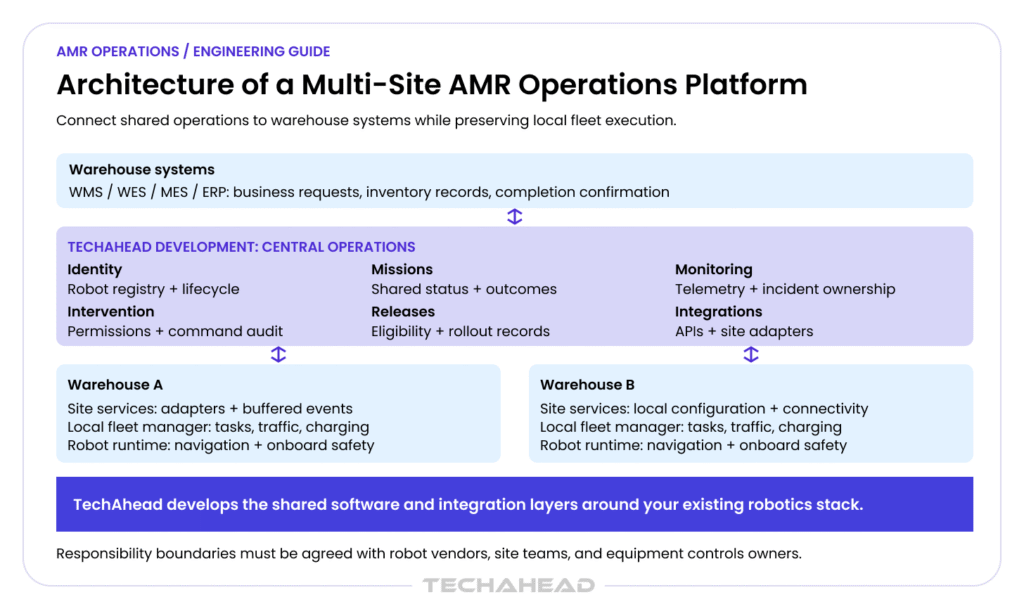
Your robot fleet management architecture should establish responsibility before selecting technologies. For multi-site deployments, the architecture choice should reflect how modern fleet management systems divide responsibilities across cloud, edge, and local control. Cloud and edge architecture for AMR fleet management requires clear decisions about what continues when the connection between them fails.
| Layer | Responsibilities | Engineering boundary |
| Warehouse systems | Orders, inventory, replenishment, business confirmation | Preserve the warehouse system’s authority over its records |
| Central operations platform | Registry, cross-site visibility, incident workflows, access, release coordination | Coordinate operations across sites |
| Site integration and edge services | Adapters, event buffering, local connectivity, reconciliation | Connect central services to site conditions |
| Local fleet manager | Supported task dispatch, traffic coordination, charging, execution status | Retain vendor-specific execution responsibilities |
| Robot runtime | Navigation, sensing, motion, onboard safety functions | Respect the existing robot and safety stack |
The OTTO Fleet Manager reference makes the local workload concrete: job allocation, opportunistic charging, congestion management, enterprise APIs, and PLC connectivity. The central layer provides full visibility across sites without replacing local execution. Your central platform should consume the relevant status and expose supported workflows without introducing a competing traffic controller.
Assign an authoritative source for each record. The WMS may own the business order, the local fleet manager the execution state, and the cloud platform the cross-site incident workflow. In a connected platform, multi-site software also reduces fragmented data silos and maintenance overhead. Document how conflicts are resolved and which system may initiate each action. This prevents two services from independently retrying, cancelling, or reassigning the same work.
Must Read: Building the Software Layer for Tote Handling, Fleet Orchestration, and WMS Integration
For TechAhead, robot fleet operations software development focuses on the shared registry, mission records, dashboards, authorization, release workflows, and integration services around that existing execution stack. This specialized software should integrate with other systems, and standardized releases across sites reduce maintenance overhead and support uniform performance.
Multi-site does not automatically mean multi-vendor. Start with the fleet managers your customers already use; introduce vendor adapters and heterogeneous fleets when there is a demonstrated requirement, including a mixed fleet with mobile robots and autonomous vehicles only when the deployment actually includes them.
VDA 5050 fleet integration can support standardized communication with compatible robots or controllers. VDA announced version 3.0 in April 2026, extending support for freely navigating robots, and interoperability also matters in warehouse operations where manual vehicles must share space. Confirm the actual versions and capabilities each vendor implements.
Open-RMF supports interoperability between fleets and infrastructure such as doors and elevators. In mixed environments, mobile robotics can use Laser SLAM technology to localize vehicles in real time, but the interface selected should match a defined responsibility.
How do you manage robot identity across multiple sites when units are replaced, reassigned, or temporarily serviced? Separate persistent identity from display names and network addresses.
Build a robot registry that preserves the information needed to identify, operate, and service each unit:
Device provisioning should establish trust before telemetry or commands are accepted. Cybersecurity threats complicate mobile robot fleet management across sites, which is why strict identity controls matter. The robot lifecycle should include activation, reassignment, credential rotation, retirement, and revocation.
A robot moved between warehouses needs a controlled transition: close or reconcile outstanding work, change permissions, apply the destination configuration, and preserve historical records under the previous site.
Site permissions must also distinguish local operators, OEM support, customer administrators, and service partners. Where the OEM serves multiple customers, enforce tenant isolation in APIs, event subscriptions, storage, and exports. A filtered dashboard alone is insufficient.
Use configuration templates for shared settings and controlled overrides for site-specific endpoints, operating windows, supported workflows, and mapped engine data from integrated equipment or vehicles when available. Detect configuration drift against the intended version. TechAhead’s robotics cybersecurity and device identity services provide a relevant development scope for identity, access, update, and audit controls.
For example, two warehouses might both call a destination “Receiving 1.” Scope that name to the correct customer and site, and map it to the local fleet manager’s endpoint identifier. A copied configuration should not silently send an order to an unrelated location. Version the mapping and validate it during site onboarding, especially when layouts, workstations, or customer systems change.
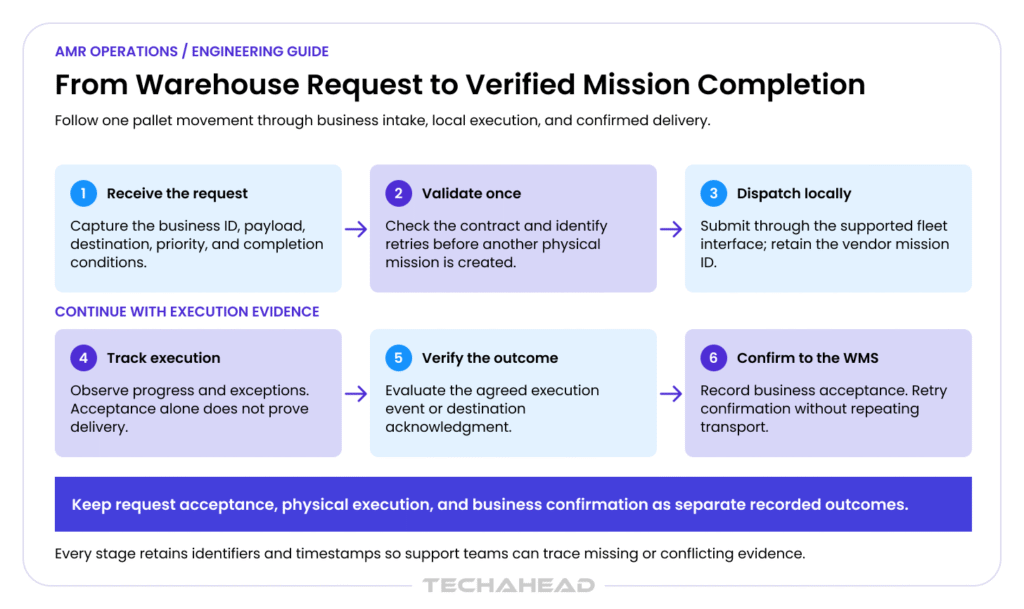
Consider a WMS request to move a pallet from receiving to a replenishment station. The central platform validates the request, passes it through the supported local interface, tracks execution, and returns completion information to the WMS.
AMR WMS integration needs an explicit contract. Define the following before connecting the systems:
Normalize job status into a shared mission lifecycle while preserving the original vendor state for diagnosis. Distinguish received, accepted, executing, interrupted, completed, and failed states according to the supported workflow. Real time tracking improves visibility, but it should not be treated as proof of completion.
Duplicate-request protection matters when a warehouse system retries after a timeout. Record the original request and return its existing result rather than dispatching the same pallet movement twice. Mission acknowledgment confirms acceptance; it does not establish physical completion.
Also define what cancellation means at each stage. Before dispatch, a request may be withdrawn centrally. After execution starts, the local manager may accept a cancellation, defer it, or require a supported recovery action. Preserve that response rather than immediately displaying “cancelled.” The warehouse team needs to know whether the pallet remains at its source, is travelling, or has reached a destination.
After execution, verify the agreed evidence: the vendor’s completion event, destination equipment acknowledgment, or, where site workflows depend on location confirmation, gps tracking as supplemental evidence. Track whether the WMS accepted the result. If that final integration fails, retry the business confirmation without repeating the physical mission.
When integrating AMR fleet management with WMS, extend the same discipline to WES, MES, ERP, and PLC interfaces. API adapters should translate contracts, preserve identifiers, expose errors, and may also exchange data with other systems for broader operational confirmation, including real time gps tracking where needed. Use OPC UA where the equipment interface supports it; establish equipment-level interlocks with the responsible controls team.
TechAhead’s robotics AI, data, and integration services cover event integration around existing robot systems. Each connection needs ownership, versioning, and a recovery procedure.
To monitor AMR fleets across multiple warehouses, combine robot telemetry with mission context and site conditions to improve asset utilization and site-level productivity. Battery status alone cannot tell you whether replenishment is falling behind.
Useful robot fleet monitoring combines several signals:
Mark stale data explicitly; an old location should not appear current. When monitoring includes maintenance signals, predictive maintenance can extend hardware lifespans by preempting breakdowns.
Manage robot fleet alerts across multiple sites by routing them according to impact and ownership. A blocked replenishment mission may require immediate local action; an intermittent sensor warning may need planned investigation. Incident triage and alert escalation should identify the responsible team, affected work, and next action.
For operational observability, align event timestamps and distinguish event time from ingestion time. TechAhead’s robotics data platform and fleet analytics services are relevant to governed pipelines and consistent metrics across sites.
Make performance definitions inspectable. For a transport mission, measure waiting time separately from travel and destination handoff. Otherwise, a slow conveyor acknowledgment can appear to be a robot navigation problem. Retain the underlying events so teams can investigate a reported delay. Where data is missing, show the gap rather than producing a misleadingly complete performance score.
Remote intervention for warehouse AMR fleets should use supported actions with defined preconditions. Begin with diagnosis, acknowledgment, or mission recovery; enable direct remote control only where the robot, network, site procedures, and safety design support it.
Build robot fleet remote intervention around four controls:
Record the operator, reason, target, command expiry, acknowledgment, and observed outcome in an audit trail.
If a command times out, investigate its state before retrying. Where remote recovery cannot resolve a physical problem, assign a local response. Intervention records should also support maintenance workflows when a remote fix becomes an on-site service task. A dispatch workflow can connect to robotics field service management software when technicians, parts, and service evidence are required.
Consider an OEM support engineer and a warehouse operator attempting recovery simultaneously. The intervention workflow should identify the active owner and reject incompatible commands. A lost support connection must not leave an indefinite lock; define session expiry and local handover. Record the transition so the next operator or field crews can understand which actions were attempted and which outcomes remain uncertain.
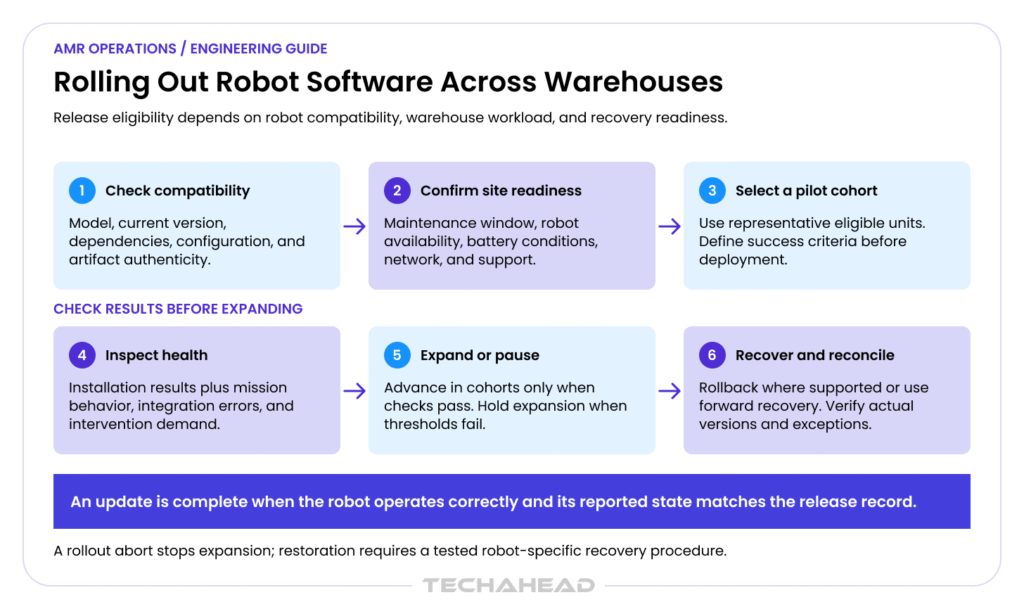
Deploying OTA updates to robot fleets across sites requires more than selecting every online unit. A robot may be executing work, running an incompatible dependency, or connected through a site with limited recovery support, and eligibility may also depend on whether equipment is properly maintained before update rollout.
For robot fleet OTA updates, assess eligibility before scheduling deployment:
Automated maintenance alerts or automated maintenance reminders should not conflict with release windows or recovery plans.
Define release cohorts by relevant compatibility, operational characteristics, and maintenance scheduling.
Use canary deployment on a suitable pilot cohort, then staged rollout across eligible sites. Check installation results alongside mission success, integration behavior, intervention rates, and resource use. Specify the conditions that pause expansion.
AWS IoT Jobs documentation describes rollout, abort, timeout, and retry controls. Those controls can support deployment orchestration, but your robot update implementation must still define recovery and rollback behavior.
Rollback needs a compatible prior artifact, configuration, and data state. For irreversible changes, plan a forward recovery path. Compare intended and reported versions after deployment, and retain exceptions in the release record.
A pilot at one quiet warehouse does not demonstrate readiness for every site. Choose cohorts that cover relevant hardware generations, interface versions, and operational patterns. A site using a different PLC adapter may need its own integration check even when the robot package is identical. Keep a release eligible for one warehouse while holding another until its dependency is resolved.
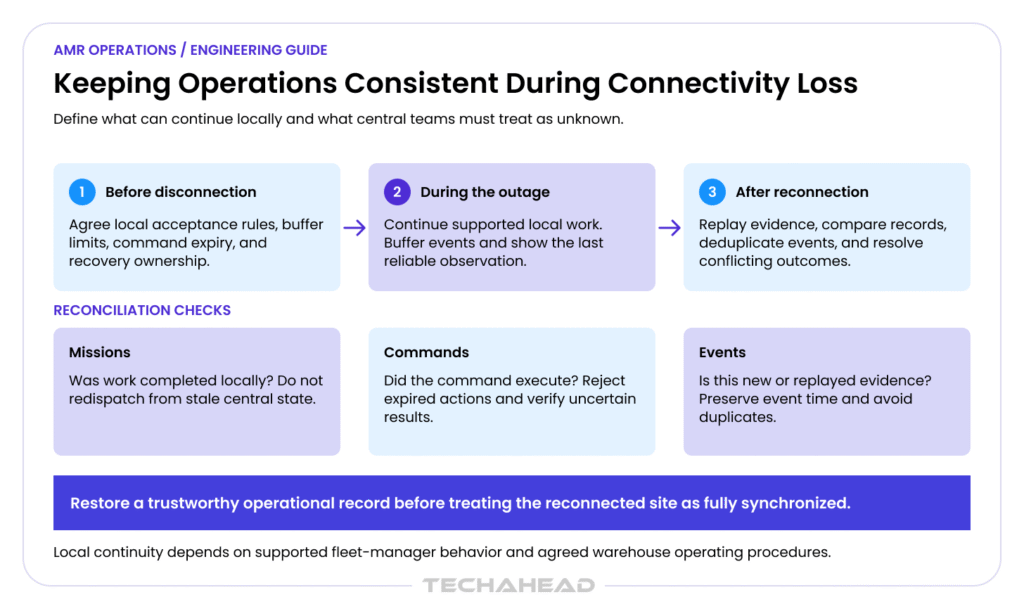
How do you keep AMR operations running during network outages? Specify the degraded operating mode before implementation.
Where supported, the local fleet manager can continue accepted work during a cloud outage. A site edge gateway can buffer events and retain approved local integrations. Define which new work may be accepted locally and which actions require central connectivity.
Offline operation also changes what central operators can trust. Show the last reliable observation and connection status. Prevent remote commands from silently accumulating for execution after their operational context has expired.
On reconnection, state reconciliation should compare buffered events, local execution records, and central mission records. The recovery workflow should:
A completed local task must not be redispatched simply because its completion arrived late.
Track unresolved outcomes until evidence establishes what happened. Event buffering and reconnection are useful only when recovery restores a trustworthy operational record.
Buffer capacity and retention need explicit limits. If an outage exceeds them, identify the resulting evidence gap and use a defined recovery process. Where a warehouse has allowed new local work during disconnection, synchronize those mission identifiers before accepting overlapping central requests. Connectivity returning is a transport event; operational recovery is a separate process that may take longer.
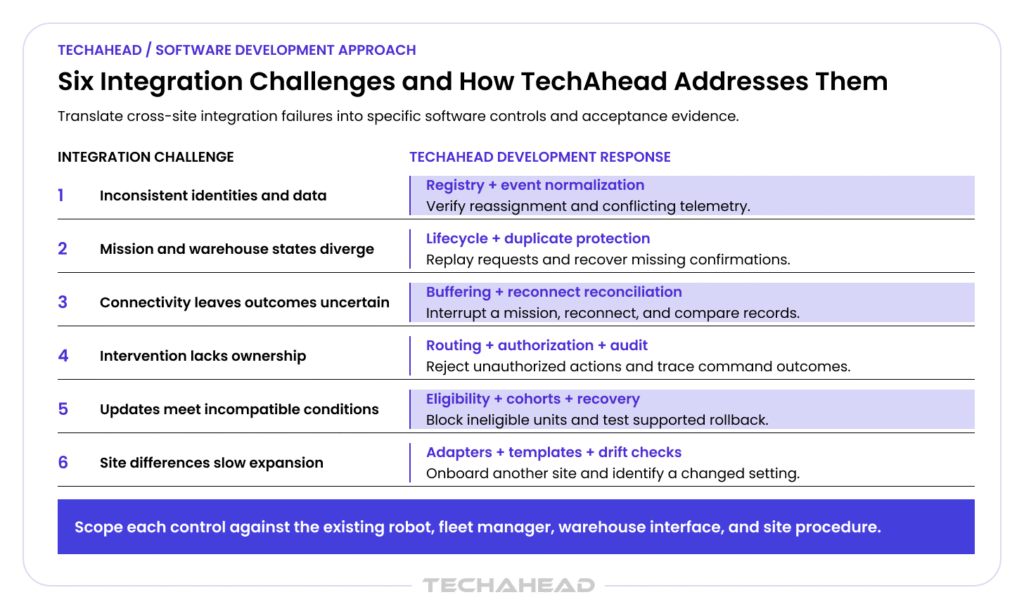
Custom robot fleet management software development must accommodate the interfaces and operating conditions already present at customer sites. These six problems should be addressed in the delivery scope, with evidence showing that the proposed controls work.
Different systems may identify the same robot differently or report incompatible status fields. This can break fleet history and produce misleading cross-site views.
TechAhead’s development approach:
A warehouse request can remain open after physical completion, or a retry can create duplicate work. The integration must recover without losing track of what the robot actually did.
TechAhead’s development approach:
Local work may continue while central records stop updating. Reconnection can then introduce delayed events, duplicate requests, and conflicting status.
TechAhead’s development approach:
An incident may remain unassigned, or two people may attempt incompatible recovery actions. Both problems make resolution harder to trace.
TechAhead’s development approach:
A software package may install correctly but fail against a warehouse’s adapter version, configuration, or operating workflow.
TechAhead’s development approach:
Repeated custom connectors and undocumented configuration changes make each warehouse harder to onboard and support.
TechAhead’s development approach:
TechAhead’s Robot Fleet Operations Software Development Services can scope these controls around your current stack. The delivery plan should identify dependencies on vendor APIs, robot runtime capabilities, warehouse equipment, and customer procedures before implementation.
Scaling AMR operations across multiple warehouses requires proof that shared software works under different site conditions. In its September 30, 2026 announcement, Geekplus reported more than 1,600 autonomous robots across two LPP Logistics sites. The deployment illustrates why expansion planning must accommodate local workflows and configurations. Future validation should also account for 5G technology improving connectivity for mobile robots.
For your warehouse robot fleet management platform, build acceptance checks around consequential failures:
Use simulation to assess material movement, layout constraints, congestion, and fleet sizing. AR and VR can also support immersive operational insights during validation and operator review. Combine it with hardware and integration tests that reproduce actual interfaces. Compare cycle time and throughput under representative workloads, without assuming every site should produce identical results.
Test combinations that cross system boundaries: the robot finishes while the WMS is unavailable; a release begins while a unit receives work; an operator loses access during an intervention session. These exercises reveal assumptions that isolated component checks can miss. Retain event traces, expected outcomes, observed behavior, and named owners for unresolved failures as the basis for site acceptance.
If ownership and procurement decisions remain unresolved, review build versus buy for robot fleet management software alongside this implementation plan.
Multi-site AMR fleet management software should help your teams answer what happened, who can act, and whether another warehouse is ready to join. Achieving that requires reliable contracts between business systems, central services, site infrastructure, and local execution.
Your first delivery scope can establish persistent identity, one verified mission workflow, actionable monitoring, and controlled intervention. Extend releases, recovery, and site onboarding against explicit acceptance criteria. Keep responsibilities and unresolved dependencies visible throughout robot fleet operations software development.
Discuss your warehouse interfaces, fleet managers, and expansion requirements with TechAhead. We can map the shared software layers, integration dependencies, and validation work needed to develop your multi-site robot fleet operations platform.
Bring a representative mission workflow so the discussion starts with the work your platform must support. Discuss your requirements with us today.
Multi-site robot fleet management software should centralize robot identity, mission status, fleet health, alerts, remote intervention, OTA releases, and site integrations. Local fleet managers retain supported execution responsibilities, while shared records provide consistent visibility across warehouses.
Yes, where supported interfaces are available. TechAhead develops the robot fleet operations platform around existing autonomy and fleet systems, adding shared mission visibility, access controls, alert workflows, release management, and enterprise integrations, including connections to other systems and telematics standards where customer environments require them, without replacing local execution.
AMR WMS integration should link business requests to mission identifiers, prevent duplicate execution, and verify physical completion before confirming warehouse outcomes. TechAhead can develop adapters and recovery workflows that preserve warehouse systems as authoritative records.
Accepted missions can continue locally where the fleet manager supports disconnected operation. Buffer events, flag stale telemetry, and expire unsuitable remote commands. After reconnection, reconcile execution records before retrying requests or reporting completion across the central platform.
Robot fleet remote intervention needs trusted device identities, customer isolation, site permissions, authenticated access, command authorization, session expiry, and audit trails. Use supported actions, prevent conflicting control, and verify execution outcomes while preserving local safety functions.
Robot fleet OTA updates require signed packages, compatibility checks, eligible release cohorts, maintenance windows, and staged deployment. Standardized update processes also support uniform performance across sites. Verify mission and integration behavior after installation, pause expansion when checks fail, and provide tested rollback or forward recovery for affected robots.
No. Multi-site AMR fleet management can use existing vendor APIs. VDA 5050 supports standardized job and status exchange for compatible implementations; assess supported versions and actions. Some environments may also rely on standards such as AEMP 2.0; Razor Tracking supports AEMP 2.0 Telematics Standard. Multi-site visibility alone does not require a mixed-vendor control system.
Assess ISO 3691-4 and ANSI/A3 R15.08 where applicable to the robot system and deployment. Maintain risk assessments, integration tests, access records, and change evidence. Fleet software supports traceability; robot and site safety still require separate validation.
Start with a representative warehouse mission and document interfaces, identity, permissions, failure scenarios, and acceptance criteria. TechAhead can map these requirements into a target architecture and pilot workflow before extending robot fleet operations software development across sites.
Test duplicate requests, interrupted connectivity, missing completion events, unauthorized commands, update recovery, and site configuration changes. Warehouse robot fleet management should pass agreed acceptance checks on representative hardware and integrations before another facility enters production.
We use cookies to ensure our website functions properly, improve performance, and provide a personalized experience. You can choose which types of cookies to allow below.
Required for core functionality such as security, network management, and accessibility. These cannot be disabled.
Help us understand site traffic and user interactions so we can improve performance and usability.
Enable enhanced functionality and personalization such as language or region preferences.
Used to deliver relevant ads, track campaign performance, and measure advertising effectiveness.