


 Copy Link
 Share on X
 Share on Facebook
 Share on LinkedIn
Always Active
Required for core functionality such as security, network management, and accessibility. These cannot be disabled.

Uncover the transformative potential of digital and mobile solutions for your industry.





 Last Updated: Sep 18, 2026
Sep 17, 2026
Last Updated: Sep 18, 2026
Sep 17, 2026  181
181  22 min. Read


Key Takeaways
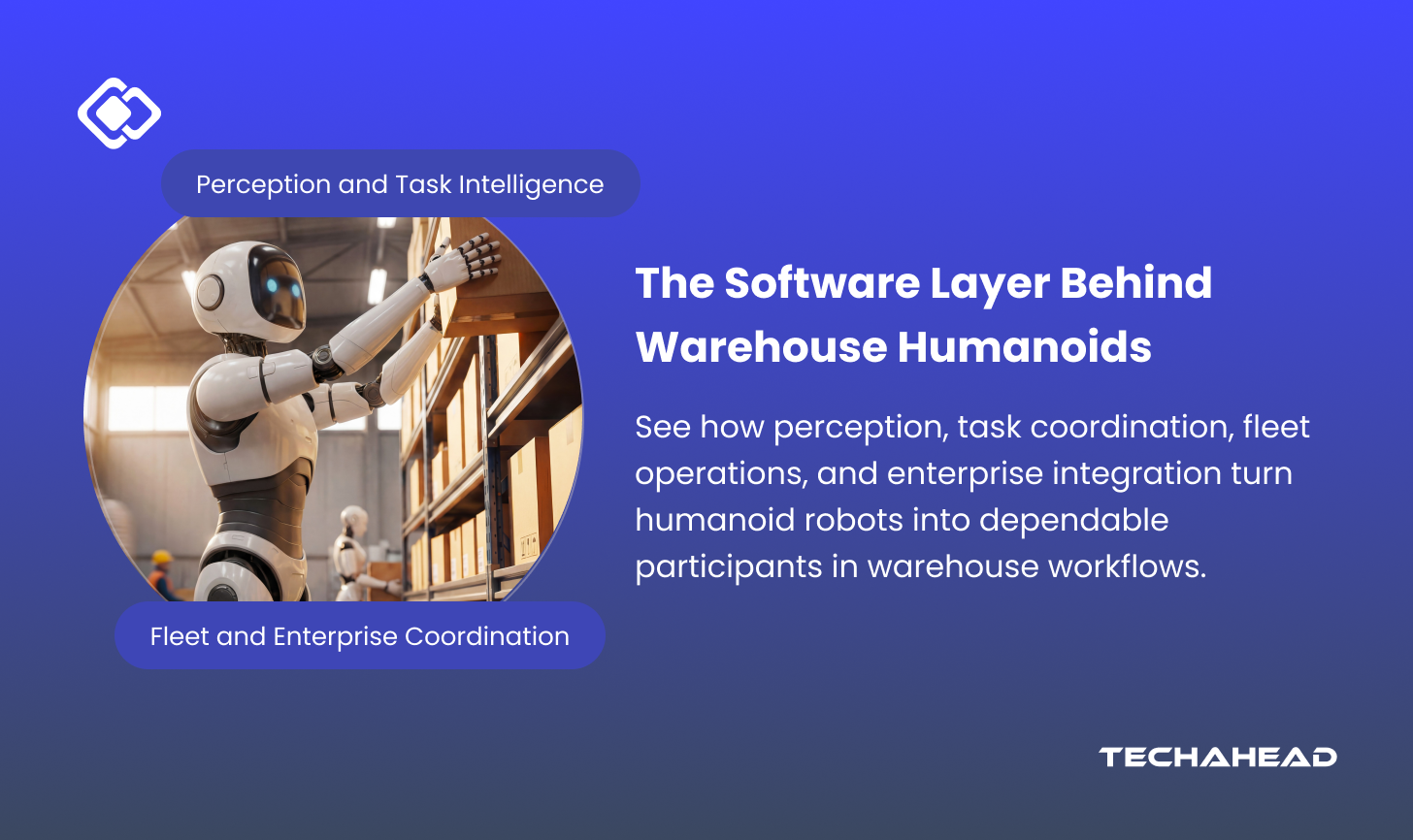
A humanoid carrying a tote makes for a compelling warehouse video. The harder work begins outside the camera frame.
Some system has to decide which tote should move, whether the robot can handle it, what route is available, and how the task fits around people, conveyors, autonomous mobile robots, and other equipment. Another system must confirm that the tote reached the right destination. If execution fails, an operator needs enough context to intervene without reconstructing the event from scattered logs.
This is where the commercial value of humanoid robots in warehouses will be decided. Locomotion, dexterity, and perception matter, but a capable machine can still become an isolated piece of equipment if it cannot participate in the operating model around it.
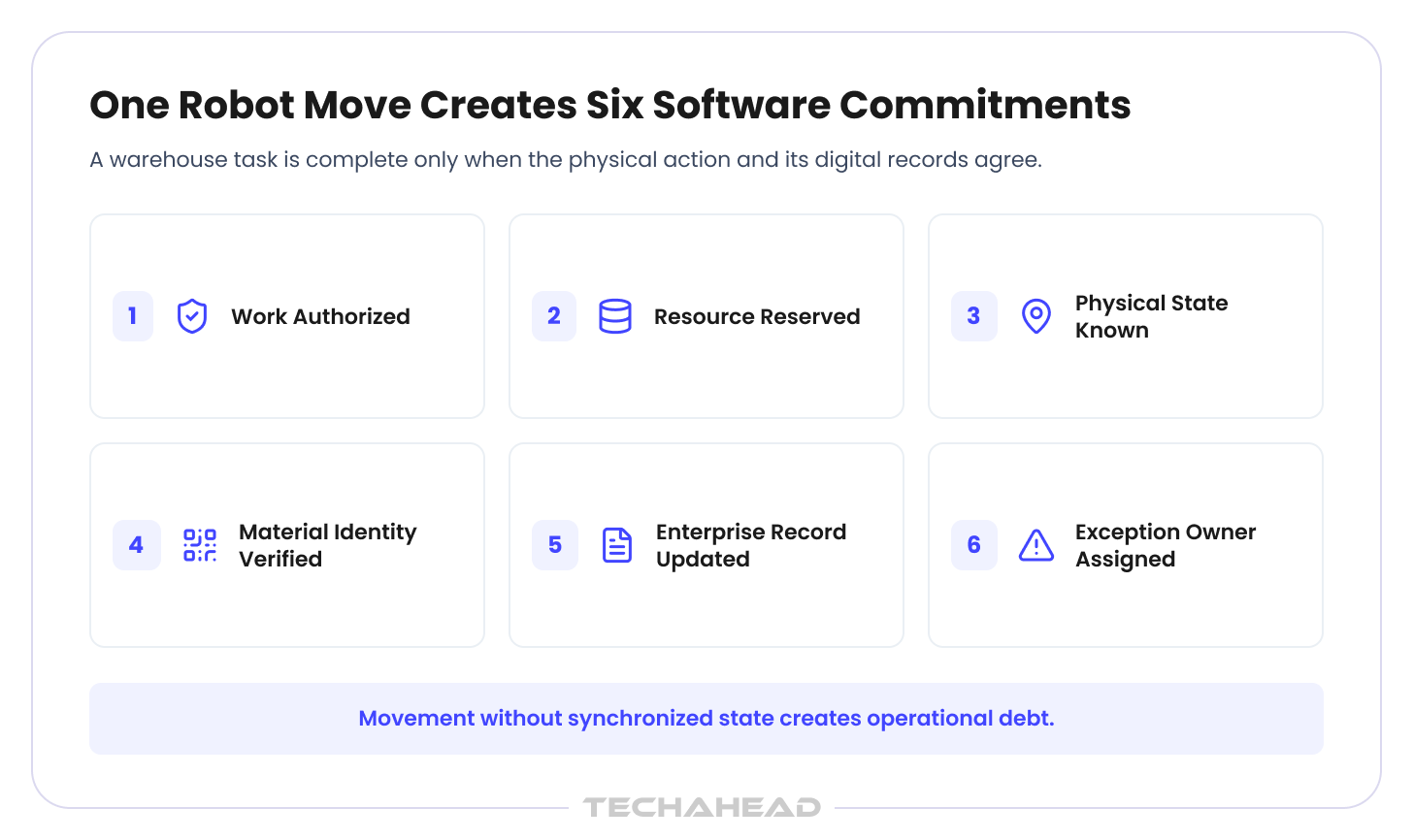
For humanoid robots in logistics, the software challenge reaches beyond the autonomy stack. It includes perception, deterministic safety boundaries, task orchestration, fleet operations, enterprise integration, telemetry, release management, and service workflows. These layers turn robot capability into an operable product and physical tasks into a dependable part of fulfillment.
Related: How Embodied Intelligence Is Redefining Industrial Operations
Warehouses generate business demand: replenish a forward-pick location, remove an empty tote, sequence parts, transfer a package for scanning, or clear an exception before a cutoff. They do not issue joint-level motion instructions.
The robot understands the physical world. The warehouse management system understands inventory and orders. The missing software layer translates between the two.
That translation is difficult because warehouse operations contain more context than a single robot can observe. A task may depend on:
A humanoid may be technically able to pick up a container while the operation still requires it to wait. The destination could be blocked, another robot may have reserved the aisle, or the WMS may have canceled the underlying work. Local autonomy alone cannot resolve every enterprise-level constraint.
Must Read: Edge AI in Manufacturing (How It Drives Trends)
Humanoid robots should not be the default answer to every movement problem. Fixed automation is often superior for stable, high-volume processes. AMRs suit predictable point-to-point transport, while robotic arms provide speed inside engineered workcells. Humanoid robots become relevant when a task needs mobility and manipulation across infrastructure designed around human reach and movement.
The selection should follow the workflow. The software layer should then make the chosen equipment function as part of one operation.
“The warehouse value of a humanoid will be measured by how reliably it participates in the operation around it. That requires software connecting robot capability with tasks, data, people, and enterprise systems.”
Vikas Kaushik, CEO, TechAhead
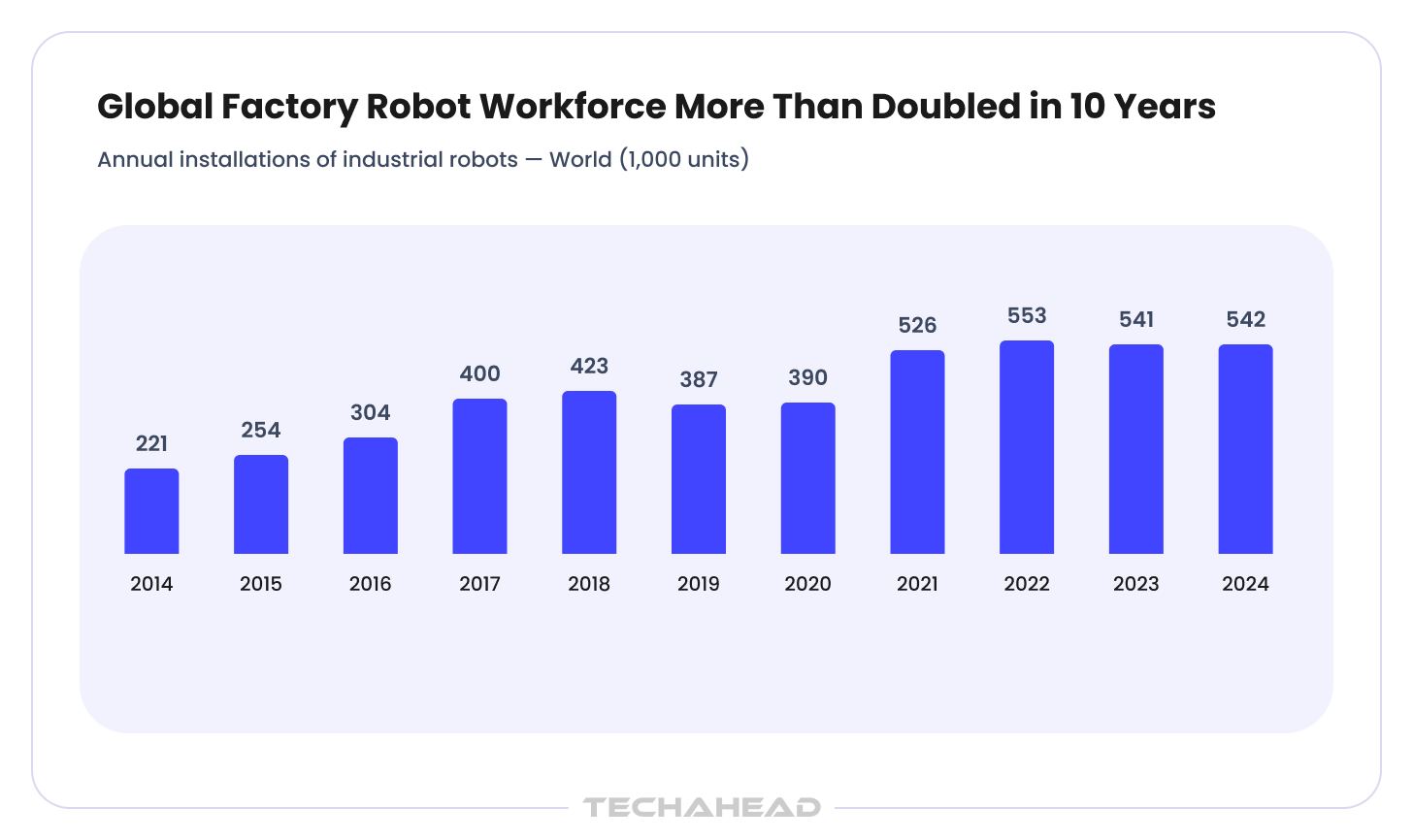
The wider warehouse automation market offers context, though it should not be confused with humanoid adoption. The International Federation of Robotics reported more than 199,000 professional service robot sales in 2024, up 9%, and 542,000 industrial robot installations. Humanoid robots remain an emerging category within a mature automation estate.
There is no single universal architecture for warehouse robotics software. An OEM building a general-purpose platform has different boundaries from a logistics operator integrating a vendor product. Still, production-oriented systems tend to require six connected layers.
The robot first needs a usable representation of its surroundings. Cameras, depth sensors, force sensing, joint feedback, and other inputs help estimate objects, free space, people, equipment, and the robot’s own physical state.
Also Read: Unlock Business Potential with IoT
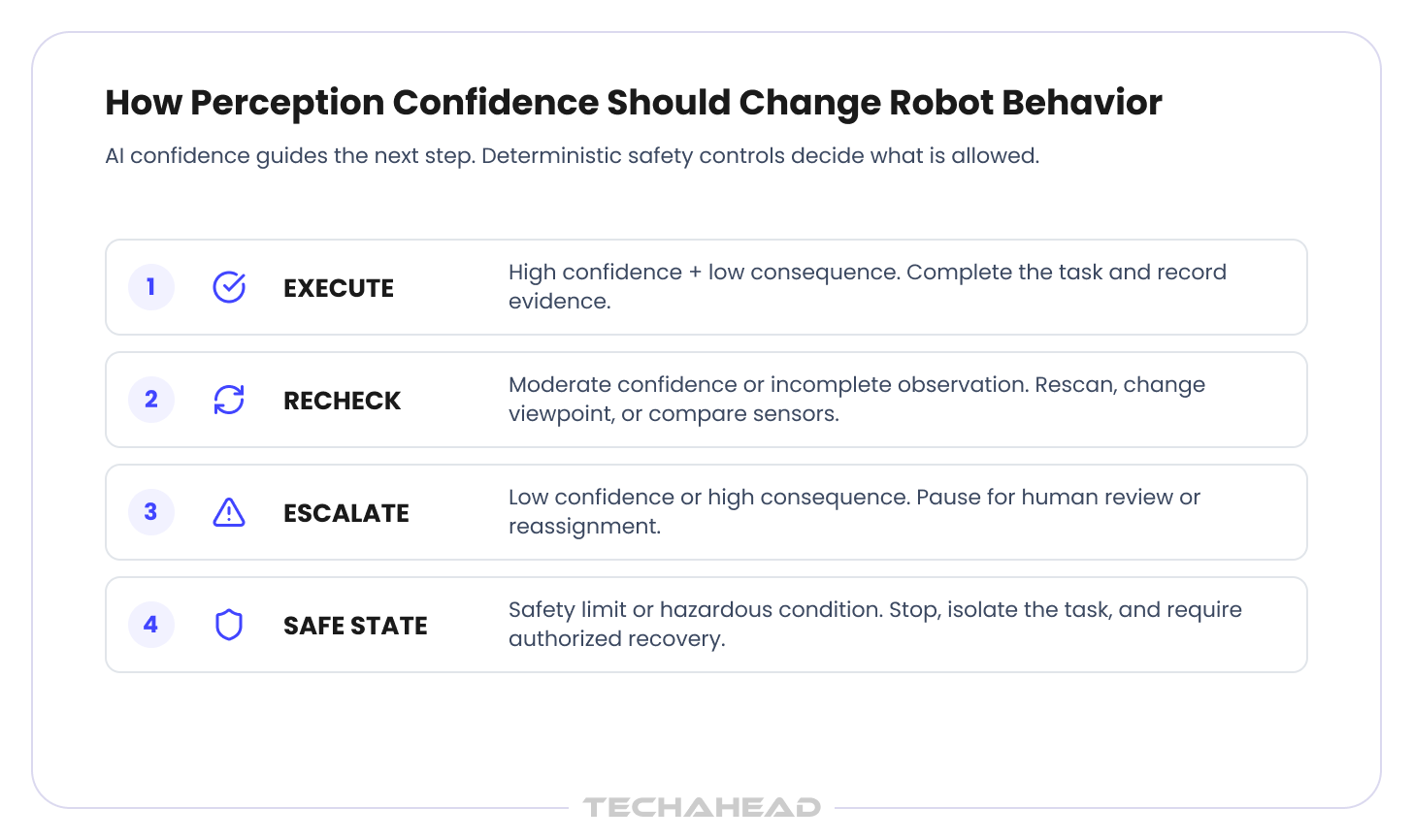
Warehouse perception is rarely clean. In dynamic environments, humanoid robots still struggle with perception in cluttered environments, which is why confidence thresholds and fallback behavior remain necessary. Cartons deform, reflective wrap affects vision, labels are hidden, and containers arrive at different angles. Learned policies can adapt grasping to this variation, but confidence thresholds, timeouts, safety-rated controls, and defined fallback behaviors remain necessary.
The autonomy stack converts intent into physical behavior. A warehouse skill might be expressed as move_tote, pick_package for pick and place tasks, place_in_slot, or pull_cart, with parameters defining source, destination, payload, and completion conditions.
Reusable skills let orchestration software request outcomes without prescribing joint movement. The contract between warehouse software and the robot should describe preconditions, payloads, states, failure codes, cancellation behavior, and completion evidence.
The distinction between probabilistic and deterministic software becomes important at this boundary. Perception and learned manipulation may return uncertain results. Access control, mission state, safety interlocks, task ownership, and inventory updates should behave predictably.
A model may propose an action; a deterministic control layer should decide whether the action is permitted in the current operating state, while also enforcing payload capacity limits and slower cycle times than specialized warehouse automation. In practice, many current humanoids can comfortably lift only 20–30 pounds, so skill selection has to account for current humanoid designs having lower payload limits and slower operation than both industrial robots and humans.
The orchestration layer converts warehouse demand into executable work. It decomposes jobs, evaluates constraints, selects resources, assigns missions, and reschedules when conditions change.
Effective multi robot coordination requires more than sending the next job to the nearest machine. Multi robot task allocation may consider skills, end effectors, charge state, zone permissions, travel time, downstream capacity, and shared resources such as aisles, scanners, chargers, and workstations.
This logic may sit in a WES, OEM platform, fleet manager, or separate orchestration service. Ownership matters: two systems cannot control the same mission or reserve the same physical resource.
Once more than a few robots enter daily operations, teams need a control plane. Robot fleet operations software provides the shared operational view around deployed units: identity, configuration, location, health, assigned work, utilization, alerts, interventions, and software releases.
For an OEM, this layer connects engineering with customer operations. Support teams need the hardware revision, autonomy build, model version, and configuration behind an event. Operators need to know whether the robot is available, blocked, degraded, or awaiting help.
Remote intervention should be designed as a controlled workflow. Authentication, role-based permissions, explicit session ownership, command logging, and safe handback to autonomy all matter. The same discipline applies to over-the-air releases. Staged rollouts, health checks, rollback criteria, and version traceability reduce the chance that one update affects an entire fleet.
Robots generate camera streams, joint states, task events, diagnostics, and model outputs. Sending everything to the cloud is costly; retaining too little makes failures difficult to reproduce.
A practical robotics AI, data and integration layer acts as a robotics data platform and data infrastructure, filtering information by operational purpose. High-rate control remains onboard. Edge services preserve local resilience and evidence during network interruptions, while cloud services support cross-site analytics, model evaluation, and fleet reporting; that data and reporting also help defend ROI when humanoid programs carry high capital expenditure.
Enterprise connectors translate robot activity into warehouse systems. This robotics AI integration connects WMS or WES demand with ERP, CMMS, identity, and incident workflows. The robot becomes useful when these systems agree on what was requested, what occurred, and what remains unresolved.
Safety cannot depend on an AI model behaving correctly every time. Risk assessment, force and speed limits, monitored stops, exclusion zones, emergency behavior, and safe recovery require engineered controls appropriate to the application, especially because humanoids are often introduced to alleviate physical workload and reduce the risk of injury without adding new injury risks. ISO published updated ISO 10218-1 and ISO 10218-2 editions in 2025 for industrial robots and their integration. Their applicability to a particular humanoid installation must be assessed by qualified safety professionals rather than assumed from the robot’s form factor.
Security also has physical consequences. Device identity, mutual authentication, least-privilege permissions, signed software, network segmentation, audit logs, and a defined vulnerability-response process belong in the operating design.
Serviceability closes the loop. Diagnostics should identify the affected subsystem and preserve the evidence needed for triage. Faults should create structured work, not disappear into a generic alert feed.
Most warehouse operations will use mixed fleets. Humanoid robots will share space with people, AMRs, forklifts, arms, conveyors, and manual stations. This makes warehouse robotics integration a coordination problem as much as an API problem.
One useful architectural pattern separates three kinds of control:
| Control scope | Primary responsibility | Typical time horizon |
| On-robot autonomy | Balance, collision avoidance, grasping, motion and local recovery | Milliseconds to seconds |
| Facility orchestration | Mission assignment, traffic, shared resources and workflow dependencies | Seconds to minutes |
| Enterprise planning | Orders, inventory, labor, capacity and business priorities | Minutes to days |
The boundaries should be explicit. A WMS should not control joint motion. An onboard policy should not independently change inventory. The orchestration layer should not bypass a robot’s safety controller.
Interoperability standards can reduce part of the burden. VDA 5050 version 3.0 defines a vendor-neutral interface between mobile robots and master control. The MassRobotics AMR Interoperability Standard supports sharing status information across manufacturers. Neither replaces application-specific integration or defines a universal humanoid-skill contract. Both point toward stable operational facts around proprietary autonomy.
Facilities also need a shared exception model. “Task failed” is not actionable. The platform should distinguish an obstructed path, unavailable destination, uncertain grasp, damaged package, low battery, lost localization, safety stop, network loss, and hardware fault. Each condition can trigger the correct recovery.
The clearest disclosed commercial example is the GXO and Agility Robotics deployment at a SPANX facility, a successful pilot for broader warehouse humanoid adoption. Digit robots move totes from other mobile robots and place them onto conveyors, while Agility Arc orchestrates the workflow.
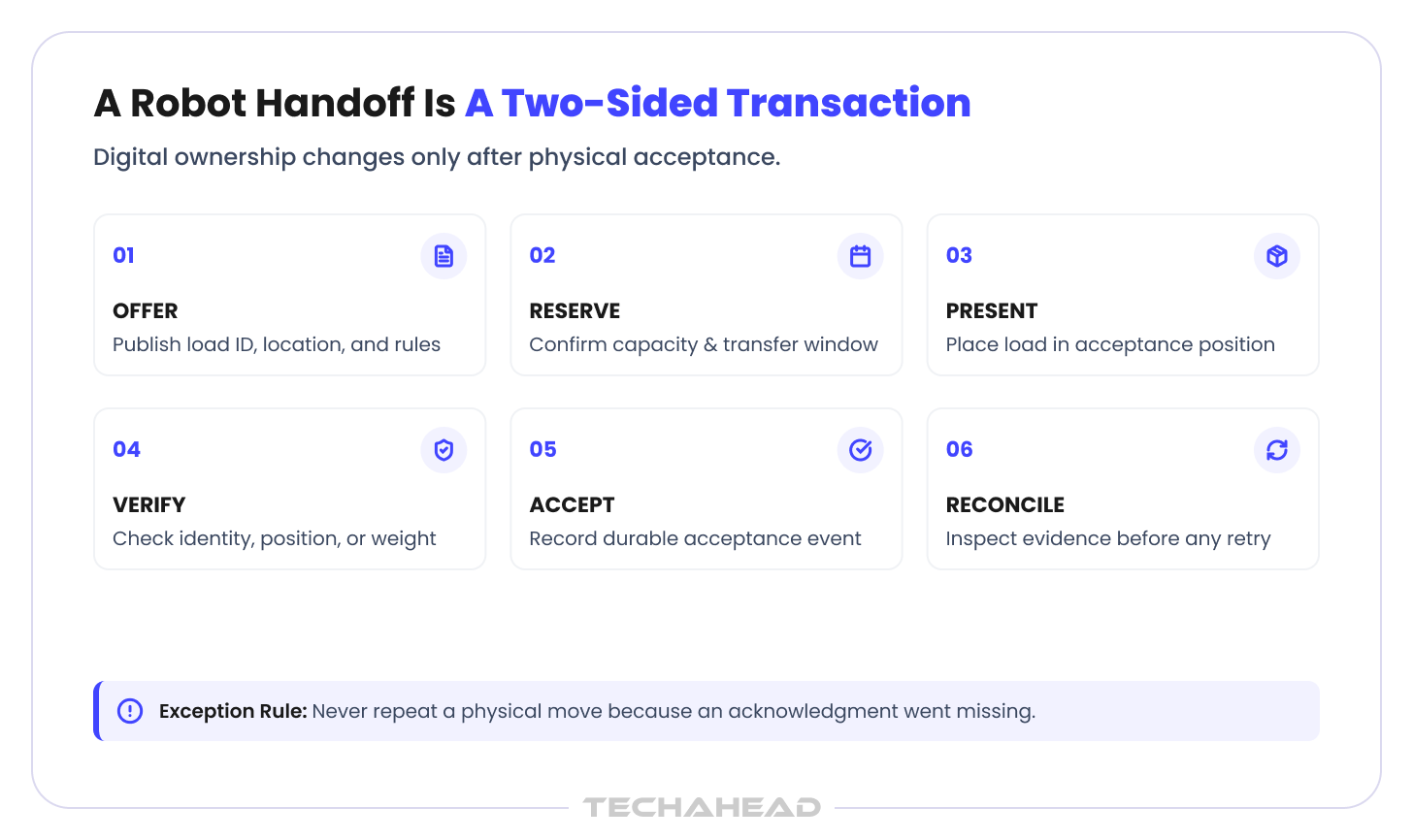
A tote must arrive, become available, move safely, and be accepted by the conveyor. Task state, resource availability, and recovery extend across vendors and equipment types. That is the practical shape of multi-robot coordination.
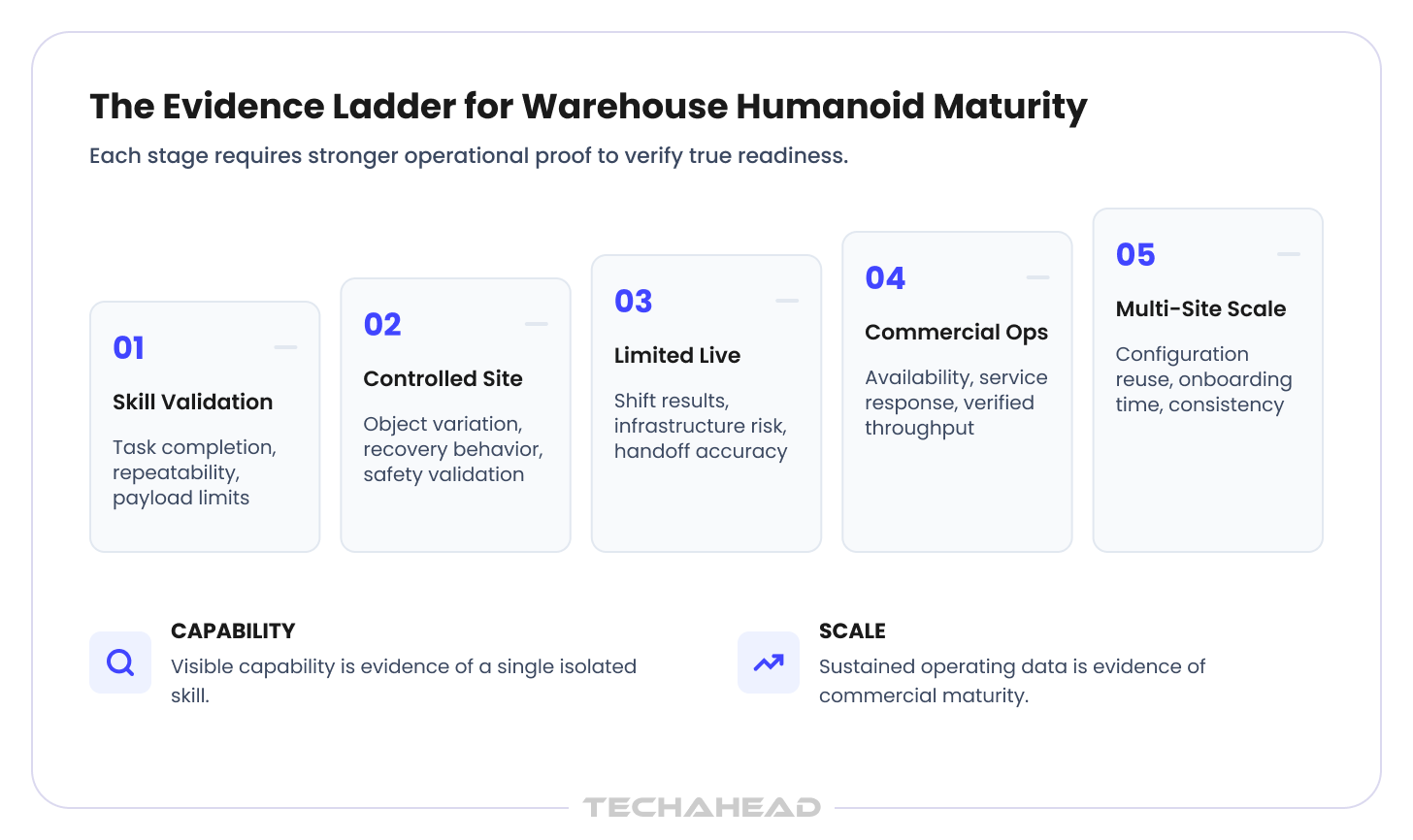
Public evidence for the humanoid robot warehouse category remains uneven. These examples distinguish commercial operation, controlled implementation, and announced rollout. An agreement or evaluation is not proof of fleet-scale performance.
In the GXO, Agility, and SPANX program, Digit performs repetitive tote movement between mobile robots and conveyors. The deployment shows why humanoids may fit human-oriented infrastructure while still requiring coordination with existing automation.
Challenge: A delay or error at one handoff can block two systems and affect downstream flow.
What it demonstrates: The operational unit is the end-to-end material movement, not the robot’s individual carry action.
TechAhead recommended approach: Model the handoff as a stateful workflow. Require machine-readable readiness signals from the source and destination, enforce timeouts, preserve task ownership, and provide recovery paths for missing, damaged, or incorrectly positioned totes.
GXO announced an agreement to evaluate Reflex Robotics technology for live operations under a Robots-as-a-Service model. The announcement is useful evidence of commercial interest, but it does not publish production-scale performance data.
Challenge: A general-purpose machine may gain new skills faster than warehouse systems can absorb them safely.
What it demonstrates: Extensibility needs governance because a general-purpose machine can expand across multiple task types. Each new skill changes the robot’s capability profile, operational risks, monitoring requirements, and possible task assignments.
TechAhead recommended approach: Maintain a versioned capability registry. The scheduler should assign only validated skill and payload combinations for the robot’s current hardware, software, site, and safety configuration. New capabilities should enter operations through controlled release gates.
GXO and Apptronik established a multi-phase development initiative for Apollo. The published program began with lab evaluation before potential use in a US distribution center. Apptronik identified movements ranging from boxes and totes to item picking and barcode scanning.
Challenge: Success during a prepared evaluation does not establish performance across a full shift, changing inventory, network interruptions, congestion, or unplanned human interaction.
What it demonstrates: Readiness requires operational evidence across conditions, not a successful nominal path.
TechAhead recommended approach: Build an evaluation harness around representative workflows. Track intervention rate, task completion, cycle-time distribution, recovery success, energy consumption, blocked time, and causes of failure. Use event replay to compare software versions before deployment decisions.
Sanctuary AI and automotive supplier Magna established a strategic deployment partnership to introduce general-purpose AI robots into Magna’s manufacturing operations. The program combines Sanctuary AI’s dexterous manipulation technology with Magna’s engineering, manufacturing, and industrial integration capabilities.
Challenge: Manufacturing environments contain parts, tools, containers, and materials with different shapes, orientations, and handling requirements. Conventional automation becomes difficult to scale when every variation requires separate programming or tooling.
What it demonstrates: Dexterous manipulation depends on more than grasping capability. Production deployments require task-specific training data, perception confidence, force control, workflow authorization, and clear recovery rules. This partnership represents a planned industrial deployment program rather than independently verified fleet-scale performance.
TechAhead recommended approach: Build a governed data pipeline that connects demonstrations, task outcomes, grasp failures, intervention records, and model versions. Low-confidence actions should trigger a safe exception workflow instead of allowing the robot to continue without operational validation.
In early 2026, Humanoid, SAP, and Martur Fompak completed a controlled implementation in a live production-logistics environment. HMND 01 received work through SAP, navigated to a pallet, retrieved a KLT container, and delivered it to a trolley. According to Humanoid, SAP Extended Warehouse Management communicated through SAP’s agent layer and the robot API.
Challenge: Enterprise software and physical execution can diverge. A timeout does not reveal whether the robot never started, remains in motion, or completed the movement before the response was lost.
What it demonstrates: Direct integration needs a durable task-state protocol, not only an API call.
TechAhead recommended approach: Use idempotent command identifiers, explicit acknowledgment states, reconciliation, bounded retries, and completion evidence. An integration service should prevent duplicate physical actions and restore consistent state after a connection failure.
Mercedes-Benz and Apptronik entered a commercial agreement to evaluate Apollo humanoid robots in manufacturing logistics. Proposed workflows include bringing assembly kits to production workers, inspecting components, and returning totes of kitted parts later in the process.
Challenge: Line-side delivery involves changing material requirements, narrow operating spaces, human traffic, component verification, and strict production timing. A delayed or incorrect delivery can interrupt downstream assembly work.
What it demonstrates: A humanoid robot may perform the physical movement, but the workflow still depends on production-system integration, accurate kit identification, task sequencing, zone permissions, and confirmation that the correct material reached the correct station.
TechAhead recommended approach: Connect the robot orchestration layer with the manufacturing execution system, warehouse platform, and component-traceability records. Every task should carry a kit identifier, destination, priority, inspection state, delivery confirmation, and exception path.
In March 2025, UBTECH reported a multi-humanoid collaborative training program at ZEEKR’s 5G Intelligent Factory. Walker S1 robots were used across sorting, material handling, quality inspection, and precision assembly scenarios.
Challenge: Multiple humanoids working in shared areas must coordinate task ownership, routes, loads, workstations, and dependencies. Local robot decisions can create congestion or conflicting actions when fleet-wide state is unavailable.
What it demonstrates: Scaling requires centralized task governance combined with distributed robot control. Shared mapping, workload allocation, synchronized state, and resource reservations become essential when several robots participate in connected workflows.
TechAhead recommended approach: Implement vendor-neutral multi-robot coordination with task queues, capability-based allocation, zone reservations, collision-aware scheduling, heartbeat monitoring, and shared exception states. The orchestration layer should preserve operational control even when individual robots or cloud services become unavailable.
Production responsibility begins when humanoid robots operate through changing demand, software versions, equipment conditions, and staffing patterns.
The control plane should show what is deployed, which robotic systems are available or degraded across the warehouse floor, what work is assigned, which system owns each task, which software versions are running, and what changed before a regression.
This is the practical role of robot fleet management software. It provides fleet-level context without replacing the robot’s real-time controller.
Observability must also extend beyond infrastructure metrics. CPU, memory, and network health are useful, but warehouse teams need physical and business signals: completed moves, blocked minutes, grasp retries, intervention time, empty travel, charge-related unavailability, scan success, and exceptions by workflow.
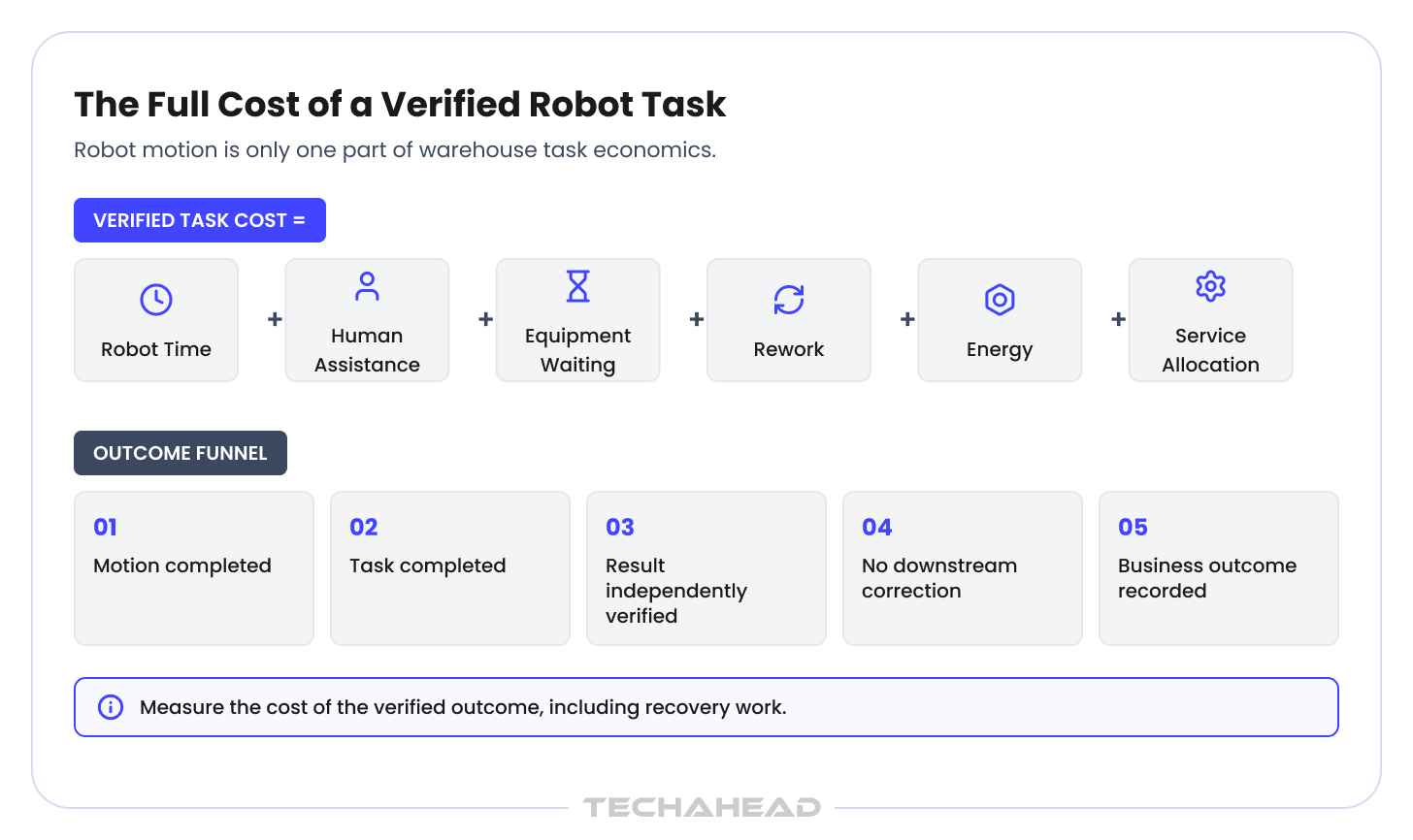
An alert becomes valuable when it reaches someone who can resolve it with the right evidence. Robotics field service management software can connect fleet diagnostics with triage, work orders, technician assignment, parts, safety procedures, and repair evidence.
The event should carry the robot identity, site, subsystem, fault history, current software versions, relevant logs, and actions already attempted. After repair, the service record should update the asset history and govern return to operation. This reduces the gap between robotics engineering and field operations.
| A robotics company needed to replace fragmented monitoring and support workflows as autonomous systems expanded across customer locations. Disconnected telemetry, software, incident, and maintenance tools limited fleet visibility. TechAhead designed a modular operations layer around the existing hardware and autonomy stack. The proposed architecture centralized robot identity, telemetry, fleet health, mission status, access, and exceptions while connecting alerts with traceable service actions.The platform gave engineering and operations teams a shared view of deployed units, configurations, and unresolved incidents, supporting controlled releases, remote intervention, and additional sites. |
Physical systems experience partial failures in real world warehouse operations, where recovery must account for unpredictable conditions. A robot may stop while holding an object, connectivity may drop after task acceptance, or a destination may become unavailable mid-mission.
Recovery behavior should be defined during workflow design:
Without this model, operators improvise. Those workarounds may be effective in the moment but difficult to audit, reproduce, or scale.
“A warehouse robot fleet needs more than autonomy. It needs observable software boundaries, controlled releases, recoverable workflows, and data that explains what happened when physical execution diverges from the plan.”
Mukul Mayank, COO, TechAhead
Humanoids should earn their place against available alternatives. The strongest case usually involves several human-oriented constraints at once: travel through existing spaces, reaching across different heights, manipulating varied objects, using carts or containers already in service, and moving between tasks without rebuilding the facility around a fixed cell, especially when avoiding major retrofits matters because traditional automation systems can exceed $10 million in installation costs.
| Technology | Strong fit | Common limitation |
| Fixed conveyor or sortation | Stable, high-volume, repeatable flow | Layout changes and variable work can be expensive |
| AMR or AGV | Point-to-point transport and predictable payload movement | Usually requires compatible load-transfer interfaces |
| Robotic arm or cobot | Repetitive manipulation within a defined workcell | Limited mobility and reach beyond the engineered cell |
| Humanoid or mobile manipulator | Work requiring mobility, reach, and manipulation in human-oriented spaces | Higher software, safety, reliability, and service complexity |
| Human worker | Judgment, improvisation, unusual exceptions, and rapidly changing work | Ergonomic exposure and limited availability for repetitive physical tasks |
Determine whether the job requires both movement and manipulation, whether simpler transfer equipment could handle it, how exceptions will be resolved, and whether expected utilization justifies the integration and service burden.
The answer may be a humanoid, an AMR with a top module, an arm on a mobile base, fixed automation, or a redesigned manual process. A balanced architecture allows these choices to coexist.
For a robotics OEM, the product boundary expands with multi-site deployment, enterprise connectivity, fleet support, and service levels. Building every surrounding system inside the autonomy team can slow the robot roadmap, while ad hoc customer integrations become difficult to support.
A robotic software development and integration partner can take responsibility for the layers around the machine while the OEM retains hardware, safety-rated functions, and proprietary autonomy. The work may include:
Warehouse operators need the same clarity from the opposite direction. The WMS should remain authoritative for inventory and business demand. The robot platform should remain authoritative for execution capability and local state. The orchestration layer should preserve ownership and evidence across that boundary.
MarketsandMarkets projects the warehouse robotics software market to grow from $2.45 billion in 2025 to $4.47 billion by 2031. That is a market forecast rather than an observed outcome, but its emphasis on fleet orchestration, execution systems, simulation, and integration reflects where warehouse automation complexity is accumulating.
The humanoid itself will remain the most visible part of the system. Daily operational value will depend on the less visible software that assigns useful work, coordinates shared resources, records what occurred, and helps people recover when reality departs from the plan.
Building a humanoid warehouse program requires software that connects physical tasks with fleet control, enterprise data, and ongoing service operations.
Contact TechAhead to assess the software architecture needed around your existing robot and warehouse technology stack.
A production-ready stack needs perception, motion planning, task orchestration, robot fleet management software, safety controls, observability, remote support, and WMS or WES integration to help humanoid robots operate effectively in warehouse environments built for people. Together, these capabilities connect autonomous behavior with warehouse workflows and operating policies.
Warehouse robotics integration typically uses APIs, event streams, middleware, or an orchestration layer to exchange inventory, location, task, and exception data. This is especially attractive for existing facilities because humanoids can fit into current workflows without major infrastructure changes or costly facility modifications, while the design should preserve the WMS as the system of record as robots execute authorized movements.
OEMs should separate autonomy from fleet operations and create modular services for identity, telemetry, mission status, access control, diagnostics, and updates. TechAhead can engineer this software layer around an OEM’s existing robots, autonomy stack, and enterprise interfaces.
Multi-robot coordination assigns tasks, reserves shared resources, controls traffic, and manages handoffs among humanoids, AMRs, conveyors, fixed automation, and workers, so robots can operate alongside humans in mixed warehouse operations. A vendor-neutral orchestration layer prevents isolated fleet decisions from disrupting overall warehouse flow.
Strong candidates include repetitive tote transfers, depalletizing, case handling, machine tending, kitting, and material replenishment in human-designed environments. Selection should consider task frequency, payload, reach, travel distance, exception rate, safety exposure, and process stability.
Requirements depend on the robot, application, jurisdiction, and operating environment. Organizations should conduct task-level risk assessments to protect human workers, identify hazardous tasks, and evaluate applicable OSHA obligations, ISO 10218, mobile-robot standards, functional safety, cybersecurity, access controls, and documented human-override procedures.
Use an integration architecture with governed APIs, event normalization, durable task states, retry logic, and audit trails. TechAhead can connect robotics AI and operational data with WMS, ERP, support, and field-service workflows without replacing core enterprise platforms.
Teams should monitor task completion, intervention frequency, cycle time, perception confidence, grasp success, battery health, fault codes, network quality, safety events, and recovery time, while also using labor statistics to frame productivity trends and account for labor shortages when scaling outcomes. These signals make robot fleet operations measurable and support evidence-based scaling decisions.
Security should cover device identity, encrypted communication, least-privilege access, signed software updates, network segmentation, credential rotation, audit logging, model governance for large language models where they support robot reasoning or operator interaction, and incident response. Sensitive images, telemetry, and operational data also require defined retention and access policies.
Begin with task and facility assessment, integration mapping, safety validation, controlled workflow testing, exception analysis, and measurable acceptance criteria, and validate the economics before large scale deployment because current humanoid robots can cost hundreds of thousands of dollars each. TechAhead can support the software, data, orchestration, and enterprise integration work required to progress toward repeatable multi-site operations, and this staged process reduces risk before large scale deployment.
We use cookies to ensure our website functions properly, improve performance, and provide a personalized experience. You can choose which types of cookies to allow below.
Required for core functionality such as security, network management, and accessibility. These cannot be disabled.
Help us understand site traffic and user interactions so we can improve performance and usability.
Enable enhanced functionality and personalization such as language or region preferences.
Used to deliver relevant ads, track campaign performance, and measure advertising effectiveness.