


 Copy Link
 Share on X
 Share on Facebook
 Share on LinkedIn
Always Active
Required for core functionality such as security, network management, and accessibility. These cannot be disabled.

Uncover the transformative potential of digital and mobile solutions for your industry.





 Last Updated: Sep 16, 2026
Sep 16, 2026
Last Updated: Sep 16, 2026
Sep 16, 2026  149
149  14 min. Read


Key Takeaways
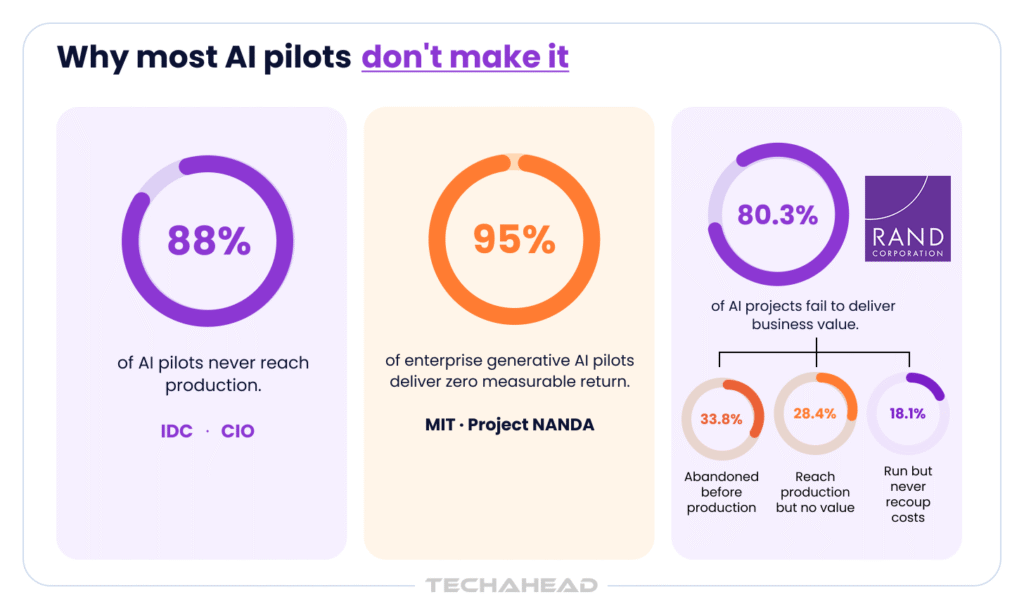
Here is the number that should reframe every AI roadmap conversation happening right now: 88% of AI pilots never reach production, according to IDC and CIO research.
MIT’s Project NANDA puts the damage even higher, finding that 95% of enterprise generative AI pilots deliver zero measurable return on the profit and loss statement.
Source: TechAhead AI Team
RAND Corporation, analyzing more than 2,400 companies, found that 80.3% of AI projects fail to deliver business value, roughly twice the failure rate of conventional software projects, and broke that number down further: 33.8% are abandoned before they ever reach production, 28.4% reach production but fail to deliver expected value, and 18.1% run but never recoup their costs.
None of this is a model quality problem. The demos work. The internal reviews get positive feedback.
The models get built, sometimes in a weekend. What consistently fails is everything around the model: the data foundation, the operational discipline, the governance, the ownership.
MIT Sloan research found that 61% of enterprise AI projects were approved on projected ROI that was never actually measured after launch, and that projects defining quantified success metrics upfront hit a 54% success rate, compared to just 12% for projects that did not.
Gartner’s own forecasting reinforces the same pattern from a different angle: the firm predicts that over 40% of agentic AI projects will be canceled by the end of 2027, and separately warns that 60% of AI projects lacking properly AI-ready data will be abandoned through 2026.
The models keep improving every year. The production-conversion rate has not moved with them. That gap, between model capability and organizational readiness, is exactly what a maturity model exists to measure.
This is precisely the gap an AI product maturity model is built to close. It gives product leaders, CTOs, and founders a shared, honest language for a question that usually gets answered with vibes: is this AI initiative actually ready to scale, or is it still a working demo wearing a product’s clothes?
An AI product maturity model is a structured way to assess how far an AI-built initiative has moved from a working demonstration toward a durable, governed, enterprise-ready product.
It borrows the basic idea of classic software maturity models, the notion that capability develops in identifiable stages, but it has to account for problems traditional software maturity models were never built to handle: model drift, data dependency, non-deterministic outputs, and governance obligations that barely existed a few years ago.
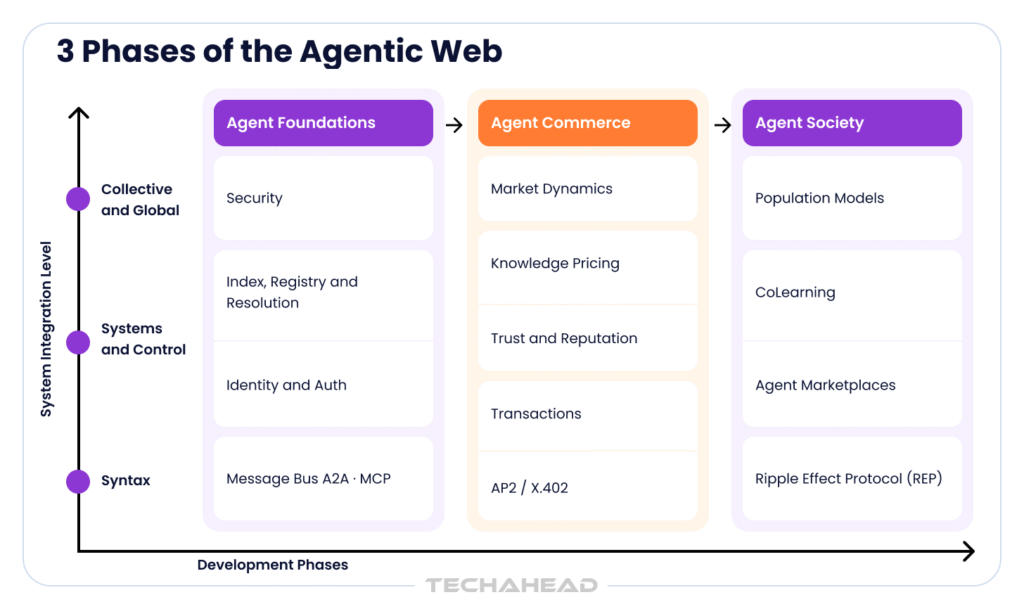
At a high level, most AI-built initiatives move through four recognizable stages:
The value of naming these stages explicitly is that it turns “should we scale this?” from a gut call into a structured decision. Leaders can use the model at each gate review or funding decision to ask a sharper question than “does it work”: which stage are we actually at, and what specifically needs to be true before we’re safe to move to the next one?
That single reframe is often what prevents the phenomenon teams have started calling pilot purgatory, the state where a promising AI pilot never quite graduates and never quite gets killed, consuming budget and attention indefinitely.
Table 1: The four maturity stages, at a glance
| Stage | Typical owner | Data handling | Failure mode if scaled too early |
| Experiment | One or two engineers | Manual, ad hoc, often sample data | Breaks the moment real data shows up |
| Pilot | A product or innovation team | Real data, manual pipelines | Works until the one person who understands it leaves |
| Production | Product + engineering, with defined SLAs | Automated pipelines, basic monitoring | Fine for its scoped use case, fragile outside it |
| Enterprise Scale | Cross-functional, with governance | Governed, audited, versioned | N/A, this is the target state |
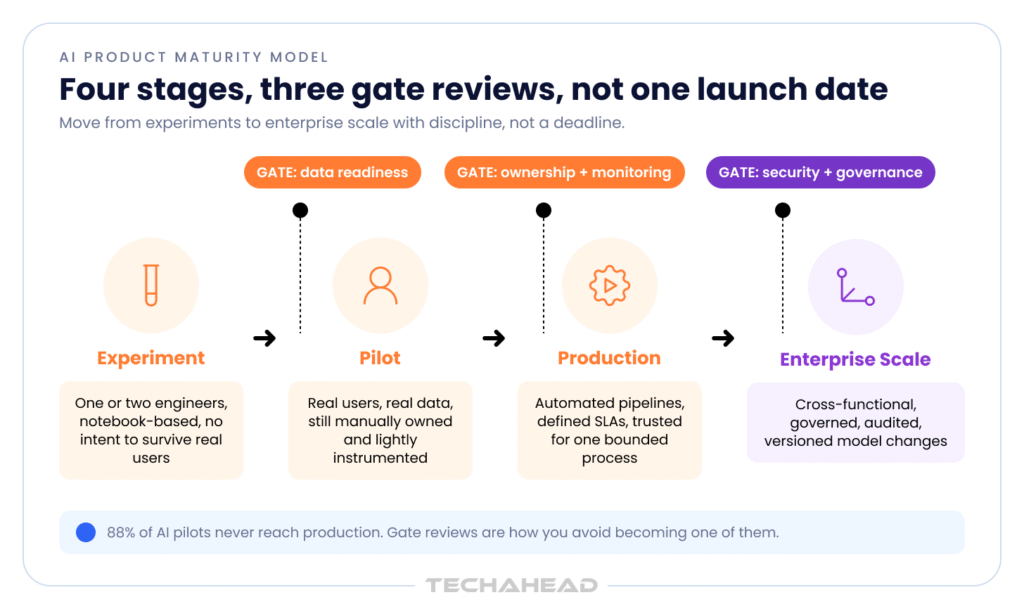
The maturity model is not a replacement for a product lifecycle. It is a lens you apply at specific points inside one. A typical AI product lifecycle moves through opportunity identification, a data and feasibility check, prototype, pilot, production, and then scale, and maturity assessments belong at the transitions between these stages, not as a one-time audit at the end.
Three transition points matter most in practice.
The first is the prototype-to-pilot decision: has the team validated the underlying data is actually available in production, not just in a curated sample used for the demo? The second is the pilot-to-production decision: does the system have defined ownership, monitoring, and a rollback plan, or is it still running because one engineer keeps it alive manually?
The third, and the one organizations skip most often under pressure to show results, is the production-to-enterprise-scale decision: does this system have the security, governance, and audit controls that a second business unit, a regulator, or a customer’s security review will actually demand?
Each of these transitions maps to two different kinds of investment that need to move together. Business value, meaning the revenue impact, cost savings, or risk reduction the AI initiative is expected to deliver, tends to get modeled early and optimistically.
Technical investment, meaning the team size, tooling, monitoring, and governance required to sustain that value reliably, tends to get modeled late or not at all. The 61% of AI projects that MIT Sloan found were approved on unmeasured projected ROI are, almost by definition, projects where this second investment category was never seriously scoped in the first place.
(Source: TechAhead AI Team)
Treating maturity as something assessed continuously, at each gate, rather than declared once at launch, is what keeps a genuinely useful AI product from quietly drifting backward as data sources change, models get swapped, or the one person who understood the pipeline moves teams.
This is where the maturity model earns its keep, because “does the demo work” and “is this a durable product” are almost entirely different questions, answered by looking at almost entirely different signals.
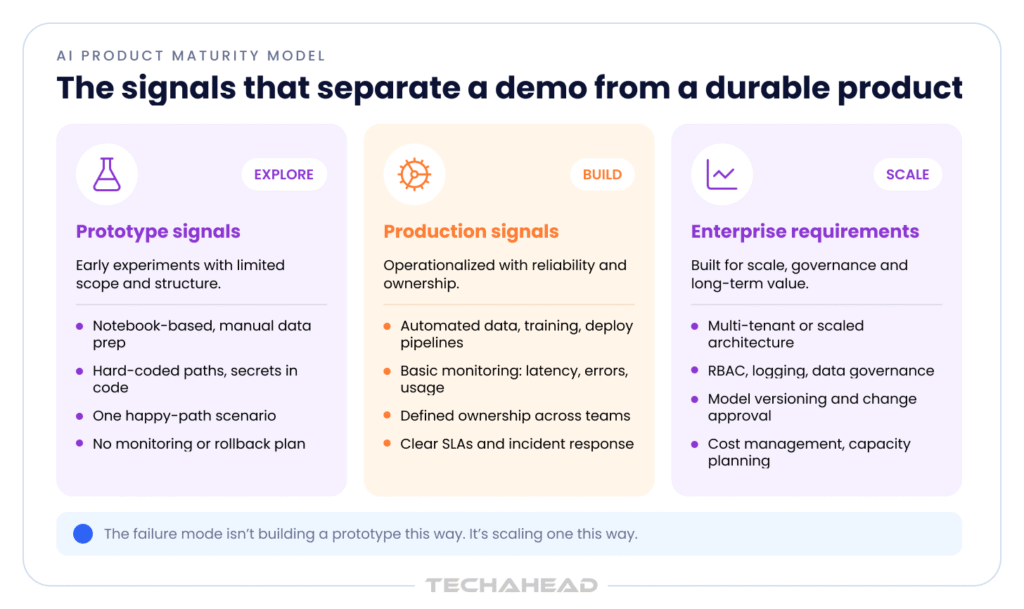
A system still in prototype territory usually shows most of the following: notebook-based workflows and manual data preparation rather than automated pipelines.
Besides, in some cases, hard-coded file paths and secrets sitting directly in code rather than in a secrets manager, a single happy-path scenario with no meaningful error handling for the messy inputs real users inevitably provide, and no monitoring, no drift detection, and no rollback plan if the model’s behavior degrades.
None of this is a criticism. Every AI product starts here, and it should. The failure mode is not building a prototype this way, it is scaling one this way.
A system that has genuinely crossed into production shows a different, more boring but far more durable set of characteristics: automated pipelines for data, training, and deployment, so a person is not manually re-running notebooks to keep the system alive; basic but real monitoring covering latency, error rates, and usage; defined ownership across product, engineering, and MLOps, so “who fixes this at 2am” has an actual answer; and clear SLAs or SLOs backed by an incident response process, not an informal understanding that someone will notice if it breaks.
Enterprise scale adds a further layer that pilots and even solid production systems frequently lack: multi-tenant or properly scaled single-tenant architecture, security and compliance controls including role-based access control, logging, and data governance, model governance covering versioning, change approvals, and rollback authority, and real cost management and capacity planning rather than an assumption that infrastructure spend will scale linearly and predictably.
Source: TechAhead AI Team
The tie-back matters more than any individual bullet: the maturity model’s real job is helping a team see, honestly, which of these signals they already have and which ones they are quietly missing, before a scaling decision forces the gap into the open in front of a customer, an auditor, or an outage.
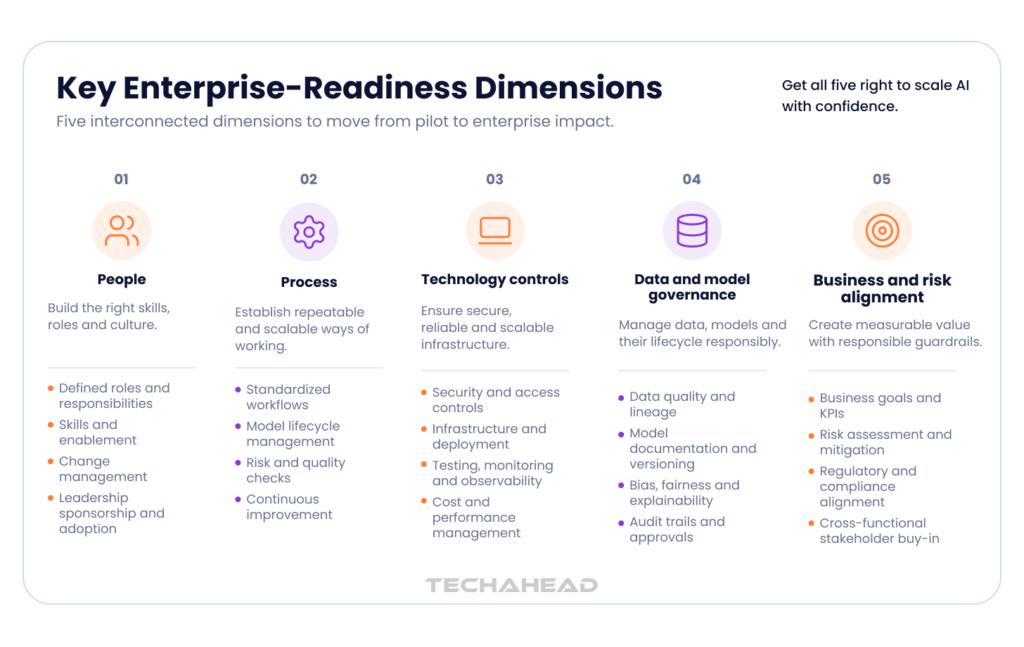
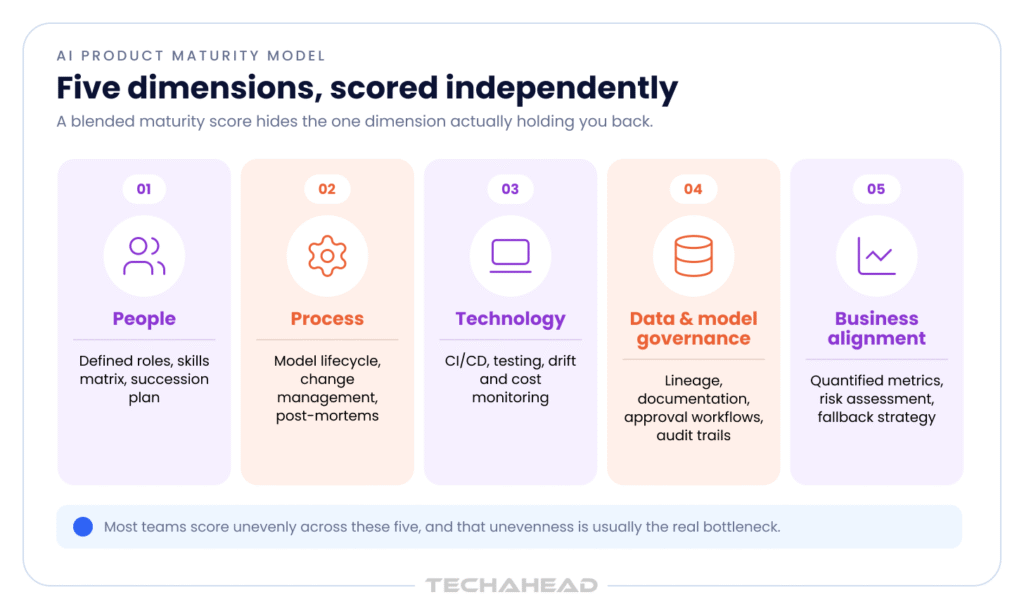
Enterprise readiness is not one property, it is the product of five distinct dimensions, each of which can be assessed and scored independently. Treating them as a single blended “maturity score” hides exactly the information leaders need most: which specific dimension is the actual bottleneck.
Enterprise-ready AI products have clearly defined roles, not just enthusiastic volunteers: a product owner, ML engineer, data engineer, and someone accountable for MLOps and security or compliance. Beyond roles, teams need an honest skills matrix showing who can actually maintain the models, pipelines, and infrastructure if the original builder leaves, along with a real onboarding plan for whoever comes next.
This dimension covers the full model development lifecycle: structured discovery and prioritization for AI features rather than opportunistic building, a defined path from data preparation through training, validation, and deployment, formal change management and release processes, and, critically, incident management with real post-mortems when an AI system fails, not just for when conventional software fails.
Source: TechAhead AI team
The technical backbone of enterprise readiness includes CI/CD covering both code and models, automated testing that spans unit tests, integration tests, and model quality checks, monitoring across performance, drift, data quality, and cost, and security controls covering access management, encryption, and secrets management. Notably, most of these are direct fixes for the prototype signals listed above: automated pipelines replace notebooks, monitoring replaces silence, and a secrets manager replaces hard-coded credentials.
This is the dimension MIT, RAND, and Gartner’s research points to most consistently as the actual root cause of AI project failure, not a niche compliance concern. It includes data lineage and provenance, model documentation covering intended use, known limitations, and performance metrics, formal approval workflows before model changes ship, and audit trails for both data and model access.
An organization with 41% of its enterprise AI projects blocked by poor real-time data access, a figure Fivetran’s 2025 research found across enterprise AI initiatives, is a data governance failure wearing an AI failure’s clothing.
The final dimension ties the previous four back to why the initiative exists at all: clear, quantified success metrics defined before the project starts, not after; a genuine risk assessment covering bias, fairness, regulatory exposure, and reputational risk; a defined fallback strategy for when the model underperforms, because it eventually will; and alignment with existing enterprise architecture and IT policy rather than a shadow system living outside it.
Table 2: A simple 1 to 5 self-assessment per dimension
| Level | People | Process | Technology | Data & model governance | Business alignment |
| 1 | One volunteer builder | Ad hoc, undocumented | Manual, notebook-based | No lineage or documentation | No defined success metric |
| 2 | Informal team, unclear roles | Basic discovery, no lifecycle | Some automation, no testing | Documentation exists, not enforced | Metric exists, not tracked |
| 3 | Defined roles, thin coverage | Defined lifecycle, inconsistent | CI/CD for code, not models | Approval workflow, manual audit | Metric tracked post-launch |
| 4 | Full team, documented skills matrix | Lifecycle + incident process | Full CI/CD, drift monitoring | Automated lineage and audit trail | Metric tracked, tied to funding |
| 5 | Team + succession plan | Continuous improvement loop | Full observability + rollback | Governed, audited, versioned | Risk-adjusted, board-visible |
Most organizations, when they score honestly against this table, find their five dimensions sit at wildly different levels, a team strong on technology controls but at Level 1 on data governance, for instance. That unevenness is usually the actual explanation for why a technically impressive pilot has stalled.
Before committing further budget to an AI initiative, four questions cut through most of the noise: Where are we on the maturity curve today, honestly, not optimistically? Which of the five dimensions above is our biggest gap? What business outcome specifically depends on moving up one maturity level, and is that outcome worth the investment required? And, the question most likely to be uncomfortable: are we trying to scale something that is still, underneath a polished interface, a prototype?
The path forward does not require a company-wide transformation program. It requires four concrete, sequenced actions.
First, run a lightweight maturity assessment, using the framework above, across one or two priority AI initiatives rather than the entire portfolio at once.
Second, identify the two or three must-fix gaps standing between the current state and the next stage, commonly monitoring, governance, or CI/CD, rather than attempting to fix all five dimensions simultaneously.
Third, define a genuine 90-day roadmap with specific, checkable milestones for closing those gaps, not a vague commitment to “improve maturity.” Fourth, make an explicit build-versus-partner-versus-platform decision for whatever capability is missing, since attempting to build MLOps tooling or governance infrastructure from scratch is rarely the highest-leverage use of an internal team’s time.
(Source: TechAhead AI Team)
The goal of this entire exercise is not maximum maturity everywhere. A low-risk internal tool used by three people does not need enterprise-grade model governance, and building it anyway is wasted investment in the opposite direction from the pilot-purgatory failure mode. The goal is appropriate maturity for the actual risk and value of each specific AI product, assessed honestly rather than assumed.
Most organizations do not lack ambition around AI, they lack a disciplined way to tell which of their AI initiatives are close to durable and which are quietly still prototypes.
TechAhead runs structured AI maturity assessment workshops that score initiatives against the five dimensions above, then works with product and engineering leaders to design the target architecture, governance model, and operating structure needed to close the specific gaps identified, not a generic best-practices checklist.
A typical engagement follows a simple sequence: assess the current maturity level honestly across one or two priority initiatives, build a roadmap that sequences the two or three highest-leverage fixes, implement the MLOps, monitoring, security, and scale-out work required, and measure whether the resulting system actually delivers the business outcome it was funded to deliver, closing exactly the loop that MIT Sloan found missing in 61% of enterprise AI projects.
Trying to figure out whether your AI initiative is ready to scale, or still a prototype in production’s clothing? TechAhead’s engineering team is glad to walk through a maturity assessment together.
It is a structured way to gauge how production-ready and enterprise-ready an AI initiative actually is, beyond the simple question of whether it works in a demo.
Higher maturity levels demand more disciplined engineering, governance, and operations. Better models alone do not move a system up the maturity curve.
Sometimes, but it usually needs a targeted refactor or partial rewrite to meet security, scalability, and maintainability requirements before it can scale safely.
Before every pilot-to-production transition, and always before any enterprise-wide rollout, since these are exactly the points where hidden maturity gaps surface.
Not always. When the core logic is sound, a targeted refactor covering pipelines, security, and monitoring is often enough to close the remaining gaps.
We use cookies to ensure our website functions properly, improve performance, and provide a personalized experience. You can choose which types of cookies to allow below.
Required for core functionality such as security, network management, and accessibility. These cannot be disabled.
Help us understand site traffic and user interactions so we can improve performance and usability.
Enable enhanced functionality and personalization such as language or region preferences.
Used to deliver relevant ads, track campaign performance, and measure advertising effectiveness.