


 Copy Link
 Share on X
 Share on Facebook
 Share on LinkedIn
Always Active
Required for core functionality such as security, network management, and accessibility. These cannot be disabled.

Uncover the transformative potential of digital and mobile solutions for your industry.





 Last Updated: Oct 7, 2026
Oct 5, 2026
Last Updated: Oct 7, 2026
Oct 5, 2026  115
115  21 min. Read


Key Takeaways
A hospital can know that an infusion pump is somewhere on the third floor and still leave a nurse searching for equipment. It can locate the pump beside a patient’s bed and still be unable to tell whether that pump is operating, awaiting cleaning, or unavailable for maintenance.
Your hospital asset tracking investment should address a defined retrieval, redistribution, maintenance, or purchasing decision. We work backward from that decision to accuracy, update frequency, infrastructure, and integration requirements.
In its March 2025 Market Guide for Indoor Location Services, Gartner connects location tracking with safety, compliance, and cost priorities. For your hospital, those priorities become useful when the architecture supports a defined equipment workflow. Your teams may need department-level visibility for redistribution, correct-room identification for retrieval, or finer positioning for a specific clinical task. Each requirement changes the infrastructure, update frequency, battery workload, and validation your system needs.
Integrations with maintenance and cleaning records then help turn location observations into actionable equipment availability. We compare RFID, Bluetooth Low Energy (BLE), ultra-wideband (UWB), and hybrid models on that basis, then explain scope, costs, and rollout evidence.
Must Read: AI in Medical Technology
When you ask how to choose hospital asset tracking technology, we start by separating inventory visibility from continuous location tracking. A real-time location system, or RTLS, is a system category; RFID, BLE, and UWB describe technologies that can contribute to different tracking architectures.
Use these starting hypotheses for your site assessment:
A high-value ventilator does not automatically require the most precise radio. Match precision to the retrieval decision.
Through our healthcare technology consulting, we translate your equipment workflows, existing systems, and operating constraints into an implementation scope. The first deliverable should establish what staff must know and how the hospital will verify that knowledge.
For your medical equipment tracking system, we turn “room-level accuracy” into a procurement requirement. It needs a definition of the correct room, acceptable error, update delay, and conditions under which the claim holds.
Test doorway errors and movement delays. A stable reading can still arrive too late to support a transfer.
Use four practical levels:
Specify how each result appears to staff. “Last detected in clean storage, six minutes ago” communicates something different from “available in clean storage.” The second statement also requires evidence about readiness.
Measure successful retrieval and correct workflow actions alongside positioning error.
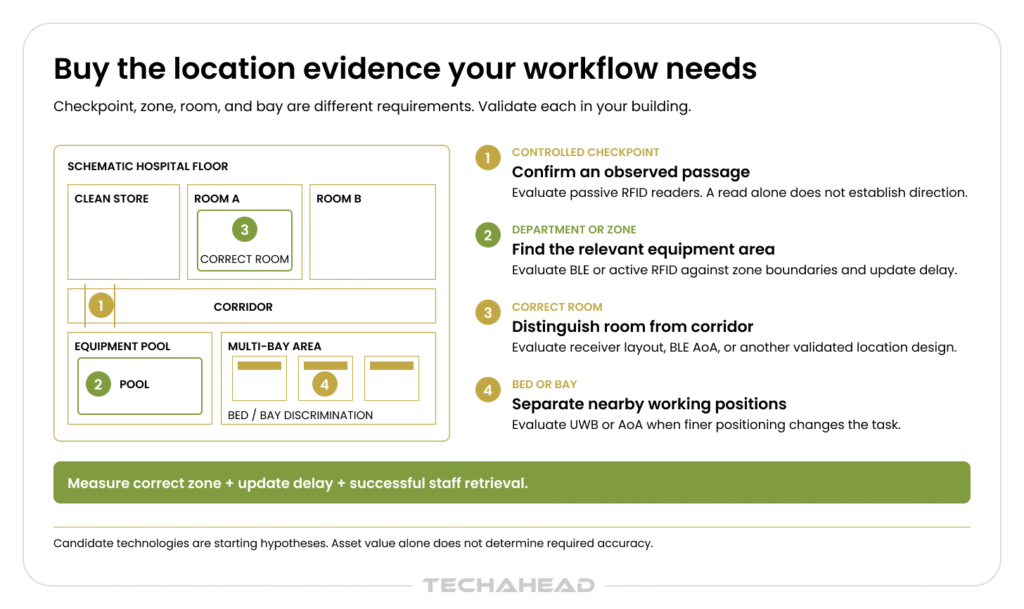
Passive RFID tags obtain operating power from the reader; active RFID tags have their own power source. That distinction changes tag maintenance and deployment design. The FDA’s RFID overview describes both forms as part of broader RFID technology used in hospitals and other healthcare applications.
For equipment inventory or controlled transfers, passive UHF RFID can support handheld reads or fixed-reader observations. RFID tracking is also used beyond equipment for surgical instruments and medications. Its value depends on whether the equipment actually passes the intended detection point and whether the read is correctly associated with the workflow. RFID tags can also help verify medication authenticity for regulatory compliance and patient safety.
Related Read: IoT App Development (2026 Guide)
Ask the supplier to demonstrate:
Active RFID can support other location designs, with battery servicing added to the operating model. Request the specific frequency, positioning method, receiver layout, and tag behavior rather than treating “RFID” as a complete specification. GS1 notes that read range and detection volume depend on several configuration factors; read distance is not equivalent to positional accuracy.
Conventional BLE RSSI approaches use received signal strength as an input to location estimation. In a hospital, test the resulting room or zone classification around walls, equipment clusters, doors, and moving people.
Bluetooth Angle of Arrival (AoA) adds directional measurements. A transmitting asset tag sends a signal that a locator’s antenna array uses to estimate direction. Bluetooth SIG describes this architecture and its potential for high-accuracy positioning.
An AoA proposal needs locator placement and calibration plans. Before reusing BLE-capable Wi-Fi access points, check:
Bluetooth Channel Sounding adds distance measurements between compatible devices. Bluetooth SIG’s June 2026 coverage discusses endpoint support and combining distance with direction. Its feature documentation explains that measurements require an implementation-specific calculation algorithm. Evaluate the complete positioning solution: distance to one device does not uniquely identify a room.
UWB ranging uses signal timing to estimate distance. Its capabilities make it a candidate for precise location requirements, but anchor placement, obstructions, and the chosen positioning design remain important. FiRa’s technical FAQ explains the effects of propagation conditions and material barriers.
Test tags behind equipment, coverage transitions, and anchor disconnection. Include installation access, power, backhaul, and calibration. Extra precision should produce a measurable workflow improvement; finding the correct pump store may already meet your need.
The following hospital asset tracking technology comparison is a scoping matrix. Each candidate needs validation against the actual building and workflow; the rows are not universal technology prescriptions.
| Asset and workflow | Required location evidence | Candidate architecture and infrastructure | Environmental checks | Essential integration |
| Infusion pumps: retrieve and redistribute | Correct storage room or clinical zone; fresh location | BLE receivers or AoA locators; test whether finer positioning adds value | Adjacent rooms, dense pump storage, tag orientation | Asset register, cleaning status, maintenance restrictions |
| Wheelchairs: stock and transfer | Department counts and controlled transfer observations | Passive RFID checkpoints for controlled routes; BLE for ongoing visibility | Group movements, missed routes, detection near portals | Inventory and equipment dispatch |
| Portable monitors: find a ready unit | Room or zone location plus readiness status | BLE or active RFID design matched to required granularity | Walls, bedside obstructions, tag attachment | Maintenance system; device status where available |
| Ventilators: locate eligible equipment | Current location and explicit eligibility for use | BLE, AoA, or UWB according to retrieval requirements | Crowded clinical areas, movement between floors | Maintenance, cleaning, and reservation records |
| Mobile imaging equipment: allocation | Department or room; bay position only where needed | Broad tracking with selective AoA/UWB precision | Equipment body, parking geometry, coverage transitions | Scheduling, dispatch, and maintenance |
| RPM kits: dispatch and returns | Custody events and reconciliation at hospital boundaries | RFID/barcode handoffs; BLE where local visibility helps | Packing, grouped returns, unread items | Kit inventory, fulfillment, and return processing |
In practice, mobile equipment can be hard to find without asset tracking systems, and some hospitals report roughly 30% becomes unlocatable. RTLS can improve equipment utilization by 20–30% when requirements are matched to asset class and zone.
For RPM owners, off-site dispatch, custody, patient assignment, connectivity, and returns need a separate design. For device teams, an attached location tag does not establish operating state or clinical performance.
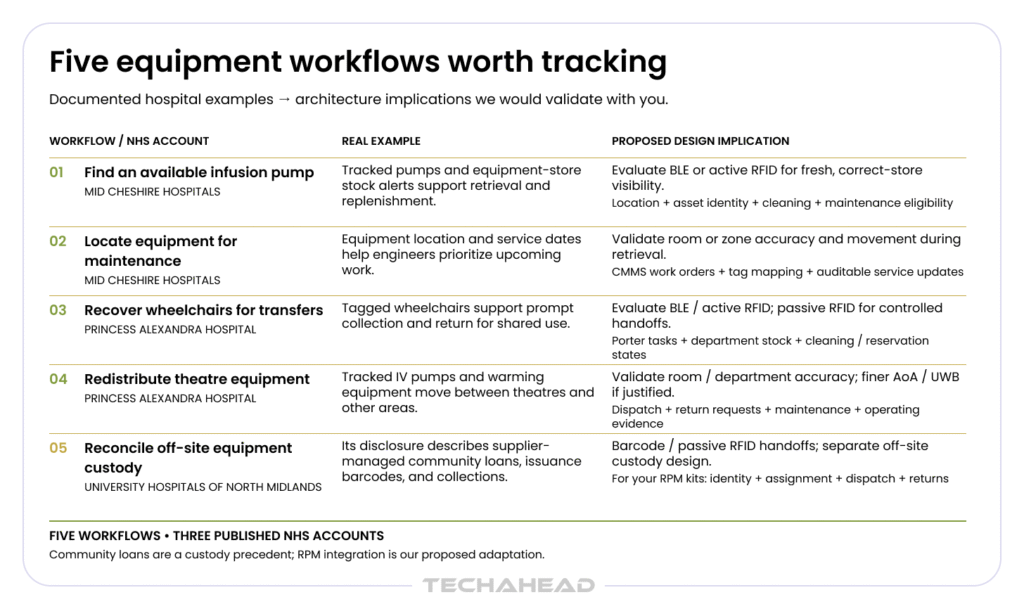
These five priorities follow the equipment workflows above. The examples come from published NHS accounts, including several workflows within the same deployment. They demonstrate operational needs; our architecture recommendations below require validation in your hospital.
Mid Cheshire Hospitals’ May 2025 case study describes tracking infusion pumps and alerting staff when equipment-store inventory falls below defined stock levels, with reducing shift searching as a core objective. It connects retrieval with replenishment rather than leaving staff to search individually.
The same Mid Cheshire deployment makes maintenance dates accessible alongside equipment location and supports engineers prioritizing upcoming service work as part of proactive maintenance across the asset life cycle. This is a separate task from clinicians finding an available device.
Princess Alexandra Hospital’s published RTLS account documents tagged non-collapsible wheelchairs and the need to return or collect them promptly. Even 20 minutes per shift spent searching can cost hospitals more than $2,500 annually per staff member, which is why these systems help reduce costs. Its initial positioning problems also show why adjacent-room testing matters.
Princess Alexandra also tracks IV pumps and patient-warming equipment that move from theatres to other areas. Hospitals lose $4,000 per bed annually to misplaced equipment, especially when limited shared inventory includes high value equipment, surgical equipment, and other valuable assets. The account describes collection needs for this limited shared inventory, linking location to allocation and engineering access for critical assets and other high value assets.
In an October 2025 disclosure, University Hospitals of North Midlands describes supplier-managed community loan equipment, barcode identification at patient issuance, and collection arrangements. This is a custody example, not evidence of an RPM deployment.
We recommend evaluating a hybrid hospital asset tracking architecture when your requirements vary enough to warrant different detection methods. This hybrid model also supports broader asset management solutions when different asset classes need different detection methods. One illustrative design could use passive RFID for controlled inventory movements, BLE for broad equipment visibility, and selective UWB coverage for a workflow needing finer positioning.
Hybrid can also describe a tag combining BLE discovery with UWB ranging. FiRa discusses using BLE for low-power discovery and activating UWB when fine ranging is needed. That is a different design from deploying separate tag populations across asset classes.
Both models need shared asset identity, history-preserving tag replacement, and rules resolving conflicting locations by freshness, source, coverage, and confidence.
An asset management system or unified inventory management layer helps prevent data gaps between clinical and IT records across multiple locations.
Related: Impact of Cloud Computing on Asset & Inventory Management
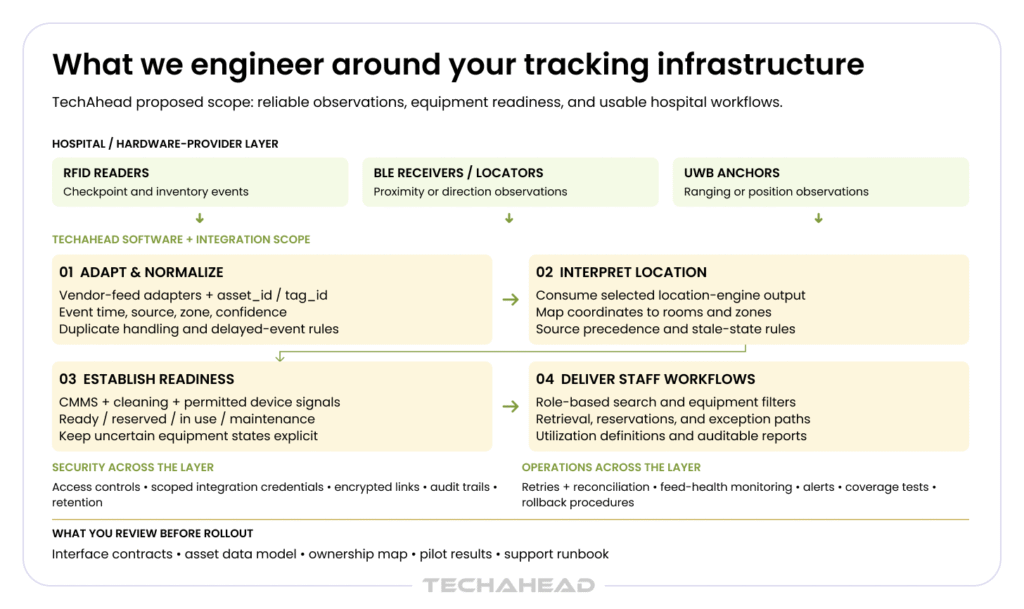
Our healthcare IoT solutions work can connect tracking observations with operational software and integrations. A useful architecture brief identifies which component owns detection, location interpretation, asset status, and workflow action.
Our proposed hospital RTLS integration scope includes:
We agree ownership with you and your hardware providers. Each added platform must justify its integration and maintenance workload.
We agree on the definition of utilization with you before dashboard development. Fortune’s August 2025 reporting describes how NYU Langone uses dashboards to manage hospital operations. Equipment in a patient room may be idle, reserved, awaiting collection, or actively operating, and real time data is what turns those observations into usable decisions.
We define the events and correction permissions behind equipment readiness:
This layer supports manage medical equipment decisions as part of healthcare asset tracking, not just location display.
Permitted telemetry, dispatch records, cleaning confirmations, and work orders support different states. Label location-derived or motion-derived inferences explicitly.
For medical equipment utilization, define the numerator and denominator. Active operating time divided by eligible service time answers a different question from time spent in a clinical zone divided by total calendar time. Document exclusions and periods with insufficient evidence. Stronger inventory management evidence can also reduce inflated capital expenses by helping hospitals avoid unnecessary purchases.
Validate reports against observed activity before reducing purchases. Low recorded utilization may reflect surplus, missing data, or a legitimate standby requirement.
Start with the asset register and computerized maintenance management system (CMMS), then add cleaning, dispatch, or reservation interfaces. Include EHR data for a defined care workflow with established permissions. APIs, HL7, or FHIR interfaces must match the receiving system’s requirements and support both operational systems and medical records without creating discrepancies.
Through healthcare software development services, we can develop the operational interfaces and applications that make these states usable. Procurement should also require exportable equipment identities, event history, timestamps, and documented interfaces so future changes remain practical for asset management and operational efficiency.
We evaluate tag battery life at your proposed update frequency and movement profile. Nordic Semiconductor’s guidance explains the tradeoff between BLE advertising interval, average power consumption, and discoverability.
Your operating plan should specify:
Radio conditions can degrade location observations. Separately, electromagnetic interference can affect medical-device performance. The FDA recommends assessing the hospital electromagnetic environment and coordinating equipment installation and management.
Include clinical engineering and facilities teams in the evaluation. Review device-manufacturer instructions and test plans for relevant areas. Tag and receiver placement near specialized equipment, including MRI areas, requires appropriate approval.
For connected medical-device teams, the FDA’s wireless technology guidance addresses wireless coexistence, quality of service, security, and electromagnetic compatibility. Determine applicability from the device’s intended use and system design.
An equipment identifier and location are not automatically patient information. Linking equipment events to identifiable patient care can change the privacy assessment. HHS explains the relevant PHI definition and Security Rule safeguards for ePHI.
Keep unnecessary patient details out of tags and equipment dashboards. Define:
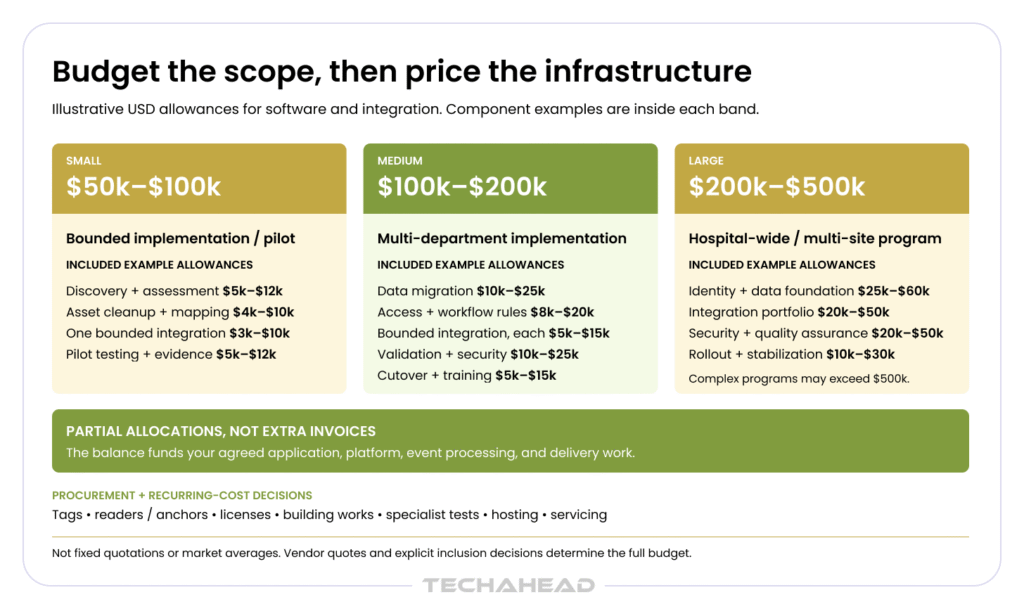
We frame hospital asset tracking implementation cost around deliverable scope. A bounded workflow implementation, a multi-department integration program, and a hospital-wide hybrid platform have different engineering and validation demands.
The smaller allowances sit inside their respective engagement bands. Discovery is part of the engagement, rather than a separately priced prerequisite. Business cases also often include savings from eliminating equipment searches, with some hospitals estimating over $500,000 annually.
| Engagement scope | Illustrative total | Examples of allowances inside that total |
| Small: bounded implementation or pilot covering selected assets, limited zones, a retrieval interface, and one defined integration | 50k–100k | Workflow discovery and technical assessment: 5k–12k; asset-register cleanup and tag mapping: 4k–10k; one bounded integration: 3k–10k; pilot testing and acceptance evidence: 5k–12k |
| Medium: multi-department implementation with shared asset identity, operational states, several interfaces, and phased deployment | 100k–200k | Asset data migration and reconciliation: 10k–25k; access and workflow rules: 8k–20k; a bounded integration: 5k–15k each; validation and security testing: 10k–25k; cutover and training: 5k–15k |
| Large: hospital-wide or multi-site program with hybrid feeds, enterprise integrations, reporting, and rollout governance | 200k–500k | Shared asset identity and data foundation: 25k–60k; scoped integration portfolio: 20k–50k; security and quality assurance: 20k–50k; rollout and stabilization: 10k–30k |
Establish what the engagement includes before comparing proposals. Third-party tags, readers, anchors, platform licenses, building works, and specialist testing require supplier quotes and explicit inclusion decisions. These engineering bands do not imply that every hardware purchase or recurring expense is covered. In hospital asset management, the more cost effective decision is often to narrow scope to the workflows and integrations that support ROI first, not to judge price in isolation.
Your total cost of ownership should include:
Measure retrieval effort, rentals, eligible availability, and avoidable purchasing against a baseline. Mobile equipment misplaced in unauthorized areas can create avoidable replacement costs and should be included in ROI assumptions. Treat recovered time as capacity until cash savings are demonstrated. McKinsey’s 2026 healthcare work analysis distinguishes released capacity from cost-structure changes. Applying that principle, we verify operating workload changes before assigning financial returns, improve visibility into mobile equipment use, help reduce costs, and prevent duplicate utilization and procurement benefits.
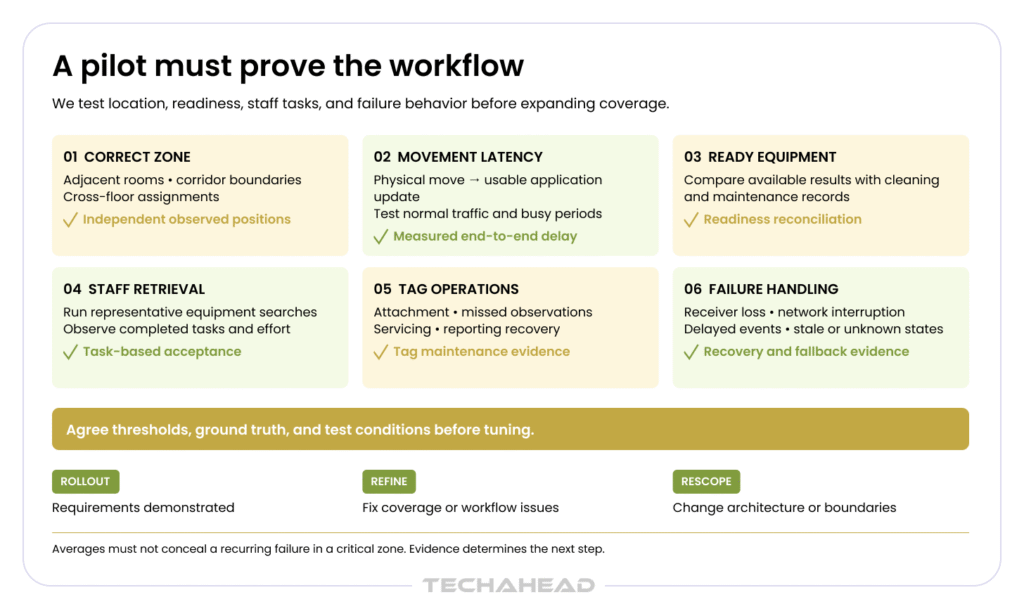
We design your hospital RTLS pilot around the conditions most likely to undermine the proposed system. Include adjacent rooms, dense storage, representative clinical areas, and typical equipment transfers. Observe different shifts and normal traffic.
Agree the acceptance measures before tuning begins:
Use independently observed positions and workflow records as ground truth. Document samples and conditions, then test after tuning on new observations. Set thresholds from operational need and risk; hospital-wide averages should not hide critical-zone failures.
Require an acceptance report, coverage plan, integration results, support ownership, and a rollout decision. Evidence may support expansion, narrower coverage, or a different positioning method.
We turn your requirements into a buildable scope:
Demand for hospital asset management and RFID adoption is rising, and the hospital asset tracking market is projected to reach $40.58 billion by 2031.
Our hospital asset tracking and IoT integration capabilities include RFID, BLE, connected equipment workflows, utilization analytics, and inventory integration for healthcare organizations operating across healthcare settings. We can help define the software and integration layer around selected tracking technologies, coordinate responsibilities with hardware providers, and plan a phased rollout.
We agree ownership for data, readiness, infrastructure, applications, and operations. TechAhead’s Claude & OpenAI services partner, SOC 2 Type II report, and ISO/IEC 27001 certification provide company-level assurance alongside your project-specific controls and tests.
Bring your equipment inventory, floor plans, existing tracking proposal, and integration requirements to TechAhead. We can help turn them into a scoped architecture and validation plan for effective healthcare asset tracking across healthcare environments with different operational constraints.
You gain a clearer basis for deciding what to deploy, what it will require to operate, and when the evidence supports expansion. Connect with us today.
Choose hospital asset tracking technology by workflow: passive RFID for controlled scans, BLE for ongoing visibility, and UWB where finer positioning improves a task. Validate accuracy, update delay, infrastructure, and integration requirements against your actual equipment movements.
Use a hybrid hospital asset tracking architecture when checkpoint inventory, continuous equipment visibility, and selective precision serve different workflows. At TechAhead, we define shared asset identities, source precedence, and stale-location rules before connecting multiple tracking feeds.
Test a medical equipment tracking system against independently observed positions in adjacent rooms, corridors, storage areas, and different floors. Measure correct-room classification, movement latency, and successful retrieval; an average coordinate error alone cannot establish workflow suitability.
Possibly, depending on access-point capabilities, supported tags, observation access, licensing, and coverage. Validate your proposed hospital RTLS in representative areas. Existing connectivity does not establish room-level positioning performance; additional receivers, locators, or configuration changes may be needed.
Set update frequency from the equipment retrieval requirement. Longer BLE advertising intervals can reduce power consumption while affecting discoverability. Evaluate movement-triggered updates, low-battery alerts, and servicing ownership; validate tag battery life under your actual configuration.
Start with shared asset identities and maintenance records in your CMMS. Add EHR interfaces for defined clinical workflows. At TechAhead, we scope hospital RTLS integration around supported APIs, event reconciliation, permissions, and clear system ownership.
Location alone cannot confirm equipment readiness or active use. Combine tracking observations with cleaning confirmations, maintenance restrictions, reservations, and permitted device telemetry. For medical equipment utilization, define operating-time evidence, eligible service time, and how inferred states are labeled.
HIPAA applicability depends on whether tracking data includes protected health information. Linking equipment events to identifiable patient care can create ePHI. Assess data flows, risk analysis, access controls, auditability, transmission safeguards, and applicable business associate agreements.
Involve clinical engineering before installation. Assess the electromagnetic environment, review device-manufacturer instructions, and evaluate tracking hardware near critical equipment. Your wireless coexistence and electromagnetic compatibility review should consider placement, operating conditions, and documented responses to interference.
Require agreed accuracy thresholds, representative workflows, integration tests, and failure-recovery evidence. At TechAhead, we structure hospital RTLS pilots around staff retrieval tasks, readiness checks, tag servicing, and documented ownership before recommending a phased rollout.
We use cookies to ensure our website functions properly, improve performance, and provide a personalized experience. You can choose which types of cookies to allow below.
Required for core functionality such as security, network management, and accessibility. These cannot be disabled.
Help us understand site traffic and user interactions so we can improve performance and usability.
Enable enhanced functionality and personalization such as language or region preferences.
Used to deliver relevant ads, track campaign performance, and measure advertising effectiveness.