


 Copy Link
 Share on X
 Share on Facebook
 Share on LinkedIn
Always Active
Required for core functionality such as security, network management, and accessibility. These cannot be disabled.

Uncover the transformative potential of digital and mobile solutions for your industry.





 Last Updated: Sep 18, 2026
Jun 20, 2026
Last Updated: Sep 18, 2026
Jun 20, 2026  765
765  14 min. Read


Key Takeaways


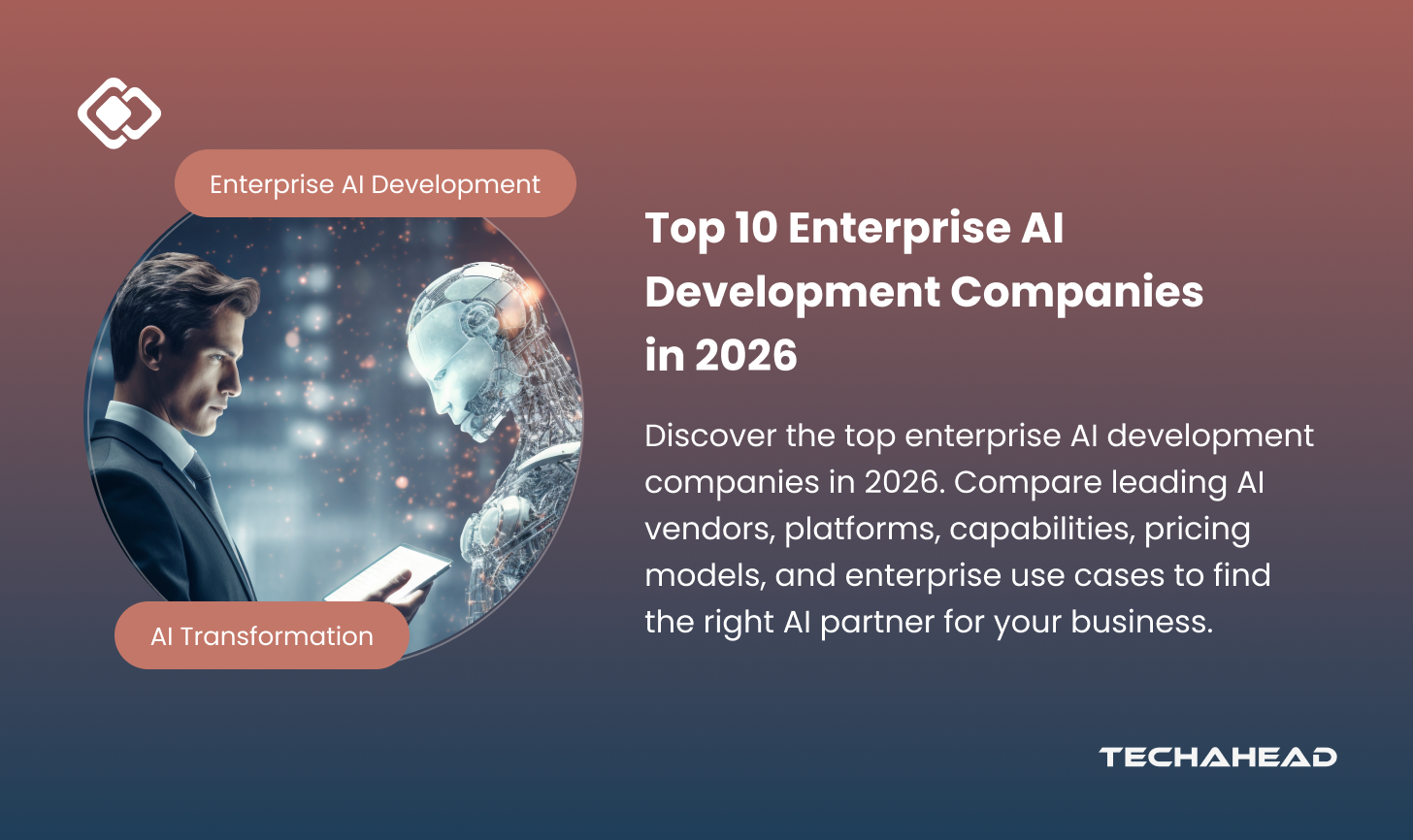
AI stopped being a side project for most enterprises a while back. By 2026, it’s woven into customer service, operations, software development, cybersecurity, analytics, basically anywhere a company makes decisions at scale.
What’s changed is how leaders evaluate the vendors behind all this. A flashy model demo doesn’t close deals anymore. Buyers want to know about governance, security posture, how something scales past a pilot, and whether it actually moves the needle on ROI. As more companies graduate from “let’s try AI” to “AI runs part of our business,” picking the right partner matters more than it used to.
“According to Grand View Research, the global Enterprise Artificial Intelligence market is projected to reach$155.2 billion by 2030, growing at a remarkable 37.6% CAGR between 2025 and 2030. The growth is being driven by increasing adoption of AI-powered automation, intelligent assistants, advanced analytics, and enterprise-wide digital transformation initiatives.”
That growth has pulled in a crowded field of competitors: foundation model labs, hyperscalers, infrastructure specialists, enterprise search players. Below, we break down ten companies worth knowing in 2026, what each of them is good at, and who should you look at them.
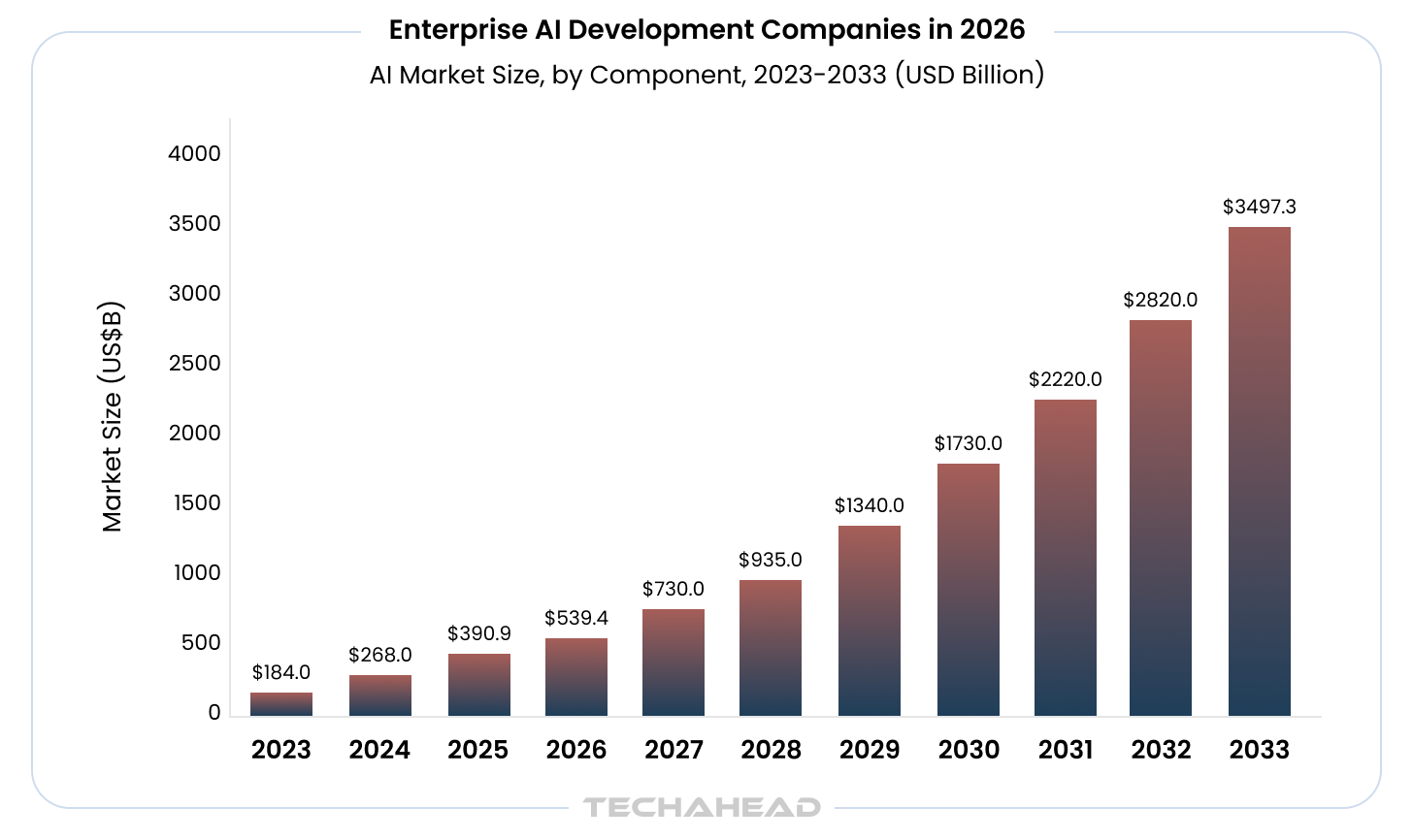
In this guide, we analyze the top enterprise AI development companies in 2026, comparing their capabilities, enterprise adoption, core strengths, and ideal use cases to help business leaders identify the right partner for long-term AI success.
Plenty of vendors promise transformation. Fewer can deliver it once you’re past a few hundred users, tangled in legacy systems, or operating under real compliance pressure. So we weighted a few things heavily:
Track record with real enterprises. Companies with traction across Fortune 500 clients or regulated industries tend to have already solved the boring-but-critical problems; uptime, security audits, data residency; that sink less mature vendors.
Range of capabilities. Generative AI development, AI agents enterprise search, automation, predictive analytics, custom model work: we looked at how many of these a company could credibly support, not just one flashy use case.
Security and governance. This is a boardroom topic now, not just an IT checkbox. We looked at how each company handles access control, model governance, and compliance readiness.
Ability to scale. AI projects rarely stay contained to one team. We checked whether each vendor’s approach holds up once a deployment spreads across departments and existing tech stacks.
Actual business outcomes. Capabilities are nice; results are what matter. We looked for evidence of productivity gains, cost reduction, or faster decision-making tied to real deployments.
Here, you will discover trusted enterprise AI development company that deliver high-quality mobile applications for startups, enterprises, and global brands.
Company Overview
TechAhead has built its reputation by skipping the one-size-fits-all platform pitch. The company designs custom AI systems around what a specific business actually needs; AI agents, generative AI tools, workflow automation, and integrations into existing enterprise software.
In 2026, TechAhead became Claude & OpenAI Services Partner; a status Claude and OpenAI grants to firms it recognizes for designing, implementing, and scaling production-grade AI solutions on its models and APIs. As CEO Vikas Kaushik puts it
“Our focus is on delivering real business outcomes — whether that’s improving operational efficiency, enhancing customer experiences, or enabling new digital products — using Claude and OpenAI’s models as part of a broader solution strategy.”
What Makes TechAhead Stand Out
The company backs that up with real certifications like SOC 2 Type II, plus AWS Advanced Tier partner status. With 16+ years in business and 2,500+ apps and software projects delivered, their strength lies in transforming AI concepts into production-ready business solutions. Its combination of AI expertise, software engineering capabilities, and enterprise implementation experience makes it a strong partner for organizations pursuing long-term AI transformation initiatives.
Company Overview
Addepto leans hard into the data side of AI; machine learning, predictive analytics, computer vision, and the data engineering work that has to happen before any of that is useful. Retail, manufacturing, finance, and logistics companies choose addepto when they’ve got a lot of data and not enough insight pulled from it. Worth noting: Addepto was acquired by KMS Technology in December 2025, so prospective clients are effectively evaluating the combined entity now.
Areas of AI Expertise
Why they made the list
Addepto combines AI development with strong data engineering capabilities, making it a solid choice for organizations looking to build intelligent solutions on top of large and complex datasets.
Company Overview
STX Next is a technology company that comes from a software engineering background, with Python roots dating back to 2005, and has extended that into AI product development, NLP, and predictive analytics. It’s grown partly through acquisition (Brainhub, Ermlab) alongside organic growth, and now runs a US-facing team specifically to support American clients.
Areas of AI Expertise
Why they made the list
STX Next stands out for its ability to combine AI expertise with scalable software engineering, helping organizations build reliable AI-powered applications.
Company Overview
Machine learning, predictive analytics, and generative AI solutions are the areas of expertise for ThirdEye Data, an AI and data engineering firm situated in Silicon Valley. The organization, which was established in 2010, assists businesses in using data to enhance decision-making, automate procedures, and promote corporate expansion.
Areas of AI Expertise
Why they made the list
ThirdEye Data stands out for its strong foundation in data engineering and AI implementation. Its expertise in transforming complex datasets into actionable business insights makes it a valuable partner for enterprises pursuing data-driven AI initiatives.
Company Overview
Oxagile has carved out a niche in media, entertainment, healthcare, and telecom, where the data is heavy on video and content. Recommendation engines, video analytics, and computer vision are where Oxagile’s experience tends to pay off most.
Areas of AI Expertise
Why they made the list
Oxagile has developed a strong reputation for applying AI to content-driven and data-intensive business environments.
Company Overview
HatchWorks AI was named the #1 AI Services Company by Clutch and built its delivery model around a proprietary methodology it calls Generative-Driven Development (GenDD), using AI throughout the software build process itself, not just in the finished product. Founded in 2016, the company pairs US-based strategy and leadership with nearshore engineering teams across Latin America, all working in US time zones.
Areas of AI Expertise
Why they made the list
HatchWorks focus on automation and operational efficiency which makes it a valuable partner for enterprises pursuing practical AI adoption.
Company Overview
Qubika is a product engineering shop at its core, formed from the merger of Moove It and December Labs. Its AI work, generative AI, ML, data platforms, tends to show up embedded in client-facing software rather than as a standalone offering. It holds a Databricks Gold Tier partnership and AWS Advanced Tier status.
Areas of AI Expertise
Why they made the list
Qubika combines product innovation with AI expertise, helping organizations accelerate digital transformation initiatives.
Company Overview
InData Labs is an AI and big data consultancy that helps organizations leverage machine learning and analytics to improve business performance. The company has experience delivering AI solutions across multiple industries.
Areas of AI Expertise
Why they made the list
The company excels at transforming complex business data into actionable insights through AI-driven solutions.
Company Overview
Netguru blends product design and engineering with AI strategy work, building generative AI and automation into the kind of polished, user-facing products that startups and scale-ups need to compete. It’s a certified B Corporation, which may matter to organizations weighing ESG criteria alongside technical fit.
Areas of AI Expertise
Why they made the list
Netguru brings together product design, engineering, and AI expertise to help businesses create user-focused digital experiences.
Company Overview
Turing takes a different approach entirely, rather than building products itself, it connects enterprises and AI labs with vetted engineers, data scientists, and domain experts. Originally a developer-staffing platform, it has shifted significantly toward frontier AI work, model training data, evals, and reinforcement learning support for AI labs.
Areas of AI Expertise
Why they made the list
Turing provides enterprises with access to specialized AI talent and engineering expertise, helping accelerate AI development initiatives.
| Company | Strongest At | Best Fit For |
| TechAhead | Custom Enterprise AI Development | End-to-end AI implementation |
| Addepto | Data-Driven AI Solutions | Data-heavy organizations |
| STX Next | AI-Powered Software Engineering | Teams building AI-enabled products |
| ThirdEye Data | Data engineering & applied GenAI | Enterprises needing data-first AI builds |
| Oxagile | Media & Content Intelligence | Media, telecom, content platforms |
| HatchWorks AI | AI-augmented software delivery | ROI-driven mid-market & enterprise |
| Qubika | Product Innovation & AI Engineering | Companies building AI-powered products |
| InData Labs | Advanced Analytics & Machine Learning | Data-centric enterprises |
| Netguru | AI-Driven Product Development | Startups and scale-ups |
| Turing | AI Engineering Talent Solutions | Enterprises scaling AI teams fast |
Enterprise AI is no longer seen as an investment for the future. It has grown to be a crucial business skill for many companies, impacting decision-making, customer satisfaction, operational effectiveness, and productivity. This quick adoption across businesses is being driven by a number of factors.
AI Agents Are Moving Into Business Workflows
Organizations are increasingly using AI agents to manage repetitive jobs, support staff, and automate multi-step procedures. AI agents, in contrast to conventional automation technologies, are able to comprehend context, communicate with corporate systems, and carry out tasks with little assistance from humans. Consequently, companies are utilizing AI agents to improve staff productivity, corporate knowledge management, customer service, and sales operations.
Generative AI Is Delivering Enterprise Value
Beyond content creation, generative AI development has advanced significantly. Large language models are being used by businesses to power internal assistants, automate document processing, boost consumer interactions, and increase information discovery. Teams are using these apps to save manual labor while increasing productivity and uniformity throughout company operations.
Data Is Becoming More Actionable
Large amounts of organized and unstructured data may be instantly analyzed by contemporary AI systems. As a result, businesses can see trends, find opportunities, and make choices more quickly by using insights rather than guesswork. This capacity is turning into a major competitive advantage for businesses handling complicated processes.
AI Is Strengthening Operational Efficiency
AI was first used by many companies to increase productivity. These days, businesses are using artificial intelligence to better resource allocation across departments, automate workflows, streamline supply chains, and save operating expenses. One of the main causes of the ongoing surge in corporate AI investment is this transition from testing to operational effect.
Enterprise AI Platforms Are Becoming More Accessible
Adoption obstacles have decreased due to the increasing availability of cloud infrastructure, pre-trained models, and AI development frameworks. AI technologies may now be implemented by organizations more quickly than in the past while upholding security, governance, and compliance requirements. Businesses are anticipated to extend deployments outside specific departments and more thoroughly incorporate AI into routine company operations as AI development technologies continue to advance.
Businesses are moving from testing to execution as enterprise AI adoption is picking up speed. Finding the ideal partner to successfully apply AI technology is now the true problem, not gaining access to it. Choosing a firm that comprehends both the technology and the business effect behind it is crucial for success, whether you’re wanting to automate processes, improve decision-making, enhance client experiences, or create unique AI solutions. The ideal generative AI development partner will assist you in developing scalable solutions that yield quantifiable outcomes now and lay the groundwork for future expansion and innovation.
Enterprise AI development companies go beyond application development by building systems that can learn from data, automate decisions, and improve over time. They combine expertise in machine learning, generative AI, data engineering, and enterprise integration to create intelligent solutions that solve business problems at scale.
Beyond technical expertise, organizations should assess the company’s experience with enterprise integrations, data security, AI governance, scalability, and post-deployment support. A strong AI partner should understand both the technology and the business processes the solution is intended to improve.
Yes. Modern AI solutions are typically designed to integrate with ERP platforms, CRM systems, cloud infrastructure, knowledge bases, and internal business applications. Successful integration ensures that AI becomes part of existing workflows rather than operating as a disconnected tool.
AI agents are increasingly being used to automate repetitive tasks, support customer service operations, manage internal knowledge requests, assist employees with research, and streamline multi-step workflows. Unlike traditional automation tools, AI agents can understand context and adapt to changing inputs.
It depends on the business objective. Off-the-shelf tools can accelerate adoption for common use cases, while custom AI development provides greater flexibility, deeper integrations, and solutions tailored to specific operational requirements. Many enterprises combine both approaches as part of their AI strategy.
Implementation timelines vary based on project complexity, data readiness, integration requirements, and governance considerations. Simple AI applications may take a few months, while enterprise-wide AI initiatives involving multiple systems and business units often require phased deployments over a longer period.
Healthcare, financial services, retail, manufacturing, logistics, and enterprise software companies are among the sectors experiencing significant returns from AI adoption. Common benefits include improved operational efficiency, faster decision-making, cost reduction, and enhanced customer experiences.
Long-term success depends on clear business objectives, high-quality data, strong governance practices, and continuous optimization after deployment. Organizations that treat AI as an ongoing business capability rather than a one-time technology project are more likely to achieve sustainable results.
We use cookies to ensure our website functions properly, improve performance, and provide a personalized experience. You can choose which types of cookies to allow below.
Required for core functionality such as security, network management, and accessibility. These cannot be disabled.
Help us understand site traffic and user interactions so we can improve performance and usability.
Enable enhanced functionality and personalization such as language or region preferences.
Used to deliver relevant ads, track campaign performance, and measure advertising effectiveness.