


 Copy Link
 Share on X
 Share on Facebook
 Share on LinkedIn


Always Active
Required for core functionality such as security, network management, and accessibility. These cannot be disabled.

Uncover the transformative potential of digital and mobile solutions for your industry.





 Last Updated: Sep 18, 2026
Aug 3, 2026
Last Updated: Sep 18, 2026
Aug 3, 2026  267
267  17 min. Read


Key Takeaways


Construction is no longer just about managing materials, crews, and project timelines on-site. As projects become more complex, construction companies are investing in digital tools to connect field teams, automate workflows, improve reporting, and make faster decisions.
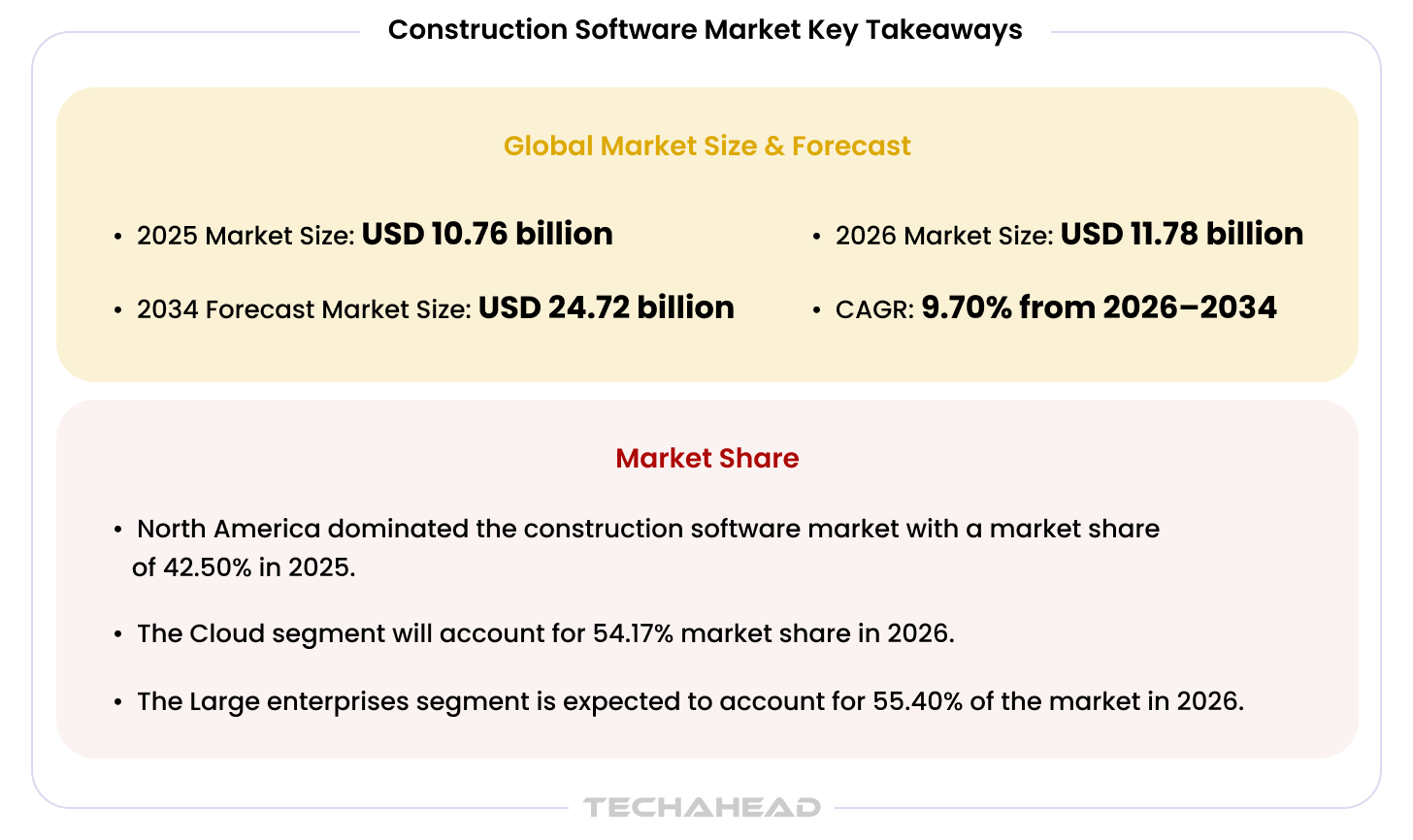
The transition is clearly obvious in the market. The worldwide construction software market was valued at $10.76 billion in 2025 and is expected to reach $24.72 billion by 2034, expanding at a 9.7% CAGR. North America accounted for 42.5% of the market in 2025, indicating a significant demand for digital construction solutions.
Mobile technology is becoming an increasingly significant aspect of this change. Many companies now see mobile-first, cloud-based crew apps as a critical opportunity to integrate construction sites with central project teams in real time. For contractors, builders, and construction companies, the question is not about whether to digitize. It is finding a construction app development company capable of transforming complicated field and back-office procedures into secure, scalable software.
The guide covers the 10 best construction app development companies in 2026, comparing their expertise, capabilities, and ideal use cases to help you choose the right technology partner.
Choosing a construction app development business is more than just finding a team that can create an iOS or Android app. For a construction company, the most important consideration is whether the technology partner knows how work is completed across the job site, project office, contractors, and management team.
A useful construction app should address particular operational issues. Field workers may need to send daily reports from the construction site, project managers may want real-time status updates, and executives may desire a consolidated picture of schedules, expenses, documentation, and resources. If these operations are still fragmented among spreadsheets, email, messaging apps, and independent software, the ideal construction management app development partner should be able to integrate them into one unified platform.
Before comparing construction app developers, determine how the application may be improved. A contractor trying to digitize field reports will have very different needs than a huge construction company developing a project management platform.
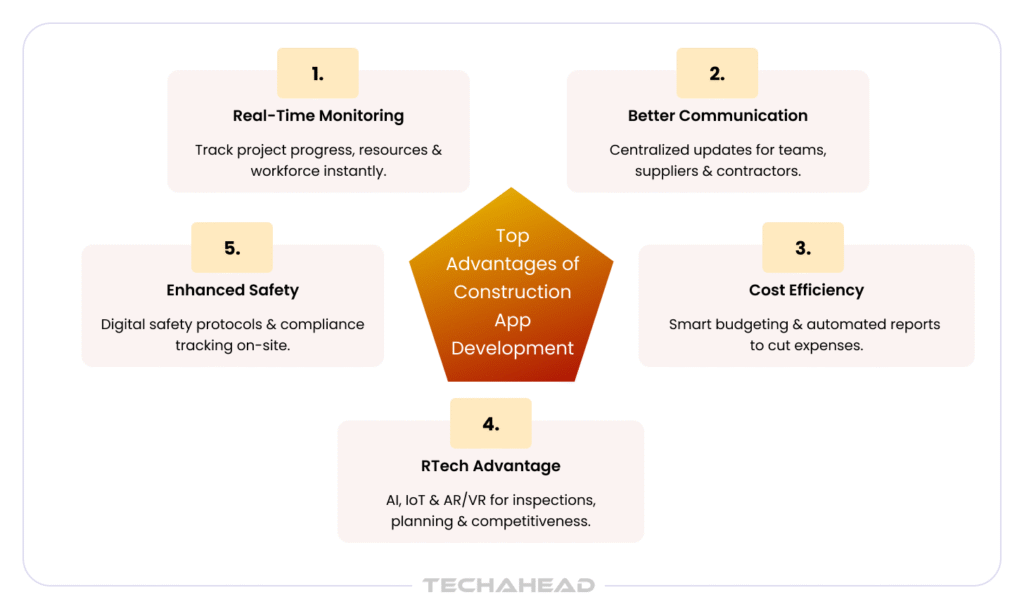
Look for a development partner that can support:
This is when the distinction between a simple construction mobile app and an enterprise-grade platform becomes apparent. The application must match how your teams work now while also allowing for additional features as the organization expands.
Construction software is increasingly required to operate outside the office. A mobile-first experience enables supervisors and field workers to collect information as it happens, rather than inputting it later from a desktop. The backend must also manage data securely across various projects, users, locations, and devices.
For this reason, it is worth evaluating whether a vendor has experience beyond mobile development alone. A partner with expertise in cloud application development can design the infrastructure needed to scale project data, APIs, integrations, and user access as adoption grows. Similarly, AI development services can add practical capabilities such as automated workflows, intelligent document processing, predictive analysis, and enterprise search rather than treating AI as a standalone feature.
For businesses updating spreadsheets or outdated construction software, modernization experience is also important. The proper partner should be able to integrate a new application with current systems rather than forcing the company to rebuild everything from scratch.
TechAhead’s mobile app development services cover native and cross-platform applications, along with backend systems, cloud infrastructure, AI capabilities, web platforms, and third-party integrations. That broader product-engineering approach is particularly relevant when a construction app needs to become part of a larger digital ecosystem rather than remain a standalone mobile tool.
Before signing with a construction software development company, ask:
These questions are more important than a large list of technologies. A technically competent team may nonetheless be the incorrect choice if it does not comprehend construction workflows or plan for the industry’s operational realities. With these parameters in mind, the following construction app development businesses are distinguished by their ability to provide scalable mobile, cloud, and software solutions for construction and associated enterprise use cases.
The best construction app development firm depends on the specific project at hand. A field reporting app, a construction ERP, an estimating platform, and an enterprise project management system require vastly diverse technological capabilities.
The firms mentioned below have been selected based on their documented construction software work, mobile development skills, enterprise engineering experience, integrations, and construction-specific solutions. Rather than treating all vendors as equivalent, the list highlights the company’s most significant aspects for a construction customer.
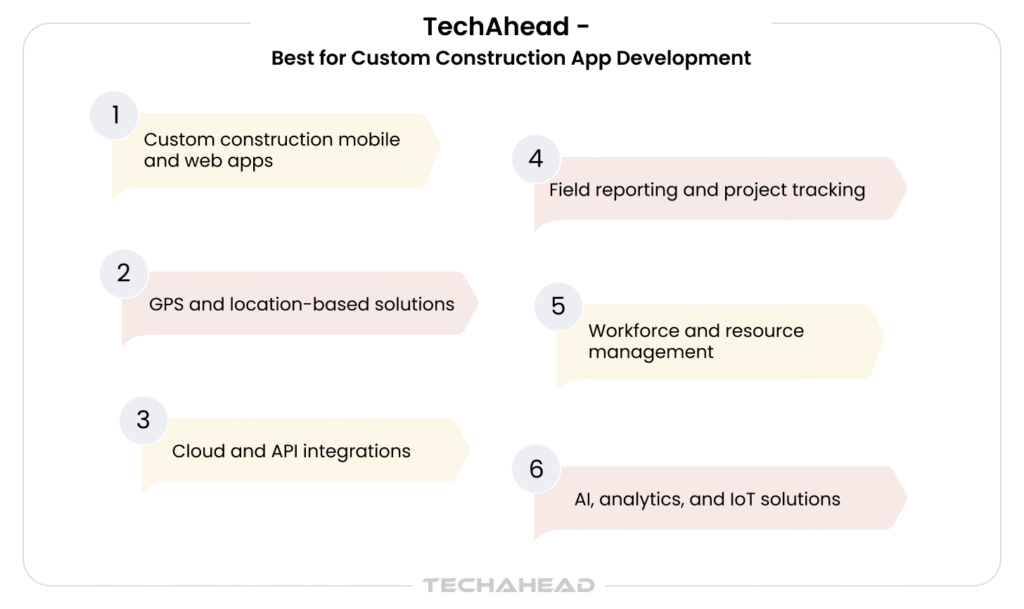
TechAhead creates custom software development services and mobile applications for contractors, builders, and construction companies. Its features include field reporting, project tracking, workforce management, cloud platforms, system integrations, and AI-powered analytics.
A prominent project is the Lafarge Construction App, created for the worldwide construction materials corporation. TechAhead used location-based technologies, job-site data, and real-time dealer connectivity to solve GPS errors, product mismatches, and disconnected dealers communications. The published case study shows a 40% increase in consumer inquiries, a 20% decrease in sales and marketing expenditures, and an 80%+ reduction in GPS-related mistakes.
Key construction capabilities:
Best for: Construction enterprises, contractors, and building-material companies that need custom software built around their existing workflows.
ScienceSoft delivers a long history of software engineering experience to construction technology, with proven work in mobile applications, field operations, ERP connections, and construction-related SaaS offerings. Its building portfolio includes an iOS roof-sketching application that leverages GPS and project photos to assist roofing crews in creating measurements and bids on-site.
The business has also created mobile document management software for contractors and engineers working in an IFS ERP environment. That makes ScienceSoft especially useful when the objective is to connect a mobile experience to existing corporate systems rather than construct an isolated application.
Key construction capabilities:
Best for: Construction companies and contractors that need mobile tools tightly integrated with existing ERP or enterprise systems rather than standalone software.
Chetu offers a focused construction software practice that covers numerous operational areas rather than addressing construction as a broad industrial vertical. It provides documented services such as project management, estimating, accounting, equipment management, BIM integration, submittals, and mobile field apps.
Its construction accounting services, for example, include budget modules, cost-code databases, estimating and bidding interfaces, and linkages with ERP and business intelligence systems. Chetu also creates construction submittal software that manages drawings, specifications, inspection reports, RFIs, and other project paperwork.
Key construction capabilities:
Best for: Contractors and construction businesses that need software built around specific industry workflows such as estimating, accounting, bidding, or document control.
EY works with engineering and construction companies on digital transformation, technology strategy, and operational improvement. Its U.S. Engineering & Construction practice highlights technologies including BIM, digital twins, drones, blockchain, and 3D printing as tools reshaping construction delivery.
For companies dealing with complex capital projects, EY’s strength is less about building a standalone mobile app and more about connecting technology with broader business and construction processes. Its current work also focuses on data strategy and technology alignment for capital projects.
Key construction capabilities:
Best for: Large construction and engineering organizations looking for digital transformation, technology strategy, and enterprise-level construction solutions.
Deloitte combines engineering, technology consulting, and construction industry expertise. Its 2026 Engineering & Construction outlook highlights AI-powered scheduling, computer vision, BIM, digital twins, IoT, robotics, and connected jobsite technologies as important areas of construction’s digital transformation.
Its Deloitte Engineering practice also provides software platform engineering, software product and app development, data and AI engineering, and cybersecurity, giving construction enterprises access to both industry consulting and technology implementation capabilities.
Key construction capabilities:
Best for: Large construction and engineering enterprises pursuing AI, connected construction, data modernization, and complex technology transformation.
DataArt is an enterprise software engineering firm with a heavy emphasis on data, analytics, and digital platforms. Its construction-related work includes a digital commerce platform designed for UNACEM, a large cement producer, that integrates building supplies, ordering, credit management, delivery tracking, and customer care into a single system.
The project featured geolocation, delivery status monitoring, credit assignment, order management, and customer feedback. That knowledge makes DataArt a viable option for construction companies whose challenges extend beyond an app design to the underlying data and digital ecosystems.
Key construction capabilities:
Best for: Construction-material companies, distributors, and enterprises that need data-heavy digital platforms and integrations.
BairesDev offers a dedicated construction software development practice focused on custom applications for project management, scheduling, budgeting, resource allocation, and document management. It also highlights IoT-based monitoring and predictive maintenance as construction use cases.
Its model can be useful for construction companies that need additional engineering capacity alongside their existing technology team. BairesDev reports access to more than 4,000 software engineers across 100+ technologies, while its construction practice focuses on building solutions around individual business requirements rather than forcing teams into a standard product.
Key construction capabilities:
Best for: Construction enterprises that need scalable engineering capacity for a custom software initiative.
Intellectsoft creates comprehensive construction software solutions for businesses, contractors, and real estate organizations. It provides project management systems, site inspections, partner and vendor portals, ERP integration, cost estimation, bidding platforms, equipment tracking, scheduling, accounting, BIM assistance, budgeting and tendering, and inventory management.
To support complex construction operations, the firm uses advanced technologies such as AI, IoT, AR/VR, cloud computing, big data, and 2D/3D modeling. This makes it ideal for enterprises that want to automate many levels of their construction activities within a single ecosystem.
Key construction capabilities:
Best for: Construction businesses planning a scalable, enterprise-grade software platform with multiple integrated operational modules.
RaftLabs specializes in construction software for builders, developers, and construction organizations. Its construction portfolio comprises project management tools, field mobile applications, subcontractor portals, estimating software, and linkages with accounting and estimating systems.
The company’s field apps are built around actual site procedures, including daily reports, inspections, punch lists, and picture proof, with offline capability and synchronization when access is restored. It also provides a construction estimating system that includes digital quantity takeoffs, cost databases, bid assembly, and historical cost benchmarking.
Key construction capabilities:
Best for: Mid-market contractors and construction businesses replacing spreadsheets and disconnected workflows with custom software.
Cleveroad is a software development business with over 15 years of technical expertise, including bespoke software, mobile apps, product design, specialized development teams, and MVP development.
For construction organizations, its value lies mostly in custom product engineering rather than a strictly targeted construction software offering. This may be a good fit for firms with a defined product concept and a need for a team to design, build, and grow a web or mobile application.
Key capabilities:
Best for: Construction startups, technology providers, and businesses validating or launching a new construction-focused digital product.
The cost of producing a construction app is determined by the application’s functionality rather than the sector. A basic field reporting app will have a totally different budget than a corporate construction platform integrated with ERP, accounting, BIM, IoT, or AI systems.
| Construction App Type | Typical Complexity | Main Cost Drivers |
| Field reporting app | Low–Medium | Forms, photos, GPS, offline access |
| Project management app | Medium | Scheduling, dashboards, roles, integrations |
| Construction ERP | High | Finance, workforce, projects, reporting, integrations |
| AI-powered construction platform | High | AI models, data pipelines, automation, enterprise integrations |
Construction experience: Has the company developed software for contractors, builders, field teams, or other construction-related businesses?
The best construction app development company is not necessarily the one with the longest feature list. It is the one that understands your workflow, can integrate with the systems you already use, and has the engineering capability to support the product after launch. For a straightforward field application, a specialized development team may be enough. For a construction business planning a connected platform across mobile, cloud, ERP, analytics, and AI, the evaluation needs to go deeper.
TechAhead’s construction portfolio, including its Lafarge project, gives buyers a concrete example of that broader approach. If you already have a construction app idea, an existing system that needs modernization, or a workflow you want to digitize, custom software development services can help turn those requirements into a scalable product.
Construction app development costs vary based on the app’s features, platforms, integrations, user roles, security requirements, and overall complexity. A basic field reporting application will typically require less development than a construction management platform with ERP integration, offline functionality, AI, analytics, and multiple user dashboards.
A construction management app can take several months to develop, depending on its scope. The timeline is influenced by the number of features, UI/UX requirements, backend architecture, integrations, testing, and whether the application needs iOS, Android, web, or all three. Starting with an MVP can help construction companies launch core functionality sooner and expand the platform over time.
A construction mobile app should support the workflows that happen on and off the job site. Common features include daily reports, task management, project scheduling, GPS, photo and document sharing, inspections, workforce tracking, notifications, role-based access, offline functionality, dashboards, and integrations with existing construction software.
Yes. A construction app can be designed with offline functionality so field workers can capture reports, photos, inspections, and other project information without a reliable internet connection. The application can synchronize the stored data with the cloud once connectivity is restored. This is an important requirement to discuss when choosing a construction app development company.
Yes. Custom construction software can integrate with ERP, accounting, CRM, BIM, payroll, inventory, and other business systems through APIs or other integration methods. These connections allow project, workforce, financial, and operational data to move between systems instead of forcing teams to enter the same information multiple times.
Construction software can refer to a broad platform covering project management, estimating, accounting, scheduling, documents, workforce management, or other operations. A custom construction app is developed around a company’s specific workflows and requirements. Businesses often choose custom construction software development when existing products cannot accommodate their processes, integrations, or scalability requirements.
Start by evaluating construction industry experience, relevant case studies, mobile and cloud development capabilities, integration expertise, security practices, scalability, and post-launch support. Ask potential construction app developers to explain how they would handle your field workflows, existing systems, offline requirements, user roles, and future product expansion.
Yes. AI can be incorporated into construction software for use cases such as automated document processing, intelligent search, workflow automation, predictive analytics, reporting, and project insights. The right application depends on the company’s data, existing systems, and specific operational problem rather than simply adding AI as a standalone feature.
Yes. Construction software modernization can replace outdated interfaces, improve system architecture, move applications to the cloud, introduce mobile access, connect legacy systems through APIs, and add newer capabilities such as analytics or AI. Modernization can be a practical option when an existing system contains valuable business data and workflows that the company does not want to rebuild from scratch.
A construction-focused development partner is more likely to understand requirements such as job-site connectivity, field reporting, project documentation, workforce coordination, construction-system integrations, and multi-project data management. For complex projects, industry knowledge combined with mobile, cloud, integration, and enterprise software expertise can reduce the risk of building an application that works technically but does not fit the way construction teams operate.
We use cookies to ensure our website functions properly, improve performance, and provide a personalized experience. You can choose which types of cookies to allow below.
Required for core functionality such as security, network management, and accessibility. These cannot be disabled.
Help us understand site traffic and user interactions so we can improve performance and usability.
Enable enhanced functionality and personalization such as language or region preferences.
Used to deliver relevant ads, track campaign performance, and measure advertising effectiveness.