


 Copy Link
 Share on X
 Share on Facebook
 Share on LinkedIn
Always Active
Required for core functionality such as security, network management, and accessibility. These cannot be disabled.

Uncover the transformative potential of digital and mobile solutions for your industry.





 Last Updated: Sep 30, 2026
Sep 12, 2026
Last Updated: Sep 30, 2026
Sep 12, 2026  101
101  15 min. Read


Key Takeaways


More than 70% of midsize and large warehouses plan to have an AMR fleet running by the end of 2026, according to a recent Future Market Insights analysis of the mobile robot fleet traffic management market. That number says a lot about where this category is headed: fleet software isn’t a pilot-program line item anymore. It’s infrastructure.
The definition of “fleet management” has moved fast too. A decade ago it meant GPS dots on a map and a geofencing alert. Today it means orchestrating a mixed population of hardware, often from several vendors at once, under one control plane. A modern fleet platform typically needs to handle:
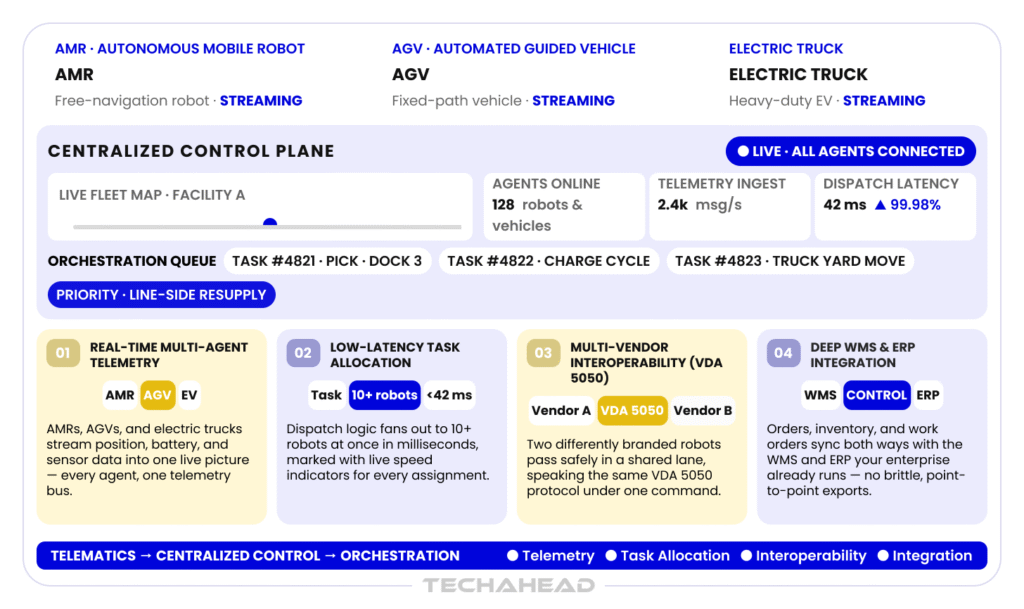
Picking the engineering partner who builds that layer is a strategic decision, not a procurement checkbox. It’s also easy to get it wrong if you compare vendors on hardware specs alone, rather than software architecture and long-term data ownership. TechAhead’s work in robot fleet management software is a useful reference point here: enterprises increasingly want a system that sits above the robot vendor, not one built inside it. This guide covers the ten fleet management software companies worth evaluating in 2026.
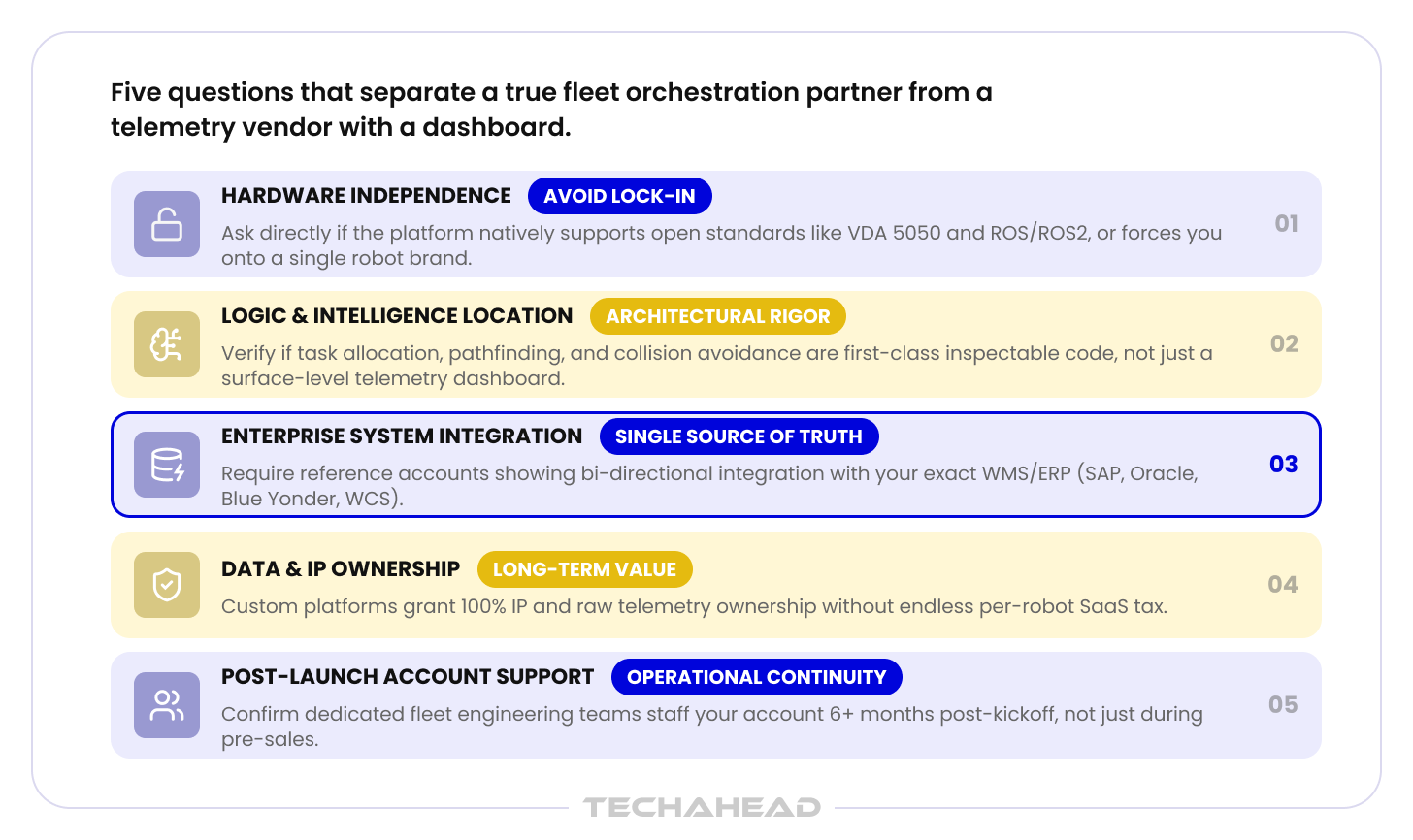
A few questions tend to separate a good vendor fit from an expensive mistake before you ever get to feature comparisons:
Hardware independence. If your floor already runs a mix of robots and AGVs from different manufacturers, a vendor locked to one hardware line will box you in within a year. Ask directly whether the platform supports open standards like VDA 5050 or works natively with ROS/ROS2 to support robot fleet operation software development, rather than requiring you to standardize on a single robot brand.
Where the intelligence actually lives. Some platforms are dashboards bolted onto someone else’s telemetry feed. Others build fleet coordination, task allocation, and predictive maintenance as first-class software, so the logic that keeps 200 robots from colliding in a narrow aisle is something your team can inspect and modify. That distinction matters once you scale past a single pilot site.
Integration depth with WMS and ERP. Fleet software that can’t talk cleanly to SAP, Oracle, Blue Yonder, or a legacy WCS just creates a second system of record nobody trusts. Ask for a reference customer running the exact integration you need, not a generic case study slide.
Who owns the data. Off-the-shelf SaaS platforms often meter access to your own telemetry and charge per-robot fees indefinitely. A custom-built platform costs more upfront but hands you full IP ownership, plus the freedom to build predictive models on your own operational history without asking a vendor’s permission first.
Who supports the account after launch. A five-person startup building your control plane carries a different risk profile than an established engineering firm with a dedicated fleet operations practice. Look for a partner that offers ongoing robot service, support, and maintenance well beyond the initial deployment, and ask who will staff the account six months in—not just who runs the kickoff call.
Must Read: Build vs Buy: Robot Fleet Management Software
| Company | Core Focus | Interoperability | Key Specialty |
| TechAhead | Robot fleet operations & enterprise logistics | High (VDA 5050, ROS/ROS2, REST/MQTT) | Physical AI, AMR/AGV control planes, custom enterprise integration |
| InOrbit | Autonomous robot operations (RobOps) | High (Open API, ROS) | Fleet observability, incident management, real-time tracking |
| Formant | Robotics data infrastructure & control | High (ROS/ROS2, custom SDKs) | Teleoperation, real-time streaming, cloud infrastructure |
| Locus Robotics | Warehouse AMR orchestration | High (LocusONE, WMS integration) | Task interleaving, multi-form-factor fleets, RaaS model |
| Seegrid | Material handling AMRs | Medium (Fleet Central, proprietary + WMS) | Vision-guided navigation, pallet trucks and tuggers |
| Vecna Robotics | Industrial fleet orchestration | High (Pivotal platform, WMS integration) | Autonomous forklifts, tuggers, human-robot workflow blending |
| Körber Supply Chain | Warehouse logistics & dispatch | High (WMS/WCS integrations) | End-to-end supply chain execution, distribution fleet management |
| Samsara | Connected vehicle operations | High (Open API hub) | Commercial GPS tracking, driver safety, ELD compliance |
| Motive | Fleet telematics & AI safety | High (open API, IoT hardware) | AI dashcams, ELD compliance, equipment and spend monitoring |
| Trimble MAPS | Commercial routing & navigation | High (enterprise APIs) | Truck-safe routing, hazmat planning, ETA calculation |
TechAhead builds custom fleet management software at the intersection of enterprise systems, IoT telemetry, and autonomous operations. Instead of selling a fixed product, the team engineers a modular control plane around whatever robot and autonomy stack a client already has, which matters once a fleet spans multiple facilities and vendors. On the technical side, their work typically includes:
Because the software is engineered rather than licensed, clients keep full IP ownership instead of paying indefinitely for a black-box platform. Teams already exploring autonomous decision-making elsewhere in the business will find TechAhead’s agentic AI development services extend naturally into fleet dispatch logic and exception handling.
Best for: Enterprise robot fleet operations and custom Physical AI engineering
InOrbit is built for teams that already have robots deployed and need a layer that shows what those robots are actually doing in real time. Rather than replacing a robot’s native autonomy stack, it sits above it as a RobOps infrastructure layer. Its core capabilities include:
That observability layer is where a lot of homegrown monitoring tools break down once a fleet grows past a handful of units, which is exactly the gap InOrbit was built to close.
Best for: RobOps data infrastructure and fleet observability
Formant approaches fleet management from the data side first. Its platform is built to ingest, store, and stream continuous telemetry from heterogeneous robotic fleets, which becomes the real bottleneck once a company moves from a five-robot pilot to a fifty-robot deployment. Technically, that shows up as:
Formant tends to appeal most to robotics companies scaling from pilot to enterprise, rather than enterprises buying their first fleet platform outright.
Best for: Cloud infrastructure and teleoperation
Locus Robotics spun out of the 3PL operator Quiet Logistics in 2014 and has since become one of the more recognizable names in warehouse automation. Its LocusONE platform is built around a few specific technical strengths:
The company’s billions of completed picks across live deployments give it one of the larger production datasets in this category, which shows up in how well the coordination engine handles edge cases.
Best for: Warehouse AMR orchestration at scale
Seegrid was founded in 2003 by robotics researcher Hans Moravec, and its core technology, infrastructure-free localization, became something of an industry standard: its AMRs navigate warehouses without magnetic strips or wire guidance embedded in the floor. That approach still underpins the company’s current lineup:
Independent analysts have repeatedly ranked Seegrid among the top AMR providers serving the US manufacturing and logistics market, and its two-decade operating history gives it a longer production track record than most newer entrants here.
Best for: Vision-guided material handling automation
Vecna Robotics, founded in 2018 as a spinout of the broader Vecna technology group, focuses on automating material handling tasks that still require close coordination between people and robots, like forklift operation and cart towing. Its technical foundation includes:
That human-in-the-loop philosophy is a meaningful differentiator for facilities not ready to go fully lights-out, and independent research firms have consistently ranked Vecna as a leader in the robot fleet management software category.
Best for: Human-robot workflow orchestration in industrial settings
Körber built its North American supply chain software foothold by acquiring Minneapolis-based HighJump, and that Minneapolis center remains a substantial operations hub, not a token sales office. On the technical side, the platform covers:
For enterprises already running Körber’s warehouse management suite, adding its fleet dispatch layer on top tends to be a more straightforward integration than bolting on a separate third-party system.
Best for: Integrated supply chain execution and dispatch
Samsara focuses on road logistics rather than indoor robotics, but its open API platform has become a common connective layer for enterprises linking vehicle fleets into broader supply chain infrastructure. Its core technical offering includes:
It’s a strong fit for organizations whose fleet challenge is primarily on-road vehicles rather than warehouse robotics.
Best for: Commercial vehicle telematics and connected operations
Motive, formerly known as KeepTruckin, has grown into one of the larger independent players in commercial fleet telematics. It combines IoT hardware with a cloud software layer, and its technical differentiators include:
That combination has made Motive especially popular with trucking and construction fleets focused on reducing accident rates and insurance costs.
Best for: AI-powered fleet safety and telematics
Trimble MAPS, built on the legacy of ALK Technologies, focuses specifically on the routing problem within fleet management rather than fleet coordination broadly. Its technical strengths include:
For companies whose fleet software stack is otherwise solid but whose routing logic is generic or outdated, Trimble MAPS is often a targeted upgrade rather than a full platform swap.
Best for: Commercial routing and truck-safe navigation
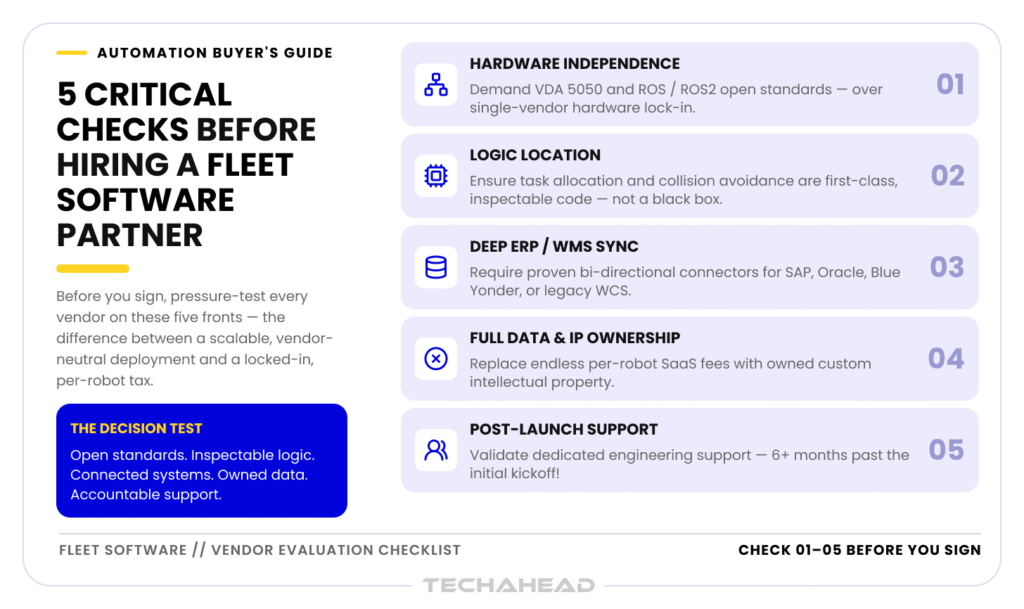
Those four questions surface the obvious risks. The less obvious ones usually show up after the contract is signed, once the pilot succeeds and the real scaling work begins.
The pilot-to-scale gap is where most fleet projects actually stall. A platform that comfortably coordinates fifteen robots in one facility can behave very differently at two hundred robots across four sites. Task allocation logic that looked instant in a demo can start queuing under real warehouse traffic, and a dashboard built for one operations manager doesn’t always hold up when three shifts and two regional teams pull from it simultaneously. Before signing anything, ask the vendor to walk through a customer that scaled past its original pilot footprint, and ask specifically what broke along the way. Any team that’s actually done this work will have an answer ready. A team that hasn’t will talk around the question.
Total cost of ownership rarely matches the sales conversation. A per-robot subscription fee looks manageable on a ten-robot deployment and considerably less manageable at three hundred. Custom-built platforms flip that math: higher upfront engineering cost, but no compounding per-unit fee as the fleet grows, and no vendor gatekeeping access to your own operational data down the line. Neither model is automatically correct. The right choice depends on how fast you expect the fleet to grow and how much long-term control your organization actually needs over the telemetry and predictive models the platform generates.
Timeline expectations deserve their own conversation, separate from the sales pitch. A control plane built to unify three different robot vendors under one dashboard is a materially different engineering effort than a single-vendor fleet dashboard, and vendors don’t always volunteer that distinction upfront. Ask for a realistic build timeline broken into phases, specifically when the first working integration ships versus when full multi-site orchestration goes live, so the internal stakeholders funding this project aren’t expecting a finished platform on day one of a six-month engagement.
Explore: API Development Services
Team continuity matters more than most buyers weigh it. Fleet software isn’t a one-time build. It needs ongoing tuning as facilities change, new hardware gets added, and warehouse management systems get upgraded on their own schedules. Ask who specifically supports the account after go-live, whether that’s the same engineers who built the platform or a separate support tier, and how quickly they can respond when a fleet-wide issue surfaces at 2 a.m. during a peak fulfillment window. The answer often says more about a vendor’s long-term reliability than anything in their sales deck.
Whether you’re standing up a control plane for a first AMR pilot or replacing a fleet system that’s stopped scaling with your operation, the engineering decisions made in the first few months often determine whether the platform still serves you in three years or becomes the thing everyone routes around. TechAhead’s fleet operations team works directly with logistics and manufacturing organizations to architect systems built for the hardware mix they actually have, not the one a vendor wishes they had. If you’re evaluating what a custom build would look like for your operation, TechAhead’s team can walk through your current stack and flag where an off-the-shelf platform would eventually box you in.
Fleet management software has quietly become one of the more consequential engineering decisions a logistics or manufacturing enterprise makes, precisely because it sits underneath everything else: the WMS, the ERP, the floor operations, and increasingly, the AI models making predictive maintenance and routing decisions in real time. The ten companies above span a real range, from robotics-first hardware vendors with their own software layer to infrastructure specialists that plug into whatever hardware you already own. The right fit depends less on brand recognition and more on how closely a vendor’s architecture matches the specific mix of robots, vehicles, and legacy systems already running your operation and whether you’ll actually own what gets built at the end of it.
Fleet management software helps businesses monitor, coordinate, and optimize fleets of vehicles, robots, and autonomous equipment through capabilities such as telemetry, task management, routing, and fleet orchestration.
Fleet management software development involves building platforms for fleet tracking, task allocation, telemetry, routing, automation, analytics, and integrations with enterprise systems such as WMS and ERP.
The article covers TechAhead, InOrbit, Formant, Locus Robotics, Seegrid, Vecna Robotics, Körber Supply Chain, Samsara, Motive, and Trimble MAPS.
AMR fleet management software coordinates autonomous mobile robots by managing tasks, robot status, telemetry, traffic, and communication with warehouse systems.
Modern fleet platforms can use open APIs, ROS/ROS2, and standards such as VDA 5050 to connect robots from different manufacturers through a common control layer.
Common technologies include ROS, ROS2, VDA 5050, MQTT, WebSockets, gRPC, REST APIs, IoT telemetry, AI, and machine learning, depending on the fleet’s requirements.
SaaS fleet software typically provides a ready-made platform through a subscription model, while custom fleet management software is built around specific hardware, workflows, integrations, and data requirements.
Consider its experience with your fleet type, interoperability requirements, WMS/ERP integrations, scalability, data ownership, development approach, and ongoing support after deployment.
We use cookies to ensure our website functions properly, improve performance, and provide a personalized experience. You can choose which types of cookies to allow below.
Required for core functionality such as security, network management, and accessibility. These cannot be disabled.
Help us understand site traffic and user interactions so we can improve performance and usability.
Enable enhanced functionality and personalization such as language or region preferences.
Used to deliver relevant ads, track campaign performance, and measure advertising effectiveness.