


 Copy Link
 Share on X
 Share on Facebook
 Share on LinkedIn


Always Active
Required for core functionality such as security, network management, and accessibility. These cannot be disabled.

Uncover the transformative potential of digital and mobile solutions for your industry.





 Last Updated: Oct 9, 2026
Jul 1, 2026
Last Updated: Oct 9, 2026
Jul 1, 2026  641
641  22 min. Read


Key Takeaways
AI automation stopped being a “we’re looking into it” conversation somewhere around 2024. Now it’s a deliverable with a due date. Boards want pilots in production, not in decks. Customers have gotten used to faster, more personalized service and don’t have much patience for software that can’t keep up. Companies that automated parts of their operations a year or two ago are already building on top of those systems — they’re not waiting.
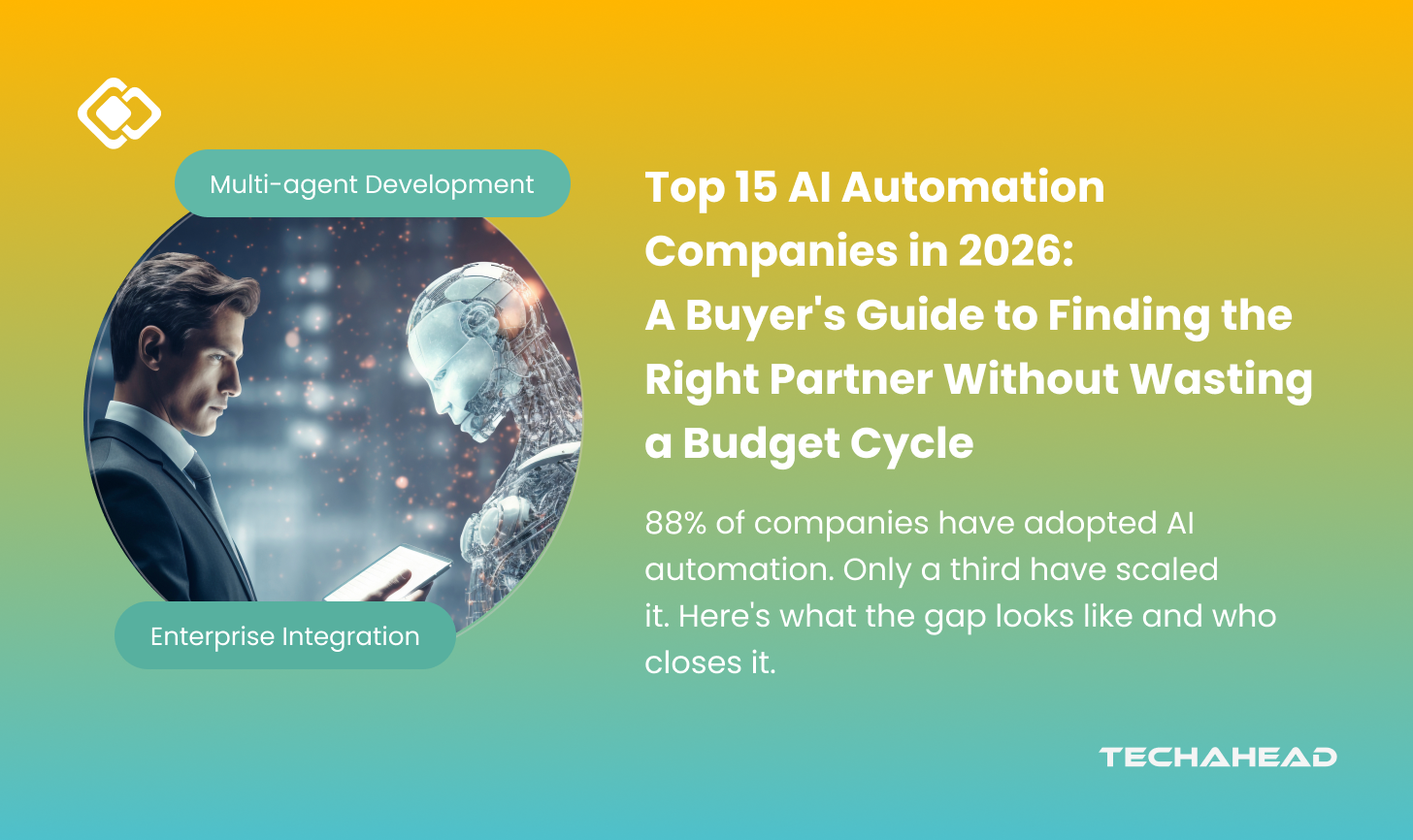
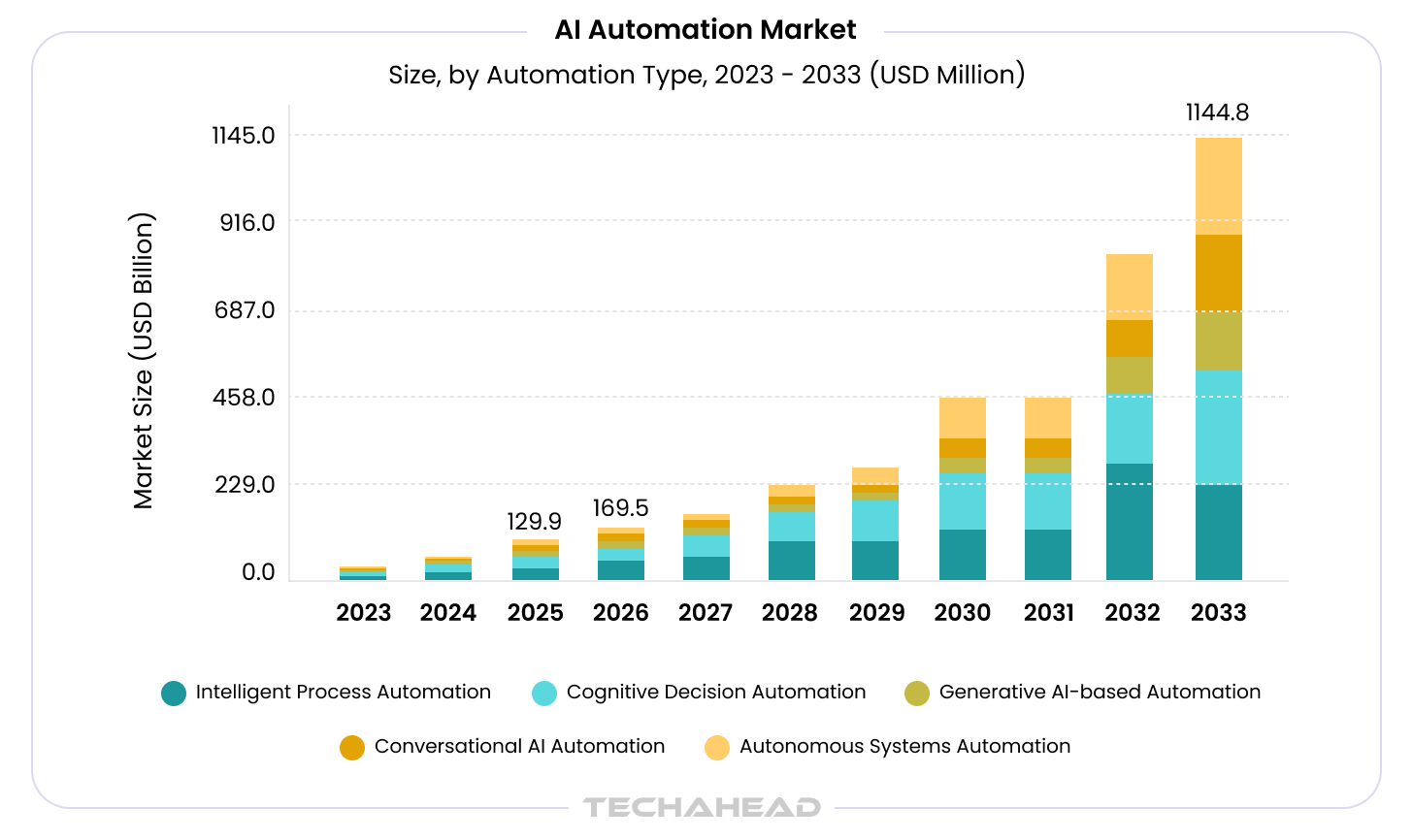
The global AI automation market hit $129.9 billion in 2025. Reports have it at $169.5 billion this year, growing to $1,144.8 billion by 2033 at a 31.4% CAGR, and North America alone accounts for close to a third of that. About 88% of organizations now use AI automation somewhere in their operations, up from just over half in 2023. The catch is that only around a third have scaled it past a single pilot. That gap is where vendor selection stops being a detail and starts being the whole thing.
The market has gotten crowded quickly. Hundreds of companies now call themselves AI automation specialists, ranging from boutique consultancies to global agencies. What separates them in ways that actually matter; delivery track record, security maturity, how they handle regulated environments rarely shows up on a homepage. A pilot that never makes it to production, a compliance issue discovered post-launch, or a system nobody on your team can maintain these are expensive outcomes, and they’re more common than vendors like to advertise. And this is where innovative AI automation specialist firms come together to make a leaderboard.
This guide covers 15 AI automation companies worth considering in 2026. What they build, who they build it for, and what to ask before you hire any of them.
The category covers more ground than it used to. A vendor worth talking to should be able to speak specifically about most of this, with real examples.
Why not build this internally?
Some companies do, especially once AI engineering becomes core to their competitive advantage. But most organizations use an external partner for the first one or two production deployments to establish governance patterns and avoid early, expensive mistakes, then build internal capability over time.
A few things have come together at the same time. Boards want to see AI ROI inside a single fiscal year, not a multi-year transformation story. The underlying models are reliable enough now for regulated production environments, which wasn’t true even two years ago. Customer expectations have shifted. And the competitive pressure is concrete: slower decision-making costs real money when your competitors are operating on better data.
This is a fundamentally different shift from what classical automation has delivered. RPA and fixed business rules work well for predictable, repetitive tasks. They break exceptions, and managing those exceptions adds oversight costs that eat into the savings. AI automation companies handles ambiguity, unstructured inputs, and judgment calls that weren’t automatable before.
| Dimension | Traditional Automation (RPA) | AI Automation |
| Best suited for | Repetitive, rules-based tasks | Ambiguous, judgment-based tasks |
| Handles exceptions | Poorly — breaks on edge cases | Better, can reason and adapt |
| Data types | Structured only | Structured and unstructured (text, voice, images) |
| Setup effort | Lower, but brittle long-term | Higher upfront, more adaptable later |
| Governance needs | Minimal | Significant, drift monitoring, audit trails |
| Typical use cases | Data entry, reports | Support, document review, forecasting, copilots |
The list was built around a few things that turned out to matter more than others: actual production deployments rather than demos, demonstrated experience in regulated industries where errors carry real consequences, third-party verification through Clutch and G2 over vendor-written testimonials, security certifications that can be requested and reviewed.
No company on this list is the right fit for every situation. Your industry, budget, and whether you need hands-on engineering or more of a strategic layer will determine what actually works for you.
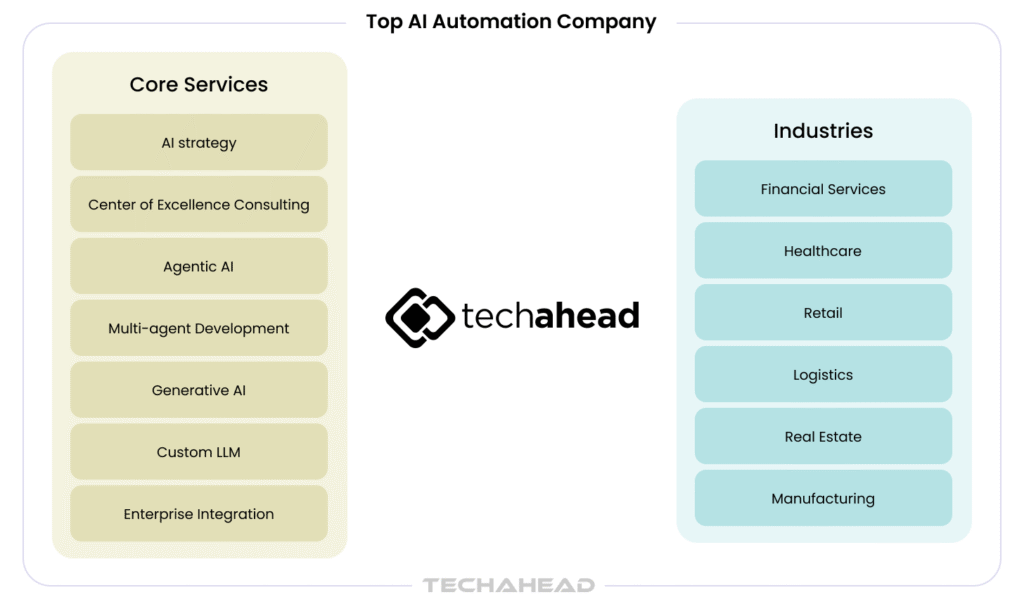
TechAhead assists businesses in developing AI-powered chatbots, workflow automation, intelligent document processing, agentic AI solutions. With certifications such as SOC 2 Type II and many others, the organization adheres to robust security and AI governance policies. In 2026, it became Claude & OpenAI Services Partner in addition to being an AWS Advanced Tier Services Partner.
Service-wise, TechAhead’s offerings span agentic AI systems, generative AI applications and chatbots built on GPT, Gemini, and Claude models, document and workflow automation, enterprise AI integration into existing ERP/CRM systems, and mobile AI development, an area where the company’s original specialization (native and cross-platform app development) gives it more historical depth than many AI-only entrants to the market.
Core Services: AI strategy and Center of Excellence consulting, agentic AI and multi-agent development, generative AI and custom LLM work, enterprise integration.
Industries: Healthcare, financial services, retail, manufacturing, real estate, logistics.
Best For: Teams that want one partner owning AI strategy through deployment, with direct OpenAI partner access built in.
Azumo is an AI development company founded in 2016 and headquartered in San Francisco. The company reports 100+ production AI projects delivered to clients including Meta, Discovery, and Zynga, spanning computer vision, NLP, generative AI, RAG, and agentic systems. It’s SOC 2 certified and holds AWS, Google, and Microsoft partner status, and its work regularly touches HIPAA, GDPR, and SOX-regulated environments for healthcare and financial clients.
Core Services: Custom AI/ML development, AI agents, chatbot and voice AI, RAG pipelines, Salesforce/SAP/ServiceNow integration.
Industries: Fintech, healthcare, media, gaming, e-commerce, manufacturing.
Best For: Teams wanting Fortune-100-grade engineering at nearshore pricing with full U.S. time-zone overlap.
Markovate is a generative AI consultancy and development firm that handles both the strategy and the build. They have over 300 digital products shipped. Client outcomes include CAD/BOM automation in manufacturing and HIPAA-compliant medical coding AI in healthcare. Concrete, verifiable results that matter more than capability lists.
Core Services: Agentic AI, generative AI development, MLOps consulting, chatbot development.
Industries: Healthcare, fintech, manufacturing, insurance, retail, SaaS.
Best For: Startups and mid-market companies in healthcare or fintech wanting both strategy and hands-on build work.
EffectiveSoft delivers AI automation inside longer-term software engineering relationships, not as a standalone product. ISO 27001 certified, Clutch Global Champion. In 2025 it appeared in an “Agentic AI in Digital Engineering” market report alongside Accenture, OpenAI, and Anthropic. A notable placement for a firm of its size.
Core Services: AI automation within broader software engineering programs, enterprise system integration, governance-focused AI delivery.
Industries Served: Financial services, healthcare, logistics, transportation.
Best For: Enterprises that want AI automation delivered as part of a long-term software engineering relationship, with strong governance emphasis.
HatchWorks built a delivery methodology called Generative-Driven Development. Generative AI embedded into how software gets built, not just what it produces. Faster timelines, same engineering standards. Worth understanding if you’re building AI-powered software products rather than deploying standalone automation tools.
Core Services: Generative AI development, LLM integration, AI-augmented software engineering, custom AI systems.
Industries Served: Technology, financial services, healthcare, SaaS.
Best For: Mid-market and growth-stage companies that need AI capabilities built directly into software products, not just advisory guidance.
Rootstrap integrates AI into customer-facing products and internal dashboards and AI as a product feature, not a bolted-on layer. A solid choice when the user experience surrounding the AI matters as much as what the AI actually does.
Core Services: Product engineering, AI and LLM integration, cloud and data engineering support.
Industries Served: Consumer technology, SaaS, media.
Best For: Companies that need AI features embedded into a broader product build, where user experience quality matters as much as the AI itself.
BlueLabel brings design and AI integration together in the same delivery. Most AI vendors treat interface design as secondary. Here it’s part of the core work, which matters when end-user adoption determines whether the project delivers real value or just a technically functional system nobody uses.
Core Services: AI integration, workflow automation, mobile and product development, UX/UI design.
Industries Served: Consumer products, media, technology, healthcare.
Best For: Organizations that need AI capabilities embedded into a polished, design-forward digital product.
SoluLab is an AI and software development company with a U.S. office in Iselin, New Jersey, and global delivery centers, founded in 2014. The company works with both startups and enterprise clients, blending technical AI development with business strategy across a wide range of automation use cases.
Core Services: AI consulting, custom AI application development, automation workflows, blockchain-adjacent integrations.
Industries Served: Healthcare, fintech, retail, logistics.
Best For: Startups and mid-market businesses seeking a single partner across AI strategy and execution.
An 85% client retention rate documented on independent review platforms is harder to manufacture than an award. Over 1,000 projects delivered for 500+ clients through a 200+ person in-house engineering team. Biz4Group’s track record is worth paying attention to.
Core Services: AI chatbot development, AI agent and agentic AI development, AI avatars, custom AI application development.
Industries Served: Healthcare, staffing and HR tech, e-commerce, gaming.
Best For: Startups through Fortune 500 companies needing a long-established, in-house engineering team for custom AI builds
Helpware sits where AI and customer experience operations overlap. Agentic AI, voice AI, and AI chatbot deployment go directly into CX workflows, paired with human-in-the-loop LLM training and data annotation. Public clients include DoorDash and Samsara. Built for teams that can’t run customer-facing AI without human oversight baked in.
Core Services: Agentic AI, voice AI, chatbot deployment, AI-powered quality monitoring, human-in-the-loop model training.
Industries Served: E-commerce, logistics, technology, consumer services.
Best For: Companies that need AI customer experience automation paired with human oversight and training infrastructure.
Pontis runs a specialist AI team; not a generalist software shop with an AI practice attached. Conversational AI, autonomous agents, computer vision, RPA, and n8n-powered workflow automation for enterprise clients including Teva Pharmaceuticals, OTP Bank, and Mitsubishi Motors. Industries where error tolerance is low and compliance isn’t optional.
Core Services: Conversational AI, autonomous agents, computer vision, RPA, workflow automation.
Industries Served: Pharmaceuticals, banking, automotive.
Best For: Enterprises in regulated or industrial sectors needing a focused AI team for specific automation use cases.
A lot of vendors bolt compliance on after the fact. Pharos Production doesn’t work that way. Every project gets a compliance-first architecture from day one, which matters most in the industries where they do their strongest work: FinTech, healthcare, and Web3. 90+ engineers, 70+ applications delivered across 18 industries, and a 5/5 Clutch rating back that up.
Core Services: Custom AI automation, AI agent development, full-cycle software engineering.
Industries Served: FinTech, healthcare, Web3, enterprise workflows.
Best For: CTOs and product leaders who need observability, rollback procedures, and clear compliance documentation built into AI agent projects from the start.
Codebridge positions itself around production-ready AI agent systems for SaaS, enterprise, and regulated software environments, with a stated portfolio of 700+ delivered projects. The company’s approach is architecture-first: AI components are built to connect across existing user interfaces, internal systems, and data flows rather than functioning as standalone bots.
Core Services: AI agent development, software architecture for AI integration, enterprise system connectivity.
Industries Served: SaaS, enterprise software, regulated industries.
Best For: Buyers who need AI automation connected across multiple layers of an existing operating environment, not just a single chatbot.
GeekyAnts has 1,000+ projects behind it and a growing U.S. presence. AI work spans agentic AI development, RAG implementation, ML model development, and LLM orchestration. Long delivery history and full-stack depth make this a reliable pick when you want a single engineering partner with genuine range rather than a narrow specialist.
Core Services: Agentic AI development, RAG implementation, LLM orchestration, ML model development.
Industries Served: Technology, consumer products, enterprise software.
Best For: Companies seeking a long-established engineering partner with broad AI and full-stack development capability.
Intellectyx ties AI agent deployments to specific business outcomes, faster decisions, less manual overhead, rather than deploying AI and leaving the ROI case vague. Governance and observability get built into systems as they scale, not addressed after something breaks.
Core Services: Enterprise AI agents for analytics, automation, and decision intelligence.
Industries Served: Enterprise, financial services, healthcare.
Best For: Enterprises that want AI agent adoption tied explicitly to measurable business outcomes from the outset.
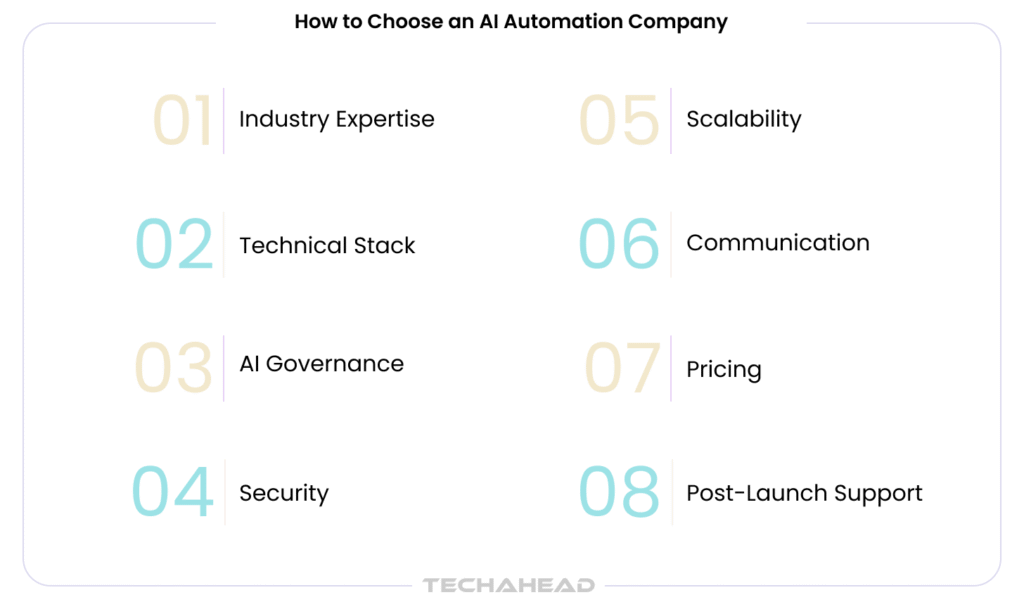
Once you have a shortlist, the comparison gets more concrete. These are the categories worth interrogating before signing anything.
Ask for examples of work in your specific industry, not just “enterprise” in general. Healthcare, finance, and legal work carry compliance requirements (HIPAA, SOC 2, GDPR/CCPA) that a generalist vendor may underestimate.
Which foundation models, vector databases, and orchestration frameworks does the vendor actually use, and can they explain why? Vendors locked into a single model provider may struggle when pricing or capability shifts, ask how model migrations are handled.
Does the vendor have a defined process for evaluating AI risk, transparency, and auditability, ideally backed by a recognized standard like ISO 42001, or is governance an afterthought bolted on after launch?
Confirm certifications directly (SOC 2 Type II reports can typically be requested under NDA) rather than taking a badge on a website at face value. Ask how data is encrypted in transit and at rest, and how role-based access is enforced.
A prototype that works for 50 users and a system that holds up under real production load are different engineering problems. Ask what load-testing and monitoring practices are in place post-launch.
Time-zone overlap, reporting cadence, and whether you’ll work with a dedicated team or a rotating pool of contractors all affect how smoothly a multi-month engagement runs.
Get a written scope and exclusions list before discussing price. Agent orchestration infrastructure, failure-recovery logic, and compliance documentation are commonly missing from initial proposals and appear later as change orders.
AI systems require ongoing monitoring for accuracy drift, prompt injection vulnerabilities, and model version changes; maintenance cost that very few initial project scopes include. Ask explicitly what happens after go-live.
Also read: AI Development Guide 2026
Returns aren’t equal across sectors. Industries with high document volumes, heavy transaction loads, or repetitive customer interaction tend to see faster, more measurable payoff.
| Industry | High-Impact Use Cases |
| Healthcare | Patient triage support, claims processing, HIPAA-compliant documentation automation |
| Finance | Fraud detection, document/KYC processing, customer service copilots |
| Retail | Personalization engines, inventory forecasting, AI-driven customer support |
| Manufacturing | Predictive maintenance, quality inspection, supply chain forecasting |
| Logistics | Route optimization, demand forecasting, automated documentation |
| Education | Adaptive learning tools, administrative automation, content generation |
| Travel | Dynamic pricing, itinerary personalization, customer support automation |
| Real Estate | Lead qualification, document processing, property-matching engines |
| Legal | Contract review and analysis, legal research assistance, document drafting support |
| Sports | Fan engagement personalization, performance analytics, ticketing automation |
Most failed AI initiatives don’t fail because the technology didn’t work, they fail because of decisions made during vendor selection and project scoping.
The direction is toward systems that coordinate with each other rather than single-purpose tools. Multi-agent architectures where specialized agents handle planning, retrieval, execution, and verification as separate functions, are moving out of research environments and into production in banking, healthcare, and commercial real estate.
Private and self-hosted LLMs will handle more sensitive workloads as data control becomes a harder requirement. Copilots will get embedded deeper into existing software rather than running as separate applications. And hyperautomation, combining RPA, AI agents, and traditional software into unified, coordinated workflows will become the standard operating model for larger enterprises.
None of this reduces the need for human oversight. If anything, governance and human-in-the-loop checks get more critical as these systems gain autonomy. AI management standards like ISO 42001 are becoming meaningful requirements, not just compliance mandate.
Must Read: Agent2Agent Architecture: A New Era of Agent Collaboration
There’s no single outstanding services provider that fits all needs, but there are innovative AI automation providers that serves your industry, your regulatory requirements, your technical environment, and your timeline, and ones that don’t. Delivery history you can verify, security certifications you can review, and a vendor that treats post-launch support as part of the engagement rather than an upsell, these matter more than company size or how polished the sales process feels.
For organizations that need a partner with both AI technical depth and enterprise AI delivery experience, TechAhead is a strong option. The criteria above will help you tell the vendors who can deliver from the ones who are simply good at describing it.
Ask them to walk you through a specific live system, what it does daily, what broke during deployment, and how it’s monitored now. Vendors with genuine delivery history answer this without hesitation. Those who pivot to a case study PDF usually don’t.
Ask what the audit trail looks like and what the rollback process is. “The model is very accurate” isn’t a governance framework. Every model gets it wrong sometimes, the question is what your safeguards are when it does.
Yes, but it adds complexity. Legacy systems often need custom connectors or middleware, which takes more time. Ask the vendor to show you a comparable legacy integration they’ve already built, not just confirm they can do it.
A chatbot responds with text. An AI agent takes action, it can query a database, update a record, trigger an API, and pass work to another system. If it can only produce text, it’s a chatbot regardless of what the proposal calls it.
For well-scoped projects with clean data, a working MVP typically takes eight to fourteen weeks. Full production deployment usually adds another four to eight on top. Anything promising production-ready output in under six weeks for a complex environment is cutting corners somewhere.
At minimum, one person who can tell when the system is behaving oddly and coordinate on maintenance. Assuming it runs itself after deployment is the mistake most organizations make, it doesn’t, it just needs less time than a human doing the same work.
Most will scope an initial engagement around a single use case or workflow. Starting focused is usually the smarter move anyway, it’s easier to catch data, integration, or adoption problems on a smaller footprint before expanding.
Ask the vendor to document the full data flow in writing, what gets sent where, which provider hosts the model, and what data processing agreements are in place. For highly sensitive data, ask specifically about private deployment options.
This is a contract question. Confirm in writing that you own all code, pipelines, and model artifacts, and that documentation is thorough enough for another team to take over. “We trust the relationship” is not a continuity plan.
Data quality. Almost every experienced vendor will say the same thing. Organizations assume their data is cleaner and more accessible than it is. Projects that skip a proper data audit at the start almost always hit that problem mid-project, where there’s far less budget and schedule to absorb it.
We use cookies to ensure our website functions properly, improve performance, and provide a personalized experience. You can choose which types of cookies to allow below.
Required for core functionality such as security, network management, and accessibility. These cannot be disabled.
Help us understand site traffic and user interactions so we can improve performance and usability.
Enable enhanced functionality and personalization such as language or region preferences.
Used to deliver relevant ads, track campaign performance, and measure advertising effectiveness.