


 Copy Link
 Share on X
 Share on Facebook
 Share on LinkedIn
Always Active
Required for core functionality such as security, network management, and accessibility. These cannot be disabled.

Uncover the transformative potential of digital and mobile solutions for your industry.



 Last Updated: Oct 28, 2026
Oct 28, 2026
 9
 17 min. Read


Key Takeaways
Every industrial enterprise runs various machines. Each pump, motor, compressor, and production line converts capital into output, and the maintenance strategy determines how much output that capital delivers. The Deloitte Analytics Institute estimates that the quality of a maintenance strategy can shift a plant’s productive capacity by 5 to 20%, which places maintenance firmly inside the conversation about revenue, margin, and customer satisfaction.
Predictive maintenance has matured into a proven response. McKinsey reports that it typically reduces machine downtime by 30 to 50% and increases machine life by 20 to 40%. Markets and Markets values the AI-driven predictive maintenance market at $2.61 billion in 2026 and projects $19.27 billion by 2032, projecting a CAGR of 39.5%.
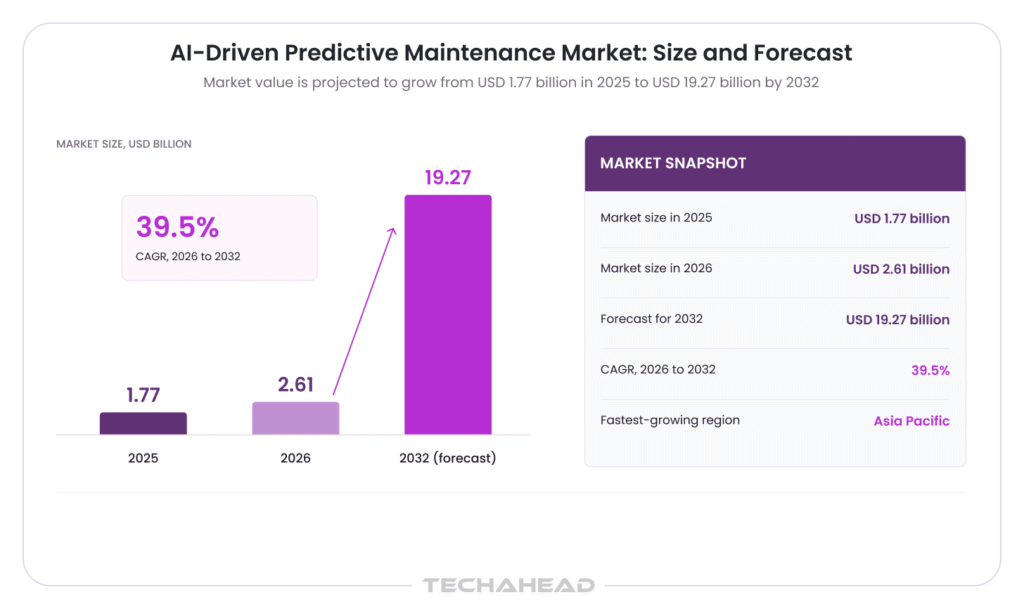
Capital is moving toward this capability at speed. A well-defined predictive maintenance strategy helps enterprises minimize downtime, and the data insights from a connected platform help them predict equipment failures while there is still time to act.
Results differ widely from one program to the next, and the explanation is consistent. The model is rarely the deciding factor. The deciding factor is the decision architecture around it: how equipment data is collected, how predictive insights reach the right maintenance teams, and how those teams turn an alert into a scheduled action.
This blog will guide you to AI-powered predictive maintenance and how to build intelligent equipment monitoring platforms that change maintenance decisions. It covers strategy allocation, asset selection, platform architecture, analytics sequencing, governance, sourcing, and the value case.
Reactive, preventive, and predictive maintenance serve different operational needs. Treating predictive maintenance as the default for every machine can increase implementation costs without delivering equivalent returns.
Reactive maintenance suits low-criticality equipment that is inexpensive to replace and has limited consequences when it fails. Preventive maintenance works well when service intervals are predictable, parts are inexpensive, and scheduled servicing can happen outside production hours. Predictive maintenance is most valuable when equipment failure carries a high financial or operational cost and measurable signals can provide useful warning.
A practical asset-allocation framework evaluates two factors:
High consequence combined with high detectability points to a predictive maintenance program. High consequence combined with low detectability points to redundancy and preventive maintenance. Low consequence points to reactive or scheduled approaches.
| Asset condition | Recommended approach | Reason |
| Low failure impact, easy replacement | Reactive maintenance | Monitoring costs may exceed the potential savings |
| Predictable wear and service intervals | Preventive maintenance | Scheduled intervention can manage the risk |
| High failure impact, detectable degradation | Predictive maintenance | Early warnings create time for planned intervention |
| High failure impact, limited detectable warning | Preventive maintenance, redundancy, or other risk controls | Predictive analytics alone may not provide sufficient protection |
The framework helps leaders direct investment toward equipment where early intervention has the greatest value. It also prevents teams from equating the number of connected machines with a predictive maintenance program’s success.
A fixed schedule treats a lightly loaded machine and a heavily loaded machine alike. The outcome is unnecessary repairs on healthy equipment and unexpected equipment failures on assets that degrade faster than the interval assumed. A predictive approach lets teams perform maintenance based on the equipment’s actual condition, which directs maintenance resources to the assets that need attention.
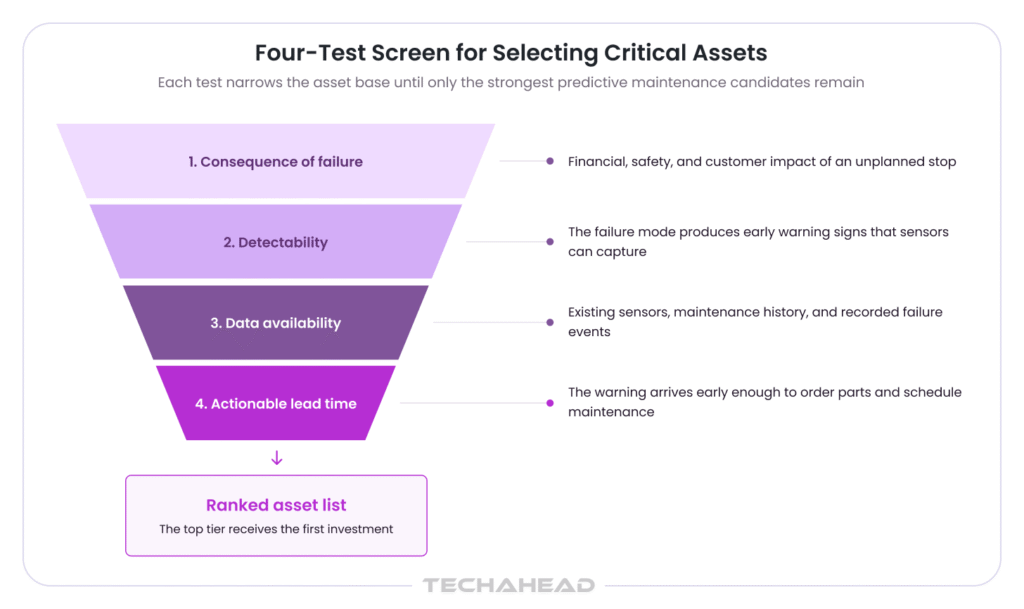
Once the maintenance strategy is defined, the next step is to rank assets for a pilot. A structured screening process keeps the initial scope manageable and makes the business case easier to evaluate.
A disciplined screen turns that principle into a ranked list built on four tests.
Rotating equipment, including motors, pumps, compressors, and fans, can be a useful starting point because vibration and temperature measurements may reveal bearing wear, imbalance, or misalignment.
Consider a production facility with several critical pumps. If a pump failure interrupts a production line, monitoring its vibration and temperature may provide enough warning to inspect the equipment before the problem escalates. If the facility already records repairs and failure causes, that history can help engineers interpret the sensor readings and evaluate the model.
Fortune Business Insights reports that rotating equipment holds the largest share of the AI-driven predictive maintenance market, at 30.2% in 2025. Vibration analysis is the usual entry point, since bearing wear, imbalance, and misalignment produce measurable signatures long before a machine stops.
The pilot should focus on a small group of high-value assets with observable failure patterns. Before development begins, record the existing downtime, repair costs, failure frequency, and maintenance response times. These baselines will help the team determine whether the platform improves operational performance.
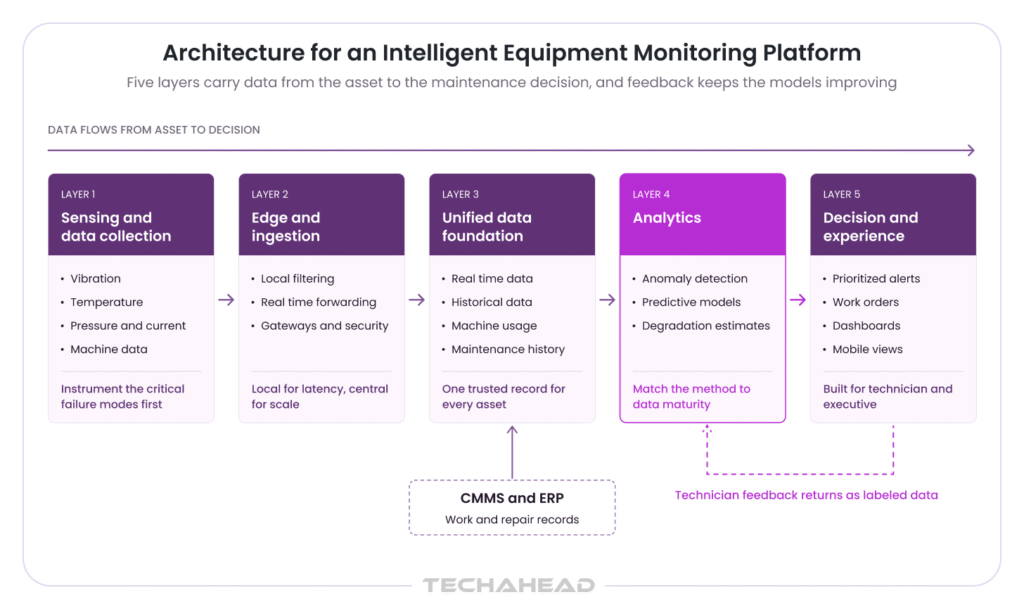
Predictive maintenance relies on a steady stream of trustworthy equipment data, and the platform that carries it deserves deliberate design. Five layers form a reference architecture, and each layer carries one design principle that executives can use to evaluate proposals.
| Layer | Role | Design principle |
| Sensing and data collection | Captures sensor data and machine data such as vibration, temperature, pressure, and current | Instrument for the failure modes selected in the asset screen |
| Edge and ingestion | Filters and forwards real-time sensor data | Process locally where latency matters and centrally where scale matters |
| Unified data foundation | Combines real-time data, historical data, machine usage, and maintenance history | Maintain one trusted record for every asset |
| Analytics | Runs anomaly detection, predictive models, and degradation estimates | Match the method to data maturity |
| Decision and experience | Delivers alerts, work orders, and role-based dashboards and mobile views | Design for the technician as carefully as for the executive |
The unified data foundation deserves special attention. A centralized system that joins streaming sensor data with maintenance history from CMMS and ERP platforms lets analytics connect a vibration pattern to the repair that followed it. Deloitte highlights streaming architectures that process incoming data within seconds, which extends the reaction window before a potential equipment failure.
Three architectural commitments protect long-term flexibility. Open interfaces allow sensors, analytics, and maintenance software from different vendors to interoperate. A vendor-neutral data layer keeps ownership of equipment data with the enterprise. Security designed across the operational technology and IT boundary from the start protects every connected asset.
Continuous condition monitoring is the operating mode that ties these layers together. Sensors observe each asset around the clock, and the platform converts those observations into a living asset health score. Leaders gain a portfolio view of asset performance across plants, which supports early detection of degradation and sharper capital planning. The same view helps teams anticipate equipment failures at the fleet level, so spare parts and technician capacity can be positioned ahead of demand.
The decision layer closes the loop. An alert that lands inside the maintenance software as a prioritized work order, complete with asset context and a recommended action, changes behavior. An alert that stays inside a dashboard rarely does.
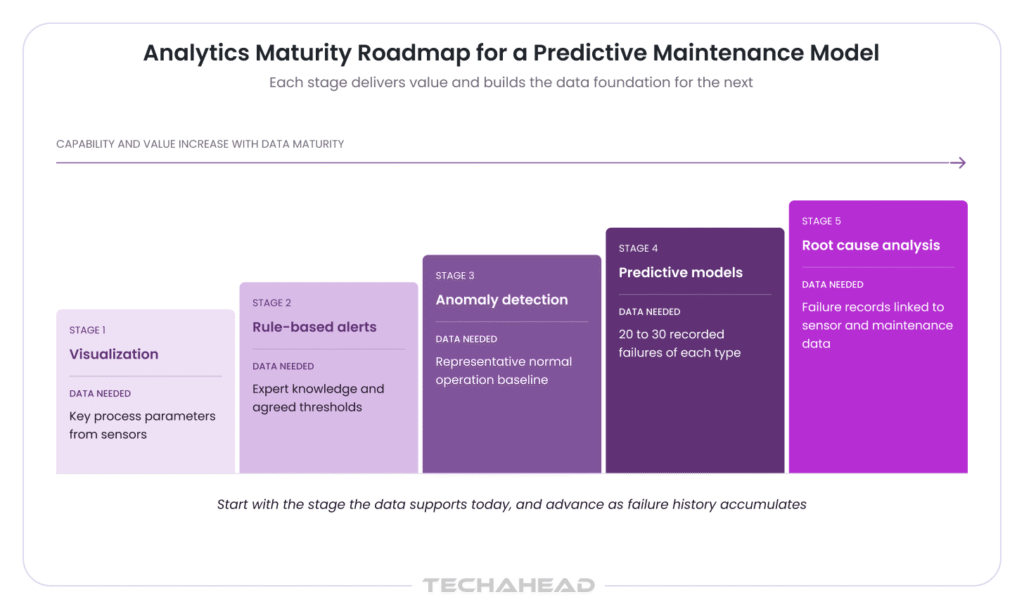
The most complex model is not always the best starting point. The appropriate analytical method depends on the failure mode, available data, and the decision the maintenance team needs to make.
| Method | Data requirements | Output | Best starting point |
| Threshold and rule-based monitoring | Engineering limits and operating rules | Alerts when readings exceed defined conditions | Known failure indicators |
| Anomaly detection | Representative data covering normal operating conditions | Deviations from expected behavior | Limited labeled failure history |
| Failure classification | Historical examples of known failure types | Estimated likelihood or category of failure | Sufficient, representative labeled events |
| Degradation and remaining useful life estimation | Time-series history and evidence of equipment degradation | Estimated deterioration or remaining useful life | Assets with suitable longitudinal data |
Threshold rules can identify known problems at relatively low cost. Anomaly detection can flag unusual combinations of readings without requiring a large collection of labeled failures. Supervised models can help classify failure types when historical records are sufficiently representative. Remaining useful life estimation requires additional care because predictions depend on operating conditions, degradation patterns, and the quality of historical observations.
A model should be evaluated on its usefulness to maintenance teams, not just its performance on a test dataset.
Track three primary measures:
False positives create unnecessary inspections and can reduce trust in the platform. Missed failures can undermine the business case. The evaluation process should therefore consider the operational cost of both outcomes.
Models also require monitoring after deployment. Changes in equipment loads, maintenance practices, sensor behavior, and operating environments can affect prediction quality. Retraining should follow a defined review process, with validation and approval before updated models influence operational decisions.
The architecture defines the platform’s components. The development process determines how those components work together in a real industrial environment.
Start by documenting the selected assets, failure modes, sensor availability, expected prediction lead time, and maintenance actions. Identify the industrial systems and enterprise applications that must exchange data with the platform.
The requirements should specify data frequency, latency, availability, access controls, retention, and how the platform behaves when connectivity or a data source fails.
Connect the required sensors, industrial gateways, and existing data sources. Build ingestion pipelines that validate incoming measurements, normalize units, synchronize timestamps, and associate readings with the correct assets.
Data-quality checks should identify missing values, duplicate events, sensor drift, and unexpected measurement ranges. The team should also document how it handles gaps so that missing readings are not mistaken for normal equipment behavior.
Create features that represent relevant equipment behavior, such as changes in vibration patterns, temperature trends, load variation, or operating cycles. Select a baseline method and compare it with more advanced models when the data supports them.
Validation should use historical periods and failure events that were not used to train the model. Where possible, test the system against actual maintenance outcomes to assess whether it provides useful warning time under real operating conditions.
Connect model outputs to the systems technicians already use. An alert should identify the asset, describe the observed condition, provide relevant evidence, and recommend an appropriate next step.
Depending on the operating process, the platform may create a draft work order or route an alert for review before creating one. Integration with spare-parts planning and technician scheduling can help teams decide whether to inspect immediately or include the work in a planned maintenance window.
Begin with a controlled pilot. Monitor data availability, ingestion delays, alert quality, model behavior, and the time between an alert and a maintenance action.
Record technician findings and the outcome of each intervention. These records provide feedback for improving rules, features, and models. Expand to additional assets only after the pilot demonstrates operational value and the team has a repeatable deployment process.
A successful implementation needs engineering ownership, operational participation, and clear release controls. The analytics team should not be the only group responsible for the system’s ongoing performance.
Also Read: The Role of IoT Apps in Remote Monitoring and Predictive Maintenance
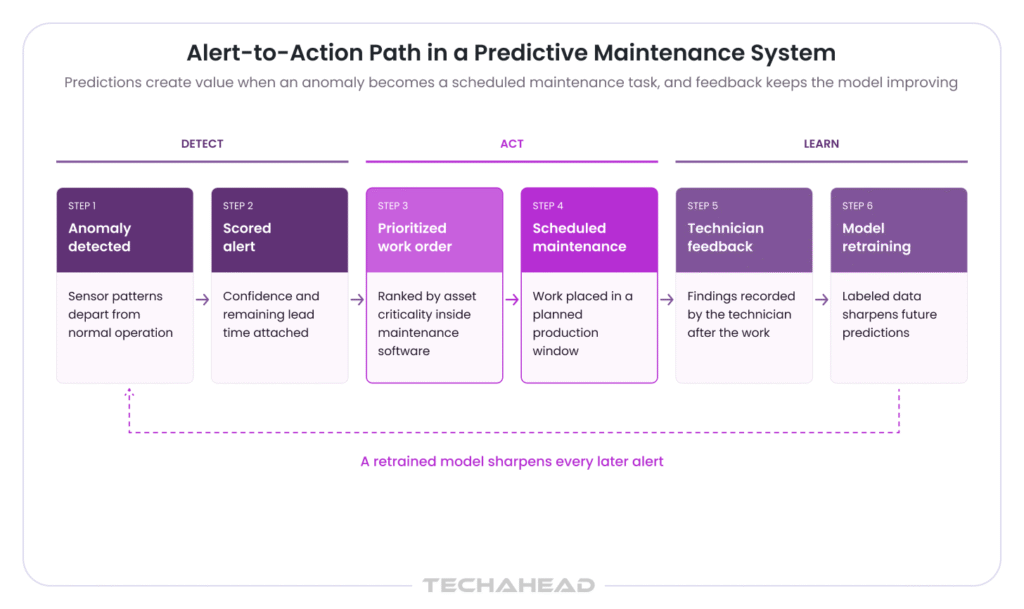
Insight creates value at the moment it changes a decision. Four design choices shape that moment.
Prioritization comes first: alerts rank by asset criticality, confidence, and remaining lead time, so maintenance teams see the highest-value action at the top of the queue.
Integration comes second: predictions flow into maintenance software as work orders connected to spare parts planning and technician availability. Predictive maintenance can ease logistics by scheduling work at convenient times and forecasting which spare parts will be required.
Planning comes third: maintenance schedules shift from calendar intervals to condition triggers, which allows teams to schedule maintenance inside planned production windows.
Feedback comes fourth: technicians record what they find, and that record returns to the model as labeled data, sharpening each later round of maintenance tasks and improving the quality of predictive insights.
The people dimension deserves equal weight. Setting up a condition-based strategy is an organizational challenge, since every maintenance leader and worker needs the skills to interpret analytical results and adapt daily routines. Explainable alerts, which show the sensor trend behind each recommendation, build the trust that adoption requires. Performance indicators such as planned-work ratio, alert-to-action time, and overall equipment effectiveness give leadership a view of whether the platform is changing behavior.
Predictions create value when they change what a maintenance team does next. The platform should connect analytics with the processes that govern inspections, repairs, and spare-parts planning.
Consider a compressor whose vibration readings begin to deviate from its normal operating pattern. The platform identifies the anomaly and checks the asset’s operating history. It then assigns a priority based on the asset’s criticality, the severity of the condition, and the available warning time.
The predictive maintenance system team receives an alert with the relevant sensor trends and supporting evidence. A technician reviews the recommendation and creates or approves a work order. The system records the inspection findings and repair outcome, allowing the team to compare the prediction with what happened.
Four workflow decisions help make this process effective:
The interface should support both maintenance technicians and operations leaders. Technicians need asset-level evidence and clear next steps. Managers need a view of equipment health, unresolved alerts, maintenance workload, and performance across sites.
Track the planned-work ratio, alert-to-action time, percentage of alerts converted into confirmed maintenance needs, and overall equipment effectiveness (OEE). These measures help establish whether the platform is improving maintenance operations rather than simply generating more alerts.
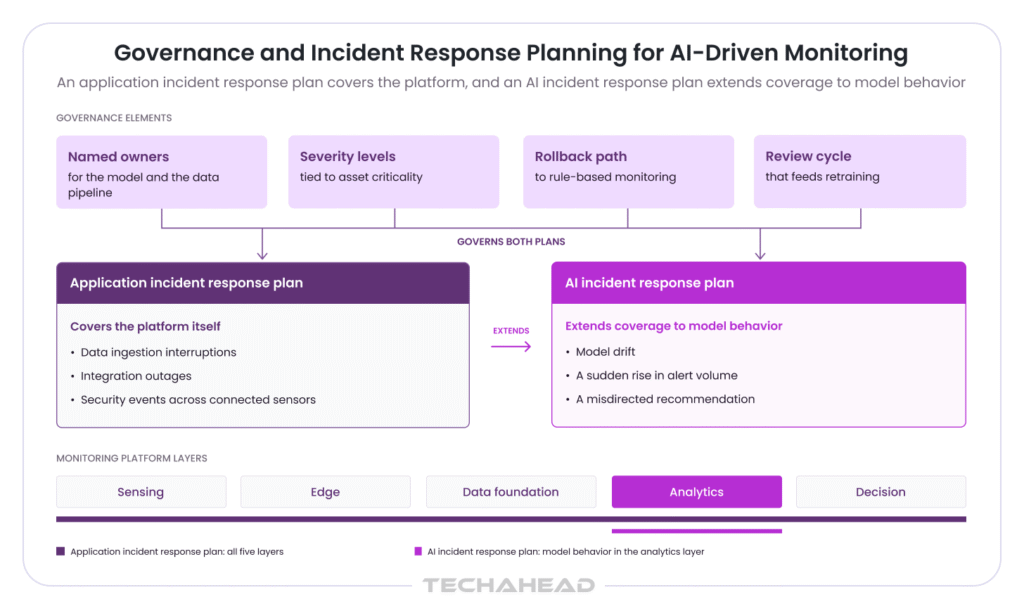
An equipment monitoring platform becomes part of the operational technology environment. Its governance should cover data pipelines, software integrations, analytics, and the decisions that follow a prediction.
An incident response plan should define:
For example, if a sensor begins producing unreliable readings, the platform should identify the data-quality problem rather than continue treating those readings as trustworthy evidence. If a deployed model begins producing excessive alerts, the team should investigate the cause and follow its approved review or rollback process.
Where a predictive model influences safety-critical decisions, the platform must preserve existing safety controls and human authorization requirements. Predictive analytics should operate within the site’s established safety and operational procedures.
Governance also needs to cover changes over time. New equipment, revised maintenance practices, and different operating conditions can affect model performance. Defined ownership and review procedures help keep the system dependable as the platform expands.
A pilot should demonstrate that the platform can identify useful equipment conditions and support appropriate maintenance actions. Scaling requires evidence that the approach works across a broader asset base.
| Phase | Focus | Exit criterion |
| Foundation | Select critical assets, connect sensors, and establish data pipelines | Reliable data and a documented baseline |
| Pilot | Deploy monitoring and analytics for one asset class | Lead time, alert precision, and operational value evaluated against agreed targets |
| Operationalize | Integrate workflows, train teams, and establish governance | Alerts routinely result in reviewed and appropriate maintenance actions |
| Scale | Expand to additional assets and sites | Business case validated across operating environments |
Five practices help maintain progress as the program expands:
The rollout should also account for differences between sites. Equipment configurations, sensor coverage, operating conditions, and maintenance practices may vary, so a model that performs well in one plant should be validated before deployment elsewhere.
A repeatable onboarding process for new assets, documented interfaces, model monitoring, and controlled releases help make expansion more predictable.
The value of AI-powered predictive maintenance lies in how effectively it turns equipment data into timely maintenance decisions. Enterprises need a reliable data foundation, suitable machine learning models, and workflows that help teams detect degradation before it leads to costly failures. A phased implementation lets organizations validate results, refine the platform, and scale with confidence.
TechAhead has already applied these principles to real-world equipment monitoring. In partnership with JLL, a Fortune 500 commercial real estate services company, TechAhead developed Intellicommand, an AI- and IoT-powered commissioning platform that uses real-time monitoring and predictive machine learning to identify problems and anomalies across 5.4 billion square feet of property and facilities worldwide.
The reported results include a 30% decrease in equipment downtime, a 20% reduction in energy consumption, and a 30% increase in equipment lifespan. Explore the Intellicommand case study.
This project demonstrates TechAhead’s experience building intelligent platforms that connect real-time data, predictive analytics, and operational requirements. If you are planning a predictive maintenance solution, we offer industrial IoT & maintenance that can help assess your equipment data, define the platform architecture, and build a roadmap aligned with your reliability and business goals.
Ready to build an intelligent equipment monitoring platform? Talk to TechAhead about your predictive maintenance requirements.
The timeline depends on sensor coverage, data quality, integration complexity, and the scope of the pilot. A focused implementation may take several months to move from data integration to operational evaluation. Expanding across multiple asset classes and sites requires additional validation, integration, and change management.
There is no universal minimum. Rule-based monitoring can begin with known operating limits, while anomaly detection requires representative normal-operation data. Supervised models need relevant labeled failure examples, and degradation or remaining useful life models require suitable historical observations over time.
Yes. Retrofit sensors and industrial gateways can collect measurements from older equipment when the relevant signals can be captured. The implementation team must assess sensor compatibility, connectivity, sampling requirements, and integration with existing control systems.
A typical platform combines industrial sensors, edge gateways, data ingestion pipelines, time-series storage, analytics or machine learning, and integrations with CMMS or ERP software. The exact technology stack depends on equipment requirements, data volume, latency, security, and deployment constraints.
Buying can suit organizations with standardized equipment and requirements covered by existing products. Custom development is more appropriate when specialized integrations or workflows are essential. A composable approach can combine established monitoring tools with custom data integration and decision workflows.
Track avoided downtime, maintenance costs, prediction lead time, alert precision, failure detection rate, and the time between an alert and an appropriate maintenance action. Compare results with the baseline established before the pilot and account for implementation and ongoing operating costs.
We use cookies to ensure our website functions properly, improve performance, and provide a personalized experience. You can choose which types of cookies to allow below.
Required for core functionality such as security, network management, and accessibility. These cannot be disabled.
Help us understand site traffic and user interactions so we can improve performance and usability.
Enable enhanced functionality and personalization such as language or region preferences.
Used to deliver relevant ads, track campaign performance, and measure advertising effectiveness.