


 Copy Link
 Share on X
 Share on Facebook
 Share on LinkedIn
Always Active
Required for core functionality such as security, network management, and accessibility. These cannot be disabled.

Uncover the transformative potential of digital and mobile solutions for your industry.



 Last Updated: Oct 30, 2026
Oct 30, 2026
 5
 20 min. Read


Key Takeaways
AI crawlers are automated bots that systematically fetch large volumes of web content, often revisiting product pages, article archives, and marketplace listings in ways that trigger repeated inventory queries, page generation, and data delivery without moving anyone closer to a purchase. Across a large catalog, that traffic can add meaningful cloud and application cost even on pages that rarely attract human visitors. This is specifically why this matters for enterprises, startups, and scaleups running public digital platforms in sectors such as healthcare, finance, logistics, real estate, and insurance.
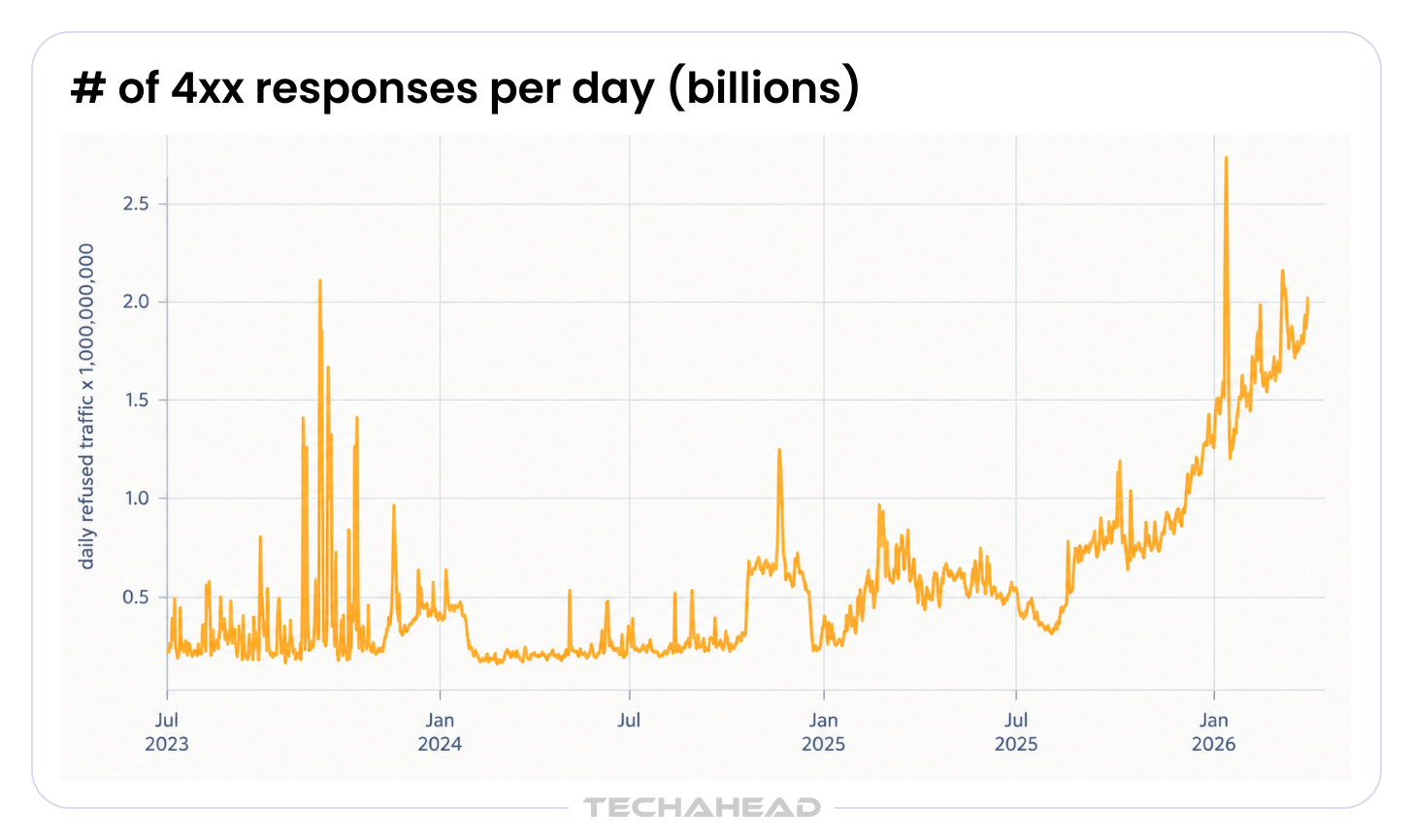
Wikimedia offers a clear example of the pressure automated access can create. In its March 2026 infrastructure update, revised in April, the foundation reported blocking or throttling about 30% of automated requests for noncompliance with its policies.
For businesses paying to serve a public catalog, the financial effect depends on what those requests make the application do. Reusing an existing response may be inexpensive; repeatedly running a complex search can consume resources that customers also need. Some of that work adds usage charges. Some uses capacity already paid for.
That difference shapes what to measure and what to fix. This article looks at how to identify and analyze AI bot traffic, connect it to cloud cost allocation, and reduce crawler load with engineering measures such as caching, query optimization, and selective access controls. The goal is to cut avoidable expense and service disruption, preserve useful automated access where it has value, and show where TechAhead’s cloud and FinOps services can help.
Related Read: Slash AWS Cloud Costs with AI-Powered FinOps
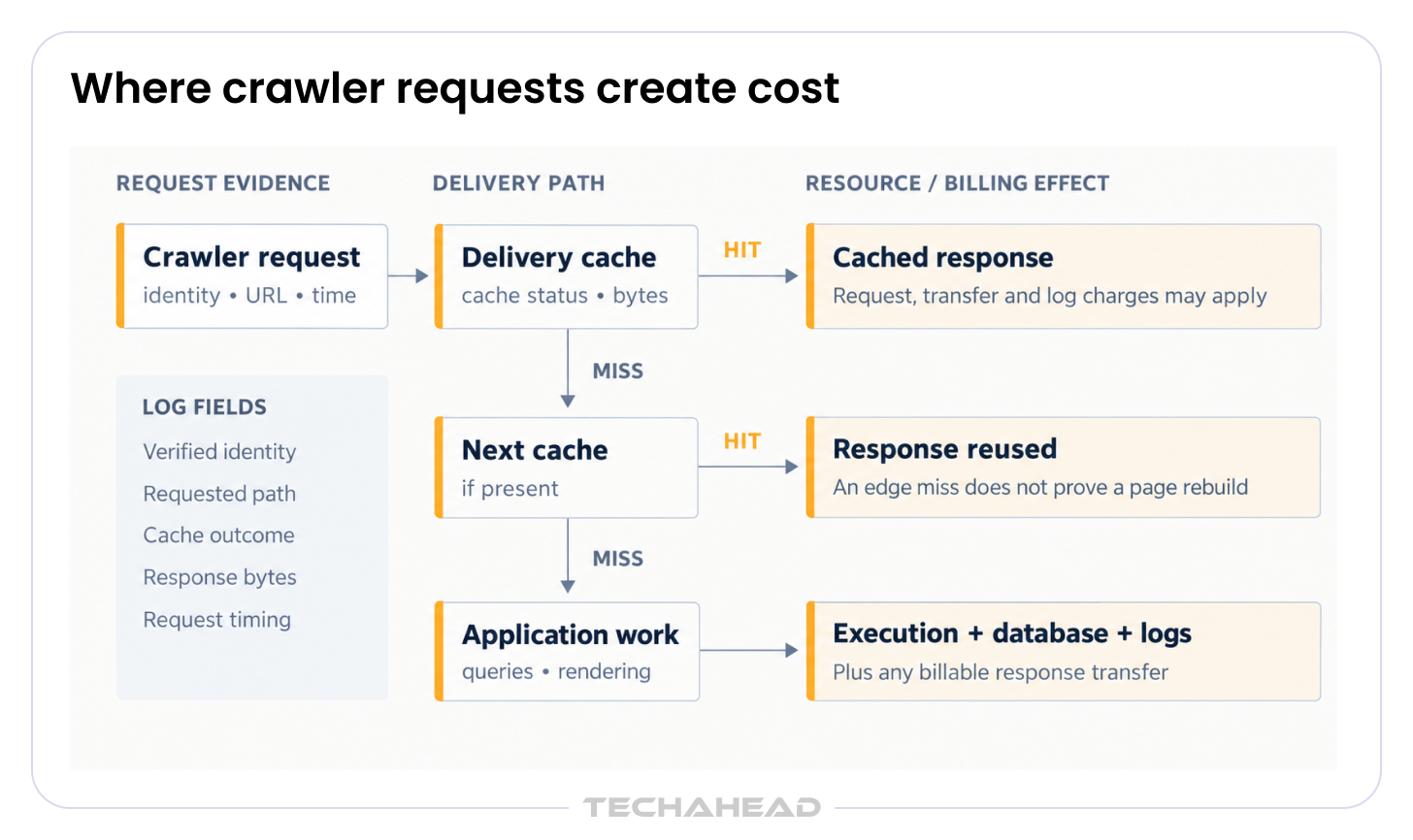
A cached article and a filtered inventory search may each count as one request. Their cost to serve can be very different. What happens after the request arrives explains much more than traffic volume alone.
When a request reaches your origin server, the application may query inventory, retrieve listings, or generate a page through server-side rendering. Some AI crawlers also perform data extraction, turning unstructured page output into structured datasets for analysis, so a frequently requested search can repeat that work even when it produces little useful activity for the business.
Repeated cache misses can increase the work reaching the application. The effect depends on the delivery path, though: another cache may still supply the response after an edge miss. A miss recorded at one layer doesn’t prove that the page was rebuilt from scratch.
Different businesses are likely to encounter different patterns:
| Business | Request pattern | Possible infrastructure effect |
| Publisher | Repeated archive searches or large-document downloads | Application execution, storage reads, transfer, and logging |
| Commerce platform | Numerous filter combinations or uncached product variations | Rendering work, query execution, and connection pressure |
| Marketplace | Deep pagination, location filters, and repeated listing searches | Expensive queries and competition with customer-facing requests |
These routes may already be efficient. Their cache hit ratio, together with application measurements, helps establish whether repeated visits create a meaningful burden.
There is rarely a separate invoice item called AI crawler costs. The effects appear across existing services and can take several forms:
The delivery arrangement matters as well. Edge delivery and origin-to-CDN transfer may carry different charges, allowances, or discounts. Counting the same bytes against both without understanding the contract can overstate the expense.
Even the investigation has a cost. Detailed traffic records consume ingestion, storage, and query resources. Keeping every request indefinitely may add expenditure without improving the diagnosis.
Traffic identity helps establish who may be responsible, but behavior explains the infrastructure effect. A recognizable operator visiting cheap public pages presents a different problem from repeated requests to a costly search endpoint.
A user-agent name is a claim, not sufficient proof of identity. Verification depends on the information an operator makes available. Google’s crawler documentation, updated in June 2026, describes its user-agent, source IP, and reverse DNS identifiers. Other operators require their own verification methods. Some AI crawlers may ignore robots.txt directives, so identity and observed behavior both matter; Google’s rules do not authenticate unrelated bots.
Purpose matters because the business may value different forms of access differently:
Identifying AI bot traffic therefore involves more than recognizing a name in a log. Requested paths, methods, response sizes, timing, and concurrent requests help explain what the visitor is doing. Browser analytics can leave part of that activity unseen because some automation is excluded or missed.
A large blocked-request count can look alarming while explaining very little about application load. Requests stopped at the edge never reached the application. A smaller stream of expensive searches may deserve more attention. For example, bulk AI crawlers may scan many URLs, while retrieval bots like ChatGPT user act on user queries and fetch one page at a time; ChatGPT-User is an AI Retrieval Bot for user queries.
Useful comparisons connect the source with the route, response code, cache status, and time of arrival. In AI crawler log file analysis, both total consumption and consumption per request matter. One identifies the largest burden; the other can expose an unusually expensive route.
Existing edge and application logs may supply part of this picture. The distinction between a request being blocked, served from cache, or processed by the application matters more than its appearance on a dashboard. Application metrics and billing records then help establish the financial significance.
A business can attribute resources to AI crawlers without being able to recover that amount as savings. This distinction is central to deciding whether a fix is worth funding. It also explains why engineering and finance can reach different conclusions from the same traffic chart.
Many bots collect data as training data to train AI models, especially large language models. Those language models use deep learning to process and generate human language by learning patterns from diverse training information, which is why traffic purpose affects business value.
Also Read: 8 Types of LLMs Powering Modern AI Agents in 2026
The financial value of AI bot traffic analysis comes from connecting three kinds of evidence:
For AWS environments, examining service charges and usage patterns helps establish where the increase appears.
Records covering different periods or time zones can suggest a connection that isn’t there. Deployments, promotions, outages, and configuration changes can also explain a rise in consumption during a busy crawling period.
Some figures are directly measurable; others require estimates. AI crawler log file analysis may establish response bytes with reasonable confidence, while assigning part of a shared database bill requires assumptions. Dividing all costs by request count treats a cached page and an expensive search as equivalent. Response time is another imperfect proxy: waiting on a dependency doesn’t necessarily consume CPU for the whole duration.
Where logs are missing or traces are sampled, some requests and expenditure will remain unassigned. That uncertainty limits how much of the increase can credibly be attributed to AI crawlers.
Suppose automated requests account for an estimated $1,200 of a committed application cluster’s monthly cost. That is useful information about resource consumption. If the cluster stays the same size under the same commitment, removing those requests may leave the invoice unchanged.
The benefit could still be valuable. The application may have more spare capacity, or the business may be able to postpone an upgrade. These are different outcomes:
These distinctions make discussions about AI crawler hosting costs more useful. They also prevent a resource-allocation estimate from becoming an unsupported savings promise.
Good cloud cost allocation explains who consumes resources. A savings estimate goes further by showing which charges would change under the proposed response, with the assumptions made clear.
Also Read: FinOps as Code: Frontier to Manage Cloud Cost
Consider a hypothetical marketplace where a verified crawler group repeatedly visits public listing routes. The following illustrative monthly amounts show how a change might affect metered charges.
| Charge category | Before the change | After the change | Reduction |
| Billable data transfer | $240 | $80 | $160 |
| Metered request execution | $160 | $60 | $100 |
| Log ingestion and retention | $100 | $40 | $60 |
| Total | $500 | $180 | $320 |
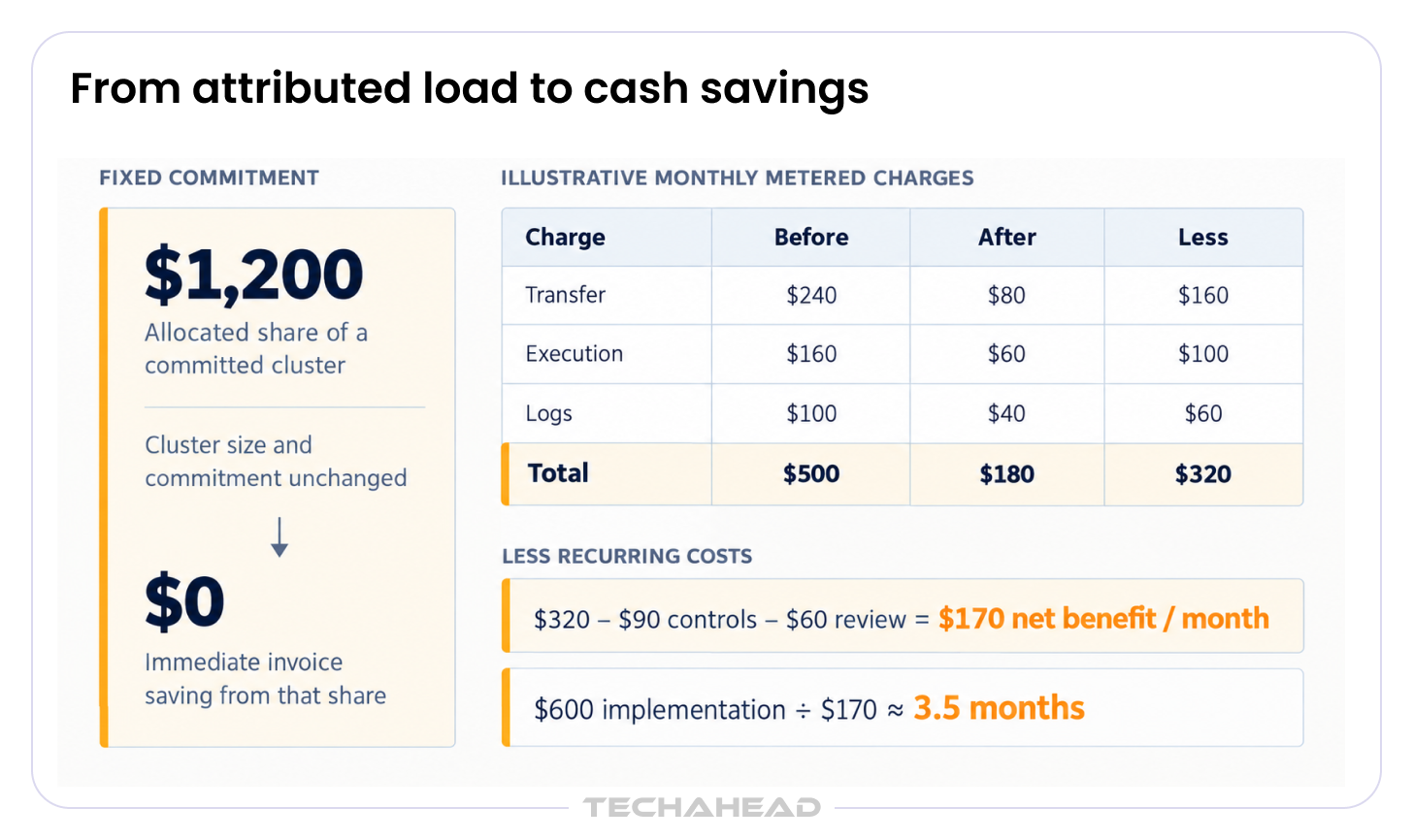
The $320 reduction is only part of the calculation:
| A $600 one-time implementation effort would take approximately 3.5 months to recover if those conditions continued. Engineering review is an operating-cost estimate, separate from the cloud invoice. The earlier $1,200 cluster allocation cannot be added to the savings unless capacity or contractual charges also change. |
A $170 monthly benefit may be too modest to justify a new platform. If those same requests are disrupting checkout, reliability could justify the work independently, but restricting them can also reduce brand visibility in search results, especially within AI-powered search and generative search results, so the financial case should be weighed against discoverability. Understanding AI crawler costs makes that discussion more concrete: the decision rests on the recoverable expense, the customer impact, and the cost of the response.
The right response depends on where AI crawlers create work. Repeated article requests may be a delivery problem; slow filtered searches may expose an application problem. Access restrictions are one option among several, each with different consequences for cost and customers.
Shared caching can reduce repeated processing when visitors can safely receive the same response. Its suitability depends on how the page behaves:
Cache rules also depend on the delivery platform. A rule that improves reuse for one route may be unsuitable for another, particularly when customer-specific information is involved.
An unnecessary tracking parameter can create multiple cache entries for the same article. A location parameter, by contrast, may genuinely change a marketplace’s listings. Removing both distinctions would risk serving incorrect content.
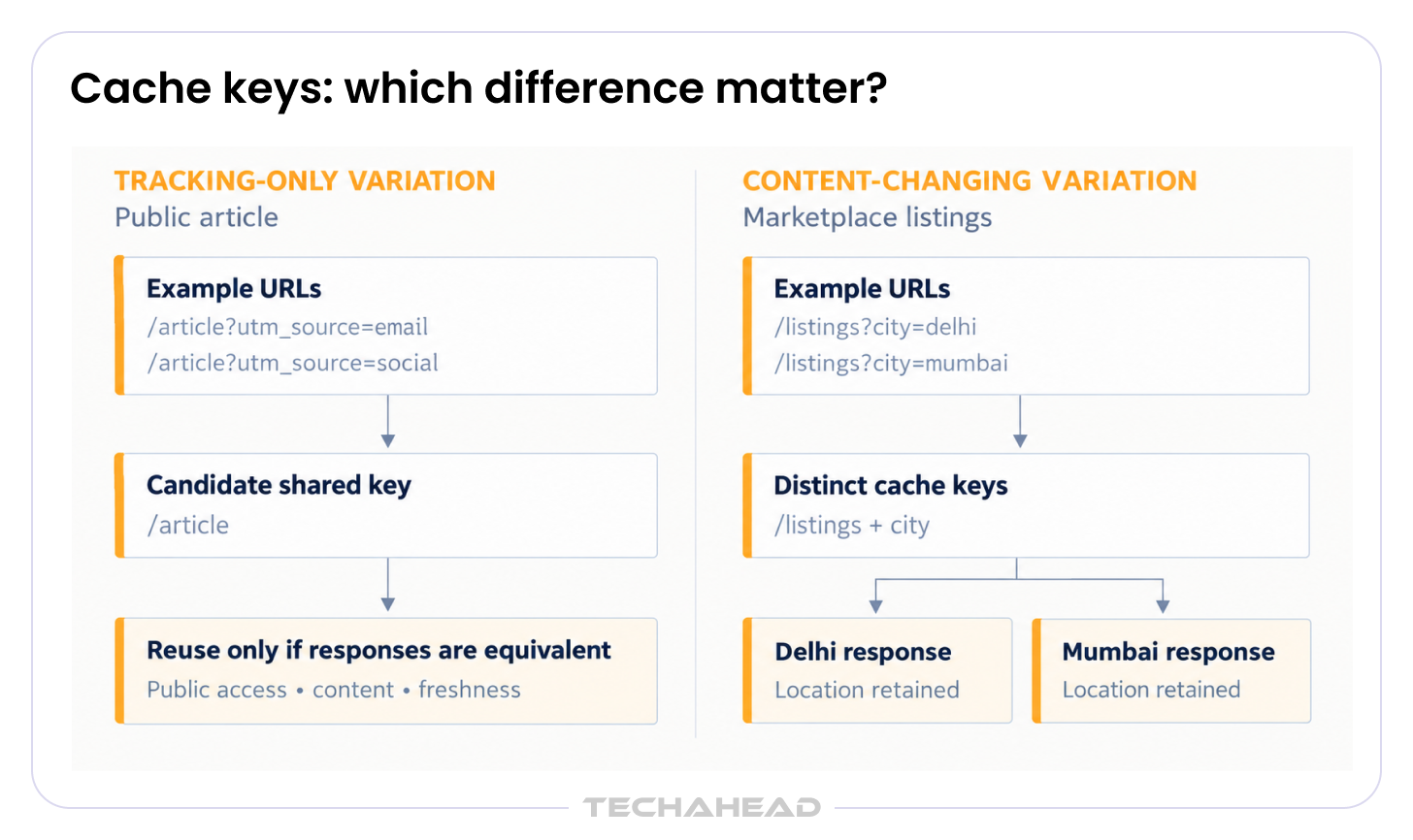
Effective CDN caching depends on preserving those differences. Recurring cache misses may reflect expired content, unnecessary variants, or responses that genuinely need fresh processing. Each cause calls for a different change.
Search, filters, and live availability may still require application work. A crawler following combinations of filters or deep pagination can repeatedly exercise the same expensive queries, including combinations that few customers use. The same patterns are also used for market research, with systems tracking competitor pricing and product launches in real time, which raises competitive intelligence exposure on these route-heavy pages.
Application improvements can reduce that burden through more efficient queries, less repeated data retrieval through database caching, or simpler page generation. Navigation changes can also reduce links that lead crawlers through effectively endless variations.
This creates an important option for AI crawler traffic: the number of visits may stay similar while each visit becomes cheaper to serve. Customers can benefit from the same improvements. Restrictions alone would leave the underlying expensive code in place.
Also Read: Cloud-Native vs. Cloud-Hosted (A Strategic Decision for Enterprises)
The challenge with bot management for AI crawlers is deciding which access has enough value to allow, limit, or refuse. Training collection, search discovery, and customer-directed requests may warrant different policies where operators support separate controls. Claude-SearchBot is one example of an AI Indexing Bot for accurate search results, which may justify different handling than Claude user or training collection.
Scoped rate limiting can reduce pressure when expensive requests arrive too quickly. Appropriate thresholds depend on application capacity, normal traffic, and the identity signals available. Load testing with representative request patterns can help establish how the application behaves as demand rises.
The implications can extend beyond load: Google’s October 2026 guidance explains that reducing its crawling can delay discovery and refreshes.
Different evidence points toward different options:
| Observed pattern | Relevant engineering option | What a useful result looks like |
| Repeated identical public responses | Cache eligibility and freshness changes | Correct content with less application work |
| Expensive filters or deep searches | Query, pagination, and route optimization | Cheaper execution with discovery preserved |
| Bursts against costly dynamic endpoints | Scoped rate limiting | Less contention with useful access preserved |
| Unwanted or policy-violating collection | Selective edge restrictions | Intended restrictions without unrelated blocking |
The question of how to block AI crawlers includes identity and scope. A claimed crawler name can be faked, while a broad network block can affect unrelated users or integrations. Reversible rules and clear exceptions make mistakes easier to correct. Where the platform supports managing these rules as code, version-controlled configuration changes give teams a record to review and a previous configuration to restore.
For AI crawlers, robots.txt communicates policy to compliant operators; it does not enforce access restrictions. Google’s March 2025 robots.txt explainer describes it as a way to tell crawlers what they may access. Some clients also ignore crawl delay directives, so robots.txt remains guidance rather than enforcement. Requests from noncompliant clients still require technical controls.
There is also a gap if clients can reach the origin server directly and bypass the delivery layer. Where the architecture supports it, restricting that path helps ensure requests pass through the intended network and application security controls.
A quieter dashboard is encouraging, but the business needs to know what improved. Lower consumption, a smaller invoice, and continued access for useful services each answer a different part of that question.
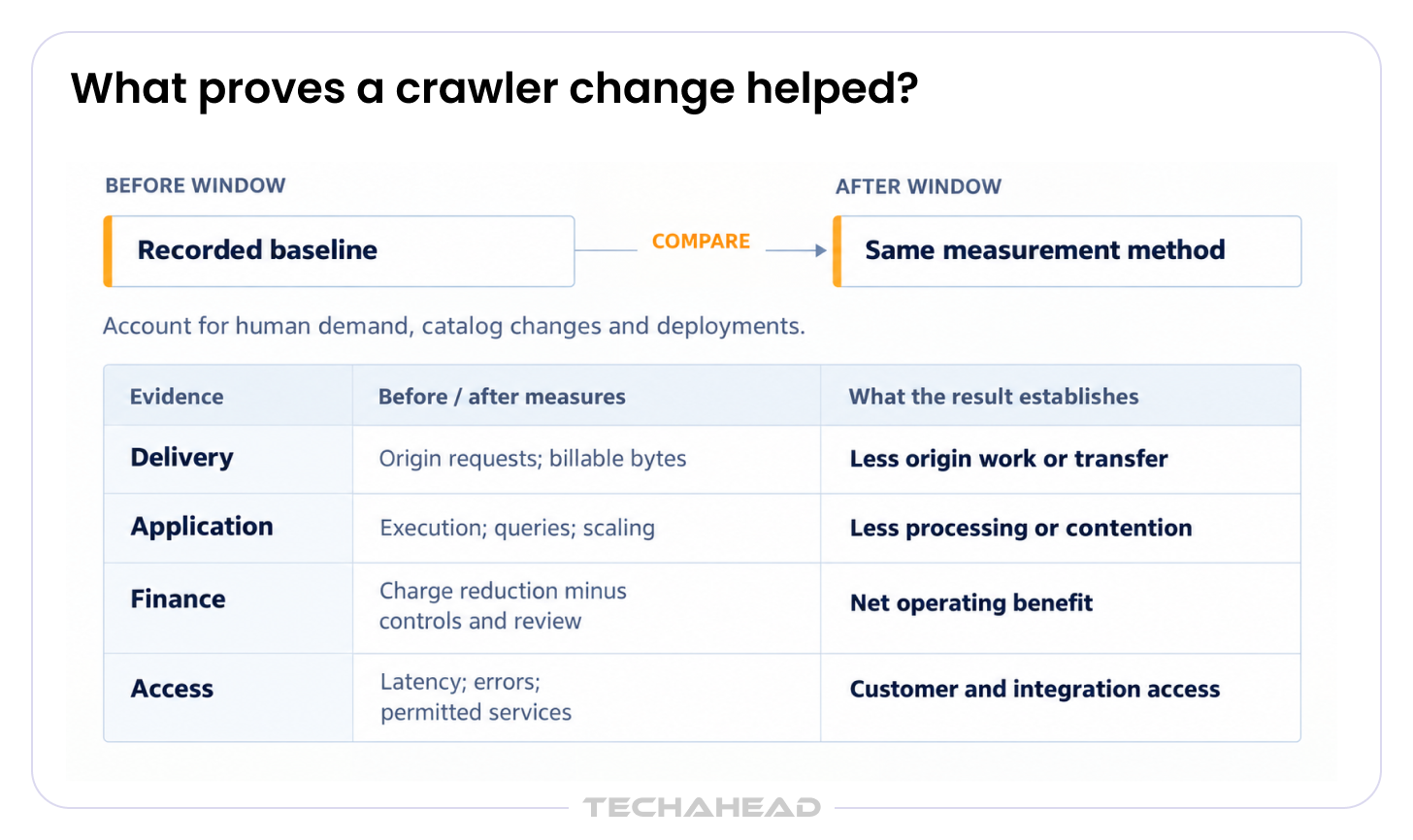
Before-and-after comparisons are more credible when customer activity and catalog size are similar, and deployments or promotions are accounted for. Relevant evidence includes:
A strong site-wide cache hit ratio can conceal an expensive search route. Similarly, fewer cache misses may reduce application work without changing fixed capacity charges.
For cloud egress costs, the financial result depends on billable transfer at the account’s effective rates, after allowances and discounts. Multiplying fewer bytes by a public list price can exaggerate savings.
The recurring cost of controls, observability, and maintenance belongs in the financial case for AI crawlers. One-time implementation costs have a separate effect on how quickly the work pays back.
Ongoing AI crawler monitoring helps reveal new operators, changed behavior, and permitted requests being blocked. Direct access tests can show problems that referral traffic alone would miss.
Also Read: AIOps for Cloud Computing Intelligence Systems
Another distinction matters: rate limiting may spread requests over more hours without reducing total work. That can improve customer response times while producing a smaller financial benefit than expected.
Clear ownership across engineering, finance, and operations makes this review practical. Engineering is responsible for implementation and reliability; FinOps validates the calculations; a business or content owner helps determine useful access. Security involvement is relevant where identity or abuse is a concern. Catalog changes, new integrations, and changing request patterns can all justify revisiting the policy.
The situations below appear in 2026 operator research and guidance. They show how we could apply our cloud engineering services, including FinOps and optimization, to the problems your business faces.
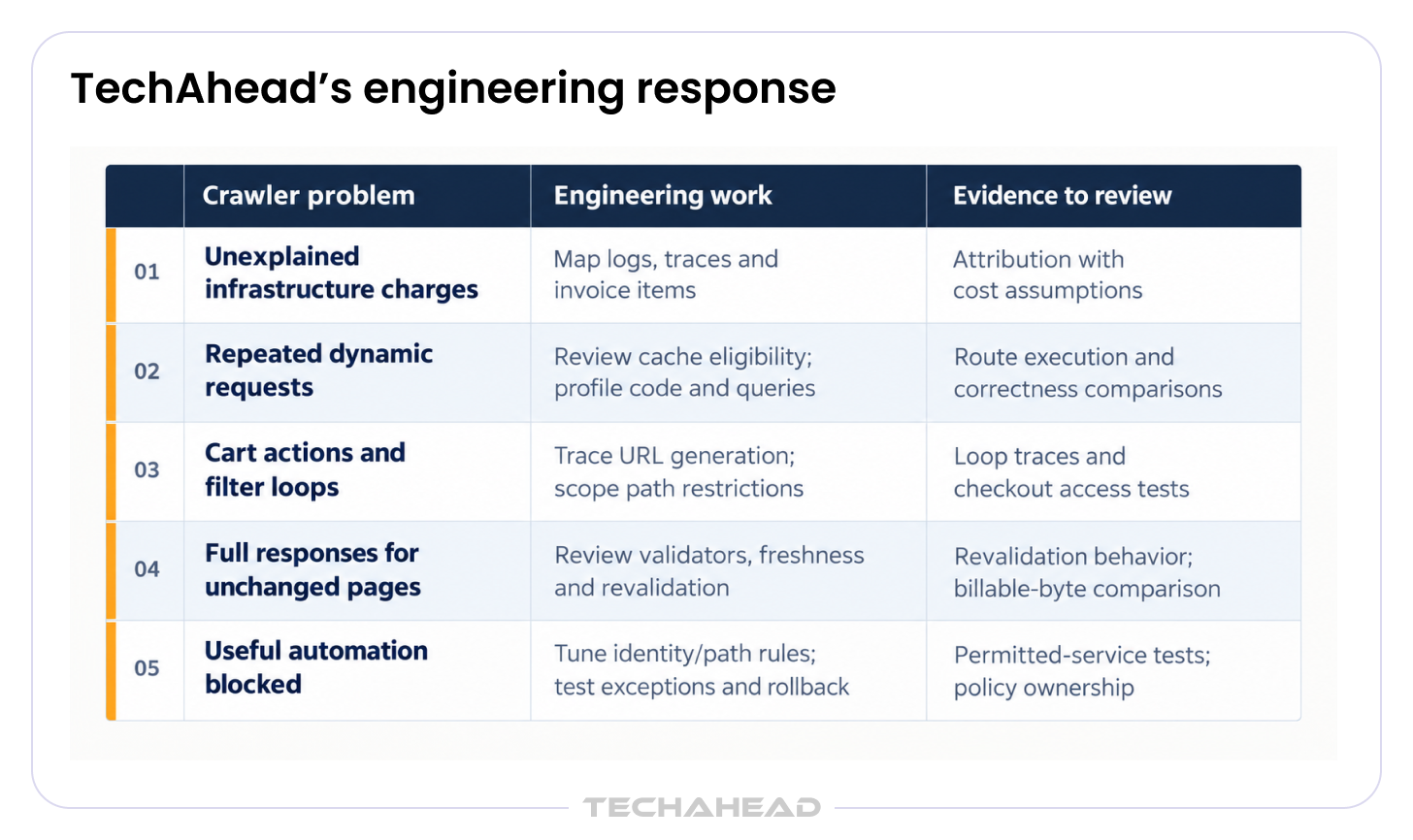
Wikimedia’s 2026 operational report describes bots spoofing browser identities and circumventing limits. Those identification problems complicate diagnosis. Even when traffic is classified, a chart by itself leaves finance with unanswered questions.
We would connect AI bot traffic analysis with application metrics and billing to explain which requests affect charges. For AWS environments, our AWS cost optimization services include architecture, workload, and billing assessment. This would help you understand which charges could fall, which costs would remain, and where the evidence is still incomplete before funding changes.
Google’s October 2026 crawl-rate guidance acknowledges that its crawling can create critical infrastructure load or unwanted costs during an outage. On commerce platforms and marketplaces, dynamic pricing, availability, and search responses are examples of work worth investigating.
Our assessment would bring CDN caching and application traces together. Where responses can be reused safely, delivery changes may reduce processing. Where fresh results are essential, the work shifts toward code and query efficiency. For example, GPTBot collects data for training OpenAI’s models, so dynamic endpoints should be evaluated separately when the traffic is tied to model training rather than search or user-retrieval use. Any changes would need to preserve accurate prices, availability, and working customer journeys.
Also Read: Quick Commerce App Development: Architecture, Caching, and Scaling Considerations
Google’s February 2026 podcast on its 2025 crawling findings identifies faceted navigation and action parameters as crawling challenges. On a store or marketplace, these can include filter combinations and URLs that trigger cart actions.
We would examine the links and application behavior creating those requests, alongside database load. Depending on the findings, the response could involve navigation changes, cheaper queries, or restrictions around cart actions. Product discovery, checkout, and order integrations would need to keep working throughout.
Google’s June 2026 crawler documentation explains that caching behavior varies between its clients. It also documents support for content validators. For publishers, this makes repeated delivery of unchanged pages a useful diagnostic question; crawler reuse cannot be assumed across operators.
Our work would cover freshness settings, redirects, response validators, and conditional requests. AI crawler monitoring would help establish whether operators actually reuse or revalidate content. The financial benefit would depend on fewer billable downloads and lower cloud egress costs under the publisher’s charging arrangement.
Wikimedia’s 2026 report describes protecting readers and community tools while restricting abusive crawling. That shared access makes blanket restrictions difficult. The business needs to preserve useful automation as well as customer access.
Our approach to bot management for AI crawlers would reflect who is making the requests, why, and which pages they need. Testing permitted integrations and planning how to reverse unintended restrictions would be part of that work. Our managed cloud services support continued monitoring and tuning as the traffic changes.
| Understanding AI crawler costs means knowing which requests create meaningful work and whether reducing that work will change what you pay. Better caching, more efficient queries, and selective access controls can help, but their value depends on your application and billing arrangements. A useful improvement might lower usage charges, postpone a capacity upgrade, or give customers a more responsive service. |
At TechAhead, we can help connect traffic patterns with application behavior and infrastructure usage, then assess which changes are worth making. Our cloud engineering and managed operations teams can support the implementation and ongoing tuning, including checks that customers and useful automation retain access.
Contact us to discuss a bot-traffic and cloud-cost assessment for your platform.
You can identify AI crawlers through CDN and server logs, then verify claimed identities using each operator’s published IP ranges or supported verification method. User-agent names alone are insufficient; requested paths and timing help explain behavior.
Effective AI crawler monitoring connects edge requests with application logs, cache outcomes, and resource metrics. TechAhead can help your team connect those records, separating requests blocked at the edge from traffic that actually reaches the application.
Yes, where providers offer separate controls. OpenAI distinguishes GPTBot from OAI-SearchBot, while Anthropic separates training, search, and user-requested retrieval. Your crawler policy can preserve desired search access while restricting training collection through the appropriate operator-specific settings.
No. Robots.txt communicates preferences to compliant operators but does not authenticate requests or enforce access restrictions. Sensitive endpoints need authentication, authorization, and appropriate network controls; crawler directives cannot replace those protections for your business applications.
Repeated requests to search, filters, and product variations can trigger queries and page generation. AI bot traffic analysis helps identify routes that increase database load or compete with customer activity, even when overall traffic appears manageable.
Shared CDN caching suits responses that visitors can safely reuse. Personalized pages, account data, and location-dependent results require careful separation. Cache eligibility and keys must preserve authorization, content differences, and freshness before broader reuse is introduced.
Selective rate limiting works best with verified identity, requested paths, and application capacity. A staged rollout with permitted-service tests and reversible rules helps protect customer journeys, search crawlers, and essential integrations while controlling disruptive request patterns.
Where GDPR applies, publicly accessible personal data still requires appropriate protection. Businesses should review exposed information, lawful processing, access permissions, and monitoring practices with privacy teams. Blocking AI crawlers alone does not establish GDPR compliance.
An assessment should cover identity verification, expensive routes, cache behavior, application dependencies, and permitted integrations. At TechAhead, we would use AI crawler log file analysis alongside application traces to identify suitable changes and define how to test them.
Successful controls reduce unnecessary application work while preserving customer access and permitted automation. TechAhead can support ongoing monitoring of execution, response times, errors, and rule exceptions, helping teams confirm improvements and adjust policies as traffic changes.
We use cookies to ensure our website functions properly, improve performance, and provide a personalized experience. You can choose which types of cookies to allow below.
Required for core functionality such as security, network management, and accessibility. These cannot be disabled.
Help us understand site traffic and user interactions so we can improve performance and usability.
Enable enhanced functionality and personalization such as language or region preferences.
Used to deliver relevant ads, track campaign performance, and measure advertising effectiveness.