

Staff Augmentation
Access top-tier talent on demand: Dedicated, Hourly, or Flexible.





 Copy Link
 Share on X
 Share on Facebook
 Share on LinkedIn
Key Takeaways
- Agentic AI doesn’t wait for prompts. It perceives, reasons, acts, and learns autonomously within clinical workflows. It executes decisions without human approval for routine scenarios, fundamentally different from passive recommendation systems.
- UMass Memorial cut readmissions 50%, Thoughtful AI saved 80% admin time, Insilico shortened drug discovery to 18 months. These are live production deployments, not pilots.
- Costs range $50K to $500K+ based on complexity, with 18-24 month ROI timelines. The business case is measurable efficiency gains, not speculative future value.
- Data quality, integration barriers, regulatory uncertainty, clinician trust, and security vulnerabilities kill most deployments. Success requires governance frameworks and FHIR-compliant architecture upfront.
- Organizations deploying now go live Q4 2026 or Q1 2027. Competitors waiting face 2028 timelines, creating a 2-3 year operational gap that compounds as AI systems learn.
AI is technology’s most important priority, and healthcare is its most urgent application.
–Satya Nadella, CEO of Microsoft
In healthcare settings, clinicians and staff must continuously locate and monitor patients, often leading to inefficiencies in workflow. AI-powered solutions have significantly enhanced this process by enabling real-time tracking, improving coordination, and accelerating response times. Within seconds, the care team has everything they need: the patient’s oxygen levels analyzed, medication interactions flagged, IV adjustments calculated, the on-call physician alerted, and a backup ventilator staged.
What’s different in 2026 is not just speed, but autonomy. Clinical staff no longer need to scramble for information. Agentic AI systems proactively orchestrate these actions, allowing healthcare professionals to focus on what truly matters, delivering high-quality patient care. This is agentic AI in healthcare, already being implemented in select hospitals today.
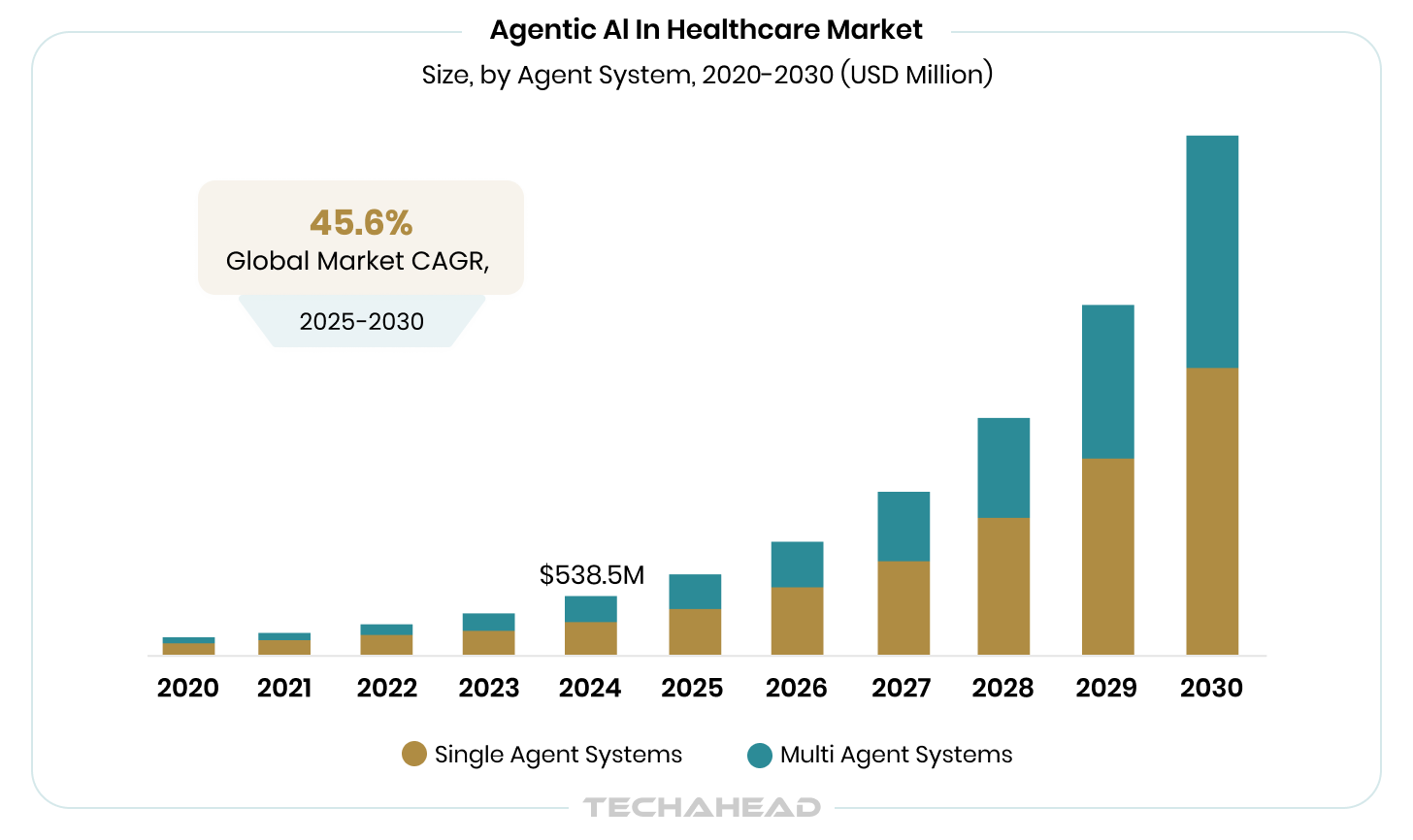
The momentum is accelerating rapidly. The global agentic AI in healthcare market was valued at USD 538.51 million in 2024 and is projected to reach USD 4.96 billion by 2030, growing at a CAGR of 45.56% from 2025 to 2030, highlighting strong enterprise adoption and investment potential.
In this blog, we will explore key use cases of agentic AI in healthcare, implementation challenges, cost considerations, and how enterprises can successfully adopt and scale these intelligent systems.
Why 2026 Is the Inflection Point for Agentic AI in Healthcare
Let’s cut through the hype and look at what’s actually happening on the ground. The global healthcare system is buckling under three converging pressures:
- Workforce Shortages
- Administrative Bloat, and
- Rising Patient Expectations
By conservative estimates, 81% of healthcare leaders report care delays directly tied to staffing constraints. Meanwhile, clinicians are drowning in documentation. In 2024, US physicians worked an average of 57.8 hours per week, but only 27.2 of those hours involved direct patient care. The rest? Data entry, insurance battles, and inbox management.
Traditional AI tried to help. And to be fair, it did, incrementally. But it also created new bottlenecks. Every insight required human follow-up. Every recommendation sat in a queue.
Enter agentic AI in healthcare 2026, a breed of systems that doesn’t just analyze and suggest. It perceives, reasons, acts, and learns. Autonomously. Think of it less as a tool and more as a digital coworker embedded in your care delivery infrastructure. One that never sleeps, never burns out, and gets smarter with every patient interaction.
Bonus Read: Top Use Cases of Agentic AI in 2026 Across Industries
A Deloitte survey from late 2025 found that 40% of healthcare tech executives no longer cite technical talent limitations as a major barrier.
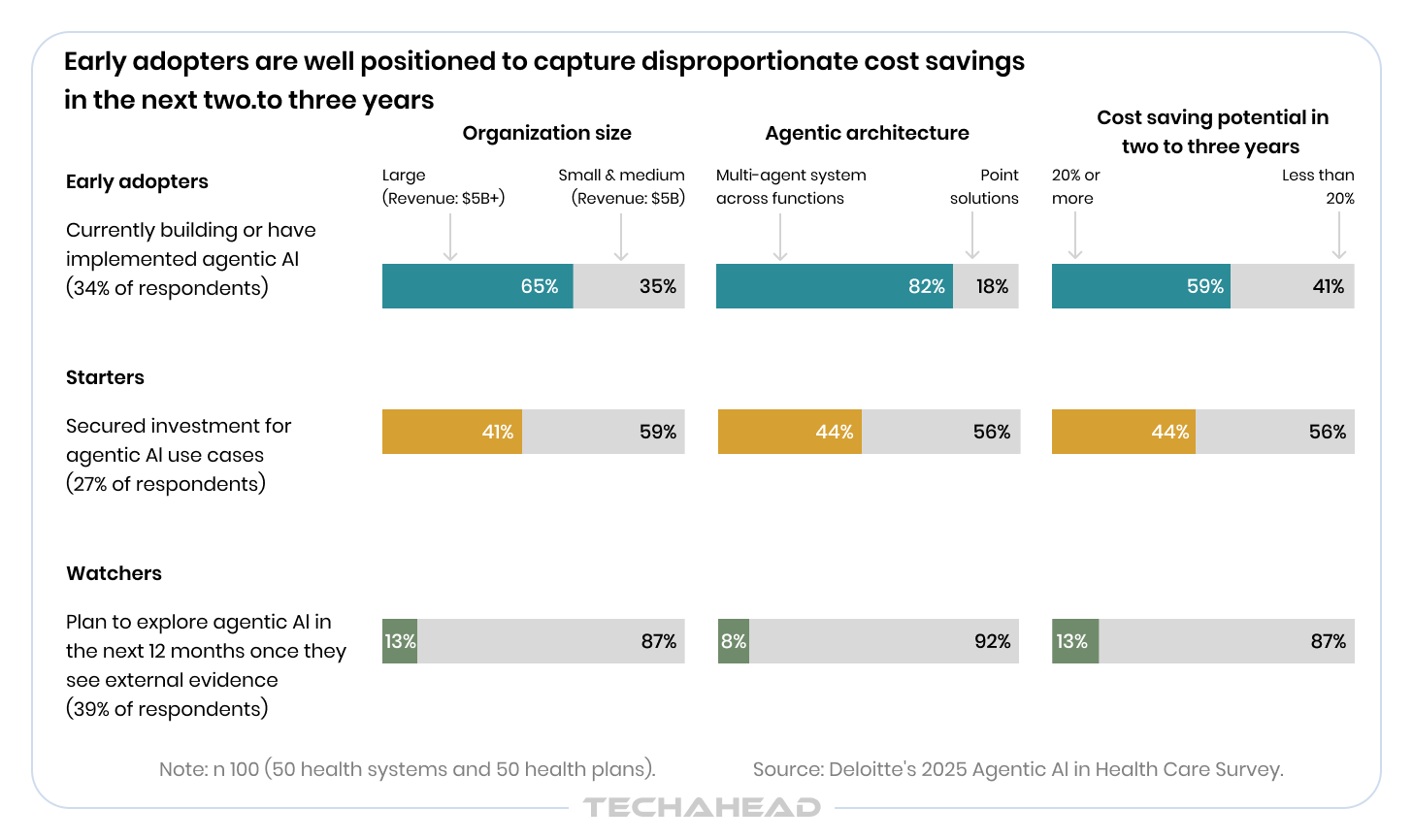
- Leadership buy-in? Up.
- Resistance to change? Dropping.
The infrastructure is maturing. The models are getting sharper.
But here’s the actual reality: most organizations aren’t ready. Not because the technology doesn’t work, but because they haven’t asked themselves the right questions yet.
Do your EHR systems support real-time data exchange?
Can your governance model handle autonomous decision-making?
Do your clinical teams understand what ‘agent’ even means in this context?
If you’re nodding along but haven’t conducted a formal readiness assessment, you’re already behind. And the organizations that figure this out first? They’re not just improving outcomes. They’re redefining what competitive advantage looks like in healthcare delivery for agentic AI in healthcare 2026 and beyond.
Must Read: AI in Healthcare: Transformative Solutions for Patients
What Actually Makes Agentic AI Different (And Why It Matters Now)
Agentic systems don’t wait. They’re built on four core capabilities that, when combined, create something closer to intelligent collaboration than automation:
- Perception and Context Awareness: They ingest data from AI-driven EHRs, wearables, lab systems, imaging platforms, and more. But they don’t just collect it. They interpret it in context, understanding relationships between vitals, medications, patient history, and environmental factors in real time.
- Reasoning Under Uncertainty: Healthcare data is incomplete. Symptoms overlap. Agentic AI doesn’t need perfect information to act. It calculates probabilities, weighs trade-offs, and makes defensible decisions even when the picture is murky.
- Action and Execution: This is where the wheel meets the road. Once a decision is made, the agent can trigger workflows, send alerts, update records, schedule resources, or adjust treatment parameters, without human approval for routine scenarios.
- Continuous Learning: Every interaction feeds back into the system. A dosage adjustment that worked? Noted. A false alarm that created alert fatigue? Calibrated. The system evolves with your organization’s patterns, not just generic training data.
Now, here’s where it gets interesting. Dr. Eric Topol, founder of Scripps Research Translational Institute, framed it perfectly:
The greatest opportunity offered by AI is not reducing errors or workloads, or even curing cancer: it is the opportunity to restore the precious and time-honored connection and trust the human touch between patients and doctors.
This level of autonomy requires a different kind of partnership with technology. You’re not deploying a feature. You’re onboarding a team member. And that means governance frameworks, audit trails, override protocols, and a cultural shift in how care teams interact with intelligent systems. Most organizations underestimate this transition. The ones that nail it partner with a healthcare development company that knows the entire circularity of deploying such a technology.
They’re the ones seeing double-digit improvements in clinician satisfaction and patient throughput within two quarters of implementing agentic AI applications in healthcare.
Recommended: Role of Data Interoperability in Healthcare Industry
Agentic AI Use Cases in Healthcare: 6 Real World Implementations
Let’s talk about where agentic AI use cases in healthcare are actually delivering value today, not in some polished case study but in live clinical environments. These examples of agentic AI in healthcare demonstrate how the technology moves from theory to measurable business impact.
1. Clinical Decision Support That Actually Supports Decisions
Traditional clinical decision support systems (CDSS) have a well-earned reputation for alert fatigue. Clinicians ignore 90% of them because most are noise. Agentic AI in healthcare flip this model. Instead of blasting every possible warning, these systems run continuous risk assessments in the background, only surfacing interventions when the signal-to-noise ratio justifies it. They’re watching for medication interactions, but also for subtle trends. A patient’s kidney function slowly declining over weeks while on a nephrotoxic drug? The agent catches it before it becomes a crisis, suggests an alternative, and drafts the order for physician review.
Real World Implementation: Oxford University x Microsoft
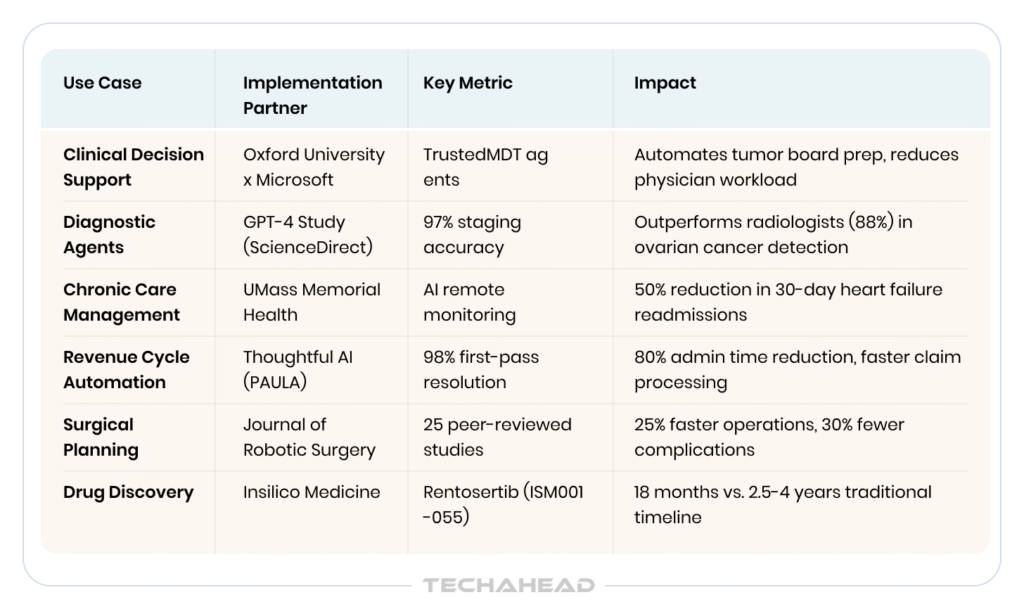
- Microsoft’s healthcare AI orchestrator features pre-configured agents with multi-agent orchestration capabilities that coordinate complex clinical workflows. For example, Oxford University’s Department of Oncology, in collaboration with Microsoft, built TrustedMDT agents that integrate with Microsoft Teams to summarize patient charts, determine cancer staging, and draft guideline-compliant treatment plans for tumor board review. This demonstrates precisely how agentic AI is being applied in healthcare to transform routine clinical workflows by handling tasks that previously required hours of physician time.
2. Diagnostic Agents That See What Radiologists Miss
Medical imaging is where AI first made its mark. But early systems were not as good because they were good at finding one thing, but useless at everything else. Modern diagnostic agents are multimodal. AI in medical diagnostics analyze imaging, lab results, patient history, and clinical notes simultaneously, looking for patterns across data types. Take early cancer detection. An agentic system doesn’t just flag a suspicious nodule on a CT scan. It correlates that finding with the patient’s smoking history, recent weight loss, inflammatory markers, and family history. Then it prioritizes the case, schedules a biopsy slot, and triggers a care coordination workflow.
Real World Implementation: GPT-4 Based Diagnostic Agents
- A systematic review published in ScienceDirect in December 2025 analyzing agentic AI systems in cancer detection found remarkable diagnostic accuracy across multiple cancer types. GPT-4-based diagnostic agents demonstrated performance matching or exceeding human specialists: 97% accuracy in ovarian cancer staging compared to 88% by radiologists, 89.5% pathology error detection versus 88.5% by pathologists, and 84.8% skin lesion classification matching dermatologists’ 84.6% accuracy.
But what’s important to note is that these systems don’t replace radiologists. They augment them. The radiologist confirms, contextualizes, and explains. The agent handles the computational heavy lifting and workflow orchestration. These are among the most validated examples of agentic AI in healthcare delivering measurable diagnostic improvements.
Must Read: The Rise of Autonomous Agents
3. Chronic Care Management That Actually Sticks
Chronic disease management has always been about consistency. Daily medication adherence. Regular monitoring. Lifestyle modifications. But here’s the problem: humans are inconsistent. Clinicians don’t have time to check in daily. Patients forget. How agentic AI is being applied in healthcare for chronic care is through persistent, adaptive monitoring agents. Think of them as digital care coordinators who never clock out.
Real World Implementation: UMass Memorial Health x AI-Powered Remote Monitoring
- UMass Memorial Health–Harrington Hospital deployed an AI-powered remote monitoring platform for chronic heart failure patients in October 2024. Patients receive internet-connected scales and blood pressure cuffs to track weight and vitals from home. The AI system analyzes daily readings, identifies patterns signaling fluid retention or medication issues, and alerts care teams before symptoms escalate into crises requiring emergency intervention.
- Blood pressure trending upward?
- Weight gain indicating fluid buildup?
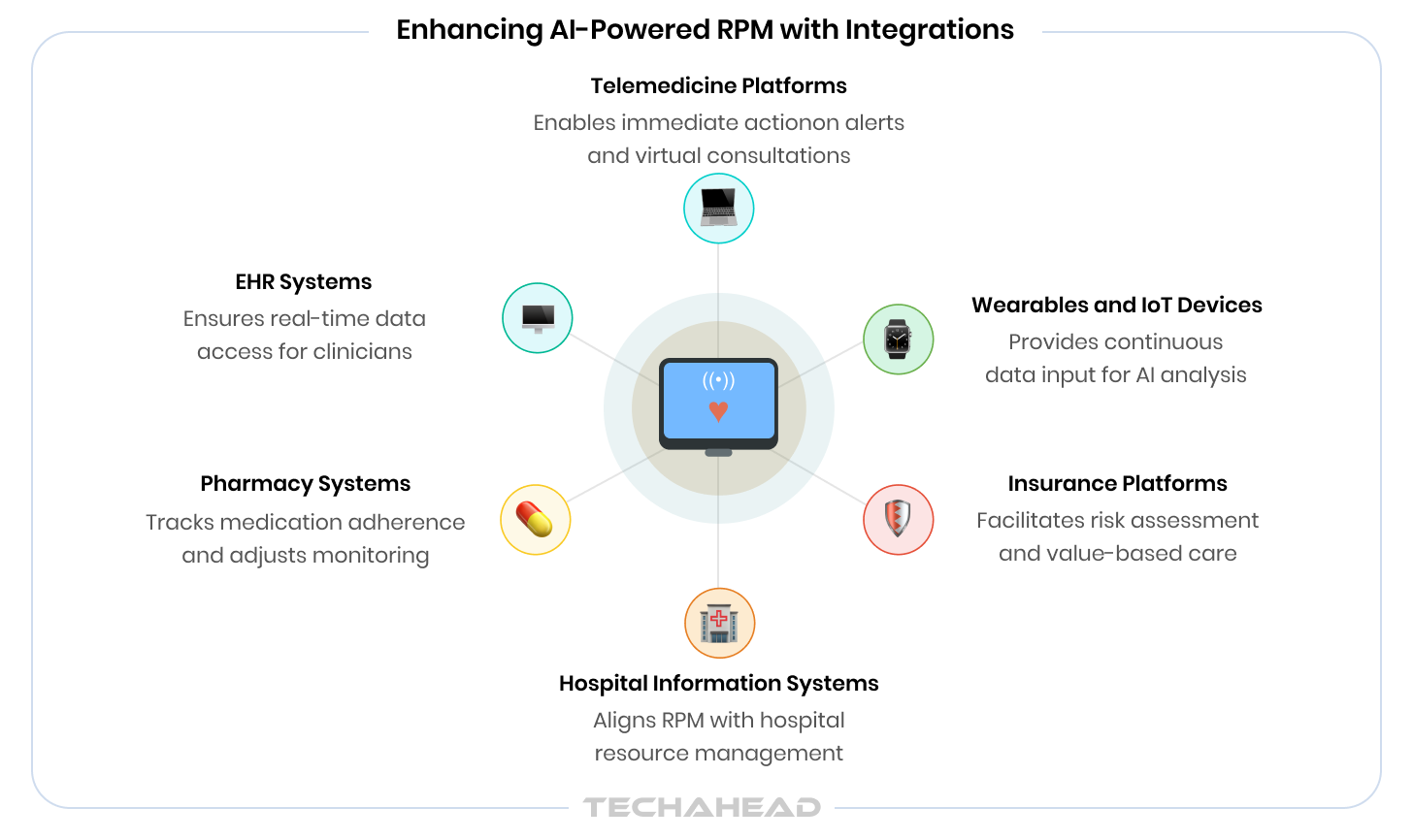
The agent correlates these signals with the patient’s medication schedule, recent dietary changes, and historical patterns, then triggers proactive outreach from nurses who can adjust treatment protocols remotely. The result? A 50% reduction in 30-day hospital readmissions for congestive heart failure patients. This demonstrates precisely how agentic AI is being applied in healthcare to transform chronic disease management from episodic interventions to continuous, intelligent monitoring that actually keeps patients stable at home.
4. Revenue Cycle Agents That Fix the Billing Nightmare
Let’s talk about the part of healthcare which is rarely discussed: billing. Prior authorizations alone consume an estimated 13 hours per physician per week. Denials? They’re up 23% year-over-year. And the administrative cost of resolving a single claim dispute can exceed the claim value itself. This is where agentic AI use cases in healthcare get brutally practical.
Real World Implementation: Thoughtful AI’s PAULA Agent
- Thoughtful AI’s PAULA agent automates prior authorizations end-to-end. It doesn’t just fill out forms. It predicts denial risk based on payer history, pre-stages appeals with supporting documentation, and tracks every interaction across the entire revenue cycle. The results? An 80% reduction in administrative time and a 98% first-pass resolution rate. That’s not incremental improvement. That’s transformation showing how agentic AI is being applied in healthcare to solve administrative bottlenecks.
But here’s what most business executives miss: these agents don’t just speed things up. They surface patterns.
- Which payers deny most frequently?
- For what procedures?
- At what time of the year?
Suddenly you’re not just processing claims faster. You’re renegotiating contracts with data-backed leverage.
5. Surgical Planning Agents That Work Backwards from Recovery
Here’s where things get genuinely futuristic. Instead of planning surgeries based on anatomy alone, emerging agents model the entire recovery trajectory first. They analyze the patient’s gait (walking pattern), muscle density, pain tolerance, home environment, and support system. Then they work backward, telling the surgeon: ‘Make this specific incision at this angle, and she’ll be walking unassisted in 21 days instead of 35.’
Real World Implementation: Journal of Robotic Surgery
- A 2025 meta-analysis published in the Journal of Robotic Surgery reviewed 25 peer-reviewed studies on AI-assisted robotic surgery from 2024-2025, comparing outcomes against traditional manual surgical techniques. The findings revealed that AI-assisted robotic surgeries demonstrated a 25% reduction in operative time and a 30% decrease in intraoperative complications compared to conventional manual methods. These AI overlays aren’t just steadying the surgeon’s hand during procedures. They’re analyzing real-time tissue responses, predicting optimal instrument trajectories, and providing surgeons with decision support that factors in patient-specific anatomy, comorbidities, and recovery trajectories.
6. Drug Discovery Agents That Cut Years Off Development
Traditional drug development takes a decade and costs over a billion dollars. Most candidates fail. Examples of agentic AI in healthcare now include systems that screen millions of molecular compounds, predict binding affinity, simulate toxicity, and even design entirely new molecules optimized for specific therapeutic targets.
Real World Implementation:
Insilico Medicine deployed its Pharma.AI platform to discover and design Rentosertib (ISM001-055), a first-in-class drug for idiopathic pulmonary fibrosis. The AI system identified TNIK as a novel therapeutic target through generative modeling, then designed the molecular structure optimized for that target. The entire process, from project initiation to preclinical candidate nomination, took just 18 months compared to the typical 2.5 – 4 years with traditional methods.
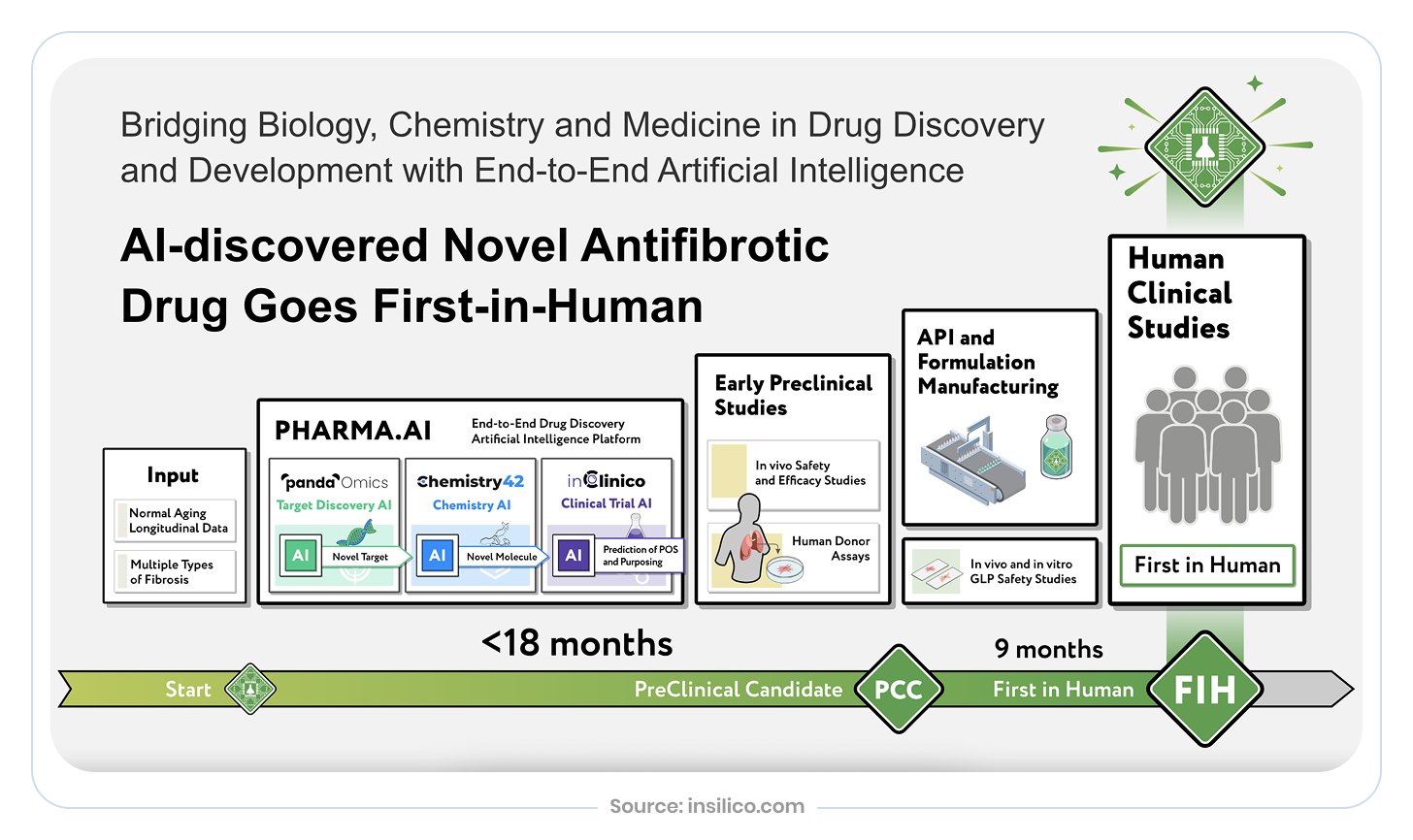
Results published in Nature Medicine in June 2025 from the Phase IIa clinical trial showed patients receiving 60mg of Rentosertib experienced a mean improvement of +98.4 mL in lung function (forced vital capacity) after 12 weeks, compared to a mean decline of -20.3 mL in the placebo group. This represents the industry’s first proof-of-concept clinical validation of a drug where both the target and molecule were discovered and designed entirely by AI.
Now, pause for a second and consider: Which of these use cases would actually move the needle in your organization? Because the temptation is to pilot everything. But the organizations seeing real value from Agentic AI in healthcare 2026? They pick one high-impact, high-pain area, prove it works, then expand. They treat agent deployment like hiring, not like installing software. We at TechAhead help bridge that gap between your idea and implementation via our 16+ years of industry specific experience.
Recommended: 2026 Healthcare IT Trends
What It Actually Costs to Build Agentic AI for Healthcare (And What You Get for the Money)
Let’s address the question everyone’s thinking but most companies dance around: what does this actually cost? Because here’s the truth: if you’re going this way, you’re either going to overpay for a glorified chatbot or underfund a system that could genuinely transform care delivery when implementing agentic AI in healthcare.
The range is wide, and for good reason. Agentic AI applications in healthcare aren’t one-size-fits-all.
Recommended: Generative AI in healthcare
A task-specific agent that automates appointment reminders? Very different from a closed-loop system that manages ICU patients autonomously. Let’s break it down:
Task-Specific Agents: $50K – $100K
These are your entry points. Single-purpose agents that handle well-defined workflows. Think prior authorization automation, patient follow-up coordination, or basic triage routing. They typically leverage existing APIs, pretrained models, and standard integration patterns. Setup is measured in weeks to a few months. Customization is minimal.
What You Get: Immediate ROI on high-volume, low-complexity tasks. These agents prove the concept, build organizational confidence, and free up human bandwidth for more complex work. They’re not highly good, but they pay for themselves within a year. A skilled healthcare development company can deploy these in a few weeks with proper integration support.
Intelligent Clinical Agents: $100K – $200K
This is where things get strategic. You’re building agents that make clinical recommendations, coordinate complex care pathways, or provide adaptive decision support. These systems integrate with EHRs, lab systems, imaging platforms, and pharmacies. They handle multimodal data, perform probabilistic reasoning, and adapt to your organization’s specific protocols. Development timelines stretch to 6-9 months.
What You Get: Measurable improvements in clinical outcomes, reduced errors, and better resource utilization. These agents start showing value within two quarters, but the real payoff compounds over time as they learn your organization’s patterns. They require governance frameworks, audit trails, and clinical oversight, but they fundamentally change how care gets delivered. This is where agentic AI in healthcare 2026 deployments are showing the strongest early ROI.
Enterprise-Grade Closed-Loop Systems: $200K – $500K
Now we’re talking about agents that operate with significant autonomy across multiple clinical and operational domains. These systems perceive, reason, act, and learn continuously. They might also be able to manage entire patient populations for chronic diseases, orchestrate surgical workflows from planning through recovery, or run clinical research protocols autonomously. They require custom architecture, robust security layers, regulatory compliance documentation, and multi-year roadmaps.
What You Get: Competitive differentiation. These aren’t cost-saving measures. They’re strategic bets that your organization can deliver fundamentally better care at scale. The organizations investing here aren’t optimizing existing workflows. They’re inventing new care models that leverage agentic AI in healthcare at enterprise scale.
But here’s the critical nuance most budget discussions miss: the real cost isn’t just development. It’s change management. It’s retraining staff. It’s updating governance policies. It’s building trust with clinicians who are rightfully skeptical. A healthcare development company that understands this doesn’t just deliver code. They deliver implementation strategies, training programs, and ongoing optimization support.
And here’s a question worth asking your chosen development company: What’s your track record on change management, not just technical deployment? Because the most expensive AI project is the one that technically works but nobody uses.
Bonus Read: Guide to the Building Blocks of Successful AI Agents
One more thing on cost: ROI timelines matter more than sticker prices. A $500K agent that pays for itself in 18 months beats a $200K system that delivers marginal value indefinitely. The organizations who are getting their healthcare agentic AI developed are thinking in terms of total cost of ownership over three to five years, not just year-one budget impact.
The Implementation Challenges Nobody Warns You About (And How to Prepare)
The gap between a successful agentic AI in healthcare 2026 deployment and a stalled pilot project often comes down to challenges that have nothing to do with the AI itself.
1. Data Quality: The Garbage In, Garbage Out Problem Still Exists
Agentic AI systems are only as good as the data they perceive. If your EHR is full of copy-pasted notes, outdated allergies, and incomplete medication lists, your agent will make decisions based on flawed information. The fix? Data governance has to come first. Clean your house before you invite intelligent agents to move in. This means standardizing data entry, implementing validation rules, and conducting quality audits.
Solution: The TechAhead Way
TechAhead begins every deployment with comprehensive data quality assessments, identifying inconsistencies before implementation. We deploy automated profiling tools, establish standardized clinical ontologies, and implement real-time validation rules. Our 4-6 week data remediation process ensures AI agents operate on clean, reliable data from day one.
2. Integration Complexity: Your IT Stack Wasn’t Built for This
Healthcare IT environments are notoriously fragmented. You’ve got your EHR, your lab system, your imaging platform, your pharmacy system, your billing software. Agentic AI in healthcare require real-time data flow across all of these. If your systems don’t talk to each other, the agent can’t act intelligently.
Solution: The TechAhead Way
TechAhead builds FHIR-compliant integration layers connecting disparate systems without disrupting workflows. Our architects map all data touchpoints, then design middleware enabling real-time bidirectional exchange between EHRs, labs, imaging, and pharmacy systems. We achieve full interoperability within 8-12 weeks while maintaining HIPAA compliance.
3. Regulatory Compliance: The Rules Are Still Being Written
Here’s the uncomfortable truth: regulatory frameworks for autonomous AI in healthcare are evolving faster than most legal teams can track. HIPAA compliance is table stakes. But what about AI-specific regulations? What about algorithmic transparency requirements? What about liability when an agent makes an autonomous decision that impacts patient care?
Solution: The TechAhead Way
TechAhead builds compliance into architecture from day one. We maintain regulatory specialists tracking FDA guidance, implement comprehensive audit logging for every agent decision, and design override protocols preserving human authority. Our governance framework includes automated bias detection, explainability reporting, and documentation supporting regulatory submissions.
4. Clinician Trust: The ‘Black Box’ Problem
Even when agents work perfectly, clinicians won’t use them if they don’t trust them. And trust requires transparency. When an agent recommends changing a medication, the clinician needs to understand why. Not just ‘the algorithm says so,‘ but ‘based on this patient’s kidney function trend, this interaction risk, and these recent studies.‘
Solution: The TechAhead Way
TechAhead designs recommendations with built-in explainability, surfacing specific clinical data, trend analysis, and evidence-based guidelines in clinician-friendly language. We implement layered explanation interfaces, structured training programs, and feedback loops where providers flag questionable recommendations, building trust through transparency rather than blind algorithmic faith.
5. Security Threats: Agents Are Attack Surfaces
Healthcare data breaches exposed 182.4 million individuals in 2024. Now add autonomous agents that can access, analyze, and act on that data. The attack surface just got bigger. Prompt injection attacks, model poisoning, adversarial inputs – these aren’t theoretical risks. They’re real vulnerabilities that require defensive architectures.
Solution: The TechAhead Way
TechAhead implements defense-in-depth architecture with input sanitization blocking prompt injection, model integrity verification detecting poisoning, and runtime monitoring flagging adversarial inputs. We deploy zero-trust segmentation, conduct quarterly AI-focused penetration testing, and maintain 24/7 SOC monitoring with threat modeling for emerging vulnerabilities.
So here’s the strategic question: Are you prepared to treat AI deployment as an organizational transformation, not just a tech project? Because the difference between success and failure usually comes down to whether leadership understands that agentic AI in healthcare requires changes to governance, training, workflows, and culture – not just infrastructure.
Are You Actually Ready? The Questions That Separate Pilots from Production
Before you write the first check to a healthcare development company, ask yourself these questions. Not as box-checking exercises, but as genuine readiness assessments:
- Can you clearly articulate the business outcome you’re trying to achieve? Not ‘we want AI’ but ‘we need to reduce prior authorization turnaround time by 50%’ or ‘we want to cut readmissions for CHF patients by 30%.’ Vague goals produce vague results.
- Do you have executive sponsorship, not just interest? Innovation theater dies when things get hard. Real transformation requires someone in the C-suite who’s willing to fight for resources, push through resistance, and measure success honestly.
- Is your data infrastructure actually ready? Run a data quality audit. Check your interoperability. Verify that your EHR can support real-time data exchange. If your systems can’t talk to each other, your agents can’t act intelligently.
- Have you identified clinical champions who will advocate for adoption? Technology alone doesn’t change behavior. You need respected clinicians who believe in the vision and can help their peers understand why this isn’t just another promise.
- Do you have a governance model for AI decision-making? Who reviews agent recommendations? Who has override authority? What’s the escalation path when the agent gets it wrong? These aren’t questions to figure out after deployment.
If you can’t answer these questions confidently, you’re not ready for production deployment. And that’s okay. Start with a focused pilot. Pick one high-value use case. Prove it works. Build organizational muscle memory around working with agents, and then scale.
Ready to Deploy Agentic AI That Actually Works? Partner with TechAhead
Implementing agentic AI in healthcare requires more than technical capability. It demands deep domain expertise, regulatory fluency, and a proven track record of delivering HIPAA-compliant AI solutions at scale. TechAhead brings all three, backed by a specialized compliance team that manages complex regulatory requirements across jurisdictions and a 240+ consultant workforce including HIPAA-certified architects, clinical workflow specialists, and AI/ML engineers.
With 16+ years serving 1,200+ global brands including The Healthy Mummy (scaled to 2 million users), Hoag Memorial Hospital, and cutting-edge digital health platforms like Plunge and Unchecked Fitness, we’ve built the muscle memory that separates successful AI deployments from stalled pilots.
We’ve connected 200+ healthcare platforms across clinical, billing, and patient engagement systems, delivering zero-downtime implementations that maintain clinical operations while transforming care delivery. From AI-powered diagnostics to predictive analytics and IoT-enabled medical device integration, our solutions process data for 500 million+ daily active users across healthcare platforms globally.
Why healthcare organizations choose TechAhead:
- SOC 2 Type II, ISO 27001:2022, ISO 13485, and ISO 42001:2023 (AI Management) certifications ensuring enterprise-grade security and compliance
- Top 10 App Developer on Clutch for 12+ consecutive years
- 150+ industry honors including Webby Awards, Google Best App 2024, and Great Place to Work certification
- AWS Advanced Partner with Healthcare Competency and Microsoft Gold Partner status
We don’t just build AI agents. We architect compliant, scalable, clinician-trusted systems that deliver measurable ROI from day one.
If you’re ready to move beyond proof-of-concept and deploy agentic AI that transforms clinical outcomes and operational efficiency, let’s discuss your roadmap. Connect today!
What exactly is agentic AI in healthcare, and how is it different from regular AI?
Unlike traditional AI that waits for prompts and just recommends, agentic AI in healthcare perceives, reasons, acts, and learns autonomously. Think of it as a digital coworker embedded in your clinical workflows: analyzing patient data continuously, triggering interventions, and adapting to your organization’s patterns without constant human supervision.
What are the most common agentic AI use cases in healthcare that deliver ROI quickly?
The fastest wins? Revenue cycle automation (prior authorizations), remote patient monitoring for chronic diseases, and clinical decision support. Examples of agentic AI in healthcare like UMass Memorial’s 50% readmission reduction or Thoughtful AI’s 80% admin time savings show measurable impact within two quarters, not two years.
How much does it actually cost to implement agentic AI in healthcare?
Real talk: task-specific agents (appointment reminders, basic triage) run $50K-$100K. Intelligent clinical agents with EHR integration cost $100K-$200K. Enterprise-grade systems managing entire patient populations? $200K-$500K+. But ROI timelines matter more than sticker prices. We’ve seen $500K agents pay for themselves in 18 months.
Is agentic AI compliant with HIPAA and other healthcare regulations?
Absolutely, when built right from day one. Agentic AI applications in healthcare must embed compliance, not bolt it on later. We implement AES-256 encryption, role-based access controls, comprehensive audit logging, and maintain SOC 2 Type II and ISO 27001:2022 certifications. Every agent decision gets documented for regulatory scrutiny.
How long does deployment take from contract signing to going live?
Depends on scope. Simple task agents? 6-8 weeks. Intelligent clinical agents with full EHR integration? 6-9 months. Enterprise closed-loop systems? 12-18 months. The critical piece most healthcare development companies skip? That 4-6 week data remediation phase upfront. Clean data determines whether your agent works brilliantly or fails spectacularly.
Will clinicians actually trust and use AI agents, or will they just ignore recommendations?
Trust comes from transparency, not magic. We build explainability into every recommendation: clinicians see exactly which patient data, trend analysis, and clinical guidelines informed each decision. Plus structured training programs and feedback loops where providers can challenge recommendations. How agentic AI is being applied in healthcare successfully? By treating it like onboarding a team member, not installing software.
What happens when the AI agent makes a mistake or recommends something wrong?
Override protocols are mandatory, not optional. Every agentic AI in healthcare 2026 deployment needs clear governance: who reviews agent recommendations, who has override authority, what’s the escalation path. We implement human-in-the-loop checkpoints for critical decisions, comprehensive audit trails, and incident response protocols. The agent assists; clinicians decide.
How do you integrate agentic AI with our existing EHR system without disrupting operations?
We build FHIR-compliant integration layers that connect to Epic, Cerner, Allscripts, and legacy systems without ripping anything out. Our architects map all data touchpoints, design middleware for real-time bidirectional exchange, and achieve full interoperability within 8-12 weeks. Zero-downtime deployment means clinical operations continue uninterrupted throughout implementation.
What’s the biggest reason agentic AI projects fail after the pilot phase?
Change management, hands down. The technology works, but organizations underestimate the cultural shift required. You need executive sponsorship (not just interest), clinical champions advocating adoption, governance frameworks for autonomous decisions, and staff retraining. The most expensive AI project? One that technically works but nobody uses because you skipped the trust-building phase.
How is TechAhead different from other healthcare development companies building AI solutions?
Sixteen years delivering HIPAA-compliant AI across 200+ healthcare platforms gives you muscle memory that separates successful deployments from stalled pilots. We don’t just write code. We deliver implementation strategies, clinician training programs, and ongoing optimization. Plus SOC 2 Type II, ISO 27001:2022, ISO 13485, and ISO 42001:2023 AI Management certifications mean compliance is architecture, not afterthought.