


 Copy Link
 Share on X
 Share on Facebook
 Share on LinkedIn


Always Active
Required for core functionality such as security, network management, and accessibility. These cannot be disabled.

Uncover the transformative potential of digital and mobile solutions for your industry.





 Last Updated: Oct 9, 2026
Oct 8, 2026
Last Updated: Oct 9, 2026
Oct 8, 2026  23
23  20 min. Read


Key Takeaways


Planning a travel app sounds straightforward until the product has to do more than display destinations.
A customizable travel platform may need to connect flights, hotels, transportation, payments, maps, customer accounts, booking systems, third-party APIs, real-time availability, and increasingly, AI-powered recommendations. Behind the simple “Book Now” button can sit a fairly complex technology ecosystem.
That makes partnering with the right travel app development company an important decision. A team that can build a polished mobile interface may not necessarily have the experience to handle booking infrastructure, travel APIs, supplier integrations, scalable backends, or the operational systems that keep a travel platform running.
If a business wants to narrow down their options, we have put together this list of the top travel app development companies in 2026. We based the selection on publicly available information about each company’s travel capabilities, software development expertise, relevant solutions, integrations, and documented industry experience.
| Rank | Company | Primary Specialization | Relevant Travel Solutions | Best Suited For |
| 1 | TechAhead | Custom travel apps and travel technology, backed by broader AI, cloud, and digital engineering | Flight, hotel, car rental, and transportation booking; AI recommendations and itineraries; smart search; GDS integration | Businesses that want custom travel apps, booking platforms, and wider travel technology |
| 2 | COAX Software | Travel, transportation, and mobility software | Booking experiences, transportation platforms, short-term rental management, travel CRM, mobility apps | Custom travel products, booking platforms, and mobility-focused apps |
| 3 | GP Solutions | Travel software and business automation | Own GP Travel Enterprise platform; custom development; GDS, bedbank, OTA, channel manager, and CRS integrations | Tour operators, DMCs, and travel businesses that need operational automation |
| 4 | DataArt | Enterprise software with a travel and hospitality practice | Property management, reservations, loyalty, revenue optimization, GDS and NDC integrations, platform modernization | Established travel and hospitality businesses modernizing legacy systems |
| 5 | AltexSoft | Travel and hospitality technology consulting plus engineering | Booking and reservation systems, GDS and NDC integrations, hotel APIs, airline management, travel payments, generative AI | Businesses that want consulting, product strategy, and engineering together |
| 6 | Intellectsoft | Custom software and digital transformation with a hospitality focus | Mobile hotel apps, contactless solutions, kiosks, smart-room technology, legacy system transformation | Hotels, resorts, and hospitality brands |
| 7 | Chetu | Custom software development across travel and hospitality | Real-time booking with payments, vacation-rental and timeshare software, Travelport and Sabre integrations | Travel agencies, OTAs, and hospitality businesses that need third-party integrations |
| 8 | Cleveroad | Travel and hospitality software development | Booking platforms, hotel management systems, travel portals, agent software, Amadeus and Sabre integrations | Agencies and hospitality businesses building booking or travel management platforms |
| 9 | Onix | Travel and tourism app development | Travel mobile apps, niche travel platforms, booking apps, travel agency software | Businesses building specialized travel and tourism apps |
| 10 | Yalantis | General digital product development | Travel apps, online travel businesses, technology for traditional agencies | Startups that need product strategy, UX, and development |
There is no one official rating of travel app development businesses; thus a helpful list must have a solid foundation for comparison.
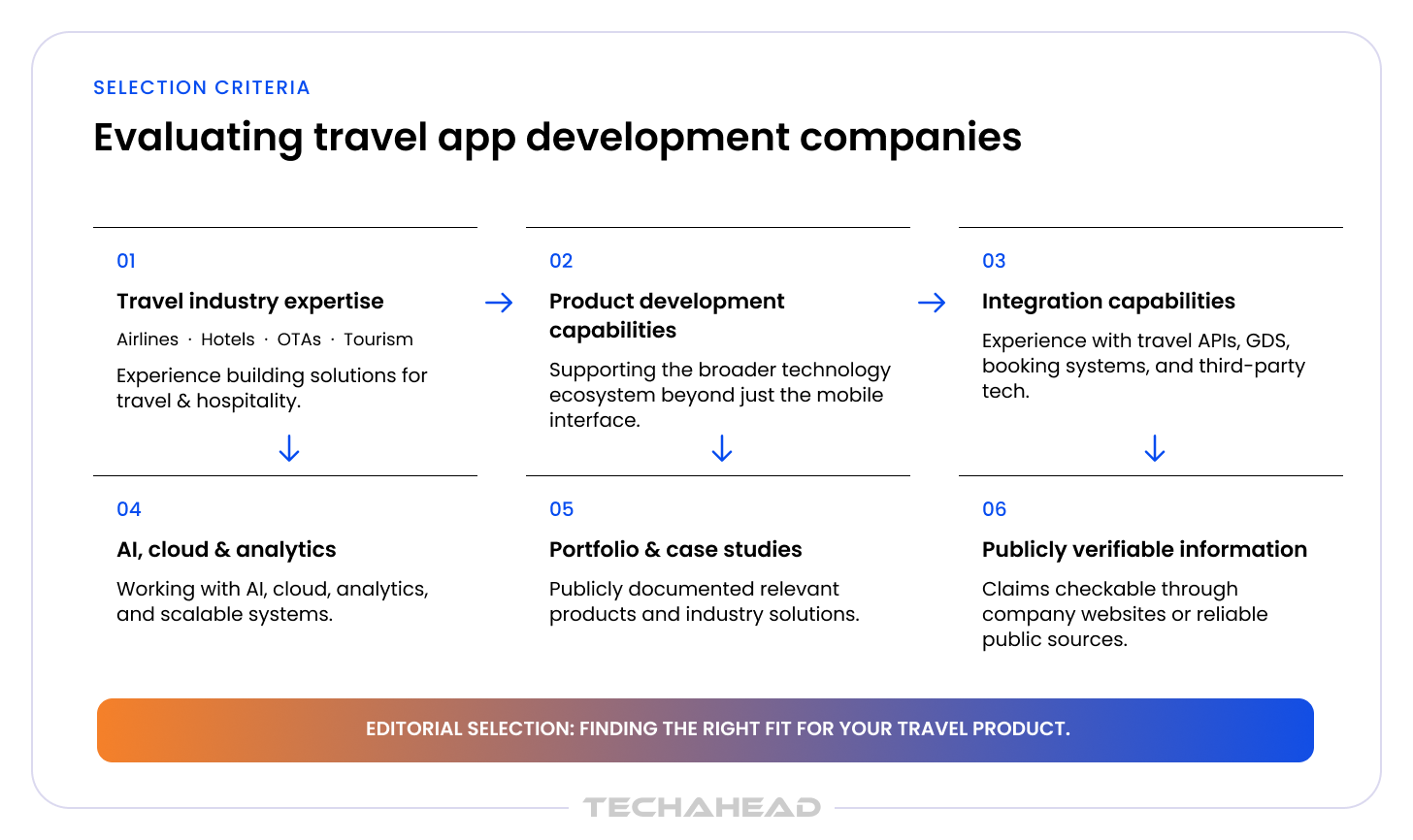
We looked at publicly available information across several areas:
The list is editorial rather than an official industry ranking. Companies can also be a better fit at different stages or for different types of travel products.
TechAhead and its travel offerings go beyond basic mobile app development. The company focuses on building travel applications and software development for booking, tourism, airlines, hotels, and other travel businesses. Its public travel offering covers flight and hotel reservations, transportation booking, itinerary platforms, smart search, price comparison, GDS integration, AI-powered personalization, and real-time travel experiences.
What TechAhead offers for travel
Its publicly documented travel capabilities include:
The width is crucial. It is unusual for a travel product to exist as a single, standalone application. Booking systems, APIs, payment infrastructure, analytics, cloud services, and administrative tools may all be layered on top of a customer-facing app. Teams may approach these components as part of a cohesive product rather than as discrete projects, considering TechAhead’s wider technological capabilities. Mobile experiences centered around trip planning, exploration, and booking are also highlighted in the company’s travel app development portfolio.
Why TechAhead stands out
Technology that combines intelligence and ease is becoming more and more necessary for travel agencies. Personalization, suggestions, real-time information, and post-booking involvement are becoming just as crucial to the experience as search and booking.
TechAhead’s positioning across travel app development, AI, API integrations, cloud, analytics, and digital product engineering makes it a strong option for businesses looking to build or modernize a connected travel platform.
Best suited for: Businesses looking for custom travel applications, booking platforms, and broader travel technology solutions.
Explore: TechAhead’s Travel App Development Service
COAX Software specializes in software development for travel, transportation, and mobility solutions. COAX Software specializes in software development for travel, transportation, and mobility solutions. Its strength is the range of travel scenarios it covers. Its published work includes booking experiences, transportation platforms, short-term rental management, travel CRM, and mobility apps. According to its public materials, COAX also puts considerable emphasis on accessibility and compliance, including WCAG and European accessibility requirements.
Why consider COAX?
For businesses looking for a development partner with a visible travel and mobility portfolio, COAX is worth considering. Its public case studies demonstrate experience with booking workflows, supplier integrations, maps, payments, and transportation technology.
Best suited for: Travel businesses looking for custom travel products, booking platforms, or mobility-focused applications.
GP Solutions has built a specialized position around travel software development and travel business automation.
The company offers its own GP Travel Enterprise platform, intended for tour operators and destination management companies, along with bespoke travel software development. Its public materials cover product management, sales, operations, booking, inventory, distribution, and third-party connections.
Where GP Solutions fits
Its integration capabilities will matter most to businesses working in complex travel ecosystems. GP Solutions lists integrations with GDS platforms, bedbanks, airline aggregators, OTAs, channel managers, CRSs, mapping providers, and other travel suppliers. It also offers custom development, dedicated teams, discovery and analysis, travel data and analytics, UI/UX design, and AI integration.
Travel companies often run complicated internal operations that a simple consumer-facing app can’t handle. GP Solutions’ focus on business process automation and travel operations speaks to companies that need technology for both customer-facing and back-office work.
Best suited for: Tour operators, DMCs, travel businesses, and companies looking for travel software combined with operational automation.
DataArt approaches travel technology from an enterprise software perspective. Travel agencies, lodging establishments, airlines, cruise lines, ground transportation firms, and other travel-related enterprises are all covered by its travel technology practice. The company’s services are publicly positioned on enhancing distribution, creating digital experiences, and updating travel software.
Property management systems, reservation management, guest interaction, loyalty programs, and revenue optimization are among its hospitality features. DataArt offers distribution and scalable growth-oriented solutions for travel agents and online travel agencies.
The company also works on travel distribution and platform modernization, including GDS and NDC integrations and revenue management systems.
Why consider DataArt?
Not every travel company is starting from scratch. Large organizations often have legacy platforms that need to be modernized without disrupting existing operations. DataArt’s focus on modernization and enterprise travel systems makes it particularly relevant for those projects.
Best suited for: Established travel and hospitality businesses undertaking enterprise software modernization or complex digital transformation.
AltexSoft is one of the more travel-specialized companies on this list. The company describes itself as a travel and hospitality technology consulting company and works with OTAs, travel management solution providers, travel technology startups, airlines, hotels, transportation companies, and other travel businesses.
Its public travel technology practice covers:
AltexSoft also publishes extensively about technical travel topics, including GDS integration, airline distribution, AI agents, OTA architecture, and travel data.
Why consider AltexSoft?
Its mix of consulting and engineering helps companies decide what to build before development begins. That can be particularly valuable for OTAs, travel SaaS companies, and businesses modernizing existing travel infrastructure.
Best suited for: Travel businesses looking for a combination of travel technology consulting, product strategy, and engineering.
Intellectsoft works across hospitality and travel with an emphasis on custom software and digital transformation. Its public hospitality offering includes mobile hotel applications, contactless hospitality solutions, mobile kiosks, smart-room technology, custom software integration, and AI and machine learning capabilities.
The company’s hospitality applications can bring services such as room booking, loyalty, personalization, concierge services, and amenities into a single digital experience. It also works on legacy system transformation, helping hospitality businesses modernize existing technology rather than replacing every system at once.
Why consider Intellectsoft?
The hospitality experience increasingly extends beyond booking. Hotels and resorts need technology for guest services, check-in, loyalty, smart rooms, and internal operations. Intellectsoft’s focus on these broader digital experiences makes it relevant for hospitality brands looking beyond a standard booking application.
Best suited for: Hotels, resorts, and hospitality businesses looking for custom applications and digital transformation.
Chetu provides custom software development services across travel and hospitality, with a broad range of solutions covering booking, reservations, vacation rentals, guest management, hospitality operations, and integrations. Its public travel and hospitality offering includes real-time booking systems with payment integration, property and guest management solutions, and vacation-rental and timeshare software.
Chetu also specifically documents Travelport integration services and custom Sabre development for B2B and B2C travel applications, travel agencies, OTAs, and travel service providers. Its hospitality technology offering also includes AI-powered solutions such as virtual assistants, guest-service bots, predictive analytics, demand planning, and backend automation.
Why consider Chetu?
Travel and hospitality businesses often need to connect new digital products with systems they already use. Chetu’s publicly documented focus on travel integrations makes it relevant for businesses dealing with existing travel infrastructure.
Best suited for: Travel agencies, OTAs, hospitality businesses, and companies requiring custom travel software and third-party integrations.
Cleveroad provides custom travel and hospitality software development for travel agencies, airlines, hotels, and other businesses. Its public travel offering covers custom software development, software reengineering, third-party integrations, booking platforms, hotel management systems, travel portals, and travel agent software.
Cleveroad also publicly documents experience with travel distribution systems and integrations involving Amadeus, Sabre, booking engines, OTAs, mapping services, payment providers, and location technologies. One example highlighted by the company is Koralgo, a platform designed to help travelers discover, compare, and book travel activities and accommodation while connecting with multiple service providers.
Why consider Cleveroad?
Its combination of mobile, web, booking, integration, and software reengineering capabilities makes it suitable for both new travel products and modernization projects.
Best suited for: Travel agencies, hospitality businesses, and companies building custom booking or travel management platforms.
Onix has a dedicated tourism app development content and service focus, covering travel applications, booking products, travel agency software, and related digital solutions. Its public travel resources cover topics including travel mobile application development, niche travel platforms, booking applications, and travel agency software.The company’s travel-focused content also demonstrates attention to areas such as travel platform architecture, features, user experience, and the technology decisions involved in building travel products.
That makes Onix worth considering for businesses that need a custom digital travel product rather than an off-the-shelf solution.
Why consider Onix?
Travel products vary widely. A booking platform, a tourism guide, and a niche travel community all require different product decisions. Onix’s work around different travel application types makes it a potential option for businesses building specialized travel experiences.
Best suited for: Businesses looking for custom travel and tourism applications with a focus on digital product development.
10. Yalantis — Custom Digital Product Development for Travel
Yalantis is a digital product development company with experience across mobile and web products. The company’s publicly available travel-related material includes work and guidance around travel applications, online travel businesses, and technology for traditional travel agencies.Its broader product development approach can be relevant to travel businesses that need help turning an idea into a customer-facing digital product.
For a travel startup, that can include decisions around product strategy, user experience, application architecture, and development rather than simply implementing a predetermined feature list.
Why consider Yalantis?
Travel applications compete heavily on usability. A technically capable platform still needs to make search, discovery, booking, and trip management feel simple. Yalantis is worth considering when product experience and custom software development are important parts of the brief.
Best suited for: Businesses and startups looking for custom digital product development with travel application requirements.
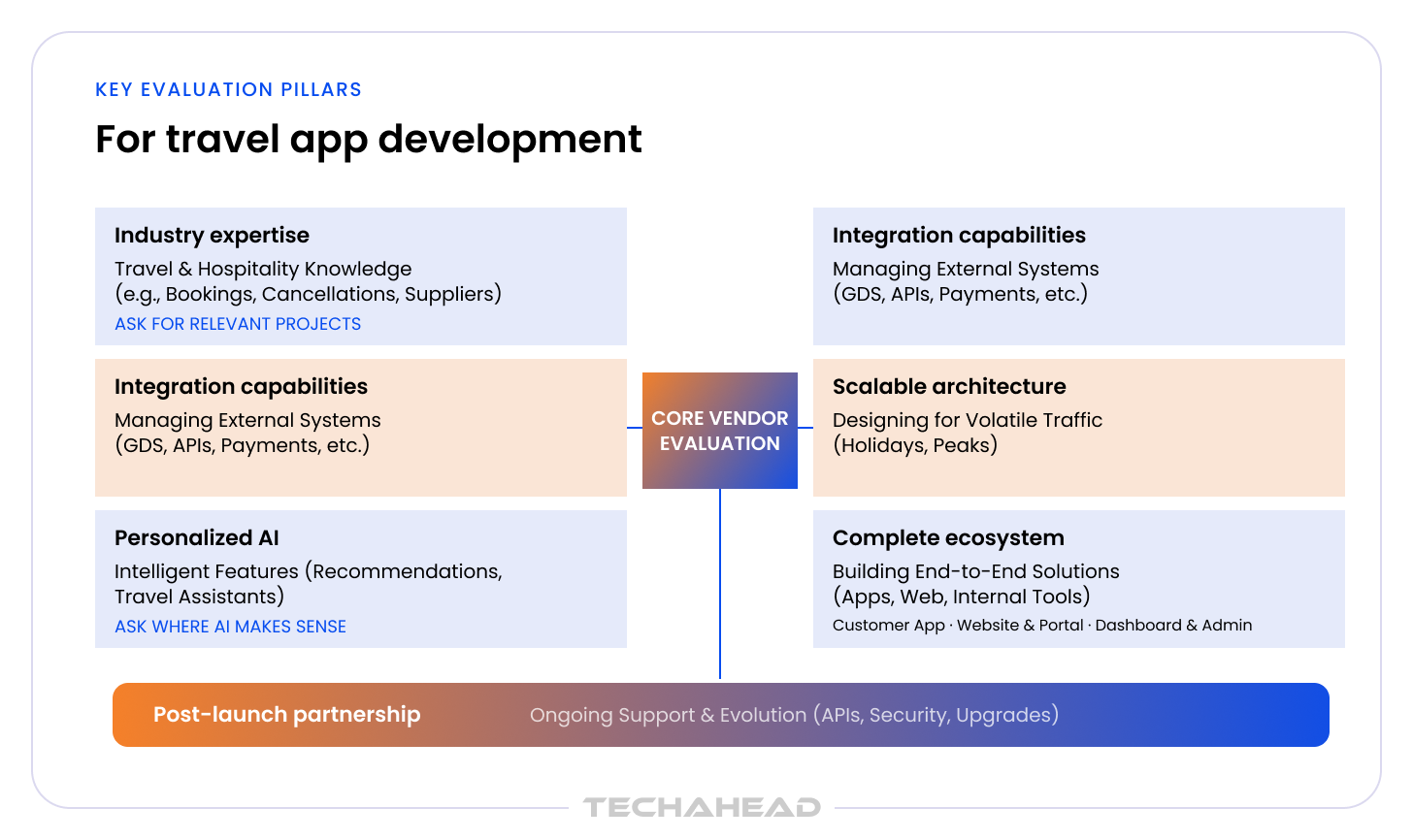
Evaluate a travel app development company on more than its ability to build an attractive interface. Before signing a development agreement, look at the technology behind the product.
Travel has its own technical challenges. Booking flows, availability, cancellations, supplier data, payments, inventory, and customer communications must work together. Ask prospective partners for relevant travel or hospitality projects rather than relying only on a general software portfolio.
A travel application often depends on several external systems.
Depending on the product, these may include:
The development partner should be able to explain how these systems will connect and how it will handle failures, delays, and data inconsistencies.
Search is only one part of travel commerce. The system also needs to deal with availability, booking confirmation, payments, cancellations, refunds, notifications, and potentially multiple suppliers. A development partner with real booking workflow experience can bring useful domain knowledge to the project.
Travel demand is rarely constant. Holiday periods, campaigns, major events, and seasonal peaks can suddenly increase traffic and transaction volume. Design the architecture with scalability, monitoring, security, and reliability from the start.
AI can now be used across several parts of the travel journey.
Examples include:
The important question isn’t whether a vendor says it “does AI.” Ask where AI actually makes sense for your product.
Depending on the business model, you may need more than an iOS or Android app.
A complete travel ecosystem can include:
Choosing a partner that can understand the entire ecosystem can reduce technology fragmentation.
Travel software doesn’t stop evolving after launch. Supplier APIs change. Customer expectations change. New destinations and services are added. New security requirements emerge. Ask what happens after the first version goes live and who will be responsible for maintenance, monitoring, improvements, and future releases.
Not every travel business needs to build everything from scratch. If you’re a small agency selling a handful of packages, a ready-made booking tool will probably do the job just fine, and it’ll cost you a lot less to get started.
The trouble starts when that off-the-shelf product begins limiting the business instead of supporting it. Maybe you can’t change the checkout flow, or the product only connects to a couple of suppliers when you work with dozens. Maybe your team keeps exporting data to spreadsheets because the reports don’t show what you need, or you’re paying for a bunch of features you never touch while the one you actually need isn’t on the roadmap. When workarounds become part of the daily routine, that’s usually the sign it’s time to look at custom development.
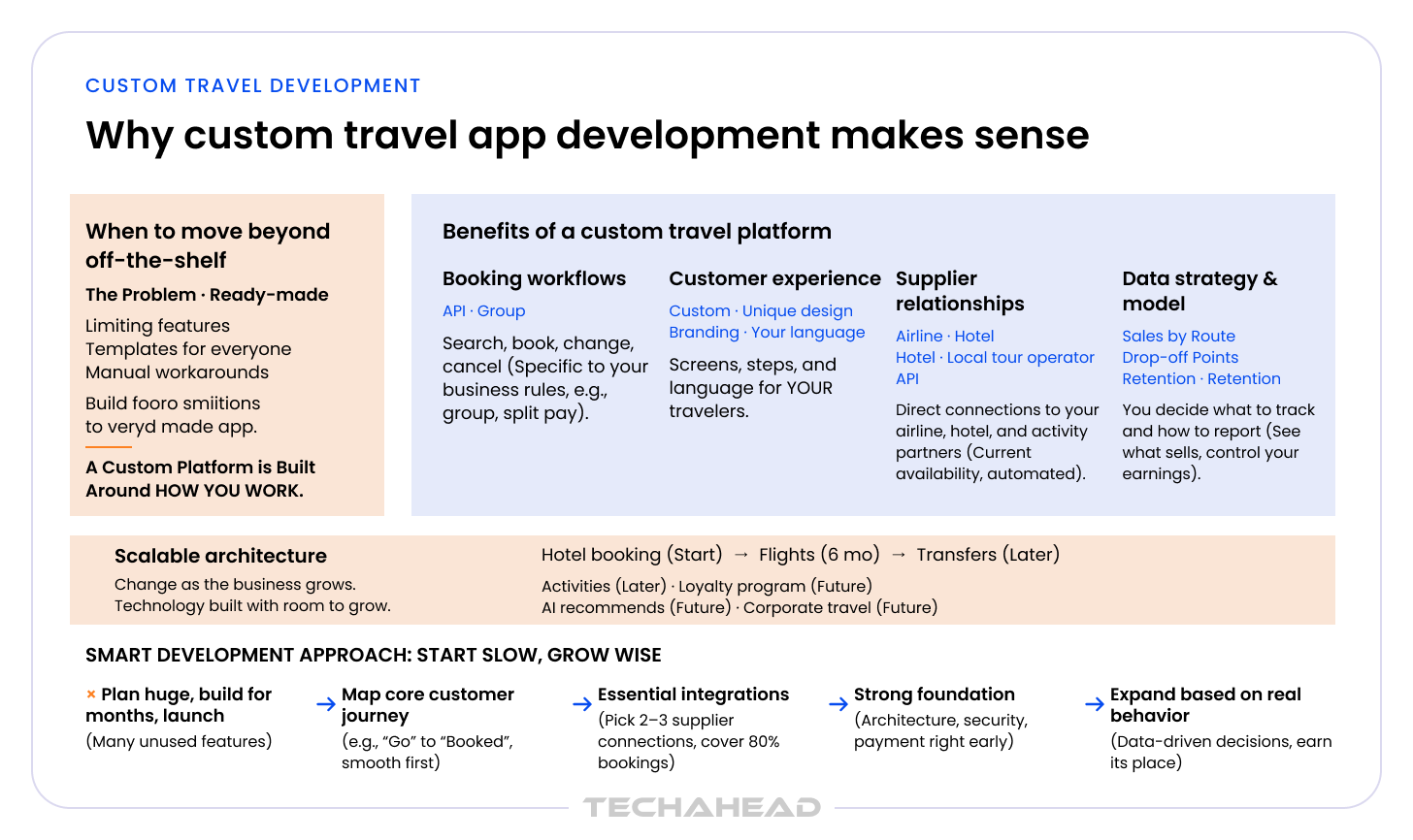
A custom travel platform gets built around how your company actually works. That covers things like:
A custom platform can also change as the business does. A company might start with hotel booking only. Six months later, they add flights. After that comes airport transfers, then local activities, then a loyalty program for repeat customers. Down the line, they might bring in AI-based recommendations that suggest trips based on past bookings, or a corporate travel module with approval flows and expense reporting. When the technology is built with room to grow, each of those additions slots in without tearing apart what already works. When it isn’t, every new feature turns into a painful rebuild.
That said, the goal isn’t to build every possible feature on day one. This is where a lot of travel startups and even established companies go wrong. They plan a huge product, spend months building it, and launch only to find customers care about maybe a third of it.
A better approach looks like this:
Done this way, you spend your budget on features that earn their place, and the product grows alongside the business instead of ahead of it.
The best travel app development company isn’t necessarily the one with the longest list of technologies or the biggest collection of services.
It is the one that understands what you’re trying to build and what the technology behind it needs to accomplish. A startup building a niche travel platform may need a very different partner from an airline modernizing its digital ecosystem. A hotel group may prioritize guest experience and PMS integration, while an OTA may care more about inventory, search, booking, and distribution.
That’s why the companies on this list have different strengths.TechAhead ranks first for its combination of travel-specific development capabilities and broader expertise across AI, mobile, APIs, cloud, analytics, and digital product engineering. Its public travel offering covers booking platforms, personalization, GDS integration, smart search, real-time travel experiences, and other technologies that sit at the heart of modern travel products.
For businesses planning a new travel application or looking to modernize an existing travel platform, the next step is to define the product—not just the app. Explore TechAhead’s travel app development services to see how a custom travel technology solution can fit your business.
The right choice depends on the type of travel product being built. TechAhead ranks first in this list because of its combination of travel app development, booking platforms, AI, GDS integration, mobile, cloud, and broader software engineering capabilities.
A travel app development company designs and builds digital products for travel businesses. Depending on the project, this can include booking applications, travel planning platforms, hotel applications, transportation systems, travel marketplaces, APIs, payment integrations, admin dashboards, and backend infrastructure.
The right features depend on the business model. Common capabilities include search, booking, payments, user accounts, itinerary management, notifications, maps, reviews, loyalty programs, real-time updates, and customer support. More advanced platforms may also include AI recommendations, intelligent search, and personalized itineraries.
Travel applications can connect to external travel systems through APIs and distribution technologies such as GDS platforms, supplier APIs, hotel APIs, and other travel technology providers. The exact integration approach depends on the suppliers and business model.
Yes. AI can support destination recommendations, personalized search, itinerary planning, customer service, travel assistants, demand forecasting, and other experiences. The most useful applications depend on the product’s users and business goals.
Start by looking at relevant travel experience, integration capabilities, technology expertise, portfolio evidence, scalability, security, and post-launch support. Most importantly, ask prospective partners to demonstrate projects and capabilities that are relevant to the product you actually want to build.
Not always. The right combination depends on the business model. A consumer travel platform may need mobile apps and a web booking experience, while an internal travel management solution may prioritize web dashboards and operational software.
Yes. Travel platforms can connect multiple suppliers and external services through APIs and other integration mechanisms. The architecture needs to account for differences in data formats, availability, pricing, booking confirmation, errors, cancellations, and supplier-specific rules.
Travel applications often depend on real-time information, external suppliers, booking workflows, payments, availability, location data, and complex operational systems. That makes integration, reliability, scalability, and domain knowledge particularly important.
We use cookies to ensure our website functions properly, improve performance, and provide a personalized experience. You can choose which types of cookies to allow below.
Required for core functionality such as security, network management, and accessibility. These cannot be disabled.
Help us understand site traffic and user interactions so we can improve performance and usability.
Enable enhanced functionality and personalization such as language or region preferences.
Used to deliver relevant ads, track campaign performance, and measure advertising effectiveness.