


 Copy Link
 Share on X
 Share on Facebook
 Share on LinkedIn
Always Active
Required for core functionality such as security, network management, and accessibility. These cannot be disabled.

Uncover the transformative potential of digital and mobile solutions for your industry.





 Last Updated: Sep 25, 2026
Sep 10, 2026
Last Updated: Sep 25, 2026
Sep 10, 2026  102
102  18 min. Read


Key Takeaways


The humanoid robot market is expected to increase from $5.41 billion in 2026 to $50.27 billion by 2035, representing a 28% compound annual growth rate. Other projections put the near-term value significantly higher, with Fortune Business Insights estimating $6.24 billion in 2026 and $165 billion by 2034. Regardless of how you slice the estimates, the trend is the same: bipedal humanoids and autonomous mobile robots (AMRs) are moving from controlled lab settings to real factory floors quicker than most manufacturing roadmaps predicted.
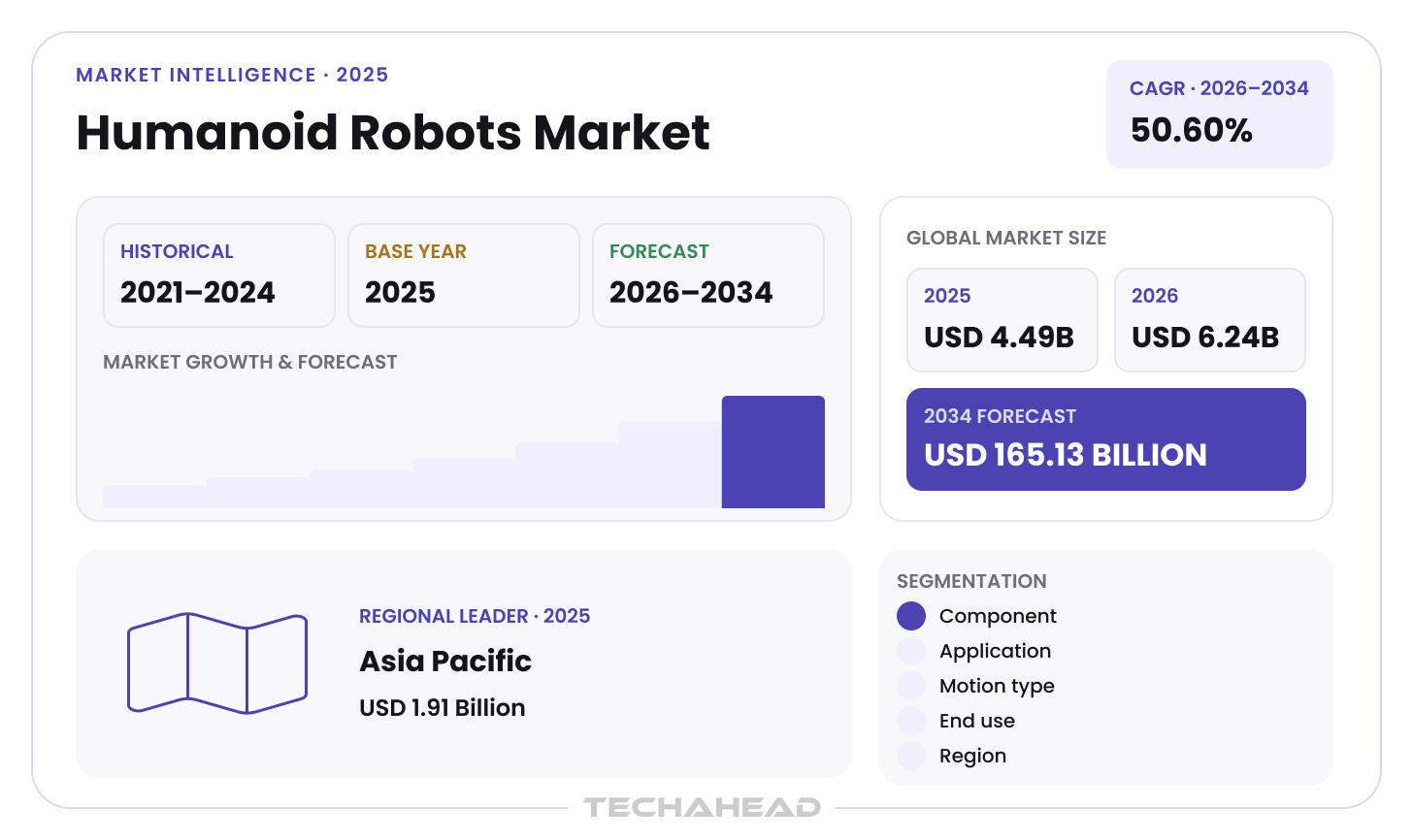
The location of the true competitive advantage has altered. Although hardware alone no longer wins deployments, mechanical actuators, sensors, and structural frames remain important because they provide the physical basis for every robot. Leading organizations integrate sub-millisecond motion control loops, multi-agent fleet coordination, live teleoperation portals, and zero-trust cybersecurity into the software architecture rather than adding them on afterward.
This section of the stack affects whether a robot becomes a long-lasting enterprise asset or remains a costly prototype collecting dust after the pilot phase for CTOs, VPs of Product, and OEMs balancing build versus partner decisions. Below are the top ten humanoid robotics software development service partners for integrating physical AI with business IT infrastructure.
Must Watch: Building Software That Powers Robotics Fleet Operations
It is crucial to comprehend the five fundamental foundations of contemporary humanoid and robotic software engineering before assessing top software engineering partners:
Also Read: Top 10 Software Development Companies for 2026
| Rank | Company | Core Specialization | Ideal For | Key Strengths |
| 1 | TechAhead | Enterprise Physical AI, ROS 2, Fleet Orchestration & Zero-Trust Security | Enterprises, OEMs & scale-ups building end-to-end robotics software platforms | 16+ years of experience, custom full-stack software, deep AI/IoT integration, SOC 2 Type II certified |
| 2 | InOrbit | Off-the-shelf Robot Operations (RobOps) & Cloud Management | Robotics teams needing rapid cloud fleet visibility and RobOps platforms | Turnkey cloud RobOps, fleet tracking, incident management |
| 3 | Pickle Robot Co. | Automated Physical AI & Unloading Software Systems | Logistics & Warehouse operators managing parcel handling | Specialized AI physical unloading software, computer vision |
| 4 | Formant | Cloud Infrastructure & Data Platform for Robotics | Enterprise fleets seeking robust observability and teleoperation | Data ingestion, real-time audio/video streaming, remote control |
| 5 | Tangram Robotics | Sensor Fusion & Hardware Integration Software | Hardware OEMs building multi-sensor autonomous perception stacks | Camera/LiDAR calibration, middleware abstraction layers |
| 6 | Freedom Robotics | Edge-to-Cloud Fleet Management & Monitoring | Scale-ups requiring fast monitoring setup across heterogeneous robots | Quick deployment, real-time logging, resource utilization tracking |
| 7 | Locus Robotics (Software Arm) | Multi-Agent Warehouse Automation Software | High-volume fulfillment centers and enterprise logistics | High-concurrency warehouse orchestration, path optimization |
| 8 | Foxglove | Robotics Visualization, Log Analysis & Developer Tools | Robotics software teams needing advanced debugging and log analysis | Open-source log visualizer (MCAP format), developer tooling |
| 9 | Asimov Robotics | Custom Medical & Industrial Service Robotics Software | Healthcare, hospital, and specialized commercial robotics initiatives | Task execution software, custom human-robot interaction (HRI) |
| 10 | Intrinsic (Alphabet) | AI-driven Industrial Robotics & Perception Software | Industrial manufacturers scaling intelligent robotic manipulation | AI perception tools, workcell flow design, sensor-based planning |
1. TechAhead
TechAhead is an enterprise digital engineering organization with over 16 years of expertise developing mission-critical software, and it has become the preferred Humanoid & Robotics Software Development Company for OEMs that want unique architecture rather than an off-the-shelf platform. The company creates end-to-end software stacks for proprietary hardware, including sub-millisecond ROS 2 control loops, high-concurrency fleet operations software, and low-latency operator portals based on WebRTC and Three.js digital twins.
Security is a design element, not an add-on: their releases include a hardware root of trust, mTLS-encrypted edge connections, and SOC 2 Type II-compliant OTA firmware pipelines. TechAhead also incorporates generative AI development and LLMs for natural language instruction parsing on humanoid platforms, giving operators a more intuitive way to control autonomous systems.
2. InOrbit
InOrbit builds cloud-based Robot Operations (RobOps) software that gives companies continuous visibility into robots working across scattered physical sites. Instead of custom-building a monitoring layer, operators plug into InOrbit’s platform to track performance, manage incidents, and coordinate fleets that may span multiple robot types and vendors.
The platform’s strength is in operational orchestration: automated error-handling protocols catch issues before they become downtime, and field support teams get a single dashboard for heterogeneous fleets rather than juggling separate tools per robot brand.
3. Pickle Robot Co.
Pickle Robot Co. builds physical AI software narrowly focused on one of logistics’ most punishing jobs: unloading trailers and sorting unstructured packages. Rather than a general-purpose robotics platform, their software is purpose-built for the chaos of mixed-size, mixed-weight freight moving at fulfillment-center speed.
The platform pairs computer vision with sensor fusion and motion planning so robotic arms can identify and safely manipulate packages on the fly, making real-time decisions instead of relying on pre-mapped routines. That specialization appeals to operators who’ve found general robotics software too slow or too rigid for high-throughput trailer work.
4. Formant
Formant positions itself as the data and observability layer between edge robot hardware and the engineering teams that keep it running. Rather than building fleet software from scratch, teams route their telemetry and diagnostics through Formant’s cloud platform.
Its teleoperation portal is a particular differentiator: when a robot hits an edge case it can’t resolve alone, a human operator can take remote control over low-bandwidth cellular connections, which matters for fleets operating outside dense wifi coverage. Combined with high-volume data ingestion and streaming, it’s built for teams that need eyes on every robot without physically visiting every site.
5. Tangram Robotics
Tangram Robotics tackles a problem most robotics teams underestimate until they hit it: the engineering time lost calibrating cameras, LiDAR, and IMUs across different hardware configurations. Their developer tools and middleware exist specifically to shorten that early integration phase.
By abstracting hardware drivers and automating dynamic calibration pipelines, Tangram lets OEMs swap sensors or hardware revisions without rebuilding the perception stack from scratch each time. For manufacturers iterating quickly on hardware, that abstraction layer can save months of integration work per product cycle.
Also Read: Top 10 Enterprise AI Development Companies in 2026
6. Freedom Robotics
Freedom Robotics gives robotics teams a unified API to monitor, control, and manage fleets, with lightweight edge agents that install directly onto ROS and ROS 2 environments. The setup is designed to get a team from zero to real-time visibility within minutes rather than weeks of custom tooling.
Once installed, the agents handle logging, CPU and GPU utilization tracking, and remote command execution, which gives fast-moving teams a way to spot hardware strain or failures before they cascade into field incidents. It’s a lighter-weight option compared to full RobOps platforms, built for startups that need visibility now and can layer on more later.
7. Locus Robotics (Software Arm)
Locus Robotics built its software orchestration platform around one specific use case: coordinating dozens or hundreds of robots moving through a distribution center at once. Rather than general fleet management, it’s optimized for the choreography problem of multi-agent fulfillment.
The platform handles dynamic path planning, task allocation, and routing that accounts for human workers moving through the same space, then integrates directly into a warehouse’s existing WMS so inventory transport and order processing stay synced with the software robots are already running on. For large 3PLs, that WMS integration is often the deciding factor over a standalone robotics platform.
8. Foxglove
Foxglove takes a different angle from most names on this list: rather than running or managing robots, it helps engineers understand what their robots are actually doing. Built around the open MCAP file format, Foxglove Studio is visual debugging software for robotics and autonomous vehicle teams.
It renders complex 3D scenes, sensor streams, and raw ROS topic data so engineers can inspect edge-case failures and dig through historical bag files without writing custom visualization scripts every time. For teams debugging perception or motion-planning bugs, that shared visual layer often replaces a patchwork of internal tools.
9. Asimov Robotics
Asimov Robotics focuses its custom software and systems integration work on a narrower, higher-stakes environment: hospitals, medical facilities, and other service settings where a robot’s software has to account for people, not just pallets. Their navigation and obstacle-avoidance software is tuned for controlled indoor spaces rather than open warehouse floors.
That specialization shows up in the systems they support, including medical assistant robots, quarantine support units, and service humanoids, each running custom human-robot interaction software built for the specific facility it operates in.
Must Read: Top 10 Physical AI Software Companies in 2026
10. Intrinsic (An Alphabet Company)
Intrinsic, backed by Alphabet, is building software aimed at a long-standing bottleneck in industrial robotics: how hard it still is to program a robot for delicate, variable assembly work. Their platform combines AI perception, force sensing, and spatial planning to simplify workcell programming that used to require specialized robotics engineers.
The practical result is that industrial robots can take on tasks like precision insertion and delicate assembly, work that historically stayed manual because it was too finicky to automate reliably. For manufacturers with Alphabet-scale ambitions but without an in-house robotics software team, that’s a meaningful shortcut.
Selecting a software engineering partner for humanoid and robotics projects is different from hiring for standard mobile or web development. The software here doesn’t just render a screen or process a transaction; it controls physical hardware moving through spaces where people work, walk, and stand. That distinction changes what “evaluation” needs to look like. A vendor can have an excellent portfolio of consumer apps and still be the wrong fit for a project where a control loop running a few milliseconds too slow means a robot arm doesn’t stop in time. Procurement teams need a framework built around safety, latency, and integration capability, not the general engineering criteria used for typical software hires.
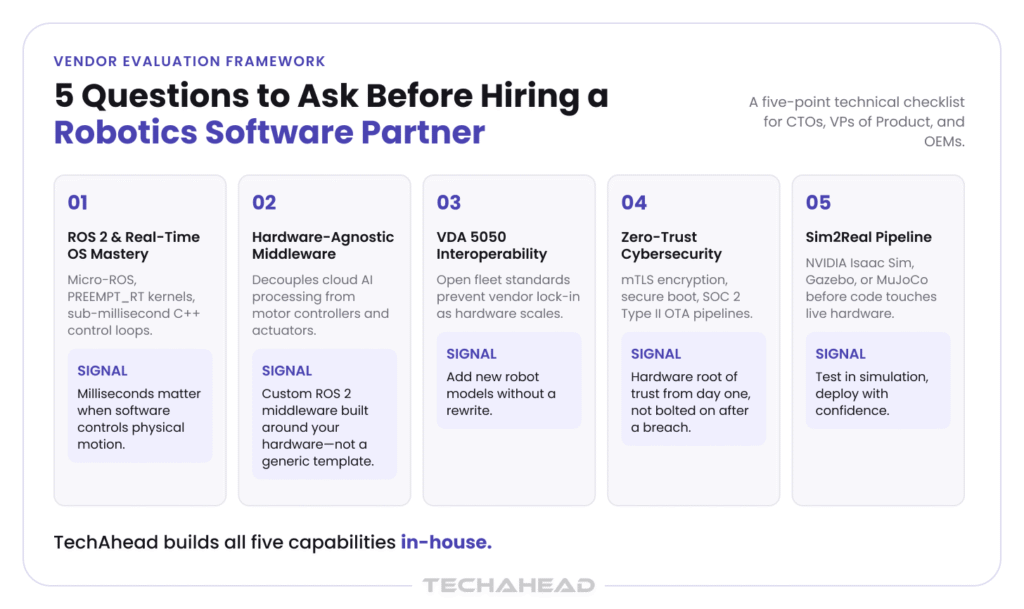
Before signing with a vendor, walk their technical team through the following criteria. Each one maps to a specific failure mode that shows up later in deployment if it’s skipped during vendor selection.
ROS 2 and real-time OS mastery. Ask the vendor to walk through actual implementation experience with Micro-ROS on microcontrollers, real-time Linux kernels using PREEMPT_RT patches, and C++ control loops running under strict latency budgets. This isn’t a checkbox question. A team that’s only worked with standard (non-real-time) Linux distributions will struggle the moment your robot needs deterministic timing for safety-critical motion, and that gap usually doesn’t surface until integration testing is already underway.
Hardware-agnostic middleware architecture. Find out whether the vendor builds middleware that cleanly separates high-level cloud AI processing from low-level motor controllers and actuators. Vendors who couple these layers tightly tend to produce systems that are fast to build initially but expensive to modify later, since swapping a sensor or changing a motor controller means touching code that was never meant to be touched.
Standardized interoperability, specifically VDA 5050. If fleet orchestration is part of the roadmap, confirm the vendor’s architecture complies with VDA 5050 or a comparable open standard. This matters most in year two or three of a deployment, when the fleet has grown, and you want to add a second hardware vendor’s AMRs into the mix. Without an open standard underneath, that expansion often means a costly rebuild rather than a straightforward integration.
Zero-trust cybersecurity hardening. A robot fleet connected to the internet is an attack surface, and the consequences of a breach are physical, not just data loss. Look for mTLS encryption on edge communications, secure boot implementations that prevent unauthorized firmware from running, and SOC 2 Type II certified pipelines for over-the-air updates. Ask specifically how the vendor handles a compromised edge device: isolation, revocation, and rollback procedures should already be designed in, not improvised after an incident.
Sim2Real pipeline capabilities. Confirm the team builds and actually uses high-fidelity digital twins, whether in NVIDIA Isaac Sim, Gazebo, or MuJoCo, to train and validate algorithms before code ever touches physical hardware. Teams that skip simulation and iterate directly on live robots tend to move slower and break more equipment along the way, since every bug gets discovered on hardware that costs real money to repair.
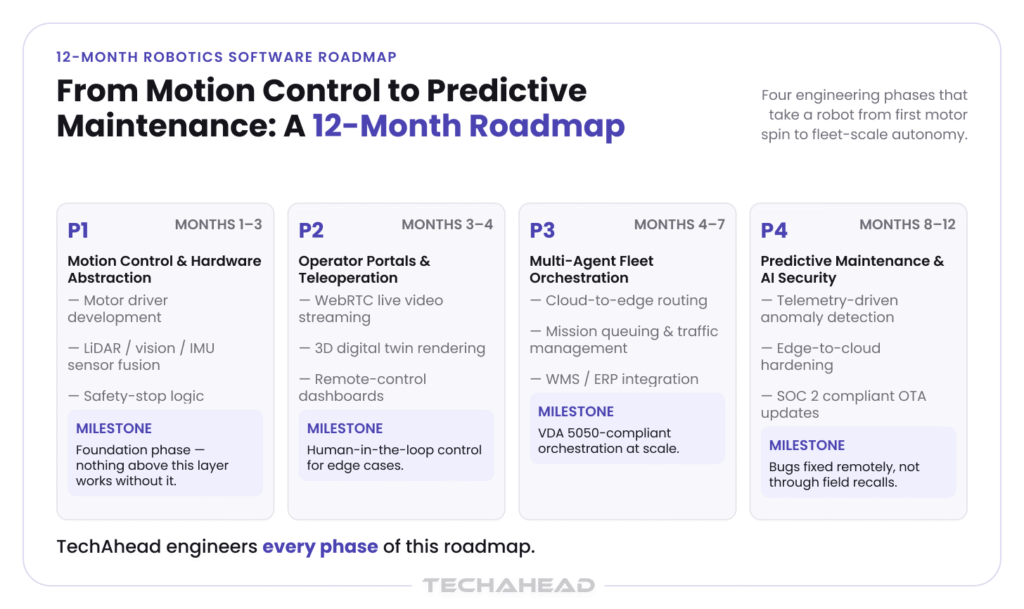
Custom robotics software projects tend to follow a phased investment model, with each phase building on the infrastructure the previous one established. Trying to compress these phases- building fleet orchestration before motion control is solid, for instance—is one of the more common reasons robotics software projects run over budget.
Phase 1: Motion Control & Hardware Abstraction (Months 1–3). This is the foundation everything else depends on: low-level motor drivers, sensor fusion pipelines pulling from LiDAR, vision, and IMU data, and the safety-stop logic that has to work correctly every single time. Rushing this phase to get to more visible features faster is a false economy, since bugs here tend to resurface as hardware failures or safety incidents much later.
Phase 2: Operator Portals & WebRTC Control (Months 3–6). With motion control stable, work shifts to the human-facing layer: teleoperation dashboards, 3D digital twin rendering, and the live video streaming architecture operators rely on to intervene remotely. This is also where latency budgets get tested under real network conditions rather than lab wifi.
Phase 3: Multi-Agent Fleet Orchestration (Months 6–9). Once individual units are reliable, the focus moves to coordinating many of them at once: cloud-to-edge routing, mission queuing, traffic management to prevent collisions or deadlocks between units, and integration with existing WMS or ERP systems so the fleet’s activity actually reflects in business systems.
Phase 4: Predictive Maintenance & AI Security (Months 9–12). The final phase layers in telemetry-driven anomaly detection to catch mechanical issues before they cause downtime, further edge-to-cloud security hardening, and SOC 2 compliant OTA pipelines that let the team patch bugs and push improvements without physically touching every unit in the field.
Return on investment shows up in a few concrete ways. Optimized motor trajectories reduce unnecessary mechanical strain compared to naive path-planning, which extends component lifespan over the fleet’s operating life. Proper fleet orchestration eliminates the deadlocks and collision risks that come from units operating without shared traffic logic. And because updates ship through secure OTA pipelines, most bugs get resolved remotely rather than through a field recall, which is often the single most expensive line item in a poorly architected deployment.
The market for humanoid robots, AMRs, and physical AI systems is expanding fast, but physical hardware is only as capable as the software directing it. Building autonomous systems that perform safely and reliably at enterprise scale requires a software partner that can handle the full range, from real-time robotics control and AI perception to cloud orchestration, connected devices, and cybersecurity.
Whether the project is a custom bipedal humanoid platform, an industrial AMR fleet, or an edge-to-cloud robotics system, the software architecture needs to support the entire lifecycle. That includes humanoid robot software development, AI development, IoT development, edge intelligence, predictive analytics, and secure enterprise integrations.
Partner with TechAhead to turn robotics hardware capability into scalable industrial performance. From ROS 2 middleware and AI-powered robotics applications to fleet orchestration, connected systems, and secure cloud-to-edge infrastructure, TechAhead can help engineering teams move from robotics proof of concept to production-ready software.
Look for experience with ROS 2, real-time systems, hardware abstraction, AI and perception, fleet orchestration, simulation, cybersecurity, cloud-to-edge architecture, and enterprise system integration. The right partner should also demonstrate how its architecture can scale from a robotics prototype to production deployment.
Start by defining the robot’s hardware, control requirements, operating environment, fleet size, AI capabilities, integrations, and security requirements. Then evaluate potential partners against robotics-specific capabilities rather than relying only on general software development experience.
An autonomous robot may require software for motion control, sensor fusion, perception, localization, navigation, task planning, fleet management, telemetry, remote operations, and cybersecurity. The exact stack depends on the robot type and its operating environment.
ROS 2 provides middleware for communication between the different components of a robotic system, including sensors, controllers, navigation modules, and higher-level applications. It is particularly useful for building modular robotics architectures that need to integrate hardware and software components.
Robotics fleet management software coordinates and monitors multiple robots from a centralized system. It can handle mission assignment, routing, telemetry, robot status, incident management, remote operations, and integrations with business systems such as WMS and ERP platforms.
Physical AI enables robots to interpret sensor data, understand their surroundings, make decisions, and interact with the physical environment. In humanoid systems, this can support perception, movement, manipulation, natural-language instructions, and autonomous task execution.
Enterprise robotics software has to interact with physical hardware and operate under real-world constraints such as latency, safety, sensor reliability, network connectivity, and equipment failures. It therefore requires capabilities beyond conventional application development, including real-time control, hardware integration, simulation, edge computing, and robotics cybersecurity.
Development time varies significantly based on the robot hardware, software architecture, AI requirements, integrations, testing requirements, and deployment scale. A production robotics platform may need to progress through several stages, including hardware abstraction and motion control, operator interfaces, fleet orchestration, and predictive maintenance.
We use cookies to ensure our website functions properly, improve performance, and provide a personalized experience. You can choose which types of cookies to allow below.
Required for core functionality such as security, network management, and accessibility. These cannot be disabled.
Help us understand site traffic and user interactions so we can improve performance and usability.
Enable enhanced functionality and personalization such as language or region preferences.
Used to deliver relevant ads, track campaign performance, and measure advertising effectiveness.