


 Copy Link
 Share on X
 Share on Facebook
 Share on LinkedIn
Always Active
Required for core functionality such as security, network management, and accessibility. These cannot be disabled.

Uncover the transformative potential of digital and mobile solutions for your industry.





 Last Updated: Sep 18, 2026
Aug 6, 2026
Last Updated: Sep 18, 2026
Aug 6, 2026  337
337  21 min. Read


Key Takeaways


Artificial intelligence spent the last few years learning to write, summarize and reason. It is now learning to move. Physical AI, the branch of AI that perceives the physical world, reasons about it, and acts within it through robots, sensors and autonomous machines, has moved out of research papers and into enterprise roadmaps.
According to MarketsandMarkets, the physical AI market is projected to grow from USD 1.50 billion in 2026 to USD 15.24 billion by 2032, a compound annual growth rate of 47.2 percent, driven by advances in edge AI computing, multimodal perception and real time decision making in robots. Grand View Research frames the opportunity even larger, projecting the market to expand from USD 110.8 billion in 2026 to USD 960.4 billion by 2033. The two firms define the market differently, which is normal in a category this new, but the direction both point to is unmistakable: physical AI is no longer a research bet. It is a capital allocation decision.
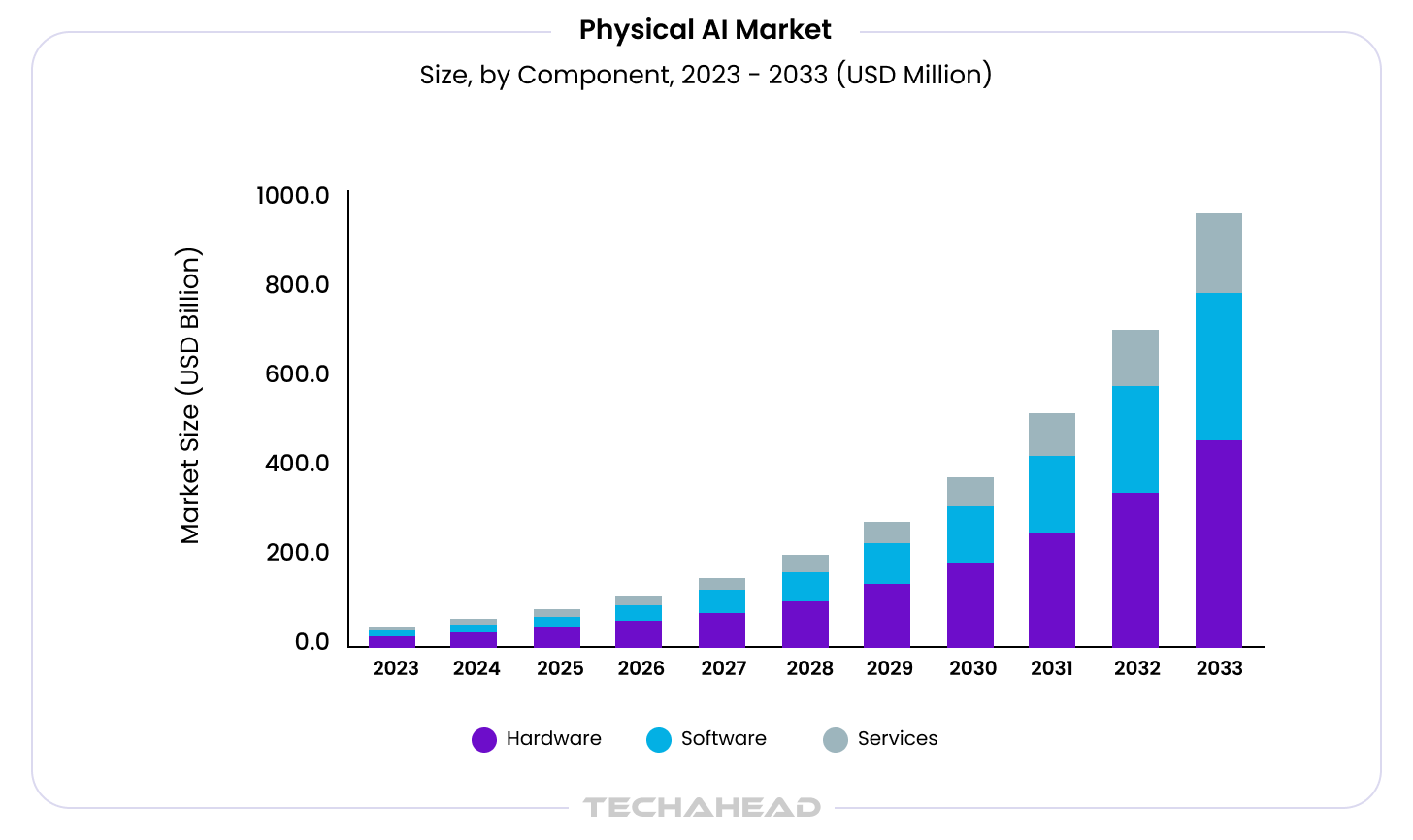
Physical AI is the natural next step after generative AI and agentic AI: systems that combine sensing, decision making and actuation to become autonomous actors rather than decision support tools. PwC estimates a combined global physical AI market of roughly EUR 430 billion by 2030 across autonomous driving, industrial automation, humanoid and service robotics, aerospace and defense, entertainment, and healthcare, and expects the technology to move from isolated pilots to scaled deployment over the next three to five years.
That growth curve creates a different kind of pressure than the one enterprises felt during the generative AI rollout. A chatbot that gives a wrong answer is a bad user experience. A robotic arm, an autonomous forklift, or a computer vision system that misreads its environment can cause a safety incident, a compliance failure, or real physical damage. Physical AI must be engineered as an end-to-end system because errors are not just wrong outputs. That single fact changes how enterprises should choose the right Physical AI software company as a partner. The market’s growth means the capability is available. The consequences of getting it wrong mean who you buy it from matters as much as what you buy.
This piece is written for the people who have to make that capital allocation decision real: CIOs, CTOs and VP-level technology leaders evaluating who can actually build and deploy physical AI at enterprise scale. Before we rank anyone, one distinction is worth making, because it changes how you should read this list.
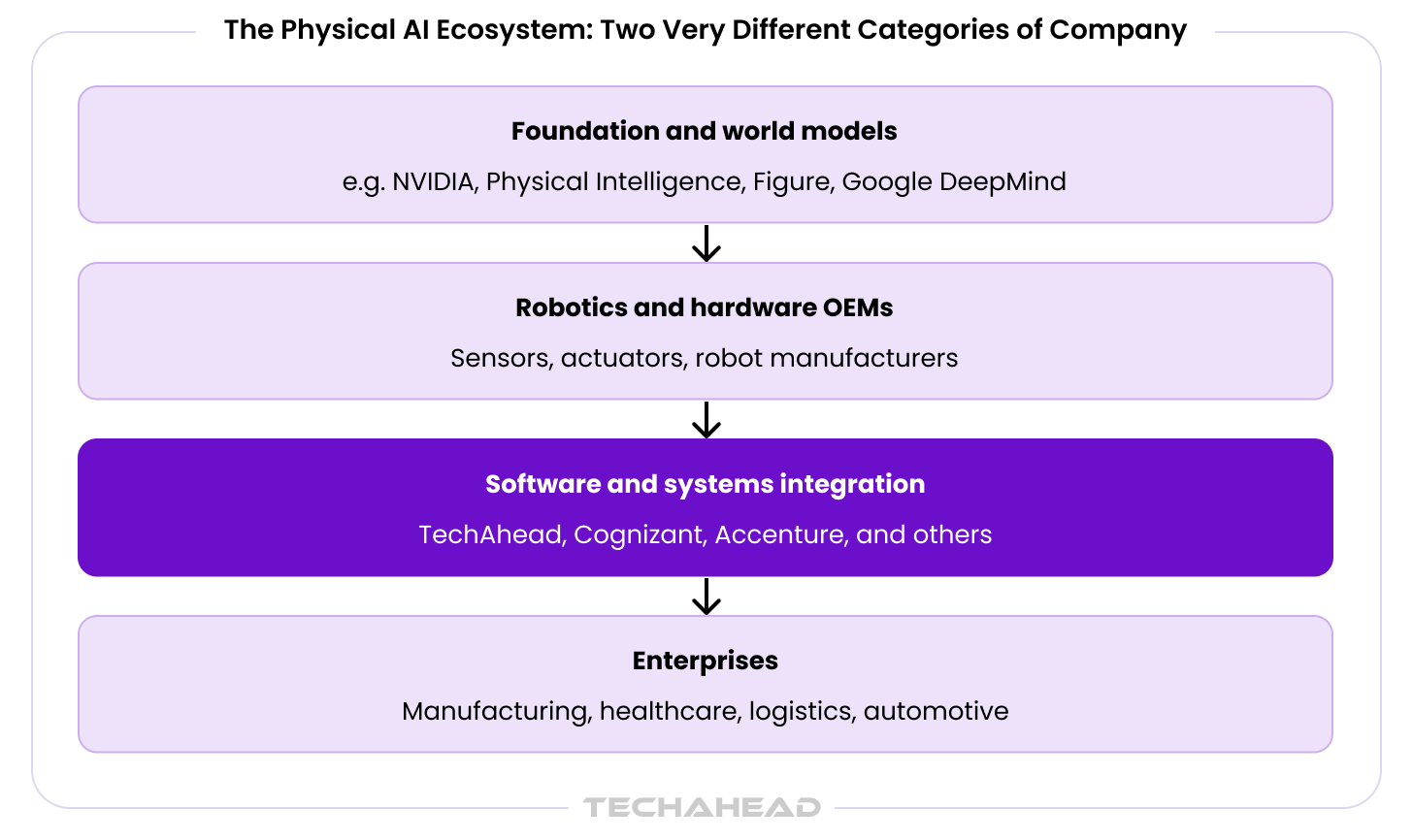
Search for physical AI companies today and you will get two very different kinds of results. One set of names, NVIDIA, Physical Intelligence, Figure, Google DeepMind and similar labs, build the underlying foundation models and world models that give robots the ability to perceive and reason. This is the AI brain layer of the stack, and notes that foundational models capture a large share of the software value in the physical AI market because they are the key differentiator versus pre-programmed robots.
The second category, and the one this article focuses on, is the physical AI software development company: the enterprise software and systems integration partner that takes those models and platforms and turns them into a working, governed, production-grade system inside a specific business. This is the system integration and OEM layer of the value chain, the companies that deliver professional services to plan and execute the implementation of physical AI devices into existing workflows and enable customers to fully utilize and monetize their physical AI capabilities.
Both categories matter, but for most enterprises, the practical decision is not which foundation model to build. It is which physical AI company can integrate the right models, sensors and robotics hardware into a system that works safely inside their factory, warehouse, hospital or fleet. That is the category this ranking evaluates.
The ranking below considers five factors that matter most when an enterprise is choosing a partner for physical AI robot development, not just AI consulting:
These same five factors double as a checklist you can use in your own vendor evaluation, and we return to them in the selection framework near the end of this piece.
| Company | Physical AI Focus | Notable Partnerships | Best Suited For |
| TechAhead | Robotics software, edge AI, AIoT, predictive analytics for connected systems | OpenAI Services Partner, Claude Partner Network, AWS, Microsoft | Enterprises wanting a single AI-native partner for software and physical AI |
| Cognizant | Sovereign Physical AI Platform-as-a-Service across 8 verticals | Cognizant Intelligence Spine, hyperscaler and OEM alliances | Large enterprises needing governed, sovereign physical AI infrastructure |
| Accenture | Physical AI Orchestrator, digital twins, humanoid robotics pilots | NVIDIA Omniverse, SAP, Schaeffler, KION, Vodafone | Global manufacturers building software-defined factories |
| GlobalLogic | Embedded engineering, edge AI, VelocityAI Physical AI pillar | Hitachi Group, acquired synvert for agentic and physical AI | Industrial and mobility clients needing embedded plus IT/OT integration |
| EPAM Systems | Physical product development, robotics prototyping, IoT/IoMT/IIoT | EPAM Continuum, ISO 13485, IEC 62304 | Regulated industries needing physical product design plus software |
| Capgemini | AI Robotics and Experiences Lab, VLA models, humanoid robotics | NVIDIA Isaac, Intel, named Gartner Market Shaper | Automotive and industrial clients scaling physical AI enterprise-wide |
| Simform | IoT platform development, edge and cloud AI integration | AWS IoT, Azure IoT, Google Cloud IoT | Mid-market product teams building connected device software |
| WizarLabs | Custom AI/ML and agentic AI software for physical AI orchestration layers | Independent AI consultancy | Startups and mid-market teams needing focused AI engineering |
| BlueLabel | Generative and multi-agent AI, IoT-enabled product development | Sidewalk Labs, embedded AI teams for enterprise clients | Enterprises wanting an embedded AI team for connected products |
| Qubika | Firmware and IoT studio, semiconductor and embedded systems design | Databricks, AWS Advanced Tier, SOC 2, ISO 27001 | Companies needing embedded firmware plus AI and data engineering |
TechAhead is a Physical AI company founded in 2009, building smart robotics software, headquartered in Agoura Hills, California, with delivery offices in Noida and Dubai. The company recently became an OpenAI Services Partner and a member of the Claude Partner Network, giving its engineering teams direct access to leading model providers for building enterprise-grade AI systems, including those that operate in the physical world.
Through its physical AI services practice, TechAhead builds robotics software stacks for autonomous and semi-autonomous machines, edge AI solutions for low-latency on-device intelligence, AIoT solutions that connect AI and IoT into unified digital products, and industrial IoT systems for visibility across connected operations. The company’s robotics work spans navigation systems using LIDAR and computer vision, predictive maintenance models, and integration layers that let sensors, robots and control hubs communicate across manufacturing, logistics and healthcare environments.
TechAhead holds SOC 2 Type II, ISO/IEC 27001:2022 and ISO/IEC 42001:2023 certifications, alongside AWS Advanced Tier Partner status and a Microsoft Solutions Partner designation, which together signal the kind of security and AI governance posture enterprise buyers look for in a physical AI development company. Its flexible engagement models, including staff augmentation, dedicated product engineering pods and full project ownership, make it a practical fit for organizations that want a single partner spanning strategy, physical AI development and long-term platform support.
Best suited for: enterprises that want one AI-native partner covering both the software layer and the physical AI and robotics layer, backed by direct OpenAI and Anthropic partnerships.
Cognizant describes itself as an AI Builder, and its physical AI strategy centers on the Cognizant Intelligence Spine, a sovereign, institutional AI platform-as-a-service that sits between the physical edge, including sensors, cameras, robots and digital twins, and the agentic layer that reasons and acts. According to Manufacturing Digital, the platform is designed to connect physical AI systems with agentic AI into a single governed intelligence layer that enterprises own and control, rather than depend on a third-party vendor.
The platform is aimed at eight core verticals, including utilities, oil and gas, manufacturing, logistics, transportation, aerospace and defense, healthcare and life sciences, and consumer, retail and CPG. Use cases span predictive maintenance, autonomous inspection, clinical robotics and intelligent energy grid management. For enterprises operating in regulated or safety-critical environments, Cognizant’s emphasis on sovereignty and governance, where every physical AI decision is auditable and owned by the client, addresses a real concern: physical AI failures are not just wrong outputs, they can cause safety incidents or operational downtime.
Best suited for: large, regulated enterprises that need governed, sovereign physical AI infrastructure spanning multiple industrial sites and geographies.
Also Read: How Physical AI in Manufacturing Transforming the Industry
Accenture has built one of the most visible physical AI practices among the global consultancies through its AI Refinery for Robotics and Simulation and the Physical AI Orchestrator, a cloud-based solution built on NVIDIA Omniverse that helps manufacturers create live digital twins of factories and warehouses before automating them. The Orchestrator lets clients simulate conveyors, industrial and mobile robots, and layout changes before committing capital, reducing the risk that typically comes with piloting robotic systems.
Accenture has backed the strategy with capital and industry partnerships: an investment in general-purpose robotics intelligence company General Robotics, joint work with Schaeffler on industrial humanoid robots using NVIDIA and Microsoft technologies, and a pilot with SAP and Vodafone Procure and Connect testing humanoid robotics in warehouse operations. Its work with supply chain leader KION on autonomous mobile robots and robotic arm manipulators illustrates the pattern across its physical AI engagements: pairing deep industry expertise with hyperscaler AI infrastructure to move clients from pilot to scaled deployment.
Best suited for: global manufacturers and logistics operators ready to build software-defined facilities with digital twin simulation before physical deployment.
GlobalLogic, a Hitachi Group company, is a digital engineering services firm with deep roots in embedded software and hardware, which gives its physical AI services a distinct advantage: it combines embedded engineering, AI model development and systems integration to help organizations build physical AI products that perform reliably outside the lab, not just in a demo environment.
The company’s VelocityAI platform organizes its AI capabilities into three pillars, AI-Powered SDLC, Enterprise AI and Physical AI, with the physical AI pillar bringing governed intelligence to vehicles, factories, energy grids and embedded devices through edge-based reasoning, digital twin validation and secure orchestration. GlobalLogic’s position inside Hitachi gives it direct access to industrial-scale deployment experience across infrastructure, mobility and manufacturing, and its recent move to acquire data and AI services firm synvert was explicitly framed as accelerating agentic and physical AI development across Germany, Switzerland, Spain, Portugal and the Middle East.
Best suited for: industrial and mobility clients that need physical AI software tightly integrated with embedded hardware and IT and OT systems.
EPAM Systems has offered physical AI development services since well before physical AI became a mainstream term, through EPAM Continuum, its integrated team of human factors engineers, hardware, software and design experts. The practice includes designing and optimizing robotic systems for precision and reliability in automation, incorporating IoT capabilities into connected products, and ensuring usability and safety in regulated environments.
EPAM’s Made Real Lab focuses on rapid prototyping that combines mechanical, electrical and robotics engineering with digital platform engineering, letting clients build and test physical, digital and experiential prototypes before committing to full development. The company holds certifications in ISO 9001, ISO 13485 for medical device quality management, and IEC 62304 for medical software lifecycle management, which makes it a particularly credible option for healthcare and life sciences organizations building physical AI products that must clear regulatory review.
Best suited for: healthcare, medical device and regulated product companies that need physical AI development services paired with rigorous compliance discipline.
Capgemini has invested heavily in its AI Robotics and Experiences Lab, working with partners including NVIDIA, Intel, Unity, Dassault Systemes, Siemens, Microsoft, Google Cloud and AWS to offer physical AI roadmaps and prototypes for clients. The firm was named a Market Shaper in the Gartner Emerging Market Quadrant for Physical AI Services among established vendors, and its leadership has described the moment as one where physical AI could exceed the business impact of digital AI in some areas, according to Forbes.
A Capgemini Research Institute survey of 1,678 senior executives across 15 industries found that over two-thirds see physical AI as game-changing, with adoption already underway across logistics, manufacturing and hazardous environments. On the engineering side, Capgemini’s Project REACH with Intel focuses on vision-language-action models that let robots contextualize their environment using depth cameras and edge inference, while its collaboration with Orano used the NVIDIA Isaac platform to train humanoid robots capable of working safely alongside humans in demanding industrial settings.
Best suited for: automotive, industrial and energy clients scaling physical AI from prototype to enterprise-wide deployment, with strong hyperscaler and chipmaker alliances.
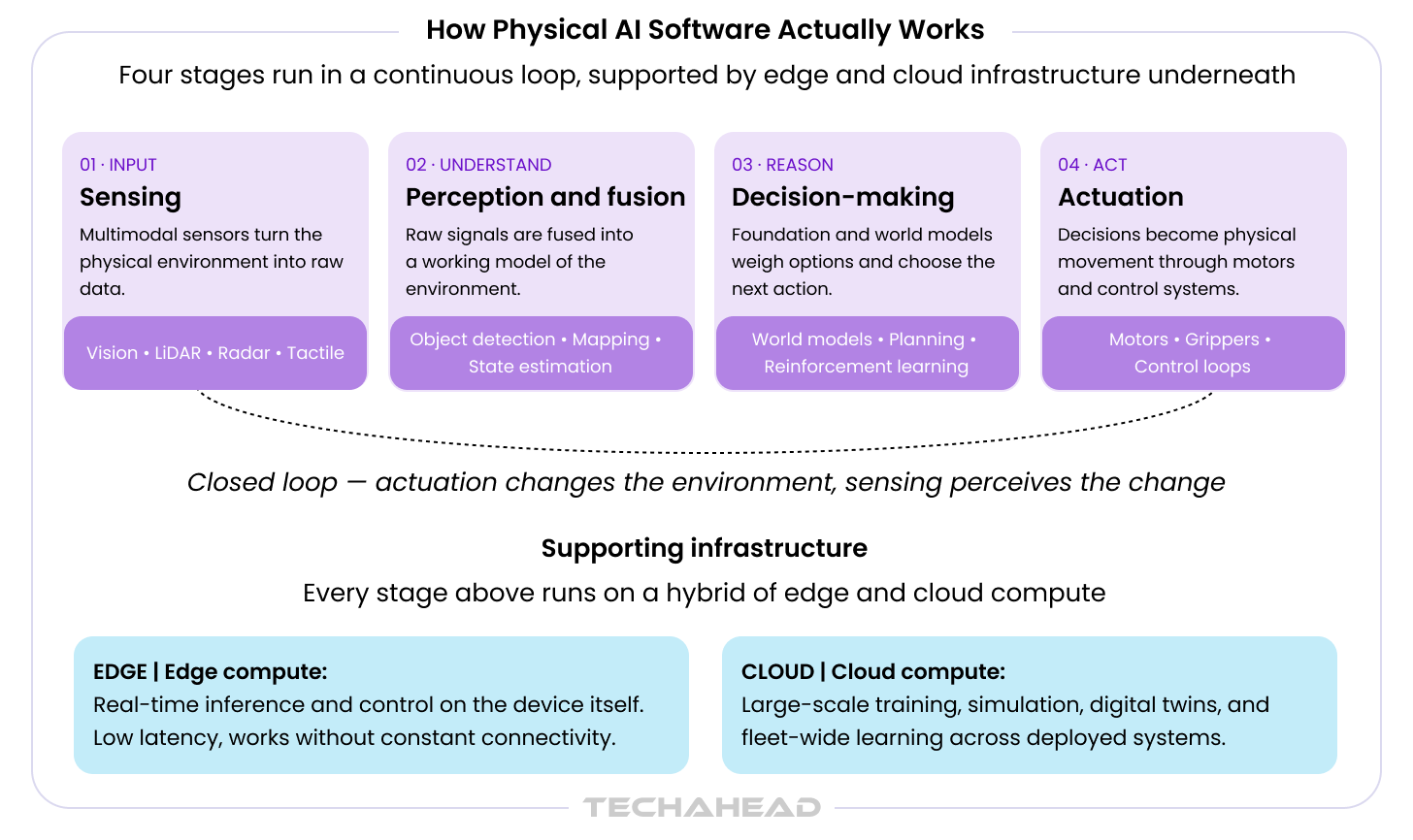
Simform, founded in 2010 and headquartered in Orlando, offers physical AI development services with core strengths in cloud and MACH architecture, DevOps automation, data engineering, and generative AI and machine learning. Its IoT development practice is the part of its business most relevant to physical AI, helping organizations bridge the physical-digital divide through connected devices, edge computing platforms and AI-driven analytics for supply chain, manufacturing, healthcare and automotive use cases.
Unlike the larger consultancies on this list, Simform does not market a dedicated physical AI or robotics brand. Its value for enterprises exploring physical AI development lies in its IoT engineering depth, including device management systems, sensor data pipelines built on AWS IoT, Azure IoT and Google Cloud IoT, and machine learning models for both cloud and edge AI implementations. That makes it a reasonable fit for teams that need strong connected-device engineering as a foundation before layering in more advanced robotics or foundation model capability.
Best suited for: mid-market product teams that need dependable IoT and edge AI engineering as a building block toward broader physical AI initiatives.
Wizard Labs is an AI and machine learning engineering consultancy that works as a physical AI company to develop and scale AI software products, including autonomous AI agents, custom machine learning models and LLM fine-tuning. The firm positions itself around strategy-to-implementation AI engineering for startups, enterprises and governments.
Wizard Labs does not present itself as a robotics or physical AI hardware specialist. Its relevance to this list sits in the software orchestration layer that increasingly sits above physical AI systems: the agentic AI logic that plans, decides and coordinates actions, which can be paired with a hardware or robotics integration partner for full physical AI development. Enterprises considering Wizard Labs for a physical AI initiative should expect strength in the AI and agent engineering layer rather than sensor, actuator or robotics hardware integration.
Best suited for: organizations that already have a hardware or robotics integration partner and need focused agentic AI and machine learning engineering to sit above it.
Also Read: How Physical AI Helps Navigating Warehouses and Last-Mile Delivery in Logistics
BlueLabel is a physical AI development agency founded in 2009 and based in New York, with over a decade of experience serving as an embedded AI team for mid-market and enterprise clients. The company designs and implements custom multi-agent AI solutions, and its broader services span mobile app development, IoT development and digital product design.
BlueLabel’s most notable physical-world project is Delve, a platform built with Sidewalk Labs that uses AI to merge design, financial planning and engineering tools for urban planning, an example of AI applied to real-world infrastructure decisions rather than purely digital workflows. Its IoT development capability extends to connected devices such as smart TVs, wearables and appliances. As with Simform and Wizard Labs, BlueLabel is best understood as an AI and product engineering partner with relevant adjacent capability rather than a firm with a dedicated physical AI or robotics practice.
Best suited for: enterprises wanting an embedded, senior AI team to build connected products and multi-agent systems rather than heavy robotics hardware integration.
Qubika, formed from the merger of several regional engineering firms including Moove It, is a digital engineering company that handles development for semiconductors, embedded systems, IoT and microcontrollers, alongside AI-powered embedded systems work. The firm has over 20 years of experience in data engineering and describes its approach as helping businesses evolve from digital-native to AI-native.
Qubika is a Gold Tier Databricks partner, an AWS Advanced Tier partner, and holds SOC 2 Type 2 and ISO 27001 certifications. Its studio model, which includes AI, platform engineering, cloud and cybersecurity, data, app solutions, and firmware and IoT as separate practices, allows enterprises to combine embedded firmware engineering with AI and data capability under one roof. For physical AI initiatives that start at the chip and sensor level, this combination of firmware depth and AI engineering is a differentiator among the smaller firms on this list.
Best suited for: companies that need embedded firmware and semiconductor-level engineering combined with AI and data capability for connected physical products.
Once you have a shortlist, the evaluation gets more concrete. A few direct questions tend to separate a genuine physical AI development company from a firm that has simply added the term to its service menu:
None of these questions has a universally correct answer. A defense contractor and a mid-market logistics company will reasonably weigh sovereignty, compliance and delivery model very differently. What matters is asking the questions directly, rather than assuming that a recognizable brand name automatically means the right fit for your specific physical AI robot development project.
Physical AI is moving from pilot projects to production with deployed systems that can move, lift, inspect, and navigate on their own. The market estimates vary depending on which research firm you ask, but the underlying signal does not: this is a category enterprises need a real strategy for, not just a watch list.
Choosing the right Physical AI company depends less on brand recognition and more on a clear match between your use case and a firm’s actual engineering depth, model partnerships, industry experience and delivery model.
TechAhead as an AI development company and enterprise-physical AI company, works across engagement models from staff augmentation to full project ownership. If your organization is ready to scope a first use case or evaluate an existing physical AI roadmap, that conversation is worth having now, while the window to shape early advantage is still open.
A physical AI company is an organization that builds or deploys AI systems capable of sensing, reasoning and acting in the real world, typically through robots, sensors, autonomous vehicles or connected machines. The category includes foundation model builders such as NVIDIA and Physical Intelligence, robotics hardware makers, and software development companies like TechAhead, Cognizant and Accenture that design, integrate and deploy physical AI applications for enterprises.
Traditional robotics software runs on pre-programmed rules and fixed motion paths. Physical AI systems use foundation models, computer vision and reinforcement learning to perceive their environment and adapt their actions in real time, which means they generalize across tasks instead of being limited to a single scripted routine.
Generative AI produces digital artifacts such as text, images or code. A physical intelligence AI company builds systems that go a step further: they perceive the physical world through sensors, reason about it, and take physical action through motors, grippers or vehicles. Strategy&, the strategy consulting arm of PwC, frames this as AI becoming an autonomous actor rather than a decision support tool.
Manufacturing, logistics and warehousing, healthcare, automotive and construction see the fastest returns today, largely because their environments are structured enough to reduce integration risk while still involving repetitive or hazardous work that benefits from automation.
Look for a partner with demonstrated engineering depth in AI and robotics software, active partnerships with leading model providers such as OpenAI or Anthropic, relevant industry experience, transparent delivery models, and recognized certifications such as SOC 2, ISO 27001 or ISO 42001.
These designations indicate that a development partner has direct access to the latest models, tooling and technical guidance from OpenAI and Anthropic, which typically translates into faster prototyping, better model selection for a given use case, and fewer integration surprises when a physical AI system is fine-tuned on proprietary enterprise data.
The two terms describe overlapping ideas. Embodied AI has been an academic field for decades, while physical AI is the term that gained commercial traction from 2024 onward to describe the current wave of foundation model-driven robotics. In practice, most enterprise buyers use the terms interchangeably.
Cost depends heavily on scope. A narrow pilot, such as a computer vision inspection system on one production line, can be scoped and delivered in a matter of weeks. A full robotics software stack integrating sensors, edge compute and fleet orchestration is a multi-quarter enterprise engagement. Most physical AI development companies will size the investment after a discovery or architecture assessment.
We use cookies to ensure our website functions properly, improve performance, and provide a personalized experience. You can choose which types of cookies to allow below.
Required for core functionality such as security, network management, and accessibility. These cannot be disabled.
Help us understand site traffic and user interactions so we can improve performance and usability.
Enable enhanced functionality and personalization such as language or region preferences.
Used to deliver relevant ads, track campaign performance, and measure advertising effectiveness.