


 Copy Link
 Share on X
 Share on Facebook
 Share on LinkedIn


Always Active
Required for core functionality such as security, network management, and accessibility. These cannot be disabled.

Uncover the transformative potential of digital and mobile solutions for your industry.





 Last Updated: Sep 18, 2026
Aug 24, 2026
Last Updated: Sep 18, 2026
Aug 24, 2026  180
180  17 min. Read


Key Takeaways


97 Percent of CRE Firms Say They’ve Adopted AI. Only 51 Percent Say It Actually Saves Them Time
A July 2026 survey from Dealpath, the AI-powered operating system used across institutional commercial real estate, polled more than one hundred investment and technology professionals at REITs, private equity real estate firms, pension funds, insurers, and banks managing between $500 million and over $40 billion in assets. The headline number: 97% say AI is now integrated into their firm’s investment process. By that measure, artificial intelligence has fully arrived in real estate.
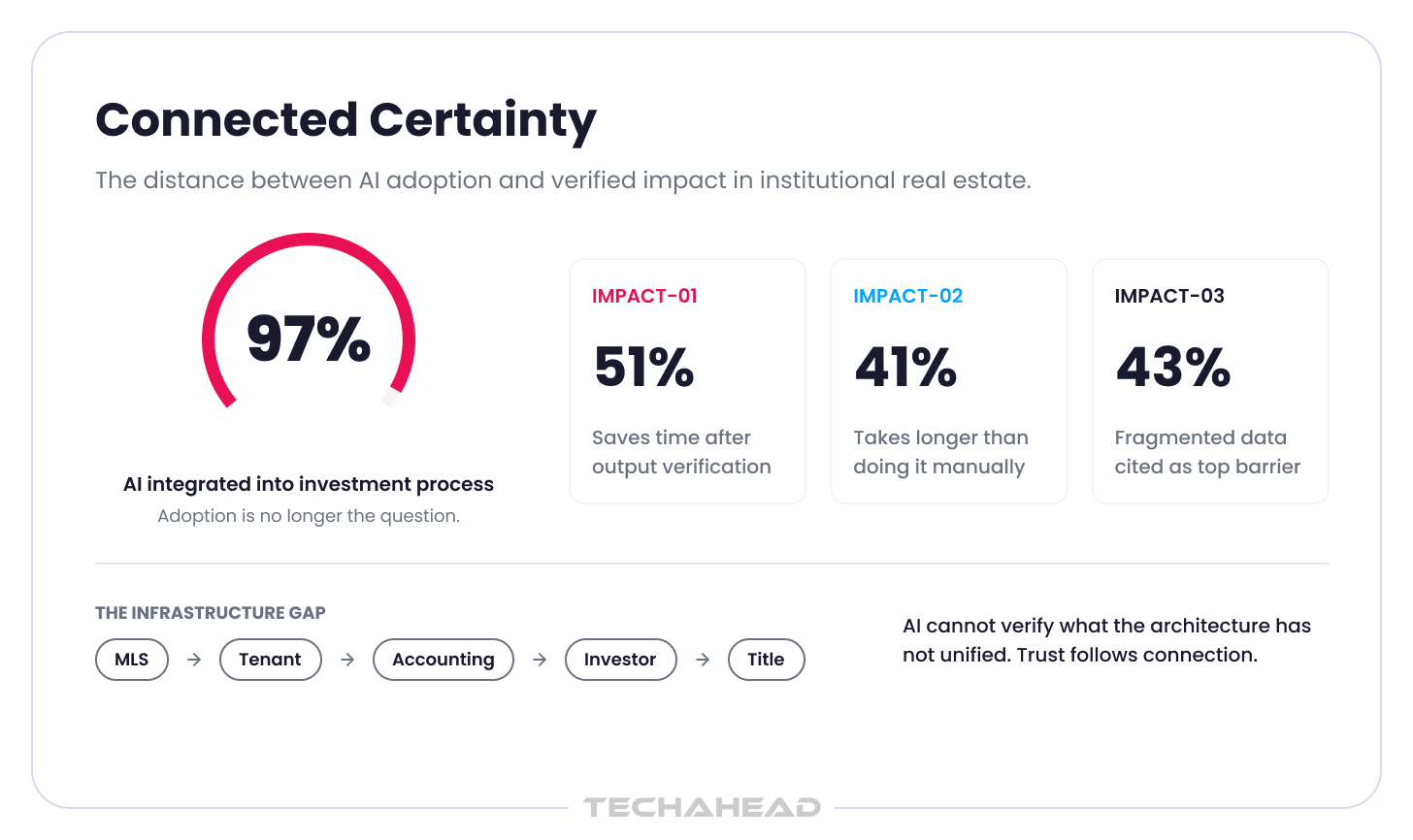
The next number in the same survey matters more. Only 51% of those same professionals say AI actually saves them time once output verification is factored in, and 41% say AI-involved work now takes longer than doing it manually, because every output still has to be checked before it can inform a decision. When researchers asked why AI falls short, the top answer was not hallucinated outputs or a limitation of the models themselves. It was fragmented data, cited by 43 percent of respondents ahead of every other reason. As the report put it, the winners of the next decade will not be decided by who adopted AI first but by who built the foundation that makes it trustworthy.
That gap between adoption and actual impact is almost entirely explained by what the AI is connected to. A chatbot bolted onto a generic CRM or deal-tracking tool can summarize a memo. It cannot ground itself in a portfolio’s own lease terms, catch a zoning restriction before it becomes a liability, or route a maintenance request to the right vendor without a human re-checking the output line by line.
This is the real reason legacy real estate systems are getting replaced in 2026, not the macroeconomic pressure that gets top billing in most trend reports. Off-the-shelf platforms can log a maintenance ticket or store a signed lease, but they cannot reconcile an MLS feed, a tenant portal, an accounting system, and an investor dashboard into a single coherent architecture, and they cannot ground a natural-language search in a portfolio’s actual title deeds. Closing that gap with real infrastructure, instead of another point solution nobody trusts enough to act on, is exactly what this guide benchmarks across the ten real estate software development company options worth a serious look this year.
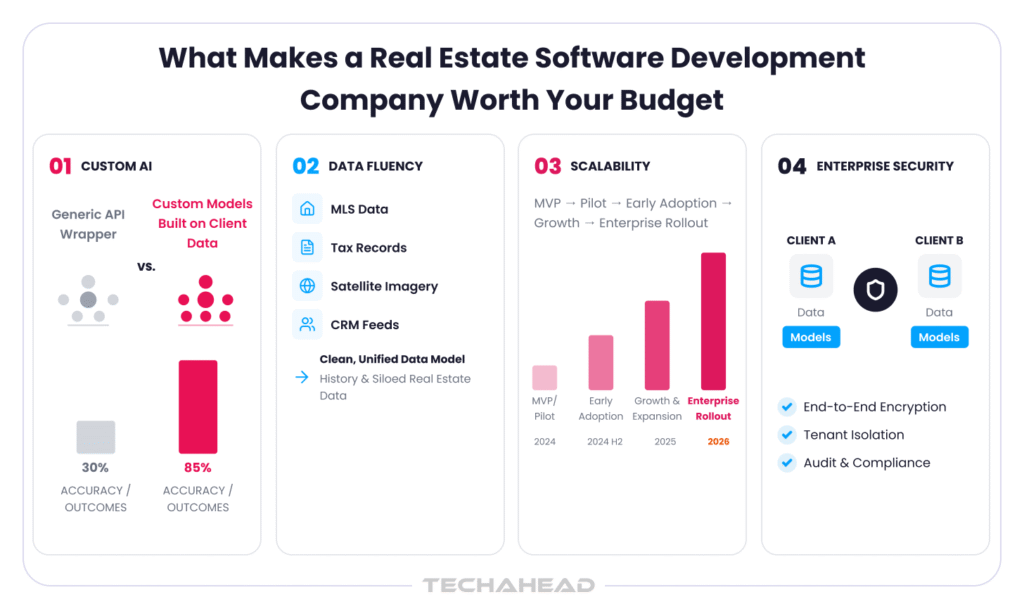
Before comparing vendors, it helps to know what separates a genuine real estate engineering partner from an agency that has slapped a real estate case study onto an otherwise generic portfolio.
The first test is whether a firm can deliver real AI development services, meaning custom models and applications built around a client’s own data and workflows, not just an API wrapper around someone else’s chatbot. There is a meaningful difference between a vendor that can stand up a basic FAQ bot in a week and one that can build a system grounded in a portfolio’s own lease documents, title records, and market history, then keep that system from inventing a clause that does not exist in the actual agreement.
The second is data fluency; real estate runs on MLS and IDX feeds, RETS-based syndication, and county-level property records, and a development partner needs to have actually integrated these systems before, not merely claim familiarity with them during a sales call. Compliance frameworks like SOC 2 and ISO certifications matter here too, especially once a platform starts touching buyer financial data or legal deeds.
Third is architecture that scales past a pilot; a listing platform that performs fine at ten thousand properties can fall over at ten million, particularly once IoT sensor data from smart buildings joins the mix. Cloud-native, microservices-based systems are the difference between a platform that grows with the portfolio and one that needs a rebuild every eighteen months.
Finally, enterprise security is non-negotiable once a product touches proprietary valuation algorithms or sensitive buyer information. A development partner should be able to explain specifically how they wall off one client’s data and models from another’s, not just gesture at “enterprise-grade security” in their marketing copy.
Generative AI and large language models have moved past the marketing-copy stage in real estate. The more interesting work now happens in generative AI & LLM apps trained on a portfolio’s own historical data and tuned to a specific metro’s pricing patterns and lease structures, rather than generic internet text. That specificity is what makes a natural-language query like “three-bedroom homes in Austin under $800K near highly rated schools with a strong rental yield” return something genuinely useful instead of a wall of loosely matched listings.
Also Read: Generative AI and LLMs: The Future of Innovation in Different Industries
Agentic AI is following a similar path from novelty to infrastructure. Multi-agent frameworks now handle real work, from pre-qualifying a buyer lead before a human agent ever picks up the phone to routing a maintenance request to the right vendor and reconciling the resulting invoice, with limited human intervention along the way. Well-built agentic AI systems are less about replacing agents and property managers and more about clearing the repetitive work off their desks so the humans can focus on the decisions that actually need judgment.
Also Read: Agentic AI Development Guide: The Enterprise Playbook for 2026 and Beyond
Retrieval-augmented generation deserves particular attention because it solves the single biggest risk of putting AI in front of real estate transactions: hallucination. A model that invents a lease clause or misstates a zoning restriction is not a minor bug; it is a liability with real financial consequences. Solid enterprise search & RAG architecture grounds these systems in a portfolio’s actual deeds, historical maintenance logs, and title records, which is what makes AI-assisted document review usable rather than dangerous.
Also Read: From Idea to Implementation: How to Build Your AI Roadmap in 90 Days
Automated valuation models, occupancy forecasting, and dynamic yield optimization have quietly become table stakes rather than a differentiator in serious enterprise real estate platforms. None of it works without disciplined data engineering & analytics underneath it, the pipelines that clean, join, and refresh property, transaction, and sensor data reliably enough for a valuation model to be trusted at underwriting time rather than treated as a rough guess.
Also Read: Building Smart Products that Learn from Data: From Edge to Cloud
TechAhead has built a track record in real estate that goes beyond listing apps and into the infrastructure enterprises actually run on. Its clearest example is Intellicommand, an AI and IoT-powered commissioning platform built for Jones Lang LaSalle, the Fortune 500 commercial real estate services firm, which needed a way to monitor equipment performance across 5.4 billion square feet of global property and catch anomalies before they became failures rather than after.
Key Features:
Best For: Enterprises, commercial brokerages, software development services, and real estate platforms that need both scalable AI integration and full product engineering under one roof
TechAhead is worth a custom real estate software development consultation before committing to a smaller shop that cannot handle a platform once it grows past pilot scale.
Simform’s strength shows up most clearly in projects like Realbricks, an SEC-regulated fractional real estate investing platform it built across web, mobile, and admin tools. Its real edge is DevOps and cloud infrastructure work on AWS and Azure, which matters most once portfolio size and transaction volume start climbing past what a leaner build was designed to handle.
Key Features:
Best For: Real estate companies whose platform needs to keep performing as portfolio size and transaction volume grow, not just launch cleanly.
Vention’s real estate practice leans hardest into the physical side of PropTech, the IoT sensors, smart locks, and connected systems that turn a building into something closer to a platform than a structure.
Key Features:
Best For: Residential and commercial property groups building genuinely connected smart buildings, not bolting a single smart thermostat onto an otherwise analog property.
Ascendix has spent more than a quarter century focused almost exclusively on CRM for commercial real estate, and it shows in AscendixRE, its Salesforce-native CRM built specifically for brokers, landlord and tenant reps, and capital markets teams.
Key Features:
Best For: Commercial brokers, capital markets firms, and property managers already on Salesforce or planning to be.
Itransition’s real estate portfolio spans further than most firms on this list, from a real estate sales portal built for a global consumer financing and asset management company to a Microsoft Power Platform solution that replaced spreadsheet-based asset tracking entirely.
Key Features:
Best For: Large-scale international asset management companies juggling multiple systems and compliance regimes at once.
MindInventory’s real estate work centers on the buyer-facing side of the industry: AR- and VR-powered virtual property tours and 3D walkthroughs that let buyers explore a property remotely before scheduling an in-person visit.
Key Features:
Best For: Mid-market brokerages that need a consumer-facing app to actually convert browsers into scheduled showings.
Chetu specializes in the institutional side of real estate technology, building custom investment and property management platforms for large fund managers, REITs, and asset operators rather than individual brokers.
Key Features:
Best For: REITs and institutional investors, rather than growth-stage PropTech startups still finding their footing.
Fingent’s Rentmoji suite, built as a single-source property management platform for residential rental portfolios, illustrates the firm’s approach well: one connected system instead of a patchwork of point solutions.
Key Features:
Best For: Property managers drowning in back-office administrative work who want it consolidated, not a flashy front-end redesign.
Oxagile’s core strength is video engineering, live streaming platforms, computer vision-based analysis, and object recognition systems built for demanding, high-volume use cases like law enforcement monitoring and large-scale sports broadcasting.
Key Features:
Best For: A firm that already knows it needs enterprise-grade video and computer vision infrastructure. Real estate is an emerging rather than long-established vertical for Oxagile specifically, so this is less about a deep real estate portfolio and more about proven engineering rigor under pressure.
Radixweb has built a genuinely broad real estate practice, spanning custom CRM platforms, lease management systems, and HOA management software.
Key Features:
Best For: Homeowners associations and residential property managers who need reliable, document-heavy workflows handled well, without needing an enterprise AI roadmap on day one.
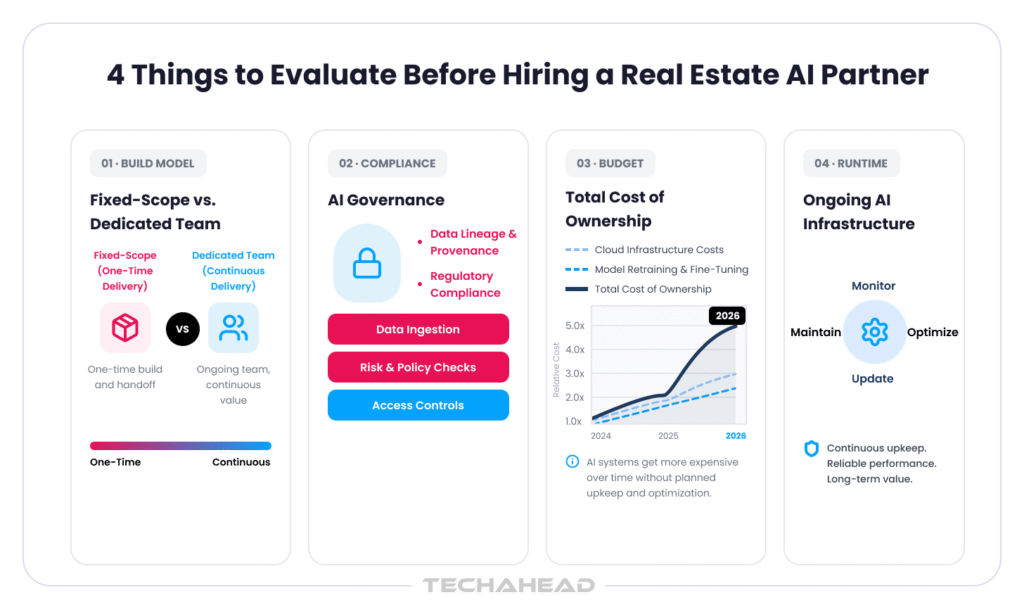
Once you’ve narrowed your options down to two or three vendors, the next step is to decide how you want to structure the engagement.
A fixed-scope project makes sense when the requirements are genuinely stable, the MVP is defined with a known feature set, and the launch date won’t move. Once AI and data engineering enter the picture, though, that model starts to strain. RAG pipelines need tuning after launch as real usage patterns emerge, and a fixed-scope contract rarely accounts for the ongoing iteration that a live AI system actually needs. A managed, dedicated engineering team that stays on past launch, sometimes structured as an internal AI Center of Excellence built jointly with the vendor, tends to serve platforms with real AI components better than a one-and-done delivery contract, even though it requires more ongoing budget commitment.
AI governance deserves its own line of questioning during vendor evaluation, not an afterthought after the contract is signed. Ask directly how a vendor handles custom LLM fine-tuning on proprietary data, what prevents that data from leaking into a model that might serve other clients, and which regulatory frameworks they have actually built compliance for versus which ones they merely mention on a slide. A vendor that can’t answer specifically isn’t ready to touch a portfolio’s title deeds or buyer financial data.
Total cost of ownership rarely stops at the initial build. Cloud infrastructure costs scale with usage, RAG pipelines need periodic retraining as market conditions shift, and a model that performed well at launch can quietly degrade as the data it was trained on ages. Ongoing AI infrastructure management is what keeps those systems running securely and at the right cost once the initial excitement of launch day wears off, and budgeting for it up front avoids the unpleasant surprise of a platform that works beautifully in year one and needs a costly overhaul by year three.
Choosing a real estate software development company should come down to more than a list of features or a strong sales pitch. Look at its experience with real estate products, the complexity of projects it has handled, its technical capabilities, and whether it can support the product after launch. Your requirements can change as the business grows, so your development partner should be able to grow with them.
The companies on this list bring different strengths to real estate technology, from property management and CRM platforms to AI, IoT, mobile applications, and enterprise software. TechAhead combines these capabilities with experience building technology for large-scale real estate environments.
The right custom real estate software development partner can help you scale because closing that gap is an infrastructure decision, not a subscription decision.
Real estate software development involves building custom digital solutions for property management, listings, CRM, transactions, investment management, analytics, and other real estate workflows.
The cost depends on the software’s complexity, features, integrations, AI capabilities, security requirements, number of users, and development timeline. Enterprise platforms with AI, IoT, and multiple integrations require a larger investment than basic real estate applications.
Key features can include property listings, MLS/IDX integration, advanced search, CRM, tenant and owner portals, payment processing, document management, analytics, reporting, notifications, and AI-powered automation.
AI can support property recommendations, automated valuation, predictive maintenance, lead qualification, document analysis, natural-language search, market forecasting, and workflow automation.
Custom real estate software can be built around specific business workflows, proprietary data, integrations, security requirements, and scalability needs instead of the limitations of an off-the-shelf platform.
Real estate platforms can connect with MLS/IDX feeds, property databases, CRMs, accounting platforms, IoT devices, payment gateways, and other systems through secure APIs and custom integrations.
Businesses should evaluate a vendor’s real estate expertise, AI and data engineering capabilities, cloud architecture, security practices, integration experience, case studies, scalability, and ongoing support.
Yes. RAG can connect AI applications to proprietary data such as lease documents, property records, title information, and maintenance records, helping users retrieve relevant information while reducing the risk of unsupported AI-generated answers.
We use cookies to ensure our website functions properly, improve performance, and provide a personalized experience. You can choose which types of cookies to allow below.
Required for core functionality such as security, network management, and accessibility. These cannot be disabled.
Help us understand site traffic and user interactions so we can improve performance and usability.
Enable enhanced functionality and personalization such as language or region preferences.
Used to deliver relevant ads, track campaign performance, and measure advertising effectiveness.