


 Copy Link
 Share on X
 Share on Facebook
 Share on LinkedIn


Always Active
Required for core functionality such as security, network management, and accessibility. These cannot be disabled.

Uncover the transformative potential of digital and mobile solutions for your industry.





 Last Updated: Sep 22, 2026
Apr 2, 2026
Last Updated: Sep 22, 2026
Apr 2, 2026  755
755  11 min. Read


Key Takeaways
The way enterprises build products is changing — permanently.
Not because of a trend. Not because of hype. But because the economics of intelligence have finally tipped in favor of businesses willing to embed learning directly into what they build.
Consider the numbers. The global edge computing market sits at USD 168.40 billion in 2025 and is projected to reach USD 248.96 billion by 2030, growing at a steady 8.1% CAGR. However, that is just the foundation.
Edge AI, the ability for devices to learn or make decisions without cloud dependency is exploding from USD 11.8 billion to USD 56.8 billion in the same period, at a staggering 36.9% CAGR. And AIoT, the convergence of artificial intelligence and connected devices, will grow from USD 25.44 billion to USD 81.04 billion by 2030 at 26.1% CAGR.
These are not small numbers. They represent a fundamental shift in how the world’s enterprises are choosing to operate.
Here is the reality, customers expect personalization. Operations demand real-time decisions. Competitors are moving faster. And somewhere between the data being collected and the decisions being made, value is leaking out of the business every single day.
Smart products fix that leak.
Products that learn from data at the edge, in the cloud, everywhere in between do not just perform better. They compound. They get sharper with every user interaction, every sensor reading, every transaction processed. They turn operational noise into business revenues.
From edge computing fundamentals to cloud architecture, real-world use cases, and ROI, this guide gives enterprise leaders everything needed to build smarter products.
Enterprise products that cannot learn from data are a ‘liability’. Customer expectations have shifted dramatically, and markets move faster than any human team can manually track or respond to. Smart enterprises are utilizing data intelligence to:
The gap between data-intelligent products and traditional ones is no longer measured in features; it is measured in revenue. Enterprises that embed learning capabilities directly into their products today are not just keeping up with the market. They are defining it.
The edge-to-cloud continuum is not a binary choice between two technologies; it is a spectrum of where your data is processed, stored, and acted upon. For enterprise leaders, understanding this spectrum is necessary for every smart product decision.
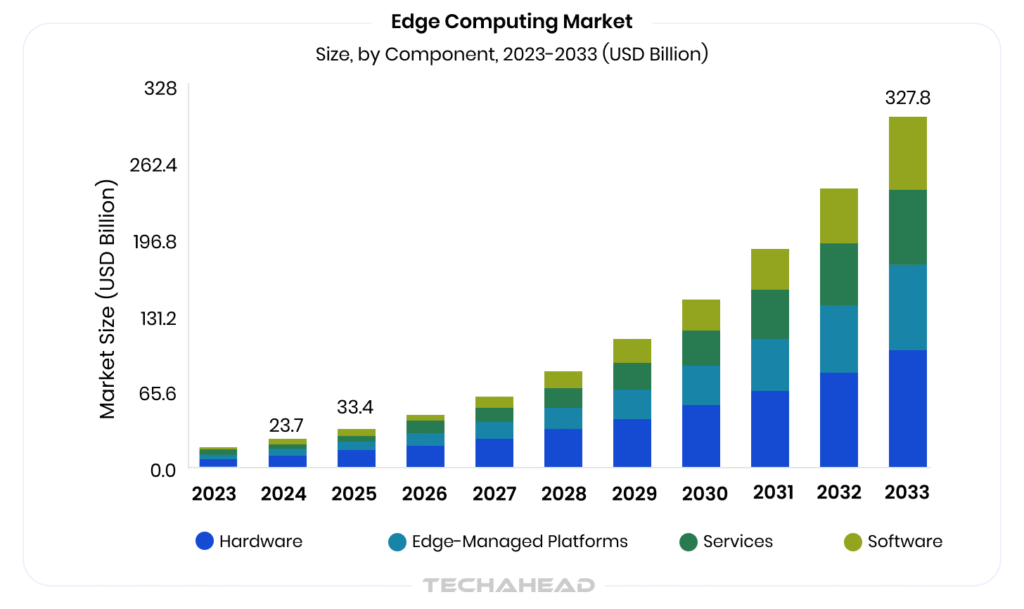
The edge refers to any computing that happens close to the data source on devices, sensors, factory floors, or local servers. Instead of sending raw data to a central cloud, the edge processes it instantly, on-site. The global edge computing market size was estimated at USD 23.65 billion in 2024 and is expected to reach USD 327.79 billion in 2033, growing at a CAGR of 33.0% from 2025 to 2033.
The cloud handles everything that requires scale, storage, and deep computation, training machine learning models, storing historical data, running analytics dashboards across global operations.
Most enterprise products do not live purely at the edge or purely in the cloud, you need to operate across both, dynamically shifting workloads based on latency needs, cost.
Understanding this continuum allows your product and engineering teams to architect systems that are fast at the edge, intelligent in the cloud, and seamlessly connected in between.
Building a data-intelligent product is not a single engineering effort; it is a four distinct stages, each laying the foundation for the next:
Every smart product begins with capturing the right data. It means embedding sensors, event trackers, and logging systems into your product from day one. Without clean, consistent data flowing in, no learning is possible. However, before that, you need to know why you are collecting data and if you have the legal right to use it for ML training.
Raw data is worthless without structure. In this stage, engineering teams build pipelines that clean, transform, and route data from edge devices to cloud storage; it means it is ready for model training.
This is where your product begins to actually learn. Machine learning models are trained on historical data, validated for accuracy, and deployed back into the product to power predictions and automated decisions.
The most overlooked stage is also the most powerful. Smart products monitor their own performance, collect new data from real-world usage, and retrain models regularly; getting sharper, faster, and more valuable over time.
Together, these four stages transform a static software product into a learning enterprise asset that compounds in value the longer it runs.
Choosing between edge & cloud computing is one of the most consequential architectural decisions an enterprise makes. The wrong choice leads to latency issues, runaway infrastructure costs or can be compliance violations. The following table gives you a clear idea where each excels to build smarter and more resilient products.
| Factor | Edge Computing | Cloud Computing |
| Processing Location | On-device or local server | Centralized remote data center |
| Latency | Ultra-low (milliseconds) | Higher (seconds) |
| Internet Dependency | Minimal or none | Required |
| Data Privacy | High, data stays local | Moderate, data leaves the device |
| Scalability | Limited to local hardware | Virtually unlimited |
| Cost Model | Higher upfront hardware cost | Pay-as-you-go operational cost |
| Best For | Real-time decisions, remote locations | Deep analytics, model training, storage |
| Industry Fit | Manufacturing, Healthcare, Retail IoT | Finance, SaaS, Enterprise Analytics |
| Model Training | Not ideal | Highly capable |
| Security Control | Full local control | Shared responsibility model |
Most enterprise smart products do not choose one over the other; they strategically combine both for maximum performance.
Real-time edge processing is not a futuristic concept; it is actively transforming how enterprises operate across every major sector. When milliseconds matter, waiting for cloud round-trips is not an option. Here is how leading industries are putting edge intelligence to work today:
Smart factories deploy edge processors on assembly lines to detect defects, monitor equipment vibration, predict mechanical failures before they cause downtime. A single unplanned stoppage can cost enterprises thousands per minute; edge AI eliminates that risk in real time. Siemens uses edge AI across its smart factory network to monitor machinery health in real time.
Remote clinics use edge devices to monitor patients. Besides that, wearables and bedside sensors process crucial health data locally, triggering instant alerts for abnormal readings that keep sensitive patient data fully compliant with HIPAA regulations. Philips Healthcare deploys edge-powered patient monitoring systems in ICUs that process vitals locally within seconds without routing data through external servers.
Edge computing powers real-time inventory tracking, cashierless checkout systems, in-store behavior analytics. Retailers process thousands of camera feeds, sensor inputs locally for instant shelf restocking alerts & personalized in-aisle promotions without cloud latency. For example, Amazon Go stores run entirely on hybrid models, which process hundreds of cameras in real time across all their physical locations.
Connected vehicles or fleet management systems rely on edge processors to make split-second navigation/routing decisions. Waiting for cloud responses at highway speeds is not just inefficient, it is dangerous. Tesla’s Autopilot system processes all driving data on-board using its custom FSD chip, making real-time lane, braking, collision decisions entirely at the edge.
Source: MarketsandMarkets
Smart grids use edge intelligence to balance load distribution, detect outages, prevent equipment overloads across thousands of nodes simultaneously. Local processing makes sure grid stability even when central systems are temporarily unreachable. For instance, General Electric (GE) deploys edge computing across its power grid infrastructure through its Predix platform. It helps in real-time fault detection and load balancing across utility networks.
Financial institutions use edge processing to detect fraudulent transactions, verify identities at ATMs, process payments locally in regions with unreliable connectivity. All without compromising on security or compliance. JPMorgan Chase leverages edge AI at its branch networks to run real-time fraud detection, biometric authentication locally. As a result, it also improves customer security simultaneously.
So, across every industry, the pattern is the same; when decisions cannot wait, edge processing delivers speed & security. The companies leading their sectors are not just adopting edge computing; they are building it directly into the core of their products.
Building a smart, data-intelligent product requires more than a development budget; it demands investment in data infrastructure, ML expertise, cloud architecture, ongoing model maintenance.
Many enterprises underestimate these layers, face cost overruns mid-journey. However, the return compounds over time. Smart products reduce operational costs through automation, minimize revenue loss through predictive maintenance, and increase customer lifetime value through personalization.
The right framing for enterprise stakeholders is not “What does it cost to build?” but “What does it cost us every quarter we delay?” That shift in perspective is where ROI justification becomes undeniable.
Data is no longer a byproduct of running your business; it is the engine that should be powering it. Every customer interaction, every sensor reading, every transaction your enterprise processes is a signal. The question is whether your products are listening/responding or simply collecting dust in a database somewhere.
In short, building a smart product is not a single project with a finish line. It is a continuous commitment to letting data drive better decisions, at every layer of your product, from the edge device in the field to the cloud dashboard in the boardroom.
The technology is proven. The use cases are clear. The ROI is measurable. What separates enterprises that successfully make this transition is having a development partner who has navigated this path before and knows exactly where the pitfalls are hidden. This is precisely what TechAhead is built for. From your first data audit to your first deployed ML model to a fully scaled edge-to-cloud product ecosystem; TechAhead brings the architecture expertise and strategic clarity that enterprise smart product development demands. Your data is already telling you something. It is time to build a product that listens.
Through a combination of edge processing, data anonymization, encryption, and architecture choices like hybrid cloud that keep sensitive data on-premise. Compliance frameworks like GDPR, HIPAA, and SOC 2 must be built into the architecture from day one — not added later.
A smart product learns and improves continuously from real-world usage data. A product with AI features uses fixed, pre-trained models that do not adapt over time. The former compounds in value — the latter becomes outdated.
There is no single best provider. AWS leads in breadth of ML services, Google Cloud excels in AI and data analytics, and Azure is preferred by enterprises already invested in the Microsoft ecosystem. Many enterprises adopt a multi-cloud strategy to leverage the strengths of each.
Start with a data audit; understand what data you are already collecting, where it lives, and how clean it is. Identify one high-impact business problem that data intelligence could solve. Build small, prove value, then scale deliberately. Not sure where to begin? Consult with the TechAhead team and get a structured roadmap built around your business.
We use cookies to ensure our website functions properly, improve performance, and provide a personalized experience. You can choose which types of cookies to allow below.
Required for core functionality such as security, network management, and accessibility. These cannot be disabled.
Help us understand site traffic and user interactions so we can improve performance and usability.
Enable enhanced functionality and personalization such as language or region preferences.
Used to deliver relevant ads, track campaign performance, and measure advertising effectiveness.