


 Copy Link
 Share on X
 Share on Facebook
 Share on LinkedIn


Always Active
Required for core functionality such as security, network management, and accessibility. These cannot be disabled.

Uncover the transformative potential of digital and mobile solutions for your industry.





 Last Updated: Oct 8, 2026
Oct 2, 2026
Last Updated: Oct 8, 2026
Oct 2, 2026  6
6  21 min. Read


Key Takeaways


The global electric vehicle market hit a massive milestone in 2025: sales crossed 20 million units, accounting for one in four (25%) new cars sold worldwide, according to the IEA’s Global EV Outlook 2026. Charging networks expanded just as quickly to keep pace, surging past 7 million public charge points after adding nearly 1.8 million new installations in 2025 alone.
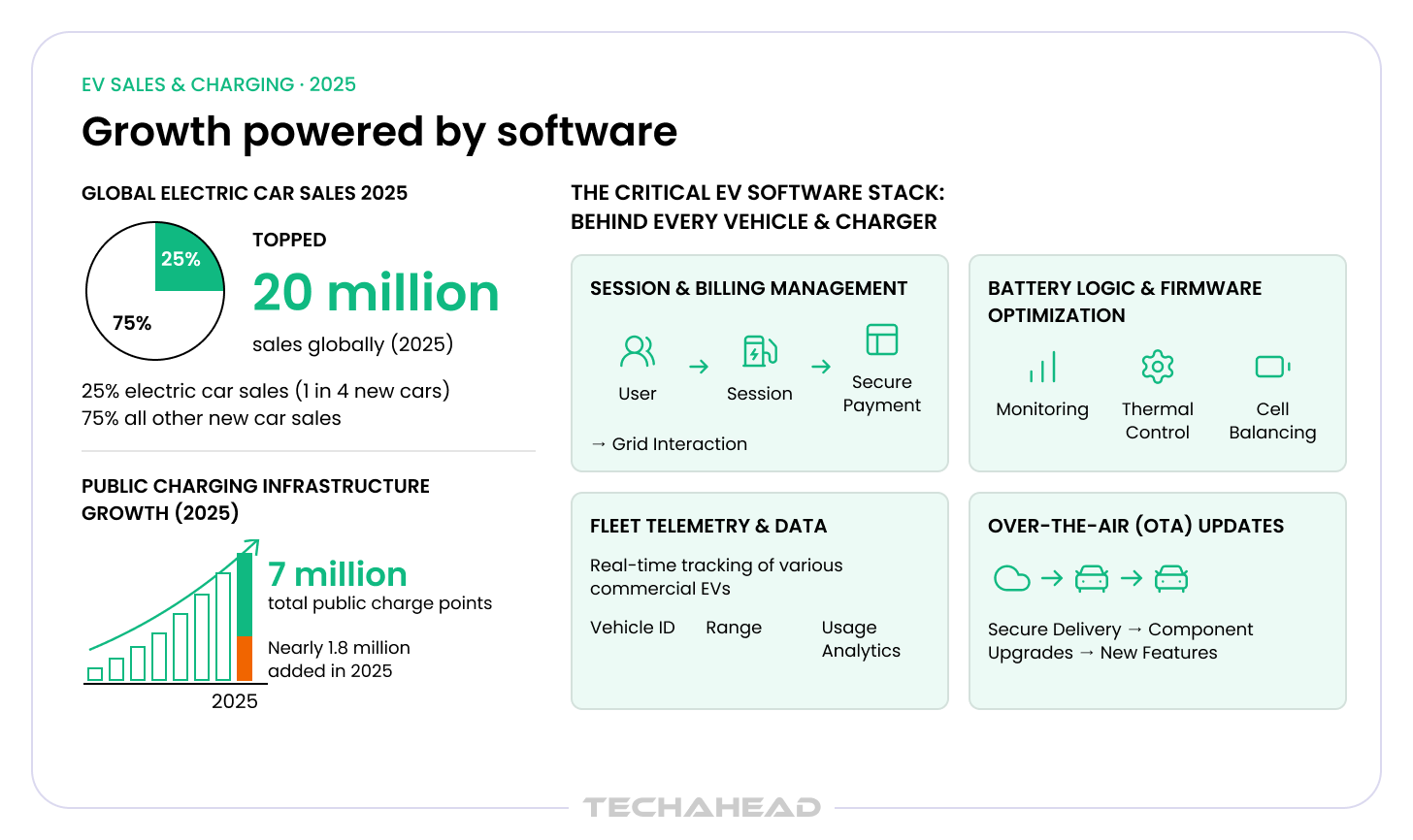
Every one of these cars and chargers uses software. The software manages billing and live charging sessions. It also handles battery management, fleet tracking, and over-the-air updates. Off-the-shelf tools work fine for setups. The struggle when you need custom hardware integrations or your own business rules. That is when custom EV software development services are needed. Finding a partner is not easy; this is because agencies usually have specializations. One might be good at low-level battery firmware. Another might be good at fleet dashboards. Another might be good at charger management systems.
This guide helps you find the right electric vehicle software development partner. We will explain how to recognize your project needs. We will show how to evaluate engineering partners. We will list ten companies to consider. We will share the questions to ask before signing a contract.
Also Read: Beyond Electric: Why Software-Defined, AI-First Architectures Are the Real Future of Automotive
EV software is not just one type of product. Most projects fit into one of four categories. The right partner depends on which category you’re in. It helps to imagine the system as three layers. At the top is the cloud and app layer. This includes dashboards, driver apps, billing, and analytics. In the middle is an edge gateway or telematics unit. This collects data. Communicates with the cloud using something like MQTT or HTTPS. At the bottom are the vehicle or charger controllers. This is where the battery management system and other embedded code live. The categories below are really parts of that stack.
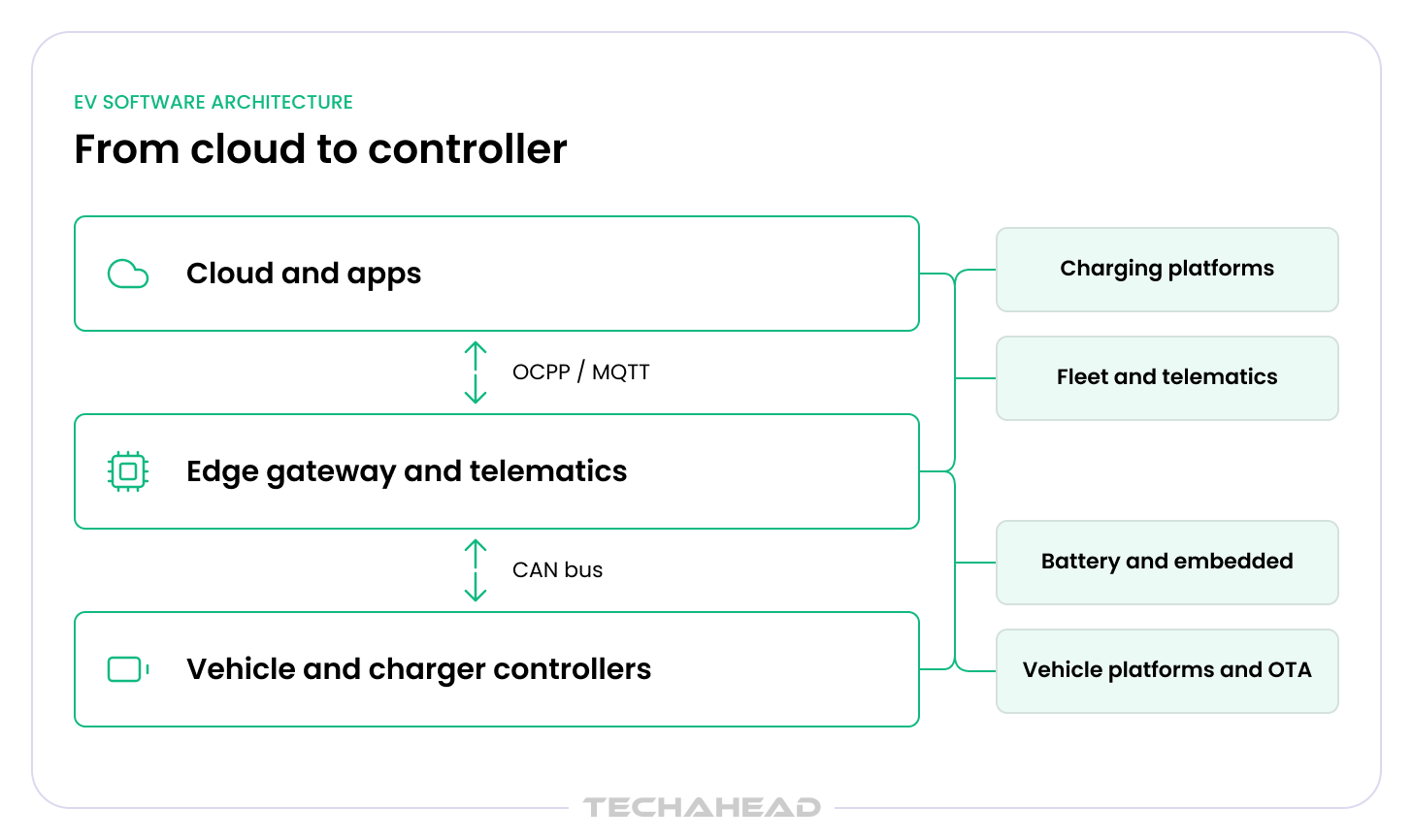
Charging platforms. If you run or plan to run charge points, you need a charging station management system (CSMS). This system talks to chargers using OCPP, the Open Charge Point Protocol. Roaming into networks happens through OCPI. Billing, tariffs, load management, and driver apps are on top. Bidirectional charging (V2G, where the car can send power back to the grid) is also starting to appear in requirements. Most of the work is in the cloud and mobile. You cannot skip testing against real chargers from different manufacturers. This is because they do not all act the same way.
Fleet and telematics. Fleet operators want to know the state of charge, and EV fleet management software can help them do that. They want to know if a route is possible. They want to know how drivers behave. They want to know when a vehicle needs service. This means taking data off the vehicle (over the CAN bus, the in-vehicle network most cars use). Then sending it to the cloud. Then turning it into something a dispatcher can use. Depot charging is part of this too. A bad schedule can cause demand charges from the utility.
Battery and embedded software. This is code that works close to the hardware. This includes battery management systems (BMS), onboard chargers, inverters, and the controllers that connect them. Mistakes here can cause range loss or safety issues. So functional safety standards such as ISO 26262 are needed. People who do this well usually have a power electronics background. Not just a software background.
Vehicle platforms and OTA. Over-the-air (OTA) updates, vehicle data pipelines, and middleware that let applications run on top of the vehicle’s hardware. This is mostly OEM territory. It is where the biggest engineering teams work
Most real projects involve two or three of these. A fleet product, for example, usually needs telematics, a charging layer, and a driver app. Knowing your mix before talking to vendors saves weeks of calls with people who cannot help you.
Vendor sites all say roughly the same thing, so focus on proof you can check.
Protocol depth. For charging work ask which OCPP versions the team has shipped. OCPP 1.6 is still common. OCPP 2.0.1 is what new builds target. OCPP 2.1 came out in 2025. It supports charging. Ask about OCPI for roaming. Also ask about ISO 15118 for Plug and Charge. This is the standard where the car and charger authenticate each other with certificates. So no one has to tap a card or open an app. Certificate handling is where a lot of teams get stuck. So it is worth asking how they manage it.
Vehicle-side experience. Look for hands-on work with CAN bus, AUTOSAR (the software architecture many automakers use) and functional safety processes. Ask for specifics: which ECU, which standard, which audit. “We follow ISO 26262” is easy to say. Showing you a safety case isn’t.
Must Read: The Road to Autonomy: Self Driving Cars Development
Cybersecurity and compliance. In markets that follow UNECE rules, including the EU regulation R155, a cybersecurity management system is required. R156 covers software update management. Even if you sell else, those rules shape what OEM customers expect from their suppliers. For the vendor itself, a SOC 2 Type II report or an ISO/IEC 27001 certificate tells you how your code and data will be handled.
Testing on real hardware. A charging platform that works against a simulator can still fail with a charger from a different manufacturer. Ask how many charger models or BMS units the team tests against. Ask if they run protocol conformance tests. Ask how they simulate thousands of sessions at once.
Ownership and handover. Who owns the code, the infrastructure templates, and the documentation when the project ends? Get it in writing before the project starts. Also ask where the cloud accounts are. If they are in the vendor’s name, moving later becomes hard.
Team shape. Check that the people on your project are the ones who were in the sales call. Check whether they have built EV products before or are learning on your dime. A short call with the engineers tells you more than any proposal.
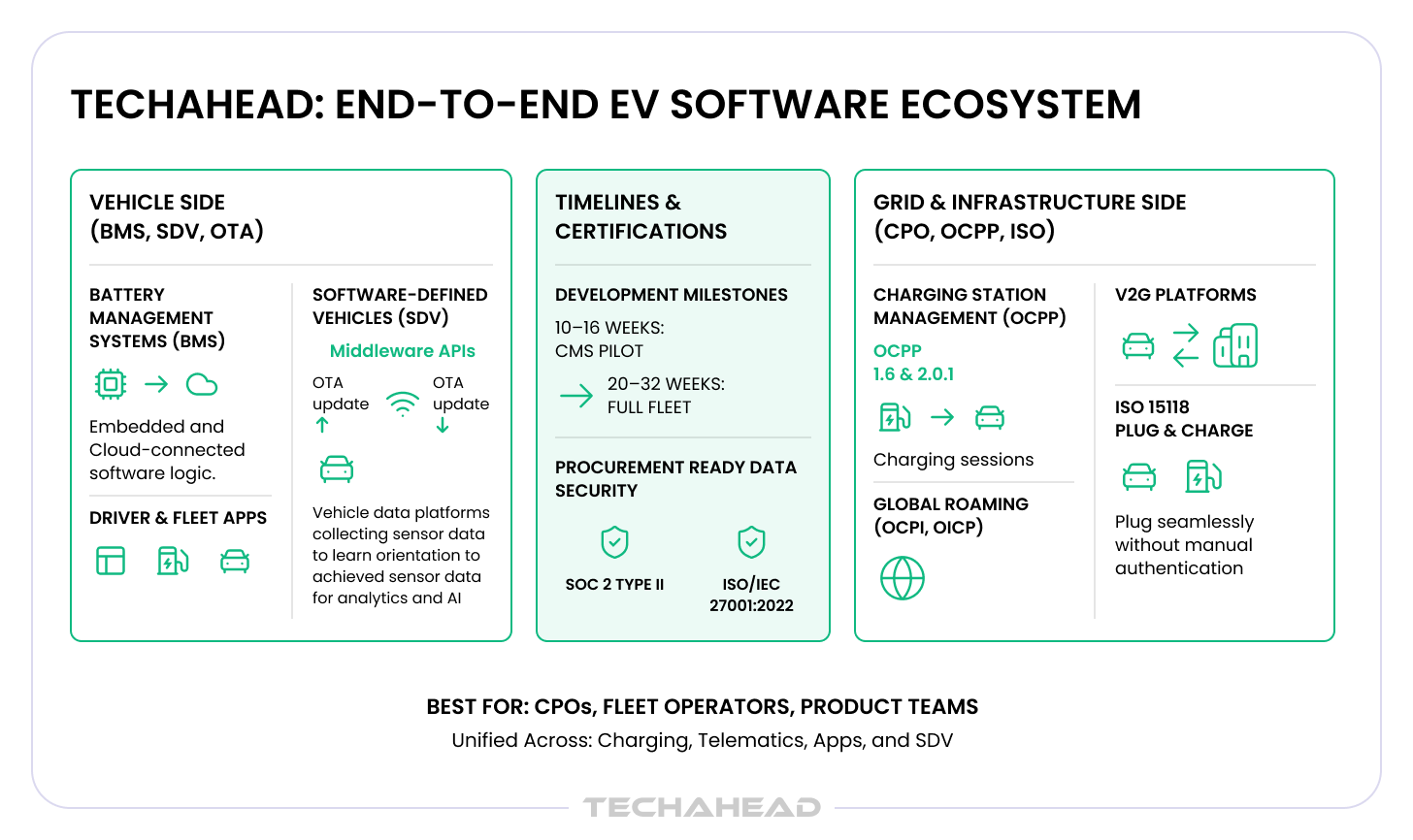
TechAhead covers the widest range of software project types on this list, which is why it opens it. Its EV page lists charging station management on OCPP 1.6 and 2.0.1, roaming over OCPI and OICP, ISO 15118 Plug and Charge, battery management software (both embedded and cloud-connected), V2G platforms, fleet telematics, and driver apps. The interfaces it names include CAN bus, MQTT, and OBD-II, and it holds SOC 2 Type II and ISO/IEC 27001:2022 certifications, which is the paperwork a procurement team will ask for anyway.
Another notable feature is its SDV work. TechAhead says it builds OTA update pipelines for software-defined vehicles, middleware that hides the differences between ECUs behind standard APIs, and vehicle data platforms that collect and route sensor data to analytics and AI. Its own planning ranges are 10 to 16 weeks from discovery to pilot for a focused charging management system and 20 to 32 weeks for a full fleet platform with telematics, though scope will push those around. If part of your product is driver-facing, EV mobile app development and IoT platform development, TechAhead will be the ideal fit.
Best for: CPOs, fleet operators, and product teams that want charging, telematics, apps, and an SDV data layer from one partner.
eInfochips is the hardware-plus-software choice. It says it has delivered turn-key EV charging hardware, smart charging apps, and a charging management platform. It also publishes reference designs for an EV charging SECC (the controller that manages communication between charger and car) a DC charger, a high-voltage BMS, and a scalable traction inverter, along with a testing framework for battery management systems. Starting from a reference design can shorten the road to a prototype, which matters when a charger maker needs electronics, firmware, and cloud software moving at the same time.
The extra feature is device management. EInfochips explains that web dashboards let operators push over-the-air updates, manage device firmware, and configure charge points without a site visit, and it sells device management as a service across IoT products. If you run thousands of chargers in the field, that’s the difference between a software patch and a truck roll. It also lists a high-power design center of excellence among its services, which becomes relevant once you move from AC chargers to DC charging.
Pick it if you build chargers or power electronics and want one team covering electronics, firmware, and the cloud.
Tata Elxsi is where you go when the battery is the product. The BMS development work on its site spans application software, basic software, complex device drivers, functional safety, controller algorithms, and plant models. It also designs battery packs across the lifecycle from system engineering through validation and mechanical design, and it offers MOBIUS+, a battery lifecycle management platform with analytics and real-time monitoring.
Through its Next Generation EV Innovation Center with Renesas, it built a BMS aimed at two-wheelers and light EVs with application software based on MATLAB/Simulink models and support for battery chemistries.
The added feature is simulation. Tata Elxsi lists management and CFD structural analysis and abuse tests such as nail penetration, thermal runaway, and side pole impact among its battery simulation services, and it has published white papers on digital-twin battery development and AI-enhanced predictive BMS. Running those tests before building physical packs saves a lot of prototypes. The emphasis on its EV pages is engineering programs for manufacturers, so it’s a match for OEMs rather than for a team after a ready-made fleet or charging product.
Best for: OEMs and Tier-1 suppliers developing their own battery systems.
KPIT works in automotive and mobility software, and its EV credibility comes from two announced programs. It was named the single-source software integration partner for BMW Group’s generation 11 kW combined charging electronics, which pairs the onboard charger with the vehicle control unit. It also formed an alliance with Eaton’s eMobility business covering inverters, onboard chargers, DC-DC converters, and power distribution modules. KPIT cites AUTOSAR and V2G among the software stacks it brings to those jobs.
For the feature, look at how the electrification work is organized. KPITs BMW announcement credited MicroFuzzy, a KPIT group company that specializes in vehicle electrification engineering alongside KPITs electric powertrain team. That setup keeps power electronics knowledge close to the software team, which helps when hardware and code have to be debugged.
Its model suits programs with OEMs and Tier-1 suppliers. A small charging startup would be a client.
Best for: OEMs and suppliers that need production-grade embedded software for powertrain and charging control.
LTTS says on its EV page that it covers design, development, integration, and testing across battery management systems, power converters, motor control, and charging infrastructure. It built e-VOLTTS, an in-house reference platform that includes a DC charger, a traction inverter, and an axial flux motor, and it runs an EV testing lab for validating components. It’s also a core member of CharIN, the organization behind the Combined Charging System, and Everest Group named it a leader in the segment of its 2023 ACES automotive engineering assessment.
The extra feature is the test infrastructure. LTTS points to a power test facility for application and firmware validation, load and drive tests, a dedicated thermal management team, and DC-DC converter efficiency above 97% in its in-house designs. Those are the details to push on in a vendor call because they show whether the company can prove its software against high-voltage hardware of only simulating it.
Where it fits: manufacturers that want charger and powertrain hardware validated alongside the software.
HCLTechs clearest EV charging proof point is its February 2025 collaboration with ChargePoint. They set up a center in India that works as a hub for ChargePoints software development, running an agile, product-focused operating model to deliver scalable and customizable charging experiences. ChargePoint describes its offering as a cloud subscription platform plus software-defined charging hardware, so the stack HCLTech engineers touch spans both cloud and device software.
The extra feature is the engagement model itself. This is a running product team, not a one-time project. You’re buying capacity and continuity: engineers who learn your ship against your roadmap and stay on it. For a charging company that already has a product and needs to ship, that’s often more useful than a fixed-scope quote.
Best for: established charging or mobility companies that need an ongoing engineering team at scale.
GlobalLogic, a Hitachi Group company, says it has more than 20 years of automotive software experience across software-defined vehicle architecture, networking, digital cockpit development, autonomous driving and EV propulsion. In July 2025, it was selected as an engineering services partner in Volvo Cars’ ecosystem, and in January 2026, it expanded its partnership with Elektrobit around high-performance computing and SDV platforms.
The extra feature sits on the side. In an interview with AI Online, a GlobalLogic automotive executive described a managed charging service that monitors charger availability and recommends charging times for fleet customers, and said the company had earned the AWS Automotive Services Competency. Treat that as a company statement. It shows GlobalLogic reaches beyond the in-vehicle stack.
Its center of gravity is still the vehicle. For a standalone charging network or a fleet dashboard, a narrower specialist may be a better fit.
Best for: OEMs and Tier-1 suppliers building in-vehicle software at scale.
Tata Technologies EV story is full-vehicle engineering. According to the Tata Group’s website, it handled design, packaging, and integration for the Tata Tigor EV (2021). Tata Motors also converted the Tiago EV (2023), finishing it in 18 months with a 4-star GNCAP safety rating. In January 2024 it announced a collaboration with Agratas, the Tata Group’s battery business, to scale product development and enterprise systems for battery design and manufacturing. Zinnov also rated it first among India-based ER&D electrification specialists and globally, according to Tata Technologies. That’s a third-party rating, so read it as one data point.
The extra feature is eVMP, its platform for turnkey EV development. The Tata Group site says an Asian EV company used Tata Technologies’ turnkey capabilities and the eVMP platform to speed up new-vehicle development. For an entrant without a vehicle program, that’s the more relevant proof point.
Pick it if you’re launching a full EV program, or running a battery business that needs engineering plus manufacturing systems.
Sibros is a product company rather than an agency. Its Deep Connected Platform combines over-the-air updates (Deep Updater), edge data logging (Deep Logger), remote diagnostics and commands, and connected-device analytics. The company says that 20 global OEMs across 36 markets use it. The platform is hardware agnostic and supports ICE, EV, hybrid, and fuel cell vehicles. There are separate fleet products for monitoring and predictive maintenance.
The extra feature is security. Sibros sells a Vehicle Security Operations Center (VSOC) alongside the platform. Guidance on in-vehicle integration and OTA best practices. If R155-style monitoring is on your roadmap, having detection and response in the stack is convenient.
You’re licensing a platform here, so custom pieces such as a driver app or a charging backend would come from another partner.
Best for: teams that would rather start from a proven OTA and vehicle data layer than build one.
Softeq is a full-stack shop: firmware, hardware design, mobile, web, and cloud. Its automotive page highlights ADAS and autonomous driving software vehicle HMIs, key systems, and telematics products that combine GPS with onboard diagnostics. It also cites familiarity with standards such as ISO 26262 and AEC-Q100.
The added feature is hardware depth. Softeq lists electronic circuit design, PCB design, simulation, FPGA design, and enclosure design among its services, and one of its published case studies is PCB design verification for a radar sensor system. It has also announced a partnership with NXP aimed at secure production of embedded systems across automotive, industrial, and consumer products.
Its automotive page doesn’t single out EV charging or battery work, so ask for references before you shortlist it for a charging or BMS project.
Best for: companies building a custom electronic product, such as a telematics unit or charger controller, where hardware and firmware matter as much as the cloud.
| Company | Core focus | Standout capability | Closest project type |
| TechAhead | Charging, fleet and driver software | SDV OTA pipelines and ECU-abstraction middleware | Charging platforms, fleet and telematics |
| eInfochips | Charger electronics and cloud | Reference designs plus remote device management | Charger and power electronics products |
| Tata Elxsi | Battery systems | Virtual abuse testing and MOBIUS+ lifecycle platform | Battery and embedded software |
| KPIT | Automotive embedded software | Charging electronics and powertrain integration for OEMs | Battery and embedded software |
| LTTS | Hardware and power electronics | Power test facility and e-VOLTTS platform | Battery, embedded and charging hardware |
| HCLTech | Managed product engineering | Long-running dedicated teams | Charging platforms at scale |
| GlobalLogic | In-vehicle software | SDV, cockpit and managed charging service | Vehicle platforms and OTA |
| Tata Technologies | Full-vehicle EV engineering | eVMP turnkey EV platform | Vehicle programs and battery systems |
| Sibros | Connected-vehicle platform | OTA, data logging and VSOC in one stack | Vehicle platforms and OTA |
| Softeq | Custom electronics and firmware | Circuit, PCB and FPGA design | Embedded software and hardware |
Picking a company is half the decision. The other half is how you’ll work with them, and the list above covers three different models.
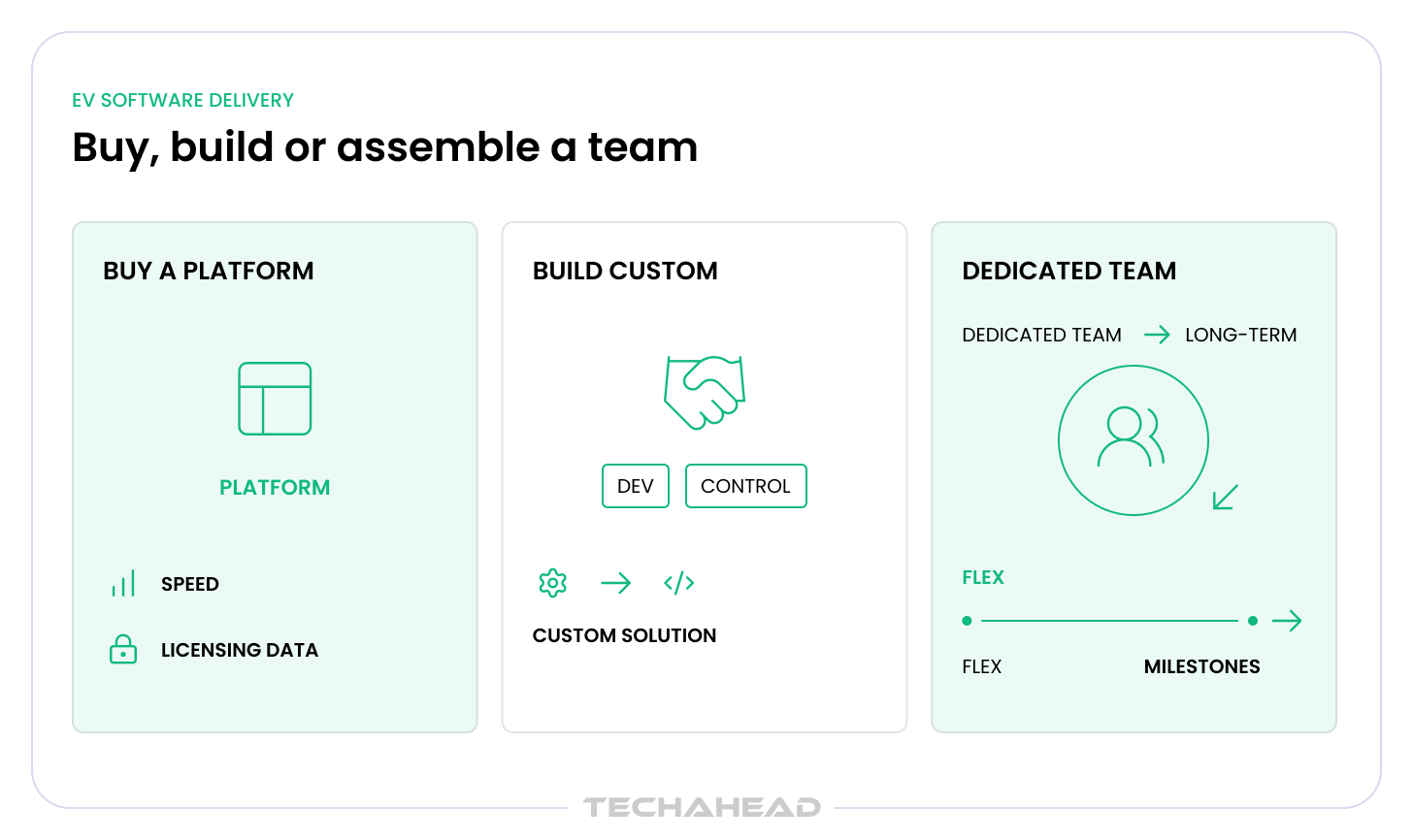
Buy a platform. If the thing you need already exists as a product, licensing it is faster. OTA and vehicle data are the clearest example, since Sibros-style platforms exist for exactly that. The trade-off is control. Before you sign, ask about data export, API limits, and what happens to your fleet if the vendor changes pricing or gets acquired.
Build with a project partner. For anything that touches your hardware or commercial logic, a scoped build usually makes more sense. This is the model behind most charging platforms, fleet products, and driver apps. Define acceptance tests against real chargers or vehicles up front, and agree on who owns the code and the infrastructure accounts, and keep a clear line between what you’re paying for now and what’s phase two.
Put a dedicated team on it. If you already have a product and a roadmap that never ends, a long-running team beats a string of projects. The HCLTech and ChargePoint arrangement is an example of this. You get continuity, and the team gets to know your codebase and your customers’ habits. You also need someone on your side who owns the backlog, because a dedicated team without a strong product owner drifts.
Most mature programs mix all three. They buy the commodity layers (maps, payments, OTA), build the parts that make the product different, and keep a small core team for the long haul. Whichever mix you choose, start with a pilot. Ten chargers or twenty vehicles will show you problems that a spec never will: flaky connectivity, odd firmware behavior, and drivers doing things nobody planned for. Then put protocol upgrades on the roadmap early. Moving from OCPP 1.6 to 2.0.1 is a real project, and teams that treat it as a patch often get surprised.
A few direct questions will get you past the sales pitch and straight to real technical capabilities:
The EV market is still making steady headway, even with the occasional bump in quarterly sales numbers. A huge chunk of the actual engineering heavy lifting now happens behind the screens—in the software powering everything from battery firmware and charging networks to fleet logistics and over-the-air updates.
The companies on this list tackle different corners of that ecosystem. Finding the right fit really comes down to three things:
Once you’re clear on those three factors, narrowing down your options gets a lot easier.
If you’re currently mapping out a charging, fleet, or battery initiative, kicking around your technical architecture with TechAhead’s EV team is a great way to get moving in the right direction.
Also Read: Reshaping Cities: How Autonomous Cars Impact Urban Life
EV software development involves building the software systems that support electric vehicles, charging infrastructure, batteries, fleet operations, connected vehicles, and driver applications. It can include EV charging management systems, telematics, battery management software, OTA updates, mobile apps, analytics, and vehicle data platforms.
An EV software development company designs and develops software for electric vehicle ecosystems. Depending on its expertise, a company may build EV charging platforms, fleet management systems, battery management software, telematics solutions, connected-vehicle platforms, driver apps, or embedded automotive software.
Start by defining your project requirements and then evaluate potential partners based on EV-specific experience, technical capabilities, previous deployments, protocol expertise, cybersecurity, testing infrastructure, team experience, and post-launch support. For charging projects, OCPP, OCPI, and ISO 15118 experience can be particularly important.
EV charging software manages and connects electric vehicle charging infrastructure. It can include charging station management systems (CSMS), charger communication, billing, tariffs, user authentication, load management, roaming, monitoring, analytics, and driver-facing applications.
OCPP is one of the key protocols used to connect charging stations with charging management platforms. OCPI supports communication and roaming between charging networks, while ISO 15118 enables vehicle-to-charger communication and features such as Plug and Charge. OCPP 2.0.1 is particularly relevant for newer charging platforms.
EV fleet management software helps businesses monitor and manage electric vehicle fleets. Common capabilities include vehicle telematics, state-of-charge monitoring, route planning, charging schedules, driver behavior, maintenance tracking, fleet analytics, and depot charging management.
Battery management software monitors and controls important battery functions such as state of charge, battery health, temperature, cell performance, and charging behavior. Advanced battery management systems can also support diagnostics, predictive maintenance, thermal management, and safety functions.
ISO 26262 provides a functional safety framework for automotive electrical and electronic systems. It becomes especially important when EV software interacts directly with safety-critical systems such as battery management, powertrain controls, inverters, and other vehicle control systems.
The cost of EV software development varies significantly depending on the project’s scope, integrations, hardware requirements, security needs, testing requirements, and complexity. A charging management platform, fleet application, BMS, and vehicle software platform can have very different development requirements and budgets.
The choice depends on your product requirements and differentiation. Buying an existing platform can accelerate deployment for commodity capabilities, while custom EV software development provides greater control over business logic, integrations, user experience, and proprietary features. Many mature EV programs use a combination of both approaches.
We use cookies to ensure our website functions properly, improve performance, and provide a personalized experience. You can choose which types of cookies to allow below.
Required for core functionality such as security, network management, and accessibility. These cannot be disabled.
Help us understand site traffic and user interactions so we can improve performance and usability.
Enable enhanced functionality and personalization such as language or region preferences.
Used to deliver relevant ads, track campaign performance, and measure advertising effectiveness.