


 Copy Link
 Share on X
 Share on Facebook
 Share on LinkedIn


Always Active
Required for core functionality such as security, network management, and accessibility. These cannot be disabled.

Uncover the transformative potential of digital and mobile solutions for your industry.



 Last Updated: Nov 13, 2026
Nov 5, 2026
 8
 24 min. Read


Key Takeaways


A driver pulls up to a charger with 6% battery left. They tap “Start.” Nothing happens.
That single moment explains why EV software is harder than it looks. The app has to talk to the charger, the payment system, the map, and the driver’s account in real time. If one link breaks, the driver is stranded, and your brand takes the blame.
And the number of drivers hitting that moment is climbing. The International Energy Agency’s Global EV Outlook 2026 forecasts that about 23 million electric cars will be sold worldwide in 2026, close to 30% of all new cars. For comparison, the same report says 2025 sales passed 20 million, roughly one in four new cars. Early 2026 was bumpy, with first-quarter sales down 8% year on year after policy changes in major markets. The full-year outlook still points up.
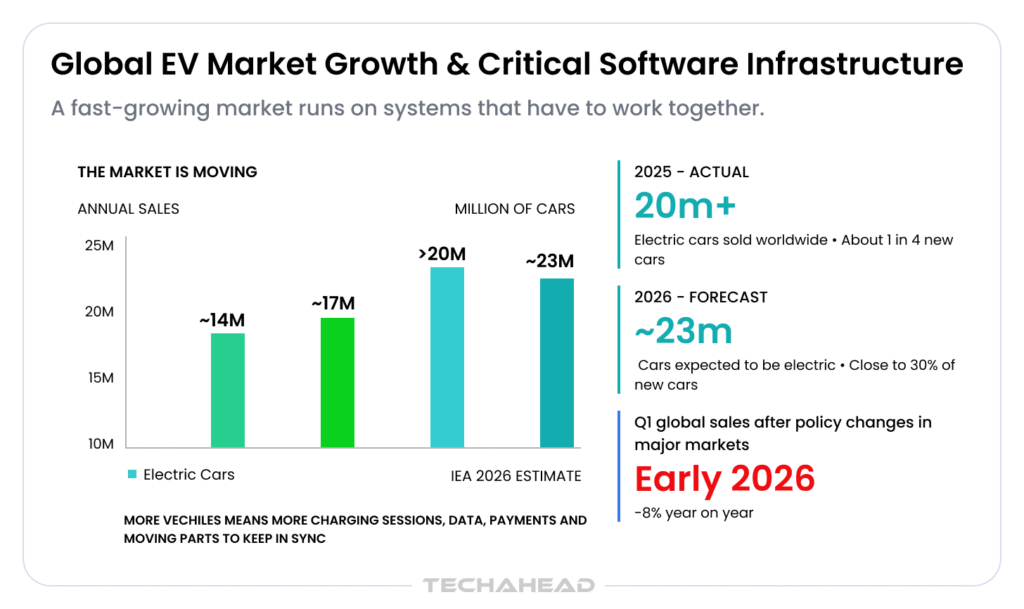
Every one of those cars needs software around it. Drivers want to find a working charger, start a session, pay, and get on with their day. Fleet managers want to know which vehicles are charged and which aren’t. Charging operators want to see what’s broken before a customer tells them.
That’s where the right electric vehicle app development company earns its fee. Building an EV app is more than a station map with a nice skin. You’re dealing with live data, payments, location services, IoT connectivity, cloud infrastructure, and often charging protocols like OCPP and OCPI.
What you need depends on who you are. A charging startup may want a driver app with station discovery and payments. A network operator will likely need a full platform for charger monitoring, session management, and operations. A fleet business cares about vehicle tracking, charging schedules, route optimization, and energy reporting.
So we put together a list of 10 electric vehicle app development companies. We looked at EV project experience, mobile and software engineering strength, connected-device expertise, and the ability to handle complex digital products. Further down, you’ll also find a buyer’s checklist, vendor questions, red flags, and the factors that drive project cost, so you can walk into your first call prepared.
Must read: Top 10 EV Software Development Companies in 2026: A Technical Buyer’s Guide
| Rank | Company | Best suited for |
| 1 | TechAhead | End-to-end EV apps, charging platforms, and fleet solutions |
| 2 | Progression Agency | EV charging apps and charging management platforms |
| 3 | eInfochips | EV charger connectivity and product engineering |
| 4 | Fuego UX | EV charging app design and user experience |
| 5 | HappyFunCorp | Connected EV charging experiences and mobile apps |
| 6 | ArcTouch | Connected products and custom mobile applications |
| 7 | BlueLabel | Custom mobile applications and digital product development |
| 8 | Fueled | Consumer-facing mobile products and digital experiences |
| 9 | 10Pearls | Enterprise software, mobile apps, and digital engineering |
| 10 | Chop Dawg | Custom mobile app development for startups and growing businesses |
| If you are.. | Start by looking at |
| Building a full charging platform plus a driver app | TechAhead, Progression Agency |
| A charger manufacturer that needs hardware and software to work together | eInfochips, TechAhead |
| Running an EV app that drivers find confusing | Fuego UX (design), TechAhead (redesign plus modernization) |
| Connecting a physical charging network to a mobile app | HappyFunCorp, Progression Agency |
| Launching a fleet product with vehicle data and dashboards | TechAhead, 10Pearls |
| An early-stage startup testing an EV idea | Chop Dawg, BlueLabel (confirm EV experience) |
| Focused on a polished consumer app experience | Fueled, ArcTouch (confirm hardware experience) |
Best for: End-to-end EV apps, charging infrastructure, and fleet management platforms
TechAhead is a digital product engineering company that builds mobile apps and connected software platforms. It leads our list because its EV work spans the entire chain, from the driver’s phone to the backend of a charging network or fleet.
Its electric vehicle app development services include charging station apps, fleet management platforms, battery monitoring, and connected mobility. Charging businesses get station discovery, live availability, session management, and payments. Fleet operators get vehicle tracking, state-of-charge monitoring, and route planning. The team works with OCPP and OCPI, plus the cloud and IoT integrations an app needs to talk to charging hardware.
Key services:
Why consider TechAhead? Pick it when mobile, cloud, IoT, and backend pieces must work as one connected product. Its AI development practice also applies to uses like predictive maintenance.
What to verify: Share your charger models, protocols, and expected scale early, and ask which EV projects the proposed team has worked on.
Best for: EV charging applications and charging network management
Progression Agency builds software for EV charging networks. That covers the apps drivers use and the systems operators rely on to run the chargers, so it works on both the customer-facing app and the operational platform behind it.
For drivers, the work includes charger discovery, starting a session, payments, and account management. On the operator side, it takes in charging station management software, OCPP connectivity, network operations, and roaming integrations. The app is planned alongside the chargers, pricing systems, and backend operations rather than treated as a separate product.
Key services:
Why consider Progression Agency? Look at it if your main need is a charging platform that links the driver experience to the infrastructure. Its stated work with charging networks suits operators who want one team on both the app and the operations layer.
What to verify: If your plans go beyond charging, such as fleet analytics or broader connected mobility, ask how far its scope extends.
Best for: EV charger software, connected devices, and product engineering
eInfochips, an Arrow Electronics company, offers product engineering and digital transformation across embedded systems, IoT, cloud, AI, and connected technologies. That background helps when your EV app has to interact with physical charging equipment.
It has published EV charging case studies, including one where it built Android and iOS apps with an EV supply equipment manufacturer. Users could manage chargers remotely, schedule charging, review usage history, and pull up charging information. Its documented EV work also covers charger management platforms, OCPP-compliant systems, cloud infrastructure, and hardware connectivity.
Key services:
Why consider eInfochips? It suits EV manufacturers and charging equipment businesses that want software and hardware engineering on one team. The documented charging projects make it especially relevant for connected chargers and remote monitoring.
What to verify: If your product is a consumer app with no hardware component, check whether its engineering-heavy approach matches the design polish you want.
Best for: EV charging app UX research and interface design
Fuego UX is a user experience and product design agency with documented work in EV charging. Its EVCS project involved redesigning the mobile app for an expanding EV charging network.
The focus was the driver’s experience of the network: UX research, a mobile app redesign, design system development, and interface improvements. It also covered subscription plan integration and a more consistent charging experience. Fuego contributes mainly on the design side and isn’t building charging infrastructure software end to end, so a larger build needs an engineering partner.
Key services:
Why consider Fuego UX? It’s worth a look when your biggest problem is an existing EV app that frustrates people, or when you want a more intuitive driver experience from day one. The EVCS project is a direct example in the charging app space.
What to verify: Ask who will build the design. If you need design and engineering from one team, compare it with the full-stack partners on this list.
Best for: Connected EV charging experiences and mobile application development
HappyFunCorp is a digital product development company working across mobile apps, software engineering, and connected digital experiences. Its published work includes a project for an EV charging brand that wanted to tie its physical charging infrastructure to a fuller mobile experience.
The team designed, architected, and built iOS and Android apps so drivers could interact with the charging network. The app supported charging, payments, and access to charging metrics, linking the physical charging moment to the digital product. That matters when your app must talk reliably to chargers and keep drivers informed during a session.
Key services:
Why consider HappyFunCorp? It’s a relevant option for EV businesses that need a custom mobile product connected to physical infrastructure. The published charging-network project gives buyers something concrete to walk through with the team.
What to verify: Ask which protocols and operator-side tools the team has handled, since the published project centers on the driver app.
Best for: Connected products and custom mobile applications
ArcTouch is a digital product development company that specializes in mobile apps, connected products, and software experiences. Its work spans product strategy, UX/UI design, app development, APIs, and cloud-connected services.
For EV businesses, that mix helps when an app has to connect vehicles, devices, and users. A connected mobility app might pull together device data, user accounts, notifications, and backend services while still feeling consistent across mobile platforms. The connected-product background is the main draw here, so use its public portfolio to look for EV work that matches your plans.
Key services:
Why consider ArcTouch? It’s worth evaluating if you need a strong mobile product with a connected-device experience. Treat it as a skilled generalist rather than an EV specialist, and judge it on how well its connected-product work maps to yours.
What to verify: Ask for EV-specific case studies, and ask how the team handles charger protocols and real-time session data.
Best for: Custom mobile applications and digital product development
BlueLabel is a digital product development company that builds mobile apps and software products for businesses. Its services cover product strategy, design, app engineering, and emerging technologies.
For an EV business, a partner like this can turn a concept into a working app: a driver-facing app, a fleet dashboard, or a platform that connects customers with charging services. It is a broader digital product option, not a dedicated EV charging software specialist, so ask about its experience with IoT integrations, real-time data, and payment workflows before you pick it.
Key services:
Why consider BlueLabel? It may suit businesses that want a product partner to shape and build a custom mobile app. Weigh its EV-specific technical experience against your integration and infrastructure needs. If you already have the hardware side covered, a product-focused team like this can be a sensible fit for the app layer.
What to verify: Ask how it would handle charger communication and live data, because that’s where generalist teams most often get stuck.
Best for: Consumer-facing mobile applications and digital experiences
Fueled is a digital product agency known for mobile apps and digital experiences. Its work includes product strategy, UX/UI design, mobile engineering, and app development.
In EV, the driver-facing experience shapes how people feel about a charging network. Account setup, station discovery, payment flows, charging history, and notifications all have to work together without adding friction. Fueled’s mobile product skills fit that need, though as with the other generalist agencies here, you should confirm direct experience with EV charging systems and hardware integrations.
Key services:
Why consider Fueled? It’s worth considering when the project leans hard on the customer-facing app and the overall digital experience. If your charging infrastructure is complex, look closely at its backend and integration capabilities too. A good test is to ask the team to walk you through how a driver would start and pay for a session in an app it has shipped.
What to verify: Ask who owns the charger integration and backend work, and whether that team is in-house.
Best for: Enterprise software development and connected digital platforms
10Pearls is a digital development and technology consulting company. It offers custom software, mobile apps, cloud engineering, data, and AI, and its enterprise background can help when you’re building complex apps that must plug into existing systems.
For EV companies, that might mean fleet management interfaces, operational dashboards, connected apps, and data-driven platforms. These often pull information from many sources, need role-based access, and have to work with business systems. It is a broader digital engineering partner, not a company with an established EV charging specialty, so assess its experience with charging protocols and vehicle telemetry.
Key services:
Why consider 10Pearls? It may fit larger organizations looking for a technology partner to build or modernize enterprise software. The wider engineering skills apply to EV platforms with complex integrations and heavy data needs. It is most relevant to fleet and operations software, less so to a consumer charging app.
What to verify: Ask for examples involving telemetry or device data, since EV-specific specialization isn’t established.
Best for: Custom mobile app development for startups and growing businesses
Chop Dawg is an app development company that works with startups and established businesses. It plans, designs, and builds custom digital products, including mobile apps, web platforms, product strategy, and ongoing support.
For an EV startup, a partner like this can help build a first product, test the user experience, and get an app to market. Depending on your business model, that could be a driver app, a charging-service marketplace, or a fleet-facing app. It’s a general app development company, not an EV-specific engineering provider, so confirm it can handle charging hardware and real-time vehicle data.
Key services:
Why consider Chop Dawg? It may work for startups that want a custom EV-related app and an initial roadmap. If your project involves charging infrastructure or vehicle connectivity, vet the technical expertise carefully.
What to verify: Ask how the product would grow from a first release into a platform with hardware and backend integrations.
The right partner depends on what you’re building, which systems it has to connect with, and what business problem it needs to solve. A shortlist is only useful if you check these areas before you sign anything.
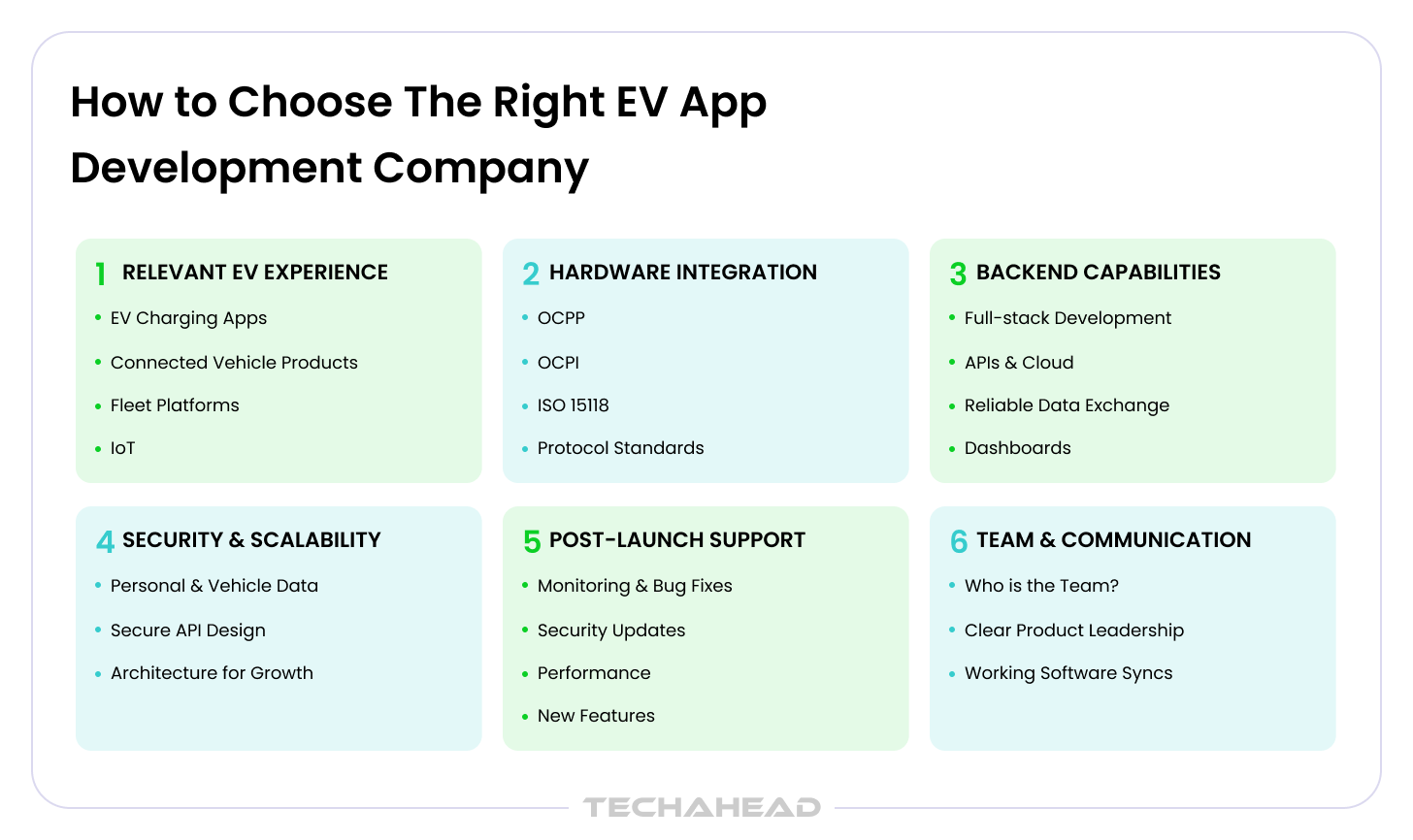
Look past general mobile app portfolios. Ask if the company has built EV charging apps, connected vehicle products, fleet platforms, or IoT-enabled applications.
A team that knows the EV ecosystem spots problems early. Charger communication, real-time data, energy monitoring, and hardware integrations all have their own traps, and an inexperienced team finds them on your budget.
If your app connects to charging stations, check the company’s experience with the relevant protocols and standards:
What you actually need depends on your hardware, your charging network, and your business model. A good partner can tell you which integrations your product requires and which ones you can skip for now.
An EV app is rarely just a mobile app. It may need a backend platform, cloud infrastructure, APIs, databases, analytics, and an admin dashboard.
Find out whether the company can handle all of those pieces together. That matters most for charging networks and fleet platforms, where real-time updates and reliable data exchange aren’t optional. Cloud and DevOps maturity shows up here too, so ask how releases, monitoring, and incident response work. Teams that offer cloud engineering services in-house tend to answer those questions faster.
EV apps can handle personal information, location data, payment details, vehicle information, and charging records. Security belongs in the process from day one.
Ask about authentication, encryption, access controls, secure API design, payment integrations, testing, and ongoing maintenance. A vendor with a dedicated cybersecurity practice should be able to show you how those controls work in practice. Then ask whether the architecture can take on more users, stations, and vehicle integrations as you grow.
Launch day is the start, not the finish. Charging networks expand, hardware changes, operating systems update, and customers expect more over time.
Pick a company that can handle monitoring, bug fixes, security updates, performance improvements, and new features after launch.
Find out who you’ll actually work with. Ask who leads product decisions, who owns the backend, and how often you’ll see working software. A vendor that can’t describe its own process clearly won’t run yours clearly either.
Also read: Legacy System Modernization: Key Strategies for Future-Proofing Your Enterprise
Bring these to every first call. The answers tell you more than any portfolio page.
Some warning signs show up early. Don’t ignore them.
Your feature list depends on whether the app serves EV drivers, charging network operators, fleet managers, or vehicle owners. Still, several capabilities show up almost everywhere.
| Feature | What it does | Business value |
| Charging station locator | Displays nearby charging stations, locations, and availability | Helps drivers find charging options |
| Real-time charger status | Shows whether a charger is available, occupied, or out of service | Reduces uncertainty and unnecessary visits |
| Charging session management | Allows users to start, monitor, and stop charging sessions | Simplifies the charging experience |
| In-app payments | Supports charging payments, invoices, and transaction history | Makes payment and billing easier |
| Route planning | Identifies charging stops along a journey | Supports more convenient EV travel |
| Battery monitoring | Displays battery status, charging progress, and related information | Helps users monitor vehicle health |
| Fleet tracking | Tracks vehicle locations and fleet activity | Improves fleet visibility |
| Analytics dashboard | Provides charging, usage, and operational reports | Supports business decisions |
| Notifications | Sends alerts about charging sessions, payments, and vehicle status | Keeps users informed |
For a commercial EV platform, you may also want dynamic pricing, subscription management, multi-network roaming, remote diagnostics, and predictive maintenance.
One practical tip. Don’t try to ship every feature in version one. Pick the few that prove your business model, like finding a charger, starting a session, and paying, then add the rest once real users show you what they need.
This is also where projects go sideways. Teams start with a feature wish list, then discover midway that the chargers they chose don’t expose the data the app needs. Sort out hardware and data access first. A partner with IoT app development and AI and ML engineering depth, like TechAhead, can usually flag those gaps during planning instead of after the first build.
Must read: Top 10 IoT Development Companies
Building an EV app means thinking about how drivers, charging operators, fleet businesses, and energy providers use the platform and which rules apply to the data you hold.
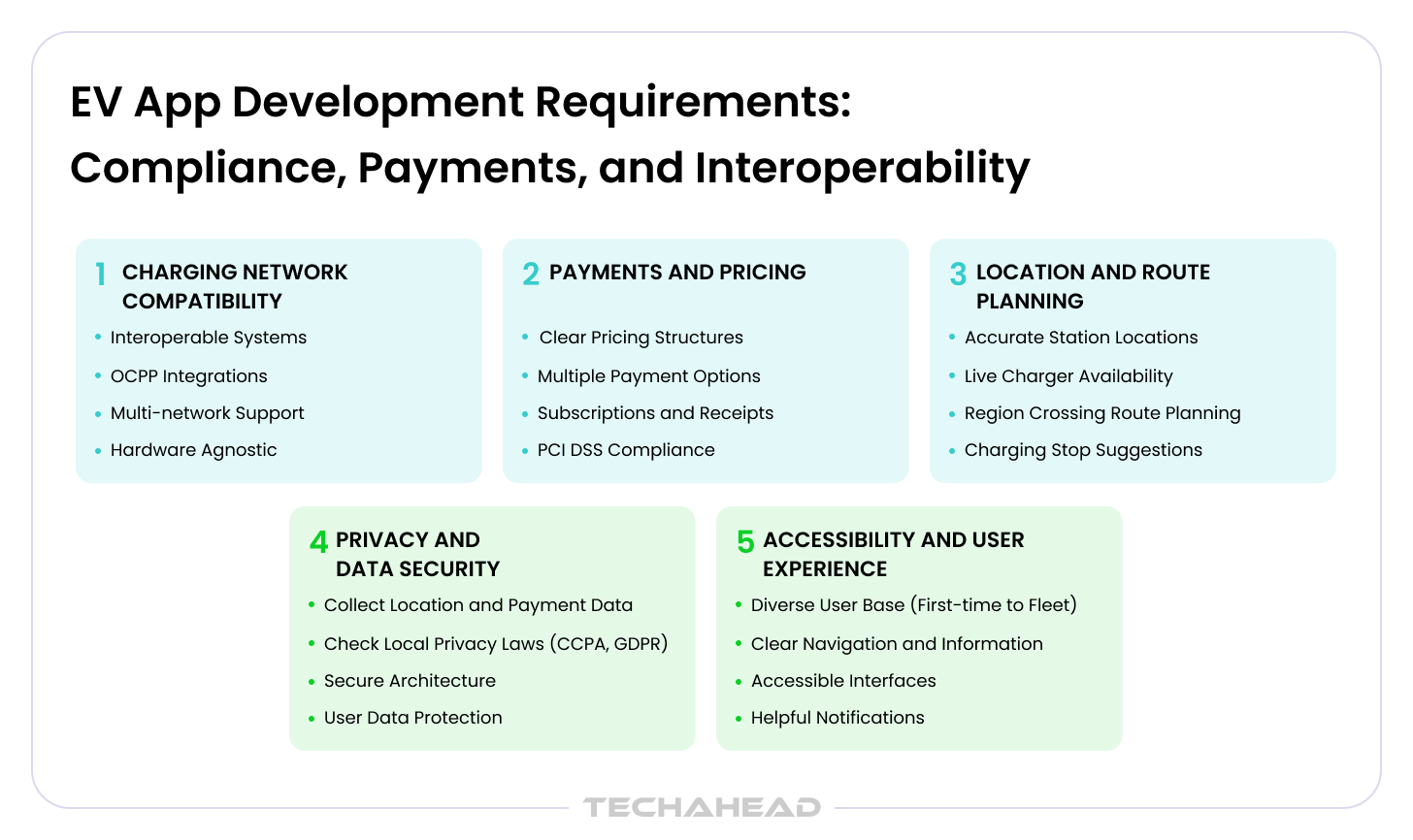
An EV app may have to work with several charging networks, charger manufacturers, and hardware setups. OCPP and the right roaming integrations can help you build interoperable systems, depending on the deployment.
Show pricing clearly before and during a session. Depending on your model, you may need card payments, digital wallets, subscriptions, receipts, and different pricing structures. Design payment handling around the applicable PCI DSS requirements.
Accurate station locations, live charger availability, route planning, and charging-stop suggestions make an app far more useful for drivers crossing regions.
EV apps collect location and payment data, so check which privacy laws cover your users. Depending on where they live, that could include the California Consumer Privacy Act (CCPA), as amended by the California Privacy Rights Act (CPRA), or the GDPR. Ask your legal team, and ask your development partner how the architecture supports those obligations.
Your users range from first-time EV owners to fleet drivers who charge daily. Clear navigation, readable charging information, accessible interfaces, and helpful notifications cut friction across the whole journey.
Also read: Top 17 Leading AI Consulting Companies in 2026
Off-the-shelf platforms work fine when your needs are standard. But if you’re building a differentiated charging network, a connected vehicle product, or a fleet operation, you’ll probably want more control over the software.
Custom EV app development lets you shape the app around your own workflows, customer experience, and technology stack. Here’s what you get:
A quick gut check helps here. If a standard platform already covers your core workflow, start there. If you keep hitting limits on pricing models, hardware support, or reporting, that’s your sign to go custom.
An EV app pulls on mobile engineering, backend development, cloud infrastructure, IoT, and data management all at once. The hard part is making those pieces behave like one product that holds up in real charging and mobility operations.
TechAhead works across those areas through its EV software development services. Here’s what it brings to an EV project:
Whether you’re launching a new EV product, rebuilding an existing platform, or connecting charging infrastructure to digital apps, the team can support the work from planning through ongoing improvement, including mobile app development for the driver side.
The EV market keeps growing, and drivers have little patience for apps that fail at the charger. The companies that win will be the ones whose software just works when someone needs it.
Pick a partner on evidence, not on polish. Look for documented EV work, ask hard integration questions, and plan for life after launch. The profiles above give you a starting point. Your own scope, hardware, and goals should decide the rest.
If you’re planning an EV charging app, fleet platform, or connected mobility product, talk to the TechAhead team. Bring your idea, your hardware list, and your questions, and ask for a scoped proposal.
An electric vehicle app development company designs and builds digital solutions for EV drivers, charging network operators, vehicle manufacturers, and fleet businesses. Its services can include EV charging mobile apps, charging station management systems, vehicle tracking platforms, battery monitoring applications, payment integrations, and connected mobility software.
The cost of EV app development in the USA depends on the application’s features, complexity, technology stack, and integration requirements. A basic EV driver app will generally require less investment than a full charging management platform with OCPP integration, real-time charger monitoring, payment processing, and fleet management capabilities. Businesses should define their requirements and request a project-specific estimate.
An EV charging station app should typically include station discovery, real-time charger availability, navigation, charging session management, in-app payments, charging history, and notifications. More advanced EV charging applications may also support charger reservations, subscription plans, dynamic pricing, roaming, and remote monitoring.
EV app development commonly involves mobile technologies such as Swift, Kotlin, Flutter, and React Native, along with backend technologies such as Node.js and Python. Cloud platforms, IoT connectivity, APIs, geolocation services, databases, and analytics are also important. The technology stack depends on the application’s functionality, hardware integrations, and scalability requirements.
OCPP (Open Charge Point Protocol) enables communication between EV charging stations and charging station management systems. OCPI (Open Charge Point Interface) supports information exchange and roaming between charging networks and e-mobility service providers. Both can play an important role in developing interoperable EV charging platforms, depending on the system architecture.
The development timeline depends on the application scope, integrations, and testing requirements. A relatively simple driver-facing EV app may take a few months, while a more advanced charging platform involving hardware connectivity, backend management, payment systems, and real-time data can take considerably longer. A detailed project timeline should be established after technical requirements are finalized.
Yes. An EV application can integrate with multiple charging networks and compatible charging stations through APIs and protocols such as OCPP and OCPI. The exact integration approach depends on charger compatibility, network agreements, hardware capabilities, and access to the required APIs.
Look for a company with relevant EV or connected-device experience, mobile and backend development expertise, IoT integration capabilities, and knowledge of charging protocols. Review its case studies, ask about hardware testing and security practices, understand its development process, and confirm what post-launch support it provides. The right partner should be able to demonstrate how its experience matches your specific EV product requirements.
We use cookies to ensure our website functions properly, improve performance, and provide a personalized experience. You can choose which types of cookies to allow below.
Required for core functionality such as security, network management, and accessibility. These cannot be disabled.
Help us understand site traffic and user interactions so we can improve performance and usability.
Enable enhanced functionality and personalization such as language or region preferences.
Used to deliver relevant ads, track campaign performance, and measure advertising effectiveness.