


 Copy Link
 Share on X
 Share on Facebook
 Share on LinkedIn
Always Active
Required for core functionality such as security, network management, and accessibility. These cannot be disabled.

Uncover the transformative potential of digital and mobile solutions for your industry.





 Last Updated: Sep 22, 2026
Jun 1, 2026
Last Updated: Sep 22, 2026
Jun 1, 2026  798
798  18 min. Read


Key Takeaways
The promise of writing a few sentences and receiving a fully functioning web application or SaaS software used to be the stuff of developer science fiction.
But Generative AI changed everything.
In 2026, this developer’s fiction is a normal Tuesday morning at tens of thousands of startups!
And one of the earliest AI-platform that made this transformation possible is Lovable.
Formerly known as GPT Engineer, Lovable has made that transition from prompt to production-ready codebase faster, more reliable, and more architecturally sophisticated than almost any platform before it.
But calling Lovable a “no-code tool” badly undersells what it actually is.
How Lovable Works? (Source)
Unlike drag-and-drop builders that produce non-exportable visual blocks, Lovable generates real, editable React and TypeScript source code, complete with routing, authentication, database schemas, and storage. The output is yours. The code runs. The architecture scales.
Lovable finances (Source: TechAhead AI Team)
This blog is a technical deep-dive written for developers, architects, and product leaders who want to understand what is happening under the hood.
We will cover the full system architecture, the backend design decisions, the AI agent orchestration loop, the infrastructure layer, security posture, and where the platform is heading next.
At TechAhead, we build complex, scalable mobile and web applications for clients across verticals. Platforms like Lovable represent a genuine architectural shift in how early-stage product development is conceived and executed, and understanding their internals matters for anyone thinking seriously about the next generation of software delivery.
For organizations adopting these workflows, AI development services are essential for turning AI-generated starting points into secure, scalable products with sound architecture, reliable integrations, and production-ready governance.
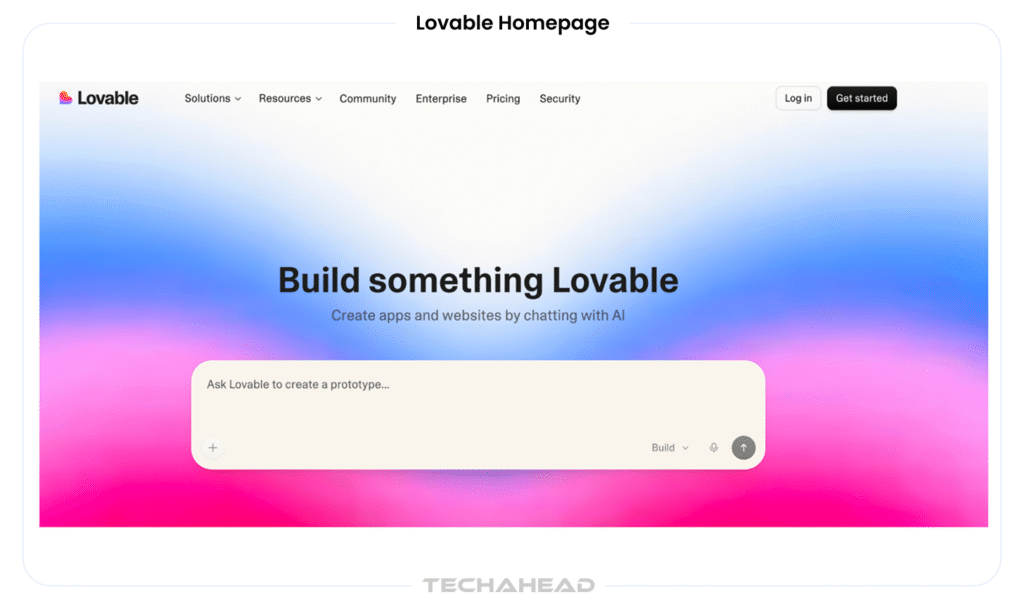
Lovable is an AI-powered platform that enables users of any technical background to create full-stack web applications through natural language prompts. Its core interface is simple by design: a dialogue panel on the left where you describe what you want, and a live application preview on the right where you see it built in real time.
Lovable Homepage
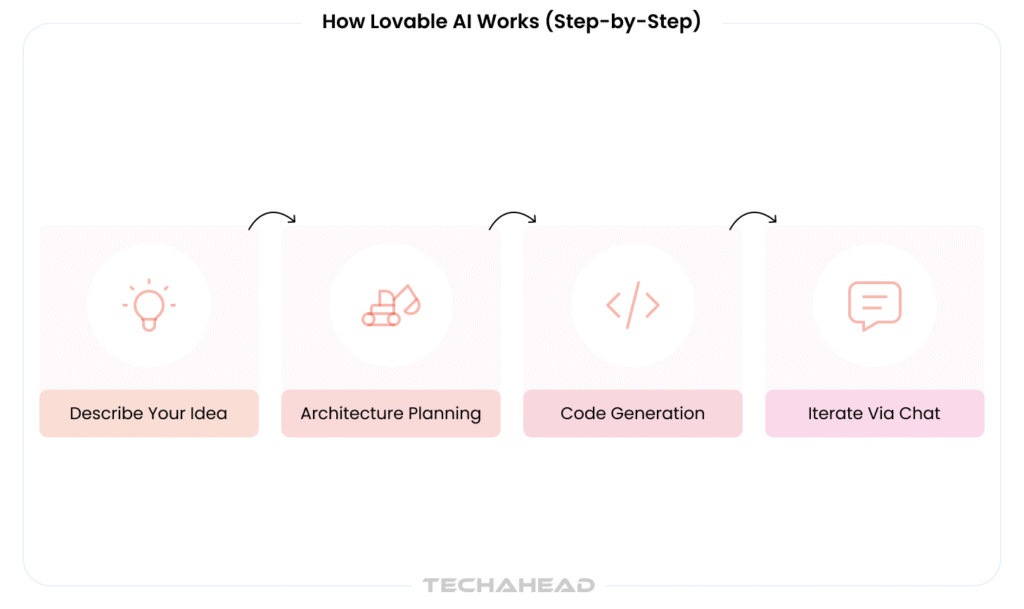
The generative loop is iterative. You prompt, Lovable generates, you verify, you revise. There is no separate “design phase” or “development phase.” Intent and output collapse into a single continuous workflow.
How Lovable Works? (Source: TechAhead AI Team)
What You Can Build
The platform is web-only, but that covers a wide surface area. Users have built landing pages, CRMs, project management tools, social applications, inventory systems, and real-time collaboration tools entirely within Lovable. The output is mobile-responsive by default, though native mobile applications are outside the current scope.
| Feature | Lovable | Typical No-Code Builder |
| Output Type | Real source code (React, TypeScript) | Visual blocks, non-exportable |
| Code Ownership | Full GitHub export available | Platform-locked |
| Backend Support | Auth, database, storage, edge functions | Limited or plugin-based |
| Third-Party APIs | Native OpenAPI integration | Often restricted |
| Developer Handoff | Clean, editable codebase | Re-build required |
The emphasis on real, owned, editable code is the most important differentiator architecturally. It means the platform’s output is not a dead end. Developers can take over at any point, extend the codebase, and deploy to any infrastructure they control.
Lovable’s architecture is best understood as a layered system where each layer has a clearly scoped responsibility. The layers do not operate in isolation; they form a tightly coupled pipeline from user intent to deployed application.
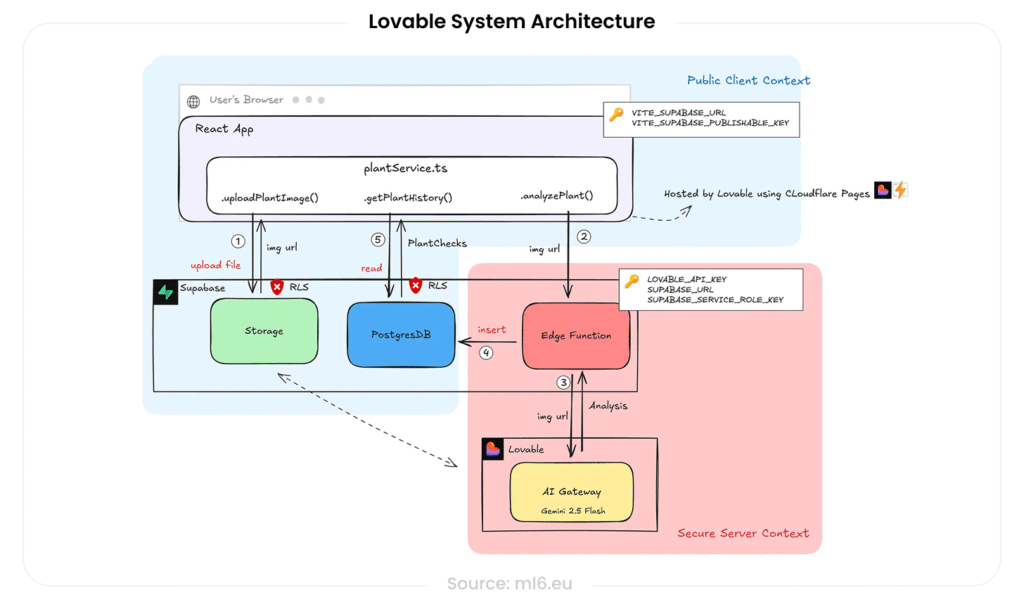
Lovable System Architecture (Source)
| Layer | Components | Purpose |
| User Interface | Chat interface, live preview, Code mode, Visual Edits | User interacts via natural language; sees real-time app preview |
| Agent Orchestration | LLM agent, prompt engine, context manager, change planner | Analyzes tasks, builds change plans, generates code patches |
| Code Generation Engine | React/TanStack generator, Tailwind styler, TypeScript compiler | Produces frontend code, routing, and components |
| Backend Engine | Lovable Cloud (built-in) or Supabase integration | Database, authentication, storage, edge functions |
| Infrastructure Layer | GCP, AWS, Cloudflare, Kafka, Snowflake, BigQuery | Hosting, scaling, data analytics, observability |
| Integration Layer | GitHub, Stripe, OpenAI, third-party OpenAPI backends | External service connectivity |
The data flow through this architecture follows a deterministic pattern, even when the generation output is probabilistic:
Intent parsing: The user inputs a prompt. The agent parses intent, task boundaries, and constraints.
Context collection: The platform gathers the current project’s file tree, environment state, and signals from prior iterations.
Change set generation: The LLM agent builds a change plan covering frontend patches, API changes, data layer modifications, and integration updates.
Build and preview: The project is rebuilt and a preview is deployed. The user sees results immediately.
Feedback loop: Errors, clarifications, and new requirements feed into the next agent cycle.
Lovable started in Spring 2023 as the GPT Engineer CLI, a single-shot code generation tool run from the terminal.
By 2024, the product shifted to a chat-first SaaS interface with live preview and controlled change application.
The late 2024 rebranding to Lovable marked a deeper repositioning: from AI code generator to end-to-end application platform. By 2025 and 2026, the focus shifted further to enterprise controls, policy governance, traceability, and regulated autonomy.
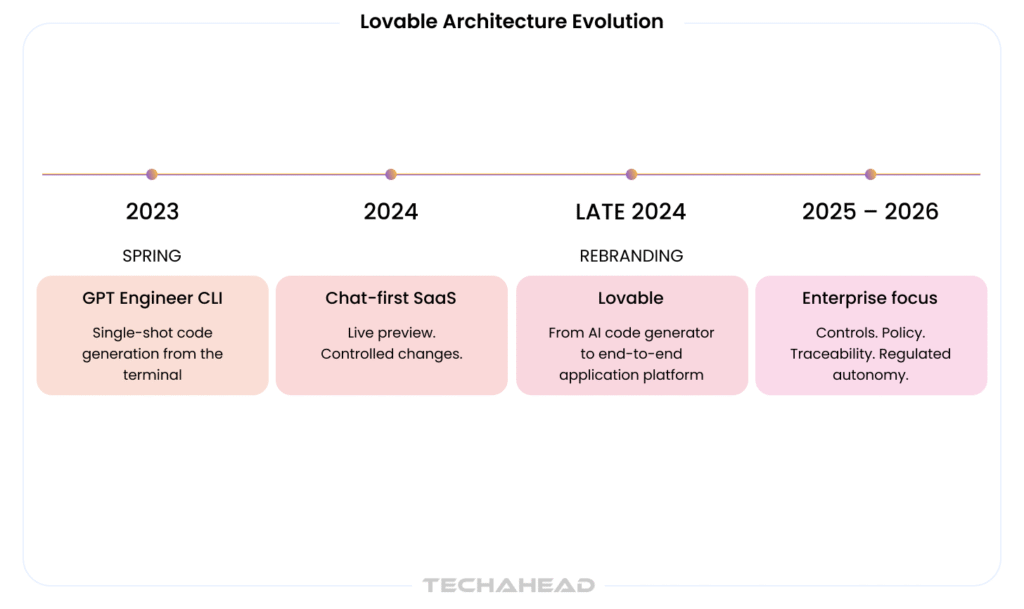
Lovable Architecture Evolution (Source: TechAhead AI Team)
Lovable’s frontend generation is not a black box. The platform has a well-defined default stack that every generated application inherits, and the choices are deliberate: they prioritise developer ergonomics, type safety, and modern tooling.
| Component | Technology | Notes |
| Framework | React (legacy) / TanStack Start (new, from May 2026) | TanStack Start includes server-side rendering (SSR) except on Enterprise plans |
| Build Tool | Vite | Fast development builds and hot module replacement |
| Language | TypeScript | Type-safe code generation throughout |
| Styling | Tailwind CSS | Utility-first; supports Shadcn and DaisyUI component libraries |
| Routing | React Router | Handles navigation and page-level route generation |
| UI Components | Shadcn / DaisyUI | Pre-built, accessible component primitives |
Lovable builds pages, routes, components, and Tailwind styling automatically from natural language. The platform supports Visual Edits for manual text and color adjustments without re-prompting the agent, and it includes prerendering on deployed public URLs for SEO and AI search visibility.
Both the older React-plus-Vite stack and the newer TanStack Start stack support SEO and AI search visibility natively, without external prerendering services.
Plan mode lets users brainstorm features, debug issues, and understand what changes the agent intends to make before any code is written.
Code mode exposes the generated source files directly, allowing manual edits.
Visual Edits lets non-developers click on UI elements and change text or colors inline. Together, these three modes serve a spectrum from fully AI-driven generation to fully manual control.
Backend Architecture: Lovable Cloud & Supabase
The backend story is where Lovable’s architectural decisions become most consequential. Most AI app builders generate static or client-only frontends. Lovable went in the opposite direction: it built a full-stack backend pipeline that generates the database schema, authentication flows, storage configuration, and business logic automatically.
| Option | Description | Best For |
| Lovable Cloud (built-in) | Fully managed backend with database, auth, storage, and edge functions | Fastest setup; no external configuration required |
| Supabase Integration | Open-source Firebase alternative on PostgreSQL | Users wanting more control or a self-hostable path |
| Third-Party OpenAPI Backends | Connect to external REST/GraphQL APIs | Custom backend requirements and existing infrastructure |
Lovable Cloud is the platform’s built-in, fully managed backend. It provisions and manages everything the application needs without requiring users to touch a single configuration file.
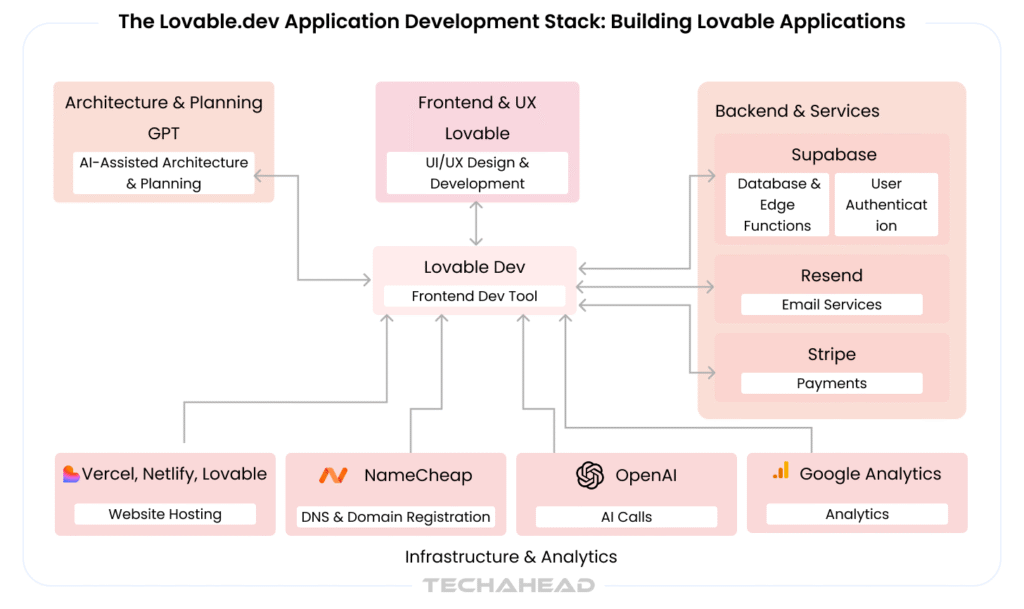
Lovable Development Stack (Source)
It provides a PostgreSQL-backed database for storing messages, user profiles, file references, and application data; an authentication system with user signup, login, and role-based permissions; object storage for file uploads and media; edge functions for running backend business logic; and native AI integrations powered by Google Gemini for LLM features, image generation, and text analysis, all at zero additional setup cost.
“Lovable Cloud scales with the application. Users can upgrade their instance for traffic spikes, and row-level security ensures that users only access data they are authorized to see, without writing access control logic manually.”
Pricing follows a usage-based model. A free tier covers up to $25/month in usage, which is adequate for prototyping and early development. Billing is usage-based thereafter, with no manual configuration of infrastructure required at any stage.
For teams that want more control, Lovable’s Supabase integration is architecturally the more interesting choice.
Supabase is an open-source Firebase alternative built on PostgreSQL. It supports all major authentication providers, includes a real-time engine, and offers a generous free tier. Critically, it is self-hostable, which matters for compliance-sensitive deployments.
The integration workflow is straightforward: the user connects their Supabase project by providing a project URL and API keys. Lovable then generates a Postgres schema based on the application prompt, syncs authentication flows with Supabase Auth, and wires the frontend to consume Supabase REST and GraphQL APIs for all CRUD operations. Real-time event subscriptions and file storage can be layered on as needed.
The most architecturally significant aspect of the Supabase integration is not the surface-level API connectivity. It is the MCP layer underneath.
Lovable does not merely integrate with Supabase; it orchestrates it.
Through MCP, Lovable can read and modify the entire backend state in a structured feedback loop. It accesses database schemas, secrets and API keys, and logs and errors. It runs the Supabase CLI behind the scenes, including via Docker, for edge function deployment. The result is a system where the AI agent has deep, bidirectional access to the backend rather than just the ability to write API calls on the frontend.
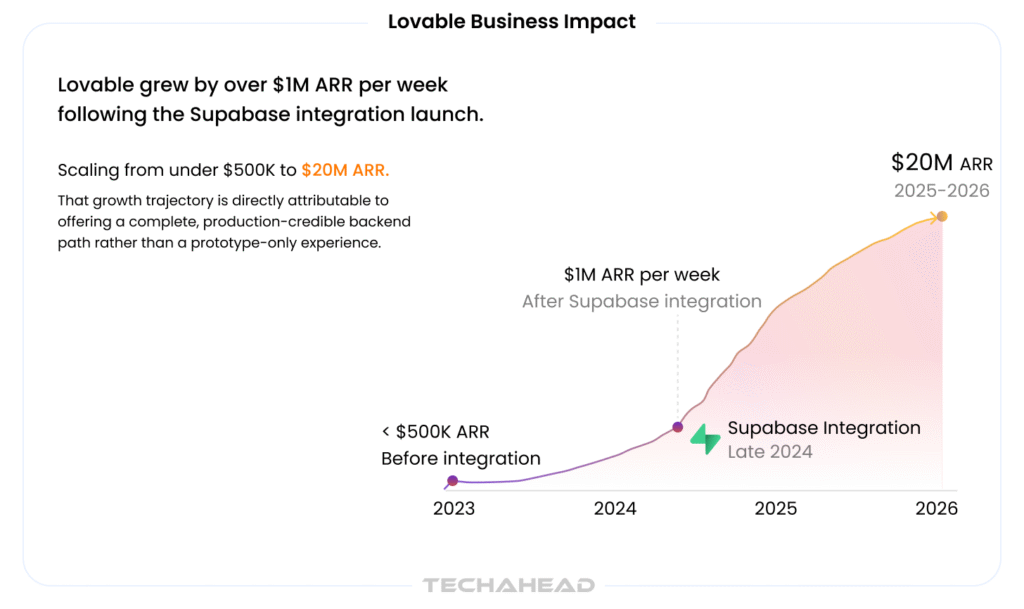
Lovable Business Impact (Source: TechAhead AI Team)
| Feature | Lovable Cloud | Supabase Integration |
| Setup | One prompt, zero configuration | Requires project URL and API keys |
| Database | Built-in Postgres | Postgres |
| Authentication | Built-in | Supabase Auth |
| Storage | Built-in | Supabase Storage |
| Edge Functions | Built-in, AI-ready | Supabase Edge Functions |
| Control Level | Less control, faster deployment | More control, self-hostable |
| Best For | Quick prototyping, MVPs | Production apps needing full control |
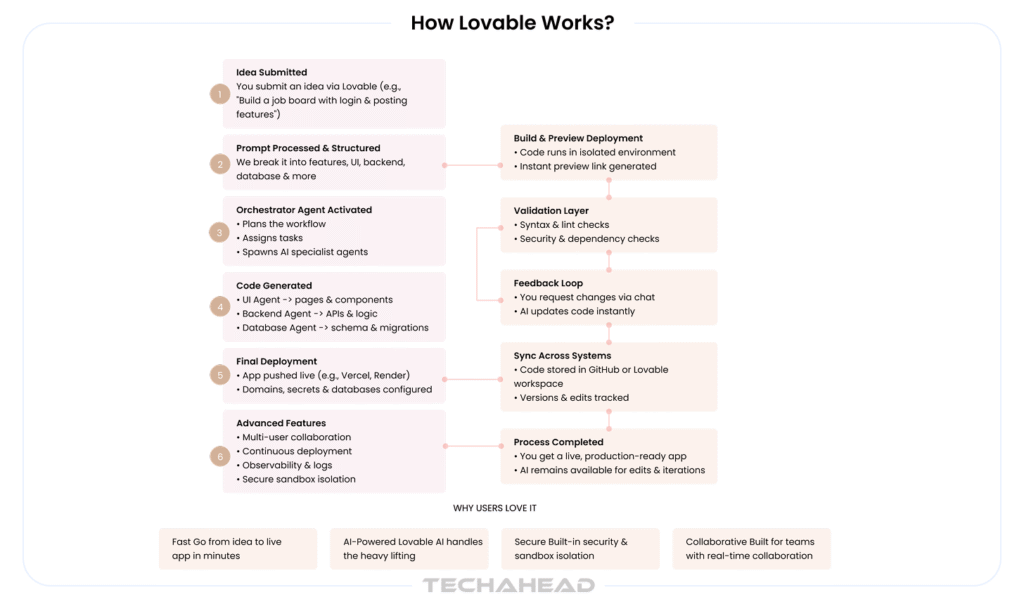
The agent orchestration layer is the cognitive core of Lovable. It is what transforms a sentence like “build me a CRM with deal tracking and email notifications” into a working full-stack application. Understanding how this loop works is essential for anyone evaluating the platform for serious product development.
Goal and Boundaries (Task Spec): The user defines intent, requirements, and constraints, including stack preferences, timing, and scope limits.
Context Collection (Task Context): The platform gathers the full project file tree, environment state, and signals from previous iterations. Lovable processes recent messages to maintain working context across cycles.
Planning and Generation (Change Set): The LLM agent builds a change plan, then generates patches for the frontend, API layer, data layer, and integration surfaces. Chat mode exposes this plan before it is applied, showing diff previews across multiple files.
Build and Preview: The project rebuilds. Artifacts are deployed into a preview environment. Results are visible immediately.
Feedback Loop (Next Cycle): Errors, new requirements, and clarifications feed directly into the next agent cycle. A Try-to-fix button attempts automatic error resolution without consuming credits.
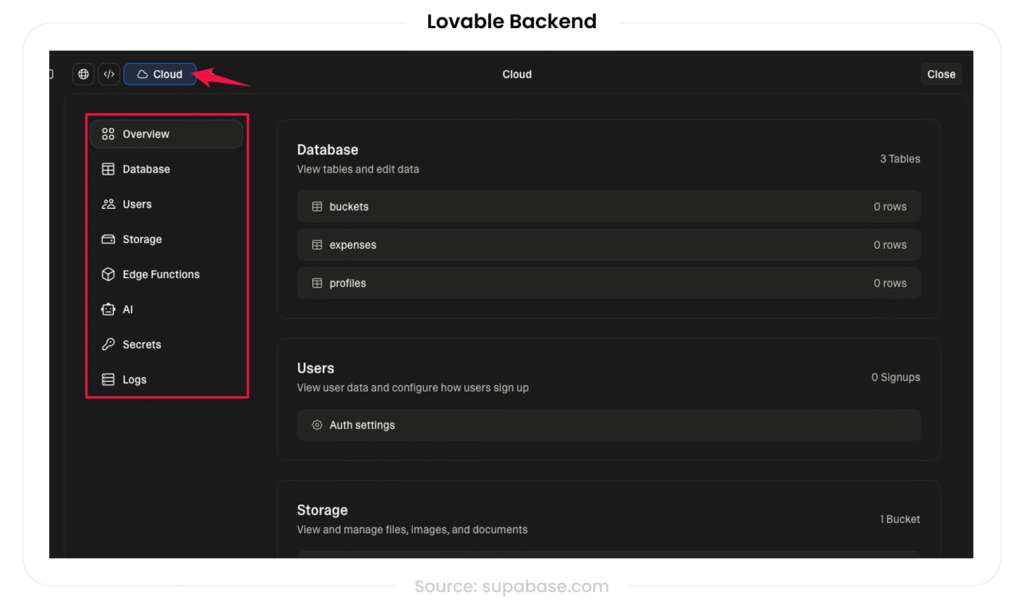
Lovable Backend (Source)
| Strategy | Implementation |
| Prompt structure | Clear, specific task framing significantly improves generation quality |
| Context management | Processes recent messages; users should include relevant details in each prompt |
| Sandboxing | Code execution is isolated for safety and reproducibility |
| Test harness | Generated code is validated before deployment to preview |
| Incremental building | Platform explicitly advises “start small and build in increments” |
| Refactoring | Dedicated refactor cycles improve code structure without changing behavior |
To ground the agent loop in something concrete, here is how data moves through a Lovable-generated plant analysis application at runtime.
Step 1: Image Upload
The browser uploads an image directly to Supabase Storage using the publishable key. The storage access policy permits this action from the client side.
Step 2: Function Invocation
The browser invokes the analyze-plant Edge Function, handing off processing to the server environment.
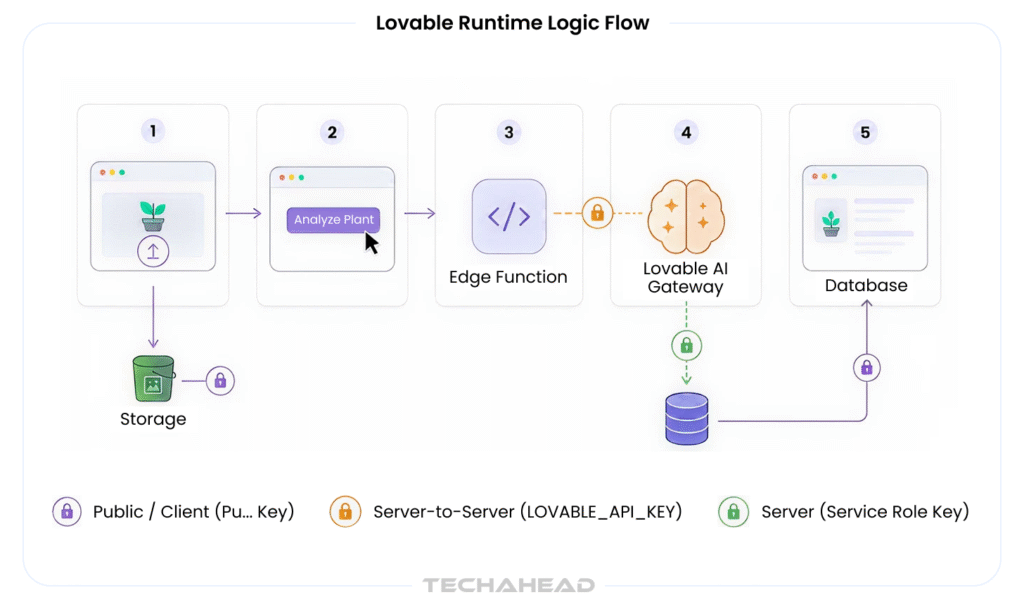
Lovable Runtime Logic Flow (Source: TechAhead AI Team)
Step 3: AI Gateway Call
The Edge Function calls the Lovable AI Gateway using LOVABLE_API_KEY. This secret never leaves the server. The client has no visibility into it at any point.
Step 4: Result Written to Database
The AI response is written to the database using the service-role secret key, again entirely server-side.
Step 5: Results Displayed to User
The browser reads the plant history directly from the database and renders the results to the user.
Lovable’s error handling is notably user-friendly compared to traditional development workflows. The recommended resolution path is: use the Try-to-fix option first (automatic resolution, no credit deduction).
If that fails, ask the agent to investigate by describing the observed behavior. If the issue persists, preview an older working version and revert. As a last resort, edit a past message and revert to explore an alternative approach. All changes remain in the chat history and can be reapplied at any point.
Lovable’s infrastructure layer is polyglot by design, drawing from multiple cloud providers and data infrastructure tools to balance performance, cost, and operational flexibility.
| Category | Technologies |
| Cloud Providers | GCP, AWS, Fly.io, Cloud Run, Modal |
| CDN and Edge | Cloudflare |
| Message Queues | Kafka, Pub/Sub, Kinesis |
| Data Warehousing | Snowflake, BigQuery, Redshift, ClickHouse |
| Orchestration | Apache Airflow, Dagster, Prefect |
| IaC | Terraform, Pulumi |
| Observability | Grafana, OpenTelemetry |
| CI/CD | GitHub Actions |
| Backend Languages | Go, Rust, Python, TypeScript |
Users have three deployment paths for their Lovable-generated applications. The first is Lovable’s own hosting with custom domain support. The second is GitHub export, which transfers the full codebase for version control, external backup, and engineering team involvement. The third is self-hosted production: the generated frontend can be built normally and deployed to any infrastructure, such as AWS S3 behind CloudFront, giving teams complete infrastructure ownership.
The 2026 enterprise tier introduces policy constraints via a LOVABLE.md file that defines what the AI agent can and cannot modify. A CI/CD pipeline layer blocks changes that violate those guidelines across infrastructure, pipeline configuration, and API clients.
An audit trail records all agent actions for compliance and traceability. Two-factor authentication, ISO 27001:2022, SOC 2 Type II, and GDPR compliance round out the enterprise governance posture.
Security in AI-generated applications is a legitimate concern. When the code is written by a model, the question of whether it is secure by default is non-trivial. Lovable addresses this at multiple levels.
Authentication is built in from the first prompt.
User signup, login, and role-based permission structures are generated automatically and are not optional add-ons. Row-level security ensures users can only access data that belongs to them without requiring developers to write custom access control logic.
API keys and secrets are stored in Lovable Cloud or Supabase secrets rather than hard-coded into source files. Two-factor authentication is available via authenticator apps or SMS. Private projects support viewer and editor permission levels.
| Standard | Status |
| ISO 27001:2022 | Certified |
| SOC 2 Type II | Certified |
| GDPR | Fully compliant |
| Third-party audits | Independent audits conducted |
The LOVABLE.md governance file is a particularly interesting design decision. It is a versioned, Git-committed rules file that specifies what the AI agent is permitted to modify.
This gives enterprise teams a policy-as-code layer that travels with the codebase rather than living in a separate dashboard. CI/CD validation runs these checks automatically during pull requests. Combined with full code ownership and GitHub export capability, this means there is no vendor lock-in on governance decisions either.
Lovable’s commercial trajectory is worth examining because it validates architectural decisions made at the infrastructure level, particularly the Supabase integration.
| Round | Date | Amount | Valuation | Lead Investors |
| Pre-Series A | Feb 2025 | $15M | NA | Creandum |
| Series A | Jul 2025 | $200M | $1.8B | Accel |
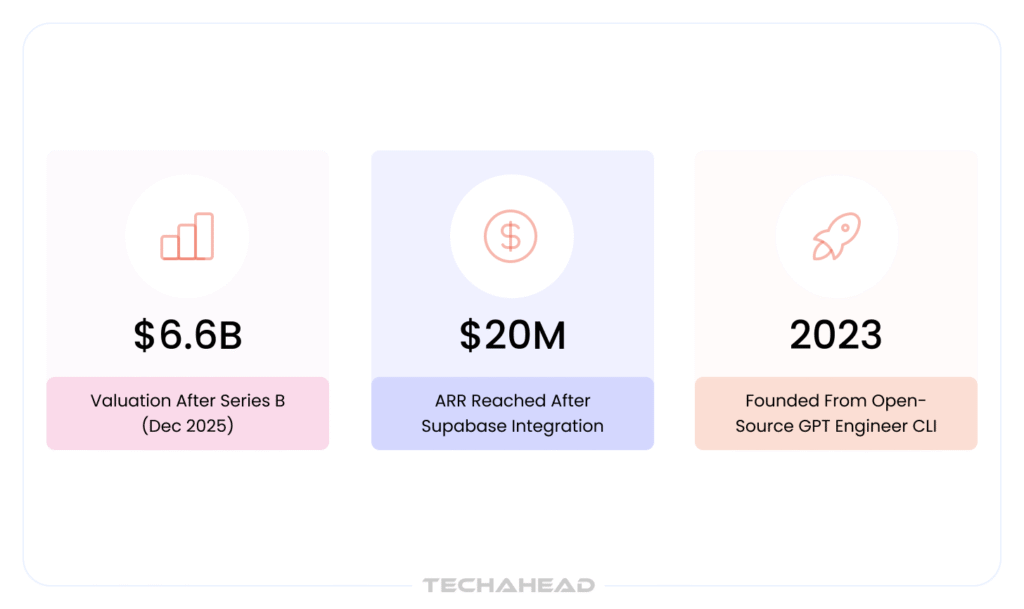
| Series B | Dec 2025 | $330M | $6.6B | CapitalG, Menlo Ventures |
The free tier covers up to $25/month in usage, which is sufficient for early development and prototyping. Paid plans follow usage-based billing as applications gain real users and traffic. Every plan includes Lovable AI, powered by Google Gemini, at no additional cost.
Enterprise plans are currently excluded from TanStack Start SSR and carry additional controls and governance tooling.
The growth numbers are notable: Lovable grew by over $1M ARR per week at its peak following the Supabase integration, scaling from under $500K to $20M ARR. That is a rate of growth that reflects product-market fit at the architecture level, not just the marketing level.
A technically honest assessment requires acknowledging where the platform falls short of production requirements without human oversight.
| Limitation | Description |
| Web-only output | No native mobile app development; output is mobile-responsive web, not native iOS or Android |
| No GitHub import | Cannot start a new project from an existing GitHub repository |
| Context window limits | The agent processes recent messages; users must include relevant context in each prompt rather than assuming persistent memory |
| Prompt-quality dependency | Generation quality varies directly with the clarity and specificity of task framing |
Human review remains mandatory for production deployments. Security posture, architectural soundness, and infrastructure cost still require qualified engineers to assess. Enterprise use cases need a governance layer that goes beyond what the platform provides out of the box.
Without good observability tooling, agent cycles that produce unexpected outputs are harder to debug systematically. And without GitHub export, the project lives inside Lovable’s platform, creating soft vendor lock-in that teams should plan around from the start.
The most significant technical direction for Lovable involves Model Context Protocol becoming a first-class integration standard rather than a custom engineering effort.
MCP is a standardized protocol that allows SaaS platforms to expose their resources, tools, and prompt surfaces in formats optimized for LLM consumption. Instead of Lovable building custom translation layers for each new backend service it wants to support, SaaS providers like Supabase expose MCP servers. Lovable’s agents consume those servers directly.
The benefits compound at scale: faster integrations across more backends, smarter agents that receive structured and high-quality context rather than scraped API documentation, and more powerful AI-to-AI automation chains between Lovable and the services it orchestrates.
The publicly stated roadmap includes deeper enterprise controls with policy constraints and controlled autonomy, accelerated backend integrations via MCP, enhanced SEO and AI search visibility with built-in Semrush-powered keyword research and llms.txt support, and a Lovable API (Build with URL) that allows programmatic application generation. That last item is particularly significant for development agencies: the ability to trigger Lovable’s generation pipeline programmatically opens the door to automated prototyping at scale.
“For development agencies: MCP-based programmatic generation represents a meaningful workflow shift. Teams that currently build early-stage prototypes manually could use Lovable’s API to generate baseline applications and then focus engineering capacity on differentiated functionality.”
Lovable is not a shortcut that produces disposable prototypes. It is a managed product assembly environment that generates production-credible full-stack applications, complete with real code, owned infrastructure, and a backend architecture that has been validated at commercial scale.
The strongest single architectural decision in Lovable’s stack is the Supabase integration with MCP orchestration. It transformed the platform from a frontend generator into a genuine full-stack development environment, and the $20M ARR growth that followed validates that decision with revenue data.
The hybrid model, AI-generated code that is also real, editable, exportable code, is what distinguishes Lovable from the generation of no-code tools before it. For non-technical users, it means full-stack applications in hours. For developers, it means a fast-path to a working codebase that can be taken over, extended, and deployed to any infrastructure.
The limitations are real but navigable: human review is still mandatory for production security and architecture, context management requires discipline, and the web-only scope rules out certain project types entirely. But for the use cases it covers, Lovable represents a genuine shift in what the first week of a product build looks like.
It is not just a tool. It is a platform that turns models into products.
Building a Product? Let’s Talk Architecture.
At TechAhead, we help startups and enterprises go from idea to production-ready applications.
Whether you want to evaluate AI-assisted development workflows, need a team to extend a Lovable-generated codebase, or are building something entirely custom, our engineers are ready to help.
No. Lovable builds mobile-responsive web apps only, not native iOS or Android.
You do. Every line can be exported to GitHub and modified freely.
Yes, with human review of security, architecture, and infrastructure before going live.
Secrets are stored server-side and never exposed to the browser at any point.
Lovable Cloud, a fully managed Postgres-backed backend with auth, storage, and edge functions.
We use cookies to ensure our website functions properly, improve performance, and provide a personalized experience. You can choose which types of cookies to allow below.
Required for core functionality such as security, network management, and accessibility. These cannot be disabled.
Help us understand site traffic and user interactions so we can improve performance and usability.
Enable enhanced functionality and personalization such as language or region preferences.
Used to deliver relevant ads, track campaign performance, and measure advertising effectiveness.