


 Copy Link
 Share on X
 Share on Facebook
 Share on LinkedIn
Always Active
Required for core functionality such as security, network management, and accessibility. These cannot be disabled.

Uncover the transformative potential of digital and mobile solutions for your industry.





 Last Updated: Sep 22, 2026
May 27, 2026
Last Updated: Sep 22, 2026
May 27, 2026  561
561  16 min. Read


Key Takeaways
Every successful software company starts with a monolith. That’s not a mistake; it’s pragmatism. Until the deploy pipeline slows, production incidents multiply, and 1,000 engineers start stepping on each other’s code simultaneously.
That’s the moment enterprises switch to microservices. Not because of architectural ambition. Because the monolith pain exceeds the migration cost.
The market reflects this decisively. The global microservices architecture market reached $7.4 billion in 2025 and is projected to reach $18.7 billion by 2035 — growing at a 20–21% CAGR. The cloud microservices market alone is heading toward $11.36 billion by 2033.
Airbnb’s migration is the most instructive case study in this space; not because they moved fastest, but because they chose SOA deliberately over pure microservices, solved the right problem, and documented what broke along the way. In this blog, we breakdown Airbnb’s migration; architectural decisions, organizational lessons; all mapped out before you start yours.
Airbnb operated on a monolithic architecture from its inception in 2008 until around 2017. They used a Ruby on Rails monolith that the engineering team affectionately called the “Monorail.” And for most of those nine years, it worked exactly as intended.
That is the part of this story most engineering blogs skip over. The monolith was not a mistake. It was a deliberate, correct architectural choice for a company that needed to move fast, iterate constantly, and ship features before competitors caught up. Search, payment systems, and fraud prevention all lived in the same codebase, and for a small, fast-moving team, that meant features could be built, tested, and deployed by a single engineer without coordination overhead.
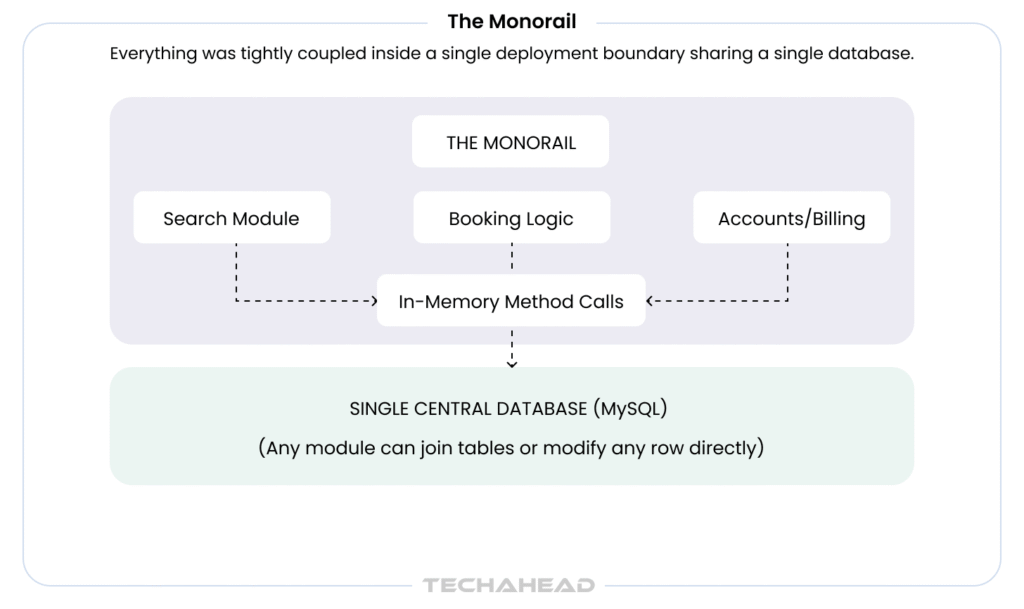
Most engineers were full stack and could work on every part of the codebase, executing end-to-end features by themselves. Features could be completed within a single team, which helped the company build new products very quickly.
The monolith was also simpler to operate. Single deployment pipeline. Unified monitoring. Monoliths are easy to get started with and easier to build, develop, monitor, and deploy. Building new features generally requires lower overhead and it is easier to onboard new hires.
The problems did not start until the scale did. Once Airbnb’s engineering team grew past 100 engineers, they started experiencing frequent, painful backlogs in the Monorail deploy chain. By the time the org grew from 200 engineers in 2015 toward 1,000, the exact same architecture that made a team of 20 productive was actively working against them.
So, the monolith did not fail because it was poorly built. It failed because it succeeded, and success at Airbnb’s scale eventually outgrew what any monolith was designed to support.
The decision was not driven by architectural ambition. It was driven by engineering pain that had become operationally unsustainable. By the time Airbnb committed to migration, the Monorail had stopped being an asset and started being the single biggest drag on engineering productivity across the entire organization.
Airbnb engineers were delayed from deploying their code to production on average 15 hours each week due to reverts and rollbacks. Fifteen hours. Per engineer. Per week. For an organization of 1,000 engineers, that is not a productivity problem; it is a structural crisis.
The short answer for why Airbnb migrated is for the people. Airbnb’s engineering team was growing rapidly, often doubling year over year; and they needed an architecture that could move quickly and grow with their team.
Airbnb committed to freezing feature development in the monolith in 2019, a decision that forced the migration from a theoretical priority to a concrete engineering commitment with a real deadline.
Without that decision, the migration would have continued to be deferred in favor of shipping features. The monolith would have continued to slow. And the 15-hour weekly deployment tax would have kept compounding.
The decision to migrate was not about chasing microservices as an architectural trend. It was about a 1,000-person engineering organization that had outgrown the infrastructure it was running on and needed to rebuild it without stopping the business.
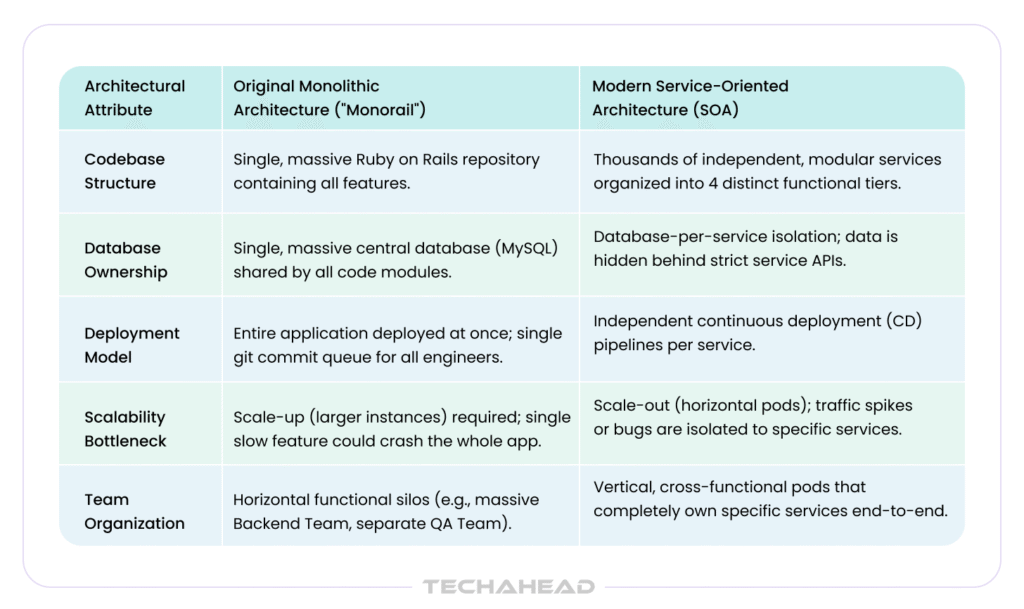
Airbnb’s redesign to SOA was a long journey that benefited from an iterative approach; executed while still shipping new features, accelerating developer velocity. That constraint; migrate without stopping the business shaped every strategic decision that followed.
The first strategic decision was the architecture target itself. Airbnb did not pursue pure microservices; they chose Service-Oriented Architecture, a deliberate choice that distinguished their approach from the Netflix model most engineers reference when discussing this type of migration.
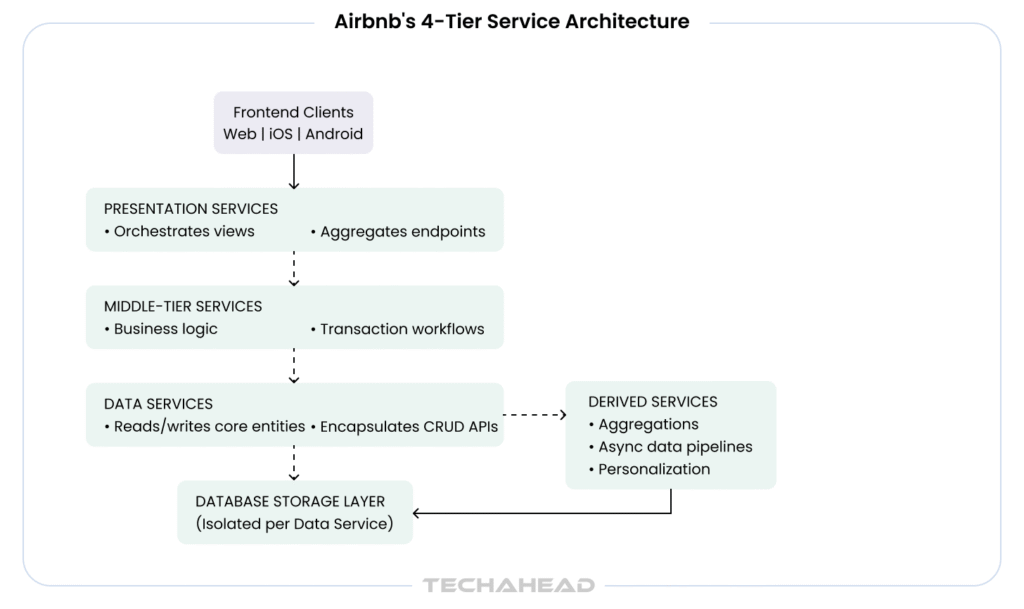
In an SOA model, services are shared and reused enterprise-wide, whereas a microservices architecture is built on individual services that function independently. Airbnb chose SOA as it made more sense for their specific organizational needs. They eventually structured their services into four distinct tiers to handle the scale, which moves past a generic SOA description:
SOA encourages larger, business-focused services rather than the tiny, granular microservices that create coordination overhead without delivering equivalent value.
Airbnb specifically wanted to avoid taking their monolith and switching to really tiny granular microservices; they wanted services to be larger and focus on business functionality without duplicating that functionality across multiple services.
Learn More,
How much does vacation rental app like Airbnb development cost?
Before migrating anything, Airbnb established non-negotiable design principles that every new service had to follow. This prevented the most common migration failure mode: decomposing a monolith into a distributed monolith where all the old coupling problems persist, just across network boundaries instead of function calls.
Each service should own both the reads and writes to its own data, meaning if another service needed particular data, they had to go through the owning service’s API. Services should also address a specific concern and avoid duplicate functionality.
This is the engineering decision that made Airbnb’s migration technically credible. Rather than switching traffic to new services and hoping they worked correctly, Airbnb managed migration complexity by phasing it. They take 1% of load on the new service, comparing results against the Monorail, and progressively increasing load until comparison was clean against 100% of traffic.
For read operations this was relatively simple. For write comparisons, Airbnb had the new service write to a shadow database, then issued a read request to both the production database and the shadow one.
This shadow database approach is one of the most technically rigorous migration validation strategies in documented enterprise architecture history.
Airbnb followed best practices by auto-generating boilerplate code using Apache Thrift; an open-source framework that auto-generates code in multiple languages. At 1,000 engineers, manual standardization is an ‘organizational fantasy’. Auto-generation is one of the decisions that separated Airbnb’s migration from the distributed monolith trap and later many organizations follow the same method.
Airbnb committed to freezing feature development in the monolith in 2019. That single decision converted migration from a theoretical priority into a concrete engineering commitment with a real deadline. Without it, the migration would have continued competing with feature development indefinitely. The monolith would have kept growing. And the 15-hour weekly deployment tax would have kept compounding across an engineering organization that was doubling year over year.
Airbnb’s migration story resonates deeply with the enterprise modernization work TechAhead has delivered for clients where legacy systems accumulated over years of rapid growth had to be restructured without disrupting live operations.
For American Express, data architecture that had never been designed to support modern API consumption required the same incremental, comparison-based migration discipline Airbnb applied; validating new architecture against existing behavior before switching traffic.
The lesson that transfers most directly from Airbnb’s experience to every enterprise modernization engagement TechAhead handles: freeze the old system, define your service boundaries before you build, and validate every migration step with real traffic comparison before you commit.
The organizations that skip those three steps are the ones that end up with distributed monoliths; and the organizations that follow them are the ones that end up with scalable architecture.
Moving from a monolith to SOA was also an organizational transformation. Here is how Airbnb restructured around service ownership:
Airbnb’s migration is one of the most documented, most referenced enterprise architecture transformations in modern software engineering history. Here are the ten lessons that you should consider while considering the same journey:
This is the lesson most engineering teams resist; usually Airbnb operated on a single Rails monolith for a decade before migrating. They only made the migration to SOA after it was getting really painful to continue development on the monolith. The monolith was a strategic approach; it was the right architecture until it was not.
Airbnb’s four service categories: data fetching, business logic, workflow orchestration, and UI aggregation were defined before migration began. The enterprises that skip this step end up with a distributed monolith: all the operational complexity of microservices with none of the ownership clarity.
Airbnb migrated functionality incrementally using a dual read comparison approach; it means taking 1% of load on the new service, comparing results against the Monorail, and progressively increasing traffic until comparison was clean against 100% of load. No enterprise migration that skips incremental validation survives contact with production traffic. The big bang migration often leads to the most expensive rollbacks.
The shadow database approach Airbnb used for write validation (writing to a shadow database simultaneously with production and comparing results before switching traffic) is one of the most rigorous migration validation strategies documented. However, it is expensive to build, but generally it becomes less expensive if compared to a data corruption incident discovered after the traffic switch.
Airbnb committed to freezing feature development in the monolith in 2019 because even though everyone was committed to the importance of SOA, without a hard freeze date, every sprint has a legitimate reason to defer migration in favor of feature delivery.
Airbnb built common infrastructure shared by teams across services; they allow all Airbnb services to define clean APIs and communicate with each other. The framework handled inter-service communication, error propagation, observability metrics, and schema validation, so engineers could focus on implementing core business logic. The enterprises that skip shared tooling investment end up with 200 services that each handle inter-service communication differently.
The monolith’s ownership ambiguity was one of its core operational failures. Airbnb’s fix was structural and non-negotiable; one owning team per service, with designated engineers accountable for every service they own. Improving clarity and boundaries for ownership increased efficiency and helped teams execute more effectively on product.
This is the most counterintuitive lesson from Airbnb’s migration, and the most important. Microservices are more for scaling organizations than applications. The technical benefits are real. However, the primary driver for Airbnb’s migration was enabling 1,000 engineers to ship independently without stepping on each other.
Airbnb’s migration delivered outcomes that showed up where it mattered most: in production. Page load times improved up to 10x. Rollback-driven downtime dropped significantly. Developer productivity, build cycles, deploy frequency, site reliability, and latency all improved measurably across the engineering organization. The lesson is not that microservices are faster. It is that the right migration strategy compounds performance gains that a monolith simply cannot deliver.
Most enterprises use the terms interchangeably and build the wrong architecture as a result. In an SOA model, services are shared and reused enterprise-wide but a microservices architecture is built on individual services that function independently. Airbnb chose SOA deliberately because shared, reusable business-focused services served their organizational needs better than the granular, independent microservices that Netflix popularized. The right choice depends on your team size, ownership model, and reuse requirements.
Most importantly, it happened because Airbnb defined what success looked like before migration began and measured against it. It means, as an enterprise owner, if you migrate without defined success metrics (“don’t know whether they succeeded”), the migration just seems expensive.
Three companies. Three monolith problems. Three migration strategies. And three completely different architectural outcomes; each shaped by the specific scale, organizational structure, and operational requirements that drove the migration decision. Understanding how Airbnb, Netflix, and Uber approached the same fundamental problem differently is the most practical reference framework any enterprise team can have before committing to a migration strategy of their own.
Reading about Airbnb’s migration is one thing, but applying those lessons inside a live enterprise environment is different; it is where most modernization programs succeed or fail.
At TechAhead, Airbnb’s most transferable lesson shows up in every modernization engagement we run. For example, when modernizing JLL’s Intellicommand platform, discovery revealed building management system dependencies and data ownership boundaries that had accumulated organically over years without clear structure. Exactly the same condition that made Airbnb’s Monorail unmaintainable. Drawing those boundaries in discovery (not mid-build) kept the project on track.
For Lafarge’s construction platform, legacy infrastructure that had never been designed for API consumption required the same incremental extraction discipline Airbnb documented; shadow validation before traffic switching, service boundary definition before code. The outcome: 40% increase in enquiries and 80% reduction in GPS errors came from months of careful incremental work, not a big-bang architectural replacement.
We believe successful modernization is not about the architecture designed; it is actually about the discipline maintained across every decision that follows.
Airbnb’s migration is the most honest, most documented enterprise microservices architecture transformation in modern software engineering history. The lessons are clear: migrate only when the pain is real, define boundaries before building, validate incrementally, plan for the problems your migration creates before you solve the ones it fixes. Most enterprises read the headline and miss the operational detail that made it actually work.
Architecture decisions made in week one shape your system for the next five years. Make them with engineers who have done this before. TechAhead has applied these lessons across enterprise modernization engagements for JLL, AXA, Lafarge, and other Fortune 500 clients; SOC 2 Type II & ISO 42001 certified, Claude & OpenAI Services Partner, and AWS partner with 16+ years of enterprise delivery experience behind every architecture recommendation we make.
Start with the highest-pain, lowest-dependency components; the parts causing the most deployment friction with the fewest connections to the rest of the codebase. At TechAhead, our discovery framework maps each monolith component against two axes: business value delivered and coupling complexity. High value, low coupling extracts first. High coupling components wait until their dependencies are resolved.
In a monolith, security lives at the perimeter; one authentication layer, one authorization check, one network boundary. In microservices, every service is a potential attack surface. Security must move inside the architecture: service-to-service authentication, encrypted inter-service communication, per-service access controls, and audit logging at every boundary. At TechAhead, our SOC 2 Type II certified delivery framework treats microservices security as an architectural standard, not a perimeter feature retrofitted after services are deployed.
Zero-trust means no service, user, or network connection is trusted by default; every request is authenticated and authorized regardless of origin. In microservices, it means mutual TLS between services, short-lived credentials, least-privilege access policies, and continuous verification at every service boundary. For enterprise microservices deployments, zero-trust is the security model that prevents a compromised service from moving laterally across your entire architecture without detection.
A realistic enterprise migration ranges from $200,000 for a focused single-application extraction to $2,000,000+ for a full platform decomposition with compliance controls, legacy integration remediation, and organizational restructuring. The variables that move that number most are data complexity, legacy documentation quality, and compliance requirements.
We use cookies to ensure our website functions properly, improve performance, and provide a personalized experience. You can choose which types of cookies to allow below.
Required for core functionality such as security, network management, and accessibility. These cannot be disabled.
Help us understand site traffic and user interactions so we can improve performance and usability.
Enable enhanced functionality and personalization such as language or region preferences.
Used to deliver relevant ads, track campaign performance, and measure advertising effectiveness.