


 Copy Link
 Share on X
 Share on Facebook
 Share on LinkedIn


Always Active
Required for core functionality such as security, network management, and accessibility. These cannot be disabled.

Uncover the transformative potential of digital and mobile solutions for your industry.





 Last Updated: Sep 18, 2026
Jun 17, 2026
Last Updated: Sep 18, 2026
Jun 17, 2026  763
763  20 min. Read



Key Takeaways
Picture this: A shopper is scrolling through Instagram and spots a striking mid-century armchair at a friend’s apartment. They love it: The silhouette, the fabric, the tapered wooden legs.
They open their favourite e-commerce app and type: “modern gray armchair, wooden legs, fabric upholstery.” The search returns 400 results. Half are wrong. A quarter are out of stock. The shopper gives up, closes the app, and the sale dies.
Now rewind. Same shopper. Same armchair. This time, they tap the camera icon in the app, snap a photo, and in under three seconds, the AI surfaces five near-identical products, a “shop the look” bundle with a complementary rug and floor lamp, and an AR preview that lets them drop the chair into their living room before buying. One tap to cart. Purchase complete.
This is not a prototype. This is AI-powered visual search, and it is already running at scale across the world’s most competitive e-commerce platforms.
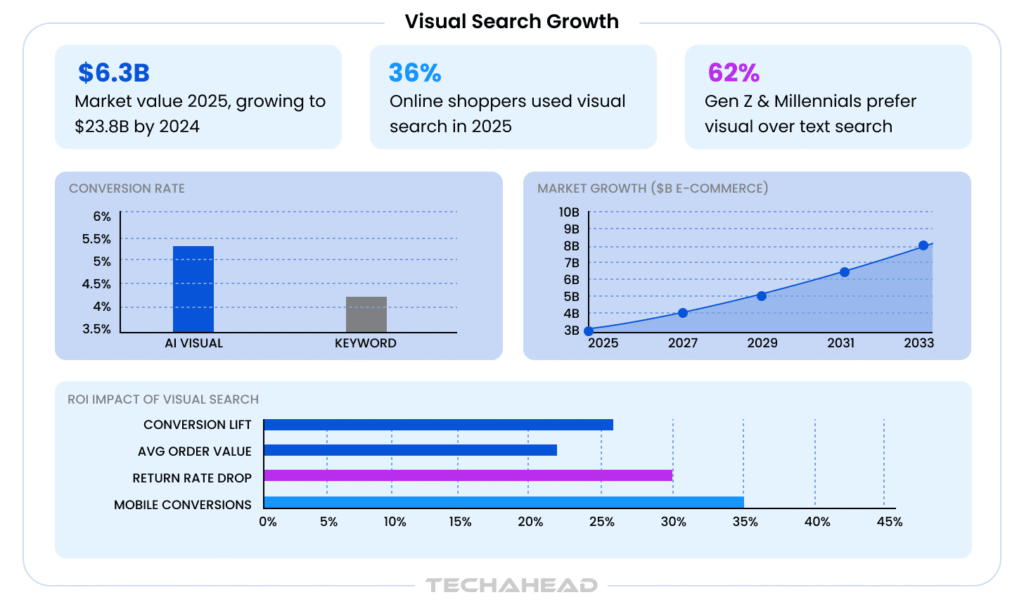
The numbers validate the urgency. According to market research, the global visual search market was valued at $6.3 billion in 2025 and is projected to reach $23.8 billion by 2034, growing at a CAGR of 17.8%. Within e-commerce specifically, the segment was worth $3.06 billion in 2025 and is on a trajectory toward $10 billion by 2035 at a 12.6% CAGR. And critically, 36% of online shoppers had already used visual search by 2025, a figure climbing fast as Gen Z and Millennial consumers increasingly expect their shopping apps to speak the language of images, not text.
For brands and developers building mobile-first shopping experiences, the message is unambiguous: AI visual search is no longer a premium feature. It is the new baseline for competitive product discovery. Working with an experienced AI development company helps retailers turn this capability into a fast, accurate, and scalable product-discovery experience.
Let’s break down exactly how it works, what it delivers, and how to build it right.
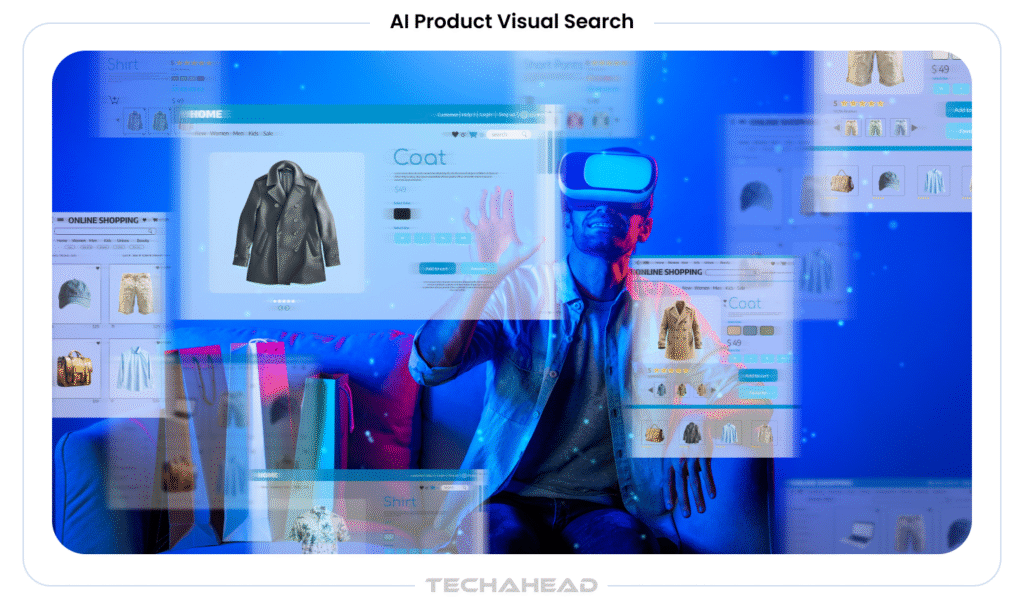
E-commerce visual search is an AI-driven product discovery method that allows consumers to use a photo, screenshot, or real-time camera feed as a search query instead of text. Instead of typing “navy blue suede Chelsea boot with stacked heel,” the shopper uploads a photo of the exact boot they spotted on someone at a café. The AI interprets the image, identifies the key visual attributes: Colour, material, sole shape, silhouette, and surfaces matching or similar products from the catalogue.
This is fundamentally different from legacy “search by image” plugins, which typically performed pixel-matching against a static database. Modern AI visual search goes far deeper. It recognises patterns, shapes, textures, fabrics, and stylistic nuances that no keyword string could reliably capture. It understands aesthetic intent, not just visual content.
A shopper uploading a photo of a boho-style pendant lamp might be served other boho lighting options even if none of them share the same exact shape, because the AI has learned to match style registers, not just visual properties.
The core problem it solves is what practitioners call the vocabulary gap: customers have visual inspiration but lack the words to convert it into a search query. This gap is most acute in fashion, furniture, beauty, jewellery, and home décor, categories where customers are highly inspired by what they see online and offline, but often cannot articulate what they want in the structured language that keyword search demands.
The evolution from pixel-matching to multimodal AI has been rapid. Today’s visual search engines combine computer vision, deep learning, natural language processing, and semantic vector representations to understand what a customer means, not just what pixels are in their image.
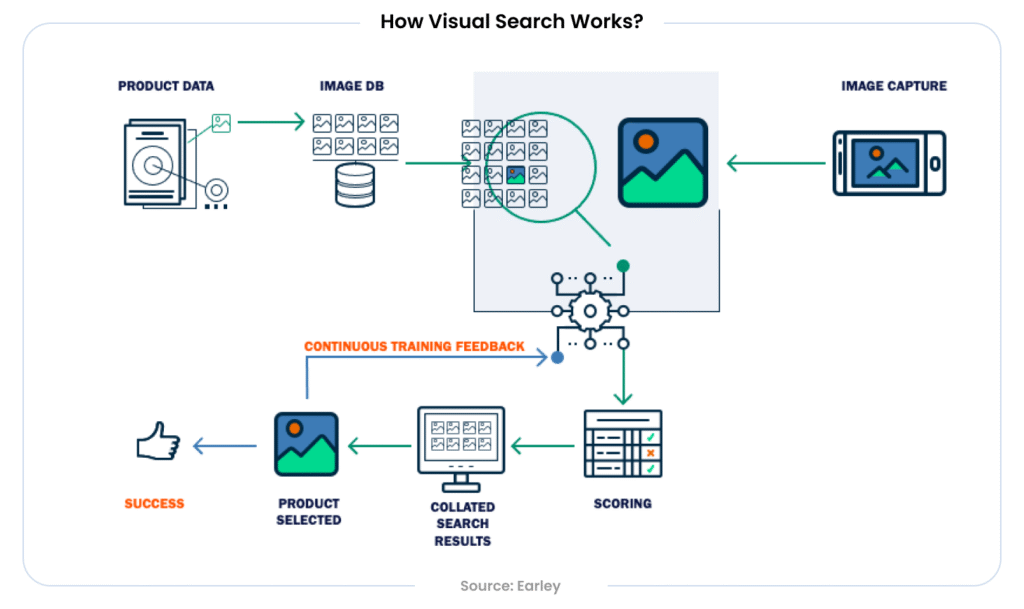
When a shopper uploads a photo, what actually happens in the 1.8 seconds before relevant products appear on screen? The answer involves a layered technology stack that is more sophisticated than most people realise.
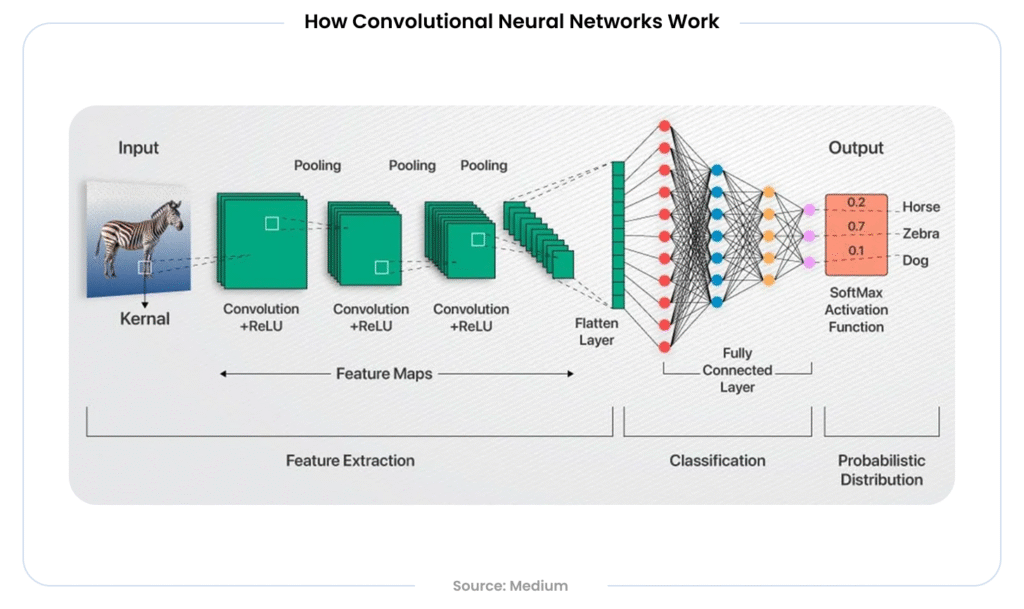
At the foundation sits computer vision, the discipline of training machines to interpret and understand visual content the way humans do. Modern visual search systems use Convolutional Neural Networks (CNNs), a class of deep learning architecture specifically designed to detect and classify spatial hierarchies in images. A CNN trained on fashion product images, for example, learns to detect edges, textures, patterns, and compositional features across multiple layers of abstraction: from raw pixel data at the input layer to high-level semantic concepts (sleeve length, collar type, heel height) at the output.
1. Pixel-to-Product Matching The AI analyses an uploaded photo to identify specific attributes such as shape, colour, texture, and maps those attributes to exact or similar matches in your product catalogue. This works even when the uploaded image is imperfect: taken in low light, at an angle, or partially obscured.
2. Visual Attribute Recognition Instead of relying on text metadata, the system sees details that are genuinely unsearchable: a particular Aztec weave pattern in a throw blanket, the precise silhouette of a mid-century credenza, or the subtle difference between a straight-leg and a wide-leg trouser cut. This capability alone eliminates the most common cause of zero-result searches in apparel and home retail.
3. Multi-Object Detection Advanced visual AI can deconstruct a lifestyle image and search for multiple items simultaneously. A single shot of a styled living room, sofa, coffee table, floor lamp, cushions, rug, can trigger five separate product searches in parallel, with results surfaced in a “shop this room” layout. This is one of the highest-value applications for furniture and interior retail, driving significant cross-sell revenue.
4. Real-Time Camera Search The most frictionless version of visual search: no upload needed. The shopper points their phone camera at a physical object, a pair of trainers, a planter, a dining chair at a restaurant, and the system identifies and surfaces matching products in real time. This is the “snap and shop” experience that Gen Z consumers increasingly expect as the default.
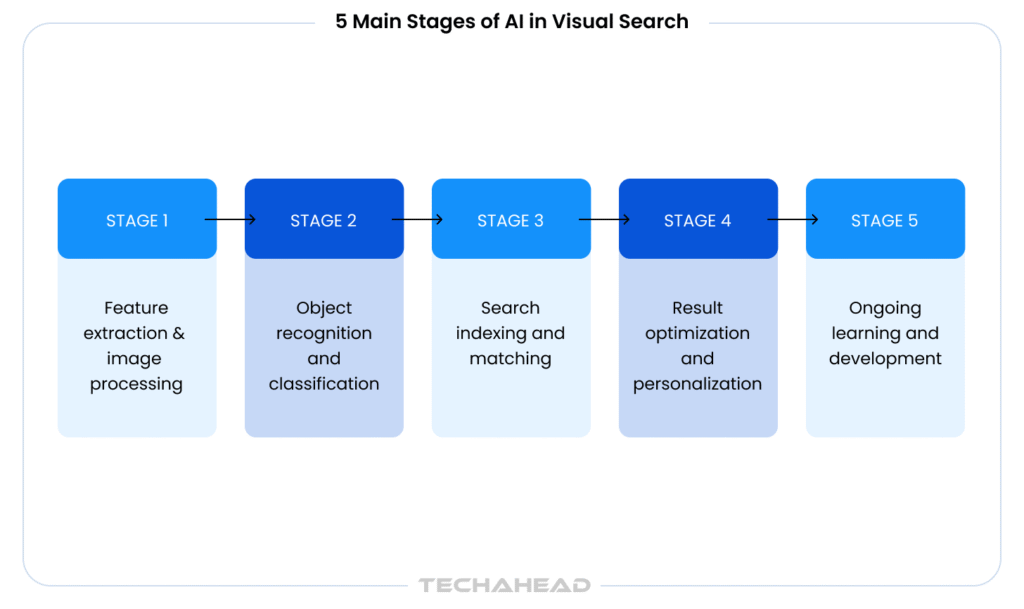
Under the hood, the core mechanism works like this:
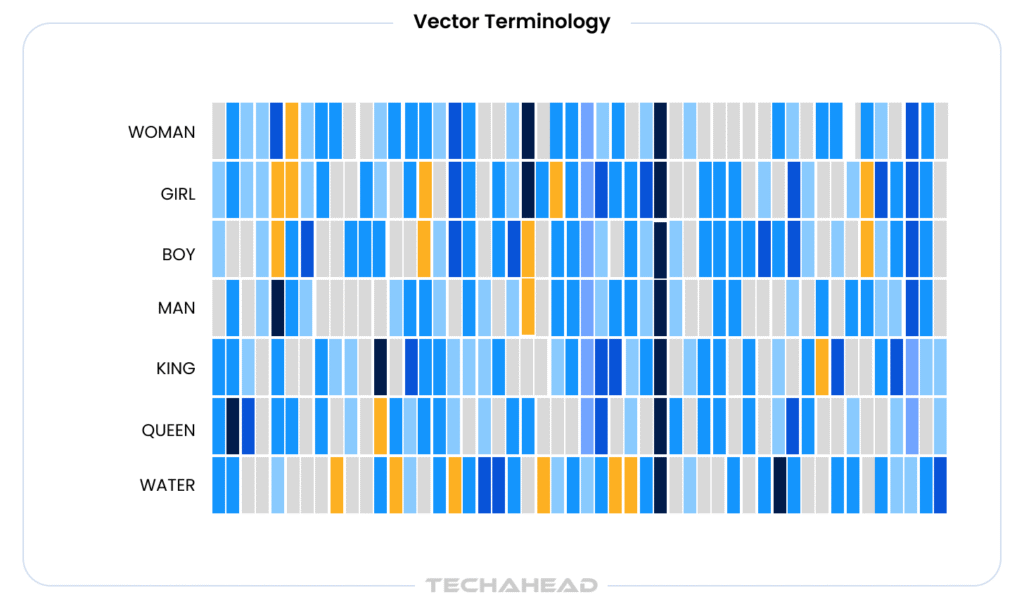
This vector-based approach is why modern visual search can match a black-and-white photo of a vase to a powder-blue ceramic option from your catalogue: the style register, proportions, and silhouette are semantically similar even when the colours differ.
The whole process delivers results in under two to three seconds, fast enough to maintain the engagement threshold that mobile shoppers demand.
The frontier of visual search is multimodal AI: systems that blend image inputs with text, voice, and even video into a unified understanding. A shopper might upload a photo and add text context (“show me something similar but in green, under £150”), and the AI processes both signals simultaneously to refine results. Dynamic Yield describes this as a shift from matching what’s in a photo to understanding what a customer means with it, a move from visual recognition to genuine intent recognition.
The business case for AI visual search is no longer theoretical. The data across conversion, revenue, and operational metrics is compelling.
| Metric | Result | Source |
| Conversion rate (AI visual search) | 5.2% vs 4.1% (standard keyword) | EasyApps Ecom, 2026 |
| Revenue per search | $2.80 vs $2.10 (standard) | EasyApps Ecom, 2026 |
| Conversion rate lift vs traditional search | ~26% higher | Laconica, 2026 |
| Gen Z/Millennial preference for visual search | 62% prefer it over any other new shopping tech | Experro / AMZScout, 2026 |
| Online shoppers using visual search (2025) | 36% | Laconica, 2026 |
| Global visual search growth | 70% increase globally | Anchor Group, 2025 |
| Amazon visual searches via Google Lens | 4 billion per month | Anchor Group, 2025 |
| Average Order Value boost | 20–25% increase | Industry estimates |
| Return rate reduction (with AR + visual search) | 20–40% decrease | Industry estimates |
The visual search market overall was valued at $6.3 billion in 2025 and is projected to grow at a 17.8% CAGR to reach $23.8 billion by 2034. E-commerce commands 32.5% of that market, approximately $2.05 billion in 2025 alone. The e-commerce-specific segment is on its own trajectory: from $3.06 billion in 2025 to an estimated $10 billion by 2035, growing at 12.6% annually.
Gartner has predicted that 30% of major e-commerce brands would integrate visual search by 2025, and given adoption rates, many are already past that threshold.

AI visual search is not a generic capability. Its impact is most transformative in categories where visual attributes are the primary driver of purchase decisions, where customers buy with their eyes long before they buy with their wallets.
| Industry | How Visual Search Works | Key Business Benefits |
| Fashion & Apparel | Upload outfit photos, screenshots from Instagram/Pinterest; AI matches shape, texture, pattern, colour, silhouette | Style discovery, complete-outfit cross-selling, reducing guess-buying and returns |
| Furniture & Home Décor | Photo of a room → finds similar furniture; AR previews placement in shopper’s actual space | Reduces returns by up to 40%, drives 35% higher engagement, shortens consideration cycle |
| Jewellery | Search specific designs, gemstone cuts, metal finishes through image queries | Surfaces unique pieces that text search cannot describe; drives higher-value purchases |
| Beauty & Skincare | Scan product packaging or influencer photos to find lipstick shades, foundation matches | Seamless inspiration-to-checkout path; enables virtual try-on via AR integration |
| Lifestyle & Accessories | Aesthetic and style coherence matters more than brand name | Captures the nuance and “feel” that keyword search consistently fails to express |
| Niche & Artisanal Retail | Unique product lines with no standard naming conventions | Visual search surfaces products that metadata alone would never surface |
Levi’s Jeans has used visual search to position itself as a leader in denim discovery, allowing shoppers to find specific washes, fits, and silhouettes through image queries rather than highly specific keyword strings.
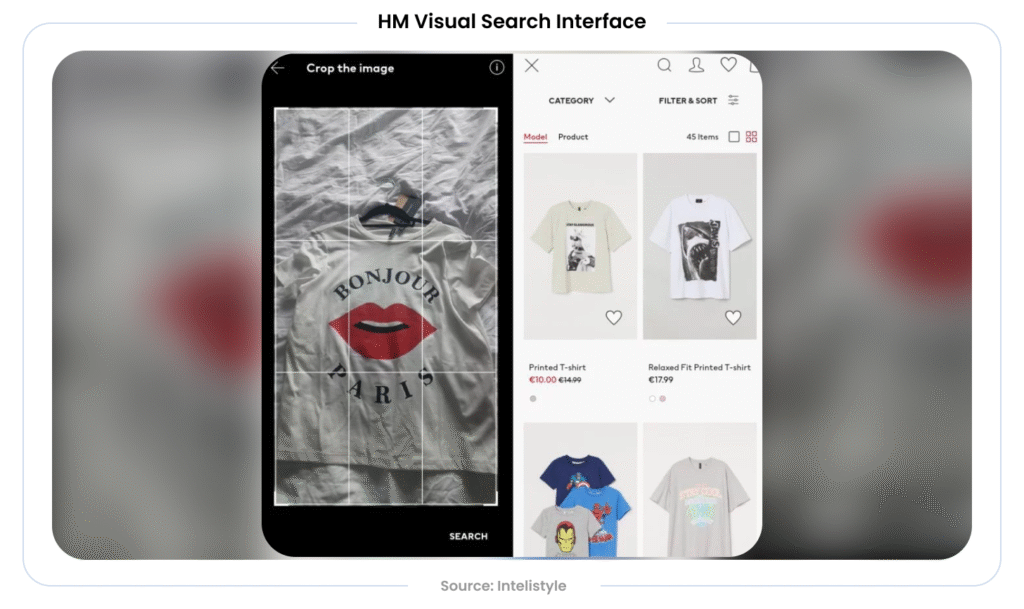
H&M integrated visual search into its app so shoppers can upload photos or screenshots, from street style, social media, or real life, and find matching items from H&M’s catalogue or stylistically similar alternatives.
Flipkart, one of India’s largest e-commerce platforms, implemented image search for fashion, enabling discovery by colour, pattern, and style match, a significant advantage in a market where consumers discover fashion heavily through social media and Bollywood content.
Shein has built one of the most aggressive visual search implementations in fast fashion, allowing customers to search by uploading any image and receiving a ranked list of visually similar products from its enormous catalogue.
The pattern across all these brands is consistent: visual attributes matter more than names or technical descriptions in the categories where they operate. The keyword vocabulary gap is not a niche problem, it is the default state of most shopping intent.
Many brands still frame visual search as a “nice-to-have” feature for a future roadmap. That framing is expensive. The absence of visual search is not neutral, it is actively costing revenue through five compounding mechanisms.
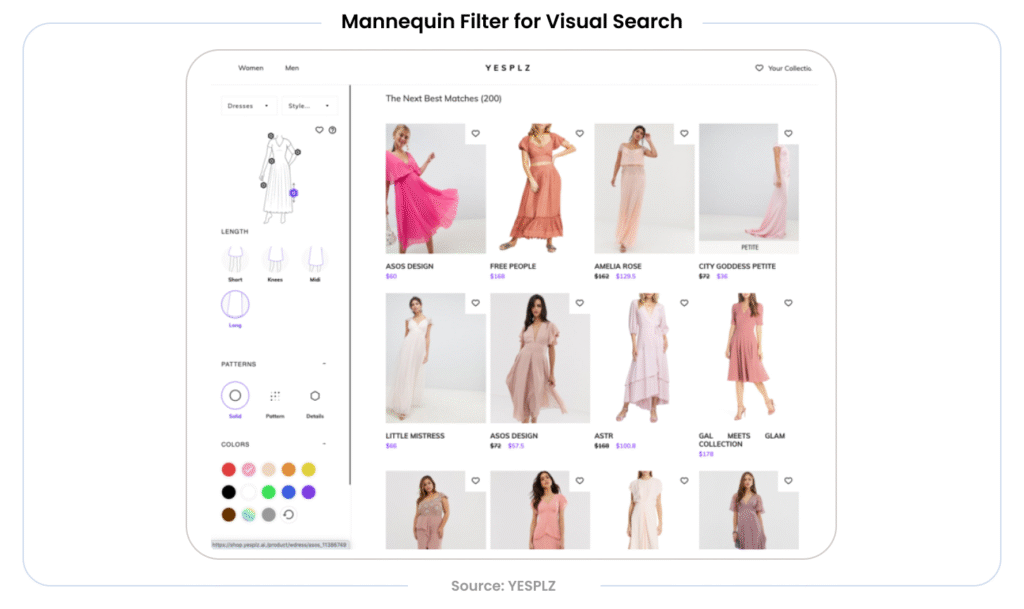
Traditional keyword search breaks down on vague descriptions and visual concepts that don’t translate to text. When shoppers type a description that returns no usable results, most leave immediately rather than reformulating their query. Frustrated shoppers abandon the session rather than retry.
Typing a precise product description on a smartphone keyboard is high-friction by nature. For the Gen Z and Millennial shoppers who now generate the majority of mobile commerce traffic, a “snap and shop” interaction is the expected standard. Forcing them to type is like forcing them to call a customer service number; they won’t.
Customers who don’t know the term “scalloped hem,” “tapered leg,” or “travertine finish” cannot find products that match those descriptions through text search. The result is that your most distinctive, visually striking inventory, precisely the products most likely to delight and convert , becomes effectively invisible to the shoppers most likely to buy it.
Without visual AI to surface “visually similar” products and “shop the look” bundles, cross-sell and upsell opportunities go untriggered. Style-based recommendation is one of the highest-AOV mechanisms in e-commerce, and it only works when the AI understands aesthetic relationships between products, something text search and rule-based recommendation engines fundamentally cannot do.
Text-based search leads to guess-buying: shoppers purchase based on an imperfect mental model of what the product looks like. When the item arrives and does not match their visual expectation, it gets returned. Visual search closes the perception gap before the purchase, which is why brands deploying it report 20-40% return rate reductions. At scale, that is significant operational cost saving.
The bottom line: visual search is no longer a competitive differentiator. For fashion, furniture, beauty, and accessories, it has become the baseline expectation. Brands without it are not standing still, they are falling behind.
Experienced ecommerce development companies can help retailers assess catalogue readiness, choose the right visual-search architecture, and integrate the feature with existing storefront, inventory, and analytics systems.
Knowing visual search drives results and actually deploying it at scale are different problems. Here are the five practices that separate high-performing visual search implementations from underwhelming ones.
A visual search system that only works on high-resolution, well-lit product shots will fail in the hands of real shoppers. Users upload blurry screenshots from Instagram Stories, grainy photos taken at dim restaurants, and cropped images with partial product visibility.

Your implementation must handle the full range of real-world input quality, from 480p screenshots to 4K camera captures, with consistent accuracy. AI-driven image pre-processing pipelines that normalise input before passing it to the matching model are essential for production reliability.
Research consistently shows that e-commerce engagement drops sharply when search results take longer than two seconds to load. For visual search, where the shopper is in an active moment of inspiration and intent, latency is particularly damaging. Optimise your vector index, use efficient nearest-neighbour algorithms (HNSW or FAISS), and cache popular visual query vectors to ensure consistent sub-2-second response times at scale.
Shoppers reach inspiration through multiple channels: phone cameras, Instagram screenshots, Pinterest saves, TikTok captures, and magazine scans. Your visual search implementation should accept all of these and convert each one into a purchase opportunity. The most high-value use case is often the screenshot, a shopper saw a product somewhere else and wants to find your version of it. Capturing that intent is pure incremental revenue.
Visual search improves with use, but only if you architect for it. Track which products shoppers click on after a visual query, which they purchase, and which they skip. Use this behavioural data to continuously fine-tune your embedding model and ranking logic. A visual search system deployed and forgotten will degrade in relevance as your catalogue grows; one with active machine learning feedback loops gets smarter every day.
Visual search is only as good as the product data it queries against. Poor-quality product images, inconsistent backgrounds, bad lighting, and missing angles directly reduce match accuracy. Invest in AI-driven image processing to standardise your catalogue images, and ensure your product metadata is structured to complement (not substitute for) visual matching.
Consistent image quality, multiple angles, and accurate attribute labelling create the foundation on which high-accuracy visual search is built.
| Challenge | Recommended Solution |
| Low-quality or inconsistent catalogue images | AI-driven image processing pipeline for standardisation |
| Complex real-world image backgrounds | Advanced segmentation models that isolate the primary product |
| Lighting and angle variation in user uploads | Train visual models on diverse, real-world image datasets |
| Managing a large and frequently updated catalogue | Efficient vector database with incremental index updates |
| Integration with existing search infrastructure | API-first architecture; most leading providers (ViSenze, Google Vision API, AWS Rekognition) offer minimal-dependency integration |
| User privacy for uploaded images | Secure ephemeral processing; do not store user images beyond the query session |
For most e-commerce platforms, an MVP visual search integration can be deployed in four to eight weeks using API-first architecture, with no fundamental re-engineering of existing infrastructure. Advanced capabilities, AR room previews, multi-object detection, personalised ranking, add four to twelve additional weeks depending on scope.
The dominant vendor options provide pre-trained models that require only catalogue-specific fine-tuning, which dramatically reduces time-to-value compared to building from scratch.
Visual search technology is not static. The trajectory from the current state to where it is heading in the next three to five years is significant enough to factor into product roadmaps today.
The next generation of visual search is multimodal by design, systems that process images, text, voice, and video simultaneously as a unified query. A shopper will be able to upload a photo of a sofa, say “show me this in a darker fabric under $800,” and receive results that honour all three constraints: the visual reference, the spoken modification, and the price filter.
This collapses the gap between inspiration and specification into a single conversational interaction.
Dynamic Yield describes this evolution as moving from visual recognition to visual intent recognition, the AI understands not just what is in the image but what the customer wants from it, contextualised by their history, location, and session behaviour.
Mobile hardware improvements are enabling always-on visual search through the camera feed, no tap to capture required. A shopper walking through a store or watching a video will be able to hold their phone up to any object and receive instant product matches. This is already prototyped in Google Lens and will increasingly be the baseline expectation in retail mobile apps.
AI visual search systems are moving toward understanding aesthetic registers beyond individual products. A shopper’s uploaded image of a “dark academic” bedroom will eventually surface not just similar furniture but an entire curated collection matching the aesthetic mood, candles, textiles, artwork, and accessories that belong together in that aesthetic world.
This is closer to the personalised stylist experience than anything a keyword search can approximate.
The most commercially powerful near-term trend is the convergence of visual search with AR. Retailers who have integrated both report that shoppers using AR features to preview products in their own space are significantly more likely to purchase and significantly less likely to return.
Data consistently shows that retailers with AR and 3D/visual elements achieve 94% higher conversion rates than those without. As mobile AR performance improves and the friction of accessing AR falls, the combination of visual search (find it) and AR (try it) becomes a seamless discovery-to-confidence pipeline.
The numbers reinforce investment urgency. The e-commerce visual search segment is projected to grow from $3.06 billion in 2025 to $10 billion by 2035, driven by mobile-first consumer behaviour, improving AI model accessibility, and the expanding share of visual-first content platforms (TikTok, Instagram, Pinterest) in the discovery journey. As those platforms deepen their own visual search integrations, the brands that have not built parallel in-app capabilities will lose discovery intent to the platforms rather than capturing it at the point of purchase.
Text-based keyword search was built for a web of documents. E-commerce is a web of objects. The vocabulary gap between the two has always been a friction point, but for a decade, brands accepted it as an unavoidable constraint and optimised around it.
AI visual search eliminates the constraint entirely.
It bridges the gap between inspiration and inventory, between the photo a shopper screenshots on a Sunday morning and the product that lands in their cart by Sunday afternoon.
It removes the language barrier, meets the mobile-native expectations of the next generation of shoppers, and delivers measurable, consistent ROI: 26% higher conversion rates, 20–25% Average Order Value increases, and 20–40% reductions in return rates that translate directly into improved unit economics.
For TechAhead’s clients building mobile apps and e-commerce platforms, the architectural window for competitive advantage is right now, while 64% of major retailers have not yet deployed visual search at scale. When every brand has it, it will be table stakes. Today, it is still a meaningful differentiator.
The future of e-commerce is visual-first. Snap. Search. Shop. Brands that build that experience today are writing the revenue story their competitors will be studying tomorrow.
Yes, and this is arguably where the highest-value visual search revenue sits. A shopper who screenshots a product from Instagram, TikTok, or Pinterest has demonstrated strong purchase intent: they loved what they saw enough to save it. A well-implemented visual search system captures that intent and converts it into a direct purchase rather than letting the shopper get lost looking for the product across multiple sites.
A basic image search plugin typically performs pixel-matching: it looks for visually identical or near-identical images. Modern AI visual search is architecturally different. It converts both the query image and your catalogue products into high-dimensional semantic vectors and matches based on style, aesthetic, and attribute similarity, not pixel overlap. It also integrates with merchandising rules, inventory availability, and personalisation signals, so results are commercially relevant, not just visually similar.
Yes, structurally. Visual search enables a shift from single-item matching to aesthetic curation. When the AI understands that a customer is searching for a product in a “warm industrial” aesthetic, it can surface complementary items that belong in the same visual world, triggering “shop the look” bundles and stylistically coherent cross-sells that text-based search and rule-based recommendation engines cannot produce. Brands implementing visual search consistently report 20–25% AOV increases.
Categories where visual attributes are the primary purchase driver: fashion and apparel, furniture and home décor, jewellery, beauty and skincare, and lifestyle accessories. These are categories where customers are inspired by what they see on social media, in real life, in editorial content, and frequently cannot translate that inspiration into keyword queries. Visual search is essentially built for these categories.
Using API-first architecture from established providers, most businesses can deploy an MVP visual search integration in four to eight weeks with minimal engineering dependency. Advanced features like AR previews, multi-object detection, and behaviour-based personalised ranking add further scope but are typically modular additions rather than re-architecture requirements. The barrier to entry has fallen significantly as pre-trained vision models have become commercially accessible.
We use cookies to ensure our website functions properly, improve performance, and provide a personalized experience. You can choose which types of cookies to allow below.
Required for core functionality such as security, network management, and accessibility. These cannot be disabled.
Help us understand site traffic and user interactions so we can improve performance and usability.
Enable enhanced functionality and personalization such as language or region preferences.
Used to deliver relevant ads, track campaign performance, and measure advertising effectiveness.