

Staff Augmentation
Access top-tier talent on demand: Dedicated, Hourly, or Flexible.


 Copy Link
 Share on X
 Share on Facebook
 Share on LinkedIn
The gap between good apps and exceptional ones shrinks to milliseconds, the time needed to anticipate user needs before they ask.
Most applications still operate reactively: tap, respond, repeat. This request-response model served well for decades, but in 2025, it’s obsolete. Users expect apps that know them, adapt instantly, and feel telepathic.
AI-driven predictive optimization represents this shift: from reactive to anticipatory.
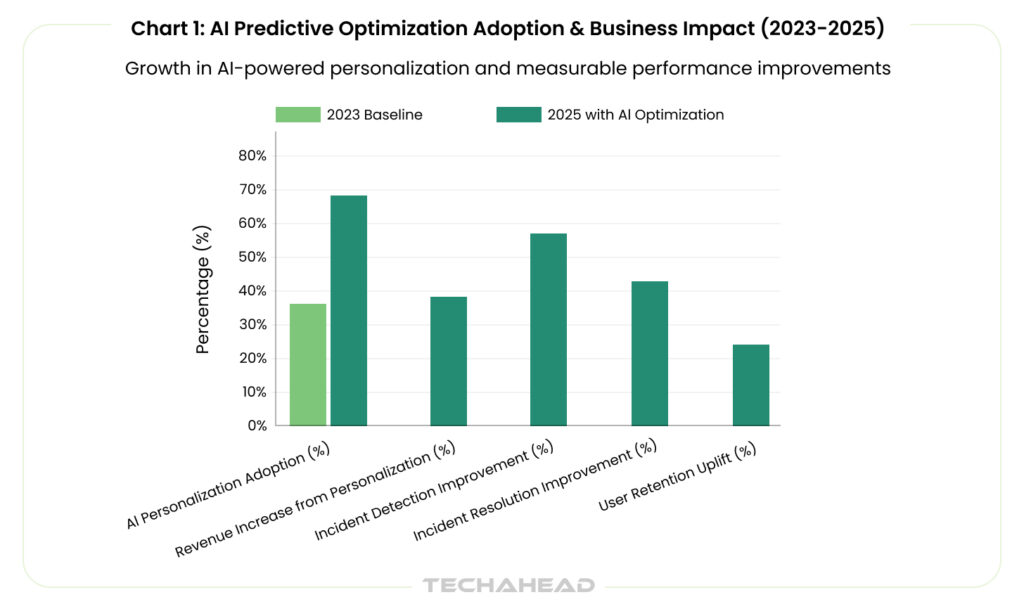
According to Gartner’s 2024 report, 72% of mobile apps deployed in 2025 incorporate AI-based personalization, up from 38% in 2023.
Cross-platform frameworks like React Native and Flutter enable unified predictive intelligence layers serving consistent experiences across iOS, Android, web, and desktop, delivering higher engagement, improved retention, and new revenue opportunities.
Key Takeaways
- AI-driven predictive optimization transforms reactive apps into proactive, anticipatory user experiences
- 72% of mobile apps will incorporate AI-based personalization by 2025
- Cross-platform frameworks enable unified predictive intelligence layers across iOS, Android, web
- AI-powered APM reduces incident detection time by 60% and resolution by 45%
- Predictive personalization drives 40% more revenue compared to non-personalized experiences
- MLOps infrastructure ensures continuous model accuracy through automated retraining and monitoring
- Hybrid edge-cloud architectures balance latency, privacy, model complexity, and user experience
What Is AI-Driven Predictive Optimization in Cross-Platform Apps?
Concept and Core Components
AI-driven predictive optimization converges three critical capabilities:
1. Predictive Analytics
Machine learning models analyze historical behavior, system performance, and contextual signals to forecast future states, next feature engagement, server degradation, churn risk, or purchase likelihood. Unlike rule-based systems, predictive models learn patterns and adapt continuously.
2. Automated Decision-Making
Predictions trigger real-time actions: personalized content delivery, resource preloading, traffic rerouting, targeted offers, or UI adjustments. Decisions happen in milliseconds, creating intuitive experiences.
3. Continuous Feedback Loops
MLOps infrastructure maintains accuracy through monitoring, automated retraining, A/B testing, and rollback mechanisms, transforming static predictions into living, learning systems.
Why Cross-Platform Makes This Harder (and More Valuable)
Building predictive optimization into cross-platform applications presents unique challenges that don’t exist in native-only or web-only contexts:
Fragmented Ecosystem Complexity
iOS and Android have different performance characteristics, sensor capabilities, privacy frameworks, and user behavior patterns. Web browsers vary in computational capacity and API support. Desktop applications run on diverse hardware configurations.
Made By TechAhead AI Team
A prediction model trained primarily on iOS data may perform poorly when serving Android users. Feature availability differs, what works with Core ML on iOS requires different implementations for TensorFlow Lite on Android.
Network and Computational Constraints
Mobile devices operate on variable network conditions (4G, 5G, WiFi, offline), have limited battery life, and range from flagship processors to budget chipsets. Predictive models must balance accuracy with resource consumption. A sophisticated recommendation engine that delivers excellent results but drains battery in 3 hours fails to serve users effectively.
Multi-Cloud Backend Complexity
Cross-platform apps often integrate with multiple backend services across different cloud providers, AWS for compute, Google Cloud for ML serving, Azure for enterprise integrations. Coordinating predictions across these distributed systems while maintaining low latency and high availability requires sophisticated orchestration.
The Cross-Platform Opportunity
Despite these challenges, cross-platform frameworks create unprecedented opportunities for predictive optimization. React Native, Flutter, and modern web frameworks enable teams to build a unified prediction layer that serves all client applications consistently.
Instead of maintaining separate iOS and Android ML pipelines, teams can instrument telemetry collection once, train models on unified datasets representing all user segments, deploy predictions through shared APIs or SDK modules, and run A/B experiments that compare experiences across platforms simultaneously.
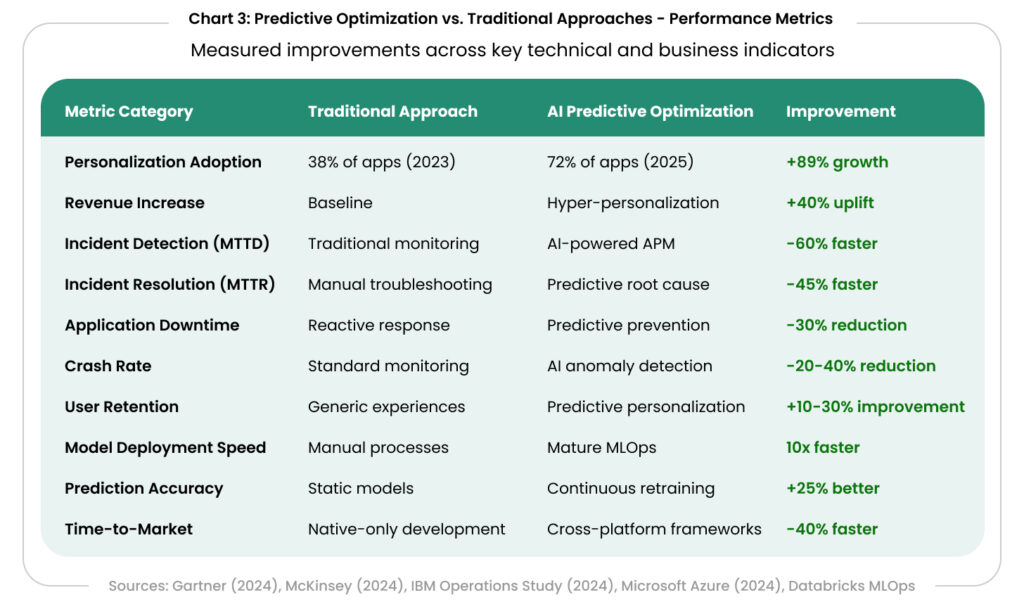
According to Forrester’s 2024 Mobile Development Survey, organizations using cross-platform frameworks with centralized ML capabilities report 40% faster time-to-market for new predictive features compared to native-only approaches, while maintaining 95%+ feature parity across platforms.
Key Use Cases of Predictive Optimization in Cross-Platform Apps
Hyper-Personalized Journeys and Content
Modern users expect apps to understand their preferences, anticipate their needs, and deliver relevant experiences without requiring explicit configuration. Generic, one-size-fits-all interfaces increasingly feel dated and frustrating.
Predictive personalization engines analyze behavioral signals, past interactions, session patterns, time-of-day usage, location context, device type, and even interaction speed, to forecast what content, features, or actions users need next. These predictions drive:
Dynamic Content Recommendations
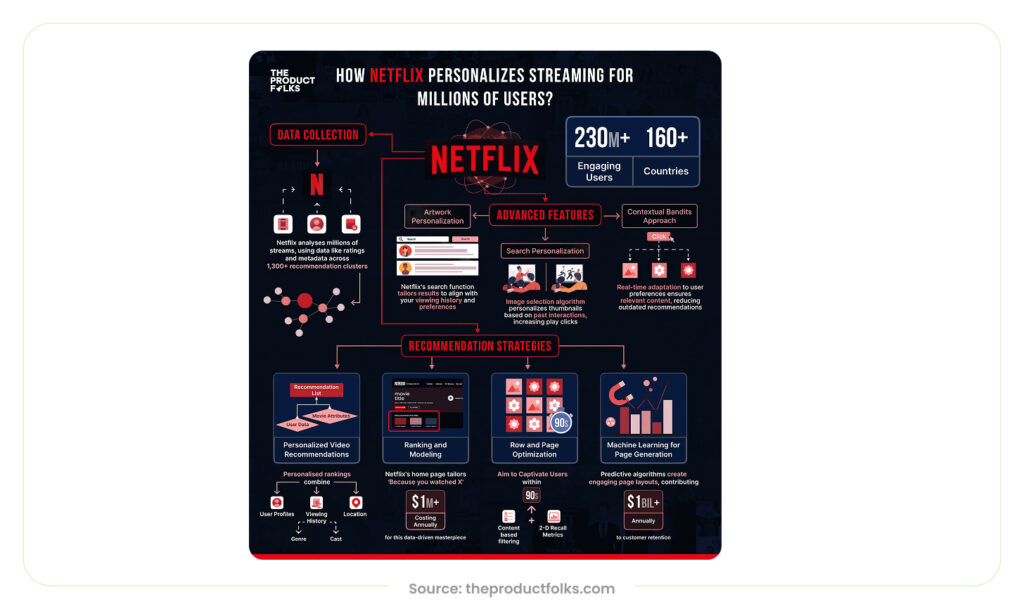
Netflix doesn’t show everyone the same homepage. Spotify doesn’t suggest identical playlists. News apps don’t prioritize the same articles. Predictive models analyze viewing history, engagement signals (completed vs. abandoned content), and similarity to other users to surface content with the highest predicted engagement probability.
Adaptive Onboarding Flows
First-time users with different backgrounds need different guidance. A predictive onboarding system detects signals during initial interactions, how quickly users navigate, which features they explore, whether they skip or consume tutorial content, and adapts the experience in real-time. Users who demonstrate high technical proficiency see streamlined paths; those who hesitate receive additional guidance and tooltips.
Contextual In-App Messaging
Timing matters enormously in user communication. Predictive systems determine optimal moments to surface upgrade prompts, feature announcements, or assistance offers based on predicted user receptivity. A user who just completed a successful transaction is more receptive to upgrade messaging than one struggling with a technical issue.
The business impact is substantial. According to McKinsey’s 2024 Personalization Report, companies that excel at personalization generate 40% more revenue from those activities than average players.
For mobile apps specifically, Segment’s 2024 State of Personalization Report found that 72% of consumers expect businesses to recognize them as individuals and know their interests, and 76% get frustrated when this doesn’t happen.
Implementation Approach
A shared “Personalization Engine” microservice sits between backend data sources and all client applications. Mobile and web clients request personalized recommendations via unified APIs, receiving pre-computed suggestions based on user profiles, real-time context, and predicted intent.
The service consumes data from product catalogs, user interaction databases, and ML model serving endpoints, then assembles personalized responses optimized for each platform’s display characteristics.
Predictive Performance and Reliability (APM + AI)
Application failures cost more than user frustration; they directly impact revenue, brand reputation, and operational costs. Yet traditional monitoring approaches are fundamentally reactive: alerts trigger after problems occur, incident response begins when users already experience degradation, and root cause analysis happens during post-mortems.
AI-powered Application Performance Monitoring (APM) inverts this model by predicting incidents before they impact users. Machine learning models analyze historical performance telemetry, response times, error rates, resource utilization, and traffic patterns to detect anomalies that precede failures.
Anomaly Detection and Forecasting
Instead of threshold-based alerts that trigger when CPU exceeds 80%, predictive APM recognizes unusual patterns: gradual memory leaks trending toward critical levels, database query times increasing at rates that will cause timeouts within 20 minutes, or API response time distributions shifting in ways that historically preceded cascading failures.
Gartner’s 2024 APM Market Guide reports that 52% of new APM tools launched in 2024 include AI-driven anomaly detection, predictive analytics, and automated root-cause analysis as core capabilities. This represents a dramatic shift from 2022, when fewer than 15% offered these features.
Real-World Impact
IBM’s 2024 operations study found that enterprises using AI-enhanced APM reduced mean time to detection (MTTD) by 60% and mean time to resolution (MTTR) by 45% compared to traditional rule-based monitoring.
Microsoft Azure’s predictive insights feature, which analyzes telemetry to forecast potential issues, helped customers achieve 30% reduction in unplanned downtime during its first year of general availability (Microsoft Azure Blog, 2024).
Cross-Platform Performance Optimization
For cross-platform applications, predictive APM becomes even more valuable. Performance characteristics vary dramatically across platforms, what runs smoothly on flagship Android devices may struggle on budget hardware; web performance depends on browser engine and network quality. Predictive models can:
- Forecast device-specific performance issues before deploying updates
- Predict optimal bundle sizes and caching strategies per platform
- Anticipate API latency spikes and trigger client-side fallbacks
- Identify users likely to experience crashes based on device profiles and enable defensive coding paths
Teams integrate predictive APM with existing mobile performance optimization practices, code splitting, lazy loading, efficient state management, image optimization, using predictions to prioritize which optimizations deliver maximum impact for which user segments.
Predictive In-App Commerce and Monetization
E-commerce and subscription-based applications generate revenue through strategic timing, relevant offers, and understanding user lifetime value. Predictive optimization transforms these elements from art to science.
Dynamic Pricing and Offer Timing
Predictive models analyze purchase history, browsing behavior, price sensitivity signals, and external factors (seasonality, competitive pricing, inventory levels) to determine optimal pricing and promotion strategies per user segment. Airlines and hotels have used dynamic pricing for decades; modern ML capabilities bring this sophistication to mobile commerce at scale.
Churn Prediction and Retention
Subscription businesses live or die by retention rates. Predictive churn models identify users at risk of cancellation days or weeks before they churn, based on declining engagement, support interactions, failed payment patterns, or usage behaviors that historically precede cancellation. This advance warning enables proactive interventions, personalized retention offers, targeted feature highlights, or customer success outreach when they’re most effective.
Lifetime Value Segmentation
Not all users are equally valuable. Predictive LTV (Lifetime Value) models forecast long-term revenue potential for each user based on early behaviors, demographic signals, acquisition channels, and initial transaction patterns. This enables sophisticated resource allocation: invest more in retaining high-LTV users, optimize acquisition costs against predicted returns, and tailor experiences to maximize value from each segment.
The monetization opportunity is substantial. According to Sensor Tower’s 2024 AI Apps Report, global revenue for AI-powered applications reached $3.1 billion in the first eight months of 2024, representing 58% year-over-year growth. Apps that embedded predictive intelligence into core monetization flows, recommendation engines, dynamic pricing, and churn prevention, thereby significantly outperformed those using basic rules-based systems.
Implementation Pattern
Predictive commerce services wire into cross-platform checkout flows and subscription management systems through unified APIs. When users browse products, client apps request personalized pricing and offer recommendations. During checkout, real-time churn risk scores influence which retention offers to display. Post-purchase, predictive models schedule optimal times for upsell messaging based on satisfaction signals and usage patterns.
Architecture: How Predictive Optimization Fits into a Cross-Platform Stack
Data Layer and Telemetry Collection
Predictive models are only as good as the data feeding them. Comprehensive, high-quality telemetry collection forms the foundation of any predictive optimization system.
Multi-Platform Instrumentation
Cross-platform applications must capture consistent telemetry across iOS, Android, web, and desktop clients while accounting for platform-specific capabilities and constraints:
- User Interaction Events: Taps, swipes, scrolls, form submissions, navigation patterns
- Performance Metrics: Screen render times, API latency, memory usage, battery consumption
- Session Context: Device model, OS version, network type, geographic location, time-of-day
- Business Events: Product views, add-to-cart actions, checkouts, subscriptions, content consumption
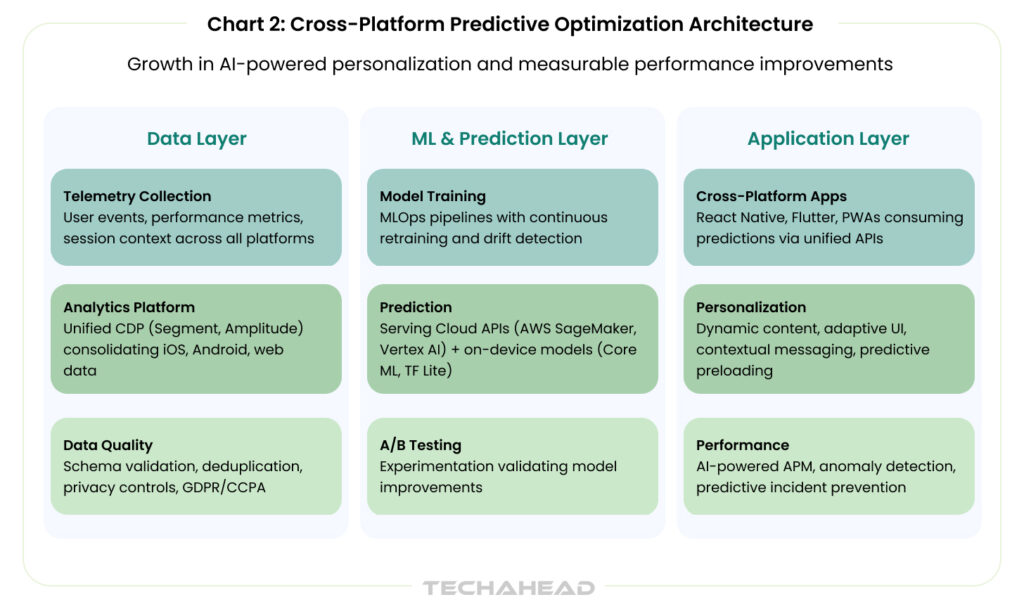
Source: TechAhead AI Team
Unified Analytics Platforms
Modern Customer Data Platforms (CDPs) and mobile analytics tools consolidate telemetry from disparate sources into unified user profiles. Segment, Amplitude, and Mixpanel enable teams to instrument events once using cross-platform SDKs, then route that data to analytics warehouses, ML training pipelines, and real-time personalization engines.
Best practices for instrumentation include:
- Semantic event naming conventions that remain consistent across platforms
- Privacy-first design with user consent management and data anonymization
- Sampling strategies for high-volume events to manage data costs
- Schema validation preventing corrupted data from polluting training datasets
- Cross-device identity resolution linking users across mobile, web, and desktop sessions
Data Quality and Governance
Poor data quality destroys predictive model accuracy. Duplicate events, missing fields, inconsistent timestamps, and bot traffic must be filtered during collection or cleaning phases. Data governance frameworks ensure compliance with GDPR, CCPA, and industry-specific regulations while maintaining the data richness required for effective predictions.
Model Lifecycle and MLOps
Machine learning models degrade over time as user behaviors shift, new features launch, and market conditions evolve. MLOps, the discipline of operationalizing machine learning, ensures predictions remain accurate, reliable, and continuously improving.
Core MLOps Components
1. Continuous Integration/Continuous Deployment for ML
Just as modern software engineering uses CI/CD pipelines for code, MLOps applies similar principles to models. Automated pipelines handle data validation, feature engineering, model training, evaluation against holdout sets, and deployment to serving infrastructure. Version control tracks model lineage, training configurations, and performance metrics.
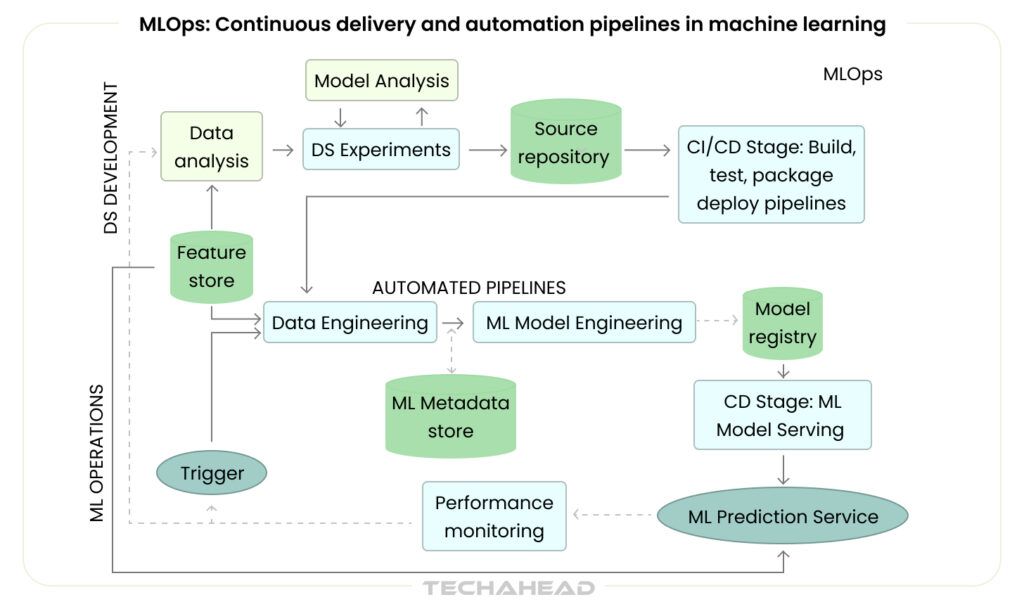
2. Model Monitoring and Drift Detection
Production models require continuous health monitoring. Key metrics include:
- Prediction accuracy on live data compared to validation baselines
- Input distribution drift detecting when incoming data diverges from training distributions
- Concept drift identifying when relationships between features and outcomes change
- Serving latency ensuring predictions meet real-time requirements
3. Automated Retraining Pipelines
When monitoring detects degradation, automated retraining pipelines ingest fresh data, retrain models, validate improvements, and deploy updated versions, often without human intervention for well-established pipelines.
4. A/B Testing and Gradual Rollouts
New model versions undergo rigorous A/B testing before full deployment. Gradual rollouts expose small user percentages to updated models while monitoring for unexpected behaviors or performance regressions. Rollback mechanisms enable instant reversion if issues emerge.
Databricks’ 2024 State of Data + AI Report found that organizations with mature MLOps practices deploy new models 10x faster and achieve 25% higher prediction accuracy compared to those using ad-hoc approaches. By 2025, predictive analytics supported by robust MLOps infrastructure has become central to strategic decision-making across Fortune 500 enterprises.
Integration with Cross-Platform Apps
MLOps pipelines feed predictions to client applications through versioned APIs. Mobile and web apps consume predictions without needing to understand model internals, they simply request recommendations, churn scores, or performance forecasts through standardized endpoints. This separation of concerns enables data science teams to iterate on models independently from frontend development cycles.
Cross-Platform Implementation Patterns and Tech Stack
Frontend: React Native, Flutter, and Web
Shared Prediction Services Architecture
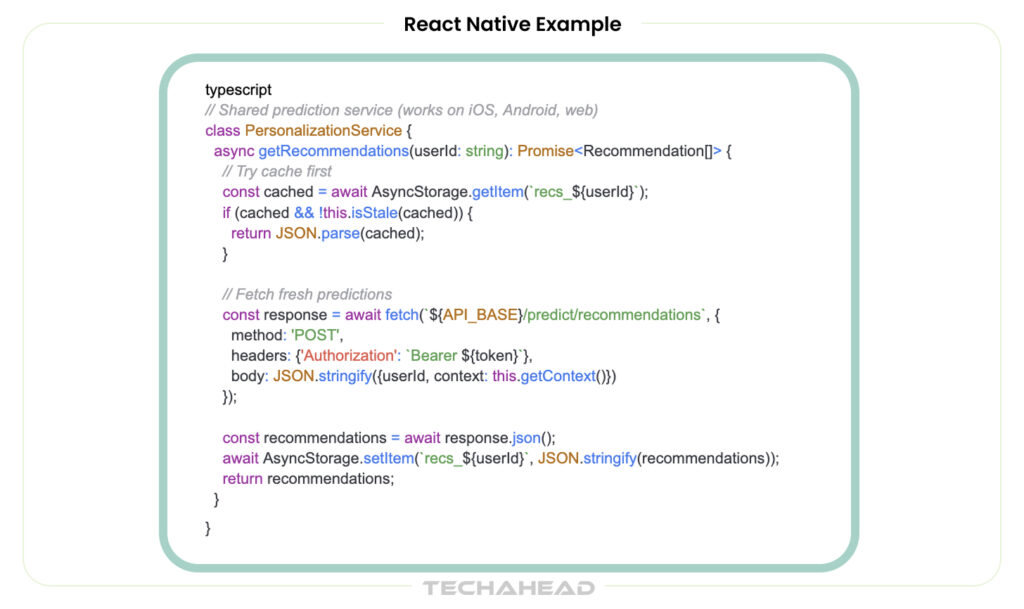
Cross-platform frameworks enable teams to build prediction consumption logic once and deploy it everywhere. Key patterns include:
1. Unified API Clients
TypeScript or Dart modules encapsulate all prediction API interactions, authentication, request formatting, response parsing, error handling, caching. React Native and Flutter components import these modules, calling prediction services identically across iOS, Android, and web.
Source: TechAhead AI Team
2. Offline-First Design with Cached Predictions
Mobile apps can’t assume constant connectivity. Effective implementations:
- Cache recent predictions locally using platform storage (AsyncStorage, SharedPreferences, IndexedDB)
- Serve cached predictions instantly while fetching fresh ones in the background
- Implement cache invalidation strategies based on prediction staleness thresholds
- Gracefully degrade when neither fresh nor cached predictions are available
3. Platform-Specific Optimizations
While core logic remains shared, platform-specific wrappers optimize for each environment:
- iOS apps leverage Core ML for certain on-device predictions
- Android apps use TensorFlow Lite or ML Kit
- Web apps employ Web Workers for a non-blocking model inference
- Desktop apps utilize more aggressive prefetching, given less stringent battery constraints
Flutter Advantages
Flutter’s single codebase compiles to native ARM code for iOS/Android and JavaScript for web, enabling truly unified implementations with excellent performance. Dart’s strong typing and null safety reduce runtime errors in prediction handling logic.
Backend and Infrastructure
Scalable Cloud Platforms
Modern predictive systems leverage managed cloud services to minimize operational overhead:
Model Serving:
- AWS SageMaker: Managed model hosting with auto-scaling and A/B testing
- Google Vertex AI: Unified ML platform with feature store and continuous training
- Azure Machine Learning: Enterprise-grade MLOps with comprehensive monitoring
Supporting Infrastructure:
- Feature Stores (Tecton, Feast): Centralized repositories for ML features with low-latency serving
- Vector Databases (Pinecone, Weaviate): Efficient similarity search for recommendation systems
- Stream Processing (Apache Kafka, AWS Kinesis): Real-time feature computation from event streams
- Data Warehouses (Snowflake, BigQuery): Training data storage and batch feature generation
AI-Powered APM Integration
Observability platforms with built-in ML capabilities monitor both application performance and ML model health:
- Datadog: Anomaly detection on metrics, log analysis, distributed tracing
- New Relic: Predictive alerts, intelligent incident correlation
- Dynatrace: AI-powered root cause analysis, automatic baselining
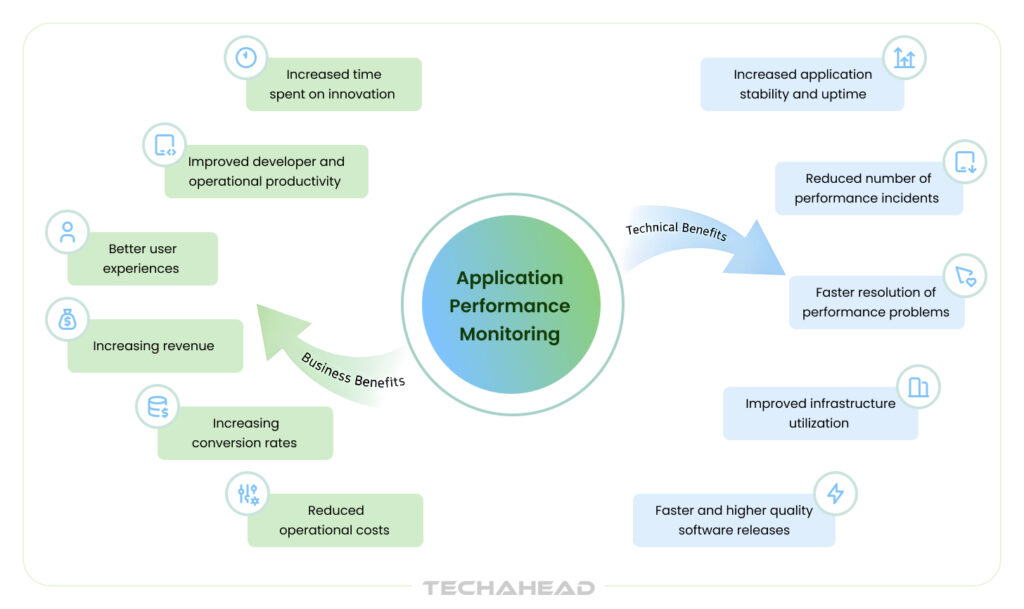
These tools instrument cross-platform apps uniformly, correlating frontend performance (screen load times, API latency) with backend health (database performance, service dependencies) to provide holistic visibility.
Security, Privacy, and Compliance
Predictive optimization systems process sensitive user data, requiring robust security and privacy controls:
Consent-Driven Data Collection
Respect user privacy preferences through:
- Granular consent management for analytics and personalization
- Clear disclosure of how predictions improve experiences
- Opt-out mechanisms that maintain functionality with reduced personalization
- Transparency around data retention and model training practices
Data Protection Measures
- Encryption at rest: All stored telemetry and user profiles encrypted
- Encryption in transit: TLS 1.3+ for all client-server communication
- Anonymization: Remove or hash PII in datasets used for model training
- Access controls: Role-based access restricting who can query user data or deploy models
- Audit logging: Comprehensive tracking of data access and model deployments
Cross-Region Compliance
Global applications must navigate varying data residency requirements:
- GDPR (EU): User consent, right to deletion, data minimization
- CCPA (California): Disclosure requirements, opt-out rights
- Industry-specific: HIPAA (healthcare), PCI DSS (payments), FERPA (education)
Architecture decisions include:
- Regional data isolation: Store EU user data in EU regions, US data in US regions
- Federated analytics: Aggregate insights without centralizing raw data
- Privacy-preserving ML: Differential privacy, federated learning, secure multi-party computation
Integrating security and privacy into DevSecOps pipelines ensures every model deployment undergoes security reviews, data lineage audits, and compliance validation before reaching production.
Partner with TechAhead for Predictive Cross-Platform Experiences
AI-driven predictive optimization represents a fundamental competitive differentiator for modern applications. Organizations mastering this convergence, combining robust ML infrastructure, cross-platform engineering, and user-centric design, deliver experiences that feel magical while driving measurable improvements in engagement, retention, and revenue.
With sixteen years of mobile and web development expertise, TechAhead architects predictive systems across React Native, Flutter, and progressive web apps. From data infrastructure and MLOps pipelines to model serving APIs and on-device optimization, we guide clients through discovery, implementation, and sustained innovation.
Ready to build faster, smarter, always-on experiences?
Schedule a consultation to develop your strategic roadmap for embedding predictive optimization across platforms.
What is AI-driven predictive optimization in cross-platform apps?
It combines machine learning forecasts with automated decision-making to deliver personalized experiences, prevent failures, and optimize performance across platforms.
How does predictive optimization improve app performance and reliability?
AI-powered APM predicts incidents before they occur through anomaly detection, reducing downtime by 30-50% and enabling proactive issue resolution.
What’s the difference between edge AI and cloud-based predictions?
Edge AI runs on-device for low latency and privacy; cloud handles complex models and cross-user intelligence requiring significant compute power.
How do cross-platform frameworks simplify predictive optimization implementation?
React Native and Flutter enable unified prediction layers serving all platforms, reducing development overhead while maintaining consistent personalized experiences.
What ROI can businesses expect from predictive optimization features?
Enterprises typically see 40% revenue increases from personalization, 20-40% crash reduction, and 10-30% improvements in user retention rates.