


 Copy Link
 Share on X
 Share on Facebook
 Share on LinkedIn
Always Active
Required for core functionality such as security, network management, and accessibility. These cannot be disabled.

Uncover the transformative potential of digital and mobile solutions for your industry.



 Last Updated: Nov 20, 2026
Nov 20, 2026
 14
 17 min. Read


Key Takeaways
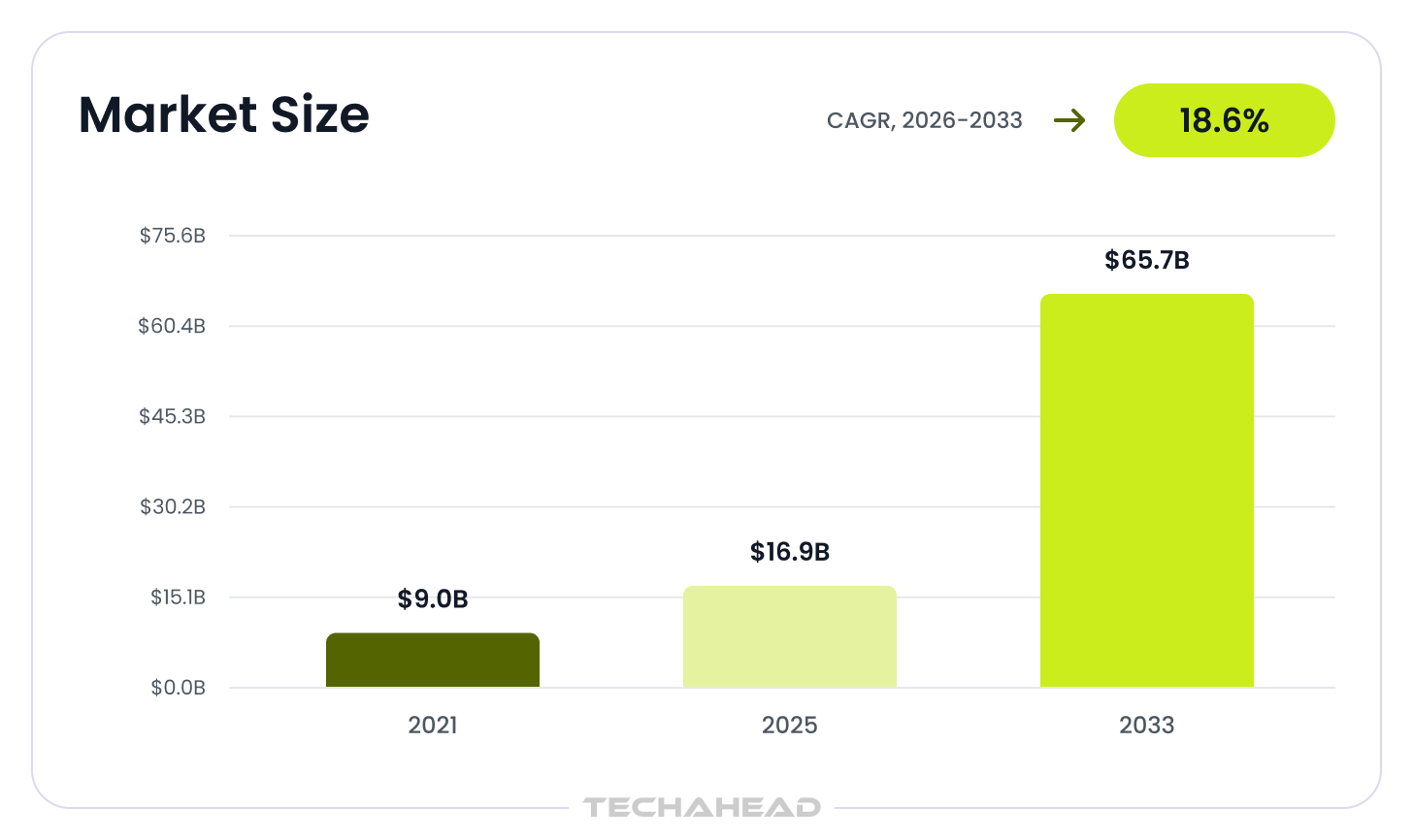
AI is reshaping how coaching is delivered, priced and scaled. Grand View Research values the global AI personal trainer market at $16.9 billion in 2025 and projects $65.7 billion by 2033, an 18.6% compound annual growth rate. For fitness, nutrition, wellness and corporate coaching organizations, that growth places technology at the center of the coaching business.
Most organizations began this journey on a configurable platform, and the choice made sense. Everfit, for example, brings an AI workout builder that converts existing programs into structured plans, an AI meal scanner, automated workflows, payments and a white label client app into one product. It gives a coaching business a fast, proven route to digital delivery.
Growth then raises a second set of questions that belong in the boardroom. Who owns the client experience across locations and partners? How does client data inform every coaching decision? Can the company’s own methodology shape the AI, the meal plan and the workout program? And whose priorities set the product roadmap?
These questions explain why coaching businesses at this stage evaluate a custom platform. This point of view shows how to build an AI powered coaching platform like Everfit, with human coaching at the center and AI preparing the first draft. It covers when building creates value, the features and AI layer to prioritize, the reference architecture and a phased roadmap. It also draws on a platform TechAhead delivered for a nutrition coaching company that made this move.
Also Read: Why connected fitness is the future of the fitness industry?
Traditional coaching runs on spreadsheets, shared documents and message threads. A personal trainer builds a workout program in one tool, shares a meal plan in another and collects check ins in a third. This approach serves a small roster well and asks for more effort with every new client.
All in one platforms brought these tasks together. One app holds the workout program, the meal plan, progress tracking, payments and messaging, so coach and client work from a single source of truth. AI powered coaching builds on this foundation. The AI reads client data, drafts the next step, and returns time to the coach.
The International Coaching Federation counts 122,974 coach practitioners worldwide, up 15% since 2023, and 59% of coaches expect to earn more in the coming year through more clients and more sessions. Demand for coaching is rising, and software determines how many clients each coach can serve with excellence.
Expectations rise alongside demand. McKinsey reports that 71% of consumers expect companies to deliver personalized interactions. A coaching platform that holds each client’s profile, goals and training history meets that expectation by design.
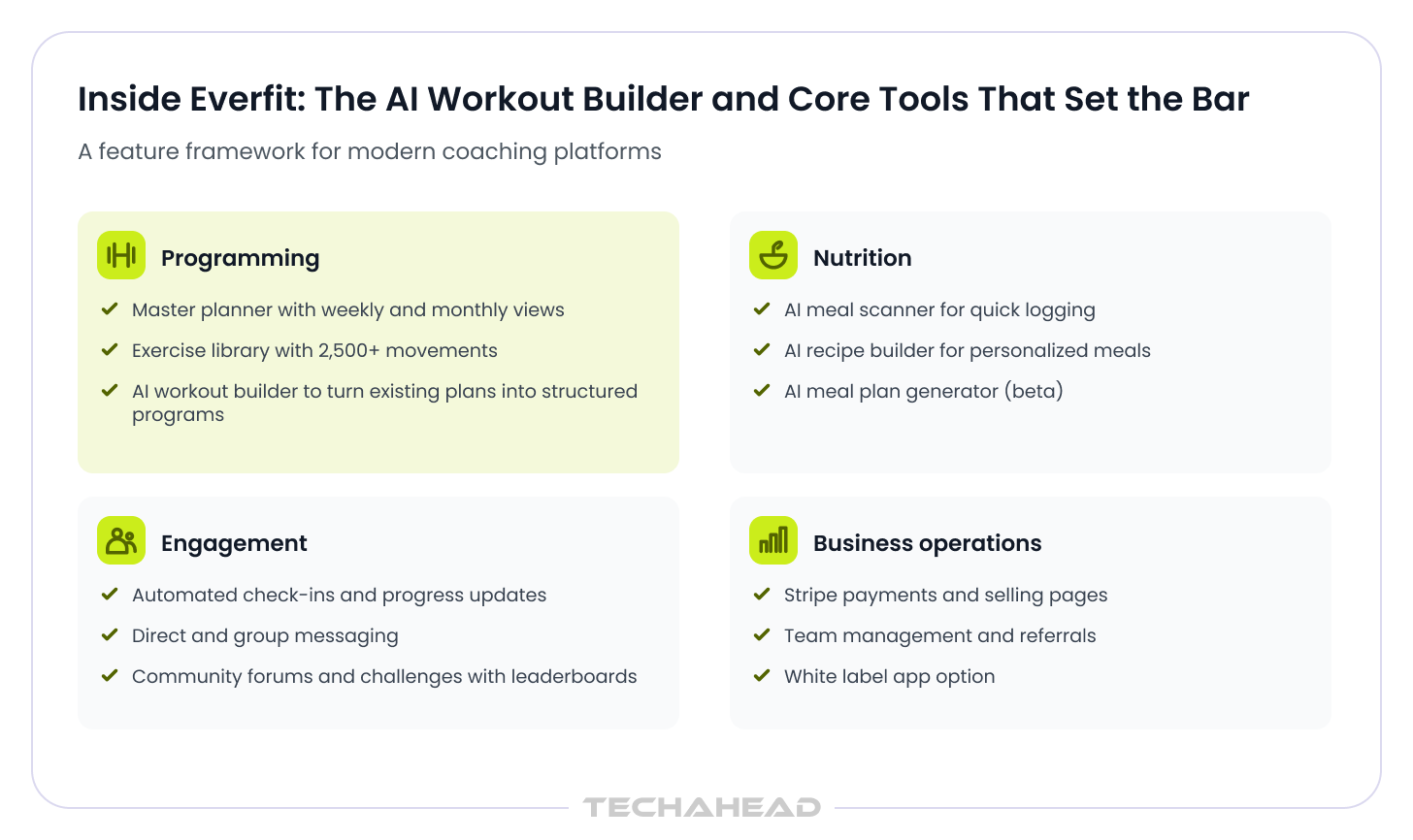
Industry leaders in digital coaching set the expectations that buyers carry into every evaluation, and Everfit offers a useful reference point. It describes itself as a Fitness Intelligence platform that combines data, AI-driven personalization, and coach input. Based on its public product descriptions, the feature set groups naturally into four jobs: programming, nutrition, engagement and business operations.
Programming covers a master planner with weekly and monthly views, an exercise library of more than 2,500 movements and program templates. An AI workout builder turns existing text or PDF programs into structured plans. Nutrition adds an AI meal scanner and an AI recipe builder, with an AI meal plan generator in beta. Engagement covers automated check ins, direct and group messaging, community forums and challenges with leaderboards. Business operations cover Stripe payments, selling pages, a sales dashboard, team management, referrals and a white label app option.
The commercial model follows the same logic. A free plan for a small client roster and a free trial let coaches experience the product, tiers scale with the number of clients, studio plans serve gyms and boutique studios, and add-ons for areas such as automation and payments extend the core offer. A clear pricing page makes the options easy to compare. Platform builders can choose a free plan, a 14 day free trial or both, and package advanced AI as an AI add-on, which lets a coach start small and expand as the practice grows.
On the client side, the client app delivers structured workouts, meal plan and nutrition tracking, habit coaching, reminders and messaging, with Apple Health sync on iPhone and Health Connect and Wear OS support on Android.
These strengths define the baseline. Any new platform inherits the same expectations: a polished client app, a responsive admin side and an AI workout builder that gives coaches time back.
A configurable product serves many coaching businesses with one shared roadmap. A custom platform serves one business with its own roadmap. Both models have a place, and the trade off is clear. Platforms deliver speed and predictable monthly costs. Custom builds deliver differentiation, control and a client experience shaped around the business.
McKinsey’s global survey on AI shows that organizations pursue a mix of off the shelf capabilities and significant customization. Its latest edition finds that redesigning workflows has the largest effect on bottom line impact from generative AI, out of 25 attributes tested. Coaching businesses face a parallel opportunity. The platform that mirrors the coaching workflow captures the most value from AI.
Five questions help leaders decide:
Three or more affirmative answers point toward a custom platform.
| Dimension | Configurable platform | Custom platform |
| Client experience | Branded app on a shared design | Fully owned iOS and Android experience |
| AI capabilities | Built in AI workout builder and coaching tools | AI shaped around the coaching method, such as meal photo analysis and a knowledge base grounded assistant |
| Coach workflows | Standard and configurable | Designed around the business |
| Business roles | Team and studio capabilities | Roles tailored to coaches, gyms, administrators and referral partners |
| Payments | Built in, with add ons | Integrated into the business model |
| Ownership | Vendor operated | Application and architecture built for one business |
| Roadmap | Shaped by priorities across many customers | Directed by the business’s own priorities |
The comparison reflects publicly described capabilities and serves as a directional guide.
Established coaching businesses. Gym networks, nutrition companies and wellness brands often begin on configurable software. As the coaching business grows, they look for greater control over the operating model, the client experience and the integrations.
Organizations digitizing coaching operations. Corporate wellness providers, multi location studios and health coaching networks turn a proven coaching method into a scalable product. Fortune Business Insights sizes the global corporate wellness market at $68.41 billion in 2025 and projects $118.21 billion by 2034, a 6.41 percent compound annual growth rate that signals steady employer demand.
Enterprise leadership coaching. HR teams run leadership coaching and employee development programs that connect development goals, performance reviews and difficult conversations. Gartner reports that 8% of HR leaders believe their managers have the skills to use AI effectively, and that 14% of organizations support managers with guidance on using generative AI in daily work. That opening makes AI supported coaching, delivered where managers already collaborate such as Microsoft Teams, a valuable addition to talent programs.
Must Read: Generative AI in Healthcare: From Predictive Diagnostics to Personalized Treatments
Founders launching new platforms. Health tech startups, nutrition brands and fitness entrepreneurs build an AI coaching app for their own market, with a branded experience and AI embedded from day one.
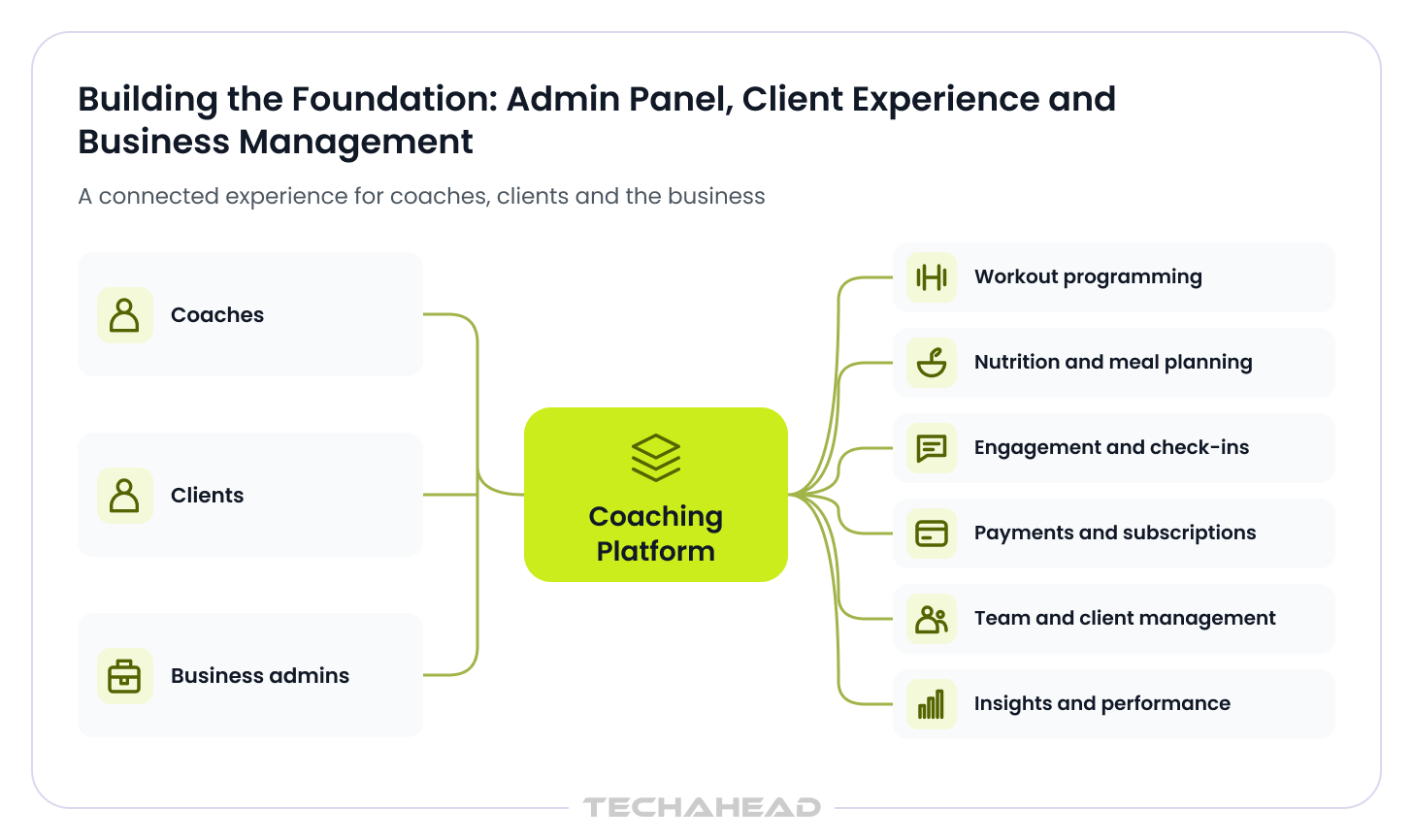
A strong coaching platform serves three audiences at once, and each deserves deliberate design.
The admin side is the coach’s workspace. It includes client management, program design tools and an exercise library. A manual workout builder gives coaches full control, and the AI workout builder accelerates the same workspace. Coaches create single workouts, full programs and on demand libraries, then deliver workouts to any device. Scheduling, payments, team roles and business dashboards sit alongside.
The client app is the daily touchpoint. Clients view their workout program, log meals against a meal plan, build habits, complete check ins, message their coach and track progress through body stats, photos and streaks. Visible progress helps clients build confidence, and wearable sync adds steps, sleep and heart rate to the picture. Public app store reviews across the category point to four priorities: fast loading screens, a workout logging flow that takes few taps, reliable sync with health and nutrition apps and message history that is easy to find. Strong first releases build these in from the start.
Business management covers subscriptions, packages, referrals and payments, so clients pay through the model the business designs. A custom platform extends this layer with roles tailored to the organization: coaches, gym owners, administrators and referral partners, each with a dedicated portal. This is where a coaching business turns its operations into a product.
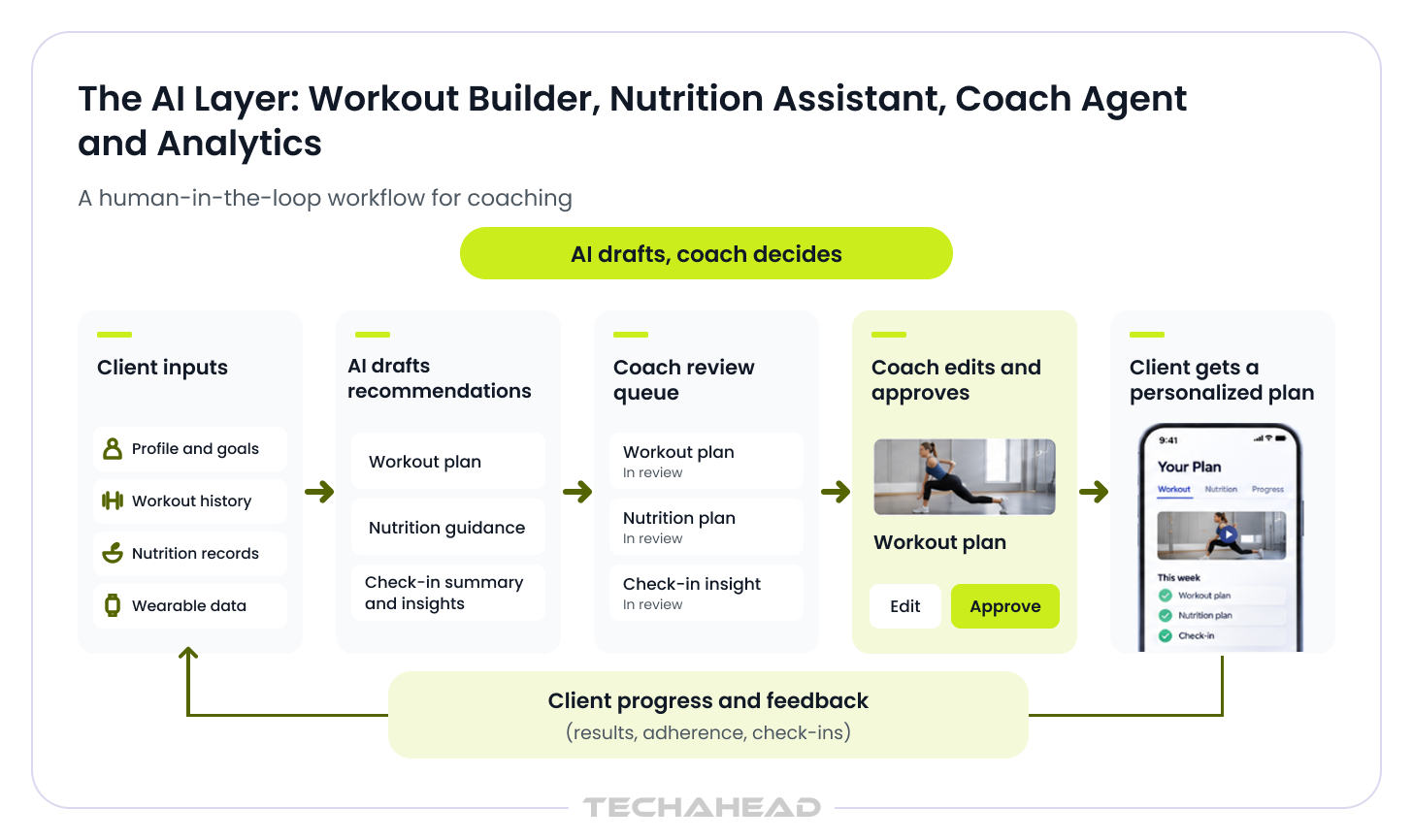
The guiding principle is simple. AI builds the first draft and the coach decides. Many coaches already use AI tools through a general assistant. A purpose built platform brings the same capability to client data, so every suggestion reflects the individual. AI runs quietly in the background, preparing drafts and surfacing patterns, while the coach focuses on the relationship.
AI workout builder. The builder reads the client’s profile, the client’s goals, training history and equipment, then drafts single workouts or full programs in seconds. The coach reviews, edits and assigns. A general assistant can draft fast, and a builder connected to client data produces guidance tailored to the person, where a general assistant produces generic output.
Nutrition guidance. AI generates a meal plan that respects macro targets and dietary restrictions, explains each choice in plain language and analyzes meal photos so logging takes seconds. A knowledge base built from the coach’s own content, retrieved at answer time, keeps nutrition guidance consistent with the company’s method.
Check ins and communication. Each week, AI summarizes training, nutrition and habits into a check in draft. When a client has a bad week, the coach sees the signal early and sends a supportive message. AI also prepares talking points for difficult conversations, such as renewals or plan resets. The coach sends every message in a personal voice, which protects the client’s trust.
Insight and retention. The platform tracks goals, flags changes in engagement and highlights who needs attention first. Coaches make retention decisions from patterns.
Content and marketing. Content ideas, newsletter drafts and program descriptions come from the coach’s knowledge base, which helps drive growth through consistent outreach.
An AI agent for coaches and leaders. An AI agent connected to client data can answer questions such as which clients need attention this week, then prepare follow ups for approval. McKinsey describes agentic AI as the next frontier of generative AI. For leadership coaching, the same agent can work inside Microsoft Teams, where managers already collaborate, and prepare conversation guides for performance reviews and development goals.
Also Read: Agentic AI Development Guide (The Enterprise Playbook for 2026 and Beyond)
Every AI generated plan arrives as an AI draft in a review queue. Human coaching stays at the center, bringing accountability, empathy and judgment, while AI supplies speed and consistency.
A clean architecture keeps AI close to the data and keeps the coach in control. Four layers, supported by a set of integrations, cover most needs.
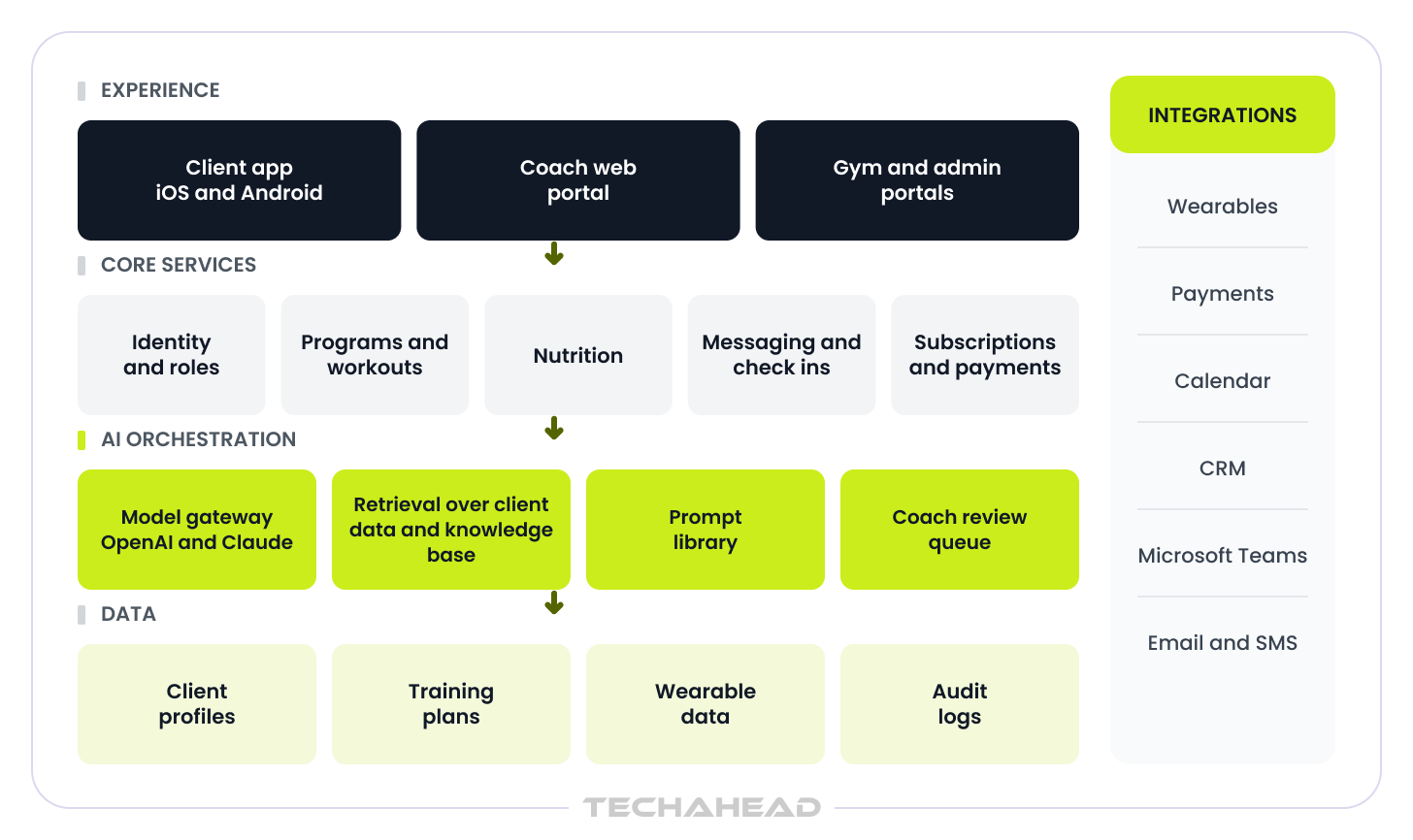
Multi tenant design lets one codebase serve many gyms, brands and corporate accounts, each with its own data boundaries and branding. Model access runs through a gateway to OpenAI and Claude APIs, which lets the team select the best model for each task and evolve as models improve. Retrieval connects the models to client data and the coach’s knowledge base. Structured outputs let the platform validate every AI draft before a coach sees it.
Health and fitness data is personal, and a coaching platform earns loyalty through careful stewardship. Consent management, encryption, role based access, data retention rules and regional regulations belong in the first design sessions. The International Coaching Federation publishes AI coaching standards covering principles and ethical guidelines for integrating AI into coaching while maintaining trust, which makes a strong reference for product policy.
Human review builds trust as well. In McKinsey’s survey, 27% of respondents whose organizations use generative AI say employees review all generated content before it is used. A coaching platform can make review the default, with every workout, meal plan and message passing through the coach before it reaches the client. Scope of practice checks, safety rules for exercise and nutrition and clear disclosure of where AI assists complete the picture.
Must Read: Generative AI in Pharma: Use Cases, Operating Model, and Governance for 2026
A phased roadmap lets leaders fund the first release, measure results and expand with evidence.
Treat advanced analytics as a nice to have in the first release, and place the core coaching loop first: plan, deliver, check in, adjust.
| Layer | Typical choices |
| Web portals | React and Next.js |
| Backend | Node.js or Python services with REST or GraphQL APIs |
| Data | PostgreSQL with a vector store for retrieval |
| Cloud | AWS with multi tenant architecture |
| AI | OpenAI and Claude APIs behind a model gateway |
| Payments | Stripe or regional payment gateways |
| Analytics | Product analytics and engagement dashboards |
| Mobile | Native iOS and Android, or React Native and Flutter |
Investment follows five variables: the platforms covered, the depth of AI, the number of integrations, the compliance scope and the number of user roles. Revenue models include subscriptions, per coach and per location tiers, studio plans, referral programs and AI add-ons. A transparent pricing page helps clients pay with confidence. A scoping workshop turns these variables into a phased estimate.
Best Practices for Building a Coaching Platform: Data Quality, Engagement and Coach Adoption
Businesses on a configurable platform can plan the move as a staged program. Client accounts, coaching history, subscriptions, content libraries and integrations form the core inventory. Data portability options deserve early confirmation with the current provider. A pilot group of coaches and clients validates the new experience, a parallel run keeps coaching uninterrupted and clear communication helps clients adopt the new app with enthusiasm.
Coaching businesses that treat their platform as a core asset gain a durable advantage. They combine the speed of AI with the trust of human coaching, and they own the data and the experience that make their method distinctive. For leaders ready to explore that path, TechAhead brings the product thinking and AI engineering to turn a coaching method into a platform.
TechAhead is an AI native app and enterprise software development company, an OpenAI Services Partner and a member of the Claude partner network. Together with its web and mobile engineering teams, this helps organizations accelerate the adoption of AI solutions. For coaching businesses, the combination covers the full path: product strategy, client app and portal design, AI orchestration, integrations and cloud operations. A discovery call or scoping workshop is a practical first step.
Visit techaheadcorp.com to start the conversation.
Investment depends on the platforms covered, the depth of AI, the number of integrations, the compliance scope and the number of user roles. A phased plan starts with a focused first release, and a scoping workshop produces a detailed estimate.
Timelines follow the same variables. Many teams release a core client app and coach portal first, then add AI capabilities in phases so value arrives early.
Each serves a different stage. Configurable and white label products offer a fast start. A custom platform suits businesses that want to own the experience, the data and the roadmap.
Yes. A staged migration covers accounts, program history, subscriptions and content, supported by a pilot group and a parallel run.
AI accelerates planning, drafting and analysis. Human coaching continues to provide accountability, empathy and judgment, and the best platforms keep the coach in control.
Every plan passes through a coach review queue, supported by scope of practice rules, safety checks and consent controls.
Yes. The same architecture supports development goals, check ins and conversation preparation for managers, and an AI agent can operate inside Microsoft Teams.
We use cookies to ensure our website functions properly, improve performance, and provide a personalized experience. You can choose which types of cookies to allow below.
Required for core functionality such as security, network management, and accessibility. These cannot be disabled.
Help us understand site traffic and user interactions so we can improve performance and usability.
Enable enhanced functionality and personalization such as language or region preferences.
Used to deliver relevant ads, track campaign performance, and measure advertising effectiveness.