


 Copy Link
 Share on X
 Share on Facebook
 Share on LinkedIn


Always Active
Required for core functionality such as security, network management, and accessibility. These cannot be disabled.

Uncover the transformative potential of digital and mobile solutions for your industry.





 Last Updated: Sep 18, 2026
Aug 21, 2026
Last Updated: Sep 18, 2026
Aug 21, 2026  198
198  15 min. Read


Key Takeaways


Insurance companies are no longer attracting clients through brand loyalty. They’re winning because of how quickly a claim is processed, how properly a policy is priced, and how little friction a client has between making a claim and receiving payment. Generative AI is transforming how underwriters analyze risk, real-time telematics has turned every linked automobile into a live data source, and automated claims triage is reducing settlement times from weeks to hours.
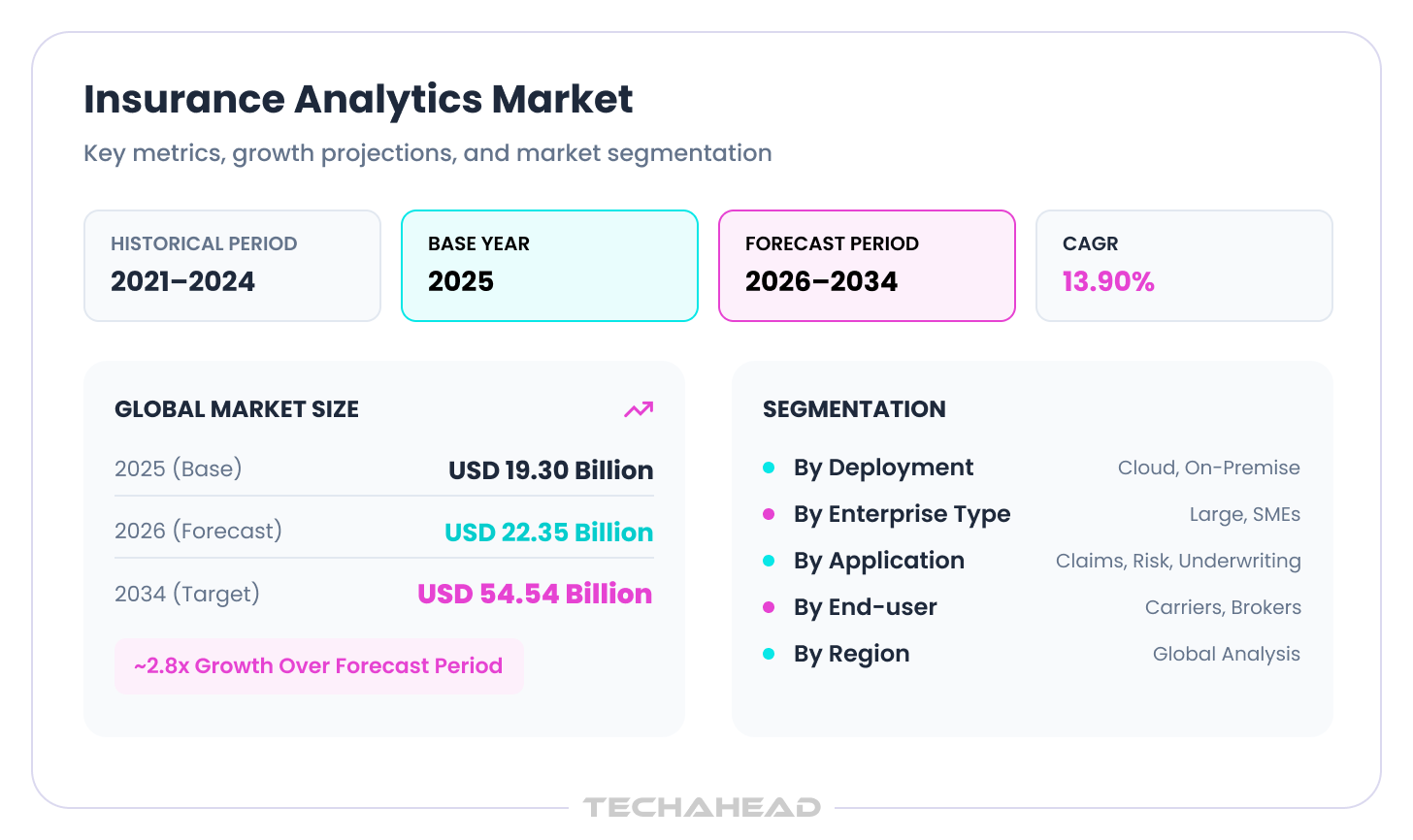
The numbers back up how fast this shift is moving. The global insurance analytics market was valued at USD 19.3 billion in 2025. The market is projected to grow to USD 22.35 billion in 2026 and reach USD 54.54 billion by 2034, exhibiting a CAGR of 13.90% during the forecast period. North America dominated the global insurance analytics market with a 40.40% share in 2025. That kind of growth means every carrier, MGA, and broker still running on a decade-old core system is now competing against someone who isn’t, and it’s a big reason demand for InsurTech app development services has climbed so fast over the last two years.
This is also why finding the right InsurTech software development company has turned into such a high-stakes decision. A legacy policy administration system wasn’t built to handle real-time data streams or AI-driven decisioning, and retrofitting one is a fundamentally different job than building on cloud-native infrastructure from the start.
Before shortlisting anybody, it’s worth understanding what distinguishes a partner who knows insurance from one who has only produced a few insurance-related applications. This list includes 10 companies worth considering in 2026, what each one is truly excellent at, and what market data suggests you should expect to spend.
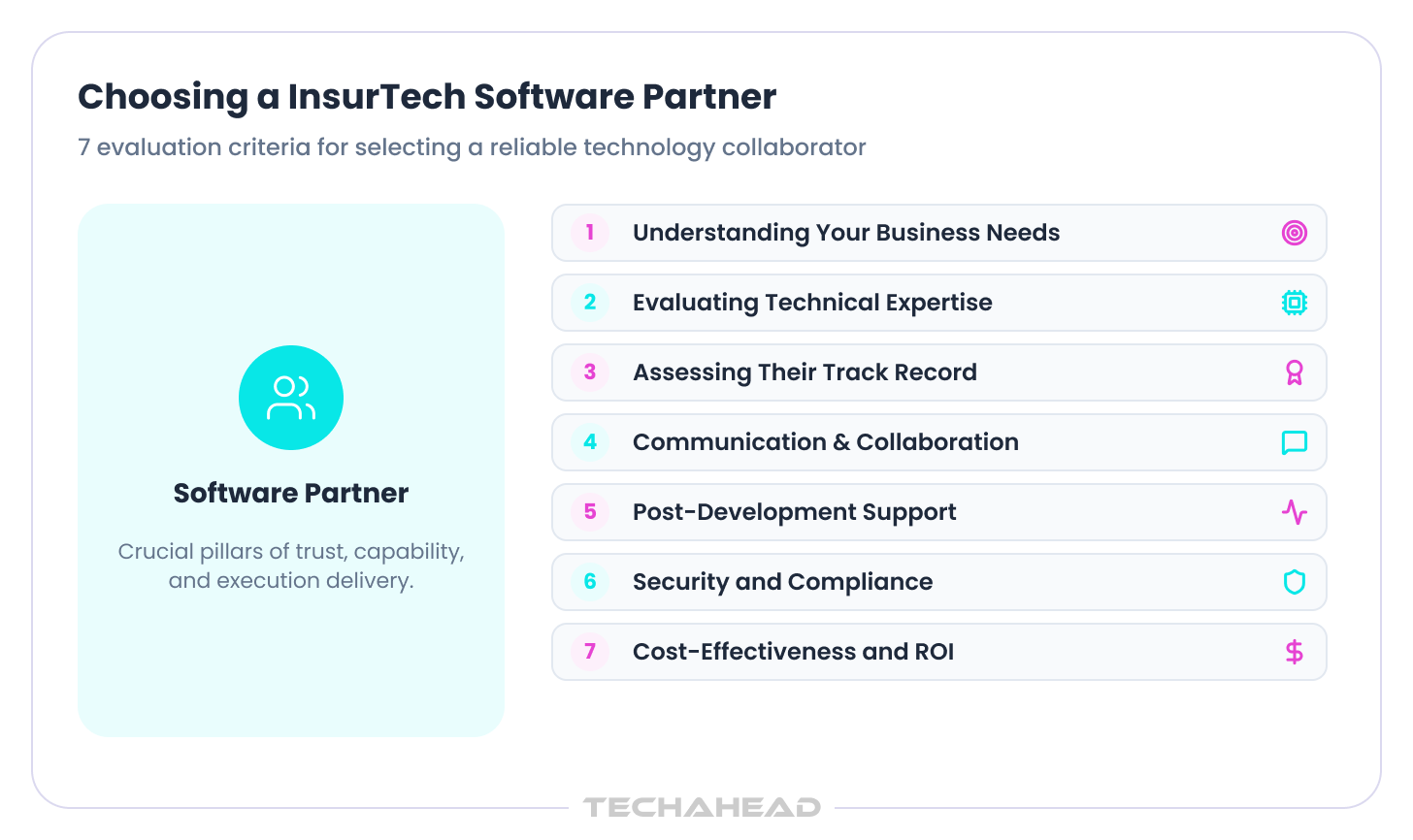
Hiring a development partner for an insurance platform is not the same as hiring one for a standard consumer application. Insurance deals with regulated personal and financial data, frequently operates on pre-cloud core systems, and increasingly depends on AI models that must withstand regulatory scrutiny rather than simply perform well in a demonstration. When comparing vendors, some factors matter more than others.
Domain and regulatory knowledge come first. A team that has never worked with GLBA, HIPAA, or state-level data residency restrictions will spend your budget studying the rules rather than developing your product. Ask for specific instances of how a vendor has handled compliance reviews and audit trails on previous insurance work, rather than a general declaration that they are “compliant by design.”
Core system integrations are just as important. Most carriers are not building a policy administration system from scratch. They require someone who can integrate new mobile experiences, claims tools, or AI technologies into an existing PAS, claims platform, or rating engine without disrupting what is presently working. A vendor with genuine knowledge of the fundamental system you use outperforms one that merely makes vague integration claims.
AI and telematics skills are increasingly becoming necessary rather than desirable. Machine learning for underwriting and fraud scoring, as well as IoT streaming pipelines for usage-based insurance, require engineers who understand data science and insurance logic. A vendor that can demonstrate an operational telematics pipeline or underwriting model is more valuable than one that can only discuss how it might hypothetically operate.
TechAhead has been building production software for enterprise clients for more than 16 years, and its insurance work reflects real carrier experience rather than a recent pivot into the space. The company holds SOC 2 Type II certification and an AWS Advanced Partnership, and its client roster includes AXA and regional carriers like Argo Texas. Its best-known insurance build is AXA Drive Easy, a roadside assistance platform for iOS and Android that automated 80% of critical customer data collection during emergency requests and cut response time by 80% through intelligent nearest-provider routing. TechAhead has also built multi-carrier policy comparison tools connecting agents and customers across more than 150 partnerships, which shows range beyond a single flagship project.
Key features: SOC 2 Type II and AWS Advanced Partnership certifications, proven telematics and roadside assistance engineering, and a cross-industry AI bench spanning healthcare and fintech alongside custom AI underwriting risk scoring work.
Best for: Carriers wanting an insurance mobile app development company with real production case studies rather than pitch-deck promises and a single partner for end-to-end insurance technology solutions.
Must Read: 80% faster roadside assistance for AXA customers
LeewayHertz’s insurance practice is built around generative AI for risk assessment, helping underwriters process applications faster and more consistently than manual review allows. The firm also works on parametric insurance, using smart contracts to automate payouts once a predefined condition, like a flight delay or a specific weather event, has been met. That combination of AI underwriting and blockchain-based products makes it a reasonable fit for carriers exploring both at once, though buyers should ask specifically for carrier-scale deployment examples rather than pilot-stage work.
Key features: Generative AI underwriting models, parametric insurance smart contracts, and blockchain-based automated payout logic.
Best for: Carriers experimenting with parametric products or looking to modernize underwriting with AI before touching their core system.
ScienceSoft’s insurance work centers on a problem most large carriers eventually run into: migrating a mainframe system built decades ago onto cloud-native microservices without disrupting live policy and claims operations. It’s slow, careful work that depends on deep legacy-systems experience as much as modern cloud skills. This isn’t the right fit for a carrier that just wants a new mobile feature added quickly, but for one staring down a genuine core system replacement, that patience is exactly the point.
Key features: Mainframe-to-cloud migration expertise, microservices architecture design, and minimal-downtime transition planning for live policy systems.
Best for: Carriers running on legacy core systems that need a full modernization rather than a feature add-on.
Itransition’s insurance practice focuses on integration work, connecting custom software to established platforms like Guidewire, Salesforce Financial Services Cloud, and SAP. For a carrier that’s already invested heavily in one of these core systems, a partner who specializes in extending that investment rather than replacing it can save both time and budget. The tradeoff is that this model works best when you already know which core platform you’re standardizing on.
Key features: Guidewire and Duck Creek-adjacent integration experience, Salesforce Financial Services Cloud connectors, SAP-based enterprise workflows.
Best for: Carriers standardized on a major core platform who need custom features layered on top without a rip-and-replace project.
Intellectsoft has built a name in usage-based insurance apps and the connected vehicle IoT pipelines that power them. This is the technical backbone behind pay-as-you-drive and pay-how-you-drive policies, a segment that keeps growing as more carriers look to reward safer driving with dynamic pricing. The work requires real experience streaming IoT data at scale, not just building a mobile app that displays a driving score to the customer.
Key features: Connected vehicle IoT pipelines, usage-based insurance scoring models, real-time telematics data streaming.
Best for: Carriers building or expanding a usage-based insurance product tied to connected vehicle data.
Chetu tends to serve carriers who need steady engineering capacity rather than a single large project. Its work spans custom API bridges, rating engine updates, and ongoing maintenance of existing policy administration systems. For a carrier that already has a working InsurTech stack and just needs a reliable team to keep extending and maintaining it, Chetu’s on-demand model is a lower-friction option than committing to a full platform rebuild.
Key features: On-demand engineering capacity, custom API bridge development, rating engine and PAS maintenance.
Best for: Carriers with an existing platform who need ongoing support and incremental upgrades, not a rebuild.
Eleks leans into analytics engineering, particularly around automated claim validation and fraud scoring. Claims fraud is one of the largest sources of avoidable payout for any carrier, and a predictive model that flags suspicious claims before they’re paid is a genuinely high-value use of AI in this industry. Carriers with a strong volume of historical claims data but no in-house data science team to use it are the clearest fit here.
Key features: AI-driven fraud detection models, automated claim validation workflows, predictive risk scoring built on historical claims data.
Best for: Carriers with substantial claims history looking to reduce fraud losses without building an internal data science function.
Software Mind focuses on self-service mobile experiences, building policyholder portals and digital First Notice of Loss tools meant to boost conversion and take pressure off the call center. As policyholders increasingly expect the same self-service ease from their insurer that they get from their bank or airline, a partner focused specifically on high-conversion mobile interfaces fills a real and growing gap for many carriers.
Key features: Self-service policyholder portal design, digital FNOL claims filing, cross-platform mobile experience optimization.
Best for: Carriers trying to reduce call center volume by moving policy and claims tasks into a mobile-first experience.
Apexon’s insurance practice focuses on AWS and Azure cloud modernization for brokers, MGA platforms, and underwriters. This kind of infrastructure work is foundational rather than flashy, but it’s often the prerequisite for everything else on this list. AI models, telematics pipelines, and mobile portals run better and cost less to operate on properly modernized cloud infrastructure than on a patched-together legacy stack.
Key features: AWS and Azure cloud migration for insurance workloads, MGA and broker platform modernization, and cost and performance optimization post-migration.
Best for: Brokers and MGAs whose infrastructure needs to catch up before any AI or mobile initiative can realistically launch.
ValueMomentum operates primarily as an IT consulting and modernization firm for commercial and personal line carriers, with deep familiarity with core insurance systems. Carriers who want a partner that blends strategic consulting with hands-on engineering, particularly around core system modernization, may prefer this more consulting-forward model over a pure development shop that expects you to arrive with a fully scoped project.
Key features: Core insurance systems consulting, commercial and personal lines modernization experience, and strategy-plus-engineering delivery model.
Best for: Carriers who need help defining the modernization roadmap itself, not just executing an already-scoped build.
Pricing for insurance software development varies widely depending on project scope, security requirements, and how deeply the solution needs to integrate with existing core systems. The table below reflects verified data from Clutch provider profiles.
| Development Provider / Scope | Hourly Rate Range | Average Project Size | Typical Deliverables Included |
| TechAhead (Global Agile Delivery) | $25 to $49 / hr | $25,000 to $250,000+ | Native mobile policy apps, AI claims processing, IoT telematics integration |
| North American Enterprise Firms | $100 to $150+ / hr | $100,000 to $500,000+ | Heavy mainframe modernizations, on-site enterprise consulting |
| Specialized AI and Blockchain Studios | $50 to $99 / hr | $50,000 to $300,000+ | Parametric insurance smart contracts, automated predictive risk engines |
The rate a vendor charges only tells part of the story. What actually drives your total cost is scope, and most insurance projects fall into one of three tiers.
An MVP or basic app, running roughly $25,000 to $50,000 over three to four months, typically covers basic policy viewing, digital ID access, a payment gateway, and simple push alerts. This tier fits a carrier or MGA validating a new digital product before committing to a full build.
A mid-tier portal and claims app, priced from $50,000 to $150,000 over five to seven months, adds First Notice of Loss filing, OCR-based document extraction, payment integrations, and agent-facing dashboards. Most carriers modernizing an existing policyholder experience land somewhere in this range.
An enterprise AI platform, starting around $150,000 and often exceeding $250,000 over eight to twelve months or more, brings together real-time telematics, custom AI underwriting models, automated fraud triage, and legacy PAS synchronization. This is the tier where the gap between an experienced insurance technology partner and a generalist development shop shows up most clearly, both in final cost and in how well the finished platform survives regulatory scrutiny down the line.
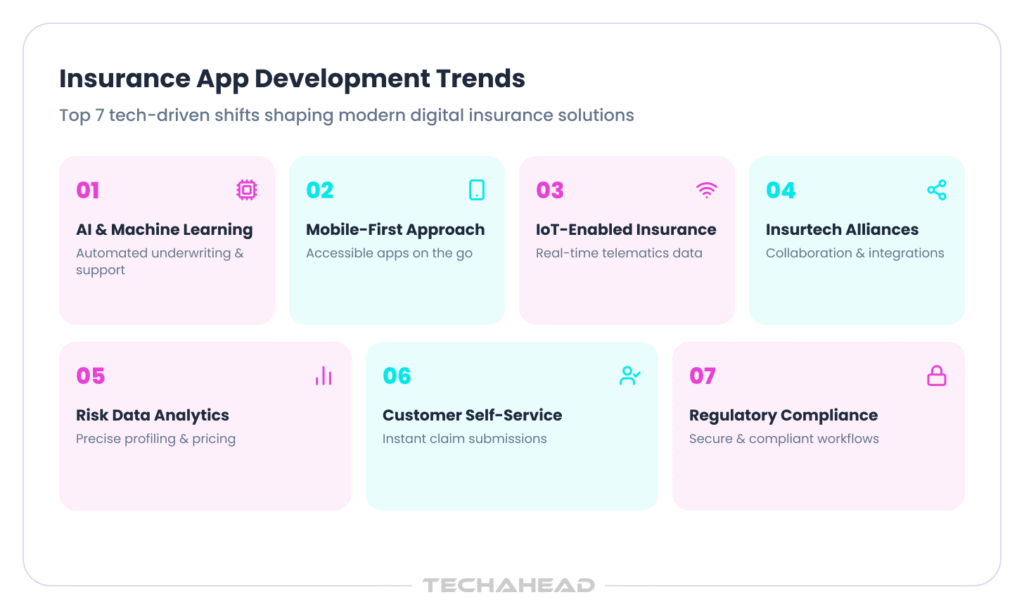
A few shifts are worth watching if you’re planning a build in the next twelve months, because they’ll affect what you ask vendors for.
AI underwriting is transitioning from pilot to default. A few years ago, most carriers used AI models alongside human underwriters as a check. More people are now trusting automatic decision-making for uncomplicated policies, with human evaluation reserved for borderline instances. If you’re investigating an InsurTech software development business, ask how their models handle explainability, as regulators in numerous states require carriers to justify AI-driven denials in clear terms. Formal AI vendor qualifications are also worth investigating. TechAhead, for example, is a registered OpenAI Services Partner, which means that its underwriting and claims AI work is based on direct access to OpenAI’s model roadmap and technical resources, rather than a general API interface added later.
Must Read: TechAhead Is Now an OpenAI Services Partner: What It Means for Enterprise AI Adoption
Embedded insurance is growing beyond automobile and travel. Purchasing a policy is becoming more common at the same time as making another transaction, like renting a car, purchasing gadgets, or scheduling a gig-economy job. That trend is driving more carriers to adopt API-first design, because embedded goods rely on how readily they can integrate into someone else’s checkout cycle.
Claims are growing faster as the front end gets smarter. OCR, computer vision for damage assessment, and automated document extraction eliminate the need for human procedures in the First Notice of Loss process. A claim that used to take an adjuster days to analyze may now receive a preliminary estimate in minutes, which is critical for client retention after what is often a traumatic event.
And security requirements continue to rise. As more insurance data flows through third-party APIs and cloud infrastructure, SOC 2 Type II and comparable certifications are becoming a standard demand in RFPs. Avoid any vendor that still considers security certification optional.
The carriers pulling ahead in 2026 aren’t necessarily the ones with the biggest technology budgets. They’re the ones who picked a development partner capable of moving quickly without cutting corners on security, compliance, or system reliability. Whether the priority is a fraud detection model, a telematics-based pricing engine, or a mobile experience policyholders will actually want to use, the right InsurTech software development company should be able to show production evidence that they’ve solved this exact problem before, not just a slide deck promising they can.
If you’re ready to scope your next insurance technology initiative, TechAhead’s InsurTech solutions team offers a custom discovery session and technical roadmap built around your specific core systems, compliance requirements, and growth goals.
InsurTech software development typically costs $25,000–$50,000 for an MVP, $50,000–$150,000 for a mid-tier claims or policyholder platform, and $150,000–$250,000+ for enterprise AI, telematics, and legacy-system modernization. The final cost depends on features, integrations, security requirements, and project complexity.
InsurTech development companies provide services including insurance app development, AI software development, claims automation, digital FNOL, fraud detection, telematics integration, policy management, cloud modernization, API development, and legacy system integration.
AI can automate and improve insurance underwriting, risk scoring, fraud detection, claims triage, document processing, damage assessment, and predictive analytics. Modern insurance platforms can use AI to accelerate decisions while keeping human review for more complex cases.
Look for insurance domain expertise, regulatory and security knowledge, core-system integration experience, AI and telematics capabilities, cloud expertise, and proven production-level insurance projects. The right partner should be able to demonstrate how it has solved similar insurance technology challenges before.
A basic insurance application can take around 3–4 months, while a mid-tier policyholder or claims platform may take 5–7 months. Enterprise InsurTech platforms involving AI, telematics, and legacy-system synchronization can take 8–12 months or longer.
InsurTech developers typically use APIs, microservices, integration layers, and cloud architecture to connect new applications with existing policy administration systems, claims platforms, rating engines, and other core insurance infrastructure. This allows insurers to modernize customer-facing and AI capabilities without immediately replacing their entire core system.
The biggest InsurTech trends include AI-powered underwriting, automated claims processing, embedded insurance, telematics and usage-based insurance, API-first platforms, cloud modernization, and AI-powered fraud detection. These technologies are helping insurers improve pricing, claims efficiency, customer experience, and operational scalability.
We use cookies to ensure our website functions properly, improve performance, and provide a personalized experience. You can choose which types of cookies to allow below.
Required for core functionality such as security, network management, and accessibility. These cannot be disabled.
Help us understand site traffic and user interactions so we can improve performance and usability.
Enable enhanced functionality and personalization such as language or region preferences.
Used to deliver relevant ads, track campaign performance, and measure advertising effectiveness.