


 Copy Link
 Share on X
 Share on Facebook
 Share on LinkedIn




Always Active
Required for core functionality such as security, network management, and accessibility. These cannot be disabled.

Uncover the transformative potential of digital and mobile solutions for your industry.





 Last Updated: Oct 23, 2026
Aug 16, 2026
Last Updated: Oct 23, 2026
Aug 16, 2026  288
288  18 min. Read


Key Takeaways
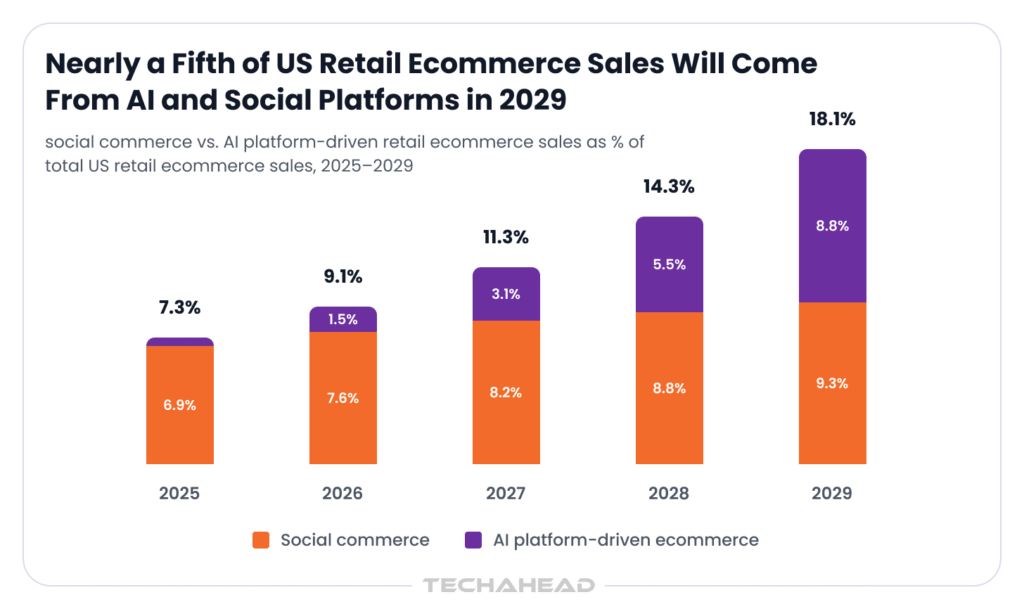
According to eMarketer, online transactions currently make up more than 21% of all retail expenditure globally, and global ecommerce sales are expected to reach $6.88 trillion in 2026. About 60% of that volume is driven solely by mobile commerce, and AI has evolved from an experimental feature to a top strategic objective for ecommerce companies this year, with adoption rates above 80%, according to a poll. Any firm looking for an ecommerce software development company is entering this environment: there are many opportunities, but there are also significant technical risks in getting the build right.
You’ve undoubtedly already realized that the traditional approach of choosing a platform, hiring a developer, and opening a shop is no longer effective if you’re now assessing ecommerce development firms. According to research from the Baymard Institute, a competitive storefront in 2026 must manage smart product discovery, mobile-first shopping, real-time inventory across channels, and payment and checkout systems that don’t bleed customers at the finish line (the average cart abandonment rate still hovers around 70%). It also requires connectors that link the storefront to the fulfillment, CRM, and ERP systems that now run the business. Businesses are no longer looking for a website. They are looking for a technological environment, and the ecommerce software development firm they choose will decide whether that ecosystem grows with them or needs to be rebuilt in two years.
This list was created just for that search. It’s a shortlist for companies looking for a real ecommerce development partner, one that can manage platform migrations, custom ecommerce software development, personalization, and the integration work that transforms an online store into a functioning business rather than just a page that shows products. It’s not just another generic agency directory. To help businesses balance boutique attention with enterprise scale, it also includes specialty shops and some of the major international engineering and consulting organizations now engaged in commerce. TechAhead is at the top of the list, and for good reason: instead of treating mobility, customization, and integration depth as add-ons, it builds them into the ecommerce platform itself.
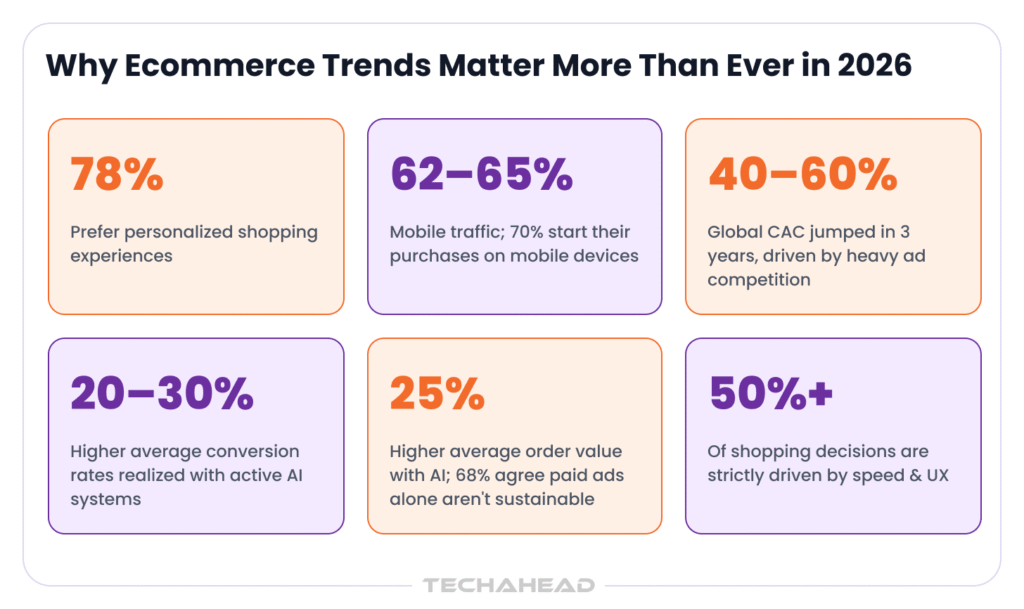
This choice matters more now than it did before because of the market data mentioned above, which is more than background information. This year, three factors are changing the definition of “good” ecommerce software.
Mobile has become the default channel, not a secondary one. A shop that ignores mobile is already losing most of its prospective consumers, because mobile devices currently account for about 60% of ecommerce transactions. Mobile-friendly checkout and ecommerce app development are becoming standard needs rather than premium extras.
Must Read: From Concept to Reality: Developing an App Like Amazon
Smart personalization has crossed from experimental to expected. Whether it’s automated customer service, visual search, or product suggestions, most ecommerce companies have already integrated machine-learning-driven customization into their stack, and most consider it a key strategic goal for the upcoming year. If a custom ecommerce development partner can’t include that level of customization in the platform, they are losing out to rivals who can.
Checkout friction is still the single biggest revenue leak in ecommerce. The majority of the traffic a firm strives to generate never converts if the cart abandonment rate is more than 70%. System performance, checkout user experience, and payment integration are more than aesthetics; they determine whether a marketing budget succeeds or fails.
Together, these patterns indicate that a corporation hiring an ecommerce software development firm is doing more than creating a store. It involves deciding whether smart customization, integration depth, and mobile-first design are included in the tech stack from the start or added two years later, requiring an expensive rebuild. This list, which starts with the businesses most qualified to do so, is intended to help bridge that gap.
| Company | Best For | Key Ecommerce Capabilities |
| TechAhead | Custom ecommerce software | AI-powered commerce, mobile and web apps, integrations |
| Elogic Commerce | Adobe Commerce and Magento enterprise builds | ERP integrations, Shopify Plus, headless commerce |
| Brainvire Infotech | Enterprise Adobe Commerce and ERP integration | Odoo, CRM for commerce, omnichannel platforms |
| EPAM Systems | Large-scale enterprise commerce engineering | Composable commerce, Adobe Commerce, global delivery |
| Publicis Sapient | Enterprise digital transformation and composable commerce | Commerce strategy, experience design, cloud migration |
| N-iX | Large-scale retail software engineering | Recommendation engines, demand planning, pricing systems |
| Zoolatech | Complex, multi-platform custom commerce | Marketplaces, headless systems, PIM/OMS integration |
| eSparkBiz | Conversion-focused store builds and migrations | Magento, Shopify, headless migrations, UX optimization |
| Elsner Technologies | AI-powered Magento development | AI personalization, Magento development, digital marketing |
| IntexSoft | Precision custom coding for complex catalogs | Custom development, data platforms, ecommerce optimization |
For companies that have surpassed what an off-the-shelf platform can do on its own, exactly the gap shown by the market statistics above, TechAhead develops ecommerce software. Based in Agoura Hills, California, the company specializes in AI-powered product discovery, unified payments and checkout, order management, omnichannel commerce, marketplace development, loyalty and subscription systems, and web platforms. Because of this combination, TechAhead is a good choice for companies who want their backend operations, mobile app, and storefront to work together as a single system rather than as a collection of separate plugins.
Retailers looking for a partner for a headless commerce architecture, a Shopify, Magento, BigCommerce, or WooCommerce deployment, or a bespoke build from the ground up will find a team that anticipates scale and customization from the start rather than retrofitting later. Businesses ready to discuss a specific project can contact TechAhead’s ecommerce development team directly to scope it.
Key services:
Best for: Businesses that need a custom-built ecommerce ecosystem spanning web, mobile, and AI rather than a single platform storefront.
Elogic Commerce has focused only on ecommerce for 17 years, as seen by the breadth of its platforms. With proven ERP connectors into SAP, Microsoft Dynamics 365, NetSuite, and Salesforce CRM, the company develops across five enterprise platforms: Adobe Commerce, Shopify Plus, Salesforce Commerce Cloud, BigCommerce, and commercetools. With a flawless customer rating across numerous verified evaluations, it ranks #1 in Clutch’s independently published Leaders Matrix for Magento and Adobe Commerce development services.
Elogic’s expertise in Shopify Plus B2B delivery sets it apart from generalist firms who handle B2B as an afterthought for corporate B2B sellers with sophisticated needs, such as tiered pricing, account portals, and PunchOut catalogs.
Key services:
Best for: Enterprise B2B and B2C brands that need deep Adobe Commerce or Shopify Plus expertise with heavy ERP integration.
Brainvire brings over two decades of ecommerce delivery to enterprise clients, with a service list that spans Adobe Commerce, Magento, Shopify, BigCommerce, and WooCommerce, alongside Odoo ERP implementation and CRM for commerce. The company holds Adobe Gold Partner and Shopify Partner status and has built a large team dedicated to full-stack ecommerce, mobile app development, and AI-enhanced commerce tooling.
What sets Brainvire apart is the breadth of its integration work. Retailers dealing with fragmented systems, separate inventory tools, disconnected CRM platforms, and manual order processes tend to get the most value from Brainvire’s approach, since the firm treats ERP and CRM integration as central to the ecommerce build rather than a separate project.
Key services:
Best for: Enterprise retailers that need ecommerce development tightly integrated with ERP, CRM, and analytics systems.
One of the most well-known companies on this list is EPAM Systems, a multinational digital platform engineering company with tens of thousands of workers and growth recognized by Fortune. It has elite or gold partner status with most major business commerce suppliers, and its commerce practice includes Adobe Commerce, SAP Commerce Cloud, BigCommerce, and composable platforms like commercetools. Brands like Liberty Global and HEAD have been among EPAM’s clients, and the company often works on full digital experience platforms rather than just the storefront layer.
For major businesses whose ecommerce project feels more like a multi-year platform update than a single build, EPAM is a strong choice because of its scalability. Unlike smaller boutique organizations, businesses that need massive engineering capacity, extensive certifications across composable and headless commerce providers, and a partner comfortable managing complex, worldwide rollouts will find EPAM equipped for that scope.
Key services:
Best for: Large global enterprises that need commerce engineering at a scale most boutique agencies can’t match.
As the technology division of Publicis Groupe, one of the world’s largest advertising and consulting holding companies, Publicis Sapient’s business practices match its size. The company has developed unique AI platforms to update historical commerce backbones for merchants running at substantial volume, and its SPEED framework—Strategy, Product, Experience, Engineering, and Data—structures how it handles commerce transformation for major global brands.
The best match here is for companies that want more than just a development team, such as those seeking strategy consulting, experience design, and engineering combined into a single enterprise transformation partner. Large stores with the funding and complexity to support it are the best candidates because it requires more involvement than most companies on our list.
Key services:
Best for: Large retailers that want commerce strategy, experience design, and engineering handled by one enterprise-scale partner.
With thousands of computer experts providing long-term software for retailers for more than 20 years, N-iX operates at a different scale than most agencies on our list. N-iX focuses on the systems that operate behind the storefront, such as search and recommendation engines, competitive pricing tools, demand planning, and out-of-stock prevention, rather than just storefront construction.
Because of its backend emphasis, N-iX is a great option for retailers whose main problem isn’t the shopping cart itself but rather the operational intelligence around it. This is especially true for large or multi-market shops that require unique systems designed to manage volume and complexity that most off-the-shelf technologies can’t support.
Key services:
Best for: Large or multi-market retailers that need custom backend systems, not just a storefront.
Zoolatech focuses on a particular issue: ecommerce platforms that were initially straightforward but became more complex as the company added marketplaces, wholesale channels, subscriptions, new payment methods, and other systems. With expertise in managing high-volume platforms, its work includes bespoke commerce, marketplace development, headless architecture, and connectors across PIM, OMS, and payment systems.
The best candidates for Zoolatech’s strategy are companies that have outgrown a single-platform arrangement, particularly those managing several sales channels or preparing for a replatform after years of accrued technological debt.
Key services:
Best for: Businesses managing multiple sales channels or replatforming after outgrowing their original ecommerce setup.
With over 15 years of expertise, eSparkBiz builds its ecommerce practice on quantifiable results, including bespoke store creation, third-party API integration, headless commerce transitions, UX optimization, and intelligent product customization. The business has credentials that bolster organizational reputation and has been acknowledged as one of Clutch’s top software development firms worldwide.
eSparkBiz’s UX-first approach to ecommerce development offers a helpful contrast to companies that prioritize platform work over design for retailers more concerned with conversion rate and customer retention than the technical construct itself.
Key services:
Best for: Businesses prioritizing conversion rate and customer experience alongside the technical platform build.
With over twenty years of expertise, Elsner Technologies has established itself as a leading Magento development business. With a sizable in-house development team, its ecommerce solution has grown to incorporate AI-powered capabilities that scale from modest budgets to enterprise complexity.
Elsner provides a platform-specific alternative to more generalist companies for companies rooted in the Magento or Adobe Commerce environment but also needing clever features like customization and automated merchandising built in.
Key services:
Best for: Magento-focused businesses that want intelligent personalization built into their platform.
IntexSoft’s clientele has focused on large-scale projects that integrate intelligent data platforms with ecommerce optimization, suggesting the company is comfortable working where data engineering and commerce intersect. It is a good fit for companies whose ecommerce needs are more about bespoke logic, data pipelines, and long-term code quality than a quick platform launch, given its reputation for strict coding standards over volume.
Key services:
Best for: Businesses with data-heavy catalogs or custom business logic that need precise, maintainable code over a quick template build.
Choosing an ecommerce partner is a long-term commitment, so we built this list around criteria that go beyond a polished portfolio.
Ecommerce development companies rarely do just one thing, and understanding the full range of services helps clarify what to ask for during vendor evaluation.
Custom ecommerce development covers ground-up builds for businesses whose requirements don’t fit neatly into an existing platform’s constraints.
Ecommerce mobile app development is becoming nearly mandatory as mobile shopping continues to grow its share of transactions. TechAhead’s guide to ecommerce app development breaks down what a mobile commerce build actually involves, from architecture decisions through launch.
Ecommerce web development remains the foundation for most storefronts, whether built on an established platform or from scratch.
Marketplace development supports businesses building multi-vendor platforms rather than a single-brand store.
Headless ecommerce development decouples the frontend from the backend, giving businesses more flexibility to change how their store looks and behaves without rebuilding the whole system.
Ecommerce platform migration covers the technically delicate work of moving a live store from one platform to another without losing data, SEO rankings, or uptime.
Payment gateway integration connects the storefront to the payment processors and financial systems a business relies on.
AI-powered ecommerce development now touches nearly every part of the stack, from product recommendations to automated customer support.
Ecommerce automation reduces manual work across customer support, order processing, and marketing. TechAhead’s view on ecommerce automation focuses on how automation can turn customer support interactions into sales opportunities, not just cost centers.
| Approach | Best For | Key Consideration |
| Shopify | Fast D2C launches | Speed and simplicity |
| WooCommerce | Flexible, WordPress-based businesses | Customization |
| Magento / Adobe Commerce | Complex commerce | Enterprise capabilities |
| BigCommerce | Growing businesses | Platform scalability |
| Custom ecommerce software | Unique or complex requirements | Maximum flexibility |
When Should You Choose Custom Ecommerce Software?
Off-the-shelf platforms work well until a business runs into requirements the platform simply wasn’t built for. Custom software tends to make sense when a business has complex business logic that standard workflows can’t accommodate, unique purchasing processes, a marketplace model connecting multiple vendors, deep enterprise integrations, advanced personalization needs, true omnichannel requirements, high transaction volume, or a customer experience the business wants to own outright rather than build within someone else’s constraints. TechAhead’s roundup of ecommerce app development platforms is a useful starting point for weighing platform trade-offs before committing to a custom build.
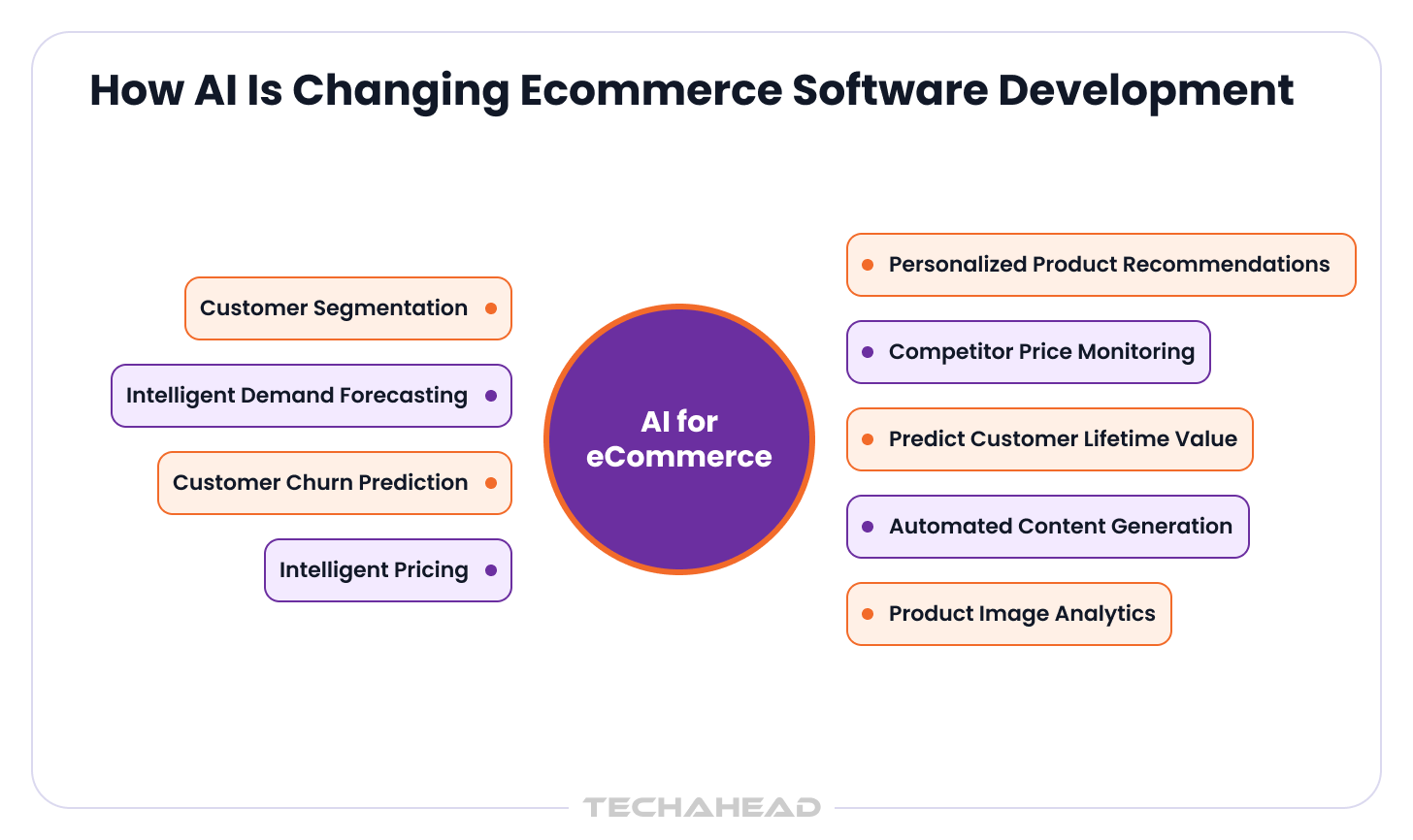
A handful of capabilities now separate a modern storefront from a dated one. Smarter product discovery helps shoppers find relevant products using behavioral signals instead of static category filters. Visual search lets customers search with an image instead of a keyword, closing the gap between how people browse and how they search, an approach TechAhead breaks down in its piece on AI visual search for ecommerce. Personalized recommendations tailor suggestions to individual shopping behavior rather than showing every visitor the same storefront, while automated customer support handles routine questions without adding headcount, freeing human teams for harder cases.
The newest layer is agentic and zero-click commerce, where software can complete a purchase on a customer’s behalf with minimal manual input. TechAhead’s article on zero-click shopping looks at how autonomous buying is starting to change purchase behavior, and it’s part of the broader shift toward digital transformation in ecommerce that most retailers are now navigating, whether they’re ready for it or not.
Cost, trend-chasing, and vendor checklists all matter, but they’re secondary to one question:
Does this partner build software for where ecommerce is headed or where it was five years ago?
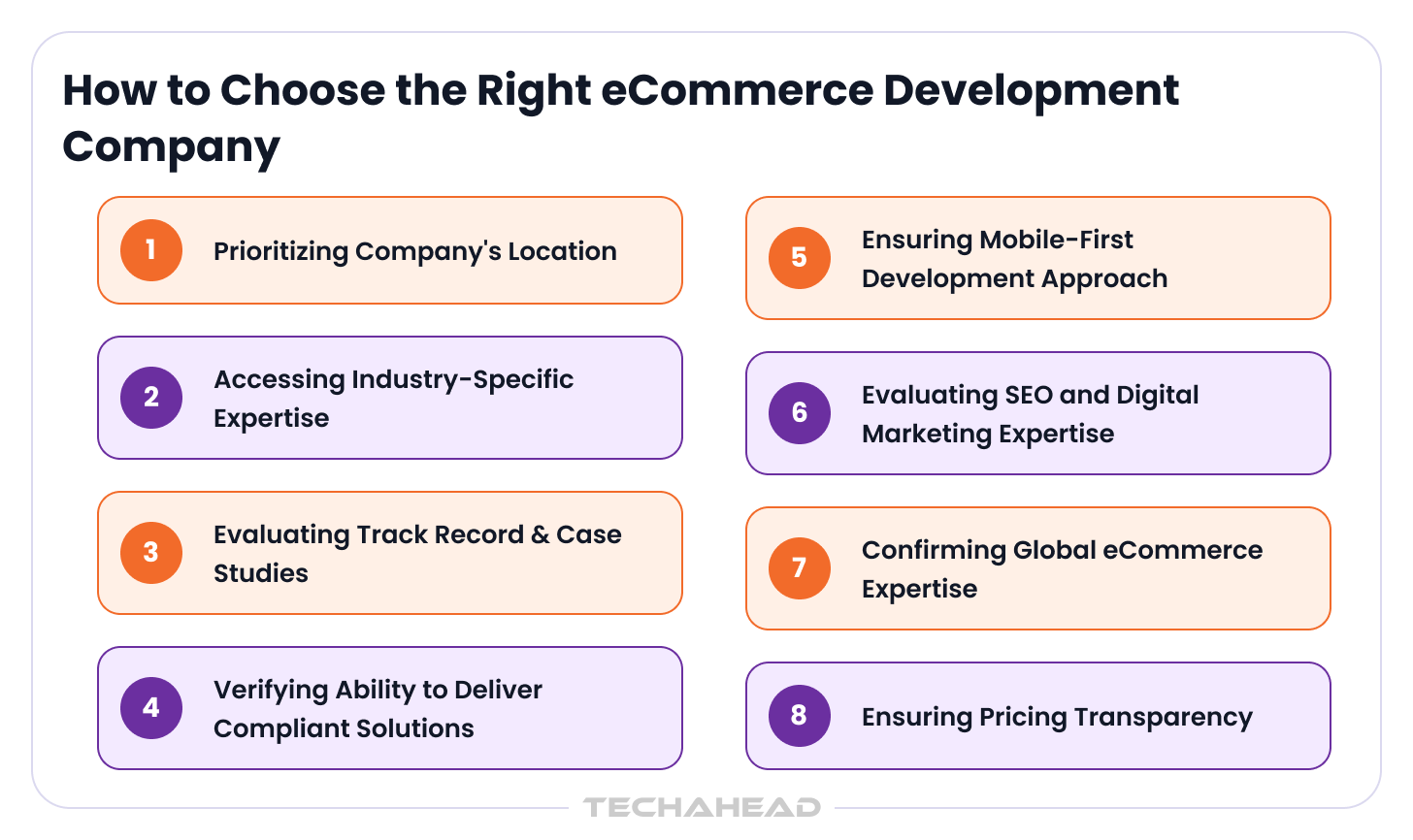
A few things worth confirming before signing with anyone on this list: get specific about requirements before requesting proposals, and verify real experience with the platform or custom stack the project needs; review case studies of similar scale and complexity; ask directly about ERP and CRM integration experience; confirm the company builds for future growth and security rather than just launch day; and compare long-term support terms as closely as the initial quote. Cost will vary with project complexity, platform choice, custom features, mobile app scope, integrations, and ongoing maintenance, so treat any quote that skips those variables with some skepticism.
With ecommerce sales heading toward $6.88 trillion this year and mobile, personalization, and checkout performance deciding who captures that growth, the businesses that win aren’t necessarily the ones with the biggest ad budget. They’re the ones whose ecommerce software was built to handle where the market is going. TechAhead checks every box above: custom ecommerce software development, native mobile commerce apps, personalization built in from day one, and the payment, ERP, and CRM integrations that keep checkout friction and cart abandonment from eating into revenue.
An ecommerce software development company builds custom ecommerce websites, mobile apps, marketplaces, platforms, integrations, and digital commerce solutions tailored to a business.
The top ecommerce software development companies featured in this guide include TechAhead, Elogic Commerce, Brainvire Infotech, EPAM Systems, Publicis Sapient, N-iX, Zoolatech, eSparkBiz, Elsner Technologies, and IntexSoft.
The cost depends on platform choice, project complexity, custom features, integrations, mobile app requirements, and ongoing maintenance. Complex ecommerce platforms typically require significantly more development than standard storefronts.
Ecommerce development services can include custom ecommerce software development, ecommerce app development, web development, marketplace development, headless commerce, platform migration, payment gateway integration, AI development, and ecommerce automation.
Custom ecommerce development makes sense when standard platforms cannot support complex business logic, marketplace functionality, advanced personalization, deep integrations, omnichannel requirements, or high transaction volumes.
Headless ecommerce separates the frontend customer experience from the backend commerce system, giving businesses greater flexibility to build and change digital shopping experiences.
AI is enabling personalized product recommendations, smarter product discovery, visual search, automated customer support, and emerging zero-click and agentic commerce experiences.
Evaluate the company’s ecommerce expertise, technology stack, platform experience, integration capabilities, scalability, relevant portfolio, and long-term support before selecting a development partner.
We use cookies to ensure our website functions properly, improve performance, and provide a personalized experience. You can choose which types of cookies to allow below.
Required for core functionality such as security, network management, and accessibility. These cannot be disabled.
Help us understand site traffic and user interactions so we can improve performance and usability.
Enable enhanced functionality and personalization such as language or region preferences.
Used to deliver relevant ads, track campaign performance, and measure advertising effectiveness.