


 Copy Link
 Share on X
 Share on Facebook
 Share on LinkedIn
Always Active
Required for core functionality such as security, network management, and accessibility. These cannot be disabled.

Uncover the transformative potential of digital and mobile solutions for your industry.





 Last Updated: Sep 16, 2026
Aug 4, 2026
Last Updated: Sep 16, 2026
Aug 4, 2026  350
350  17 min. Read


Key Takeaways


Selecting a blockchain development company could seem simple until you start comparing suppliers. Many companies promise scalable apps, Web3 development, smart contracts, and secure blockchain solutions. The harder question is whether they have the engineering depth, industry expertise, and technological know-how to produce a blockchain product that works beyond the prototype stage.
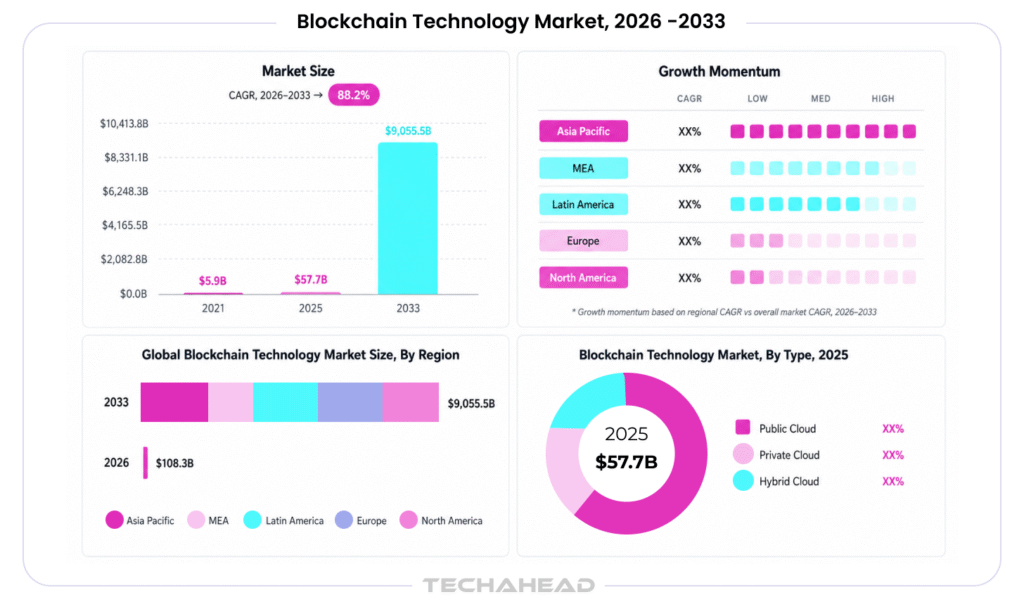
As companies integrate blockchain technology into practical applications like digital payments, asset tokenization, supply chain management, decentralized identification, and enterprise data interchange, this distinction becomes increasingly important. Grand View Research projects that the worldwide blockchain technology industry was valued at USD 57.7 billion in 2025 and is projected to grow from USD 108.3 billion in 2026 to USD 9,055.5 billion by 2033, growing at a CAGR of 88.2% from 2026 to 2033.
However, market expansion is only one factor to consider for a company assessing blockchain development services. Finding a development partner who can select the best blockchain architecture, integrate it with current systems, create secure smart contracts, handle regulatory requirements, and maintain the product as it grows is the most important choice.
To help you narrow down your options before making a hiring decision, this article analyzes the top 10 blockchain development firms in 2026 based on their blockchain knowledge, services, industry experience, technological skills, and fit for various project types.
The perfect blockchain partner should do more than simply develop smart contracts and dApps. Businesses need a development team that can integrate blockchain technology with a real product, existing procedures, and long-term business goals.
When comparing blockchain development companies, look for these core capabilities:
Businesses must understand where blockchain truly fits before development can start. Blockchain consultancy may assist with use case analysis, technology selection, architectural definition, and development roadmap creation.
For organizations adopting blockchain across business operations, enterprise blockchain development focuses on secure, scalable networks that can work with existing infrastructure and support business-critical workflows.
Complex business requirements are rarely met by off-the-shelf solutions. With custom blockchain app development, businesses can create apps tailored to specific workflows, users, connectors, and security needs.
Smart contracts can automate transactions and corporate procedures, but they must be properly planned and tested. Seek out developers who can manage the creation, testing, auditing, and deployment of smart contracts within the same project.
Companies creating decentralized goods could require dApp development with scalable backend infrastructure, blockchain connections, wallet connectivity, and user identification.
Real-world assets can be transformed into digital representations through tokenization so they can be issued, controlled, transferred, or exchanged on blockchain networks. For financial services, real estate, digital assets, and other ownership-based use cases, asset tokenization development is very pertinent.
Seldom does an enterprise blockchain function independently. Without disrupting essential business processes, a competent partner should be able to connect blockchain networks with databases, ERP platforms, payment systems, APIs, and existing enterprise applications. For instance, TechAhead focuses on using middleware and APIs to integrate blockchain with databases, ERP systems, and legacy systems.
From the design of smart contracts to their implementation and monitoring, security should be considered at every stage of development. To monitor transactions, network activity, and application performance, businesses should also consider using blockchain data analytics.
To put it briefly, don’t choose a blockchain development business based just on how many technologies are featured on its website. Seek a partner who can handle all aspects of your project, including strategy, architecture, development, integration, security, deployment, and continuing maintenance.
The businesses listed below were chosen based on their capacity to serve various blockchain use cases, breadth of services, technological know-how, industry experience, and blockchain development skills. Rather than viewing all providers as interchangeable, each business is highlighted based on the kind of blockchain project it is most qualified to manage.
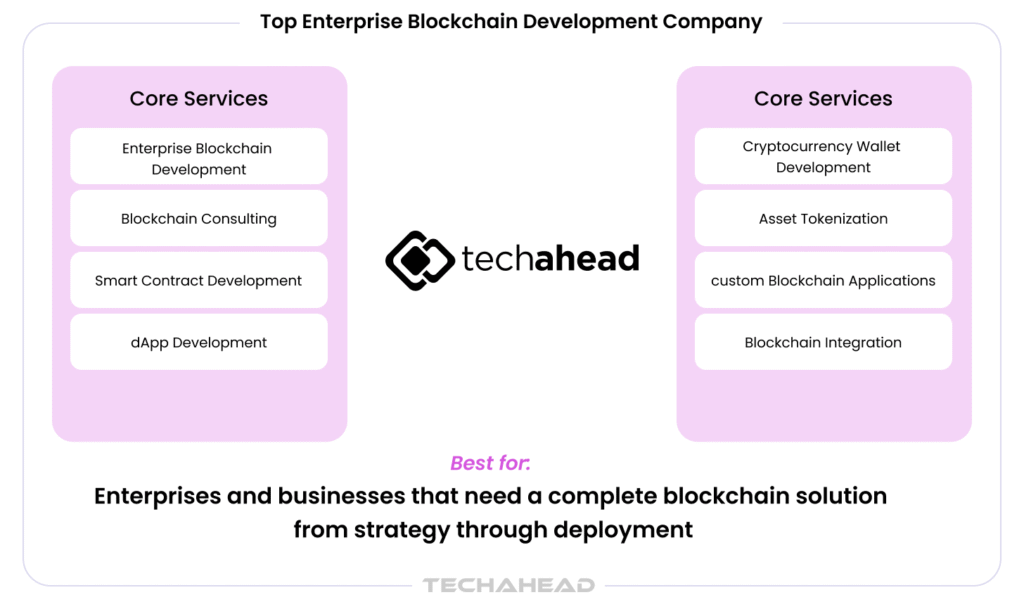
TechAhead is a U.S.-based technology company that offers blockchain development services to startups, large corporations, and companies wishing to incorporate decentralized technology into their operations and products.
Its blockchain skills span the whole development lifecycle, including custom blockchain app development, smart contracts, dApps, asset tokenization, security, testing, deployment, and continuous maintenance, in addition to blockchain technology design and consultancy. Additionally, Ethereum, Hyperledger Fabric, Polygon, Binance Smart Chain, and Solana are among the platforms that TechAhead works with.
Its emphasis on integrating blockchain with current corporate infrastructure is a crucial distinction. Its services, which include blockchain integration with databases, ERP platforms, middleware, APIs, and legacy systems, make it useful for businesses that need more than a stand-alone Web3 application.
Key services: Enterprise blockchain development, blockchain consulting, smart contract development, dApp development, asset tokenization, custom blockchain applications, blockchain integration, cryptocurrency wallet development
Best for: Enterprises and businesses that need a complete blockchain solution from strategy through deployment
Dreamers Inc. is a blockchain engineering studio specializing in protocol development, validator infrastructure, DeFi systems, MEV solutions, Solana development, and custom Web3 products. The company works extensively at the infrastructure layer, helping organizations build and operate performance-critical blockchain systems.
Their expertise spans both application-level development and the underlying infrastructure that powers modern Web3 ecosystems, making them a strong choice for organizations building scalable blockchain products and execution-sensitive systems.
Key Services: Blockchain Consulting & Architecture, Smart Contract Development, Protocol & Blockchain Engineering, Solana Development, DeFi Protocol Development, Validator Infrastructure, RPC Infrastructure, Web3 Product Development, Security & Infrastructure Audits, Custom Blockchain Solutions
Best for: Projects requiring expertise across blockchain infrastructure, protocols, and Web3 applications.
Goji Labs combines software development, UX/UI design, and product strategy in a product-focused approach to technology development. Its blockchain work focuses on helping companies turn complex technical ideas into practical digital products.
Because of this, the firm is especially relevant to companies that need help not just with blockchain engineering but also with long-term product strategy, MVP development, product discovery, and user experience. Goji Labs is now listed by DesignRush as one of its blockchain development businesses in the United States.
Key services: Blockchain development, product strategy, UX/UI design, Web3 development, custom software development
Best for: Businesses that need product strategy and blockchain development under one partner
EY provides blockchain consulting and technology services as part of its broader enterprise transformation practice. Its blockchain capabilities cover strategy, opportunity assessment, platform architecture, vendor integration, smart contract testing, and enterprise blockchain implementation.
Its approach is particularly suited to organizations that need to evaluate blockchain use cases, develop a transformation roadmap, and move from proofs of concept to larger implementations integrated with existing business processes.
Key services: Blockchain consulting, enterprise blockchain solutions, blockchain strategy, smart contract testing, platform integration, digital asset strategy
Best for: Large enterprises seeking blockchain consulting, implementation, and transformation support
Deloitte offers blockchain and digital asset services focused on helping organizations evaluate, develop, and implement blockchain-based business solutions. Its capabilities span blockchain transformation, digital assets, crypto payments, asset tokenization, exchange systems, custody solutions, and regulatory compliance.
With blockchain capabilities across industries including financial services, healthcare, real estate, manufacturing, and government, Deloitte is well suited to businesses navigating complex blockchain adoption and digital asset requirements.
Key services: Blockchain transformation, digital asset solutions, asset tokenization, crypto payments, blockchain implementation, regulatory and risk consulting
Best for: Enterprises looking for blockchain transformation, digital asset strategy, and large-scale implementation support
As part of its larger technological portfolio, ScienceSoft, a reputable IT consulting and software development firm, offers blockchain development. Use cases include smart contracts, digital assets, secure data sharing, and business blockchain solutions, all covered by its blockchain capabilities.
Businesses where blockchain is just one part of a bigger digital transformation or corporate application may benefit from its broader software engineering foundation.
Key services: Blockchain consulting, blockchain software development, smart contracts, Hyperledger solutions, blockchain integration
Best for: Mid-sized and large organizations that need blockchain alongside broader enterprise software capabilities.
For businesses developing blockchain-based solutions, PixelPlex offers unique blockchain development and consulting services. Its skills include Web3 products, tokenization, smart contracts, blockchain applications, and cryptocurrency solutions.
The business is especially well-suited to projects that need a bespoke technological architecture rather than an off-the-shelf blockchain implementation.
Key services: Custom blockchain development, smart contracts, tokenization, Web3 development, blockchain consulting
Best for: Businesses requiring tailored blockchain architecture and development
Aetsoft’s blockchain development services cover applications, smart contracts, tokenization, and Web3 solutions. The business may be a good fit for companies in need of a development team for a specific blockchain product because of its expertise working across several blockchain use cases.
Aetsoft has greater visibility in the blockchain services industry since it is included in current blockchain development rankings.
Key services: Blockchain development, Web3 development, smart contracts, tokenization, dApp development
Best for: Businesses and startups building blockchain or Web3 products
RedDuck is a specialized blockchain development firm that develops blockchain solutions, decentralized applications, and smart contracts. According to Clutch’s July 2026 U.S. blockchain rankings, RedDuck’s services are 100% blockchain-focused and have a 5.0 rating based on 14 reviews.
Because of its specialization, it is a very pertinent choice for companies that already have a well-defined Web3 product concept and require specialized blockchain technical knowledge.
Key services: Smart contract development, dApp development, blockchain solutions, Web3 development
Best for: Web3 startups and businesses requiring specialized smart contract or dApp development
4soft is a software development firm with expertise in Web3 and blockchain technologies. Its services target businesses seeking technical support for blockchain platforms, decentralized apps, and other emerging-technology products.
The business is a relevant supplier to consider when comparing specialist blockchain engineering teams because it is listed in current blockchain development rankings.
Key services: Blockchain development, Web3 development, dApp development, smart contracts, software engineering
Best for: Startups and businesses looking for blockchain engineering expertise
Making a shortlist of blockchain development firms is only the beginning. The ideal partner will depend on what you are doing, the complexity of the solution, and your post-launch goals for the product.
For a business integrating blockchain with its current systems, a company that excels at Web3 and dApp development might not be the best option. Similarly, a company that specializes in blockchain infrastructure may lack the product development skills needed to design and deploy a customer-facing application.
Before signing a development contract, evaluate potential partners across these areas:
Start with the problem you want blockchain to solve.
Look for relevant experience in areas such as:
A provider with experience in your industry or use case will generally understand the technical and operational challenges faster.
Find out which blockchain networks and technologies the team uses.
You could require knowledge of Ethereum, Polygon, Solana, Hyperledger Fabric, BNB Chain, or other public and permissioned networks, depending on your needs.
The number of technologies on a company’s website is not the key question. Consider scalability, transaction speed, cost, interoperability, security, and governance when determining which platform is best for your project.
A blockchain project involves considerably more than writing code. A capable partner should be able to support:
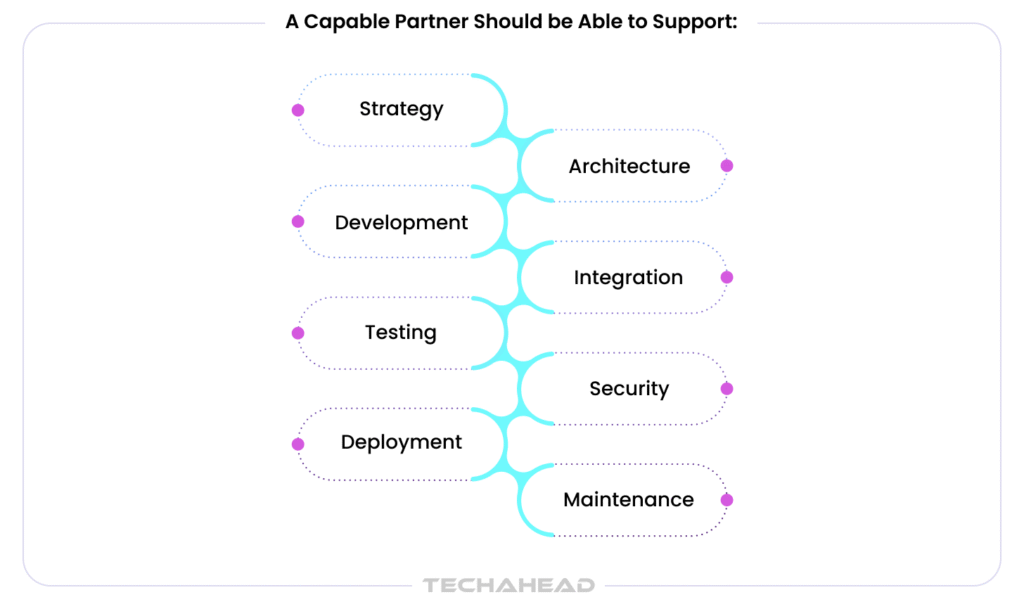
This end-to-end capability becomes especially important for enterprises where blockchain needs to interact with existing APIs, databases, ERP systems, payment platforms, or other business applications.
Security should be evaluated before development begins, particularly when your application involves financial transactions, digital assets, or smart contracts.
Ask potential providers about:
A strong development partner should be able to explain its security approach in business terms, not simply claim that the solution will be “secure.”
After implementation, blockchain ecosystems continue to change. Network upgrades, performance optimization, security fixes, new integrations, or feature improvements can be necessary for your application.
Before selecting a supplier, find out whether they provide blockchain maintenance and support after launch and who will be responsible for maintaining the solution’s functionality as it grows.
Finally, review case studies, client feedback, technical portfolios, and previous projects.
Pay particular attention to projects that demonstrate measurable outcomes, complex integrations, enterprise deployments, or blockchain solutions similar to what you are planning to build.
Ultimately, the finest blockchain development firm is the one that combines relevant technical know-how with a thorough understanding of your company’s goals. Even if a supplier has a lot of blockchain expertise, it might not be the best partner for your project if it can’t integrate that technology with your current systems, users, security needs, and expansion goals.
The cost of developing a blockchain greatly depends on the project you are working on. The cost of an enterprise blockchain platform, which entails numerous connectors, security needs, unique architecture, and continuous maintenance, might differ significantly from that of a basic smart contract or proof of concept.
Businesses should estimate their project based on its magnitude, technical complexity, blockchain architecture, integrations, security needs, and development duration rather than depending on a single industry-wide number.
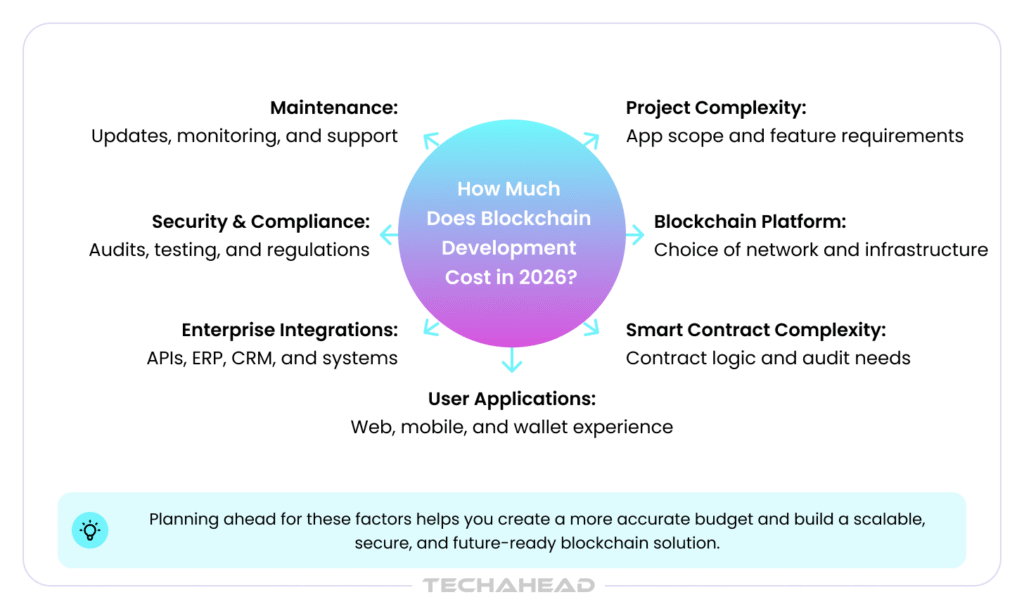
When comparing proposals from different blockchain development companies, make sure the quote clearly covers:
Because of differences in scope, technology selection, security procedures, and support methods, two businesses may provide wildly different quotes for what seems to be the same blockchain project.
Because of this, the cheapest estimate isn’t always the most economical choice. Comparing each proposal’s technical scope, deliverables, security coverage, and long-term support is a superior strategy.
If you already have a concept for a blockchain product, the next step is to specify its technical scope before asking for development estimates. With the assistance of an experienced blockchain development partner, you can convert business requirements into an architecture, development plan, and more accurate project estimate.
Blockchain has the potential to open up new business opportunities, but there are operational and technological obstacles in the way of turning a concept into a workable solution. Businesses can choose a partner capable of handling these problems by being aware of them before development begins.
As the number of users, transactions, and data volumes rise, a blockchain application must remain dependable. During architectural planning, rather than after the application is online, the development team must account for transaction throughput, network congestion, latency, and infrastructure needs.
Critical corporate procedures may be automated by smart contracts, but when they manage transactions or digital assets, flaws might have dire repercussions. The project lifecycle should incorporate code reviews, testing, secure development procedures, and suitable audits.
Blockchain is seldom a stand-alone technology for businesses. It could have to interact with databases, ERP systems, payment platforms, cloud infrastructure, identity solutions, and APIs that are already in place. Inadequate integration planning can complicate things and make adoption challenging.
Blockchain initiatives that deal with financial services, digital assets, payments, or personal data may need to consider regulatory and compliance standards. These factors can affect the architecture, data storage model, access restrictions, and transaction procedures.
Must Read: Key Challenges & Benefits of Decentralized Finance (DeFi) for Enterprises
If consumers are confused by wallets, transactions, authentication, or other Web3 features, even technically sound blockchain apps may suffer. Thus, in addition to the underlying blockchain architecture, businesses need to think about UX/UI design and user onboarding.
Blockchain networks, security standards, programming frameworks, and APIs are all still evolving. Over time, security updates, performance optimization, monitoring, upgrades, and new integrations may be needed for production applications.
Because of these difficulties, blockchain development should not be seen as a one-time job but rather as a long-term product engineering endeavor. The ideal partner should be able to see these risks early on, plan around them, and offer the necessary post-deployment technical assistance.
It is seldom the technology alone that separates a profitable proof of concept from a viable blockchain product. Selecting a partner that can link blockchain innovation with practical business results is crucial.
By providing corporate blockchain development services that address strategy, architecture, engineering, security, and long-term product growth, TechAhead helps companies go beyond experimentation. The team concentrates on creating solutions that smoothly interface with current business systems and grow with future requirements rather than viewing blockchain as a stand-alone technology.
| Capability | How It Creates Business Value |
| Blockchain Strategy & Consulting | Validate use cases before investing in development |
| Custom Blockchain App Development | Build products tailored to your business model |
| Smart Contract Development | Automate secure and transparent business workflows |
| Enterprise Blockchain Integration | Connect blockchain with ERP, APIs, cloud platforms, and databases |
| Asset Tokenization & Web3 Solutions | Launch next-generation digital products and ownership models |
| Post-Launch Support | Continuous optimization, monitoring, and scalability planning |
TechAhead unites product strategists, blockchain architects, designers, and engineers under a single delivery team, whether you’re creating a blockchain-powered banking platform, tokenizing real-world assets, upgrading supply chain processes, or launching a customer-facing Web3 application.
By working together, companies can lower technical risk, shorten development times, and deliver blockchain solutions designed for long-term growth rather than just initial deployment.
Look for a company with proven blockchain expertise, relevant project experience, strong security practices, and the ability to support your product from strategy and development through deployment and maintenance.
Most full-service providers offer blockchain consulting, custom blockchain development, smart contract development, dApp development, Web3 solutions, asset tokenization, blockchain integration, security, and post-launch support.
The cost depends on the project’s complexity, blockchain platform, smart contract requirements, integrations, security needs, UI/UX, development timeline, and ongoing maintenance requirements.
There is no single best platform for every project. Ethereum, Polygon, Solana, Hyperledger Fabric, and BNB Chain can be suitable depending on scalability, transaction costs, security, privacy, and business requirements.
Yes. A blockchain solution can integrate with APIs, databases, ERP systems, payment gateways, cloud platforms, and legacy applications, allowing businesses to add blockchain capabilities without rebuilding their entire technology stack.
Development timelines vary by project scope. A simple dApp or proof of concept may take considerably less time than an enterprise blockchain platform requiring custom architecture, smart contracts, multiple integrations, and extensive security testing.
TechAhead provides end-to-end blockchain development services, covering strategy, architecture, custom applications, smart contracts, dApps, tokenization, integration, security, deployment, and ongoing support for scalable business solutions.
We use cookies to ensure our website functions properly, improve performance, and provide a personalized experience. You can choose which types of cookies to allow below.
Required for core functionality such as security, network management, and accessibility. These cannot be disabled.
Help us understand site traffic and user interactions so we can improve performance and usability.
Enable enhanced functionality and personalization such as language or region preferences.
Used to deliver relevant ads, track campaign performance, and measure advertising effectiveness.