


 Copy Link
 Share on X
 Share on Facebook
 Share on LinkedIn
Always Active
Required for core functionality such as security, network management, and accessibility. These cannot be disabled.

Uncover the transformative potential of digital and mobile solutions for your industry.





 Last Updated: Sep 14, 2026
Sep 5, 2026
Last Updated: Sep 14, 2026
Sep 5, 2026  183
183  20 min. Read


Key Takeaways


Starting November 10, 2026, every U.S. Department of Defense contractor handling Controlled Unclassified Information has to hold a verified CMMC Level 2 certification just to stay eligible for a contract award. That single deadline sums up where aerospace and defense software has landed this year. Self-attestation is done. Compliance is no longer a form filed once and forgotten; it is a gate that either lets a vendor into a program or keeps them out of it entirely.
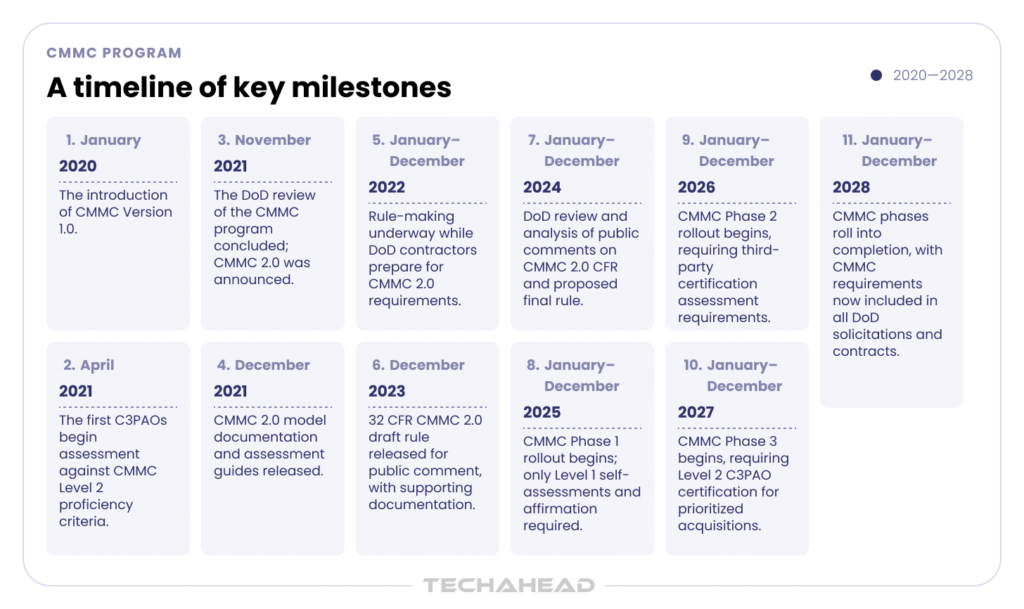
As legislative transition occurs at the same time as the underlying technological stack is being rebuilt from the bottom up. Fleets are flying longer as operators invest in dependability and predictive maintenance, defense budgets prioritize “speed to field” over legacy upgrading, and AI-enabled systems are moving beyond pilot projects and into genuine procurement lines. None of this is operated by off-the-shelf corporate software. Legacy telemetry protocols, rigid mission-planning tools, and decades-old avionics middleware were never designed for classified workflows, strict data segregation, or zero-downtime edge deployment, which is why selecting the right custom software development partner has evolved into a program-level decision rather than an IT budget line item.
This article discusses what buyers should look for in an aerospace and military software partner, the trends and technologies influencing the sector in 2027, a side-by-side comparison of 10 aerospace and defense software development firms to consider, and the compliance frameworks that no contract should proceed without.
Industry 4.0 adoption in aerospace and defense is now one of the most rapidly evolving areas of business software. According to Fortune Business Insights, the category was valued at around $15.6 billion in 2025 and is expected to increase from $17.9 billion in 2026 to $61.6 billion by 2034, representing a compound annual growth rate of over 16.7 percent. North America presently accounts for the majority of such spending, owing to the early adoption of digital manufacturing, linked production systems, and predictive maintenance tooling by major aerospace and defense primes.
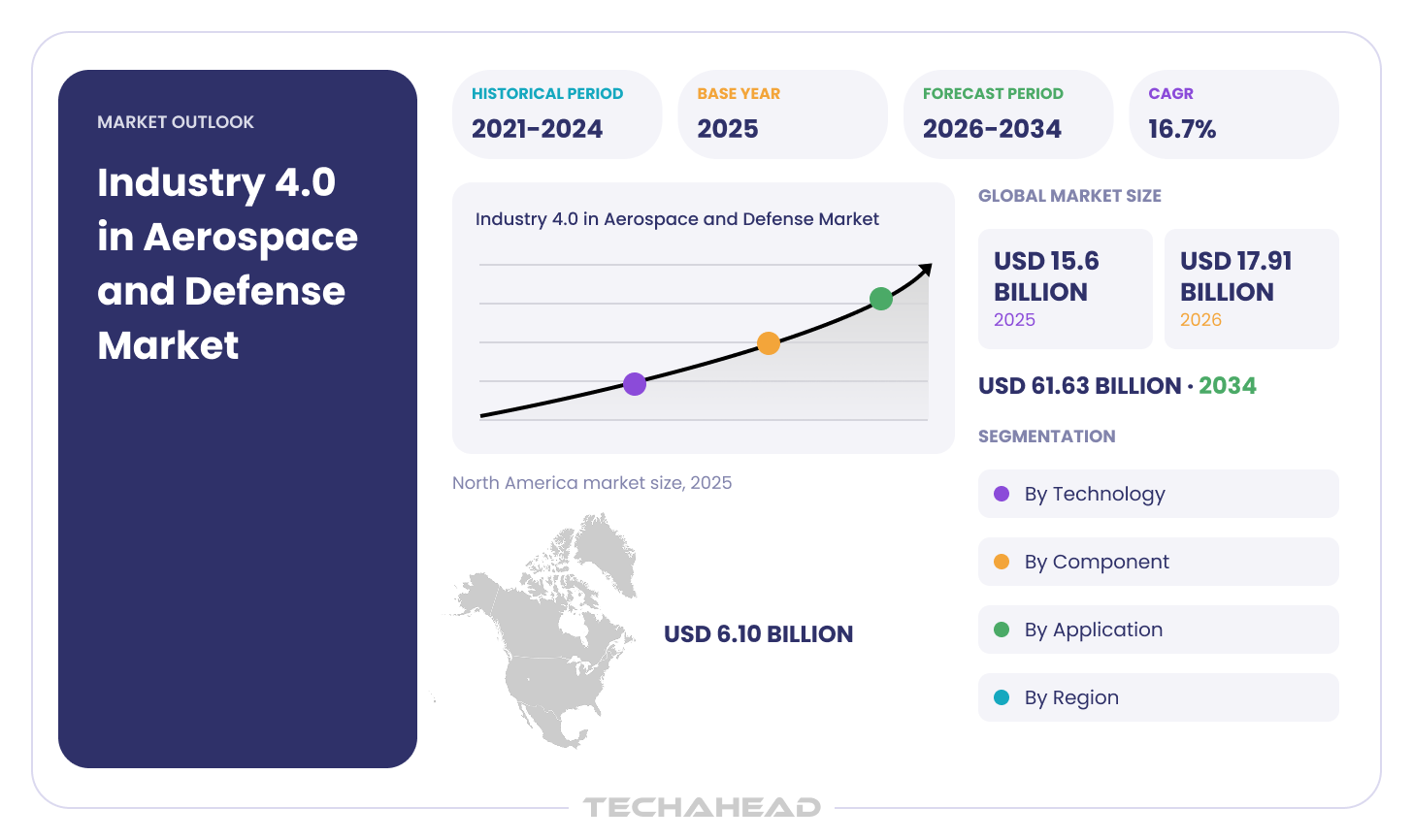
Three shifts are driving the curve. Commercial aviation is investing more heavily in AI as production backlogs force airlines to fly older fleets for extended periods of time and prioritize dependability over replacement. Defense budgets are favoring collaborative combat aircraft and AI-enabled weapons, with “speed to field” being the primary goal against which procurement teams are judged. And cybersecurity standards such as CMMC are requiring all levels of the supply chain, not just prime contractors, to modernize software development, testing, and certification.
When evaluating a software engineering partner for a mission-critical initiative, IT directors, CTOs, and defense procurement leaders frequently return to these four questions.
Must Read: How Emerging Technologies Are Transforming Global Defense Systems?
| Company | Headquarters | Core Specialization | Best Fit For |
| TechAhead | Agoura Hills, CA, USA | Mission systems, C3 platforms, agentic AI, avionics integration | Programs needing ITAR/DFARS-aligned engineering with startup-level speed |
| L&T Technology Services | Vadodara / Mumbai, India (global offices) | Embedded avionics, flight control, navigation systems | Tier-1 OEMs needing deep hardware-software integration |
| Cyient | Hyderabad, India (global offices) | Avionics engineering, geospatial analytics, fleet software | Full-lifecycle aircraft maintenance and geospatial platforms |
| BitCot | San Diego, CA, USA | Mobile, cloud, and SaaS application development | Commercial-facing mobile tools, with compliance vetted separately |
| AXISCADES | Bengaluru, India (US, EU, Canada offices) | Avionics hardware, radar, electronic warfare, counter-drone | Embedded defense electronics and manufacturing programs |
| Baltic Amadeus | Vilnius, Lithuania | Custom software, cybersecurity, legacy modernization | EU-based backend and data platform work |
| Volvsoft | Multiple (industrial engineering focus) | MES, PLM data integration, supply chain platforms | Manufacturing-heavy defense supply chain projects |
| Ansys | Canonsburg, PA, USA | Engineering simulation software | Structural, electromagnetic, and fluid dynamics modeling |
| PTC | Boston, MA, USA | Model-Based Systems Engineering, CAD, PLM | Infrastructure layer for teams already running Windchill or Creo |
| Mobibiz | Multiple (mobility-focused) | Secure mobile apps for field defense personnel | Tactical logging and asset tracking tools |
TechAhead has created a dedicated aerospace and defense engineering practice on one central idea: mission systems cannot fail, and the engineering process that supports them cannot cut shortcuts. The team creates unique Command, Control, and Communication platforms, incorporates AI-powered predictive maintenance into autonomous systems, and works on mission system architecture, avionics software, and flight control integration for defense contractors with secret needs. Its engineering work is based on ITAR, DFARS, and NIST SP 800-171 alignment from the start, rather than being retrofitted for compliance later, and the team combines that regulatory discipline with modern capabilities such as agentic AI implementation, AR and VR simulation, edge computing, and digital twin deployment.
TechAhead distinguishes itself for defense buyers by combining structured, audit-ready engineering discipline with the agility of a firm sized to move quickly, all supported by a transparent six-step development lifecycle that documents and traces every stage of a program from requirements to deployment. Its larger corporate AI development work also feeds directly into the predictive maintenance and intelligence-fusion systems that defense projects are increasingly demanding, providing customers with a partner capable of scaling from a single mission tool to a comprehensive program backbone.
Key strengths: ITAR/DFARS-aligned mission systems, C3 platform development, agentic AI, avionics and flight control integration.
L&T Technology Services is a publicly traded company of Larsen & Toubro and one of the largest pure-play engineering R&D businesses operating in aerospace and defense today, employing around 23,000 professionals across 22 global design centers. Its aerospace and military expertise includes aero engine and airframe systems, avionics, air traffic management, and the digital transformation work that connects these disciplines across the aircraft lifecycle, from initial design to production and aftermarket service.
The company has been explicit about building ITAR-compliant infrastructure to serve this market, including a dedicated Aerospace and Defense Engineering Design Center in Rockford, Illinois, built specifically to serve U.S. defense and aerospace clients, and a second center in Toulouse, France, aimed at European OEMs. LTTS counts Collins Aerospace among its named aerospace and defense clients and has built strategic alliances with multiple Fortune 500 manufacturers. For programs that need deep embedded systems and hardware-software integration expertise alongside software delivery, rather than software alone, LTTS is one of the more established names on this list.
Key strengths: Embedded avionics engineering, flight control systems, ITAR-compliant design centers, navigation platform development.
Cyient, founded in 1991 as Infotech Enterprises and rebranded in 2013, is a global engineering and technology solutions company with more than 15,000 employees across 20 countries and a dedicated aerospace and defense business unit that it has continued investing in, including leadership hires focused specifically on growing its North American defense footprint. Its work spans avionics software engineering, geospatial intelligence platforms, aftermarket maintenance systems, and fleet management software, which gives it a broader footprint across the full aircraft lifecycle than firms that specialize narrowly in flight software alone.
Cyient positions itself as a design, build, and maintain partner rather than a pure software vendor, meaning it tends to embed with a client’s engineering team over the long term instead of delivering a project and moving on. That lifecycle orientation makes it a strong fit for aerospace OEMs and defense organizations that need ongoing engineering support across design, manufacturing, and in-service maintenance rather than a single standalone software build.
Key strengths: Avionics software engineering, geospatial intelligence platforms, aftermarket fleet management, aircraft lifecycle software.
BitCot is a San Diego-based software development business that specializes in mobile, online, and SaaS applications. Its clients include aerospace companies such as Bombardier as well as enterprise brands like ResMed and Dick’s Sporting Goods. BitCot is worth a conversation for buyers looking for custom mobile command interfaces, cloud architecture modernization, or field data collection applications built by a team that is used to moving quickly on tight deadlines, especially for programs where speed of delivery is as important as the platform itself.
However, its declared portfolio focuses on commercial and business clients rather than defense-specific initiatives, and there is no publicly available ITAR or DFARS compliance history to refer to. Defense buyers with classified-environment requirements or strict export-control obligations should directly confirm BitCot’s compliance track record before scoping a mission-critical engagement, and they should expect to build out that regulatory layer together rather than inheriting it from previous defense projects.
Key strengths: Mobile command interfaces, SaaS and cloud architecture, fast-turnaround field applications, cross-platform development.
AXISCADES is a Bengaluru-based engineering and technology company with operations in France, Germany, Denmark, the United States, and Canada with a worldwide staff of over 3,000 engineers. Through its subsidiary Mistral Solutions, the firm designs and produces avionics hardware for programs such as India’s LCA Tejas Mk1A fighter plane, providing them with hands-on hardware credibility that most software-only suppliers on this list lack. Its larger portfolio includes radar systems, electronic warfare, counter-drone technologies, C4I2 platforms, and ground support systems, establishing it as both an integrated defense electronics producer and a software house.
That combination makes AXISCADES an excellent match for programs where the software is inextricably linked to the sensor, radio, or weapons hardware on which it operates, and where a partner must own both sides of the integration rather than delegating hardware requirements to others. It is one of the most well-known military electronics companies on this list.
Key strengths: Avionics hardware manufacturing, radar and electronic warfare systems, counter-drone technology, and C4I2 platforms.
Baltic Amadeus, started in 1988 as Lithuania’s first private IT company, has expanded to a 250-person software engineering and IT consulting organization with clients in the EU, the United States, and Australia. Its primary competencies include bespoke software development, cybersecurity, and legacy system modernization, all provided under ISO 27001 and ISO 9001 certification, making it a good option for backend architecture, secure API integration, and data processing services in general.
Jurisdiction, in particular, complicates matters for US defense buyers: Baltic Amadeus is headquartered in Vilnius, and ITAR restricts the export and transmission of defense-related technical data outside the United States, thus any engagement involving ITAR-controlled material must be scoped with that limitation front and center rather than assumed. For EU-based programs or non-ITAR backend and data platform work, its enterprise client mix and certification base make it a viable alternative, but US defense customers should view the compliance talk as a first step, not a formality.
Key strengths: Custom software development, cybersecurity, legacy system modernization, and ISO-certified secure engineering.
Volvsoft focuses on custom engineering software for complex industrial manufacturing, defense supply chains, and aerospace workflows, with particular strength in manufacturing execution systems, product lifecycle data integration, and secure supply chain platforms that connect disparate production systems into a single view. That focus makes it a fit for programs where the software problem is really a manufacturing and logistics problem wearing a defense label, such as tracking parts provenance across a multi-tier supplier network or synchronizing production data between a prime contractor and its subcontractors. It is a narrower specialist than the larger engineering firms on this list, which can be an advantage for buyers who already know exactly what kind of manufacturing or supply chain software they need and want a team built specifically around that problem rather than a generalist aerospace practice trying to cover every discipline at once.
Key strengths: Manufacturing Execution Systems, PLM data integration, secure supply chain platforms, industrial workflow software.
Ansys has been the industry standard in engineering simulation software since its inception in 1970, with defense contractors using it to simulate how physical forces interact across complicated systems before anything is produced. Its electromagnetic, structural, fluid dynamics, and optical simulation tools are designed for high-stress aircraft applications where catching a design problem in simulation is far less expensive than finding one in flight testing.
In July 2025, Synopsys completed its roughly $35 billion acquisition of Ansys, folding it into a combined “silicon to systems” design portfolio aimed at semiconductor, aerospace, automotive, and industrial customers, so buyers evaluating Ansys today are effectively evaluating a Synopsys business unit rather than a standalone public company. That ownership change hasn’t altered what Ansys actually does for aerospace and defense engineers day to day, but it is worth knowing when scoping a long-term licensing or integration relationship, since product roadmaps are now being planned jointly with Synopsys’s semiconductor and systems design tools.
Key strengths: Structural, electromagnetic, and fluid dynamics simulation software, predictive engineering analysis.
PTC, founded in 1985 as Parametric Technology Corporation and headquartered in Boston, anchors the model-based systems engineering side of the aerospace and defense market through its Windchill and Creo software suites, giving supply chains a shared platform for CAD, enterprise IoT, and secure engineering collaboration across every tier of a program. Industry analyst CIMdata has repeatedly named PTC the leading provider of PLM collaboration software specifically for aerospace and defense manufacturers, and its customer base includes major defense primes such as BAE Systems, Lockheed Martin, Boeing, and RTX, several of which standardized on Windchill as their enterprise platform for change and configuration management. PTC is less a custom development shop and more infrastructure that custom development partners build on top of, which is worth knowing when scoping a project that needs both a PLM backbone and a team to build custom applications around it.
Key strengths: Model-Based Systems Engineering, CAD and PLM software, secure engineering collaboration platforms.
Mobibiz is a mobility-focused development agency building secure mobile applications and digital interfaces for defense and aerospace operations, including tactical flight logging tools, location-based asset tracking, and digital manuals for field personnel who need reliable access to technical documentation without a full desktop environment nearby. It fills a narrower niche than most names on this list, useful specifically when the deliverable is a mobile-first tool for personnel already in the field rather than a back-office system or a full mission-planning platform. That narrower focus can be an advantage for buyers whose actual bottleneck is getting accurate, secure information into the hands of technicians, inspectors, or ground crews on a device they already carry, rather than a reason to rule Mobibiz out for the larger systems work handled by firms higher on this list.
Key strengths: Secure mobile applications, tactical field tools, location-based asset tracking, digital manuals.
A handful of capabilities separate a firm that can talk about aerospace and defense from one that can actually deliver inside it. AI-powered predictive maintenance and autonomous systems integration reduce asset downtime by catching failure patterns in telemetry before they become mission-affecting events. Mission systems architecture and compliance engineering make sure every layer of an application is built against federal defense standards from the first line of code, not patched in before an audit.
Avionics software and flight control systems demand low-latency, high-integrity code where a bug isn’t a bad review; it’s a safety incident. Custom Command, Control, and Communication platforms give operators a real-time, synthesized view of multiple data streams so decisions get made in seconds rather than minutes. Secure data integration work bridges the gap between legacy hardware, legacy military databases, and the cloud and edge networks modern operations actually run on. A capable partner’s AI infrastructure and MLOps setup matters here too, since predictive models are only useful if they can be deployed, monitored, and retrained inside a secure environment without constant manual intervention.
Before signing with any development firm, it’s worth confirming the team has hands-on delivery experience with the technologies actually driving this sector, not just a slide describing them.
Must Read: GenAI in Cybersecurity: Build a Resilient Cyber Defense
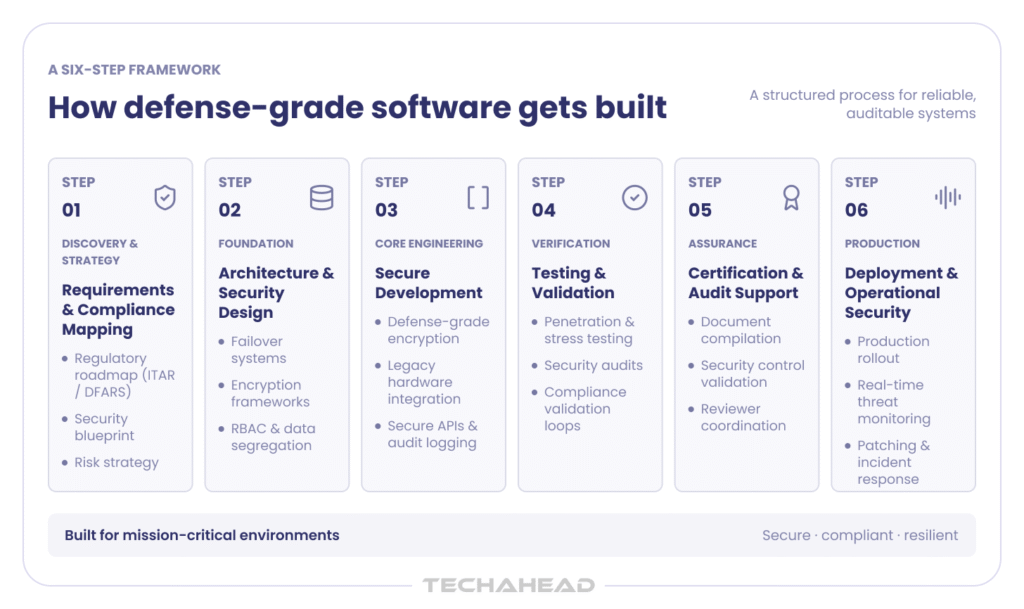
Reliable, auditable defense software doesn’t happen by accident. It happens because the development process is structured to produce it, typically across six stages.
Everything starts with requirements and compliance mapping, where the team defines technical goals, identifies which regulatory frameworks apply (ITAR, DFARS, or both), and sets the security checkpoints the rest of the build has to pass through. This stage produces a regulatory roadmap, a security blueprint, and a risk strategy before a single feature gets built.
From there, architecture and security design lay out failover systems, encryption frameworks, role-based access control, and strict data segregation, resulting in the system architecture and security framework everything downstream gets measured against.
Secure development is where the actual build happens: application features built with defense-grade encryption, integration with existing legacy hardware and software, secure APIs, and audit logging woven in from the start rather than added later.
Testing and validation puts the system through penetration testing, security audits, and performance stress testing, producing documented results that feed directly into compliance validation.
Certification and audit support compiles that documentation, validates the security controls built earlier, and coordinates with regulatory reviewers so certification doesn’t become a scramble at the finish line.
And finally, deployment and operational security roll the system into production alongside real-time threat monitoring, ongoing security patching, and an incident response plan that’s ready before it’s ever needed.
Before any contract moves forward, buyers should confirm a vendor’s track record against the frameworks that actually govern this space.
ITAR governs the export and transfer of defense-related items, services, and technical data, and it matters enormously for any vendor based outside the United States. DFARS mandates specific cybersecurity requirements for contractors handling defense data, and as of November 2026 that requirement is tied directly to CMMC Level 2 certification for any contractor touching Controlled Unclassified Information. NIST SP 800-171 lays out the specific controls required to protect that information across non-federal systems, and it’s the baseline every DFARS-compliant contractor is being measured against right now.
The right aerospace and defense software development company is the one that can hold both ends of the tension this sector runs on: real innovation in agentic AI, edge computing, and digital twins, paired with the kind of regulatory discipline that doesn’t bend under a compliance audit. Whether the project is modernizing flight control interfaces, building an autonomous swarm platform, or standing up a new command and control tool, working with a partner built for zero-failure environments matters more here than in almost any other sector.
TechAhead’s combination of a dedicated aerospace and defense practice, ITAR and DFARS-aligned engineering, and a transparent six-step delivery process makes it a strong starting point for that evaluation.
The leading companies vary by project requirements, but buyers should compare aerospace engineering expertise, defense software capabilities, compliance experience, AI and autonomous systems expertise, and secure software development practices. This article compares 10 companies across these areas.
The cost depends on the software’s complexity, security requirements, integrations, compliance obligations, AI capabilities, and development timeline. Mission-critical avionics, C3 platforms, autonomous systems, and secure defense applications typically require significantly more engineering and testing than standard enterprise software.
Aerospace software development typically focuses on aircraft, avionics, flight control, fleet management, simulation, and maintenance systems, while defense software can additionally cover C3 platforms, tactical systems, autonomous vehicles, intelligence, surveillance, and military operations. The two areas often overlap in mission-critical and security requirements.
Defense software projects may require compliance with ITAR, DFARS, NIST SP 800-171, and CMMC, depending on the data, systems, and contract requirements involved. Buyers should verify a development partner’s actual experience with the applicable requirements rather than treating compliance as a post-development exercise.
AI is being applied to predictive aircraft maintenance, autonomous systems, threat detection, intelligence fusion, navigation, mission planning, and real-time telemetry analysis. Agentic AI is also emerging in areas such as logistics, threat detection, and adaptive mission planning.
Modern aerospace and defense software increasingly uses AI, edge computing, IoT, digital twins, autonomous systems, AR/VR, robotics, and agentic AI. These technologies support applications ranging from aircraft health monitoring and mission rehearsal to autonomous navigation and predictive maintenance.
Evaluate the company’s experience with mission-critical systems, ITAR and DFARS requirements, secure DevSecOps, fault-tolerant architecture, legacy system integration, AI and edge technologies, testing, and audit support. The development process should address compliance and security from requirements and architecture through deployment, rather than adding them at the end.
We use cookies to ensure our website functions properly, improve performance, and provide a personalized experience. You can choose which types of cookies to allow below.
Required for core functionality such as security, network management, and accessibility. These cannot be disabled.
Help us understand site traffic and user interactions so we can improve performance and usability.
Enable enhanced functionality and personalization such as language or region preferences.
Used to deliver relevant ads, track campaign performance, and measure advertising effectiveness.